

Saved Bookmarks
This section includes 7 InterviewSolutions, each offering curated multiple-choice questions to sharpen your Current Affairs knowledge and support exam preparation. Choose a topic below to get started.
| 1. |
If CH_3COOH+OH^-=CH_3COO^-+H_2O+q_1 and H^+ OH^-=H_2O+q_2 then the enthalpy change for the reaction, CH_3COOH=CH_3COO^(-)+H^+, is equal to: |
|
Answer» `q_1+q_2` |
|
| 2. |
If certain atom has atomic number of 22. Then what is the maximum oxidation state of It? |
|
Answer» 1 |
|
| 3. |
If C_(aq) is in equivalent dm^(-3) and K is in S cm^(-1), then which one among the following is correct? |
|
Answer» `wedgeaq = (1000K)/C_(AQ)` |
|
| 4. |
If carbon is present in cast iron in the form of cementite' then it is known as |
| Answer» Answer :A | |
| 5. |
If CO_2 is passed in excess into lime water, the milkiness first formed disappears due to: |
|
Answer» REVERSAL of the ORIGINAL reaction |
|
| 6. |
If C_(a_(3))(PO_(4))_(2) and H_(3)PO_(3) contain same number of 'P' atom then the ratio of oxygen atoms in these compounds respectively is |
|
Answer» `8//3` |
|
| 7. |
If C+O_(2)rarrCO_(2)+94.2 kcalH_(2)+(1)/(2)O_(2)rarrH_(2)O+68.3 kcalCH_(4)+2O_(2)rarrCO_(2)+2H_(2)O+210.8 kcal |
|
Answer» `H_(2)+(1)/(2)O_(2)rarrH_(2)O+68.3 " kcal...(ii)"` On multiplication of eq. (ii) by 2 and than ADDING in eq. (i) `C+2H_(2)+2O_(2)rarrCO_(2)+2H_(2)O+230.8 " kcal...(iii)"` On SUBTRACTING eq. (iii) by following eq. `CH_(4)+2O_(2)rarrCO_(2)+2H_(2)O+210.8" kcal. we get,"` `C+2H_(2)rarrCH_(4)DeltaH=20 kcal`. |
|
| 8. |
If C(s)+O_(2)(g)to CO_(2)(g)+94.2 KcalH_(2)(g)+(1)/(2)O_(2)(g)to H_(2)O(l)+68.3 KcalCH_(4)(g)+2O_(2)(g)to CO_(2)(g)+2H_(2)O+210.8 Kcal then the heat of formation of methane will be |
|
Answer» 47.3 KCAL |
|
| 9. |
If C & D are the third & fourth virial coefficients. If (D)/(C ) = (V_(c))/(x). Then find the value of x. |
|
Answer» |
|
| 10. |
If by mistake some radioactive substance gets inside the human body, then form the point of view of radiation damage, the most harmful will be one which emits |
|
Answer» `GAMMA`-RAYS |
|
| 11. |
If butane on combustion gives carbon monoxide. Find the number of O_(2) molecule required |
|
Answer» 6 |
|
| 12. |
If by mistake radioactive substance gets into human body, then from the point of view of radiation damage, the most harmful will be one that emits. |
| Answer» Answer :a | |
| 13. |
If Br^(-) ions having conductivity =78.1" S "cm^(-1)mol^(-1) then calculate lamda_(m)^(@)(K_(+)) |
|
Answer» |
|
| 14. |
If both adsorption and absorption take place simulataneously, the process is called ……….. |
| Answer» SOLUTION :SORPTION | |
| 15. |
If both (dc)/(dt) & specific rate have same units then rate law is |
|
Answer» `R=K[A]^(2)` |
|
| 16. |
If bond lengths by x, y and z respectively, then, estimate the order of bond lengths. |
|
Answer» X GT y gtz 
|
|
| 17. |
If Boiling point of water is 100^(@)C. How much gram of NaCl is added in 500 g of water to increase its boiling point of water by approx 1^(@)C.(K_(b))_(H_(2)O)="0.52 K x kh/mole". |
|
Answer» 2.812 g `1=2xx0.52xx(w)/(58.5)xx(1000)/(500)` `w=28.125g` |
|
| 18. |
If BOD of river is high, this implies that the river is |
|
Answer» NON POLLUTED at all |
|
| 19. |
If benzene. Toluene and para-xylene are mixed in molar ratio 1:2:3. Then answer the following question carefully. Estimate the dew point pressure (At the dew point pressure all liquid vaporiaed ) for the above mixture (approximately) |
|
Answer» 180 torr `(1)/(P_(("dew point")))=[(Y_(B))/(P_(B)^(@))+(y_(T))/(P_(T)^(@))+(Y_(X))/(P_(X)^(@))]"" (Y_(B)=(1)/(6), Y_(T)=(2)/(6), Y_(X)=(3)/(6))` |
|
| 20. |
If benzene. Toluene and para-xylene are mixed in molar ratio 1:2:3. Then answer the following question carefully. Estimate the bubble point pressure (At the bubble point pressure all liquid exist. No trace of vapour inmixture) for the above mixture. |
|
Answer» 600 torr `P_("bubble") [(1)/(6)xx300+(2)/(6)xx180+(3)/(6)xx120)]=170` torr |
|
| 21. |
If benzene toluene and para-xylene are mixed in molar ratio 1 : 2: 3. Estimate the dew point pressure (At the dew point pressure all liquid vaporized) for the above mixture (approximately) |
|
Answer» <P>180 torr `(1)/(P_("(dew point)")) = [(y_(B))/(P_(B)^(@)) + (y_(T))/(P_(T)^(@)) + (y_(X))/(P_(X)^(@))] (y_(B) = (1)/(6), y_(T)= (2)/(6), y_(x) = (3)/(6))` |
|
| 22. |
If benzene toluene and para-xylene are mixed in molar ratio 1 : 2: 3. Estimate the bubble point pressure (At the bubble point pressure all liquid exist. No trace of vapour in mixture) for the above mixture. |
|
Answer» 600 torr `P_("bubble") = [(1)/(6) xx 300 + (2)/(6) xx 180 + (3)/(6) xx 120] = 170` torr |
|
| 23. |
If B.E. per nucleon of B 11 ,(the atomic mass of B-11 is 11.00931 u). , is (0.1 xx y) approximately , then what is the value of 'y' |
|
Answer» |
|
| 24. |
If BaCl_(2) ionizes to an extent of 80% in aqueous solution,the value of van't Hoff factor is |
|
Answer» 2.6 |
|
| 25. |
If at a particular tempreture, the density of 18M H_(2)SO_(4) is 1.8g Cm^(-3), calcualte: (a) Molality, (b) % concentration by weight of solution (c ) Mole fraction of water and H_(2)SO_(4), (d) Relative decrease in vapour pressure with repsect to H_(2)O solvent assuming H_(2)SO_(4) almost unionised at this high concentration. |
|
Answer» |
|
| 26. |
If Avogadro number (N_(A)) is changed from 6.022xx10^(23) to 6.022xx10^(20)"mol"^(-1), this would change |
|
Answer» the RATIO of the chemical species to each other in a balanced equation If Avogadro's number is CHANGED, the mass of 1 mole of carbon, i.e., `6.022xx10^(20)` atoms of carbon`=(12.6.022xx10^(20))/(6.022xx10^(23))` `therefore"Massof 1 mole of carbon is changed."` |
|
| 27. |
If avogado number N_(A), is changed from 6.022xx10^(23) mol^(-1) to 6.022xx10^(20) mol^(-1) this would change |
|
Answer» The DEFINITION of MASS in units of grams |
|
| 28. |
If Aufbau rule is not followed "" _(19)K will be placed in |
|
Answer» <P>s BLOCK |
|
| 29. |
If atomic number of an inert gas is Z then an element with which of the following atomic number will has highest I.E. |
|
Answer» `Z-2` SECOND highest IE in a period = HALOGENS (Z–1) |
|
| 30. |
If at certain temperature the vapour pressure of pure water is 25 mm Hg and that of a very dilute aqueous urea solution is 24.5 mm Hg, the molarity of the solution is |
|
Answer» <P>`0.02` `RARR (P^(@)-P_(s))/(P^(@))=" molality " xx(m)/(1000)` `(25-24.5)/(25)=m xx(18)/(1000)` `m=(0.02xx1000)/(18)=1.11` |
|
| 31. |
If Aufbau principle and Hund's rule were not followed |
|
Answer» Ca would have been d-block element with zero dipole moment |
|
| 32. |
If at 298 K the bond energies of C-H,C-C,C=CandH-H bonds are respectively 414, 347, 615 and 435 kJ mol^(-1), the value of enthalpy change for the reaction given below at 298 K will be H_(2)C=CH_(2)(g)+H_(2)(g)toH_(3)C-CH_(3)(g) |
|
Answer» `-250` KJ |
|
| 33. |
If at 100^@C temperature copper possess fcc arrangements. Edge length is xÅ . Then find out approximate density ("g/cm"^3) of Cu at this temperature. (Atomic weight of Cu = 63.55 u) |
|
Answer» `105/(x^3)` `therefore D = (63.5 XX 4)/(6 xx 10^(23) xx x^3 xx 10^(-24)) "g/cm"^3` `therefored = (63.5 xx 4 xx 10)/(6) "g/cm"^3`. `therefore d = (423.33)/(x^3) = 422/(x^3)`. |
|
| 34. |
If aniline is treated with conc. H_(2)SO_(4) and heated at 200^(@)C, the product is |
|
Answer» ANILINIUM SULPHATE 
|
|
| 35. |
If Aniline is treated with 1:1 mixture of con HNO_(3) and con. H_(2)SO_(4),p-nitroaniline and mnitroaniline are formed nearly in equal amounts.This is due to |
|
Answer» m-directing PROPERTY of —`NH_(2)` GROUP |
|
| 36. |
If an oil soluble dye is mixed with an emulsion and theemulsion remains colourless, then it is _______type emulsion. |
|
Answer» O-in-W |
|
| 37. |
If an iron rod is dipped in CuSO_(4) solution |
|
Answer» Blue colour of the solution turns green |
|
| 38. |
If an ionic solid XY (X & Y are monovalent ions) is doped with 10^-2moles % of another ionic solid AY_3 , then the concentration of the cation vacancies created is |
|
Answer» `6.023xx10^19 mol^-1` |
|
| 39. |
If an iron rod is deppedin CuSO_4 solution: |
|
Answer» Blue COLOUR of the solution turns red |
|
| 40. |
If an external opposing E.M.F. is slightly greater than E.M.F. of Daniel cell the reaction will |
|
Answer» be reversed |
|
| 41. |
If an endothermic reaction occurs spontaneously at constant temperature T and Pressure P, then whicch of the following is true |
|
Answer» `DeltaG gt 0` |
|
| 42. |
If an endothermic reaction is non-spontaneous at freezing point of water and becomes feasible at its boiling point then |
|
Answer» `DeltaH` is -ve, `DELTAS` is + ve `DeltaG=DeltaH-T.DeltaS` If `DeltaH` and `DeltaS` both are positive, than term T. `DeltaS` will begreater than `DeltaH` at high temperature and consequently `DeltaG` will be negative at high temperature. |
|
| 43. |
If an elementemitsphotonin its groundstatedue toelectron transition , thenits . |
|
Answer» atomicnumberwill increase |
|
| 44. |
If an element can exist in several oxidation states, it is convernient to display the reduction potentials correspondingg to the various half reactions in diagrammatic form, know as latimer diagram the latimer diagram for chlorine in acid solutio is CIO_(4)^(-)overset(+1.20V)toCiO_(3)^(-)overset(+1.18V)toHClO_(2)overset(+1.60V)toHClOoverset(1.67V)toCl_(2)overset(1.36V)toCl^(-) in basic solution. ClO_(4)^(-)overset(0.37V)toClO_(3)^(-)overset(0.30V)toClO_(2)^(-)overset(0.68V)toClO^(-)overset(0.42V)toCl_(2)overset(1.36V)toCl^(-) The standard potentials for two nonadjacent species can also be calculateed by using the concept that triangleG^(@) as an additive property but potential is not an additive property and triangleG^(@)=-nFx^(0). if a given oxidation stateis a stronger oxidising agent than the next higher oxidation state, disproportionation can occur. The reverse of disproportionation is called comproportionation. The relative stabilities of the oxidation state can also be understood by drawing a graph of triangleG^(@)//F against oxidation state, known as frost diagram, choosing the stability of zero oxidation state arbitrarily as zero. The most stable oxidation state of a species lies lowest in the diagram, disproportionation is spontaneous if the species lies above a straight line joining its two product species. Q. Which of the following statement is correct? |
|
Answer» `Cl_(2)` UNDERGOES disproportionation into `CL^(-)` and `CLO^(-)` both at `pH=0` and `pH=14`. 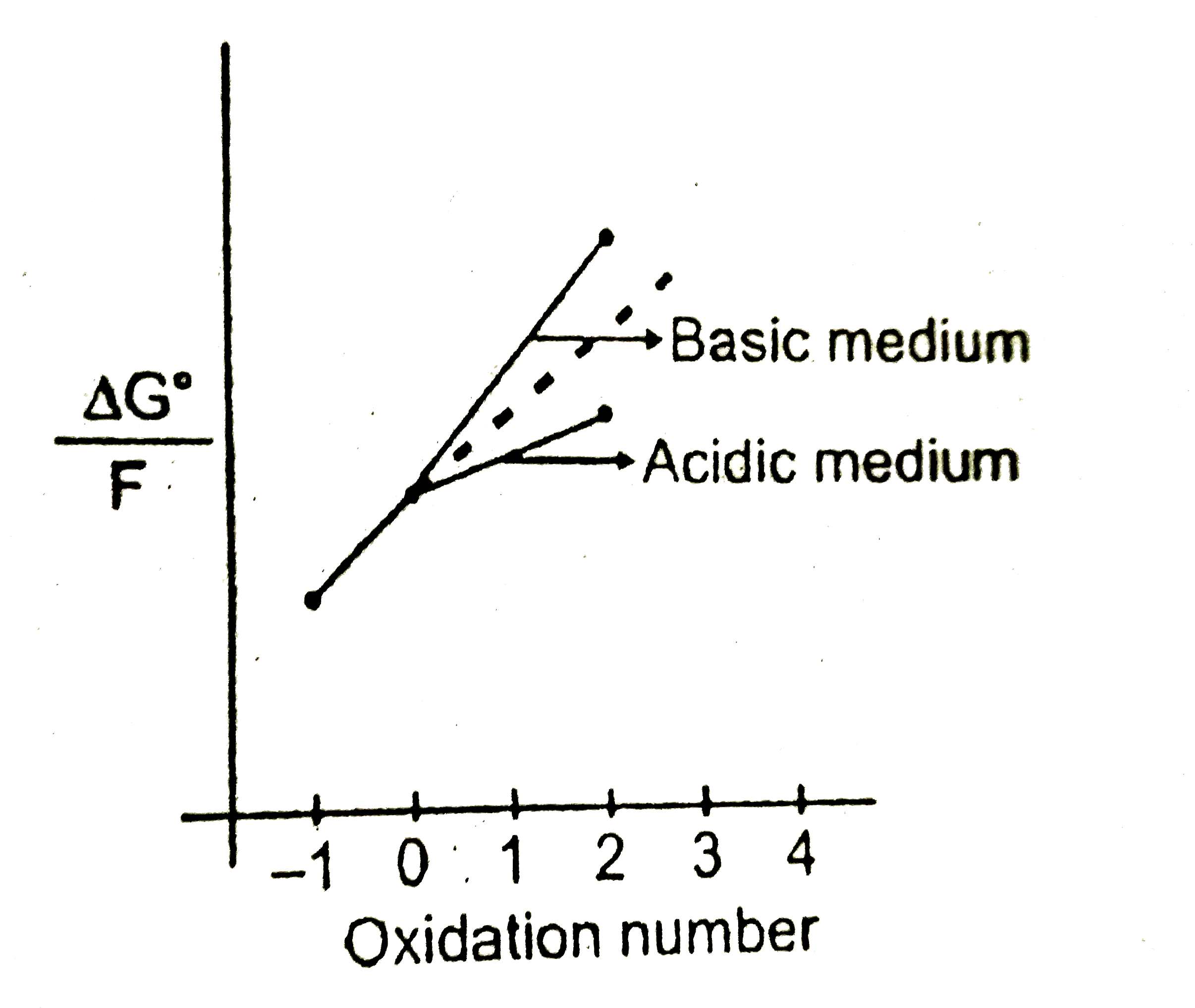
|
|
| 45. |
If an element can exist in several oxidation states, it is convernient to display the reduction potentials correspondingg to the various half reactions in diagrammatic form, know as latimer diagram the latimer diagram for chlorine in acid solutio is CIO_(4)^(-)overset(+1.20V)toCiO_(3)^(-)overset(+1.18V)toHClO_(2)overset(+1.60V)toHClOoverset(1.67V)toCl_(2)overset(1.36V)toCl^(-) in basic solution. ClO_(4)^(-)overset(0.37V)toClO_(3)^(-)overset(0.30V)toClO_(2)^(-)overset(0.68V)toClO^(-)overset(0.42V)toCl_(2)overset(1.36V)toCl^(-) The standard potentials for two nonadjacent species can also be calculateed by using the concept that triangleG^(@) as an additive property but potential is not an additive property and triangleG^(@)=-nFx^(0). if a given oxidation stateis a stronger oxidising agent than the next higher oxidation state, disproportionation can occur. The reverse of disproportionation is called comproportionation. The relative stabilities of the oxidation state can also be understood by drawing a graph of triangleG^(@)//F against oxidation state, known as frost diagram, choosing the stability of zero oxidation state arbitrarily as zero. The most stable oxidation state of a species lies lowest in the diagram, disproportionation is spontaneous if the species lies above a straight line joining its two product species. Q. For a hypothetical element, the frost diagram is shown in figure.? which of the following oxidation state is least stable? |
| Answer» ANSWER :D | |
| 46. |
If an element emits an alpha-particle, then the position of daughter element will be displaced in the periodic table by : |
|
Answer» TWO POSITIONS on left |
|
| 47. |
If an element can have four values of spin quantum numbers and rest of the quantum no. are same, which of the following statement would be incorrect :- |
|
Answer» Be would have been in the first period of P.T.  If element can have four VALUE of spin quantum number so one orbital can CONTAIN 4 electrons. |
|
| 48. |
If an element can exist in several oxidation states, it is convernient to display the reduction potentials correspondingg to the various half reactions in diagrammatic form, know as latimer diagram the latimer diagram for chlorine in acid solutio is CIO_(4)^(-)overset(+1.20V)toCiO_(3)^(-)overset(+1.18V)toHClO_(2)overset(+1.60V)toHClOoverset(1.67V)toCl_(2)overset(1.36V)toCl^(-) in basic solution. ClO_(4)^(-)overset(0.37V)toClO_(3)^(-)overset(0.30V)toClO_(2)^(-)overset(0.68V)toClO^(-)overset(0.42V)toCl_(2)overset(1.36V)toCl^(-) The standard potentials for two nonadjacent species can also be calculateed by using the concept that triangleG^(@) as an additive property but potential is not an additive property and triangleG^(@)=-nFx^(0). if a given oxidation stateis a stronger oxidising agent than the next higher oxidation state, disproportionation can occur. The reverse of disproportionation is called comproportionation. The relative stabilities of the oxidation state can also be understood by drawing a graph of triangleG^(@)//F against oxidation state, known as frost diagram, choosing the stability of zero oxidation state arbitrarily as zero. The most stable oxidation state of a species lies lowest in the diagram, disproportionation is spontaneous if the species lies above a straight line joining its two product species. Q. What is the potential couple (ClO^(-))/(Cl^(-)) at pH=14? |
|
Answer» `1.78V` |
|
| 49. |
If an element can exist in several oxidation states, it is convernient to display the reduction potentials correspondingg to the various half reactions in diagrammatic form, know as latimer diagram the latimer diagram for chlorine in acid solutio is CIO_(4)^(-)overset(+1.20V)toCiO_(3)^(-)overset(+1.18V)toHClO_(2)overset(+1.60V)toHClOoverset(1.67V)toCl_(2)overset(1.36V)toCl^(-) in basic solution. ClO_(4)^(-)overset(0.37V)toClO_(3)^(-)overset(0.30V)toClO_(2)^(-)overset(0.68V)toClO^(-)overset(0.42V)toCl_(2)overset(1.36V)toCl^(-) The standard potentials for two nonadjacent species can also be calculateed by using the concept that triangleG^(@) as an additive property but potential is not an additive property and triangleG^(@)=-nFx^(0). if a given oxidation stateis a stronger oxidising agent than the next higher oxidation state, disproportionation can occur. The reverse of disproportionation is called comproportionation. The relative stabilities of the oxidation state can also be understood by drawing a graph of triangleG^(@)//F against oxidation state, known as frost diagram, choosing the stability of zero oxidation state arbitrarily as zero. The most stable oxidation state of a species lies lowest in the diagram, disproportionation is spontaneous if the species lies above a straight line joining its two product species. Q. Which of the following couple have same value of potential at pH=0 and pH=14? |
|
Answer» `(ClO_(4)^(-))/(ClO_(3)^(-))` |
|
| 50. |
If an element can exist in several oxidation states, it is convenient to display the reduction potentials corresponding to the various half reactions in diagrammatic from, known as Latimer diagram. The Latimer diagram for chlorine in acid solutionis Cl_(4)^(-)overset(+1.20V)toClO_(3)^(-)overset(+1.60V)toClO_(2)^(-)overset(+1.60V)to ClO^(-)overset(+1.67V)toCl_(2)overset(+1.36V)toCl^(-) In basic solution is : ClO_(4)^(-)overset(+0.37V)toClO_(3)^(-)overset(+0.30V)toClO_(2)^(-)overset(+0.68)to ClO^(-)overset(+0.42V)toCl_(2)overset(+1.36)toCl^(-). The standard potentials for two nonadjacent species can also be calculated by using the concept that DeltaG^(@) is an additive property but using potential is not an assitive property and DeltaG^(@)=-nFx^(0), If a given oxidation state is a the next higher oxidation state disproportionation can occur. The reverse of relative stabilities of the oxidation state can also be understood by drawing a graph of DeltaG^(@)//F against oxidation state, known as Frost diagram, Choosing the stability of zero oxidation state arbitrery as zero. The moststable oxidation state of a apecies lies lowest in the digram Disproportionation is spontaneous if the species lies above a straight line joining its two product species. Which of the following statement is correct accordingto abovequestion ? |
|
Answer» `A^(+1)` undergoes disproportionation into A and `A^(2+)` |
|