

Saved Bookmarks
This section includes 7 InterviewSolutions, each offering curated multiple-choice questions to sharpen your Current Affairs knowledge and support exam preparation. Choose a topic below to get started.
| 1. |
If a mixtureof methane, ammonia andoxygenis passedoverPt - gauge at 973K thentheproducts will be : |
| Answer» Answer :B | |
| 2. |
If a mixture containing 1-butene, cis-2-butene and trans-2-butene is treated with perbenzoic acid, how many different isomers of epoxides result? |
|
Answer» |
|
| 3. |
If a mixture of gas has a total pressure of 100 cm Hg and the partial pressure of nitrogen in the mixture is 25 mm Hg, then the per cent of nitrogen in the mixture is : |
| Answer» ANSWER :D | |
| 4. |
If a mixture 0.4 mole H_2 and 0.2 mole Br_2 is heated at 700 K at equilibrium, the value of equilibrium constant is 0.25xx10^10 then find out the ratio of concentrations of (Br_2) and (HBr) (Report your answer as (Br_2)/(HBr)xx10^11) |
|
Answer» `because 1/4xx10^10=(0.4xx0.4)/(0.2xxy)IMPLIES y=3.2xx10^(-10)implies (Br_2)/(HBr)xx10^11=3.2/0.2xx10^(-10)xx10^(11)=80` |
|
| 5. |
If a is the length of the side of the cube, the distance between the body-centred atom and one corner atom in the cube will be ……. |
|
Answer» `2/(SQRT3) a` |
|
| 6. |
If "A" is total number of meso compounds and "B" is total number of optically active isomers, then find (A+B) for |
|
Answer» |
|
| 7. |
If 'a' is the length of the side of the cube, the distance between the body centered atom and one corner atom in the cube will be ………….. . |
|
Answer» `((2)/(sqrt3))a` `"Required distance "=((sqrt3)/(2))a` |
|
| 8. |
If ‘a’ is the length of the side of a cubic unit cell the distance between the body-centred atom and the corner atom in the cube will be |
|
Answer» `(2)/sqrt(3)a` |
|
| 9. |
If a is the initial concentration of the reaction and t_(1//2) is the half change time. Which of the following in true of the n^(th) order reaction |
|
Answer» `t_(1//2) PROP a^(N-1)` |
|
| 10. |
If a is the initial concentration then time required to decompose half of the substance for nth order is inversely proportional to: |
|
Answer» `a^n` |
|
| 11. |
If a is the initial concentration of the reactant, the time taken for completion of the reaction if it is of zero order will be |
|
Answer» a/k |
|
| 12. |
If a is the initial concentration then time required to decompose half of the substance for nth order is inversely proportiional to : |
|
Answer» `a^(N)` |
|
| 13. |
If 'a' is the initial concentration of the reactant, the time taken for completion of the reaction, if it is of zero order, will be |
|
Answer» `a/k` When reaction is complete `[A] = 0` Hence , `t = ([A_(0)])/(k) ` |
|
| 14. |
If a is the edge length of a unit cell, then correct option (s) is/are |
|
Answer» for simple CUBIC lattice, RADIUS of METAL ATOM `=a/2` For fcc lattice, distance between nearest neighbours d `=a/(sqrt(2))` |
|
| 15. |
If 'a' is the initial concentration of a substance which reacts according to zero order kinetic and k k'is rate constant, the time for the reactant to go to completion is, |
|
Answer» `a//K` |
|
| 16. |
If a is the initial concentration of a isubstance which reacts according to zero order kinetics and k is rate constant the time for the reaction to go to completion is : |
|
Answer» K/a kt `=[A]_(0) "or " t = (a)/(k)` |
|
| 17. |
If a is the degree of dissociation of Na_2 SO_4,the Van't Hof's factor 'i' used for calculating the molecular mass is: |
|
Answer» `1+ ALPHA` |
|
| 18. |
If 'A' is C_(2)H_(5)NH_(2) 'B' " is" (C_(2) H_(5) )_(2) NH, 'C' " is" (C_(2) H_(5))_(3) N thenorder ofsolubilityin water is |
|
Answer» `A GT B gt C` |
|
| 19. |
If [A] is the concentration of A at any time t and [A_(0)] is the concentration at t = 0, then for the first order reaction, the rate equation can be written as ___________. |
|
Answer» `K=(2.303)/(t)LOG[(A)/(A_(0))]` |
|
| 20. |
If A is the central atom of the molecule containing A and X atoms and E is the number of lone pairs around it, then VSEPR notation AX_(3)E will be for the molecules : |
|
Answer» `ICl_(4), PCl_(3)` |
|
| 21. |
If a homogeneous catalytic reaction can take place through three alternative paths as depicted below, the catalytic efficiency of P, Q, R representing the relative case would be |
|
Answer» <P> PgtQgtR |
|
| 22. |
If a graph is plotted between log V and log T for 2 moles of a gas of constant pressure of 0.0821 atm, then which of the following statements are correct? |
|
Answer» <P>The curve is straight LINE with slope -1. `log V =logT+"log"(nR)/P` slope =1 intercept `="log"(nR)/P=log[(2xx0.0821)/0.0821]=0.3010` |
|
| 23. |
When raisins ( Kismis ) are placed in water , they swell due to the process of |
| Answer» SOLUTION :When a grape is placed in water, there is a flow of water into the grape DUE to osmosis, HENCE it swells. | |
| 24. |
If a gas is heated at constant pressure, its density : |
|
Answer» Will INCREASE |
|
| 25. |
If a gas ia expanded at constant temperature |
|
Answer» the PRESURE decreases At constant temperature PV=Constant [Boyle.s LAW] If a gas expands i.e., V increases then P decreases i.e. a is correct d is incorrect because there is no change in number of molecules of gas. |
|
| 26. |
If a gas gets half compressed, compared to an ideal gas, the compressibility factor Z is equal to |
|
Answer» 1 |
|
| 27. |
If a gas is explained at constant temperature : |
|
Answer» Number of molecules of the GAS decrease |
|
| 28. |
If a gas expands at constant temperature , it indicates that |
|
Answer» KINETIC ENERGY of molecules remains the same |
|
| 29. |
If a fragment of DNA molecule has the base sequence : (a) TGATGCCGA (b) ATCTCGTAC (c) GTAATCCAG (d) AATTCCCGG. |
|
Answer» SOLUTION :(a) ACTACGGCT (B) TAGAGCATG (C) CATTAGGTC (d) TTAAGGGCC. |
|
| 30. |
If a gas, at constant temperature and pressure expands, then its |
|
Answer» ENTROPY first increases and then decreases |
|
| 31. |
If a freshly formed ppt of SnO_2 is peptised by a small amount of NaOH, these colloidal particles may be represented as |
|
Answer» `[SnO_2]SnO_(3)^(2-) : Na^(+)` |
|
| 32. |
If a dilute solution of aqueous NH_(3) is saturated with H_(2)S then the product formed is : |
| Answer» Answer :B | |
| 33. |
If a cylinder at NTP contains a gas and it can withstand a temperature of 473K then pressure inside the cylinder at the time of explosion will be? |
| Answer» Solution :Using Gay Lusaac’s Law `(P_(1))/(T_(1)) = (P_(2))/(T_(2))` . So, as per the data GIVEN `(1)/(273) = (P_(2))/(473) IMPLIES P_(2)= 1.732"ATM"` at the time of EXPLOSION. | |
| 34. |
If a current of oneampere flows through a metal wire for one hour, how many electrons would flow through the wire? |
|
Answer» SOLUTION :Currentstrength (i) = 1 amp, TIME (t) = 1 hr = 3600s Quantity of electricity `(Q)=1xx3600=3600` coulomb Number of electrons FLOWN through the wire `=("Quantity of electricity")/(96500)xx6.023xx10^(23)` `(3600xx6.023xx10^(23))/(96500)=2.24xx10^(22)`. |
|
| 35. |
If a current of 0.5 ampere flows through a metallic wire for two hours, then how many electrons flow through the wire? |
|
Answer» Solution :Time for which current is passed = `2 XX 60 xx 60 `seconds Quantity of current =` Ixxt= 0.5xx2xx60xx60=3600C` Number of ELECTRONS that flow when 3600 C of current is passed = `6.02xx10^23 xx 3600/96500=2.24xx10^22` |
|
| 36. |
If a current of 0.5 ampere flows through a metallic wire for 2-hours, then how many electrons would flow through the wire? |
|
Answer» Solution :`Q("COULOMB") = 1("ampere") xx t("SEC")` `= 0.5 "ampere" xx 2 xx 60 xx 60 = 3600 C` A flow of 1F, i.e., 96500 C is equivalent to the flow of 1 mole of electrons i.e., `6.023 xx 10^23` electrons 3600 C is equivalent to flow electrons = `(6.02 xx 10^(23))/(96500) xx 3600 = 2.246 xx 10^(22)` electrons. |
|
| 37. |
If a current of 0.5 ampere flows through a metallic wire for 2 hours, then how many electrons would flow through the wire ? |
| Answer» Solution :`{:(I,=,0.5 "AMPERE"),(t,=,2xx 60xx60),( ,=,7200sec ),( Q,=,It ),(,=,0.5 xx 7200),(,=,3600 C ),(96500 C ,=,1 "mole of " e ),(or 96500 C ,=,6.022 xx 10^(23)),(3600 C,=,(6.022 xx 10^(23))/((96500 )) xx 3600),( ,=,(6.022xx 360 )/(965 )xx 10^(22)),(,=,2.25xx 10^(22)"electrons"):}` | |
| 38. |
If a current of 0.5 ampere flows through a metallic wire for 2 hours, then how many electrons would flow through the wire? |
|
Answer» SOLUTION :Given : 1 = 0.5 A, t = 2 h = 2 x 60 x 60 s = 7200 s QUANTITY of electricity = I x t = (0.5 A) x (7200 s) = 3600 C A flow of 1 F, i.e., 96500 C is equivalent of flow of 1 MOLE of electrons, `6.02 xx 10^(23)` electrons `therefore 3600 C` is equivalent to flow of `=(6.02 xx 10^(23))/96500 xx 3600` electrons `=2.246 xx 10^(22)` electrons. |
|
| 39. |
If a current of 0.5 ampere flows through a metallic wire for 2 hours then how many electrons would flow through the wire. |
|
Answer» Solution :Data: I=0.5 amp, `t=2 xx 60 xx 60 =7200 Q =It ` 96500 Couloumbs `to 6.022 X 10^(23) e^(-)s""=0.5 xx 2 xx 60 xx 60` `3600 Coulombus to ? ""=3600 C` `=(6.022 xx 10^(23) xx 3600)/(96500) =0.224 xx 10^(23) e^(-)s`. |
|
| 40. |
If a current of 0.5 ampere flows through a metallic wire for 2 hours, then how many electrons flow through the wire? |
|
Answer» Solution :Q (COULOMBS)=I(ampere)`XXT(sec)=(0.5" ampere")xx(2xx60xx60s)=3600C` A flow of 1 F, i.e., 96500 C is equivaelent to flow of 1 mole of ELECTRONS, i.e., `6.02xx10^(23)` electrons `therefore3600C` is EQUIVALENT to flow of electrons `=(6.02xx10^(23))/(96500)xx3600` `=2.246xx10^(22)` electrons. |
|
| 41. |
If a compund absorbs orange colour from the white light, then the observed colour of the compound is |
| Answer» Answer :C | |
| 42. |
If a compounds has n chical centres and compound is unsymmetric then possible number of steroisomers (or optical isomers) is |
|
Answer» `2^(N)` |
|
| 43. |
If a current of 0.5A flows through a metallic wire for 2 hours, then howmany electrons would flow through the wire ? |
|
Answer» Solution :`q=ixxt=0.5xx2xx60xx60=3600C` `"96500 Coulombs are EQUAL to 6.022"xx10^(23)E`. So, 3600 Coulombs `=(6.022xx10^(23))/(96500)xx3600xx10^(22)" electrons"` |
|
| 44. |
If a compound on analysis was found to contain C = 18.5 H = 1.55% ,Cl= 55.04% and O = 24.81%. Then its empirical formula is |
|
Answer» `CHClO` Hence,FORMULA `= CHClO`. |
|
| 45. |
If acompoundcontains two oxygen atoms four carbon atoms and number of hydrogen atoms is double of carbon atoms the vapour density of it is : |
|
Answer» 88 |
|
| 46. |
If a compound absorbs violet colour from light, it will be |
|
Answer» yellow |
|
| 47. |
If a complex, Ma_(4)b_(2) (where M is a central atom and a and b are mondentate ligands ) has trigonal prismatic geometry, the total number of possible geometrical isomers would be : |
|
Answer» 4 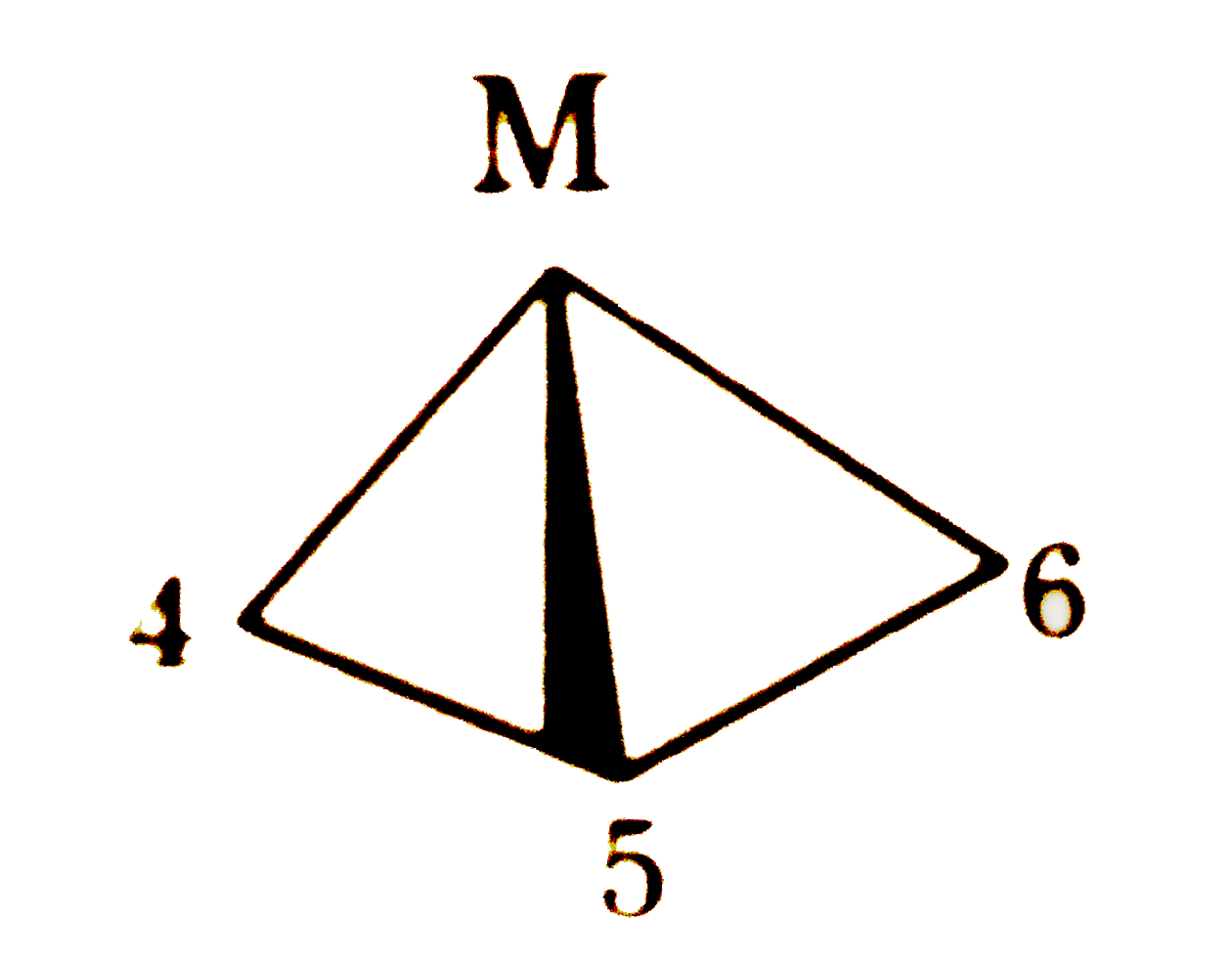
|
|
| 48. |
If a compound absorbs violet colour from the sunlight, then the observed colour is: |
|
Answer» Yellow |
|
| 49. |
If a closed container contain 5 moles of CO_(2) gas, then find total number of CO_(2) molecules in the container (N_(A)=6xx10^(23)) |
|
Answer» `3XX10^(24)` |
|
| 50. |
If a charged particle (+q) is projected with certain velocity parallel to the magnetic field , then it will |
|
Answer» trace helical path 
|
|