

Saved Bookmarks
This section includes 7 InterviewSolutions, each offering curated multiple-choice questions to sharpen your Current Affairs knowledge and support exam preparation. Choose a topic below to get started.
| 1. |
How will you distinguish between dispersed phase and dispersion medium in an emulsion ? |
| Answer» Solution :Emulsions can be diluted to any extent on ADDING DISPERSION medium. The dispersed phase FORMS a separate LAYER if added in excess. | |
| 2. |
How will you distinguish between dispersed phase and dispersion medium in an emulsion? |
| Answer» Solution :Emulsions can be diluted with any amount of DISPERSION medium WHEREAS the seperate layer is formed when the dispersed liquid is MIXED. THUS, two PHASES can be identified by addition of dispersion medium. | |
| 3. |
How will you distinguish between (CH_(3))_(2)NH and (CH_(3))_(3)N? |
|
Answer» Solution :These can be distinguished by Liebermann nitrosoamine reaction. `(CH_(3))_(2)NH` (DIMETHYLAMINE) on streatment with `HNO_(2)` (generated in situ by the action of dil. CHl on `NaNO_(2)`) gives yellow coloured oily N-nitrosodimethylamine. `underset("Dimethylamine")((CH_(3))_(2)+NH)+HO-N=O to underset("N-Nitrosodimethylamine")((CH_(3))_(2)N-N=O)+H_(2)O` N-Nitrosodimethylamine on warming with a crystal of phenol and conc. `H_(2)SO_(4)` gives a green solution which when made alkaline with aqueous NaOH TURNS deep blue and then red on dilution `(CH_(3))_(3)N` (trimethylame), on the other HAND, being a `3^(@)` amine does not give this test. |
|
| 4. |
How will you distinguish between CH_(3)OH and C_(2)H_(5)OH ? |
| Answer» Solution :`C_(2) H_(5) OH + 4I_(2) + 3Na_(2)CO_(3) overset("WARM")(to) CHI_(3) + HCOONa + 5 NaI + 2H_(2) O + 2 CO_(2) CH_(3) OH` does not give this TEST. | |
| 5. |
How will you distinguish between chloroform and carbon tetrachloride ? |
| Answer» Solution :Chloroform gives carbylamine when heated with aniline and alcoholic POTASSIUM hydroxide, WHOSE smell is very offensive. Carbon tetrachloride does not give this TEST. | |
| 6. |
How will you distinguish between carbonate and bocarbonate ions? |
| Answer» SOLUTION :`MgSO_(4)` gives a white ppt. with carbonate ions in COLD solution while a white ppt. is OBTAINED with bicarbonate ions in hot solution only. Phenolphthalein gives a pink colour with carbonate ions and no colour is obtained with bicarbonte ions. | |
| 7. |
How will you distinguish between benzaldehyde and acetadehyde ? |
|
Answer» Solution :Distinguish between benzaldehyde and ACETALDEHYDE. FEHLING Solution Test : Fehling solution A and Fehling solution B are MIXED in equal amounts. On heating the unknown COMPOUND with the MIXTURE of Fehling solution. If a red precipitate is formed `to` it is acetadehyde. If no red precipitate is obtained `to` It is benzaldehyde. |
|
| 8. |
How will you distinguish between : (b) CH_(3)-underset(underset(CH_(3))(|))(N)-H" and "(CH_(3))_(3)N |
|
Answer» Solution :(a) Orange dye test can be used to distinguish between aniline and methyl amine. Dissolve aniline in dil. HCl in a test tube. Prepare a solution of `NaNO_(2)` in WATER in another test tube. Cool both the test TUBES in ice cold water. Add `NaNO_(2)` solution tothe solution of aniline. Then add 1 mL of solution of `beta-`napthol in sodium hydroxide. An orange dye is obtained. Methylamine does not give this test. (B) Dimethyl amine (secondary amine) and trimethyl amine (tertiary amine) cane be differentiated by Hinsberg test. Dimethyl amine reacts with benzene sulphonamide to give N, N-dimethyl benzene sulphonamide which is insoluble in aq. NaOH, so a ppt. is FORMED.  Trimethyl amine does not react with benzene SULPHONYL chloride. |
|
| 9. |
How will you distinguish between aniline and ethylamine. |
Answer» SOLUTION :
|
|
| 10. |
How will you distinguish between aniline and ethylamine ? |
Answer» SOLUTION :DIFFERENCES between ANILINE and ETHYLAMINE 
|
|
| 11. |
Which test is useful to distinguish between 2-pentanone and 3-pentanone? |
|
Answer» Solution :Since 2-pentanone CONTAINS methyl KETONE `(CH_(3)-overset(O)overset(||)C-)` it undergoes iodoform test with an alkaline solution of iodine and forms yellow precipitate of iodoform But-3-pentanone does not GIVE this test. `underset("2 - pentanone")(CH_(3)-CH_(2)-CH_(2)-overset(O)overset(||)C-CH_(3))+4NaOH +3I_(2)RARR CH_(3)CH_(2)-CH_(2)-overset(O)overset(||)C-ON a +underset("(yellow precipiate)")underset("Iodoform")(CHI_(3)+3H_(2)O+3NaI)` |
|
| 12. |
How will you distinguish between a semiconductor and insulator ? |
| Answer» Solution :Semiconductors show a conductivity in the RANGE `10^(-6)-10^(4)ohm^(-1)m^(-1)` while INSULATORS show the conductivity in the range `10^(-20)-10^(-10)ohm^(-1)m^(-1)`. | |
| 13. |
How will you distinguish between 1-phenylethanol and 2-phenylethanol? |
|
Answer» Solution :By IODOFORM test. 1-Phenylethanol contains the grouping -CHOH-`CH_(3)` linked to carbon and hence GIVES iodoform test while 2-phenylethanol does not contains the grouping -`CHOH-CH_(3)` and hence does not give iodoform test. `underset("1-Phenylethanol")(C_(6)H_(5)-CHOH-CH_(3)) overset(I_(2)//NaOH) to underset("Iodoform")(CHI_(3)): underset("2-Phenylethanol")(C_(6)H_(5)CH_(2)CH_(2)OH) overset(I_(1)//NaOH)to ` No reaction. |
|
| 14. |
How will you distinguish betweebn sulphate and thiosulphate ions? |
| Answer» Solution :`AgNO_(3)` gives white ppt. with THIOSULPHATE ions which turns black on standing WHEREAS no ppt. is obtained with sulphate ions. `FeCl_(3)` given purple colour with thiosulphate ions which DISAPPEARS gradually and no ppt. or colouration is obtained in CASE of sulphate. | |
| 15. |
How will you distinguish betweeen: (b) CH_(3)-underset(CH_(3))underset(|)(N)-H and (C_(3))_(3)N |
|
Answer» Solution :a. By reacting with `NaNO_(2)` and HCl at the TEMPERATURE of aroudn to `5^(@)C`, Aniline will from diazonium sal. `CH_(3)NH_(2)` will form methanol and bubbles of `N_(2)` GAS will COME out of the solution. b. By Hinsberg.s reagent `C_(6)H_(5)SO_(2)Cl(CH_(3))_(3)N` will not react. `(CH_(3))_(2)NH` form a product which is insoluble in alkali. |
|
| 16. |
How will you distinguish between 2-pentanone and 3-pentanone. |
|
Answer» Solution :Since 2-PENTANONE contains METHYL ketone `(CH_(3)-overset(O)overset(||)C-)` it undergoes iodoform test with an alkaline solution of iodine and forms yellow precipitate of iodoform But-3-pentanone does not give this test. `underset("2 - pentanone")(CH_(3)-CH_(2)-CH_(2)-overset(O)overset(||)C-CH_(3))+4NaOH +3I_(2)rarr CH_(3)CH_(2)-CH_(2)-overset(O)overset(||)C-ON a +underset("(yellow precipiate)")underset("Iodoform")(CHI_(3)+3H_(2)O+3NaI)` |
|
| 17. |
How will you distinguish 1^(@) and 2^(@) hydroxyl groups present in glucose ? Explain with reactions. |
|
Answer» Solution :When oxidized by nitric ACID, glucose as well as gluconic acid yields dicarboxylic acid, saccharic acid. This indicates the presence of primary alcoholic `(-OH)` group in glucose. The secondary hydroxyl GROUPS NEED drastic conditions to oxidize. Thus, rest four -OH groups in glucose are secondary alcohol group. `{:(""CHO),("|"),(" "(CHOH)_(4)),("|"),(""CH_(2)OH):}overset("Oxidation")rarr underset("Saccharic acid")({:(""COOH),("|"),(" "(CHOH)_(4)),("|"),(""COOH):})overset("Oxidation")LARR underset("Gluconic acid")({:(""COOH),("|"),(" "(CHOH)_(4)),("|"),(""COOH):})` |
|
| 18. |
How will you distinguish 1^@ and 2^@ hydroxyl groups present in glucose ? Explain with reactions. |
Answer» Solution :The `-OH` group present on the terminal carbon atom (i.e., `C_6`) is called the `1^@` hydroxyl group while all the four remaining OH groups present on `C_2,C_3,C_4 and C_5` are called`2^@` hydroxyl groups. `1^@` Hydroxyl groups are easily oxidised to give carboxylic acids but `2^@` hydroxyl groups UNDERGO oxidation only under DRASTIC CONDITIONS. For example , GLUCOSE on oxidation with `HN_3` gives a dicarboxylic acid, saccharic acid having the same number of carbon atoms as glucose. This indicates that glucose contains ONE `1^@` hydroxyl group while the remaining four are `2^@` hydroxyl groups. 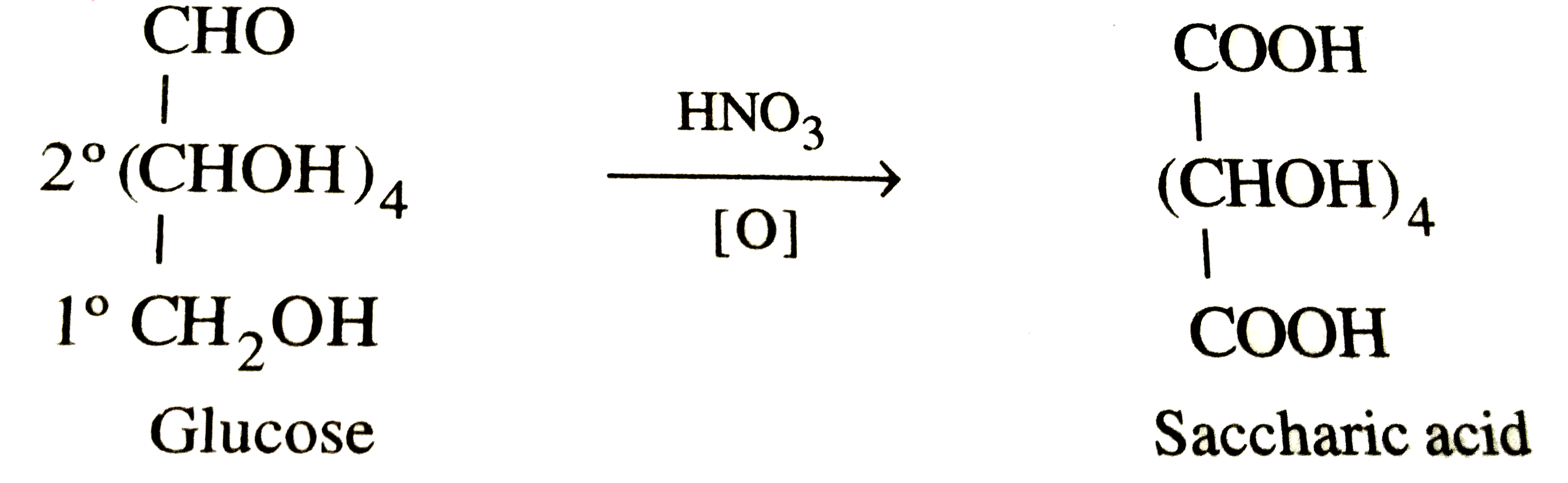
|
|
| 19. |
How will you differentiate between? (i) Aceetaldehyde and acetone. (ii) Aldehydes and ketones with (i) Tollens's regent (ii) Fehling's solution (iii) Acetone and diethyl ether (iv) Formaldehyde and acetaldehyde. (v) Ethyl alcohol and acetone (vi) Formaldehyde and ethylalcohol (vii) Pentan-2-one and pentan-3-one (viii) Benzaldehyde and acetophenone (ix) Benzaldehyde and acetaldehyde ltbr (x) Benzaldehyde and introbenzene. |
|
Answer» Solution :(i) Acetaldehyde respods to following tests while acetone does not give any of them (a) Acetaldehyde + Schiff's REAGENT solution `rarr`Pink colour. ltbr (b) Acetaldehyde + Tollens's reagent `rarr` Silver mirror. (c) Acetaldehyde + Fehiling 's solution `rarrr` Red precipiate. (d) Acetaldehyde + SODIUM hydroxide (conc.)`rarr` Brown RESINOUS mass (ii) Same test asin (i) (iii)Acetone forms yellow coloured iodoforms when heated with `I_(2)` and NaOH,i.e., it gives iodoform test. Diethyl ether not give thsi test (iv) Acetaldeyde from yellow PRECIPITATE of iodoform with an alkaline solution of iodine,i.e., give idoforms test. Formaldeyhde does not give this test (v) Ethyl alcohol gives pink colour with ceric ammoinim nitrate while acetone does not. Acetone gives pink colour with an alkaline solution of sodium nitropurusside while ethyl alcohol does not (vi) Formaldehyde responds to following test while ethyl alcohol does not give any of them (a) HCHO+ Schiff's `rarr` Pink colour (b) HCHO+ Tollen's reagent `rarr` silver mirror HCHO+ Fehling's solution `rarr` Red precipitate Ethyl alcohol give iodoforms test while HCHO does not (vii) Pentan-2-one having -`COCH_(3)` group fros a yellow precipitate of iodoforms with an alkaline solution of iondine,i.e., gives idoforms test while pentan-3-one (viii) (a) Benzaldehyde forms sliver mirror with an ammoniacal silver nitrate solution while acetophenone does not. (b) Acetophenone forms yellow precipite of iodoforms with an alkaline solution of `I_(2)` . Benzaldehyde does not react (ix) Acetaldehyde gives iodoforms test, benzaldehyde does not. (b) Acetaldehyde gives red precipitate with Fehlings's solution while benzaldehyde does not react. (x) (a) Benzaldehyde reduces. Tollens' reagent while nitrobenzene does not. (b) Benzaldehyde gives pink colour Schiff's reaent but nitrobenzene does not (c) Nitrobenzene on reduction gives aniline which exhibites dye test. Benzaldehyde does not give dye test. |
|
| 20. |
How will you differentiate between osmosis and diffusion ? |
Answer» Solution :The important POINTS of DISTINCTION between osmosis and diffusion are LISTED as FOLLOWS: 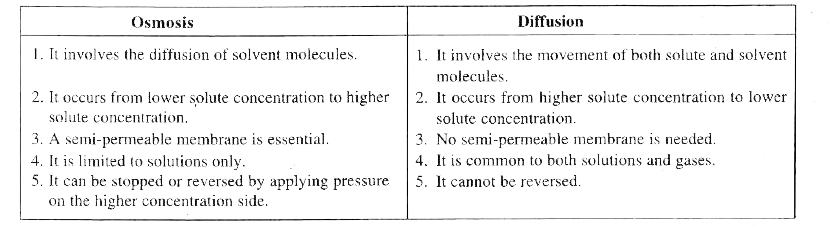
|
|
| 21. |
How will you differentiate between lyophilic and lyophobic colloids ? |
| Answer» | |
| 22. |
How will you differentiate between catalysis carried by enzymes and by inorganic catalyst |
| Answer» | |
| 23. |
How will you determine the rate constant for the decomposition of nitrogen pentaoxide in C C_(4). Decomposition of nitrogen pentoxide in C Cl_(4). |
|
Answer» Solution :`N_(2)O_(5)overset(k_(1))rarr 2NO_(2)+(1)/(2)O_(2)` (i) At time t = 0, the volume of OXYGEN liberated is zero. (ii) LET `V_(t)` and `V_(oo)` be the measured volumes of oxygen liberated after the reactant has reacted in 't' time and at completion `(t=oo)`. (iii) Initial concentration of `N_(2)O_(5)` is PROPORTIONAL to total volume of oxygen liberated (i.e.,) `(V_(oo))`. (iv) `(V_(oo)-V_(t))` is proportional to undecomposed `N_(2)O_(5)` at time 't'. (v) `therefore k_(1)=(2.303)/(t)"log"(V_(oo))/((V_(oo)-V_(t)))sec^(-1)` |
|
| 24. |
How will you determine the conductivity of an electrolytic solution using a wheatstone bridge? |
|
Answer» Solution :(i) The conductivity of an electrolytic solution is determined by using a WHEATSTONE bridge arrangement in which one resistance is replaced by a conductivity cell FILLED with the electrolytic solution of unknown conductivity. (ii) In the measurement of specific resistance of a metallic wire, a DC POWER supply is used. Here, if we apply DC current through the conductivity cell, it will lead to the ELECTROLYSIS of the solution taken in the cell. So,AC current is used for this measurement to prevent electrolysis. (iii) A wheatsome bridge is constituted using known resistances P, Q, a variable resistance S and conductivity cell (Let the resistance of the electrolytic solution taken in it be R) as shown in the figure. An AC source (550 Hz to 5 KHz) is connected between the junctions A and C. Connect a suitable detector (Such as the telephone ear piece detector) between the junctions .B. and .D.. (iv)The variable resistance .S. is adjusted until the bridge is balanced and in this conditions there is no current flow through the detector. Under balanced condition, `""P/Q=R/S` `""thereforeR=P/Q times S` (v) The resistance of the electrolytic solution (R) is calculated from the known resistance VALUES P, Q and the measured .S. value under balanced condition using the above expression. 
|
|
| 25. |
How will you convery 3-oxocylohexane carbaldehyde into -3 hydroxy-3- methyl cyclohexanecarbaldehyde? |
Answer» Solution : Aldehydes are more reactigve as compared to ketones. In a compound containing both aldehyde and keto group, the reaction occures at -CHO group preferntially. So in these transformation selective protection of -CHO group is carried out through acetal formation. The finally DEPROTECTION of -CHO with ethylene glycol is DONE with catlytic amount of ACID. The reactions are then carried out selectively at keto group and finally deprotection of -CHO group is done through acidic hydrolysis. 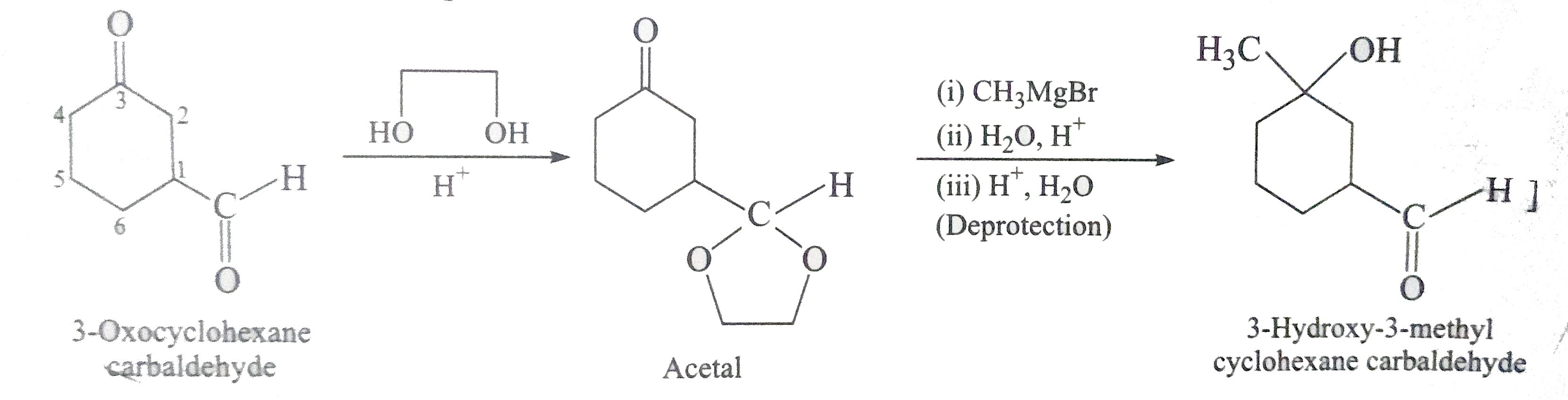
|
|
| 26. |
How will you convert the following: (i) Propene to propan-2-ol (ii) Phenol to benzoic acid (iii) Propan-l-ol to propan-2-ol |
Answer» Solution :`CH_(3)CH=CH_(2)overset("CONC."H_(2)SO_(4))toCH_(3)UNDERSET(OSO_(3)H)underset(|)(CH)-CH_(3)underset("Boil")overset(H_(2)O)toCH_(3)-underset("Propan-2-ol")underset(OH)underset(|)(CH)-CH_(3)`  `CH_(3)CH_(2)CH_(2)OHunderset(443K)overset(H^(+))toCH_(3)CH=CH_(2)overset(HBr)toCH_(3)-underset(Br)underset(|)(CH)-CH_(3)overset(aq.KOH)toCH_(3)underset(OH)underset(|)(CH)-CH_(3)` |
|
| 27. |
How will you convert toluene to m-nitrobenzoic acid? |
Answer» SOLUTION :The FOLLOWING STEPS are INVOLVED in the CONVERSION: 
|
|
| 28. |
How will you convert toluene into sym-trinitrobenzene? |
Answer» SOLUTION :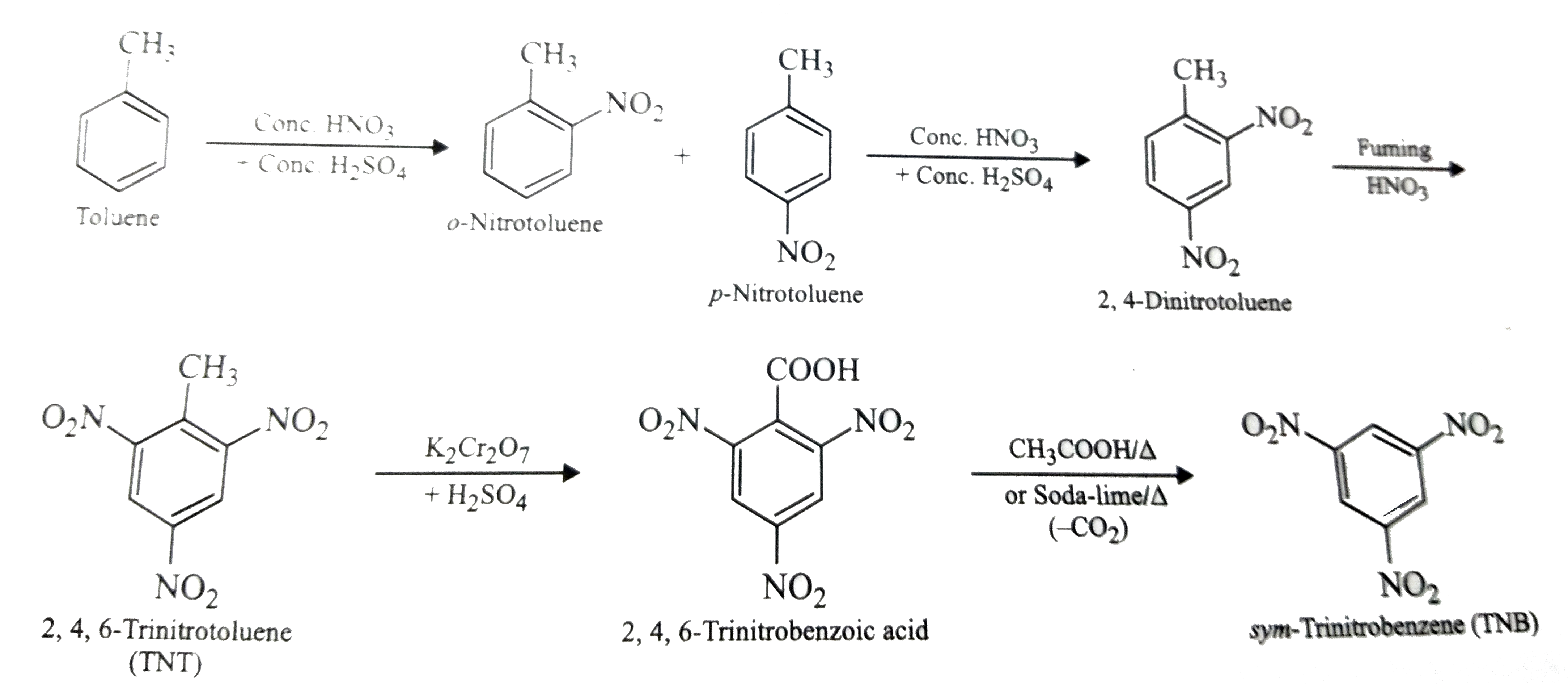
|
|
| 29. |
How will you convert the following : (i) Phenol to anisole (ii) Propan -2- ol to 2-methylpropan-2- ol (iii) Aniline to phenol. |
Answer» Solution :(i) Phenol to anisole  (ii) Propan-2-ol to 2- methylpropan-2- ol : `UNDERSET("Propan-2-ol")(CH_(3)-underset(OH)underset("|")"CH"-CH_(3))OVERSET([O])RARR underset("Propanone")(CH_(3)-underset(O)underset(||)C-CH_(3)) overset(CH_(3)MgBr)underset(H_(2)O)rarr underset("2-Methylpropan-2-ol")(CH_(3)-overset(CH_(3))overset("|")underset(OH)underset("|")"C "-CH_(3))` (III) Aniline to phenol : 
|
|
| 30. |
How will you convert the following : (i) Nitrobenzene into aniline (ii) Ethanoic acidinto methanamine (iii) Aniline into N-phenylethanamide. Write the chemical equations involved. |
Answer» Solution :(i) NITROBENZENE into ANILINE :  (ii) Ethanoic acid into methanamine : `underset("Ethanoic acid")(CH_(3)COOH)+NH_(3) rarr underset("Amm. acetate")(CH_(3)COONH_(4)) underset(H_(2)O)overset(DELTA)(rarr) underset("Ethanamide")(CH_(3)CONH_(2))overset(Br_(2)+KOH)(rarr) underset("Methanamine")(CH_(3)NH_(2))` (III) Aniline into N-phenylethanamide : 
|
|
| 31. |
How will you convert the following : (i) Nitrobenzene into aniline (ii) Ethanoic .acid into methanamine (iii) Aniline into N-phenylethanamide (Write the chemical equations involved. |
Answer» Solution :(i) 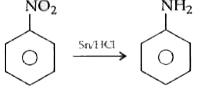 (II) `CH_(3)COOHunderset(NH_(3))(RARR)CH_(3)CONH_(2)overset(Br_(2))underset(+KOH)(rarr) CH_(3)NH_(2)` (iii) 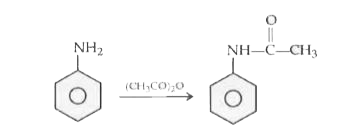
|
|
| 32. |
How will you convert the following? (i) Ethanoic acid to methanamine (ii) Aniline into N-phenylethanamide. |
|
Answer» Solution :(i). N/A (II). `underset("Aniline")(C_(6)H_(5)NH_(2))+underset("Acetic anhydride")((CH_(3)CO)_(2)O)underset(Delta)overset("PYRIDINE")t0 underset("N-Phenylethanamide")(C_(6)H_(5)-NH-overset(O)overset(||)(C)-CH_(3))+underset("Acetic acid")(CH_(3)COOH)` |
|
| 33. |
How will you convert red phosphorous into P_(2)O_(3) and P_(2)O_(5)? |
|
Answer» SOLUTION :Red phosphorus REACT with oxygen on heating to give phosphorus trioxide or phosphorus pentoxide. `P_(4)+3O_(2)overset(Delta)rarr P_(4)O_(6)" (phosphorous trioxide)"` `P_(4)+5O_(2)overset(Delta)rarr P_(4)O_(10)" (phosphorous pentaoxide)"` |
|
| 35. |
How will you convert propene to 1-nitropropane? |
| Answer» Solution :`underset("Propene")(CH_(3)CH=CH_(2)) underset(("Anti-Mark. Addn."))overset(HBr//RCOOR)to underset("1-Bromopropane")(CH_(3)CH_(2)CH_(2)-BR) underset(C_(2)H_(5)OH-H_(2)O)overset(AgNO_(2))to underset("1-Nitropropane")(CH_(3)CH_(2)CH_(2)-NO_(2))` | |
| 36. |
How will you convert propanone to propan-2-ol? |
Answer» Solution :Propanone can be reduced to propan-2-ol by a number of reagents such as catalytic HYDROGENATION with `H_(2)` in presence of `Ni,PT` or PD, `LiSAlH_(4)` or `NaBH_(4)`.  . .
|
|
| 37. |
How will you convert propanoic acid into the following componds? Ethane |
|
Answer» `CH_3CH_2COOH+NaOH rarrCH_3CH_2COONa+H_2O` `CH_3CH_2COONa+NaOH OVERSET (CaO)rarrCH_3CH_3+Na_2CO_3` |
|
| 38. |
How will you convert propanoic acid into the following compond? Butane |
|
Answer» `2CH_3CH_2COONa+2H_2O overset(electrolysis)rarrCH_3CH_2CH_2CH_3+2CO_2+2NaOH_H_2` |
|
| 39. |
How willyou convert : Propanoic acid into ethanoic acid ? |
|
Answer» Solution :Steps involved in the different conversions are given below : `underset("Propanoic acid")(CH_(3)CH_(2)COOH) overset(NH_(3))(rarr)underset("AMM. propanoate")(CH_(3)CH_(2)COONH_(4)) overset(DELTA)(rarr) underset("Propanamide")(CH_(3)CH_(2)CONH_(2)) overset(Br_(2)//KOH)(rarr) underset("Ethanamine")(CH_(3)CH_(2)NH_(2)) overset(HONO)(rarr) underset("Ethanol")(CH_(3)CH_(2)OH) underset(underset("(Oxidation)")(H_(2)SO_(4)))overset(K_(2)Cr_(2)O_(7))(rarr) underset("Ethanoic acid")(CH_(3)COOH)` |
|
| 40. |
How will you convert phenol into salicylic acid ? |
Answer» SOLUTION :
|
|
| 41. |
How will you convert phenol into benzene? |
Answer» Solution :Phenol is CONVERTED to BENZENE on heating with Zinc DUST. 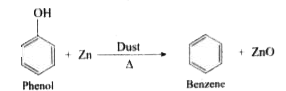
|
|
| 42. |
How willyou convert : Nitromethane into dimethylamine |
|
Answer» Solution :STEPS involved in the different conversions are given below : `underset("Nitromethane")(CH_(3)NO_(2)) OVERSET(Sn//HCl)(rarr) underset("Methanamine")(CH_(3)NH_(2)) underset(ALC. KOH, Delta)overset(CHCl_(3))(rarr) underset(underset("isocyanide")("Methyl"))(CH_(3)NC) underset("Reduction")overset("Na/Alcohol")(rarr) underset(underset("(N-Methylmethanamine)")("Dimethylamine"))(CH_(3)NHCH_(3))` |
|
| 43. |
How will you convert Nitrobenzene to phenol ? |
Answer» SOLUTION :
|
|
| 44. |
How will you convert phenol into ? 9i) Salicylaldehyde (Reimer-Tiemann reaction ) (ii) Salicylic aci (Reimer -Tiemann reaction ) (iii) p-Hydroxyazobenzene (iv) Anisole (v) Methyl salicylate (vi) Phenyl salicylate ltbr. (vii) Phenyl ethanoate (viii) Picric acid (ix) Phenolphthalein (x) Aspirin ( Acetylation of salicylic acid) (xi) 4-Nitrophenol (xii)Cyclohexanol (xiii) 2,4,6- Tribromophenol (xiv) p-Benzoquinone (xv) Aniline (xvi) 4-Bromophenol. |
Answer» SOLUTION :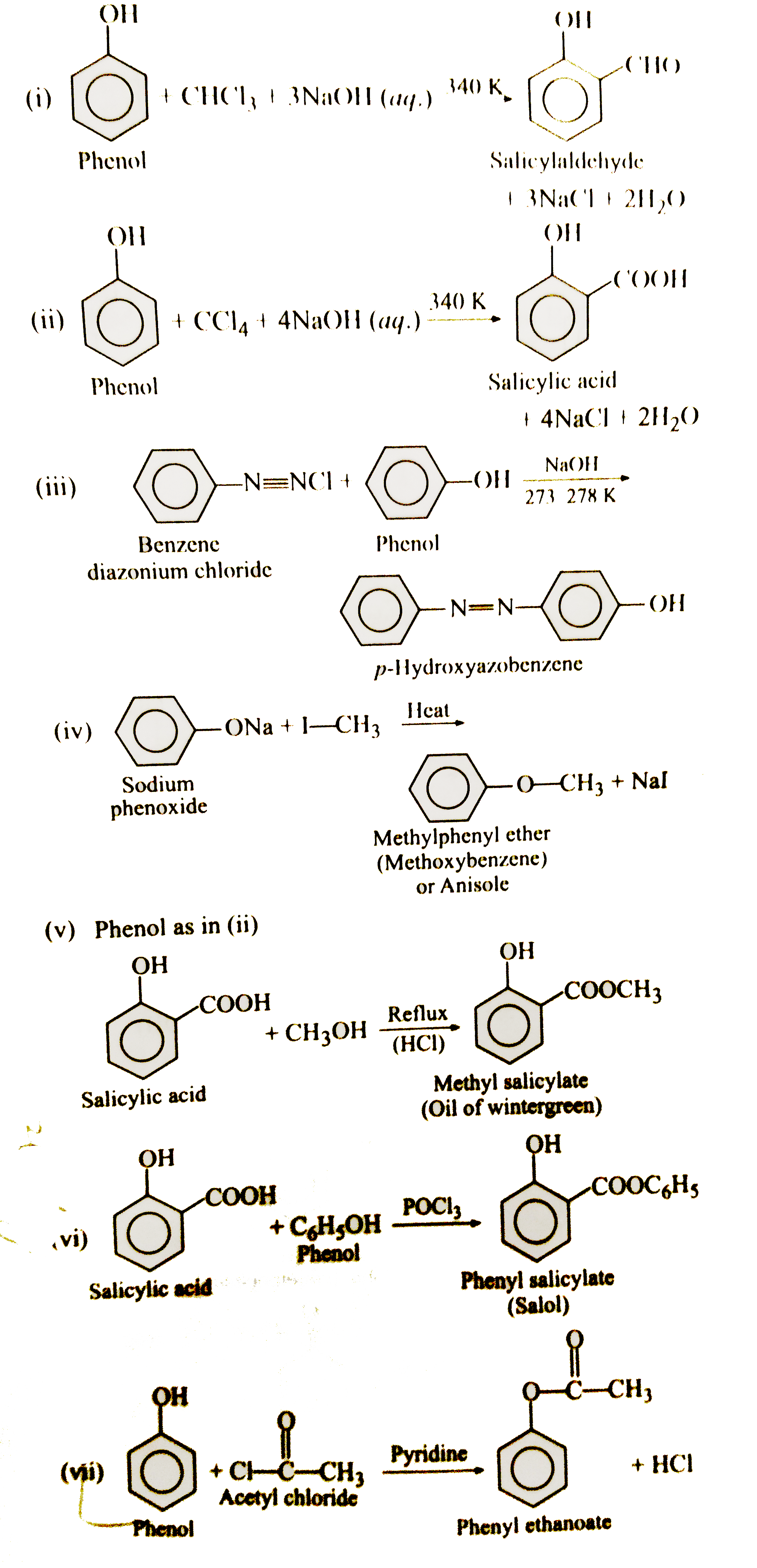 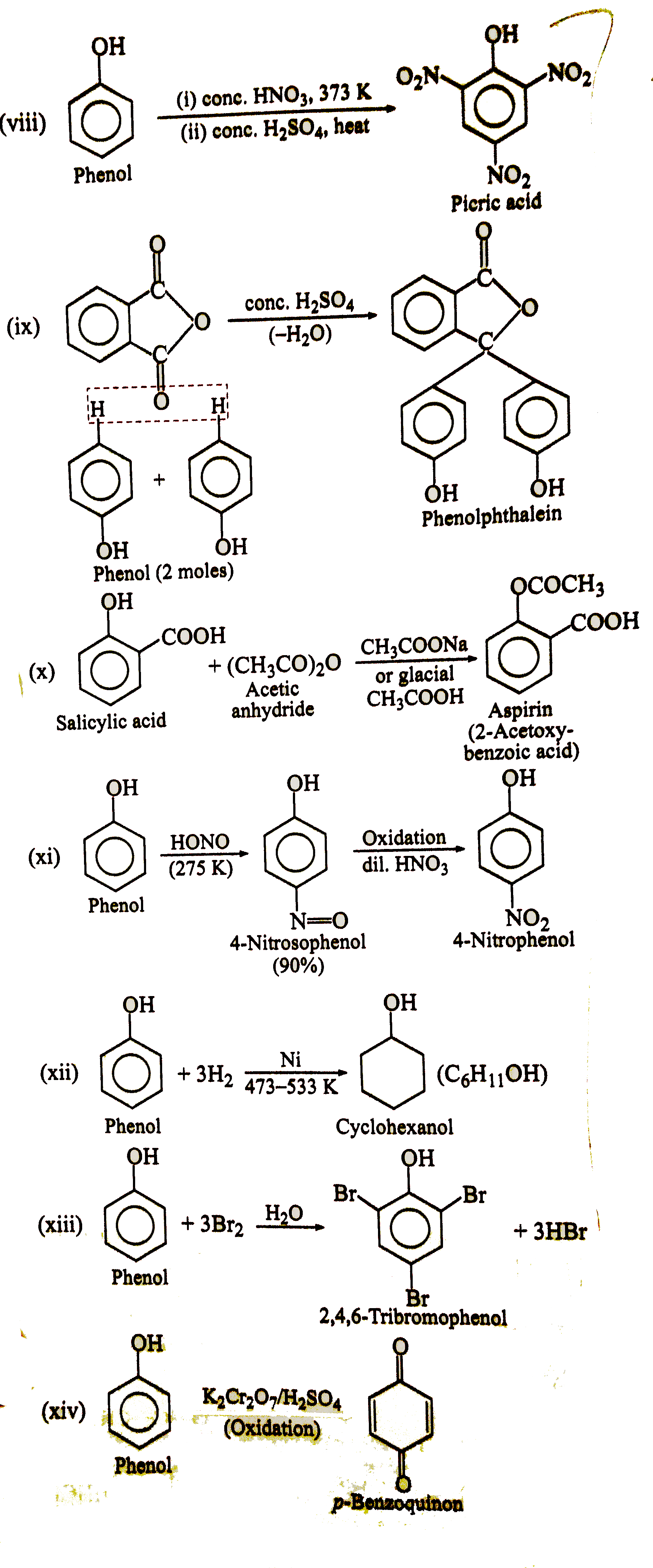 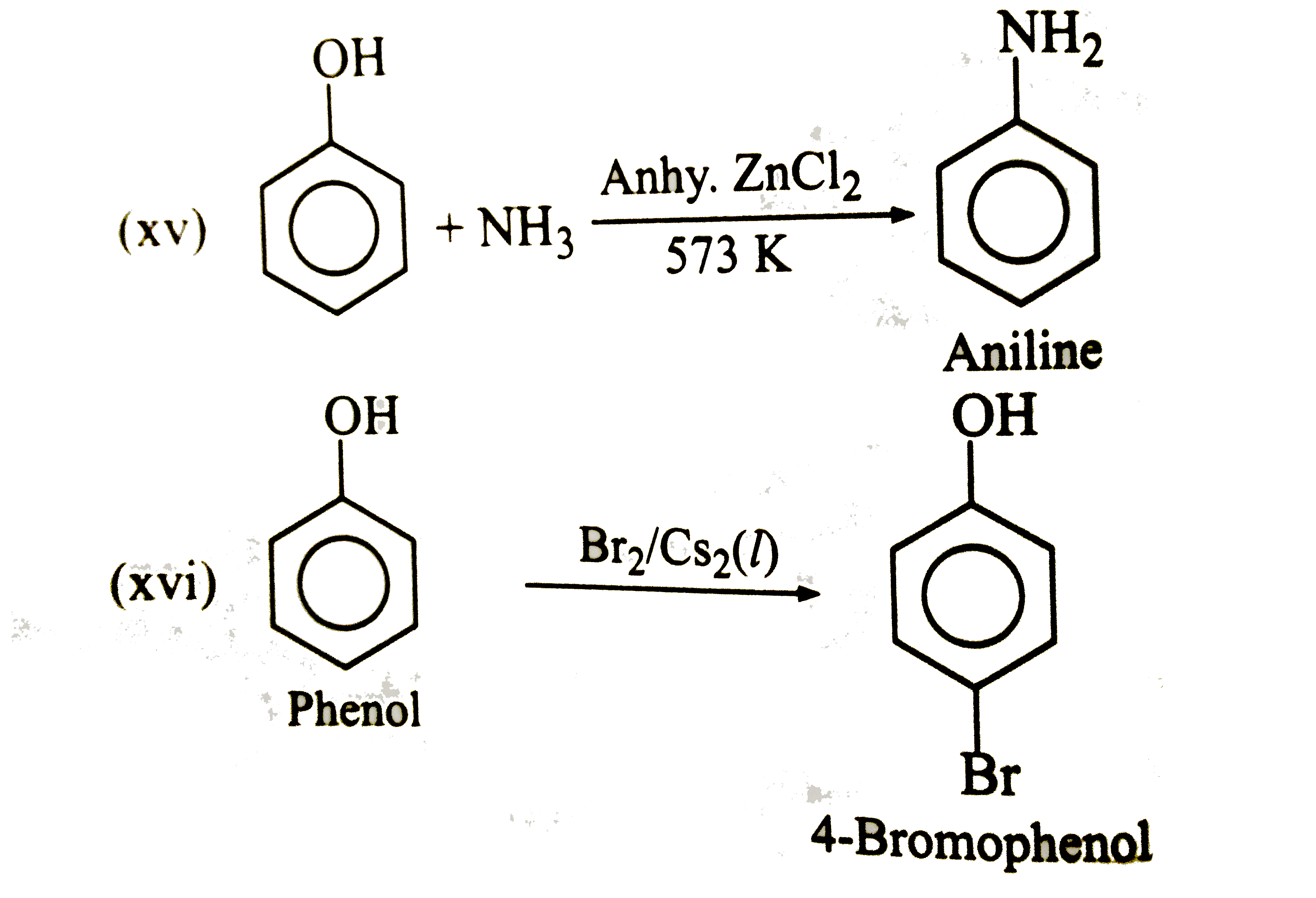
|
|
| 45. |
Write the conversion of ethylene glycol to 1,4-dioxan ? |
Answer» SOLUTION :When ethylene glycol is treated with conc. `H_(2)SO_(4)` TWO molecules of water are REMOVED and the PRODUCT formed is dioxan. 
|
|
| 46. |
How will you convert nitrobenzene into (i)1,3,5-trinitrobenzene (ii) o and p-nitrophenol (iii) m-nitro aniline (iv). Azoxybezene v. Hydrozabenzene vi. N-phenylhydroxylamine (vii). Aniline. |
Answer» Solution :(i)CONVERSION of NITROBENZENE into 1,3,5-trinitrobenzene: 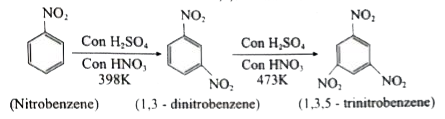 (ii) Conversion of nitrobenzene into o and p-nitrophenol: a. Method I: Nitrobenzene heated with solid KOH AR 340 K gives a low yield of a mixture of O and P nitrophenols. 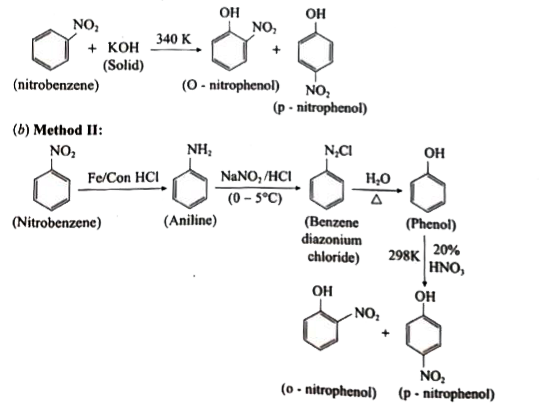 (iii) Conversiion of nitrobenzene into m-nitro aniline: 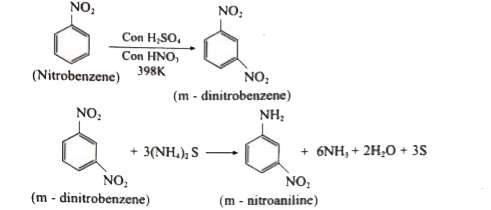 (iv). Conversion of nitrobenzene into azoxybenzene: `underset (("nitrobenzene"))(2C_(6)H_(5)NO_(2))underset(("or")"Glucose"//NaOH Delta)overset(Na_(3)AsO_(3)//NaOHDelta)(to)C_(6)H_(5)-underset(("azoxybenzene")) underset(O)underset(darr)(N)=N-C_(6)H_(5)` v. Conversion of nitrobenzene into hydrazobenzen: `underset(("nitrobenzene"))(2C_(6)H_(5)NO_(2))overset(Zn//NaOH)(to)underset(("Hydrazobenzene"))underset(C_(6)H_(5)-NH-NH-C_(6)H_(5))underset(darr2(H))([C_(6)H_(5)-N=N-C_(0)H_(5)])` (vi). Conversion of nitrobenzene into N- phenylhydroxylamine: `underset(("nitrobenzene"))(C_(6)H_(5)NO_(2))underset(H_(2)O,Delta)overset(Zn//NH_(4)Cl)(to)underset(("N-Phenylhydrozylamine"))(C_(6)H_(5)-NHOH+ZnO)` (VII). Conversion of nitrobenze into aniline: 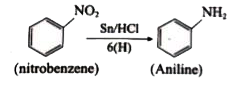
|
|
| 47. |
How will you convert methyl into ehtyl chloride? |
Answer» SOLUTION : . .
|
|
| 48. |
How will you convert Methyl amine to ethyl amine. |
|
Answer» SOLUTION :`CH_3CH_2 overset(HNO_2)RARR CH_3-O-N = O` `overset(H_2O)rarrCH_3OH overset(P+I_2)rarr CH_3I overset(KCN)rarr` ` CH_3CN overset(H) UNDERSET(Na//alcohol)rarrCH_3CH_2NH_2` |
|
| 49. |
How willyou convert : Methanol to ethanoic acid |
|
Answer» Solution :Steps involved in the different CONVERSIONS are given below : `underset("methanol")(CH_(3)OH) underset(-POCl_(3))overset(PCl_(5))(rarr)CH_(3)Cl overset(KCN(alc.))(rarr) underset("Ethanenitrile")(CH_(3)CN) underset("(HYDROLYSIS)")overset(H^(+)//H_(2)O)(rarr) underset("Ethanoic acid")(CH_(3)COOH)` |
|