

Saved Bookmarks
This section includes 7 InterviewSolutions, each offering curated multiple-choice questions to sharpen your Current Affairs knowledge and support exam preparation. Choose a topic below to get started.
| 1. |
How will you prepare 1.0 kg of an aqueous solution of acetone (CH_(3)COOH_(3)) in water in which mole fraction of acitone is 0.19. |
|
Answer» `"MOLAR mass of "CH_(3)COOH_(3)=58" g mol"^(-1), "Molar mass of "H_(2)O=18" g mol"^(-1)` `eta_((CH_(3)COOH_(3)))=("Mass of "CH_(3)COOH_(3))/("Molar mass of"CH_(3)COCH_(3))=((xg))/((58"g mol"^(-1)))=x/58mol` `eta_((H_(2)O))=("Mass of WATER")/("Molar mass of water")=((1000-x))/((18"g mol"^(-1)))=((1000-x))/18mol` `x_((CH_(3)COCH_(3)))=0.19("GIVEN")` `0.19=((x//58"mol"))/((x//58"mol")+(1000-x)//18"mol")=(x//58)/(x//58+(1000-x)//18)` `0.19=((x//58)xx(58xx18))/(18x+58(1000-x))=(18x)/(18x+58000-58x)` 0.19 (58000- 40x) = 18 x 11020=7.6xx=18x or 25.6x=11020 `or"" x=(11020)/(25.6)=431 g` `therefore" Mass of acetone to be ADDED"=431 g` Mass of water to be added =(1000-431)=569 g. |
|
| 3. |
How will you prepare 4-alkyl-4-hydroxy butanoic acid? |
|
Answer» SOLUTION :When two or more functional GROUPS are present in a molecule a less vigorous sodium BOROHYDRIDE is used as a reducing AGENT to reduce the more reactive group. For example, if a compound contains both carbonyl and carboxyl group, NaBH4 reduces the carbonyl group. `RCOCH_2CH_2COOH underset(H_2O^(+))overset(NaBH_4)to underset("4 - alkyl - 4- HYDROXY butanoic acid")(RCHOHCH_2CH_2COOH)` |
|
| 4. |
How will you prepare 0.25 m CaVI_(2) solution? |
|
Answer» `"No. of moles of "CaCI_(2)="Molality"XX"Mass of solvent in kg"` `=(0.25" mol lg"^(-1))xx(1 kg )= 0.25 mol` `"Molar mass of "CaCI_(2)=40+2xx35.5=111 " g mol"^(-1)` `"Mass of "CaCI_(2)=(0.25 mol)xx(111 g mol^(-1))=27.75 g.` |
|
| 5. |
How will you preapre PCl_(3) from white phosphorous? |
|
Answer» Solution :(i) When a slow stream of chlorine is passed over white PHOSPHOROUS, `PCl_(3)` is formed. (II) It can also be obtained by treating white phosphorus with thionyl chloride. `4P_(4)+8SOCl_(2)rarr 4PCl_(3)+4SO_(2)+2S_(2)Cl_(2)` |
|
| 6. |
howwillyouobyain ? Giveequationsonly : (a) methanefromacetone (b)ethanefromacetoneacid . ( c)methane and ethane from sodium acetate, |
|
Answer» SOLUTION :(a) (i) `UNDERSET("Acetne ")(CH_(3)COOH_(3))+4[O]to underset("Acetic acid ")(CH_(3)COOH+CO_(2)+H_(2)O)` (ii) `CH_(3)COOH+NaOH to underset("sodiumacetate")(CH_(3)COONA)+H_(2)O` (iii)`CH_(3)COONa+NaOH underset(DELTA)overset(CaO)to underset("Methane ")(CH_(4))+ Na_(2)CO_(3)` (b) (i)`underset("Acetic acid ")(CH_(3)COOH+NaOH)to underset("sodium acetate ")(CH_(3)COONa)+H_(2)O` (ii)`underset("sodiumacetate ")(2CH_(3)C OONa+2H_(2)O)overset("Electrolsis")to underset("Ethane")(CH_(3)-CH_(3))+2CO_(2)+2NaOH+H_(2)` (c )Applya (iii)and b (ii) EQUATIONS forobtainning methaneand ethanerespectively. |
|
| 7. |
How will you predict whether a reaction is not feasible? |
|
Answer» `E_("CELL")^(@)=-ve` |
|
| 8. |
How will you obtain the following from methyl isocyanide? (i) dimethylamine ltBrgt (ii) Methyl isothiocyanate |
|
Answer» Solution :(i) Reduction of isocyanides with `H_(2)`/RANEY Ni or `H_(2)//PD` or `LiAlH_(4)` gives `2^(@)` AMIDES. `underset("Methylisocyanide")(CH_(3)-Noverset(to)(=)C) underset("or "LiAlH_(4)//ETHER)overset(H_(2)//"Raney. Ni or Pd")to underset("Dimethylamine")(CH_(3)-NH-CH_(3))` (ii) HEATING methyl isocyanide with sulphur gives methyl isothiocyanate `underset("Methylisocyanide")(CH_(3)-N=C:)+S overset(Delta)to underset("Methylisothiocyanate")(CH_(3)-N=C=S)` |
|
| 9. |
How will you obtain phosphine from phosphorus ? |
|
Answer» Solution :Phosphine is produced when white phosphorus in heated with a concentrated solution NaOH in an inert ATMOSPHERE of `CO_(2)` or oil gas. `P_(4) (s) + 3NaOH(aq) underset(Delta)overset(CO_(2)atm.)rarr underset("Phosphine")(PH_(3)(g)) + underset("SOD. HYPOPHOSPHITE")(3NaH_(2)PO_(2)(aq))` |
|
| 10. |
How will you obtain monobromobenzene from aniline? |
Answer» SOLUTION :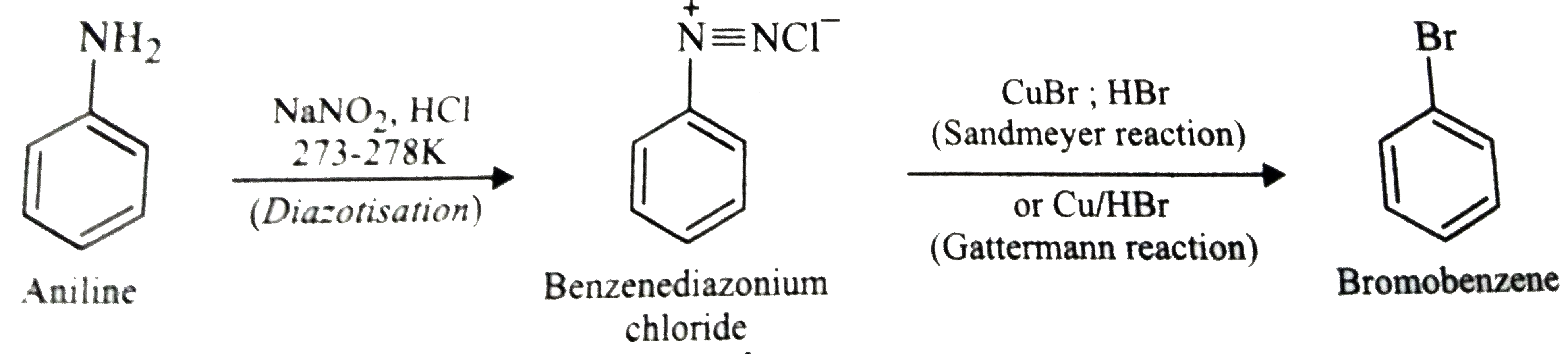
|
|
| 11. |
How will you obtain monobromobenzene from aniline ? |
Answer» SOLUTION :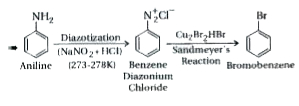
|
|
| 12. |
How will you obtain bromobenzene from aniline? |
Answer» SOLUTION : . .
|
|
| 13. |
How will you obtain a colodial sol of aresenious sulphide ? |
| Answer» Solution :Arsenous SULPHIDE is OBTAINED by passing `H_(2)S` through ARSENIOUS OXIDE solution. | |
| 14. |
How will you obtain a colloidal solution of arsenious sulfide? |
| Answer» SOLUTION :COLLOIDAL solution of arsenious SULFIDE is obtaned by passing `H_2S` gas through arsenious OXIDE solution. | |
| 15. |
How will you obtain 1-bromopropane from propene? |
| Answer» Solution :With HBr in PRESENCE of peroxides `(CH_(3)CH=CH_(2) overset("HBr, peroxides")to CH_(3)CH_(2)CH_(2)Br)` | |
| 16. |
How will you manufacture sulphuric acid by contact process? |
|
Answer» Solution :Manufacture of sulphuric acid by contact process involves the following steps. i. INITIALLY SULPHUR dioxide is produced by burning sulphur or iron pyrites in oxygen/air. `S+O_(2)rarrSO_(2)` `4FeS_(2)+11O_(2)rarr 2Fe_(2)O_(3)+8SO_(2)` ii. Sulphur dioxide formed is oxidised to sulphur trioxide by air in the presence of a catalyst such as `V_(2)O_(5)` or platinised ASBESTOS. (iii) The sulphur trioxide is absorbed in concentrated sulphuric acid and produces oleum `(H_(2)S_(2)O_(7))`. the oleum is converted into sulphuric acid by diluting it with water. `SO_(3)+H_(2)SO_(4)rarr H_(2)S_(2)O_(7)overset(H_(2)O)rarr 2H_(2)SO_(4)` To MAXIMISE the yield the plant is operated at 2 bar pressure and 720 K. The sulphuric acid obtained in this process is over `96%` pure. |
|
| 17. |
How is sulphuricacid manufacture by contact process ? |
|
Answer» Solution :Manufacture of sulphuric acid by contact process involves the following steps. i. Initially sulphur dioxide is produced by burning sulphur or iron pyrites in oxygen/air. `S+O_(2)rarrSO_(2)` `4FeS_(2)+11O_(2)rarr2Fe_(2)O_(3)+8SO_(2)` ii. Sulphur dioxide formed is oxidised to sulphur trioxide by air in the presence of a catalyst such as `V_(2)O_(5)` or platinised asbestos. iii. The sulphur trioxide is absorbed in concentration sulphuric acid and PRODUCES OLEUM `(H_(2)S_(2)O_(7))`. The oleum is converted into sulphuric acid by diluting it with water. `SO_(3)+H_(2)SO_(4)rarr H_(2)S_(2)O_(2)overset(H_(2)O)rarr 2H_(2)SO_(4)` To maximise the YIELD the plant is operated at 2 bar pressure and 720 K. The sulphuric acid obtained is this process is over `96%` pure. |
|
| 18. |
How will you manage sulphur produced during roasting process? |
| Answer» Solution :The supher dioxide PRODUCED during roasting PROCESS is harmful to the environment .In MODERN METALLURGICAL factories,This by product is trapped and converted into sulphuric acid to avoid air pollution. | |
| 19. |
How will you manage sulphur dioxide produced during roasting process? |
| Answer» Solution :The sulphur dioxide produced during roasting process is HARMFUL to the enviroment. In modern METALLURGICAL factories, this by PRODUCT is trapped and converted into SULPHURIC acid avoid air pollution. | |
| 20. |
How will you make the following conversions? Propanoic acid to 2-chloropropanoic acid. |
|
Answer» <P> |
|
| 21. |
How will you make the following conversions? Ethanoic acid to ethanol. |
|
Answer» |
|
| 22. |
How will you make the following conversions? Toluene to benzoic acid. |
|
Answer» |
|
| 23. |
How will you know whether a given OH group is alcoholic or phenolic in nature? |
| Answer» SOLUTION :Phenolic OH group gives BLUE or VIOLET COLOURATION with neutral `FeCl_(3)` while alcoholic OH group does not. | |
| 24. |
How will you identify borate radical? |
|
Answer» SOLUTION :A . `B(OH)_(3)+NH_(3)overset(Delta)(to)UNDERSET(("BORON nitride"))(BN)+3H_(2)O` b. `Na_(2)B_(4)O_(7)+H_(2)SO_(4)+5H_(2)Oto underset(("BORIC acid"))(4H_(3)BO_(3))+2Na_(2)SO_(4)` c.`B_(2)H_(6)+2NaOH+2H_(2) O to underset(("Sodiummeteborate"))(4Na)` |
|
| 25. |
How will you give expression for K_(b) to indicate its basic strength ? |
| Answer» SOLUTION :`K_(B) = ([RNH_(3)^(+)][OH^(-)])/([R-NH_(2)])` | |
| 26. |
How will you identify borate radical ? |
|
Answer» Solution :Flame Test : Borates on adding ethyl alcohol gives ethyl borate which when exposed to flame gives green COLOUR flame. `H_(3)BO_(3)+3C_(2)H_(5)OH overset("Conc.")underset(H_(2)SO_(4))to B(OC_(2)H_(5))_(3)+3H_(2)O` |
|
| 27. |
How will you get Propane nitrile from ethyl bromide? |
| Answer» Solution :`underset("Ethyl bromide")(CH_(3)-CH_(2)Br)+KCNtounderset("Propane nitrile")(CH_(3)-CH_(2)CN)+KBr` | |
| 28. |
How will you distinguish the primary, secondary and tertiary alcohols by Victor Meyer’s method ? |
|
Answer» Solution :Victor Meyer's test: (i) Alcohol is converted into alkyl iodide by treatment with `P//I_(2)`. (ii) The alkyl iodide is then converted into nitro alkane by sivler nitrite `(AgNO_(2))`. (III) The nitro alkane is treated with nitrous acid `(HNO_(2))` and then with aqueous KOH. (iv)The `1^(@), 2^(@)` and `3^(@)` alcohols are identified from the colour of the PRODUCT. (a) Primary alcohol: `underset("Ethanol"1^(@))(CH_(3)-CH_(2)-OH) overset(P//I_(2)) to underset("Ethyl iodide") (CH_(3)CH_(2)I) overset(AgNO_(2)) to underset("Nitro ethane") (CH_(3)CH_(2)NO_(2)) overset(O=N -OH) to underset("Nitroxime")underset(NO_(2))underset(|)(CH_(3)C = NOH) overset(KOH) to underset("Potassium salt of nitrolic acid (Red)")underset(NO_(2))underset(|)(CH_(3)C=N-OK^(+))` (b) Secondary alcohol:  ( c) 
|
|
| 29. |
How will you distinguish between the following pairs of terms : (i) Tetrahedral and octahedral voids. (ii) Crystal lattice and unit cell. |
|
Answer» Solution :(i) Tetrahedral and octahedral voids : When a SPHERE of the second layer is above the void of the first layer, a tetrahedral void is formed. A tetrahedral void is surrounded by four spheres. On the other hand, octahedral void is surrounded by SIX spheres. (ii) Crystal lattice and unit cell : A regular three DIMENSIONAL arrangement of points in SPACE is called crystal lattice. The smallest portion of the crystal lattice, when repeated in different DIRECTIONS generates the entire lattice, is called unit cell. |
|
| 30. |
How will you distinguish between the following pairs of terms : Tetrahedral and octahedral voids. Crystal lattice and unit cell. |
|
Answer» Solution :Tetrahedral VOID is surrounded by 4 constituent particles (atoms/molecules/ions). Octahedral void is surrounded by 6 constituent particles (atoms/molecules/ions). OR A regular three dimensional arrangement of points in space is called a crystal LATTICE. UNIT cell is the smallest portion of a crystal lattice which, when repeated in three directions, generates an entire lattice/unit cell is the miniature of crystal lattice/microscopic EDITION of the crystal lattice. |
|
| 31. |
How will you distinguish between the following pairs of terms : (i) Hexagonal close-packing and cubic close packing ? (ii) Crystal lattice and unit cell ? (iii) Tetrahedral void and octahedral void ? |
|
Answer» Solution : (i) In hexagonal close-packing, the arrangement is of type ABABAB.... where every third layer is parallel to the first layer. In cubic close-packing, the arrangement is of type ABCABCABC.... every fourth layer is same as first layer. (ii) Crystal lattice is the ARRANGMENT of lattice POINTS in three dimensional space. Unit cell is the smallest part of space lattice of a crystal that spacify the crystal completely. (iii) A voids surrounded by four spheres are called TETRAHEDRAL voids. The centres of these four spheres when joined gives tetrahedron. A voids surrounded by SIX spheres are called octatahedral voids. The centres of these six spheres when joined gives octahedron. The total number of tetrahedral voids are twice to that of number of atoms in unit cell while octahedral voids are equal to number of atoms present in unit cell. |
|
| 32. |
How will you distinguish between the following pairs of terms : (i) Hexagonal close-packing and cubic close-packing ? (ii) Crystal lattice and unit cell ? (iii) Tetrahedral void and octahedral void ? |
|
Answer» Solution :(i) ABAB ………….. type packing is CALLED hexagonal close-packing while ABCABC …………….. type packing is called cubic close-packing. (ii) Regular ARRANGEMENT of particles of a crystal in a three-dimensional space is called crystal lattice. Smallest three dimensional PORTION of a crystal lattice which when repeated over and again in the three dimensions produces the COMPLETE crystal lattice, is called unit cell. (iii) A void surrounded by four spheres is called TETRAHEDRAL void whereas a void surrounded by six spheres is called octahedral void. |
|
| 33. |
How will you distinguish between the following pairs of terms? (i) Hexagonal close-packing and cubic close-packing (ii) Crystal lattice and unit cell (iii) Tetrahedral void and octahedral void |
Answer» SOLUTION :  
|
|
| 34. |
How will you distinguish between the following isomer pairs ? (a) (i) [Cr(H_(2)O)_(6)]Cl_(3) and (ii) [Cr(H_(2)O)_(5)Cl]Cl_(2)H_(2)O (b) (i) cis [Pt (NH_(3))_(2)Cl_(2)] and (ii) trans [Pt(NH_(3))_(2)Cl_(2)] (c ) The two enantiomers of [CoCl_(2)(en)_(2)]^(+) |
|
Answer» Solution :(a) The water molecules in isomer (i) are not lost EASILY, being coordinated to the central atom WHEREAS the water molecule in isomer (ii) is lost easily on HEATING. (B) CIS isomer is dextro-rotatory whereasthe other is laevo-rotatory. |
|
| 35. |
How will you distinguish between the following pairs of terms: (a) Hexagonal close-packing and cubic close- packing ? (b) Crystal lattice and unit cell? (c) Tetrahedral void and octahedral void ? |
Answer» SOLUTION :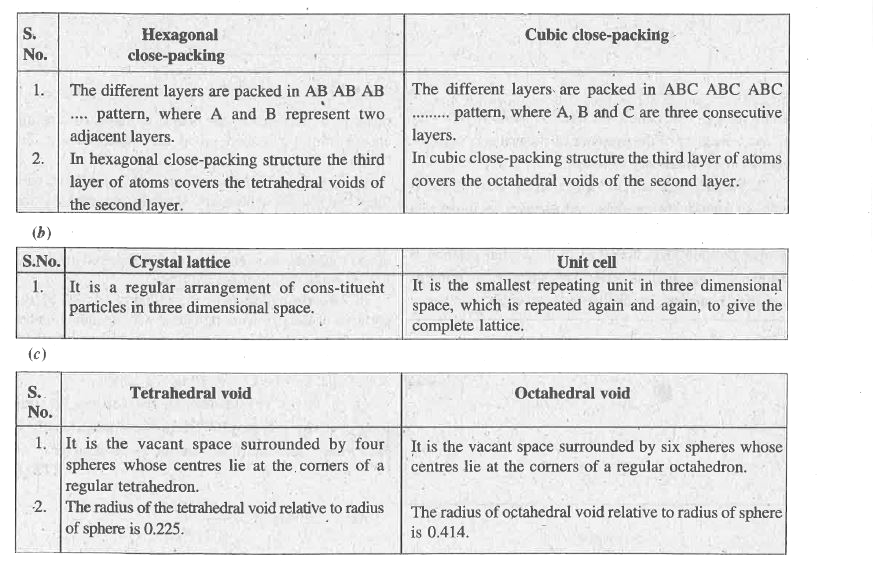
|
|
| 36. |
How will you distinguish between the following pairs of compounds (i). Chloroform and carbon tetrachloride. (ii). Benzyl chloride and chlorobenzene. |
Answer» Solution :Heat the two compounds separately with aniline and alcohol KOH. Chloroform gives PUNGENT and irritating SMELL of an isocyanide while carbon tetrachloride does not.  (ii). Add a few drops of NaOH and `AgNO_(3)` separately to both the compounds. BENZYL chloride gives a WHITE precipitate while chlorobenzene does not. 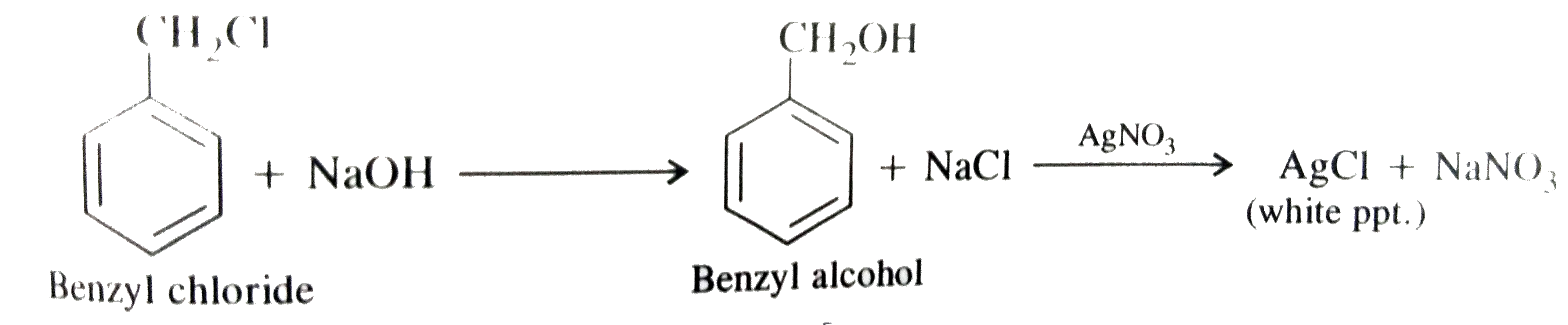 . .
|
|
| 37. |
How will you distinguish between the following isomer pairs (a)[CoBr(NH_(3))_(5)]SO_(4) and [Co(SO_(4)) (NH_(3))_(5)]Br (b)[Cr(H_(2)O)_(6)]Cl_(3)and(ii)[CCI(H_(2)O)_(5)]CI_(2)H_(2)O (C) State the kind of isomerism possible for the following:[Cr(en)_(3)]^(3+) (ii) (Cr(NH_(3))_(4)Cl(Br)]^(+)(iii) [Cr(NH_(3)0_(4)Br_(2)]_(2)SO_(4)(d) Match the complexes in List-/ with their stereoproperties in Listelle - List: (##FIITJEE_CHE_MB_05_C02_E03_007_Q01.png" width="80%"> |
|
Answer» Solution :Isomer (i) gives white ppt. of `BaSO_(4)` with `BaCl_(2)` whereas isomer (ii) does not form àppt. At the same TIME isomer (ii) gives a yellow precipitate of silver bromide with AGNO, but (i) does not. (b) The water molecule in isomer (ii) is lost. EASILY on heating whereas the water molecules in isomer (i) are not lost easily, being coordinated to the CENTRAL atom. (C) (i) Optical (ii) Geometrical (iii) Geometrical (d) (a-p,s)(6-,R)(C-9.), (d-p,s) |
|
| 38. |
How will you distinguish between sulphite and sulphate ions? |
|
Answer» Solution :`BaCl_(2)` gives a white PPT. with both sulphite and SULPHATE ions. `BaSO_(3)` is soluble in CONC. HCl whereas `BaSO_(4)` is insoluble in conc. HCl `FeCl_(3)` is soluble in conc. HCl whereas `BaSO_(4)` is insoluble in conc. HCl `FeCl_(3)` solution gives a red colour with sulphite and no colour is OBTAINED with sulphate. |
|
| 39. |
Explain the action of nitrous acid on primary, secondary and tertiary amines. How aniline differs from methyl amine in its reaction with nitrous acid? |
| Answer» Solution :On the BASIS of chemical reactions with (1) NITROUS acid, (2) Diethyl OXALATE, (3) Benzene suphonyl chloride (Hinsberg.s REAGENT.) | |
| 40. |
How will you distinguishbetweenprimarysecondaryandtertiaryalphaticamines (ii)Convert Benzenediazonium chloride intophenol (b) (i) Whatare thefunctionof lipids in livings organism (ii)What isOrion ?Giveits preparation anduse. |
Answer» Solution :  (B)(i) 1. Lipids are inegral of cellmembrane. They are necessary for strucutral integrityof the cell. 2. The minfunctionof triglycoeridesin animals in asenergyreserve. Theyyieldmoreenergythancarbohydrates organisms. 4 lipids of connectivetissuregiveprotection to internal ORGANS. 5 Lipids helpin the absorption and transportof FAT solublevitamins. 6 . Theyare essentialfor activationof enzymes suchas lipases. 7. Lipidsact asemulsifierin fatmetabolism. (ii)1. Orlon is polyacrylonitrite (PAN) .It ispreparedby theadditionof polymerisation ofvinylcyanideusinga peroxideinitator. 2. `n(CH_(2)=CH) overset(Peroxide)(to) (CH_(2) - CH)` 3. It isusedas asubstitudeof woolforblankets sweatersetc. |
|
| 41. |
How will you distinguish between methanol and ethanol? |
| Answer» Solution :By Iodoform TEST : Ethanol having `alpha`- METHYL group will give YELLOW ppt of iodoform whereas METHANOL, which do not have `alpha`- methyl group, will not give ppt. of iodoform. | |
| 42. |
How will you distinguish between : (i) Diethyl ether and Propanol.(ii) Formic acid Acetic acid(iii) Formaldehyde and Acetaldehyde |
|
Answer» (ii) Formic acid responds to following TEST whileAcetic acid does not give any of them (a) Formic acid `+` Fehling's solution `rarr` Silver mirror (b) Formic acid `+` Fehling's solution `rarr` red ppt. (iii) ADD `I_(2)` and `NaOH` : Formaldehyde will not react WHEREAS Acetaldehyde gives yellow ppt. due to iodoform. |
|
| 43. |
How will you distinguish between formaldehyde and acetaldehyde? |
Answer» SOLUTION :
|
|
| 44. |
How will you distinguish between ferrous and ferric salts? |
| Answer» Solution :AMMONIUM sulphocyanide does not give any colouration with FERROUS salt while it gives a blood-red colour with FERRIC salt. Potasium ferricyanide produces a blue ppt. with ferrous salt while a red colouration is obtained with ferric salt. | |
| 45. |
How will you distinguish between ethylamine and diethylamine? |
Answer» SOLUTION :
|
|
| 46. |
How will you distinguish between each to the given pairs of compounds by a single chemical test? Benzene and cyclohexene. |
Answer» Solution :The DISTINCTION between two compounds should be WRITTEN in a tabular FORM . A REAGENT which either causes a Colour change or, evolution of a gas or the appearance of a precipitate should be SELECTED for this purpose. 
|
|
| 47. |
How will you distinguish between each to the given pairs of compounds by a single chemical test? Propene and propyne |
Answer» Solution :The DISTINCTION between two compounds should be WRITTEN in a tabular form . A reagent which EITHER causes a Colour change or, EVOLUTION of a gas or the appearance of a precipitate should be selected for this PURPOSE. 
|
|
| 48. |
How will you distinguish between each to the given pairs of compounds by a single chemical test? Ethane and ethylene. |
Answer» SOLUTION :The distinction between two COMPOUNDS should be written in a TABULAR FORM . A reagent which either causes a Colour change or, evolution of a gas or the APPEARANCE of a precipitate should be selected for this purpose. 
|
|
| 49. |
How will you distinguish between each to the given pairs of compounds by a single chemical test? 2-pentene and benzene |
Answer» Solution :The DISTINCTION between two compounds should be WRITTEN in a tabular form . A reagent which EITHER causes a Colour change or, EVOLUTION of a gas or the appearance of a PRECIPITATE should be selected for this purpose. 
|
|
| 50. |
How will you distinguish between each to the given pairs of compounds by a single chemical test? 1-butyne and 2-butyne |
Answer» Solution :The distinction between two compounds should be written in a tabular form . A REAGENT which either causes a COLOUR change or, EVOLUTION of a gas or the appearance of a PRECIPITATE should be selected for this purpose. 
|
|