

Saved Bookmarks
This section includes 7 InterviewSolutions, each offering curated multiple-choice questions to sharpen your Current Affairs knowledge and support exam preparation. Choose a topic below to get started.
| 1. |
How will you convert benzaldehyde into the following compounds? (i) benzophenone , (ii) benzoic acid (iii)2 - hydroxyphenylaceticacid. |
Answer» SOLUTION :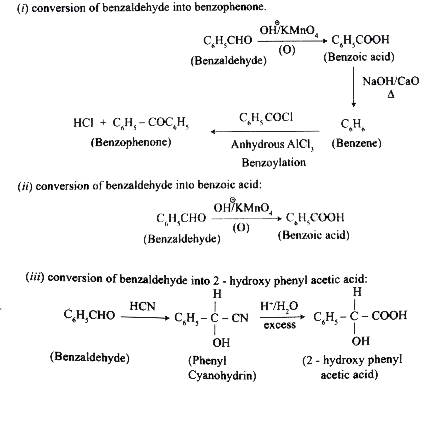
|
|
| 2. |
How will you convert : Aniline to sulphanilic acid? |
Answer» SOLUTION :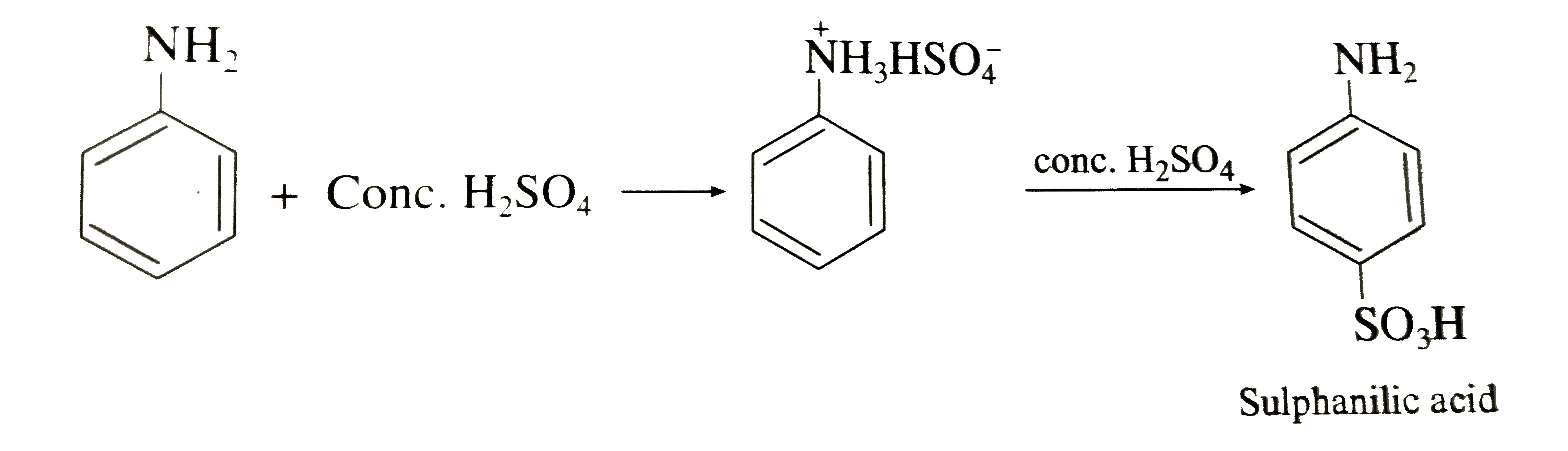
|
|
| 3. |
How will you convert benzaldehyde into the following compounds? (i) benzophenone (ii) benzoic acid (iii) 2-hydroxyphenylaceticacid. |
|
Answer» Solution :`{:(underset(("Benzaldehyde"))(C_(6)H_(5)CHO) underset((O))overset(OH^(ө)//KMnO_(4))RARR underset(("Benzoic acid"))(C_(6)H_(5)COOH)),(""darr underset(Delta)(NaOH//CaO)),(underset(("Benzophenone"))(HCl + C_(6)H_(5) - COC_(6)H_(5)) underset(underset("Benzoylation")("Anhydrous" AlCl_(3)))overset(C_(6)H_(5)COCl)rarr underset(("Benzene"))(C_(6)H_(6))):}` (ii) Conversion of benzaldehyde into benzoic acid: `underset(("Benzaldehyde"))(C_(6)H_(5)CHO) underset((O))overset(OH^(ө)//KMnO_(4))rarr underset(("Benzoic acid"))(C_(6)H_(5)COOH)` (iii) conversion of benzaldehyde into 2-hydroxy phenyl ACETIC acid: `underset(("Benzaldehyde"))(C_(6)H_(5)CHO) overset(HCN)rarr underset(("Phenyl Cyanohydrin"))(C_(6)H_(5) - underset(underset(OH)(|))overset(overset(H)(|))(C) - CN) underset("excess")overset(H^(+)//H_(2)O)rarr underset(("2-hydroxy phenyl acetic acid"))(C_(6)H_(5) - underset(underset(OH)(|))overset(overset(H)(|))(C) - COOH)` |
|
| 4. |
How will you convert aniline to chlorobenzene ? |
Answer» SOLUTION :
|
|
| 5. |
How will you convert aniline into nitrobenzene without the intermediacy of benzene? |
| Answer» Solution :`underset("ANILINE")(C_(6)H_(5)NH_(2)) underset(273-278K)overset(HNO_(2)//HBF_(4))to underset("BENZENEDIAZONIUM tetrafluroborate")(C_(6)H_(5)N_(2)^(+)BF_(4)^(-)) underset(Delta)overset(NaNO_(2)//Cu)to underset("Nitrobenzene")(C_(6)H_(5)NO_(2))` | |
| 6. |
How will you convert aniline into iodobenzene. |
| Answer» Solution :`underset("ANILINE")(C_(6)H_(5)NH_(2)) underset("273-278K (Diazotisation)")(NaNO_(2)//HCL) underset("Benzenediazonium chloride")(C_(6)H_(5) OVERSET(+)(N)-=NCl^(-)) underset(Delta)overset(Aq.KI)tounderset("Iodobenzene")(C_(6)H_(5)-I)` | |
| 7. |
How will you convert aniline (C_6H_5NH_2) to chlorobenzene? |
| Answer» SOLUTION :`(ANE_PKE_CHE_XII_C13_E02_021_S01.png" WIDTH="80%"> | |
| 8. |
How will you convert Aniline into Benzene diazonium chloride ? |
Answer» SOLUTION :
|
|
| 9. |
How will you convert an isocyanide into a secondary amine ? |
| Answer» Solution :`UNDERSET("isocyanide")underset("Alkyl")(RNC) + 4[H] OVERSET(Na//alc)tounderset("(SECONARY AMINE)")(RNHCH_3)` | |
| 10. |
How will you convert an amide into following? An amine with one carbon atom lesss than that of the amide. |
Answer» Solution :Reaction of an amide with bromine in presence of alkali gives a primary amine containing one carbon ATOM LESS than the amide.
|
|
| 11. |
How will you convert an amide into following? An amine containing the same number of carbon atoms as that in the amide. |
|
Answer» Solution :REDUCTION of an amide with `LiAlH_4` gives a primary AMINE CONTAINING the same NUMBER of carbo ATOMS `CH_3CONH_2overset(LiAlH_4)toCH_3CH_2NH_2` |
|
| 12. |
How will you convert an amide into an amine with the same number of carbon atoms? |
|
Answer» Solution :`LiAlH_(4)` reduction of `1^(@),2^(@) and 3^(@)` amides gives `1^(@),2^(@) and 3^(@)` amines containing the same number of CARBON atoms. For Example, `UNDERSET("Benzamide "(1^(@)" Amide"))(C_(6)H_(5)CONH_(2)) underset((ii)H_(2)O)overset((i)LiAlH_(4)//ether)to underset("Benzylamine "(1^(@)" Amine"))(C_(6)H_(5)CH_(2)NH_(2))` For `2^(@) and 3^(@)` amines. |
|
| 13. |
How will you convert an Alkyl halide into (i) alkane and (ii) alkyl nitrite ? |
|
Answer» Solution :(i) `underset("Alkyl halide")(R-CH_(2)-CH_(2)-X)+underset("alc")(KOH) overset(DELTA)to underset("ALKENE")(R-CH=CH_(2)+KX+H_(2)O)` (ii) `underset("Alkyl HALIDES")(R-X+ K^(+)O^(-)NO) underset(Delta)overset("Alc")to underset("Alkyl nitrite")(R-O-N=O+KX)` |
|
| 14. |
How will you convert an Alkyl halide into (i) an alcohol and (ii) alkyl isocyanide ? |
|
Answer» Solution :(i) `R-X+KOH_(aq) overset(Delta)to R-OH+KX` Alcohol (ii) `R-X+AgCN_((ALC))overset(Delta)to R-NC+AgX` ALKYL isocyanide |
|
| 15. |
How will you convert an alkyl halide into an ether? |
| Answer» Solution :`underset("halide")underset("ALKYL")(R-X)+underset("AL koxide")underset("SOD.")(NA^(+)-O^(-)-R.)overset("Ether")underset(Delta)RARR underset("Ether")(R-O-R.)+NaX`. | |
| 16. |
How will you convert: an alkyl halide into a primary amine having one more carbon than the alkyl halide used ? |
| Answer» SOLUTION :` RX +KCNto R - C -= Noverset(NI //H_2)toRCH_2 NH_2` | |
| 17. |
How will you convert an Alkyl halide (i) into ether and (i) into an Alkyl cyanide ? |
|
Answer» SOLUTION :(i) `RX+Na^(+)O^(-)R. underset(DELTA)overset("Ether")to R-O-R.+ "Nax Ether"` (ii) `R-X+KCN_((alc))overset(Delta)to RCN+KX`Alkyl cyanide |
|
| 18. |
How will you convert an alkyl halide(i) into an alcohol and (ii) into an alkyl cyanide ? |
|
Answer» Solution :(i) `UNDERSET("Alkyl halide")(RX)+ KOH_((AQ)) overset(Delta)to R-OH+ KX` (ii) `underset("Alkyl halide")(RX)+KCN underset(Delta)overset("Alc")to underset("Alkyl CYANIDE")(R-CN+KX)` |
|
| 19. |
How will you convert an acid into an ester without using an alcohol? |
|
Answer» Solution :By using diazomethane. `underset("Carboxylic acid")(RCOOH)+underset("Diazomethane")(CH_(2)N_(2)) OVERSET("DRY ether")to underset("METHYL ester")(RCOOCH_(3))+N_(2)`. |
|
| 20. |
How will you convert acetylene into n-butyl alcohol. |
Answer» SOLUTION :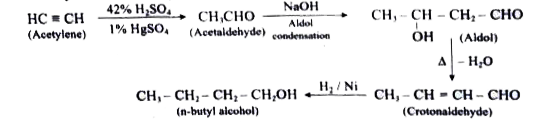
|
|
| 21. |
How will you convert acetone to 2-methyl-2- propanol ? |
Answer» SOLUTION :
|
|
| 22. |
How will you convert acetone into tertiary butyl alcohol> |
Answer» SOLUTION : 
|
|
| 23. |
How will you convert : Acetylene into acetaldehyde |
Answer» SOLUTION :
|
|
| 24. |
How will you convert acetone into 2-methyl-2-propanol? Or how is tert-butyl alcohol obtained from acetone? |
Answer» Solution :By REACTION of ACETONE with `CH_(3)MgBr` FOLLOWED by hydrolysis. 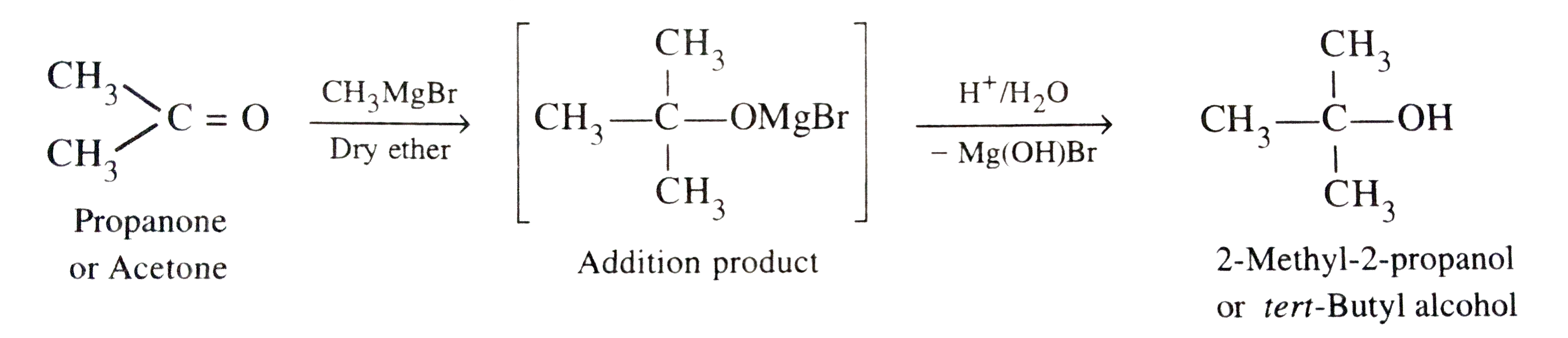
|
|
| 25. |
How will you convert Acetic acid to methyl amine. |
| Answer» SOLUTION :`CH_3COOH overset(NH_3)rarrCH_3COONH_4 overset(Delta)UNDERSET(-H_2O)RARR CH_3CONH_2 overset(NaOBr)rarrCH_3NH_2` | |
| 26. |
How will you convert Acetaldehyde to methane. |
| Answer» Solution :`CH_3CHO overset(O)underset(Cr_2O_3)RARR CH_3COOH overset(NAOH)rarr CH_3COONa overset(SODALIME)underset(Delta)rarrCH_4` | |
| 27. |
How will you convert acetaldehyde to methane ? |
| Answer» Solution :`underset("Acetaldehyde")(CH_(3)CHO)overset(O)to CH_(3)COOH overset(NAOH)to CH_(3)COONS underset(CaO)overset(NaOH)to underset("Methane")(CH_(4))` | |
| 28. |
How will you convert 4-nitrotoluene to 2-bromobenzoic acid? |
Answer» SOLUTION :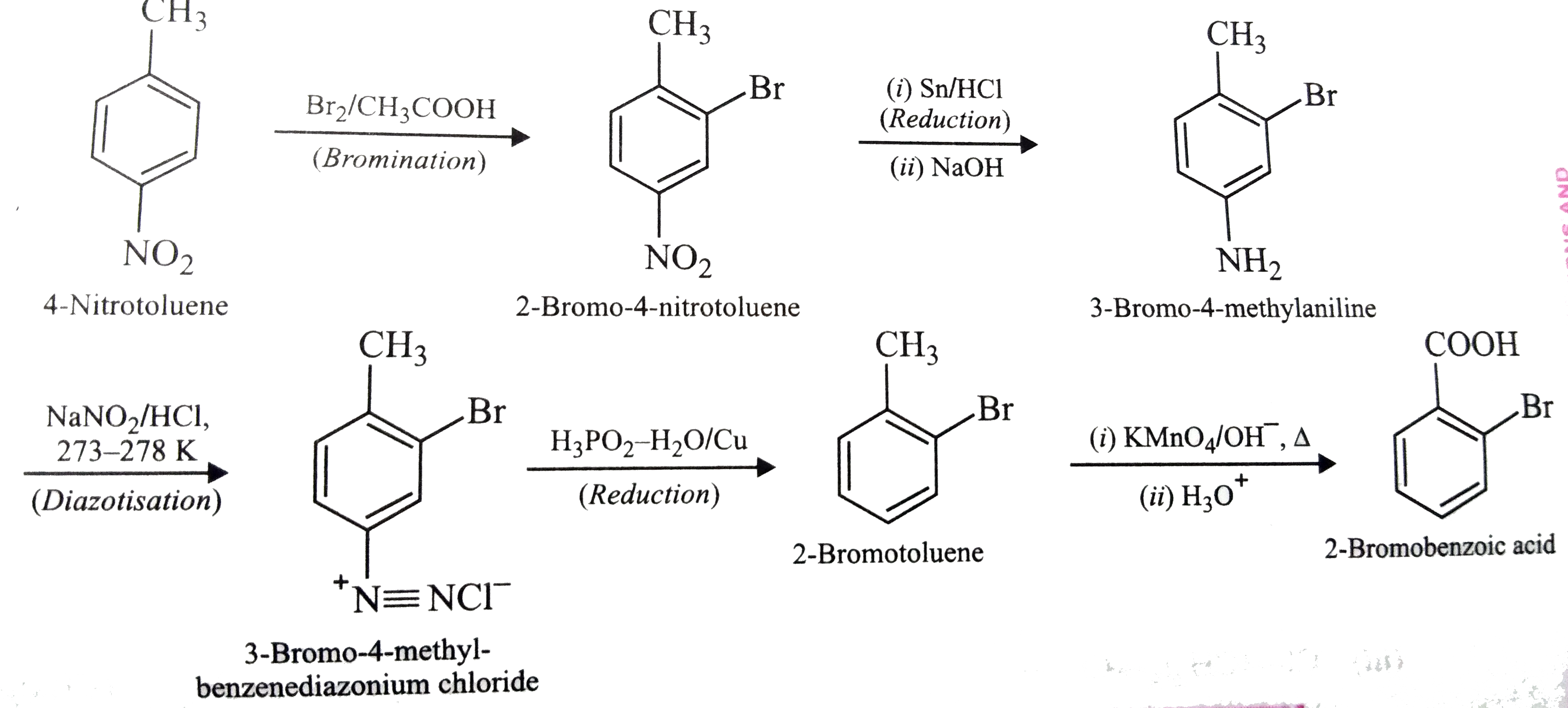
|
|
| 29. |
How will you convert 4-nitrotoluene to 2-bromobenzoic acid ? |
Answer» SOLUTION :
|
|
| 30. |
How will you convert: a carboxylic acid to a primary amine having one carbon atom less than the carboxylic acid itself? |
| Answer» SOLUTION :`RCOOH overset(NH_3 (AQ))to RCOONH_4 overset(Delta ) to RCONH_2 overset(KOH +Br_2)to RNH_2 ` | |
| 31. |
How will you convert 4 nitrotoluene to 2 - bromobenzoic acid ? |
Answer» SOLUTION :
|
|
| 32. |
How will you classify polymers on the basis of molecular forces? |
| Answer» Solution :ELASTOMERS, fibres, THERMOPLASTICS, THERMOSETTING POLYMERS. | |
| 33. |
How will you carry out the following transformations: (xii) ethanol to but-1-yne |
| Answer» Solution :`underset("Ethanol")(C_(2)H_(5)OH)underset("PYRIDINE")overset(SOCl_(2))(rarr)underset("CHLOROETHANE")(CH_(3)CH_(2)CL)overset(HC-=bar(C)overset(+)(N)a)(rarr)underset("But-1-yne")(CH_(3)CH_(2)-=CH)` | |
| 34. |
How will you carry out the following transformations: (xi) chlorobenzeneto DDT |
Answer» SOLUTION :
|
|
| 35. |
How will you carry out the following transformations: (vii) but-1-ene to n-butyl iodide. |
Answer» SOLUTION :
|
|
| 36. |
How will you carry out the following transformations: "Acetylene"to"Dideuteroacetylene" (C_2D_2) |
Answer» SOLUTION :
|
|
| 37. |
How will you carry out the following transformations: (iv) toluene to benzyl alcohol. |
Answer» SOLUTION :
|
|
| 38. |
How will you carry out the following conversions? (iv) CH_3COOHrarrCH_3CO-O-CO-CH_3 (acetic anhydride) |
|
Answer» `CH_3-COOHoverset(con.H_2SO_4//Delta)rarrCH_3-CO-O-CO-CH_3` |
|
| 39. |
How will you carry out the following reaction? Hoffmann bromamide reaction |
| Answer» SOLUTION :Amides when treated with BROMINE and NAOH solution gives primary amines with ONE carbon less. This reaction is called HOFFMANN bromamide reaction. | |
| 40. |
How will you carry out the following conversions? (i) Toluene top-toluidine (ii) p-toluidinediazonium chloridetop-toluic acid. |
Answer» SOLUTION :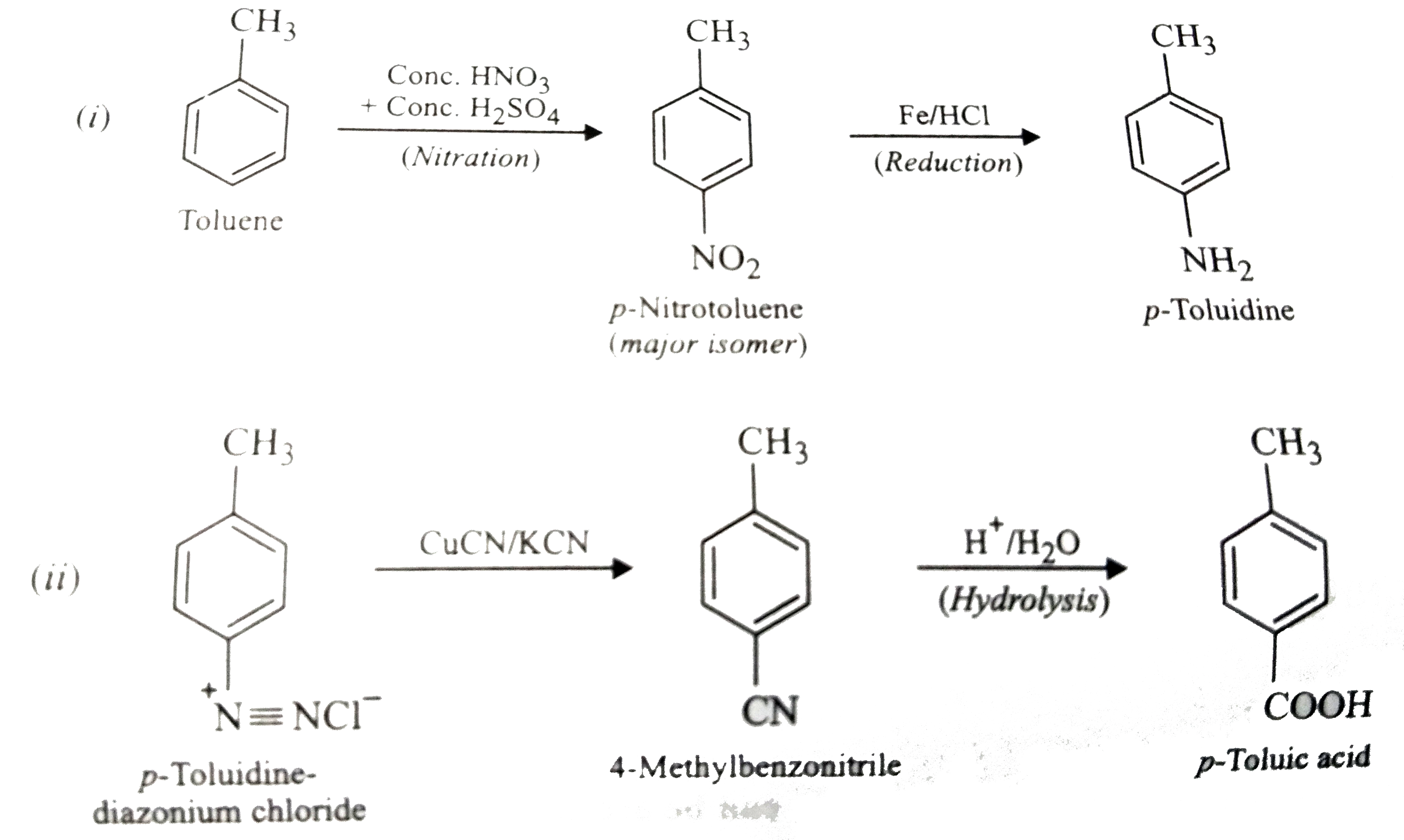
|
|
| 41. |
How will you carry out the following conversion? CH_3CH_2COOHrarrCH_3CH_2CH_2OH |
|
Answer» `CH_3-CH_2-COOHrarrCH_3-CH_2-CH_2-OH` |
|
| 42. |
How will you carry out following conversions : (a) Ethyl alcohol to ethylene glycol (b) 2-Propanol to 1- bromopropane? |
|
Answer» SOLUTION :(a) `underset("Ethyl alcohol")(C_(2)H_(5)OH)overset("conc. "H_(2)SO_(4))underset("443 K")rarrunderset(CH_(2))underset("||")(CH_(2))+H_(2)O+[O] overset("ALKALINE")underset(KMnO_(4))rarr underset("Ethylene glycol")({:(CH_(2)OH),(|),(CH_(2)OH):}` (B) `underset("2 - Propanol")(CH_(3)-underset(OH)underset("|")"CH"-CH_(3))overset("conc. "H_(2)SO_(4))underset(Delta)rarrunderset("Propene")(CH_(3)-CH=CH_(2))overset(HBr)underset(underset(underset("addition")("Anti Markovnikov"))("Benzoyl peroxide"))rarrunderset("1-Bromopropane")(CH_(3)-CH_(2)-CH_(2)Br)` |
|
| 43. |
How will you carry out the following conversions ? (i) Acetylene to acetic acid (ii) Toluene to m-nitro benzoic acid. |
Answer» SOLUTION :(i) `CH-=HCHunderset(Hg^(2+))overset("Dil"H_(2)SO_(4))(to)CH_(2)=CH-OH overset("TAUTOMERIZATION")(to)CH_(3)COOHunderset(H_(2)SO_(4))overset(K_(2)Cr_(2)O_(7))(larr)CH_(3)CHO` 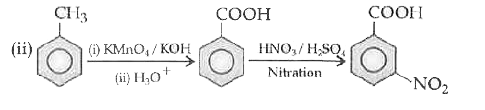
|
|
| 44. |
How will you calculate the reduction potential of Half cell? |
Answer» Solution :(i) Consider the zinc electrode DIPPED in zinc sulphate solution using SHE 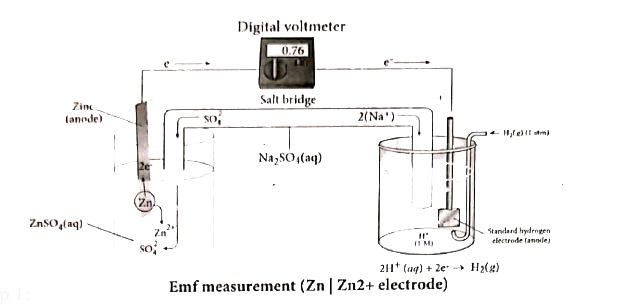 (ii) Step 1 : The following galvanic cell is constructed using SHE `Zn_((s))|Zn_((aq.1M))^(2+)||H_((aq.1M))^(+)|H_(2(g, 1 atm))|Pt_((s))` (iii) Step 2: The EMF of the above galvanic cell is measured using a voltmeter. In this case the measured emf of the above galvanic cell is 0.76 V . (iv) Calculation: We know that, `E_("cell")^(@) = (E_("ox")^@)_(Zn//Zn^(2+)) + (E_("red")^(@))_(SHE)` `:. E_("cell")^(@) = 0.76 + 0V` `= 0.76 V` The oxidation potential corresponds to the below mentioned half cell reaction which takes place at the cathode. `Zn to Zn^(2+) + 2e^(-)` (oxidation) (v) The emf of the reverse reaction will give the REDUCTION potential `Zn^(2+) + 2e^(-) to Zn "" (E_("cell")^@)_(Zn^(2+)|Zn) = - 0.76V` |
|
| 45. |
How will you calculate solubility product of AgCl which is a sparingly soluble salt? |
|
Answer» Solution :Substances like AgCl, `PbSO_(4)` etc., are sparingly soluble in water. The solubility product of such substances can be determined using conductivity measurements. Let us consider AgCl as an example `AgCl iff Ag^(+)+Cl^(-)` `K_(SP)=[Ag^(+)][Cl^(-)]` Let the CONCENTRATION of `[Ag^(+)]` be .C. mol `L^(-1)`. As per the stoichiometry, if `[Ag^(+)]=C`, then `[Cl^(-)]` ALSO equal to .C. mol `L^(-1)`. `K_(sp)=C.C` `rArr K=C^(2)` We know that the concentration (in mol `dm^(-3)`) is related to the MOLAR and specific conductance by the following expressions `""wedge_(0)=(kappa times 10^(-3))/(C("in mol "L^(-1)))` `""` (or) `""C=(kappa times 10^(-3))/wedge` Substitute the concentration value in the relation `K_(sp)=C^(2)` `""K_(sp)=((kappatimes 10^(-3))/wedge)^(2)` |
|
| 46. |
How will you calculate solubility product from molar solubility ? |
|
Answer» Solution :Solubility can be calculated from the molar solubility i.e., the maximum number of moles of SOLUTE that can be dissolved in one litre of the solution. For a solute `X_m Y_n` `X_(m)Y_(n(s)) hArr mX_((aq))^(n+)+nY_((aq))^(m-)` From the above stoichiometrically balanced EQUATION we have come to KNOW that 1 mole of `X_(m)Y_(n(s))` dissociated to furnish 'm' moles of `X^(n+)` and 'n' mole of `Y^(m-)` if's' is molar solubility of `X_(m)Y_(n)`, then `[X^(n+)]=ms and [Y^(m-)]=ns` `therefore K_(sp)=[X^(n+)]^(m)[Y^(m-)]^n` `K_(sp)=(ms)^m (ns)^n` `K_(sp)=(m)^m (n)^n (s)^(m+n)` |
|
| 47. |
How will you calculate degree of dissociation of weak electrolytes and dissociation constant using Kohlrausch's law? |
|
Answer» Solution :(i) The degree of dissociation of weak electrolyte can be calculated from the molar CONDUCTIVITY at a given concetration and the molar conductivity in INFINITE dilution USING the formula `alpha = (Lambda_m)/(Lambda_m^@)` (ii) According to Ostwald.s dilution LAW, `K_a = (alpha^2 C)/(1 - alpha)` Substituting `alpha` value in the above equation `K_a = (Lambda_m^2.C)/(Lambda_m^2 [1 - (Lambda_m)/(Lambda_m^@)]) implies K_a = (Lambda_m^@ C)/(Lambda_m^(@2).((Lambda_m^@ - Lambda_m)/(Lambda_m)) implies k_a = (Lambda_m^2 C)/(Lambda_m^@(Lambda_m^@ - Lambda_m))` . |
|
| 48. |
How will you calculate degree of dissociation of weak electrolytes and dissociation constant using Kohlrausch’s law? |
|
Answer» SOLUTION :(i) The degree of dissociation of weak electrolyte can be calculated from the MOLAR conductivity at a GIVEN concentration and the molar conductivity in infinite dilution USING the formula `alpha = (wedge_(m))/(wedge_(m)^(@))` (ii) According to Ostwald.s dilution law `K_(a) =(alpha^(2)C)/(1-alpha)` Substituting `alpha` value in the above equation `K_(a) = (wedge_(m)^(2).C)/(wedge_(m)^(2).[1-(wedge_(m))/(wedge_(m)^(@))])` `rArr K_(a) =(wedge_(m)^(2)C)/(wedge_(m)^(@).(wedge_(m)^(@)-wedge_(m))` |
|
| 49. |
How will you bring out following conversions involving three steps at most? |
Answer» Solution :(a) and (B) are SIMPLY Hofmann bromamide reactions (C ) is SIMPLE reduction with Na/alcohol or with `LiAlH_(4)`. 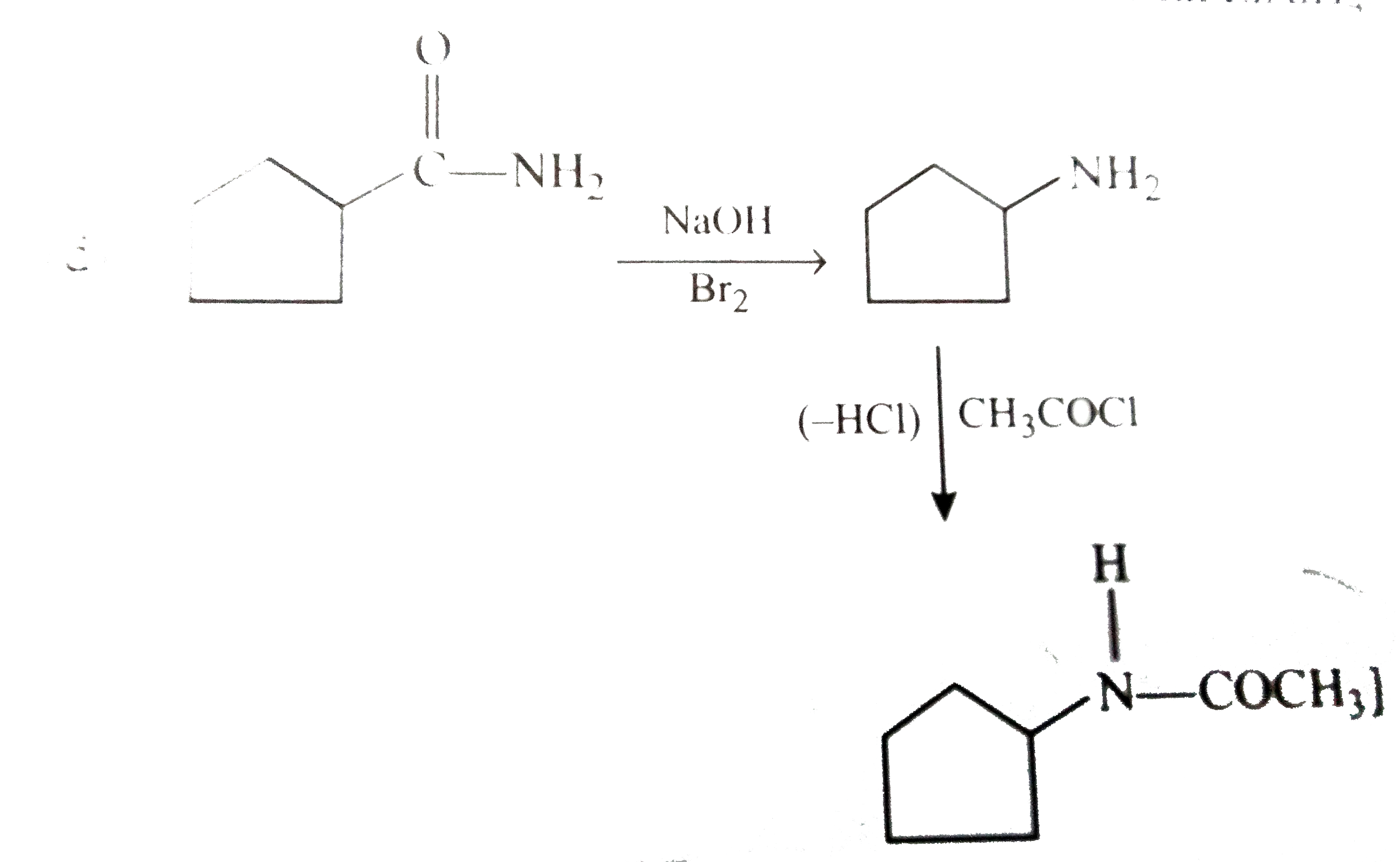
|
|
| 50. |
How will you bring about the following conversions? (Write the chemical equations) (iii) benzoic acid to Benzaldehyde |
|
Answer» |
|