

Saved Bookmarks
This section includes 7 InterviewSolutions, each offering curated multiple-choice questions to sharpen your Current Affairs knowledge and support exam preparation. Choose a topic below to get started.
| 1. |
Howwill you bring about the following conversions ? Toluene to benzyl alcohol |
Answer» SOLUTION :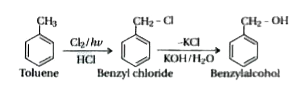
|
|
| 2. |
How will you bring about the following conversions? (Write the chemical equations) (i) Ethonal to ethene |
|
Answer» |
|
| 3. |
How will you bring about the following conversions ? Toluene to benzyl alcohol . |
Answer» SOLUTION :
|
|
| 4. |
How will you bring about the following conversions? (Write the chemical equations) (ii) Benzamide |
|
Answer» |
|
| 5. |
Howwill you bring about the following conversions ? Propene to propyne |
Answer» SOLUTION :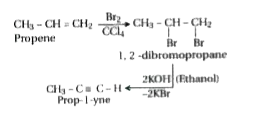
|
|
| 6. |
How will you bring about the following conversions ? Propene to propyne . |
| Answer» Solution :`underset("Propene") (CH_(3) - CH = CH_(2)) overset(Br_(2)//C Cl) to CH_(3) underset("1,2 - Dibromopropane")(-underset(BR)underset(|)CH -underset(Br) underset(|)CH_(2))underset(-2HBr) overset(NaNH_(2)//liq.NH_(3)//196 K " or alc." KOH)to underset("Propyne") (CH_(3) - C -= CH ) ` | |
| 7. |
Howwill you bring about the following conversions ? Propene to 1-nitropropane |
Answer» SOLUTION :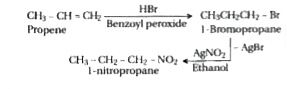
|
|
| 8. |
How willyou bring about the following conversions in not more than two steps ? (i) Propanone to Propene (ii) Benzoic acid to Benzaldehyde (iii) Ethanol to 3 - Hydroxybutanal (iv) Benzene to m - Nitroacetophenone (v) Benzaldehyde to Benzophenone (vi) Bromobenzene to 1 - Phenylethanol (vii) Benzaldehyde to 3 - Phenylpropan -1- ol (viii) Benzaldehyde to alpha- Hydroxyphenylacetic acid (ix) Benzoic acid to m - Nitrobenzyl alcohol. |
|
Answer» Solution :(i) Propanone to Propene : `underset("Propanone")(CH_(3)-overset(O)overset(||)C-CH_(3))overset(NaBH_(3))rarr underset("Propan -2- ol")(CH_(3)-overset(OH)overset("|")"CH"-CH_(3))overset("conc. "H_(2)SO_(4))underset(443K)rarr underset("Propene")(CH_(3)-CH=CH_(2))` (ii) Benzoic acid to Benzaldehyde :  (iii) Ethanol to 3 - Hydroxybutanal : `underset("Ethanol")(CH_(3)CH_(2)OH)overset("PCC")underset(underset("chlorochromate")("Pyridinium"))rarr underset("Ethanal")(CH_(3)CHO) underset(underset("CONDENSATION")underset("Aldol"))overset("Dil. NaOH")rarr underset("3 - Hydroxybutanal")(CH_(3)-overset(OH)overset("|")"CH"-CH_(2)CHO)` (iv) Benzene to m - Nitroacetophenone :  (v) Benzaldehyde to Benzophenone : `underset("Benzaldehyde")(C_(6)H_(5)CHO)+[O] overset(K_(2)Cr_(2)O_(7))underset(H_(2)SO_(4))rarr underset("Benzoic acid")(C_(6)H_(5)COOH)overset(SOCl_(2))rarr C_(6)H_(5)COCl overset(C_(6)H_(6))underset("ANHY. "AlCl_(3))rarr underset("Benzophenone")(C_(6)H_(5)COC_(6)H_(5))` (vi) BROMOBENZENE to1 - Phenylethanol :   (viii) Benzaldehyde to `alpha-` Hydroxyphenylacetic acid : `underset("Benzaldehyde")(C_(6)H_(5)CHO)+HCNrarr underset("cyanohydrin")underset("Benzaldehyde")(C_(6)H_(5)-overset(OH)overset("|")"CH"-CN)overset(H^(+)//H_(2)O)underset("Hydrolysis")rarrunderset("(Mendelic acid)")underset("acetic acid")underset(alpha- "hydroxyphenyl")(C_(6)H_(5)-overset(OH)overset("|")"CH"-COOH)` (ix) Benzoic acid to m - Nitrobenzyl alcohol : 
|
|
| 9. |
How will you bring about the following conversions ? Propene to 1- nitropropane . |
| Answer» Solution :`underset("Propene")(CH_(3)- CH = CH_(2)) underset("Anti-Markovnikov addition ")overset("HBR, PEROXIDE ") to underset("1-Bromopropane") (CH_(3) - CH_(2) - CH_(2) BR )underset(-AG Br) overset(AgNO_(2) , C_(2)H_(5)OH//H_(2)O)to underset("1-Nitropropane")(CH_(3)CH_(2)CH_(2)NO_(2)) ` | |
| 10. |
How will you bring about the following conversions? (iii) propene to 1-nitropropane. |
Answer» SOLUTION :
|
|
| 11. |
How will you bring about the following conversions? (ii) Benzoic acid to Benzamide |
|
Answer» |
|
| 12. |
How will you bring about the following conversions? (i) Ethanol to but-1-yne (ii) Ethane to bromoethene (iii) Propene to 1-nitropropane (iv) Toluene to benzyl alcohol (v) Propene to propyne (vi) Ethanol to ethyl fluoride (vii) Bromomethane to propanone (viii) But-1-ene to but-2-ene (ix) 1-Chlorobutane to n-octane (x) Benzene to biphenyl. |
Answer» SOLUTION :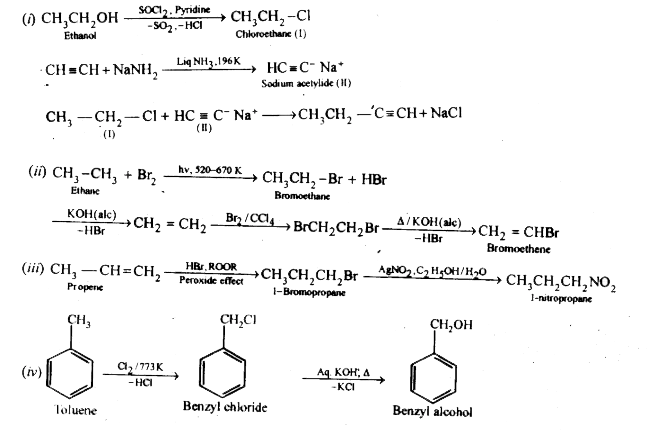 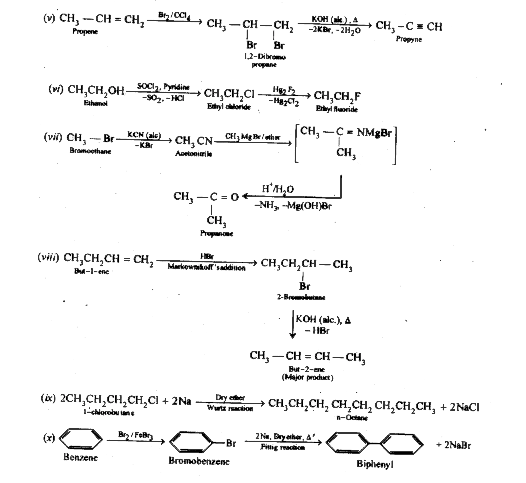
|
|
| 13. |
How will you bring about the following conversions : (i) Methyl iodide to methyl ethyl ether "" (ii)n Ethylene to divinyl ehter (iii) Dimethyl ether to diethyl ether "" (iv) Ethyl iodide to diethy ether (v) Propan-1-ol to -1- propoxypropane. |
Answer» SOLUTION :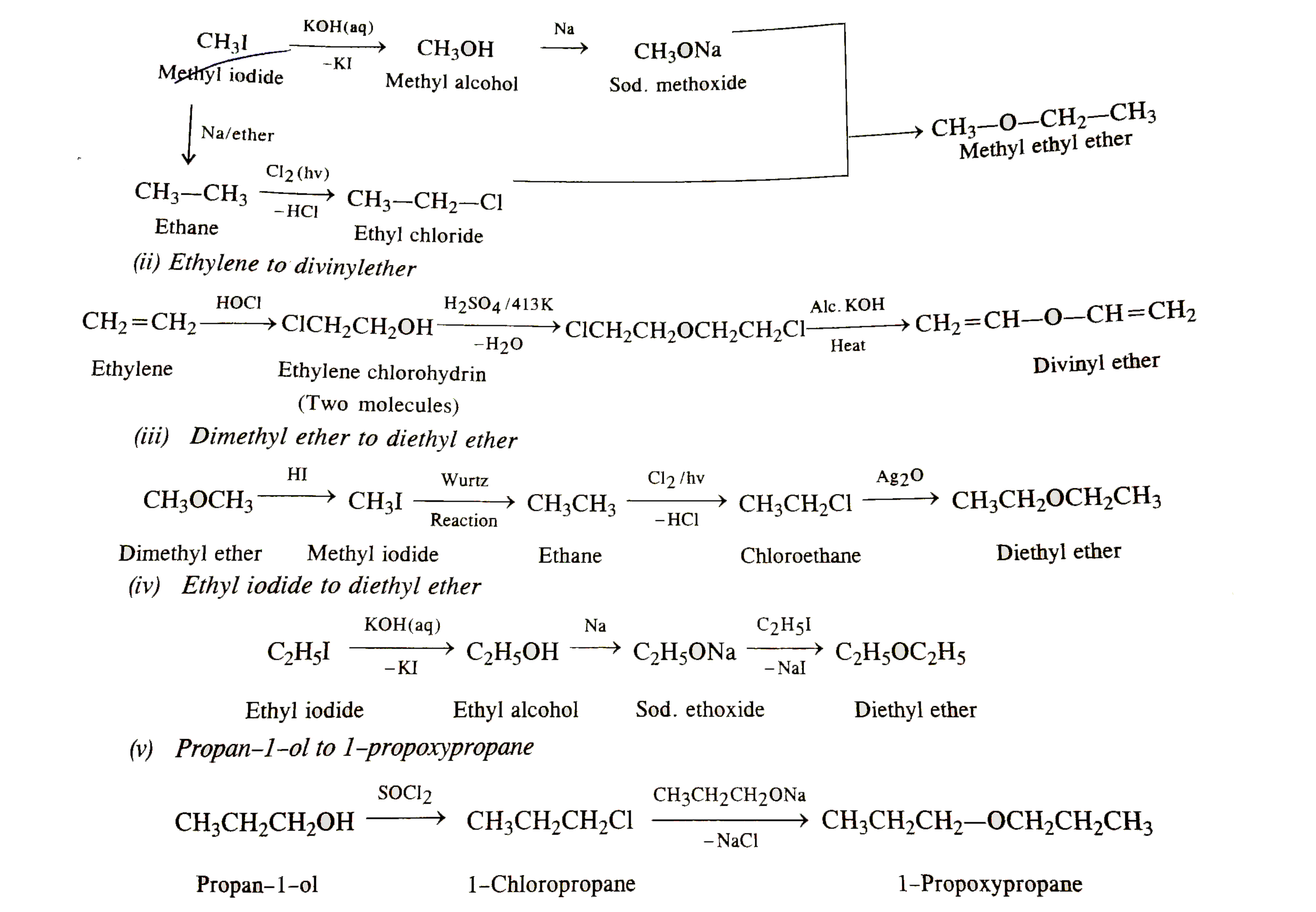
|
|
| 14. |
How will you bring about the following conversions? (i) Toluene into Benzaldehyde |
|
Answer» `(##ANE_PKE_CHE_XII_C12_E02_092_S01##)` |
|
| 15. |
How will you bring about the following conversions (i) Propene into Isopropyl bromide (ii) Propene into n-propyl bromide. |
|
Answer» Solution :(i) `UNDERSET("Propene")(CH_(5)CH)= CH_(2)+HBr to underset("Isopropyl bromide")(CH_(3)- underset(BR)underset(|)CH-CH_(3))` (II) `CH_(3)-CH= CH_(2)+HBr underset("(BENZOYL peroxide)")overset("Organic peroxide")to underset("n-Propyl bromide")(CH_(3)-CH_(2)-CH_(2)-Br)` |
|
| 16. |
How will you bring about the following conversions? (i) Ethanol to but-1-yne (ii) Ethane to bromoethene (iii) propene to 1-nitropropane (iv) toluene to benzyl alcohol (v) Propene to propyne (vi) Ethanol to ethyl fluoride (vii) Bromomethane to propanone (viii) But-1-ene to but-2-ene (ix) 1-Chlorobutane to n-octane. (x) Benzene to biphenyl. |
Answer» Solution :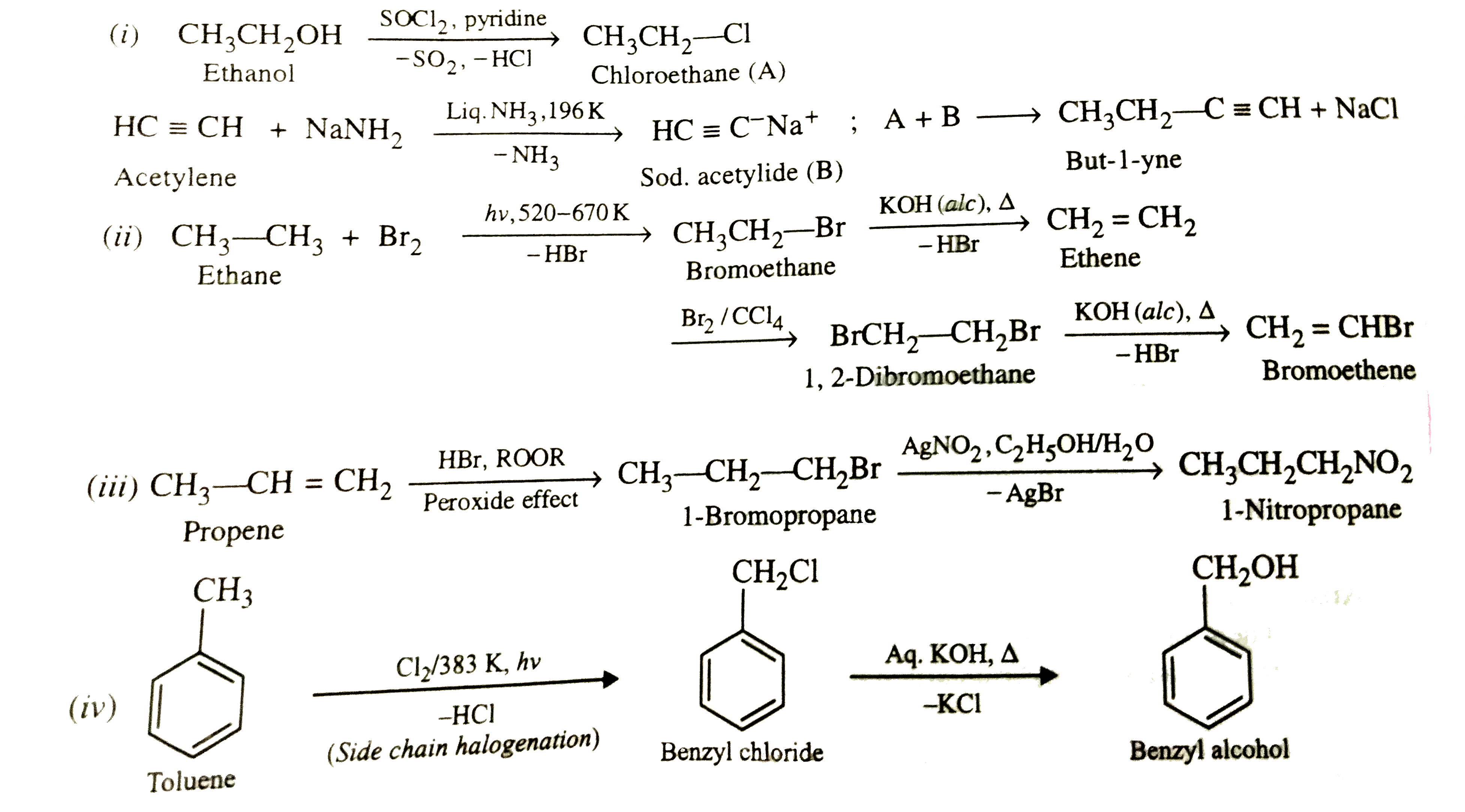 (v) `underset("Propene")(CH_(3)-CH=CH_(2)) OVERSET(Br_(2)//C Cl_(4))to underset("1,2-Dibromopropane")(CH_(3)-underset(Br)underset(|)(C)H-underset(Br)underset(|)(C)H_(2)) underset(-2" HBr")overset(NaNH_(2)//liq.NH_(3),196K)to underset("Propyne")(CH_(3)-C-=CH)` Alternatively, conversion of 1,2-dibromopropane to propyne can be carried out simply by heating with KOH (alc.) but he YIELD is low. the reason being that 1,2-dihaloalkanes can be SMOOTHLY dehydrohalogenated to vinyl HALIDES by heating with KOH (alc.), but vinyl halides being less reactive requrie a much stronger base such a `NaNH_(2)//liq`. `NH_(3)` for dehydrohalogenation to form alkynes. both these steps, can, however, be smoothly carried out simultaneously with `NaNH_(2)//liq.NH_(3)`. (vi) `underset("Ethanol")(CH_(3)CH_(2)OH) underset(-SO_(2),-HCl)overset(SOCl_(2)," pyridine")to underset("Ethyl chloride")(CH_(3)CH_(2)-Cl) underset(-Hg_(2)Cl_(2))overset(Hg_(2)F_(2))to underset("Ethyl fluoride")(CH_(3)CH_(2)-F)` (vii) `underset("Bromomethane")(CH_(3)-Br) underset(C_(2)H_(5)OH-H_(2)O,Delta)overset(KCN(alc))to underset("Acetonitrile")(CH_(3)-CN) overset(CH_(3)MgBr//ether)to [CH_(3)-underset(CH_(3))underset(|)(C)=NMgBr]underset(-NH_(3),-Mg(OH)Br)overset(H^(+)//H_(2)O)to underset("Propyne")(CH_(3)-underset(CH_(3))underset(|)(C)=O)` Alternatively, `underset("ACETYLENE")(HC-=CH) underset(-NH_(3))overset(NaNH_(2)" in liq. "NH_(3),196K)to underset("Sod. acetylide")(HC-=C^(-)+Na^(+)) underset(-NaBr)overset(CH_(3)Br)to underset("Propyne")(CH_(3)-C-=CH) underset(("Addn. of "H_(2)O))overset("Dil. "H_(2)SO_(4),HgSO_(4),333K)to underset("Propanone")(CH_(3)-overset(O)overset(||)(C)-CH_(3))` (viii) `underset("But-1-ene")(CH_(3)CH_(2)CH=CH_(2)) underset("Mark. addn.")overset(HBr )to underset("2-Bromobutane")(CH_(3)-CH_(2)-underset(Br)underset(|)(C)H-CH_(3))underset(-HB r)overset(KOH(alc.),Delta)to underset("But-2-ene (Major product)")(CH_(3)-CH=CH-CH_(3))` (ix) `underset("1-Chlorobutane")(2CH_(3)CH_(2)CH_(2)CH_(2)Cl+2Na) underset(("Wurtz reaction"))overset("Dry ether")to underset("n-Octane")(CH_(3)CH_(2)CH_(2)CH_(2)-CH_(2)CH_(2)CH_(2)CH_(3)+2NaCl)` 
|
|
| 17. |
How will you bring about the following conversions? (i). Ethanol to but-1-yne (ii). Ethane to bromoethane (iii). Propene to 1-nitropropane (iv). Toluene to benzyl alcohol (v). Propene to propyne (vi). Ethanol to ethyl fluoride (vii). Bromomethane to propanone (viii). But-1-ene to but-2-ene (ix). 1-Chlorobutane to n-octane (x). Benzene to biphenyl. |
Answer» SOLUTION :
|
|
| 18. |
How will you bring about the following conversions ? Ethanol to ethyl fluoride . |
| Answer» Solution :`underset ("Ethanol") (CH_(3)CH_(2)OH) underset(-SO_(2) ,-HCl) overset(SOCl_(2) , " PYRIDINE") tounderset("Ethyl chloride") (CH_(3)CH_(2) - CL) overset(AGF) to underset("Ethyl fluoride") (CH_(3)CH_(2) - F) ` | |
| 19. |
Howwill you bring about the following conversions ? Ethanol to ethyl fluoride |
Answer» SOLUTION :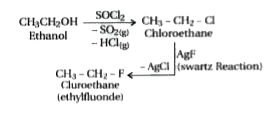
|
|
| 20. |
Howwill you bring about the following conversions ? Ethanol to but-1-yne |
| Answer» SOLUTION :`UNDERSET("Ethanol")(CH_(3)CH_(2)OH)overset(" RED P ")underset(I_(2))rarr underset("Ethyliodide ")(CH_(3)CH_(2)I)overset(HC-=C^(Θ)Na^(+))underset(-NaI)rarr underset("But-1-yne")(CH_(3)CH_(2)C-=CH)` | |
| 21. |
How will you bring about the following conversions ? Ethanol to but -1- yne . |
|
Answer» SOLUTION :`underset("ETHANOL ") (CH_(3)CH_(2)OH) underset(-SO_(2) - HCL) overset(SOCl_(2), " pyridine ")to underset("Chloroethane ") (CH_(3)CH_(2) - Cl) ` `underset("Acetylene ")(HC -=CH + NaNH_(2)) underset(-NH_(3))overset(Liq. NH_(3) , 196 K) to underset("SODIUM acetylide ") (HC -= C^(-)NA^(+)) CH_(3)CH_(2)Cl + Na^(+)C^(-) -= CH to underset("But -1-yne")(CH_(3)CH_(2) - C ) -= CH + NaCl ` |
|
| 22. |
Howwill you bring about the following conversions ? Ethane to bromoethene |
Answer» SOLUTION :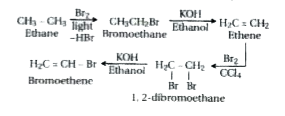
|
|
| 23. |
Howwill you bring about the following conversions ? But-1-ene to but-2-ene |
| Answer» SOLUTION :`UNDERSET("But-1-ene")(CH_(3)-CH_(2)-CH=CH_(2))overset(HBr)rarr underset("2-Bromobutane")(CH_(3)-CH_(2)-underset("BR ")underset("| ")("C ")H-CH_(3))` | |
| 24. |
How will you bring about the following conversions ? Ethane to bromoethene . |
| Answer» SOLUTION :`underset("Ethane ")(CH_(3) - CH_(3) + Br_(2)) underset(-HBr)overset(hv, 520 - 670 K) to underset("BROMOETHANE ")(CH_(3)CH_(2) - BR ) underset(-HBr)overset(KOH("alc."), Delta ) to underset("Ethene") (CH_(2) = CH_(2)) overset(Br_(2)//C Cl_(4)) to underset("1,2, - DIBROMOETHANE") (BrCH_(2) - CH_(2)Br) underset(-HBr) overset(KOH("alc."), Delta ) to underset("Bromoethene") (CH_(2) = CHBr) ` | |
| 25. |
How will you bring about the following conversions ? But -1- ene to but -2- ene . |
| Answer» SOLUTION :`underset("But -1-ene") (CH_(3)CH_(2)CH = CH_(2)) underset("Markovnikov addition") overset(HBr) to CH_(3)_ underset("2 - BROMOBUTANE") (CH_(2) - underset(Br)underset(|)CH - CH_(3)) underset(-HBr) overset(KOH (alc.), DELTA)to underset("(Saytzef Rule)")underset("(MAJOR PRODUCT)")underset("But -2-ene") (CH_(3) - CH = CH - CH_(3)) ` | |
| 26. |
Howwill you bring about the following conversions ? Bromomethane to propanone |
Answer» SOLUTION :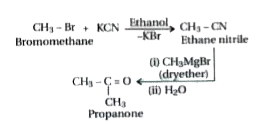
|
|
| 27. |
How will you bring about the following conversions ? Bromomethane to propanone . |
| Answer» Solution :`underset("Bromomethane") (CH_(3) - Br) underset(C_(2)H_(5)OH - H_(2) O, Delta) OVERSET(KCN (ALC.)) to underset("Acetonitrile") (CH_(3) - CN)overset(CH_(3)MgBr//"ether") to[CH_(3) - underset(CH_(3))underset(|)C = NMgBr] underset(-NH_(3) - Mg(OH)Br) overset(H^(+)//H_(2)O) to CH_(3) - underset("Propanone") underset(CH_(3))underset(|)C = O ` | |
| 28. |
Howwill you bring about the following conversions ? Benzene to biphenyl. |
Answer» SOLUTION :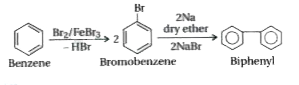
|
|
| 29. |
How will you bring about the following conversions ? Benzene to biphenyl . |
Answer» SOLUTION :
|
|
| 30. |
How will you bring about the following conversions: Acetylene to acetaldehyde |
|
Answer» Solution :Acetylene to acetaldehyde `OVERSET(CH)overset(|||)(CH)+H_(2)O underset(1% HgSO_(4))overset(40%H_(2)SO_(4))to underset("Vinyl ALCOHOL")([overset(CH-OH)overset(||)(CH_(2))]) overset("TAUTOMERISATION")to underset("Acetaldehyde")(CH_(3)-CHO)` |
|
| 31. |
Howwill you bring about the following conversions ? 1-Chlorobutane to n-octane |
Answer» SOLUTION :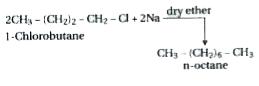
|
|
| 32. |
How will you bring about the following conversions ? 1-Chlorobutane to n-octane . |
| Answer» Solution :`underset("1 - CHLOROBUTANE") (2CH_(3)CH_(2)CH_(2)CH_(2)Cl ) +2Na underset(("WURTZ REACTION")) overset("Dry ETHER") to underset("n-octane") (CH_(3)CH_(2)CH_(2)CH_(2)) - CH_(2)CH_(2)CH_(2)CH_(3) + 2NaCl ` | |
| 33. |
How will you bring about the followingconversations in not more than two steps? a. Ethanlol to but -1 yne b. Ethnee to bromoethene c. Propene to 1- Nitropropane d. Toluene to benzyl alchol e. Propane to propyne f. Ethanol to ethyl fluoride g. Bromomethane to prepanone h. But -1-ene to but -2-ene i. 1- Chlorobutane to n- octane j. Bromocethane to cis-hex -3- ene k. Benyl alchol to phenylethanenitrile l. Benzene to biphenyl m. Cyclopentene to cycolpentya -1,3- diene n. Anline to phenyl isocyanide |
|
Answer» SOLUTION :a. `CH_(3)CH_(2)OH overset(HBr)(rarr) CH_(3)CH_(2)BR` `underset("Liq". NH_(3))overset(CH -= C-CH_(2) - CH_(3)` b. `CH_(2) = CH_(2) overset(Br_(2)//CCl_(4))(rarr)underset(Br)underset(|)(CH_(2)) - underset(Br)underset(|)(CH_(2)) underset(-HBr)overset(ALC. KOH)(rarr) CH_(2) - CH - Br` c. `CH_(3)CH = CH_(2) underset("Peroxide" +hr)overset(HBr)(rarr) CH_(3)CH_(2)CH_(2) NO_(2)` 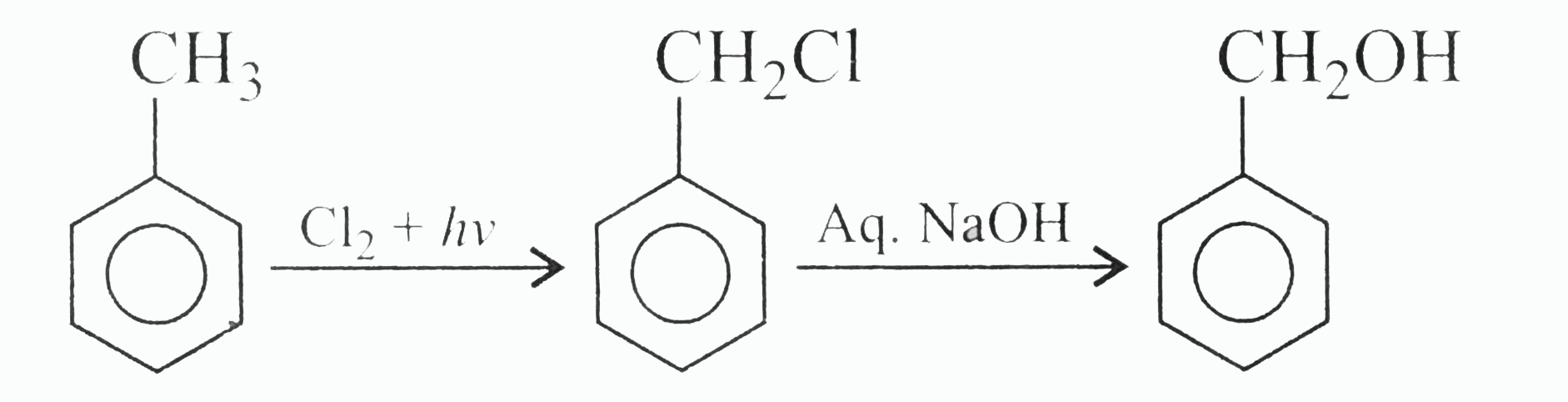 e.`CH_(3)CH = CH_(2) overset(Br_(2)//C Cl_(4))(rarr) CH_(3) - underset(Br) underset(|)(CH) - underset(Br)underset(|)(Br) underset("Alc". KOH (-2HBr))overset(2 mol)(rarr) CH_(3)C -= CH` f. `CH_(3)CH_(2)OH overset(HBr)(rarr) CH_(3)CH_(2)Br underset("Swart reaction")overset(AgF)(rarr) CH_(3)CH_(2) F + AgBr` 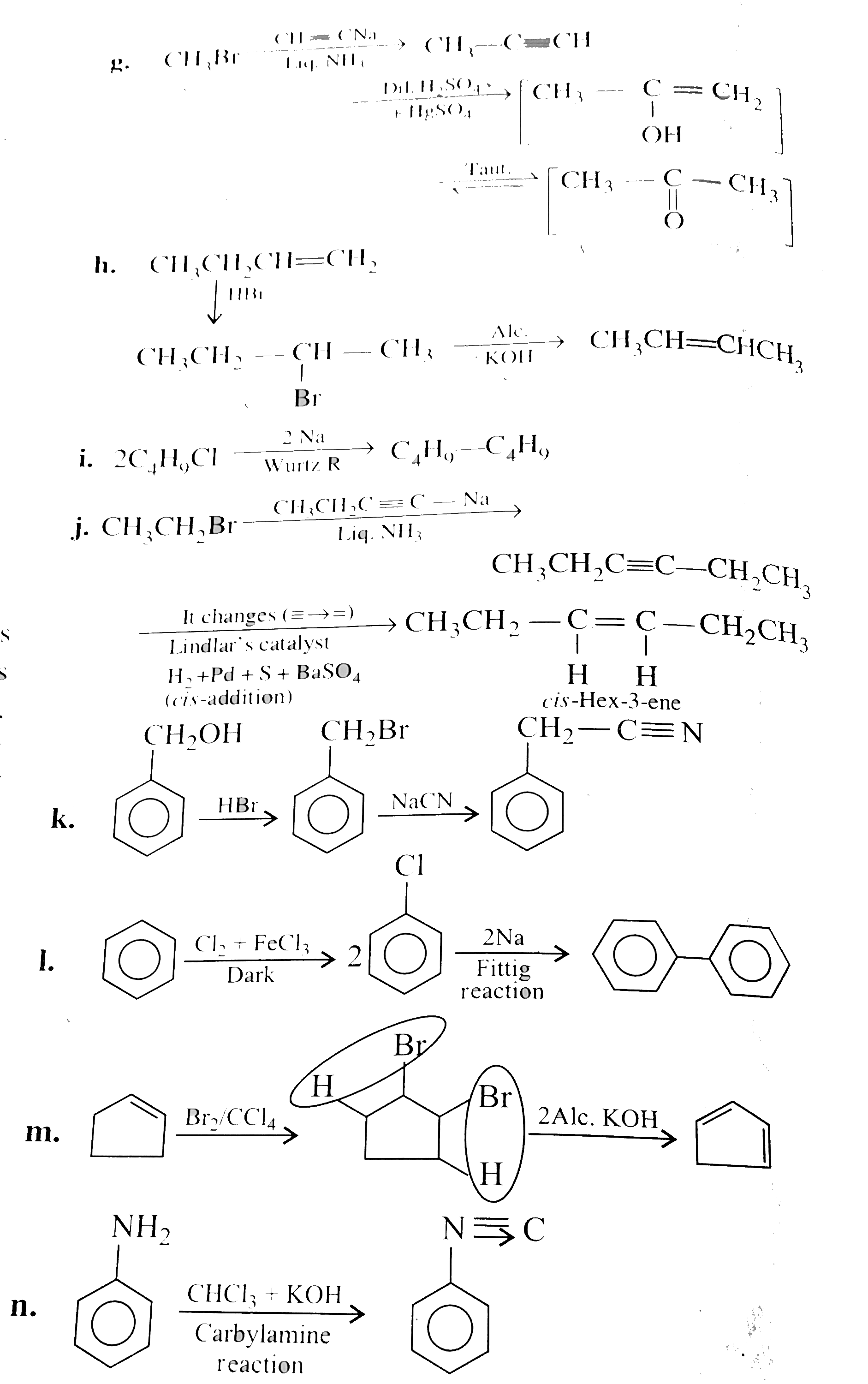
|
|
| 34. |
How will you bring about the following conversion ? (i) Benzoic acid to benzaldehyde (ii) Ethanal to but-2-enal (iii) Propanone to propene Give complete reaction in each case. |
Answer» Solution :(i) Benzoic acid to BENZALDEHYDE `:`  (ii) Ethanal to but-2-enal `:` `underset( "Ethanal ")(2CH_(3) CHO) underset("Aldol condensation")OVERSET("Dil. NaOH")(rarr) underset( "Aldol")(CH_(3) - underset( OH ) underset( |)(CH) - CH_(2) ) - CHO underset( - H_(2) O) overset( Delta ) ( rarr) underset( "But-2-enal")(CH_(3) -CH = CH- CHO )` (III) PROPANONE to propene `:` `underset("Propanone ")(CH_(3) COCH_(3)) overset( Na//"Alcohol")(rarr) underset("Propan-2-ol")(CH_(3)CHOHCH_(3)) overset( H^(+))(rarr) underset( "Propene")(CH_(3)CH) = CH_(2)` |
|
| 35. |
How will you bring about the following conversion ? 4-nitroaniline to 1,2,3-tribromobensene |
Answer» SOLUTION :4-Nitroaniline to `1,2,3`, -ribraomobenzene : 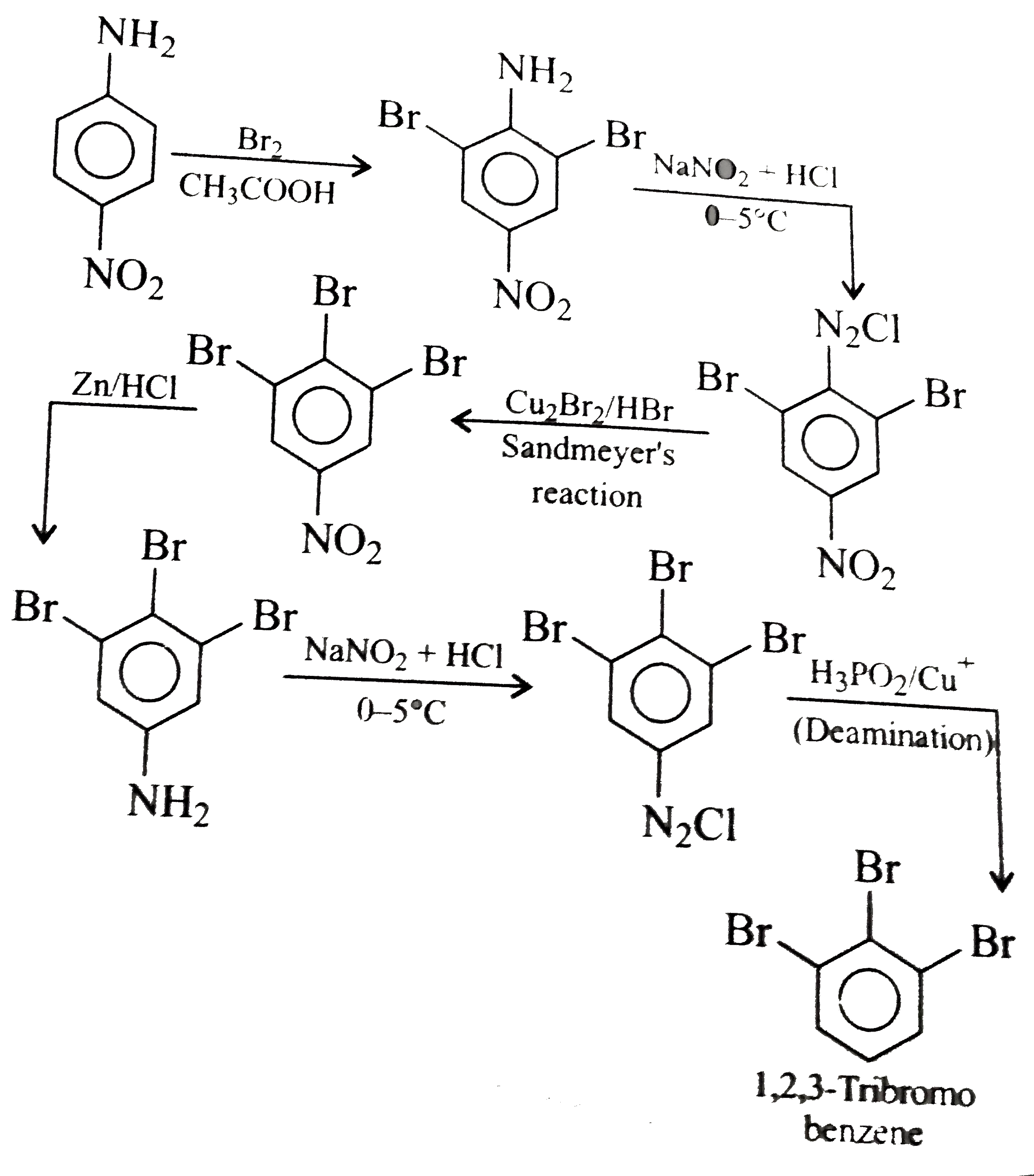
|
|
| 36. |
How will you bring about the following conversion: (i) Propanone to propane (ii) Benzoyl chloride to benzaldehyde. (iii) Ethanal to but-2-enal. |
Answer» Solution :(i) `UNDERSET("Propanone")(CH_(3)-overset(O)overset(||)(C)-CH_(3) underset(Zn.Hg+HCl)overset("Clemmensen Reduction")(to) CH_(3)-underset("Propane")(CH_(2))-CH_(3)` 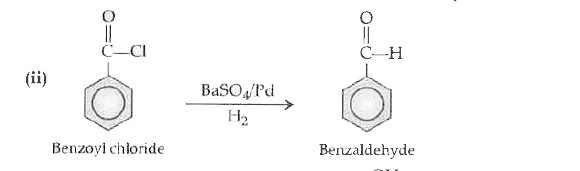 (iii) `underset("Ethanal")(CH_(3)-CHO)underset("ALDOL CONDENSATION")overset("Dil" NaOH)(to) underset("3-hydroxybutanal")(CH_(3)-overset(OH)overset(|)(CH)-CH_(2)-CHO)underset(-H_(2)O)overset(Delta)(to)CH_(3)-underset("But-2-enal")(CH)=CH-CHO` |
|
| 37. |
How will you bring about the convertion: methyl bromide to methyl iodide. |
| Answer» Solution :`underset("Methyl BROMIDE")(CH_(3)-BR) +NAI underset(("Filkenstein reaction"))OVERSET("Dry ACETONE")to underset("Methyl iodide")(CH_(3)-I)` | |
| 38. |
How will you bring about the conversion of acetic acid to acetamide? |
|
Answer» SOLUTION :Carboxylic ACIDS react with ammonia to form AMMONIUM salt which on further heating high temperature gives amides. `underset("Acetic acid")(CH_(3)-overset(O)overset(||)(C)-OH)+NH_(3)tounderset("Ammonium acetate")(CH_(3)-overset(O)overset(||)(C)-O^(-)NH_(4)^(+))overset(Delta)tounderset("Acetamide")(CH_(3)-overset(O)overset(||)(C)-NH_(2))+H_(2)O` |
|
| 39. |
How will you bring about following conversions : (i) 1-Chlorobutane to n-octane (i) 1-Bromopropane to 2-Bromopropane (ii) 2-Chloropropane to 1-propanol ? |
|
Answer» Solution :`UNDERSET("1-Chlorobutane")(2CH_(3)-CH_(2)-CH_(2)-CH_(2)-Cl+2Na) underset(Delta)overset("Dry ether")to underset("n-octane")(CH_(3)-(CH_(2))_(6)-CH_(3)+ 2NaCl)` (ii)`underset("1-Bromopropane")(CH_(3)-CH_(2)-CH_(2)-Br) underset(Delta)overset("KOH(alc.)")to CH_(3)-CH= CH_(2)+HBR to underset("2-Bromopropane")(CH_(3)- underset(Br)underset(|)CH-CH_(3))` (iii) `underset("2-Chloropropane")(CH_(3)-overset(Cl)overset(|)CH-CH_(3))underset(Delta)overset("KOH(alc.)")toCH_(3)-CH= CH_(2)+ underset("org. peroxide")overset("+HBr")to CH_(3)-CH_(2)-underset(Br)underset(|)CH_(2)overset("KOH(aq.)")to underset("1-Propanol")(H_(3)C- CH_(2)-CH_(2)-OH)` |
|
| 40. |
How will you bring about the conversion : Methyl bromide to methyl iodide |
|
Answer» Solution :Methyl bromide to methyl iodide This conversion can be brought about as under: `UNDERSET("bromide")underset("Methyl")(CH_(3)Br) + NAI overset("Acetone") to underset("iodide") underset("Methyl ") (CH_(3)I) + NaBr ` |
|
| 41. |
How will you bring about the above reaction? |
|
Answer» |
|
| 42. |
How will you be able to test sugar in a given sample of wine |
|
Answer» A) By Legal' effect |
|
| 43. |
How will you aobtain colloidal sol of arseneous stlphide ? |
| Answer» | |
| 44. |
How will you account for the origin of charge on the colloidal particles ? |
| Answer» | |
| 45. |
How will you account for the indicated molecular geometry of the following compounds in terms of valence bond theory ? [ArCl_4]^(-) is square planar while [GaCl_4]^(-) is tetrahedral . |
Answer» SOLUTION :
|
|
| 46. |
How will you account for the following? CIF_(3) molecule has T-shaped structure and not a trigonal planar one. |
Answer» SOLUTION :The electronic configuration of Cl (Z = 17) is `1s^(2) 2s^(2) 2P^(6) 3s^(2) 3p_(x)^(2) 3p_(y)^(2) 3p_(z)^(1)`. It has only one half-filled orbital. But to form three Cl-F bonds, we need three half-filled orbitals. To achieve this, one of the `3p_(y)` ELECTRONS GETS excited to 3d-orbital. The resulting five orbitals of the third shell of Cl in the first excited  state undergo `sp^(3)` d-hybridization to give T-shaped structure to `ClF_(3)` molecule. Since Cl does not undergo `sp^(2)`-hybridization, therefore, `ClF_(3)` does not have trigonal planar structure. 
|
|
| 47. |
How will you account for the high, solubility of alcohol in water? |
Answer» Solution :The first three members are completely soluble in water. From butyl alcohol to onwards, the SOLUBILITY decreases. ALCOHOLS with CHAIN of 10 - CARBON atoms are slightly soluble in water. Alcohols are soluble in water due to polar -OH group. The solubility of alcohols decreases with INCREASE of size of alkyl group 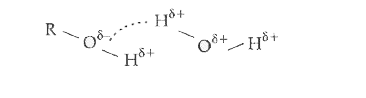
|
|
| 48. |
How will you account for the following? The electron gain enthalpy with negative sign for oxygen (-141 kJ mol^(-1)) is less than that of sulphur (-200 kJ mol^(-1)). Or The value of electron gain enthalpy with negative sign for sulphur is higher than that of oxygen. Or The electron gain enthalpy with sign is less for oxygen than for sulphur. |
|
Answer» Solution :The SIZE of O atom is smaller than that of S. Thus, when an electron is added to neutral gaseous atom, the electon-electron repulsions experienced in the samller 2p-subshell of O are comparatively larger than those encounterned in the bigger 3p-subshell of S. As a result, moreenergy is released in case of S than `{:(O(G)+E^(-) rarr O^(-)(g),,""Delta_(eg) = -141 kJ mol^(-1)),(S(g)+e^(-) rarr S^(-)(g),,""Delta_(eg) = -200 kJ mol^(-1)):}` in case of O. In other words, NEGATIVE electron gain enthalpy of S is higher than that of O. |
|
| 49. |
How will you account for the following ? (a) K_4[Fe(CN)_6] is not toxic whereas KCN is highly toxic. (b) Oxalic acid is commonly used to remove rust stains. (c ) Tetrahedral complexes used do not show any geometrical isomerism. |
|
Answer» Solution :(a) Both the compounds in water ionise are : `K_4[Fe(CN)_6] ltimplies 4K^(+)` + `[Fe(CN)_6]^(4-)` KCN `rArr` `K^(+)` + `CN^(-)` The `CN^(-)` ions are highly toxic in nature. These are released by KCN and not by the complex. Therefore, `K_4[Fe(CN)_6]` is not toxic ion furnished by oxalic acid. (b) Rust is chemically hydrated iron (III) oxide with the formula `Fe_(2)O_(3).xH_(2)O`. The compound forms a SOLUBLE complex with oxilate ion furnished by oxalic acid. `Fe_(2)O_(3)+ 6C_(2)O_(4)^(2-) + 6H_(3)O^(+)rarr2[Fe(C_(2)O_(4))_(3)]^(3-)("Soluble") + 9H_(2)O`. Therefore, rust stains are removed by oxalic acid. (C ) In a tetrahedral complex such as `NI(CO)_(4)` , all the four positions occupied by the ligands are adjacent to each other. . Therefore , cis and TRANS isomers are not possible , in this case or the complex fails to show any geometrical isomerism. |
|
| 50. |
How will you accout for the following ? (i) Actinoids exhibit more number of oxidation states than lanthanoids. (ii) Atomic radii of second and third transition series elements are almost identical. |
|
Answer» Solution :(a) This is because energy differenoe in 5f, 6d and 7S orbitals of actinoids is smaller than 4F, 5d and 6s orbitals of lanthanoids. (B) Due to lanthonoid CONTRACTION. |
|