

Saved Bookmarks
This section includes 7 InterviewSolutions, each offering curated multiple-choice questions to sharpen your Current Affairs knowledge and support exam preparation. Choose a topic below to get started.
| 1. |
How will the rate of reaction be affected when (a) surface area of the reactant is increased, (b) temperature of the reaction is decreased, and (c ) catalyst is added in a reversible reaction? |
|
Answer» Solution :(a) Surface area of the reactant is increased When surface area of the reactant is increased, there is GREATER contact between the reactant molecules. HENCE rate of reaction increases. (B) Temperature of the reaction is decreased Kinetic energy of the molecules depends upon the temperature. On decreasing the temperature, the kineticenergy of the molecules BECOMES smaller. There are smaller and less effective collisions between the molecules. This RESULTS in decrease in the rate of reaction. (c ) The equilibrium will be achieved earlier but there will be no change in the equilibrium point. |
|
| 2. |
How will the pH of brine (aq. NaCl solution) be affected when it is electrolysed? |
| Answer» Solution :When aqueous NaCl solution is electrolysed, `H_(2)` is LIBERATED at CATHODE, `Cl_(2)` at anode and NAOH is formed in the solution. Hence, pH of the solution will stops. | |
| 3. |
How will the pH of brine (aq. NaCl solution) be affected when it is electrolysed ? |
|
Answer» Solution :* The PH of the solution will RISE an NAOH is formed in the electrolytic cell. * In electrolysis of cathode of brine (NaCl) solution, reduction of `Na^(+)` does not occur on cathode but the reduction of `Na^(+)` does not occur on cathode but the reduction reaction of water on cathode gives `(H_(2)+OH^(-))`. `2H_(2)O_((l))+2e^(-) to H_(2(g))+2OH_((aq))^(-)`.. . . . (Reduction) and `pOH= -log_(10)[OH^(-)]` * So, `[OH^(-)]` INCREASES, pOH also increases and pH decreases. For understanding : `[OH^(-)]=0.1M` then pOH=0.01M then pOH=2 and pH=12 So, `[OH^(-)]` increases, pOH also increases and pH get decreases. |
|
| 4. |
How will the pH of brine (aq NaCl solution) be affected when it is electrolysed ? |
| Answer» SOLUTION :The pH of the solution will RISE as NaOH is formed in the electrolytic cell. | |
| 5. |
How will distinguish beween primary secondary and tetiary alphatic amines. |
Answer» SOLUTION :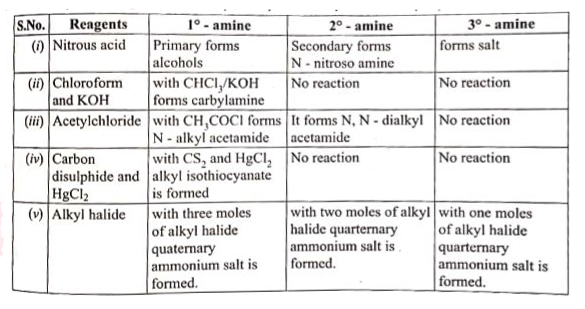
|
|
| 6. |
How will derive the formula of density of a unit cell ? |
|
Answer» Solution :Using the EDGE length of a unit cell, we can calculate the density `(rho)`of the crystal hv considering a CUBIC unit cell as follows . Density of the cell `rho=(" Mass of the unit cell")/ ("Volume of the unit cell") ""...(1)` Mass of the unit cell ={Total number of atoms belong to the unit cell } `xx`mass of one atom Mass of one atom `=("MOLAR mass"(g mol^(-1)))/("Avagardo number "(mol^(-1)))""....(2) ` `m=M/N_A""....(3)` Substitute the value (3) in (2) Mass of the unit cell `=nxxM/N_A` For a cubic unit cell , all the edge lengths are equal .i.e , a = b = C Volume of the unit cel `=axxaxxa=a^3` `:.` Density of the unit cell `=rho = (nM)/(a^3N_A)` |
|
| 7. |
How will be prepare from colemanite? |
|
Answer» SOLUTION :Borax is a SODIUM salt of tetraboric acid. It is OBTAINED from COLEMANITE ORE by boiling its solution with sodium carbonate. `underset(("Colemanite"))(2Ca_(2)B_(6)O_(11))+2NaCO_(3)+H_(2)Otounderset(("Borax"))(3Na_(2)B_(4)O_(7)+3CaCO_(3)+Ca(OH)_(2)` |
|
| 8. |
How will an increase in temperature affect each of the following equilibria ? An increase in pressure ? N_(2)(g) + O_(2)(g)hArr2NO (g)DeltaH = 181 kJ |
|
Answer» |
|
| 9. |
How will an increase in temperature affect each of the following equilibria ? An increase in pressure ? 2O_(3)(g)hArr3O_(2)(g) DeltaH = - 285 kJ |
|
Answer» |
|
| 10. |
How will an increase in temperature affect each of the following equilibria ? An increase in pressure ? CaO(s)+CO_(2)(g)hArrCaCO_(3)(s) DeltaH=–176 kJ |
|
Answer» |
|
| 11. |
How will an increase in temperature affect each of the following equilibria ? An increase in pressure ? 2NH_(3) (g)hArr N_(2)(g) + 3H_(2)(g)DeltaH = 92 kJ |
|
Answer» |
|
| 12. |
How was the reduction potential of an electrode be increased? |
|
Answer» SOLUTION :`M^(N+)+n E^(-)toM,E_(M^(n+)//M)=E_(M^(n+)//M)^(@)-(RT)/(nF)"ln"(1)/([M^(n+)])=E_(M^(n+)//M)^(@)+(RT)/(nF)"ln"[M^(n+)]` thus, electrode POTENTIAL can be increased either by increasing metal ion CONCENTRATION, i.e., `[M^(n+)]` or temperature T. |
|
| 13. |
How very pure dinitrogen gas can be obtained ? |
|
Answer» By liquidification of air and fractional distillation. |
|
| 14. |
How to we separate two sulphide ores by Froth Floatation Method? Explain with an example. |
| Answer» Solution :The separation of two sulphide ores can be achieved by adjusting PROPORTION of oil to water or by USING depressants. In the CASE of an ore containing ZNS and PBS, the depressants used in NaCN. It forms complex with ZnS and prevents it from coming with froth but PbS remains with froth. | |
| 15. |
How to produce electricity in thermal power station ? |
|
Answer» Solution :* In thermal power station, the chemical energy (HEAT of combustion) of fissil fuels (coal, gas or oil) is converted into electrical energy. * Production of electricity by thermal plants is not a very efficient method. In such plants is not a very efficient method. in such plants, the chemical energy (heat of combustion) of fossil fuels (coal, gas or oil) is first used for converting water into high pressure steam. this is then used to run a turbine to produce electricity. So by this way wastage of energy is OCCURRED and hence efficiency of such plant is less. * Thermal power station is a major source of pollution as in this, combustion of FUEL is carried out. so, pollution is occurred in OBTAINING electricity by thermal power plants. and such plant has working efficiency of almost 40%. |
|
| 16. |
How to predict the feasibility of a cell reaction ? |
|
Answer» Solution :The feasibility of a REDOX reaction can be predicted with the HELP of the electrochemical series. (i) The net emf of the cell reaction `E_("cell")` can be calculated from the expression, `E^(@)""_(cell)=E^(@)""_(cathode)-E^(@)""_(anode)` (II) In GENERAL, if `E^(@)""_(cell)=`+ve, the reaction is feasible. `E^(@)""_(cell)=` -ve, the reaction is not feasible. |
|
| 17. |
How to obtain ionic conductivity of unknown solution ? |
|
Answer» Solution :* (i) FIRST DETERMINE cell constant. (ii) determine resistance of unknown solution. (iii) CALCULATION conductivity of solution by following equation: `(kappa=("Cell constant")/(R)=(G^(**))/(R))` * SI unit of conductivity is S `m^(-1)` and sometimes S `cm^(-1)`. |
|
| 18. |
How to find out stability constant by stepwise method ? |
|
Answer» Solution :When a free metal ion is in AQUEOUS medium, it is surrounded by (coordinated with) water molecules. It is represented as `[MS_(6)]`. If ligands which are stronger than water are added to this metal salt solution, coordinated water molecules are replaced by strong ligands. Let us consider the formation of a metal complex `ML_(6)` in aqueous medium. (Charge on the metal ion is igonerd) complex formation may OCCUR in single step or step by step. If ligands added to the metal ion in single step, then `[MS_(6)]+6LhArr[ML_(6)]+6S` `beta_(overall)=([ML_(6)][S]^(6))/([MS_(6)][L]^(6))` `beta_(overall)` is called as overall stability constant. As solvent is present in large excess, its concentration in the abpve equation can be igonored . `:.beta_(overall)=([ML_(6)])/([MS_(6)][L]^(6))` If there six ligands are added to the metal ion one by one, them the formation of complex `[ML6]` can be supposed to take place through six different steps as shown below. Generally step wise stability CONSTANTS are represented by the symbol `K`. `{:([MS_(6)]+LhArr[MS_(5)L]+S,, k_(1)=([MS_(5)L])/([MS_(6)][L])),([MS_(5)]+LhArr[MS_(4)L_(2)]+S,, k_(2)=([MS_(4)L_(2)])/([MS_(5)][L])),([MS_(4)L_(2)]+LhArr[MS_(3)L_(3)]+S,, k_(3)=([MS_(3)L_(3)])/([MS_(4)L_(2)][L])),([MS_(3)L_(3)]+LhArr[MS_(3)L_(4)]+S,, k_(4)=([MS_(2)L_(4)])/([MS_(3)L_(3)][L])),([MS_(2)L_(4)]+LhArr[MSL_(5)]+S,, k_(5)=([MSL_(5)])/([MS_(2)L_(4)][L])),([MSL_(5)]+LhArr[ML_(6)]+S,, k_(6)=([ML_(6)])/([MSL_(5)][L])):}` |
|
| 19. |
How to determine activation energy of chemical reaction? |
|
Answer» Through rate constant at STANDARD tempperature |
|
| 20. |
How the tranquilizers work in body? |
|
Answer» Solution :(i) They are neurologically active drugs. (ii) Tranquilizer acts on the central nervous SYSTEM by blocking the neurotransitter DOPAMINE in the BRAIN. (iii) This drug is USED for treatment of stress anxiety, depression, sleep disorders and severe mental diseases like schizophrenia. |
|
| 21. |
How the supersonic jet aeroplanes are responsible for the depletion of ozone layer? |
|
Answer» SOLUTION :NITRIC oxide emitted by the exhaust systems of SUPERSONIC jet AEROPLANES react with ozone as under: `NO_(g) + O_3(g) to NO_2(g) + O_2(g)` This causes depletion of ozone LAYER. |
|
| 22. |
How the supersonic jet aeroplanes are responsible for the depletion of ozone layer ? |
|
Answer» Solution :The exhausts of supersonic jet aeroplanes CONTAIN nitric OXIDE (NO) which combines with ozone prresent in the atmosphere to form nitrogen dioxide and DIATOMIC oxygen. `NO (g) + O_(3) (g) rarr NO_(2)(g) + O_(2)(g)` Since supersonic jet aeroplanes fly near the oxone layer, they are responsible for depletion of ozone layer. |
|
| 23. |
How the primitive cubic unit cell is obtained ? |
Answer» Solution :Three dimensional structures is obtained by stacking TWO dimensional layers one above the other.  In this type of arrangement, the SECOND square closed PACKED layer is placed exactly above the first square close packed layer such that the spheres of first and second layers are in same alignment horizontally and VERTICALLY and in the similar way more layers can be placed one above other. If the arrangement of spheres in the first layer is called ..A.. type, then all the layers have the same arrangement. Thus this lattice has AAAAA.... type arrangement and the lattice thus generated is simple cubic unit CELL or primitive cubic unit cell. The coordination number of each sphere is six. |
|
| 24. |
How the potassium dicharomate prepared from chrome iron ore? |
|
Answer» Solution :Preparation of `K_(2)Cr_(2)O_(7)` from chrome iron orecomposition of chromite ore is `FeO.Cr_(2)O_(3)`. Step I : Concentration of ore : Powdered ore is concentrated by washing with current of WATER in hydraulic CLASSIFIER. Step II. Roasting : Conversion of chromite ore into sodium chromate : `{:(4FeO.Cr_(2)O_(3) +O_(2)rarr 2Fe_(2)O_(3)+4Cr_(2)O_(3)),([2Cr_(2)O_(3)+4Na_(2)CO_(3)+3O_(2)rarr4Na_(2)CrO_(4)+4CO_(4)+4CO_(2)]xx2),(barul(4FeOCr_(2)O_(3)+8Na_(2)CO_(3)+7O_(2) rarr 2Fe_(2)O_(3)+8Na_(2)CrO_(4)+8CO_(2))):}` Step III : Conversion of `Na_(2)CrO_(4)` into `Na_(2)Cr_(2)O_(7)` `2Na_(2)CrO_(4)+H_(2)SO_(4)" (conc.)" rarrNa_(2)Cr_(2)O_(7)+Na_(2)SO_(4)+H_(2)O` Step IV : Conversion of `Na_(2)Cr_(2)O_(7)` to `K_(2)Cr_(2)O_(7)` `Na_(2)Cr_(2)O_(7)+2KCL rarr K_(2)Cr_(2)O_(7)+2NaCl` The solution is concentrated and hot solution is orange red crystals and `NaCl` remains in the solution. `K_(2)Cr_(2)O_(7)` is filtered and purified. |
|
| 25. |
How the gem stones ruby exhibits red colour and emerald exhibits green colour ? |
| Answer» SOLUTION :Ruby is aluminium oxide `(Al_2O_3)`containing about 0.5-1% `Cr^(3+)` ion `(d^3)`. This chromium (III) is an OCTAHEDRAL complex INCORPORATED into the alumina lattice. The d-d transitions in `Cr^(3+)` give the red colour to ruby. Emerald is the beryl mineral `(3BeO.Al_2O_3. 6SiO_2)` having some `Cr^(3+)` ions at octahedral sites. The absorption bands SEEN in the ruby shift to longer wavelength, namely yellow-red and blue, CAUSING emerald to reflect green colour. | |
| 26. |
How the formula of a compound can be known on the basis of voids filled in a lattice structure ? |
|
Answer» Solution : In a close packed structure, the number of tetrahedral VOIDS are equal to twice of number of spheres while the number of octahedral voids are equal to number of spheres. In ionic SOLIDS, bigger ions i.e. usually the ANIONS form the close packed structure and the smaller ions usually the cations occupy the voids. If the cation is SMALL in size, it occupies tetrahedral voids and if it octahedral voids. In a GIVEN compound, the fraction of tetrahedral or octahedral voids that are occupied depends on the chemical formula of the compound. |
|
| 27. |
How the following conversions can carried out? (i) Propene to propan-1-ol (ii) Ethanol to but -2-yne (iii) 1-Bromopropane to 2-bromopropane (iv) toluene to benzyl alcohol (v) Benzene to 4-bromonitrobenzene (vi Benzyl alcohol to 2-phenylethanoic acid (vii) Ethanol to propanenitrile. (viii) Aniline to chlorobenzene (ix) 2-Chlorobutane to 3,4-dimethylhexane. (x) 2-Methyl-1-propene to 2-chloro-2-methylpropane (xi) Ethyl chloride to propanoic acid. (xii) but-1-ene to n-butyl iodide (xiii) 2-Chloropropane to 1-propanol (xiv) Isopropyl alcohol to iodoform (xv) Chlorobenzene to p-nitrophenol (xvi) 2-Bromopropane to 1-bromopropane (xvii) Chloroethane to butane (xviii) Benzene to diphenyl (xix) tert-Butyl bromide to isobutyl bromide (xx) Aniline to phenyl isocyanide. |
Answer» SOLUTION :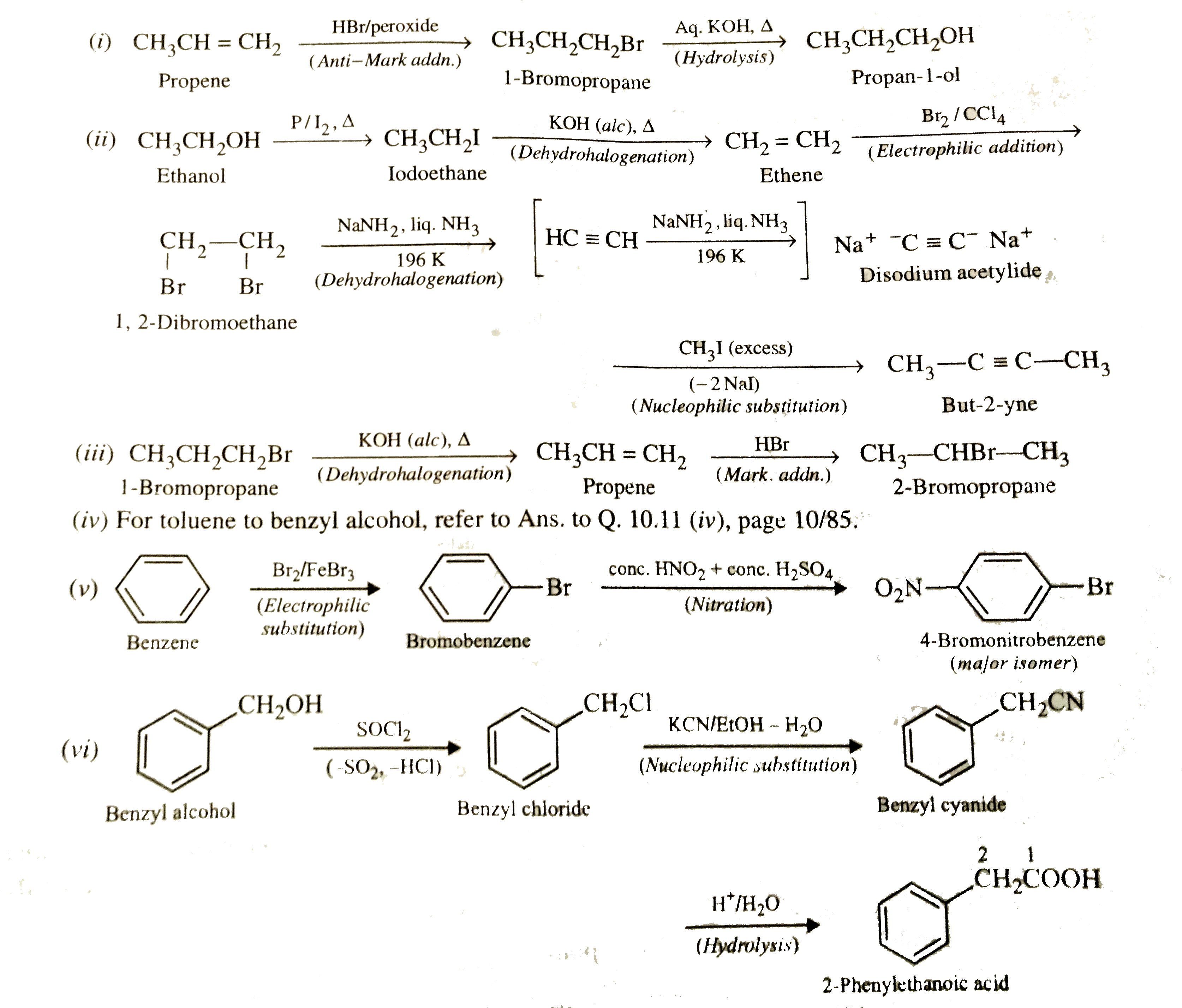 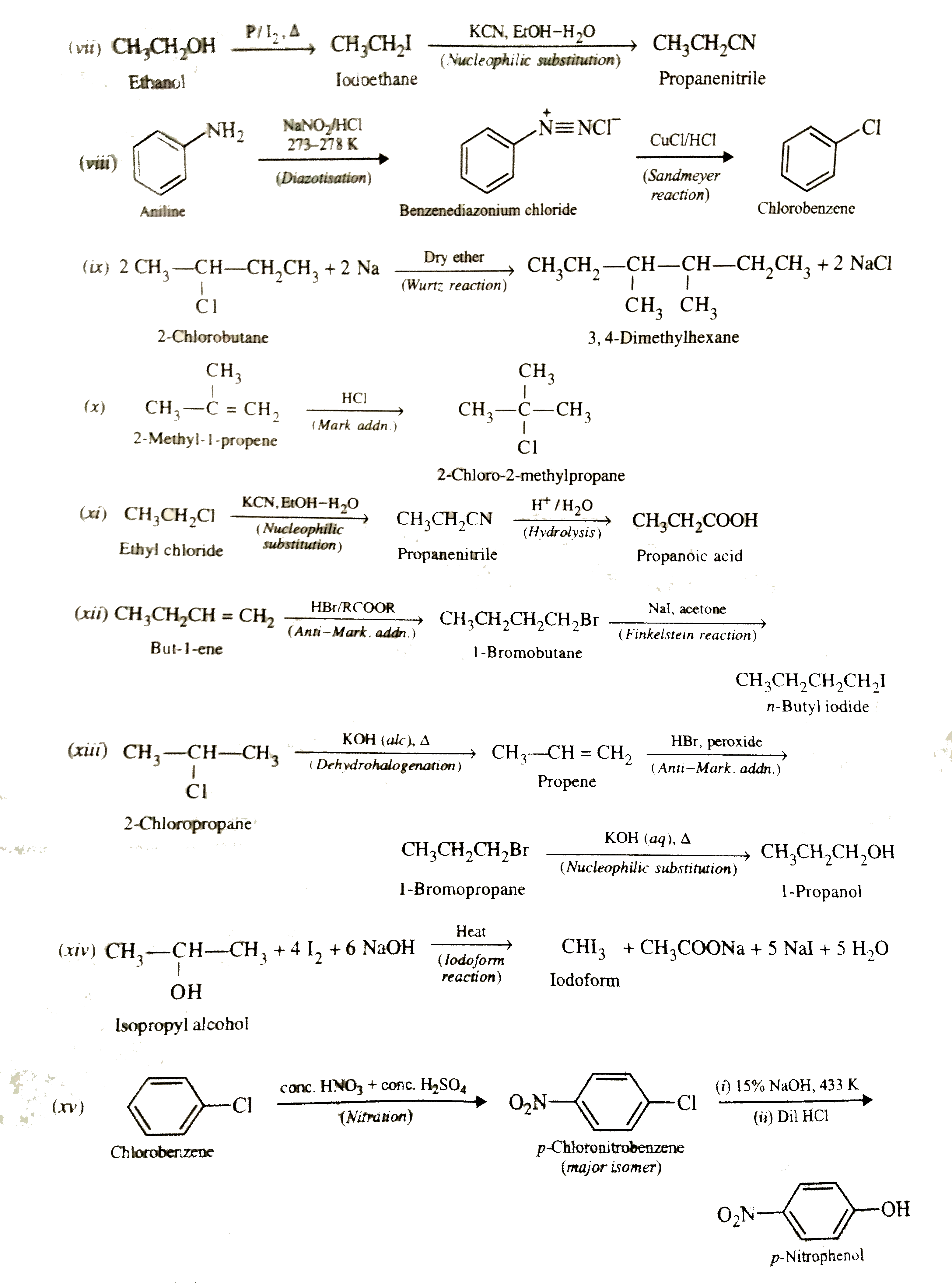 
|
|
| 28. |
How the following metals are refined: (a) Copper with cuprous oxide as impurity, (b) Copper with zinc, silver and gold as impurities and (c) Silver with lead impurity |
| Answer» SOLUTION :(a) POLING, (B) electrolysis and (c) CUPELLATION | |
| 29. |
How the following transfrormations can be brought about ? Name only the reagents . a) Cyclohexanol to cyclohexanone b) Allyl alcohol to propenal c) p - Fluorotoluene of pfluorobenzaldehyde |
|
Answer» Solution :(a) Potassium dichromate in ACIDIC medium (b) `C_(5)H_(5)overset(+)(N)HCrO_(3)Cl^(-)` (PYRIDINIUM chlorochromate)  (c) `CrO_(3)` in the presence of acetic ANHYDRIDE (i) `CrO_(2)Cl_(2)` (ii) `H_(2)O` |
|
| 30. |
How the following conversions can be carried out? (xiii) 2-chloropropane to 1-propanol |
Answer» SOLUTION :
|
|
| 31. |
How the following conversions can be carried out? (xi) Ethly chloride to propanoic acid |
Answer» SOLUTION :
|
|
| 32. |
How the following conversions can be carried out? (x) But -1-ene to n-butyliodide |
Answer» SOLUTION :
|
|
| 33. |
How the following conversions can be carried out? (x) 2-methyl-1-propane to 2-chloro-2-methylpropane |
| Answer» Solution :`underset(2-"methyl"-1-"PROPANE")(CH_(3)-OVERSET(CH_3)overset(|)(C)=CH_(2))overset(HCl)(rarr)underset(2-"chloro"-2-"methylpropan")(CH_(3)-underset(CL)underset(|)overset(CH_3)overset(|)(C)-CH_(3))` | |
| 34. |
How the following conversions can be carried out? (vii) Eenzyl alcohol to 2-phenylethanic acid |
Answer» SOLUTION :
|
|
| 35. |
How the following conversions can be carried out ?Toluene to benzyl alcohol |
Answer» SOLUTION :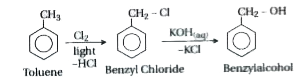
|
|
| 36. |
How the following conversions can be carriedout ? Toluene to benzyl alcohol |
| Answer» SOLUTION :For TOLUENE to BENZYL ALCOHOL , | |
| 37. |
How the following conversions can be carriedout ? tert-Butyl bromide to isobutyl bromide |
| Answer» Solution :`underset("tert -BUTYL bromides ") (CH_(3) - underset(Br) underset(|) overset(CH_(3)) overset(|) C - CH_(3)) underset(("DEHYDROHALOGENATION ")) overset(KOH (alc.) , Delta ) to underset("2 - Methyl -1- propene") (CH_(3) - overset(CH_(3)) overset(|) C = CH_(2)) underset(("Anti - Markovnikov addition ")) overset("HBR, peroxide") to underset ("Isobutyl bromide") (CH_(3) - overset(CH_(3)) overset(|) CH - CH_(2) Br ) ` | |
| 38. |
How the following conversions can be carried out ?Propene to propan-1-ol |
Answer» SOLUTION :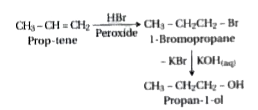
|
|
| 39. |
How the following conversions can be carried out ?tert-Butyl bromide to isobutyl bromide |
Answer» SOLUTION :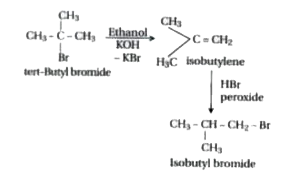
|
|
| 40. |
How the following conversions can be carried out? (i). Propene to propane-1-ol (ii). Ethanol to but-1-yne (iii). 1-Bromopropane to 2-bromopropane (iv). Toluene to benzyl alcohol (v)Benzene to 4-Bromonitrobenzene (vi). Benzyl alcohol to 2-phenylethanoic acid (vii) Ethanol to propanenitrite (viii). Aniline to chlorobenzene (ix). 2-Chlorobutane to 3,4-dimethylhexane (x). 2-Methylpropene to 2-chloro-2-methylpropane (xi). Ethyl chloride to propanoic acid (xii). But-1-ene to n-butyl iodie (xiii). 2-Chloropropane to propan-1-ol (xiv). Isopropyl alcohol to iodoform (xv). Chlorobenzene to p-nitrophenol (xvi). 2-Bromopropane to 1-bromopropane (xvii) Chloroethane to butane (xviii) Benzene to diphenyl (xix). tert-Butyl bromide to isobutyl bromide (xx). Aniline to phenyl isocyanide. |
Answer» SOLUTION :  
|
|
| 41. |
How the following conversions can be carried out? (iv) Toluene to benzly alcohol |
Answer» SOLUTION :
|
|
| 42. |
How the following conversions can be carriedout ? Propene to propan-1-ol |
| Answer» Solution :`underset("Propene") (CH_(3)CH = CH_(2)) underset(("Anti - Markovnikov addition ")) overset("HBR/ PEROXIDE") tounderset ("1 - Bromopropane") (CH_(3)CH_(2)CH_(2)Br) underset(("Hydrolysis")) overset(aq. KOH, Delta) to underset("PROPAN -1- ol") (CH_(3)CH_(2)CH_(2)OH) ` | |
| 43. |
How the following conversions can be carried out ?Isopropyl alcohol to iodoform |
Answer» SOLUTION :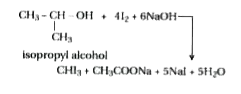
|
|
| 44. |
How the following conversions can be carriedout ? Isopropyl alcohol to iodoform |
| Answer» Solution :`underset("ISOPROPYL ALCOHOL ") (CH_(3) - underset(OH) underset(|) CH - CH_(3)) + 4I_(2) + 6NaOH OVERSET("Heat") to underset("Iodoform")( CHI_(3)) + CH_(3) COONa + 5NaI + 5H_(2)` | |
| 45. |
How the following conversions can be carried out? (ii) Ethanol to but-1-yne |
Answer» SOLUTION :
|
|
| 46. |
How the following conversions can be carried out ?Ethyl chloride to propanoic acid |
Answer» SOLUTION :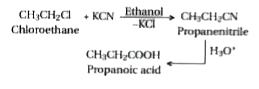
|
|
| 47. |
How the following conversions can be carried out? (i) propane to propan-1-ol |
Answer» SOLUTION :
|
|
| 48. |
How the following conversions can be carriedout ? Ethyl chloride to propanoic acid |
| Answer» Solution :`underset("ETHYL chloride ") (CH_(3)CH_(2)Cl) underset(("Nucleophilic substitution ")) overset(KCN , EtOH - H_(2)O) to underset(" Propanenitrile")(CH_(3) - CH_(2)CN) underset(("Hydrolysis")) overset(H^(+)//H_(2)O) to underset("Propanoic ACID ") (CH_(3) - CH_(2)COOH) ` | |
| 49. |
How the following conversions can be carried out ?Ethanol to propanenitrile |
Answer» SOLUTION :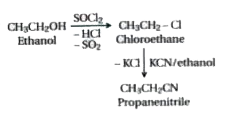
|
|
| 50. |
How the following conversions can be carriedout ? Ethanol to propanenitrile |
| Answer» Solution :`underset("Ethanol ") (CH_(3)CH_(2)OH) overset(P//I_(2) , Delta ) to underset("Iodoethane") (CH_(3)CH_(2)I) underset(("NUCLEOPHILIC substitution ")) overset(KVN) to underset("Propanenitrile") (CH_(3)CH_(2)CN) ` | |