

Saved Bookmarks
This section includes 7 InterviewSolutions, each offering curated multiple-choice questions to sharpen your Current Affairs knowledge and support exam preparation. Choose a topic below to get started.
| 1. |
How many maximum bonds are equivalent in the dichromates dianion ? |
|
Answer» |
|
| 2. |
How many maximum atoms are present in one planeof [PtCl_(3)(n^(2)-C_(2)H_(4))]^(-) ? |
|
Answer» 8 |
|
| 3. |
How many maximum atoms lie in the same plane in the structure of methylenesulphurtetrafluoride (CH_2SF_4) ? |
Answer» 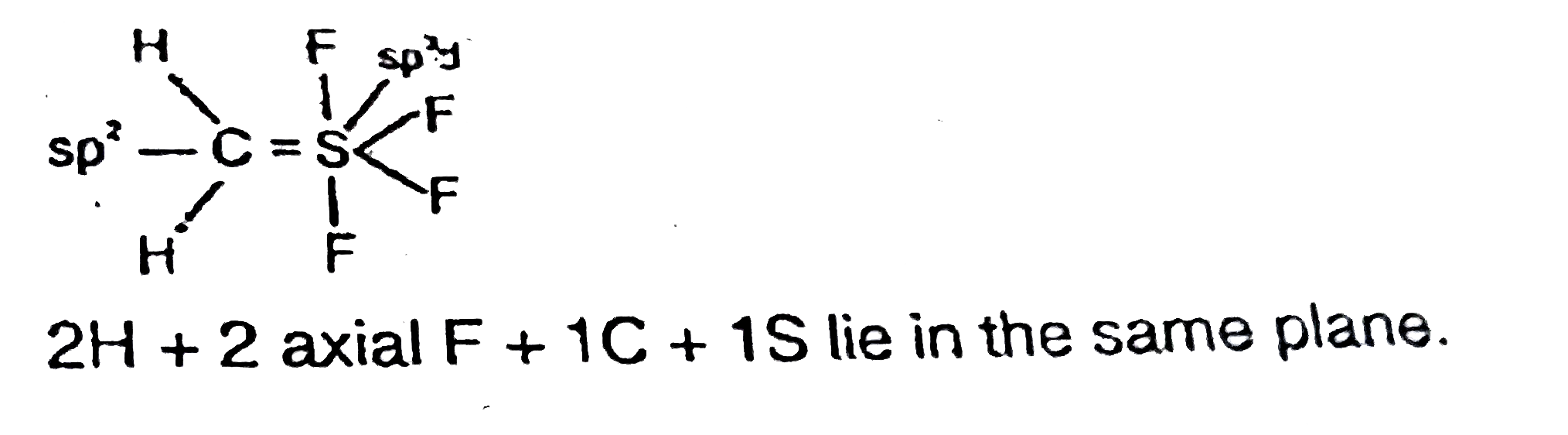
|
|
| 4. |
How many m. moles of sourose should be dissolved in 500 grams of water so as to get a solution which has a difference of 103.57^@C between boiling point and freezing point ? (K_f=1.86 K kg "mol"^(-1), K_b=0.52 K Kg "mol"^(-1)) |
|
Answer» 500 m. moles Freezing point of solution =freezing point `-DeltaT_f=0-DeltaT_f` Difference in TEMPERATURE (given)=`100+DeltaT_b-(-DeltaT_f)` `103.57=100+DeltaT_b+DeltaT_b+DeltaT_f=100+"MOLALITY"xxK_b+"molality"xxK_f` `=100+"molality"(0.52+1.86)` Molality=`(103.57-100)/238=3.57/2.38=1.5 m` and molality =`("moles"xx1000)/W_(gm(SOLVENT)), 1.5=("moles"xx1000)/500` Moles of SOLUTE =`(1.5xx500)/1000=0.75` moles |
|
| 5. |
How many lone pairs are associated with xenon in xenon difluoride : |
|
Answer» 1 |
|
| 6. |
How many litres of water must be added to 1 litre of an aqueous solution of HCl with a pH of 1 to create an aqueous solution with pH of 2 ? |
|
Answer» 0.1 L `pH=2 therefore [H^(+)]_(2)=10^(-2)M` According to DILUTION law, `M_(1)V_(1)=M_(2)V_(2)` `10^(-1)XX1=10^(-2)xx V_(2)` `V_(2)=(10^(-1)xx1)/(10^(-2))=10L` `therefore` WATER to be added `=10-1=9L`. |
|
| 7. |
How many litres of water must be added to 1 litre an aqueous solution of HCl with a pH of 1 to create an aqueous solution with pH of 2 |
|
Answer» 0.1 L `pH = 2 [H^(+)] = 10^(-2) = 0.01` for dilution of HCl `M_(1)V_(1) = M_(2)V_(2)` `0.1 XX 1 = 0.01 xx V_(2)` `V_(2) = 10 l t` Volume of water added = 10 - 1 = 1litre. |
|
| 8. |
How many litres of oxygen at 1 atm & and 273K will be required to burn completely 2.2 of propene (C_(3)H_(8)) |
|
Answer» 11.2 L |
|
| 9. |
How many litre of C_(7)H_(16) will be required to react with 176 gm of oxygen. If density of C_(7)H_(16) will be required to react with 176 gm of oxygen. If density of C^(7)H_(16) is 0.8 gm/L? |
|
Answer» 62.5L `(176)/(32)=5.5` `n_(C_(7)H_(15))"required"=(n_(O_(2)))/(11)=(5.5)/(11)=0.5` `d_(C_(7)H_(16))=(50)/(V LIT)0.8rArrV=(50)/(0.8)=(500)/(8)=62.5` litre |
|
| 10. |
How many linear chain isomers are possible for each of the following olefins ? Practice Questions |
|
Answer» `C_(4)H_(8)` `CH_(3)CH=CHCH_(3)" (cis, trans)"` (c ) `CH_(3)CH=CH_(2)" one"` (d) `CH_(3)CH_(2)CH_(2)CH_(2)CH=CH_(2)(l),CH_(3)CH_(2)CH_(2)CH=CHCH_(3)" (cis, trans)"` `CH_(3)CH_(2)CH=CHCH_(2)CH_(3)" (cis, trans)"` |
|
| 11. |
How many layers are adsorbed in chemical adsorption? |
|
Answer» One |
|
| 12. |
How many lattice points are there in one unit cell of the following lattices? Simple cubic |
|
Answer» |
|
| 13. |
How many lattice points are there in one unit cell of the following lattices? Face centred cubic |
|
Answer» |
|
| 14. |
How many lattice points are there in one unit cell of the following lattices? Body centred cubic |
|
Answer» |
|
| 15. |
How many lattice points are there in one unit cell of each of the following lattice ? (i)Face-centred cubic (ii) Face-centred tetragonal (iii) Body-centered |
|
Answer» Solution :(i)`"Lattice points in FACE-CENTRED CUBIC lattice "="8 (at corners)" +" 6 (at the face centre)"= 14` (ii) `"Face centred TETRAGONAL "= "8 (at corners) "+ "6 (at the face centre) "= 14` (iii)`"Lattice points in body-centred cube "= "8 (at corners)" +"1 (at the body centre)" = 9` |
|
| 16. |
How many lattice points are there in one unit cell of each of the following lattice ? (i) Face-centred cubic (ii) Face-centred tetragonal (iii) Body-centred |
|
Answer» Solution :(i) Face-centred CUBIC : No. of lattice POINTS = 8(at corners) + 6(at faces) = 14 No. of ATOMS per unit cell `= (8 xx 1/8) + (6 xx 1/2)` `=4` (ii) Face-centred TETRAGONAL crystal does not exists. For tetragonal crystal system only primitive and body-centred unit cells are common. (III) Body-centred cubic : No. of lattice points = 8(at corners) + 1(at body centre) `= 9` No. of atoms per unit cell `= (8 xx 1/8) + 1` `= 2`. |
|
| 17. |
How many lattice points are there in one unit cell of each of the following lattice ? (i) Face-centred cubic (ii) Face-centred tetragonal (iii) Body-centred cubic. |
|
Answer» Solution :Face-centred cubic or face-centred TETRAGONAL : There are particles on each corner and at the centre of each face in face-centred cubic. Particles per unit cell =`(8xx(1)/(8))+(6xx(1)/(2))=4` Body-centred cubic LATTICE : There are particles on each corner and in the middle of the body of each unit cell. Particles per unit cell = `(8xx(1)/(8))+1 =2` |
|
| 18. |
How many lattice points are there in one unit cell of each of the following lattice ? (i) Face - centred cubic "" (ii) Face-centred tetragonal "" (iii) Body-centered |
|
Answer» SOLUTION :(i) Lasttice point in face-CENTRED cubic lattice = 8(at corners) + 6(at the face CENTRE) = 14 (ii) Face centred tetragonal = 8(at corners) + 6(at the face centre) = 14 (iii). Lattice points in BODY-centred cube = 8(at corners) + 1 (at the body centre) = 9. |
|
| 19. |
How many kJ energy is expected during the passes of 1 ampere current for 90 sec under a potentialof 100 V? |
|
Answer» |
|
| 20. |
How many kinds of space lattices are possible in a crystal? |
|
Answer» 23 |
|
| 22. |
How many ketones are possible for molecular formula C_(4)H_(8)O? |
|
Answer» 1 |
|
| 23. |
How many ketones having molecular weight = 100 will react with LiAlH_(4) to given a product with significant optical activity ? |
|
Answer» |
|
| 24. |
How many kinds of primitive unit cells are possible |
|
Answer» 23 |
|
| 26. |
How many isomers 'x' of C_(8)H_(10) when reacts with hot alkaline KMnO_(4) give only aromatic dicarboxylic acid ? How many isomers 'y' of C_(4)H_(8) when reacts with hot alkaline KMnO_(4) give carbondioxide ? Sum of x + y =? |
|
Answer» |
|
| 27. |
How many isomers possible for [Co(gly)(dmg)(en)]^(+1)? |
|
Answer» 2 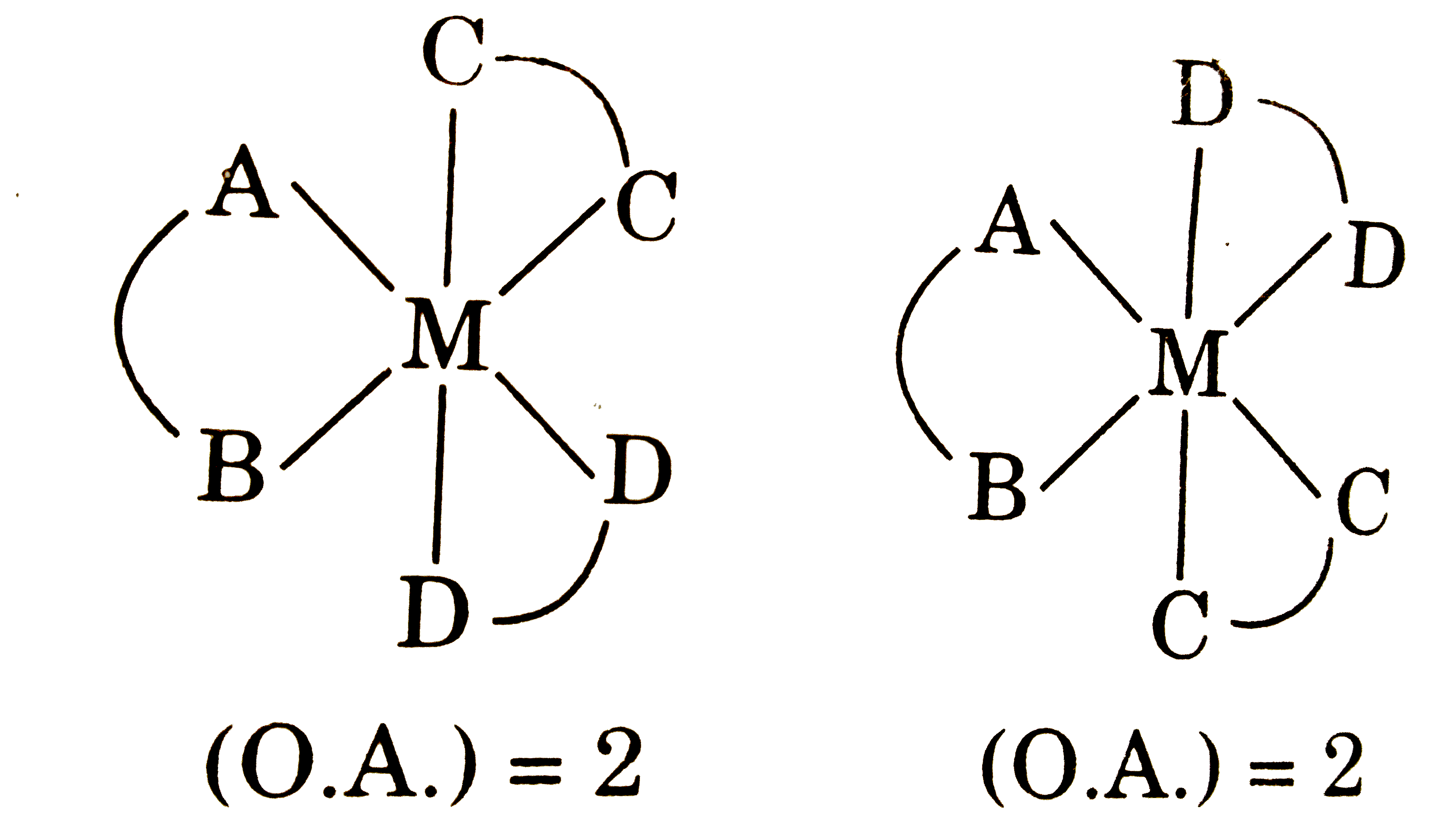
|
|
| 28. |
How many isomers on monochlorination can be obtained from (CH_3)_3C - Et |
Answer» 
|
|
| 29. |
How many isomers of the complex Pt(NH_3)_2(SCN)_2 are possible ? |
|
Answer» `[Pt(NH_3)_2(NCS)(SCN)]` - cis and trans isomers = 2 `[Pt(NH_3)_2(NCS)_2]` - cis and trans isomers = 2 The COMPLEX is square planar , so it does not have a PARI of enantiomer on account of the presence of plane of symmetry. |
|
| 30. |
How many isomers of octahedral Co(NH_(3))_(3)Cl_(3) are there ? |
|
Answer» 2 |
|
| 31. |
How many isomers of C_(5)H_(11)OH will be primary alcohols |
|
Answer» 2 `{:(overset(4)(C)H_(3)-overset(3)(C)H-overset(2)(C)H_(2)-overset(1)(C)H_(2)-OH),("|"),(""CH_(3)),("3-Methylbutan-1-ol"):}` `{:(overset(4)(C)H_(3)-overset(3)(C)H_(2)-overset(2)(C)H-overset(1)(C)H_(2)-OH),("|"),(""CH_(3)),("2-Methyl butan-1-ol"):}` `{:(""CH_(3)),("|"),(overset(3)(C)H_(3)-overset(2)(C)-overset(1)(C)H_(2)-OH),("|"),(""CH_(3)),("2, 3-Dimethyl propan-1-ol"):}` |
|
| 32. |
How many isomers of C_(5)H_(11)OH will be primary alcohol? |
|
Answer» 2 |
|
| 34. |
How many isomers of C_5H_(11)OH will be primary alcohols ? |
|
Answer» 5 |
|
| 35. |
How many isomers (including geometrical and optical) are possible for bromochlorocyclobutane? |
Answer»  
|
|
| 36. |
How many isomers exist for the [Co(NH_(3))_(4)Cl_(2)]^(+)" and "[Co(en)_(2)Cl_(2)]^(+) ions, respectively ? [en=H_(2)NC_(2)H_(4)NH_(2)] |
|
Answer» 2 and 2 |
|
| 37. |
How many isomers exist for a square planar platinum compound which has four different groups attached to the platinum atom ? |
|
Answer» ONE |
|
| 38. |
How many isomers exist for the octahedral compound, Pt(NH_(3))_(2)Cl_(4)? |
|
Answer» 1 |
|
| 39. |
How many isomers are there for the complex [Co(NH_(3))_(4)Cl_(2)]Cl? or Draw cis and trans isomers of [CoCl_(2)(NH_(3))_(4)]^(+) ion. |
| Answer» SOLUTION :No structural isomers because coordination number of cobalt is 6 but two geometrical isomers, viz, CIS and trans. No OPTICAL isomerism because no didentate ligand is present. | |
| 40. |
How many isomers are there for octahedral complex [CoCl_(2)(en)(NH_(3))_(2)]^(+) ? |
| Answer» SOLUTION :There will be two geometrical isomers. cis-isomer will show optical ISOMERISM ALSO. Thus, there will be a total of THREE isomers. | |
| 41. |
How many isomers are there for the complex [Co(NH_(3))_(4)Cl_(2)]Cl? |
| Answer» SOLUTION :TWO GEOMETRICAL ISOMERS. | |
| 42. |
How many isomers are possible for the neutral complex, [Co(NH_(3))_(3)Cl_(3)] ? |
Answer» Solution :Only two isomers are possible, VIZ, cis and TRANS (or FAC and MER) as DRAWN below : 
|
|
| 43. |
How many isomers are possible for the complex [Ir(CO)Cl(PPh_3)_2]? |
Answer» 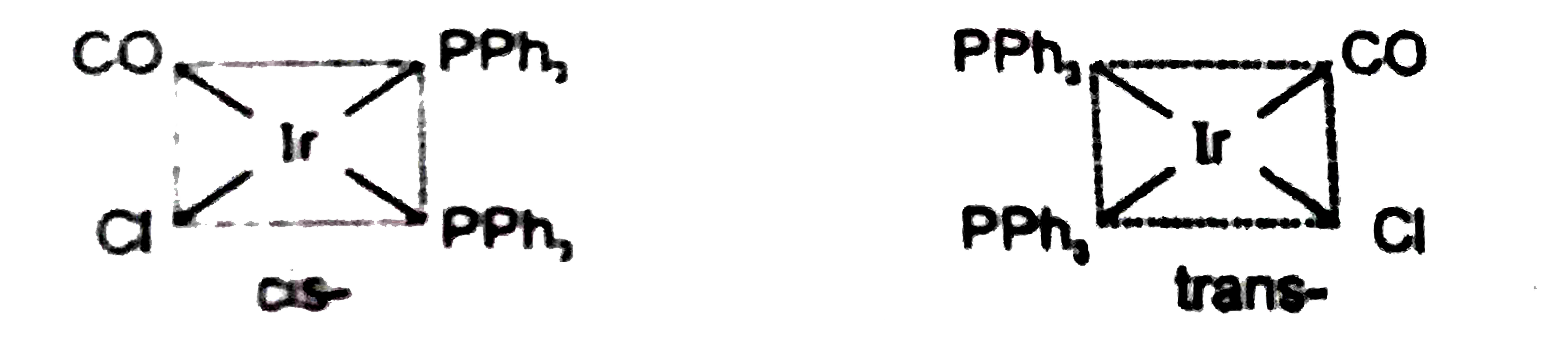
|
|
| 44. |
How many isomers are possible for the compound with molecular formula C_(4)H_(8)? |
| Answer» Answer :B | |
| 45. |
How many isomers are possible for the complex ion [Cr(NH_(3))Cl_(3)(OH)_(2)]^(2-) ? |
|
Answer» Solution :`[M a b_(3) C_(2)]` |
|
| 46. |
How many isomers are possible for the complex ion [Cr(NH_(3))_(3)Cl_(3)] ? |
|
Answer» 3 |
|
| 47. |
How many isomers are possible for molecular formula C_(3)H_(7)X ? |
|
Answer» 2 |
|
| 48. |
How manyisomers are possiblefor glucosethat have 4 asymmeticcarbon atoms ? |
|
Answer» 8 isomers |
|
| 49. |
How many isomers are possible for an octahedral complex of the type MA_(2)B_(2)C_(2) ? |
|
Answer» 3 |
|
| 50. |
How many isomers are possible for C_(4)H_(9)X ? |
|
Answer» 1 |
|