

Saved Bookmarks
This section includes 7 InterviewSolutions, each offering curated multiple-choice questions to sharpen your Current Affairs knowledge and support exam preparation. Choose a topic below to get started.
| 1. |
How many grams of NaOH must be present in one litre of the solution of give it a pH = 12? |
|
Answer» 0.20 g/lit |
|
| 2. |
How many grams of NaOH are equivalent to 100 ml of 0.1 N oxalic acid |
|
Answer» 0.2 `=(0.1xx40xx100)/(1000)=0.4` |
|
| 3. |
How many grams of NaBr must be added to 270g of water to lower the vapour pressure by 3.125mm Hg at which vapour pressure of water is 50mm Hg (Na=23,Br=80) ? Assume 100% ionisation of NaBr. |
|
Answer» <P> van'tHoff FACTOR `i=2` let moles of `NaBr=2n_(1)` mole of `H_(2)O(mn_(2))=(270)/(18)=15` `(DeltaP)/(P_("solvent")=X_("solute")=(n_(1)i)/(n_(1)i+n_(2))` `(3.125)/(50)=(2n_(1))/(2n_(1)+15)` `(2n_(1)+15)/(2n_(1))=(50)/(3.125)=16` `1+(15)/(2n_(1))=16` `(15)/(2n_(1))=15` `n_(1)=0.5` `therefore NaBr` taken `=0.5` mol `=0.5xx103=51.5g`. |
|
| 4. |
How many grams of NaCl can be added to 785 mL of 0.0015 M AgNO_3before a precipitate forms? K_(sp) (AgCl) = 1.8 xx 10^(-10) . |
| Answer» SOLUTION :`5.5 XX 10^(-6) G` | |
| 5. |
How many grams of Na_(2)CO_(3) should be dissolved in 250 g of water to prepare 0.1 m solution? |
|
Answer» `therefore " 250 g of water should contain "Na_(2)CO_(3)=(0.1)/(4)"Mole = 0.025 mole "=0.025xx106 g = 2.65 g` |
|
| 6. |
How many grams of methyl alcohol should be added to I 0 litre tank of water to prevent its freezing at 268 K ? (K _(f) for water is 1.86 K k g mol ^(-1)) |
|
Answer» `880.07g` where m = molality `273 -268 =1.86 xx(W)/( M X v)` ` 5=1 .86 xx(w)/( 32xx10)` `w= ( 5xx32xx10)/(1.86)` `= 560.2 ~~ 868 .06g` |
|
| 7. |
How many grams of KCI should be added to 1.0 kg of water to lower its freezing point to -8^(@)C. Calculate the degree of molality of BaCI_(2) in this solution. (K_(b) "for water "=0.52 K m^(-1)) |
|
Answer» `KCIoverset(("AQ"))toK^(+)CI^(-)("aq")therefore" Van't Hoff factpr"(i)=2` `DeltaT_(f)=0^(@)C-(-08^(@)C)=8^(@)C=8C=8K, *K, K_(f)=1.86" K KG mole"^(-1)` `DeltaT_(f)=ixxK_(f)xxm or m=(DeltaT_(f))/(ixxK_(f))` `m=((8K))/(2xx(1.86"K kg mol"^(-1)))=2.15" mol kg"^(-1)=2.15m` `therefore"Mass of KCI in grams = (2.15 mol)XX(74.5" g mole "^(-1))=162.2 g.` |
|
| 8. |
How many grams of ice at 0^(@)C can be melted by the addition of 500 J of heat (The molar heat of fusion for ice is 6.02 kJmol^(-1)) |
|
Answer» 0.0831 G |
|
| 9. |
Solubility product of silver bromide is 5.0xx10^(-13). The quantity of potassium bromide (molar mass taken as 120 g mol^(-1)) to be added to 1 litre of 0.05 M solution of silver nitrate to start the precipitation of AgBr is : |
|
Answer» `2.5xx10^(-14)g` |
|
| 10. |
How many grams of I_2 are present in a solution which require 40 ml of 0.11 N Na_2 S_2 O_3 to react with it ? S_2 O_3^(2-) + I_2 to S_4 O_6^(2-) + 2I^(-) |
|
Answer» 12.7 G |
|
| 11. |
How many grams of H_2SO_4 are present in o.25 mole of H_2SO_4. |
|
Answer» 2.45 |
|
| 12. |
How many grams of gas would be adsorbed per gram of a substance at 8 atm by assuming Freundlich adsorption isotherm. (x)/(m) = kp^(1//m)"" and "" k = 10^(-2)atm^(-1//3)"" & "" n = 3. |
| Answer» SOLUTION :`0.02 G` | |
| 13. |
How many grams of H_(2) and O_(2) are produced during the electrolysis of water under a 1.30 amp of current for 5 hours ? What volumes of dry gases are produced at NTP ? |
| Answer» SOLUTION :`{{:(H_(2)-0.245 G, O_(2)-1.94 g),(H_(2)-2.72 L, O_(2) - 1.36 L):}}` | |
| 14. |
How many grams of copper will be replaced in 2L of a 1.50 M CuSO_(4) solution if the latter is made to react with 27.0 of aluminium (Cu=63.5, AI= 27.0) |
|
Answer» `190.50g` `underset("2 mol")(2Al)+underset("3 mol")(3CuSO_(4))to Al_(2)(SO_(4))_(3)+underset("3 mol")(3 CU)` 2 mol of Al = 3 mol of Cu (27g = 1 mol of Al) `=(3)/(2)xx6.3g` of Cu = 95.25 g |
|
| 15. |
How many grams of concentrated nitric acid solution should be used to prepare250 mL of 2.0M HNO_(3) ? The concentrated acid is 70% HNO_(3) |
|
Answer» `90.0` G conc. `HNO_(3)` `2= (wt)/(63) GM` wt. of `70%` acid `=(100)/( 70) xx 31.5 =45` gm |
|
| 16. |
How many grams of concentrated nitric acid solution should be used to prepare 250 mL of "2.0 M HNO"_(3) ? The concentrated nitric acid is 70%HNO_(3) |
|
Answer» `"45.0 G conc HNO"_(3)` `=(2)/(1000)xx250=?0.5 MOL "=0.5xx63 g = 31.5g` As concentrated `HNO_(3)` is `70%` , therefore, concentrated `HNO_(3)` required `=(100)/(70)xx31.5g=45g` |
|
| 17. |
How many grams of concentrated nitric acid solution should be used to prepare 250 mL of 2.0 M HNO_(3) ? The concentrated acid is 70% HNO_(3) . |
|
Answer» 90.0 g conc. `HNO_(3)` `2=("mass"//63)/(100)xx63=31.5` Mass of `HNO_(3)` required for 70% solution `=(31.5xx100)/(70)=45.0g` |
|
| 18. |
How many grams of chlorine can be produced by the electrolysis of molten NaCl with a current of 1.00 A for 15 min? Also calculate the number of chlorine molecules liberated. |
|
Answer» `2CL^(-)toCl_(2)+2E^(-),""2xx96500" C liberate "Cl_(2)=1`mole `therefore900C` will liberate `Cl_(2)=(1)/(2xx96500)xx900=4.66xx10^(-3)"mole"=(4.66xx10^(-3))xx71g=0.331g` `=(4.66xx10^(-3))xx6.02xx10^(23)` molecules `=2.80xx10^(21)` molecules. |
|
| 19. |
how many grams of cobalt metal will be deposited when solution of cabalt (II) chloride is electrolyzed with a current of 10 amperes for 109 minutes (1Faraday=96,500 C, Atomic mass of Co=59u) |
|
Answer» 4 `thereforew=(E_(B)xxIt)/(96500) ""(thereforeE_(B)=(M_(B))/(Z)=(59)/(2))` `w=(59)/(2)xx(10xx109xx60)/(96500)` w=19.9 |
|
| 20. |
How many grams of CH_(3)OH should be added to water to prepare 150 ml solution of 2.0 M CH_(3)OH ? |
|
Answer» 9.6 `2.0=("Wt. of " CH_(3)OH xx 1000)/(32xx150)` `:.` Wt. of `CH_(3)OH=(2.0xx32xx150)/(1000)=9.6 G` |
|
| 21. |
How many grams of calcium oxalate should be dissolved in water to make one litre of saturated solution? K_sp of CaC_2O_4 is 2.5 x 10^-9 and its molecular weight is 128 u |
|
Answer» `6.4*10^-3 G` |
|
| 22. |
How many grams of CaO are required to neutralise 852g of P_(4)O_(10)? |
|
Answer» Solution :The REACTION will be: `6CaO+P_(4)O_(10)rarr2Ca_(3)(PO_(4))_(2)` `852g P_(4)O_(10) m3 "mol" P_(4)O_(10)` 1 MOLE of `P_(4)O_(10)` neutralises 6 MOLES of `CAO` `therefore 3 "moles of" P_(4)O_(10)` will neutralise 18 moles of CaO. `therefore "mass of" CaO=18xx56=1008g` |
|
| 23. |
How many grams of CaF_2must be dissolved in 100 mL of water at 25^@Cto make the solution saturated? K_(sp)(CaF_2) = 3.9 xx 10^(-11) |
| Answer» SOLUTION :`1.66 XX 10^(-3)G ` | |
| 24. |
How many grams of CaC_(2)O_(4) (molecular weight = 128) on dissolving water will give a saturated solution [K_(sp)(CaC_(2)O_(4)) = 2.5 xx 10^(-9) mol^(2) I^(-2)] |
|
Answer» `0.0064 G` `= 5 xx 10^(-5) mol L^(-1)` `= 5 xx 10^(-5) xx 128 = 640 xx 10^(-5) = 0.0064 g`. |
|
| 25. |
How many grams of CaC_(2)O_(4) will be dissolved in 1L of distilled water to make its saturated solution ? (K_(sp)" of " CaC_(2)O_(4)=2.5xx10^(-9)and mol. wt. of CaC_(2)O_(4)=128) : |
|
Answer» 0.0064 G |
|
| 26. |
How many gramsof CaC_2O_4 saturation will dissolve in one litre of saturated solution ? ( K_sp of CaC_2O_4 is 2.5 xx 10^_9 mol^-2 and its molecular weight is 128). |
|
Answer» 0.0064g |
|
| 27. |
How many grams of barium chloride (BaCl_(2)) are needed to prepare 100cm^(3) of 0.250 mL of a 0.50 M BaCl_(2) solution? |
|
Answer» For 1000 `CM^(3)` of 1 M `BaCl_(2)` so. Mass of `BaCl_(2)` needed `=(208)/(1000)x100xx0.25g=5.20g` |
|
| 28. |
How many grams of a non volatile solute having a molecular mass of 90 g/mole are to be dissolved in 97.5 g water in order to obtain relative lowering in the vapour pressure of 2.5 percent: |
|
Answer» 25 |
|
| 29. |
How many grams of a dibasic acid (Mol. Wt.=200) should be present in 100mL of its aqueous solution to give decinormal strength? |
|
Answer» |
|
| 30. |
How many grams atoms of S are present in 0.25 g of S |
|
Answer» 2.5 |
|
| 31. |
How many gram of KMnO_(4) are contained in 4 litres of 0.05N solution? The KMnO_(4) is to be used as an oxidant in acid medium. ( Mol. wt. of KMnO_(4) = 158) |
|
Answer» 1.58g |
|
| 32. |
How many gram of KMnO_(4)are contained in 4 litre of 0.05 N solution . The KMmO_(4) is to be used as an oxidant in acidic medium ? |
|
Answer» 1.58 g |
|
| 33. |
How many gram of HCl will be present in 150 ml of its 0.52 M solution |
|
Answer» 2.84 GM |
|
| 34. |
How many gram atoms of oxygen are present in 11.2 litres of CO_2at NTP ? |
|
Answer» |
|
| 35. |
How many gm of the oxidising agent gets reduced in the reaction of 65.4 gm of Zn with concentrated nitric acid ? |
|
Answer» 126 |
|
| 36. |
How many gm of H_(2)SO_(4) is present in 0.25 gm mole of H_(2)SO_(4) |
|
Answer» `24.5` |
|
| 37. |
How many gm. of ethanol is required in the reaction with Na metal in order to give 560 ml. dihydrogen gas at STP ? [mole. mass of ethanol = 46 gm mol^(-1)] |
|
Answer» 1.15 `(560 XX 46)/(11200)= 2.3` gram Na is NEEDED. |
|
| 38. |
How many gm of bromine will react with 21 gm C_3H_6 |
|
Answer» 80 `because` 24 gms of propene reacts with 160 gms of bromine `because` 21 gms of propene `160/42xx21=80` gms |
|
| 39. |
How many germs of K_(2)C_(7)O_(7) are required to oxidise 20.0g of Fe^(+) ion in FeSO_(4) "to" Fe^(3+) ions if the reaction is carried out in the acidic medium? Molar mass of K_(2)Cr_(2)O_(7) and FeSO_(4) are 294 and 152 respectively. |
|
Answer» 6.45g =0.132mol Ionic equation for the OXIDATION reaction carried in the acidic medium may be WRITTEN as: `Cr_(2)O_(7)^(2-)+6Fe^(2+)+14H^(+) to 2Cr^(3+)+6fe^(3+)+7H_(2)O` 6 mol. of `Fe^(2+) -= ` 1 mol of `K_(2)Cr_(2)O_(7)` 0.132 mol of `Fe^(2+)-=((1 mol))/((6 mol))xx(0.132 mol^(-1)` = 0.022 mol . of `K_(2)Cr_(2)O_(7)` MASS of `K_(2)Cr_(2)O_(7) = (0.022 mol) xx(294 g mol ^(-1))` = 6.468 g. |
|
| 41. |
How many geometrical isomers of this compound are possible: |
|
Answer» 0 |
|
| 42. |
How many geometrical isomers of this compound are possible ? |
|
Answer» 0 |
|
| 43. |
How many geometrical isomers are there for(a) [CO(NH_(3))_(2)Cl_(4)], octahedral (b) [AuCl_(2)Br_(2)] square planar (c) (CoCl_(2)Br_(2)]tetrahedral |
|
Answer» SOLUTION :TWO, CIS- and trans (b) Two, cis- and trans (c) No isomerism is exhibited. |
|
| 44. |
How many geometrical isomers arepossible for [Pt(NO_(2))(NH_(2)OH)(Py)]^(+)? |
|
Answer» |
|
| 45. |
How many geometrical isomers are possible in the following coordination entities ? (i) [Cr(C_(2)O_(4))_(3)]^(3-) (ii) [CoCl_(3)(NH_(3))_(3)] |
| Answer» Solution :(i) NIL (ii) Two (fac and MER) | |
| 46. |
how many geometrical isomers are posssible in the following coordination entitles ? (a) [Cr(C_(2)O_(4))_(3)]^(3-)(b) [Co(NH_(3))_(3)CL_(3)] |
|
Answer» SOLUTION :(a)`[Cr(C_(2)O_(4))_(3)]^(3-)`: No GEOMETRICAL isomerism is possible . (b) `[Co(NH_(3))_(3)CL_(3)]`: Two geometrical ISOMERS : fac and mer For details, consult section 7 . |
|
| 47. |
How many geometrical isomers are possible for [Pt(Py)(NH_(3))(Br)(Cl)] ? |
|
Answer» 3 |
|
| 48. |
How many geometrical isomers are possible in the following coordination entities ? [Cr(C_(2)O_(4))_(3)]^(3-) |
Answer» SOLUTION :There is no POSSIBILITY of GEOMETRICAL ISOMERISM. 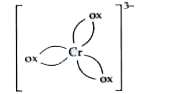
|
|
| 49. |
How many geometrical isomers are possible in the following coordination entities ? [Co(NH_(3))_(3)Cl_(3)] |
Answer» Solution :TWO GEOMETRICAL isomers are possible as GIVEN below : 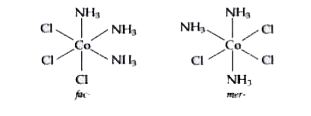
|
|
| 50. |
How many geometrical isomers are possible for the square planar complex [Pt(NO_(2))(py)(NH_(3))(NH_(2)OH)]NO_(2) (a) Four (b) Five (c ) Eight (d) Three . |
|
Answer» 4 |
|