

Saved Bookmarks
This section includes 7 InterviewSolutions, each offering curated multiple-choice questions to sharpen your Current Affairs knowledge and support exam preparation. Choose a topic below to get started.
| 1. |
How many isomers are possible for Bromo methyl cyclopentane (Ignoring chirality) |
Answer» 
|
|
| 2. |
How many isomers are possible for a compound with formula, [Co(en)_(2)Cl(NO_(2))]Cl ? |
|
Answer» 2 |
|
| 3. |
How many isomeric structural alkene on catalytic hydrogenation gives 3-Methyl hexane. |
Answer» SOLUTION :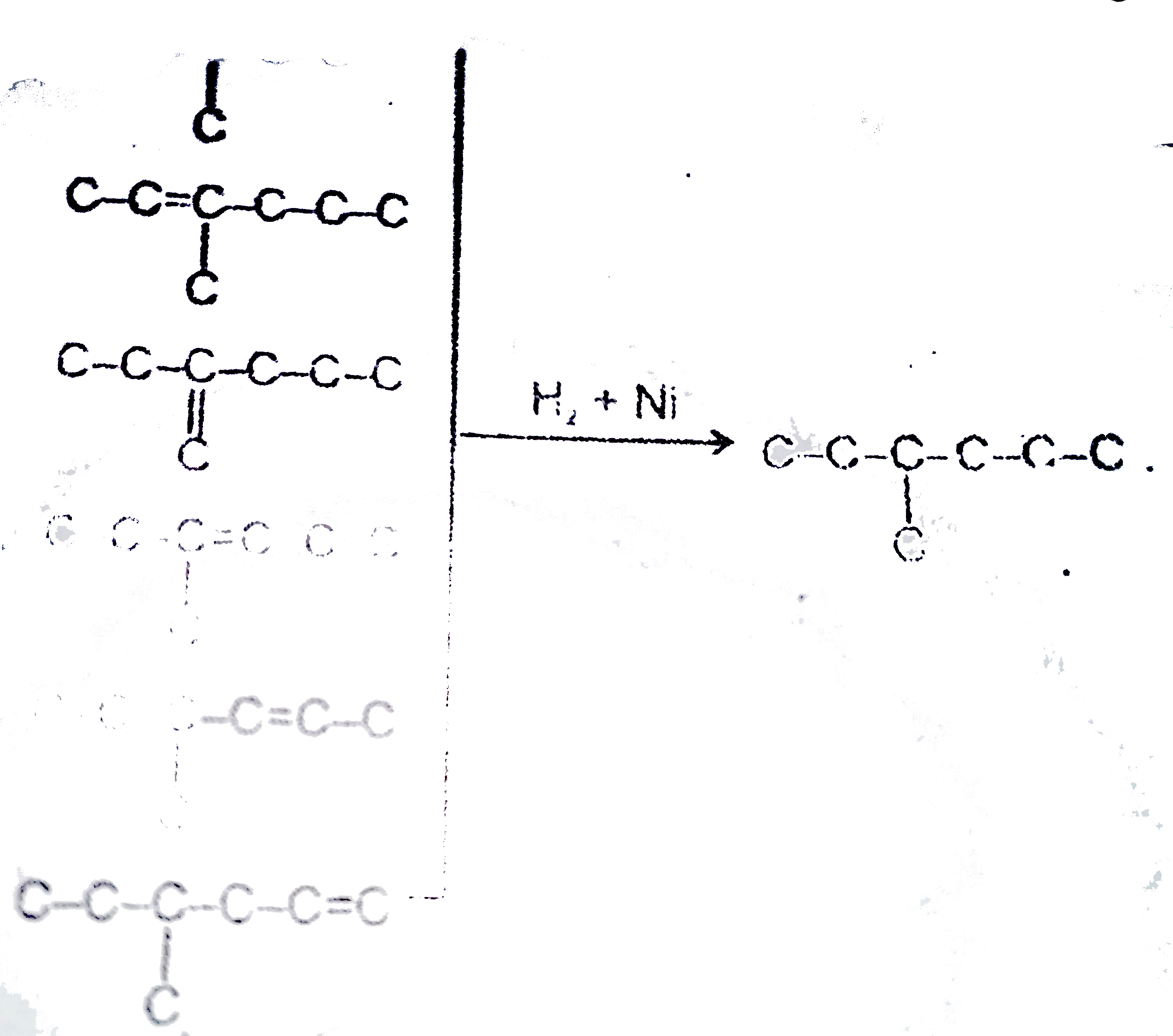
|
|
| 4. |
How many isomeric ether are represented by the molecular formula C_4H_10O |
|
Answer» 3 (i)`CH_3-O-CH_2CH_2CH_3` (ii)`CH_3-O-underset(CH_(3))underset(|)CHCH_3` (iii) `CH_3CH_2-O-CH_2CH_3` |
|
| 5. |
How many isomeric forms of C_(7)H_(9)N contain a benzene ring ? |
|
Answer» 4 
|
|
| 6. |
How many isomeric compounds will be obtained when a disubstituted derivative of benzene is prepared from its monosubstituted derivative? |
|
Answer» 3 |
|
| 7. |
How many isomeric butanes are formed by the diazotization of n-Bu-NH_(2)? |
Answer» 
|
|
| 8. |
How many isomeric amines have the molecular formula C_(4)H_(11)N? |
|
Answer» The total number of optically active COMPOUNDS from the following list is |
|
| 9. |
How many isomeric alkynes oncatalytic hydrogenation gives 3-Ethyl-4-methylheptane ? |
|
Answer» `CH_(3)-CH_(2)-CH_(2)-underset(CH_(3))underset(|)(CH)-underset(CH_(2)-CH_(3))underset(|)(CH)-C-=-CH` |
|
| 10. |
How manyisomeric alkyne on hydrogenation gives 3,3-Dimethylhexane. |
|
Answer» |
|
| 11. |
How many isomeric acyclic alcohola and ethers are possible for C_(4)H_(8)O ? |
|
Answer» 3 |
|
| 12. |
How many isomaric alkenes (structural only) on hydrogenation can give following compound? |
Answer» SOLUTION :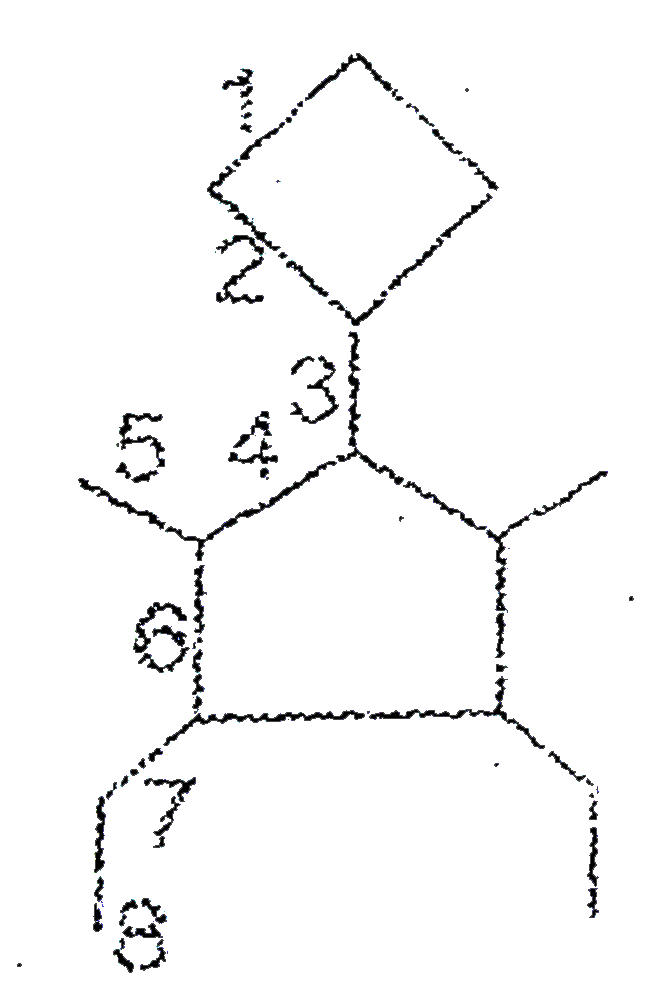
|
|
| 13. |
How many isomeres are possible for compounds having the molecular formubal CH_(5)H_(11)Br |
|
Answer» nine 2.`underset(2-"bromo pentane")(CH_(3)-CH_(2)-CH_(2)- underset(Br) underset(|)(CH)-CH_(3))` 3. `underset(3-"bromo pentane")(CH_(3)-CH_(2)-CH_(2)- underset(Br) underset(|)(CH_(2))-CH_(3))` 4. `underset(1-"bromo 2-2dimethyl propane") underset(CH_(3)) underset(|) overset(CH_(3)) overset(|)(CH_(3)-C-CH_(2))-Br` 5. `underset(2-"bromo 3-methyl butane")(CH_(3)- overset(CH_(3)) overset(|)(CH)- underset(Br)underset(|)(CH-CH_(3)))` 6. `underset(1-"bromo 2-methyl butane") (CH_(3)CH-underset(C_(2)H_(5)) underset(|)(CH_(2))-Br)` 7. `underset(1-"bromo 2-methyl butane")(CH_(3)-overset(CH_(3)) overset(|) underset(Br) underset(|)C-C_(2)H_(5)` 8. `underset("1-bromo 3-methyl butane") (CH_(3)-underset(CH_(3))underset(|)(CH)-CH_(2)-CH_(2)-Br)` |
|
| 14. |
How many iron atoms are present in a stainless stell ball bearing having a radius of 0.254 cm? the stainless steel contains 85.6% Fe by weight and has density of 7.75 g//cm^(3). |
|
Answer» |
|
| 15. |
How many ions per molecules are produced in the solution when Mohr's salt is dissolved in excess of water ? |
|
Answer» 4 |
|
| 16. |
How many ions are produced from the complex [Co(NH_3)_6]Cl_2 in solution ? |
|
Answer» 6 |
|
| 17. |
How many ions per molecule are produced in the solution when Mohr salt is dissolved in excess of water ? |
|
Answer» 6 |
|
| 18. |
How many ions are produced from the complex [Co(NH_(3) )_(5) CI]CI_(2) in solution? |
|
Answer» 4 |
|
| 19. |
How many ions are produced from the complex Co(NH_(3))_(6)Cl_(2) in solution ? |
|
Answer» 6 |
|
| 20. |
How many ions are produced from the complex, Co(NH_(3))_(6)Cl_(2) in solution ? |
|
Answer» Solution :COORDINATION number of cobalt =6. HENCE, the complex is `[Co(NH_(3))_(6)]Cl_(2)`. It ionizes in the solution as : `[Co(NH_(3))_(6)]Cl_(2)overset(+aq)rarr[Co(NH_(3))_(6)]^(2+)+2Cl^(-)` Thus, THREE ions are produced. |
|
| 21. |
How many ions are produced from the compex,[Co(NH_3)_6] Cl_2 is solution ?(i) 6(ii) 4(iii) 3 (iv) 2 |
|
Answer» Solution :The CORRECT option is (III) Co- ORDINATION number of cobalt= 6. It isionizes in the solution as : `[Co(NH_3)_6 ] Cl_2 overset(Aq)to [Co(NH_3)_6]^(2+) + 2Cl^(-)` . Hence three IONS are PRODUCED. |
|
| 22. |
How many ions can be produced from [Co(NH_3)_6]Cl_3 in aqueous solution. |
|
Answer» 6 |
|
| 23. |
How many ions are formed by the complex [Co(NH_(3))_(6)]Cl_(3) in aqueous solution? |
| Answer» Solution :FOUR ions: `[CO(NH_(3))_(6)]Cl_(3) overset(aq)ltimplies [Co(NH_(3))_(6)]^(3+) (aq) + 3Cl^(-) (aq)` | |
| 24. |
How many ions are formed per molecule of potassium hexacyano ferrate (II) when dissolved in water? |
| Answer» SOLUTION :FIVE or 5. | |
| 25. |
How many inches are there in 3.00 km ? Given that 1 km = 1000 m, 1 m = 1.094 yd, 1 yd = 36 in. |
|
Answer» Solution :The UNIT conversion factors will be : `1=(1000M)/(1km)=(1km)/(1000m),""1=(1.094yd)/(1 m)=(1m)/(1.094yd),""1=(36"in")/(1yd)=(1yd)/("36 in")` Here, the conversion involves a number of steps. Hence, the unit conversion factors are applied in such a WAY that the units of the PRECEDING factor cancel out. Thus, `3.00km=3.00 cancel(km)xx(1000cancelm)/(1cancel(km))xx(1.094cancel(yd))/(1cancelm)xx("36 in")/(1 cancel(yd))=1.18xx10^(5)" in".` Note that the answer has been reported to contain THREE significant figures (because 1000 m and 36 in. are exact numbers). |
|
| 26. |
How many interhalogen compounds are not possible ? IC l,IB r,Brl,ClBr_(3),ClF_(3),BrCl_(5),BrI_(5),Icl_(3),IF_(7) |
|
Answer» |
|
| 27. |
How many hygroscopic compounds are formed when Cl_(2) reacts with hot aqueous NaOH. |
|
Answer» NACL and `NaClO_(3)` both are hygrocopic in nature. |
|
| 28. |
How many incomplete orbitals are present in inner transition elements ? |
|
Answer» |
|
| 29. |
How many hydrogen bonds are present between pair of thymine and adenine in DNA? |
|
Answer» 1-hydrogen BOND |
|
| 30. |
Number of hydorxyl groups present in pyrosulphuric acid is |
|
Answer» |
|
| 31. |
How many hydrocarbons having molecular mass 68 can give while precipitate with Tollen's reagent ? |
Answer» SOLUTION :
|
|
| 32. |
How many hours does it take to reduce 3 mol of Fe^(3+) to Fe^(2+) with 2.00 A current (1 Faraday=96,500 C mol^(-1),R=8.314JK^(-1)mol^(-1)). |
|
Answer» `t=Q//I=(3xx96500)//2.0=144750s=40.2`HRS. |
|
| 33. |
How many homopolymer are given below ? (a) PVA(b) Gutta percha (c ) Gltptal(d) Buna-S (e ) Bakelite(f) Natural rubber (g) Buna -N(h) Nylon-66 (i) Terylene(j) Novalac |
|
Answer» |
|
| 34. |
How many hours are needed to deposit the metal based on the reaction . Fe^(2+)(aq) + 2e^(-) to Fe(s). using a current strength of 0.02amp. |
|
Answer» |
|
| 35. |
How many hours are required for a current of 3 amp of decompose electrolitically 18 g of water ? |
|
Answer» |
|
| 36. |
How many halogen atoms will be removed in the following E_(2) reaction ? |
|
Answer» 4 |
|
| 37. |
How many half cells are present in an electrochemical cell? |
|
Answer» 3 |
|
| 38. |
How many H-atoms are present in 0.046g ofethanol |
|
Answer» `6 XX 10^(20)` `= 2 xx 12 + 5 + 16 + 1 = 46` `:' 46g C_(2)H_(5)OH` has H atom = `6xx N_(A)` `:' 0.046 g` of `C_(2)H_(5)OH` has `H` atoms `= (6 xx 6.02 xx 10^(23) xx 0.046)/(46) = 3.6 xx 10^(21)` |
|
| 39. |
How many groups are o//p director in the electrophilic aromatic substitution ? (i) -NH_(2) (ii) -COH (iii) -N = O (iv) -COOH (v) -OMe (vi) - O - overset(O)overset(||)(C) - Me (vii) -Et (viii) - overset(O)overset(||)(C) - NH - Me (ix) - N = NH_(2) (x) - SO_(3)H |
|
Answer» (VII) `-Et` (IX) `-N = NH_(2)` |
|
| 40. |
How many grams of urea should be added in 500CC of water (k = 1.86) to produce a depression of 0.186^(@)C in freezing point. |
|
Answer» |
|
| 42. |
How many grams of sucrose (M. wt. = 342) should be dissolved in 100 g water in order to produce a solution with 105.0^(@)C difference between the freezing point and the boiling point ? (K_(f)=1.86^(@)C//m, K_(b)=0.51^(@)C//m) |
|
Answer» Solution :`DeltaT_(b)=K_(b)xxm` `"B. PT of solution "(T_(b))=100+DeltaT_(b)=100+K_(b)m` `"F. pt of solution "(T_(b))=0-DeltaT_(f)=0-K_(f)m, T_(b)-T_(f)=(100+K_(b)m)-(-K_(f)m)` `"F. pt. of solution "(T_(f))= 0-DeltaT_(f)=0-K_(f)m,""T_(b)-T_(f)=(100+K_(b)m)-(K_(f)m)` `""105=100+0.51xxm+1.86m.` This gives m = 2.11, i.e., 1000 G of water contain sucrose = 2.11 MOLE `=2.11xx342 g` `therefore"Mass of sucrose to be dissolved in 100 g of water "=(2.1xx342)/(1000)xx100=72g.` |
|
| 43. |
How many grams of sucrose should be dissolved in 100g water in order to produce a solution having difference between the free zing point and the boiling point temperatures at 105.0^@C |
|
Answer» `34.2` |
|
| 44. |
How many grams of sucrose (Molecular weight = 342) should be dissolved in 100 g water to produce a solution with a 105^(@) difference between the freezing point and the boiling temperatures? [K_(l)= 1.86, K_(b) = 0.51] |
|
Answer» 34.2 g |
|
| 45. |
How many grams of silver could be plated out on a serving tray by electrolysisof a solution containing silver in +1 oxidation state for a period of 8.0 hours at a current of 8.46 amp? What is the area of the tray if the thickness of the silver plating is 0.00254 cm? Density of silver is 10.5 g//cm^3 |
| Answer» SOLUTION :`271.65 G, 1.02 XX 10^4 cm^2` | |
| 46. |
How many grams of sodium acetate are to be added to a litre of 0.4 M CH_3 COOH solution so that the [H^+] of the resultant solution is 2 xx10^(-4)g ion/L? (Given K_a for acetic acid = 1.8 xx 10^(-5) ) |
|
Answer» `3.502 g` `-log( 2xx 10^(-4) ) =- log( 1.8 XX 10^(-5) ) + log(["salt"])/( 0.4)` `3.699 = 4.74+ log(["salt"])/(0.4 )` ` thereforelog(["salt"])/( 0.4 ) =- 1.041 or(["salt "])/(0.4 ) =0.091` or `["salt "] = 3.6 xx 10^(-2)` ` therefore `AMOUNTOF sodiumacetateto beadded`= 3.6 xx 10^(-2)xx 82 = 2.952`g ( molarmass of`CH_3 COONa=82`) |
|
| 47. |
How many grams of silver could be plated out on a serving tray be electrolysis of a solution containing silver in +1 oxidation state for period of 8.0 hours at a current of 8.46 amperes? What is the area of the tray if the thickness of the silver plating is 0.00254 cm? Density of silver is 10.5g/cm^(3). |
|
Answer» AREA of tray`=(25.9)/(0.00254)=1.02xx10^(4)cm^(2)`. |
|
| 48. |
How many grams of nickel are deposited by a current of 100 milliampere in 20 minutes in the electrolysis of aqueous nickel sulphate solution ? (Given atomic mass of Ni =58.7 amu.) |
|
Answer» `underset(1MOL)Ni^(2+)(aq)+underset((2 Faradays))underset(2mol)(2e^(-))to underset((58.7 G))underset(1mol)(Ni(s))` Quantity of charge PASSED (Q)`="Current in ampere" xx"time in seconds "` `=(100//1000 amp.)xx(20xx60 s)=120 As =120 C` `2xx96500 C`of charge deposit Ni=58.7 g 120 C of charge Ni`=((58.7 g))/((2xx96500C))xx(120C)=0.0365 g`. |
|
| 49. |
How many grams of NaOH will be required to prepare 500 gram solution containing 10% W/W NaOH solution ? |
|
Answer» 5 g |
|
| 50. |
How many grams of NaOH should be dissolved to make 100 cm^(3) of 0.15 M NaOH solution? |
|
Answer» SOLUTION :`1000cm^(3)` of 0.15 M NaOH cotain NaOH = 0.15 mole `therefore""100cm^(3)" of 0.15 M NaOH cotain NaOH"=(0.15)/(1000)xx100=0.015" mole"=0.015xx40g=0.6g` `""("Molar mass NaOH = 40 g mol"^(-1))` |
|