

Saved Bookmarks
This section includes 7 InterviewSolutions, each offering curated multiple-choice questions to sharpen your Current Affairs knowledge and support exam preparation. Choose a topic below to get started.
| 1. |
How long 3 ampere current should be pass to obtain 0.1 mol Cl_(2) gas through electrolysis of molten NaCl ? |
|
Answer» 220 MINUTE `W=(epsixxixxt)/(96500)` `0.1xx71=(35.5)/(96500)xx3xxt`(second). t=6433.33 second=107.22 minute`~~`110 minute |
|
| 2. |
How ligands are classified ? Explain with suitable examples. |
|
Answer» Solution :Ligands can be classified into the following types depending upon the number of DONON atomsin the ligands. (a) Mono or unidentate ligands : Having only ONE donor atom. For example : `NH_(3)` nitrogen, is the only donon atom. (b) Poly or multidenate ligands : Having two ro more donor atoms. For example : Ethylene diamine (en) `underset("two")overset(**)(NH_(2))underset("donor")(CH_(2))-underset("atoms")(CH_(2))overset(**)(NH_(2))` `["EDTA"]^(4-)` is ETHYLENEDIAMINE tetra acetate six donor atoms (c) Ambident ligands: If a ligand had two or more donor atoms, while when a COMPLEX is formed only one donor atom is attached to the metal then it is CALLED ambidentate ligand. For example, `NO_(2)` has donor atom N and O out of the two only one donor atom is is linked to the metal as M-ONO or `MNO_(2)`. |
|
| 3. |
How long 10 miliampere current should be passed through dilute aqueous solution of NaCl, so that 0.01 mol H_(2) gas can be liberated ? [1F=96500C] |
|
Answer» `9.65xx10^(4)S` |
|
| 4. |
How long 100 amp current should be pass for electrolysis of water which liberate oxygen which is sufficient for complete combustion of 27.66 gm diborane ? (atomic weight of B=10.8 u) |
|
Answer» 6.4 hours Its MOLECULAR mass=`(10.8)2+6(1)` `=21.6+6=27.6" g "MOL^(-1)` |
|
| 5. |
How lanthanoids reacts with water and dil. Acids? |
|
Answer» SOLUTION :With water lanthanoids gives HYDROXIDES with the LIBERATION of hydrogen. `6Ln+6H_(2)Orarr2Ln(OH)_(3)+3H_(2)` With DIL acid they liberate hydrogen `Ln+dil" ACIDS"rarrH_(2)` gas. |
|
| 6. |
How average K.E. of a gas molecule is related to the temperature ? |
| Answer» SOLUTION :`K.E. OO`TEMPERATURE. | |
| 7. |
How is zinc extracted ? |
|
Answer» Solution :Occurrence. Zinc does not occur in the free state. In the COMBINED state, it occurs in the following ores: (i) Zincite (red zinc ore)ZnO (ii) Zinc blendeZns (iii) Calamine (zinc spar)`ZnCO_3` In India, zinc is found in Zawar mines in Udaipur in Rajasthan and in certain parts of Kashmir. Extraction Carbon-reduction Process. It involves the following steps for extraction of zinc from zinc blende and calamine ores. 1. Concentration. The ore is first dressed to remove the rocky material sticking to it. It is then finely powdered. The main impurity present in the ore is that of iron which is removed by electromagnetic separation method. It is the concentrated by the froth floatation process which removes earthy and siliceous impurities. (it is applied to sulphide ore only). 2. Roasting. (a) In the case of the carbonate ore i.e.. calamine, the concentrated ore is calcined to remove moisture and carbon dioxide. `ZnCO_3 to ZnO + CO_2` (b) The sulphide ore is roasted at about 1200 K in excess of air by external heating. The following reactions TAKE place. `2ZnS + 3O_2 to 2ZnO + 2SO_2` During roasting some zinc sulphate is also formed. `ZnS + 2O_2 to ZnSO_4` But at high temperature the sulphate ore is decomposed `2ZnSO_4 to 2ZnO + 2SO_2 + O_2` 3. Reduction of zinc oxide to zinc metal. Zno obtained above is reduced to zinc metal by any of the following methods. Belgian Process. The oxide obtained above is mixed with crushed COKE and heated to about 1670 K in fire clay retorts. Zinc being volatile distils over and is received in an earthware pot where it condenses. The crude metal obtained is called zinc spelter. 4. Refining of zinc. It may be carried out by the following methods : (i) By distillation. Spelter contains lead, iron, cadmium and arsenic as the impurities. These are separated by utilizing the difference in their boiling points. When the spelter is distilled at 1225-1275 K, only zinc and cadmium DISTIL over while iron and lead remain behind. Zinc obtained in this way, is collected in a chamber maintained at about 1075 K where zinc REMAINS but cadmium, being more volatile, escapes out. (ii) By electrolysis. An electrolytic cell containing acidified solution of zinc sulphate is used. The anode is made of spelter and cathode of the pure zinc wire. On passing the current, pure zinc settles at the cathode and impurities are left at the anode as the anode mud. Zinc dust. To prepare zinc dust, the metal is melted and then atomised by a blast of air. Granulated Zinc. It is prepared by pouring molten zinc into cold water. |
|
| 8. |
How is xenon separated from mixture of argon- krypton-xenon adsorbed on coconut charcoal by Dewar's method. |
|
Answer» Solution :CHARCOAL containing `Ar, Kr & Xe` is BROUGHT in contact with another charcoal maintained at `93 K or -180^(@)C`. Ar diffuses in to NEW charcoal. Sample containing Kr & Xe is heated to `183K or -90^(@)C, Kr` SEPARATES. Charcoal containing Xe is furthers heated to `273 or 1 0^(@)C Xe` separates. |
|
| 9. |
How is XePtF_(6) prepared ? |
|
Answer» Solution :Xenon is TREATED with PLATINUM hexafluoride to get the compound `Xe+PtF_(6)RARR Xe[PtF_(6)]` |
|
| 10. |
How is Xanthoproteic test for a protein performed ? What is the observation made ? |
|
Answer» Solution :By treating the PROTEIN with CONC. `HNO_(3)`. YELLOW colour/yellow precipitate. |
|
| 11. |
How is wrought iron prepared from cast iron? |
|
Answer» Solution :Cast iron containing impurities like C, S, P and Si is oxidized in a reverboratory furnace lined with haematite and using lime stone. Haematite oxidizes CARBON to carbon monoxide. `Fe_(2)O_(3)+3Crarr2Fe+3CO` Limestone oxidizes silicon, sulphur and phosphorous they REACT with lime to form slag. The PURE metal is removed and free from the slag by passing through ROLLERS. |
|
| 12. |
How is wrought iron different from steel? |
|
Answer» Solution :Wrought IRON is the purest FORM of commercial iron. It is used in making anchors, wires, bolts, chains, etc. Alloy steel is obtained when other METALS are ADDED to it. Nickel steel is used for making cables, automobiles, AEROPLANE parts, etc. Chrome steel is used for cutting tools and crushing machines. |
|
| 14. |
How iswroughtirondifferentfrom steel ? |
| Answer» SOLUTION :Themaindifference betweenwroughtiron and steelin percentage ofcarbon. WROUGHTIRON is purest form of iron. It containsbetween `0*2 - 0*5% `carbon. Steel, on theother HAND , containscarbon between`0*05 - 1*5%`.Besidesthis, toobtainsteel ofdesirableproperties, definite amountsof othertransition elementssuchas Cr, Ni, Mn and W are addedto it. | |
| 15. |
How is the vapour pressure of a solvent afffected when anon volatile solute is dissolved in it? |
| Answer» SOLUTION :It will DECREASE, | |
| 16. |
How is urea formaldehyde prepared? |
Answer» Solution : It is formed by condensation polymerisation of the monomers UREA and formaldehyde.  USES: It is used in decorative laminates, TEXTILES, wrinkle RESISTANT fabrics, paper and glue wood. |
|
| 17. |
How is toluene is obtained from phenol? |
Answer» SOLUTION :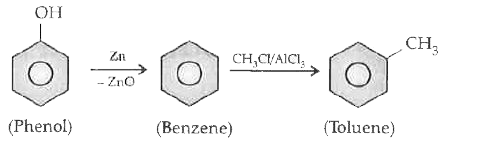
|
|
| 18. |
How is toluene converted to phenyl ethanamine? |
|
Answer» Solution :Toluene is converted to benzyl CHLORIDE by treating with `Cl_(2)` in light. It is then treated with KCN and reduced to get phenyl cthanaminc. `C_(6)H_(5)CH_(3)overset(Cl_(2))underset(light)rarrC_(6)H_(5)CH_(2)Cl overset(KCN)rarr` `C_(6)H_(5)CH_(2)CNoverset(LiAlH_(4))rarr C_(6)H_(5)CH_(2)CH_(2)NH_(2)`. |
|
| 19. |
How is thevariability of oxidationstates of the transition elements different from that of the non-transition elements ? Illustrate with examples. |
| Answer» Solution :The variability in oxidation states of transition metals is due to the INCOMPLETE filling of d-orbitals in such a way that their oxidation states differ from each other by unity,e.g., `FE^(2+)` and `Fe^(3+), Cu^(+)` and `Cu^(2+)` and `Cu^(2+)` etc. In case of non-transition elements, the oxidation states differ by units of two , e.g., `Pb^(2+)` and `Pb^(4+), Sn^(2+)` and `Sn^(4+)` etc. Moreover , in transition elements, the higher oxidation states are more stable for heavier elements in a group. For example , in group 6, MO(VI)and W(VI) are more stablethan Cr(VI) . In p-block elements , the lower oxidation states are more stable for heavier members due to inert pair effect, e.g., in group 16, Pb (II) is more stable than Pb(IV). | |
| 20. |
How is thiosulphate distinguished from sulphate? |
|
Answer» Solution :Thiosulphate gives YELLOW precipitate of sulphur on REACTION with a dilute mineral ACID. `Na_(2)S_(2)O_(3)+2HCl rarr 2NaCl+H_(2)O+SO_(2)+S` Sulphate, however, does not react with dilute mineral ACIDS. |
|
| 21. |
How is the variability in oxidation states of transition metals different from that of the non transition metals? Illustrate with examples. |
| Answer» Solution :The characteristic property of transition elements to show variable oxidation state arises out of INCOMPLETELY filld d-orbital in such a way that their oxidation states differ by UNITY Ex: V(II), V(III), V(IV) and V(V). However, in NON transition elements, teh oxidation states differ generally by two. In the r-block elements the lower oxidation states are favoured by higher member because of INERT pair effect while in d-block, higher oxidation states is favoured by higher members of the group. Ex. MO(VI), W(VI) are more stable than Cr(VI). Thus, Cr(VI) act as good oxidizing agent in acidic medium while `MoO_(3) and WO_(3)` are not | |
| 22. |
How is the theory of complex compounds used in photography? |
|
Answer» Solution :The DEVELOPED FILM in PHOTOGRAPHY will be FIXED using SODIUM thiosulphate (hypo) solution. Hypo, dissolves the undecomposed AgBr to give a soluble complex compound. `2Na_2S_2O_3+AgBr to Na_3[Ag(S_2O_3)_2]+NaBr` |
|
| 23. |
How is the theory of complexes used to sperate Fe_2O_3 and Al_2O_3 ? |
|
Answer» Solution :`Al_2O_3` is separated from `Fe_2O_3` USING AQUEOUS caustic SODA. `Al_2O_3` acts as acid to NAOH and forms a soluble complex. `Fe_2O_3` acts as a base and is insoluble, which is separated by filtration. `Al_2O_3 + NaOH to Na[Al(OH)_4(H_2O)_2]` |
|
| 24. |
How is the solubility of gases in water related with their Henry's constants at the same presssure and temperature? |
| Answer» SOLUTION :According to Henry's law `p_(A)=K_(H)x_(A).` At constant PARTIAL PRESSURE, GREATER the `K_(H)` of the gas, smaller is `x_(A)`, i.e., less is the solubility. | |
| 25. |
How is the presence of SO_2 detected? |
| Answer» SOLUTION :`SO_2` TURNS acidified potassium dichromate solution green. 'It is due to the reduction of orange coloured dichromate ions to green `Cr^3+)` ions, The TEST can also' be performed by keeping a filter PAPER dipped in acidified potassium dichromate in the gas. | |
| 26. |
How is the presence of SO_2 detected ? |
|
Answer» Solution :`SO_2` is a pungent smelling gas. Following two tests can be performed to DETECT `SO_2` . (i) `SO_2` TURNS the pink violet COLOUR of `KMnO_4` solution to colourless due to reduction of `MnO_4^(-)` to `Mn^(2+)` ions. 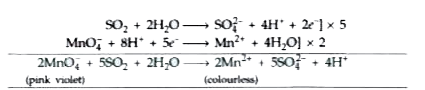 (II) `SO_2` turns acidified `K_2Cr_2O_7` solution green dueto reduction of `Cr_2O_7^(2-)" to " Cr^(3+)` ions. 
|
|
| 27. |
How is the presence of SO_(2) detected ? |
|
Answer» Solution :`SO_(2)` is a PUNGENT smelling gas. It can be detected by the following two tests : (i) `SO_(2)` turns the pink violet colour of `KMnO_(4)` solution colourless DUE to reduction of `MnO_(4)^(-)` to `MN^(2+)` ions. `underset(("pink violet"))(2 MnO_(4)^(-))+5SO_(2) + 2H_(2)O rarr underset(("colourless"))(2 Mn^(2+)) + 5 SO_(4)^(2-)+4H^(+)` (ii) `SO_(2)` turns orange coloured acidified `K_(2)Cr_(2)O_(7)` solution green due to reduction of `CrO_(7)^(2-)` to `Cr^(3+)` ions. `underset(("orange"))(Cr_(2)O_(7)^(2-))+3SO_(2) + 2 H^(+) rarr 2 Cr^(3+) + 3 SO_(4)^(2-) + H_(2)O` |
|
| 28. |
How is the molar conductivity of strong electrolytes at zero concentration determined by graphical method? Why is this method not useful for weak electrolytes? |
|
Answer» Solution :(1) Molar conductivity is the conductance of all the ions produced from ONE mole of an electrolyte. The molar conductivity of both, strong and weak electrolytes increases with dilution or the decrease in concentration of the electrolytic solution. As thedilution increase , the dissociation of the electrolyte increases, hence the total number of ions increases, therefore, the molar conductivity increases. (3) Molar conductivity `^^_(m)`is given by `^^_(m) = (k)/(C) = k xx V` where k isconductivityand C or V are concentration or dilution of the solution respectively. (4) On dilution, the molarconductivity of strong electrolytes increaserapidly and approaches to a MAXIMUM limiting value at infinitedilution or ZERO concentration and respresented as `^^ oo` or `^^_(0)` or `^^_(m)^(0)` . (5)In CASEOF weakelectrolytes, the molarcondutivityis lowandcondutivityis lowandincreaseslowly in highconcentrationregionbut incereaserapidlyat lowconcentrationor high dilutionsincetheextent of dissocitateinreasewith dilutionrapily. For strong electrolytes, the linear variation of molar conductivity (Am) with the concentration is REPRESENTED by Kohlrausch relation, `^^_(m) = ^^_(0) - a sqrt(c)`where a isa constant . `^^_(0)`values for strongelectrolytescan be obtained by extrapolating the linear graph to zero concentration (or infinite dilution). However A, for the weak electrolytes cannot be obtained by this method, since the graph increases exponentially at very high dilution and does not intersect `^^_(m)` axis, 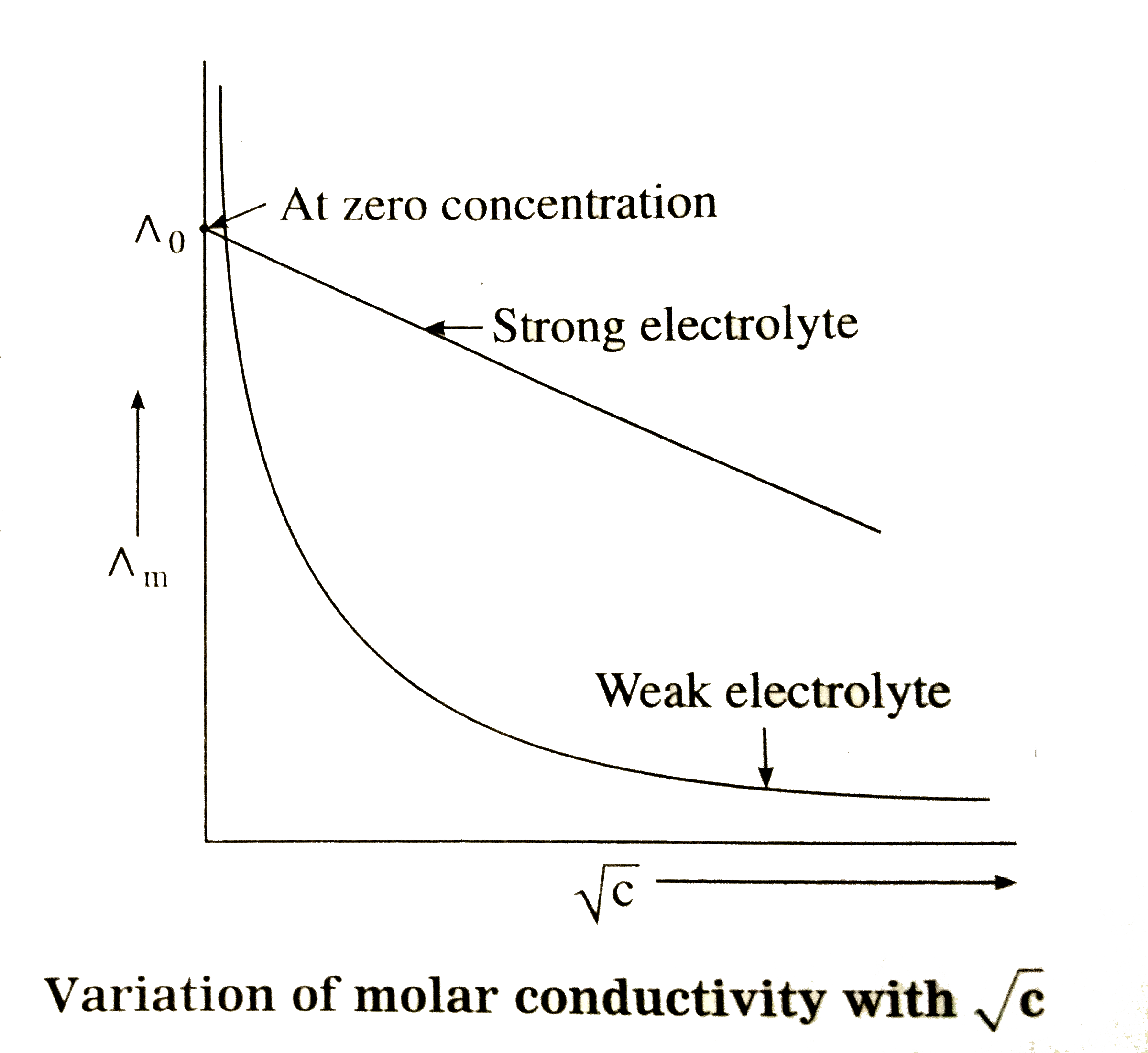
|
|
| 29. |
How is the molality of a solution different from its molarity? |
| Answer» SOLUTION :Molality of a solution is the NUMBER of moles of the solute PRESENT in 1 kg of the solvent and does not CHANGE with TEMPERATURE. Molarity of a solution is the number of moles of the solute present in 1 litre of the solution and change with temperature. | |
| 30. |
How is the magnitude of Delta_(0) affected by (i) nature of ligand and (ii) oxidation state of metal ion ? |
|
Answer» Solution :(i) `Delta_(0)` is AFFECTED by nature of ligand. Greater the STRENGTH of ligand, greater is the VALUE of `Delta_(0)`· (ii) `Delta_(0)` is also affected by OXIDATION STATE of central metal ion. Generally, higher the ionic charge on the central metal ion, the greater will be the value of Ao· |
|
| 31. |
How is the magnetic moment of a species related to the number of unpaired electrons ? |
| Answer» SOLUTION :`mu=sqrt(N(n+2))` where n is the NUMBER of UNPAIRED ELECTRONS. | |
| 32. |
How is the following conversion effected? Ethyl alcohol to Ethylene glycol |
| Answer» SOLUTION :`CH_(3)CH_(2)OH overset(AlO_(23))UNDERSET(620K) to CH_(2)=CH_(2) overset("Cold alklaine")underset(KMnO_(4)) to underset(CH_(2)OH) underset(|)overset(CH_(2)OH)` | |
| 33. |
How is the following conversion effected ? Ethyl alcohol rarr Ethylene glycol |
|
Answer» SOLUTION :`CH_(3)CH_(2)OH overset(Al_(2)O_(3))underset(620K)rarr CH_(2)=CH_(2)underset(underset("(Bayer.s reagent)")(KMnO_(4)))overset("COLD alkaline")rarr` `underset(OH)underset("|")(CH_(2))-underset(OH)underset("|")(CH_(2))` |
|
| 34. |
Show how are the following alcohols prepared by the reaction of a suitable Grignard reagent on methanal ? (i) CH_(3) - underset (CH_(3)) underset (|) (CH) - CH_(2)OH (ii) |
Answer» SOLUTION :
|
|
| 35. |
How is the following conversion carried out: Acetic acid to ethanamine? |
|
Answer» SOLUTION :The following steps are involved in the conversion: `UNDERSET("Acetic acid")(CH_(3)COOH)+NH_(3)overset("HEAT")(to)CH_(3)CONH_(2)overset(LiAlH_(4))(to)underset("Ethanamine")(CH_(3)CH_(2)NH_(2))` |
|
| 36. |
How is the energy of activation determined ? |
|
Answer» Solution :For the given reaction, rate constants `k_(1) a nd k_(2)` are measured at two DIFFERENT temperatures `T_(1)` and `T_(2)` respectively. Then `log_(10).(k_(2))/(k_(1))=E_(a)(T_(2)-T_(1))/(2.303RxxT_(1)xxT_(2))` where `E_(a)` is the energy of activation. Hence by SUBSTITUTING appropriate values, energy of activation `E_(a)` for the reaction is determined. |
|
| 37. |
How is the conversion of acetonitrile to acetic acid effected ? |
|
Answer» Solution :Acetonitrile `(CH_(3)CN)` is hydrolysed with AQUEOUS acid or alkali to get acetic acid. `UNDERSET("Acetonitrile")underset((or))underset("METHYL CYANIDE")(CH_(3)-C-=N+H_(2)O)tounderset("Acetamide")(CH_(3)-underset(O)underset(||)(C)-NH_(2))overset(H_(2)O)tounderset("Acetic acid")(CH_(3)COOH)+NH_(3)` |
|
| 38. |
How is the conductivity of an intrinsic semiconductor be increased ? |
| Answer» Solution :They CONDUCTIVITY is INCREASED by adding an APPROPRIATE amount of suitable impurity/by DOPING. | |
| 39. |
How is the colligative property of solution changed when a solute in a solution undergoes (i) association (ii) dissociation? |
| Answer» Solution :(i) The VALUE of COLLIGATIVE PROPERTY DECREASES. (ii) The value of colligative property increases. | |
| 40. |
How is the basic strength of aromatic amines affected by the presence of an electron releasing group on the benzene ring ? |
|
Answer» |
|
| 41. |
How is the basic strength of aromatic amines affected by the presence of electron releasing group on the benzene ring? |
| Answer» Solution :An ELECTRON-releasing group increases the electron density on the N-atom. As a RESULT, its tendency to donate an electron pair to a proton increases and hence the BASICITY of the AMINE increases. | |
| 42. |
How is the basic strength of aromatic amines affected by the presence of an electron releasing group on the benzene ring? |
| Answer» Solution :BASIC strength of aromatic amines is INCREASED by the PRESENCE of electron RELEASING group on the BENZENE ring. | |
| 43. |
How is the aluminium extracted from bauxite. |
|
Answer» SOLUTION :Extraction of aluminium form bauxite, .Al. is extracted from bauxite `Al_(2)O_(3)2H_(2)O` (i) Concentration of bauxite is done by leaching (II) Electrolytic Reduction (Hall - Heroult PROCESS). Purified bauxite ore is mixed with cryolite `(Na_(3)AlF_(6))` or `CaF_(6)` which lowers its MELTING point and increases electrolysed using number of graphite rods as anode and carbon lining as cathode. 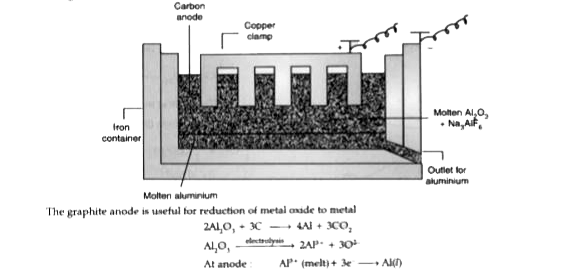 The graphite anode is useful for reduction of metal oxide to metal `2Al_(2)O_(3)+3Crarr4Al+3CO_(2)` `Al_(2)O_(3)overset("electrolysis")rarr2Al^(3+)+3O^(2-)` At anode : `Al^(3+)` (melt) `+3e^(-)rarrAl(l)` At cathode `O^(2-)-2e^(-)rarrO` `O+OrarrO_(2)` `C+O_(2)rarrCO_(2)` Graphite rods gets burnt forming CO and `CO_(2)` the aluminium thus obtained is refined electrolytically using impure Al anode, pure Al as cathode and Molten cryolite as electrolyte. At anode : `underset(("Impure"))(Al)rarrAl^(3+)+3e^(-)` At cathode `Al^(3+)+3e^(-)rarrAl` (Pure) |
|
| 44. |
how is that alcohol and water are miscible in all proportions? |
Answer» Solution :DUE to intermolecular H-bonding (as SHOWN below) ALCOHOL and WATER are miscible in all PROPORTIONS. 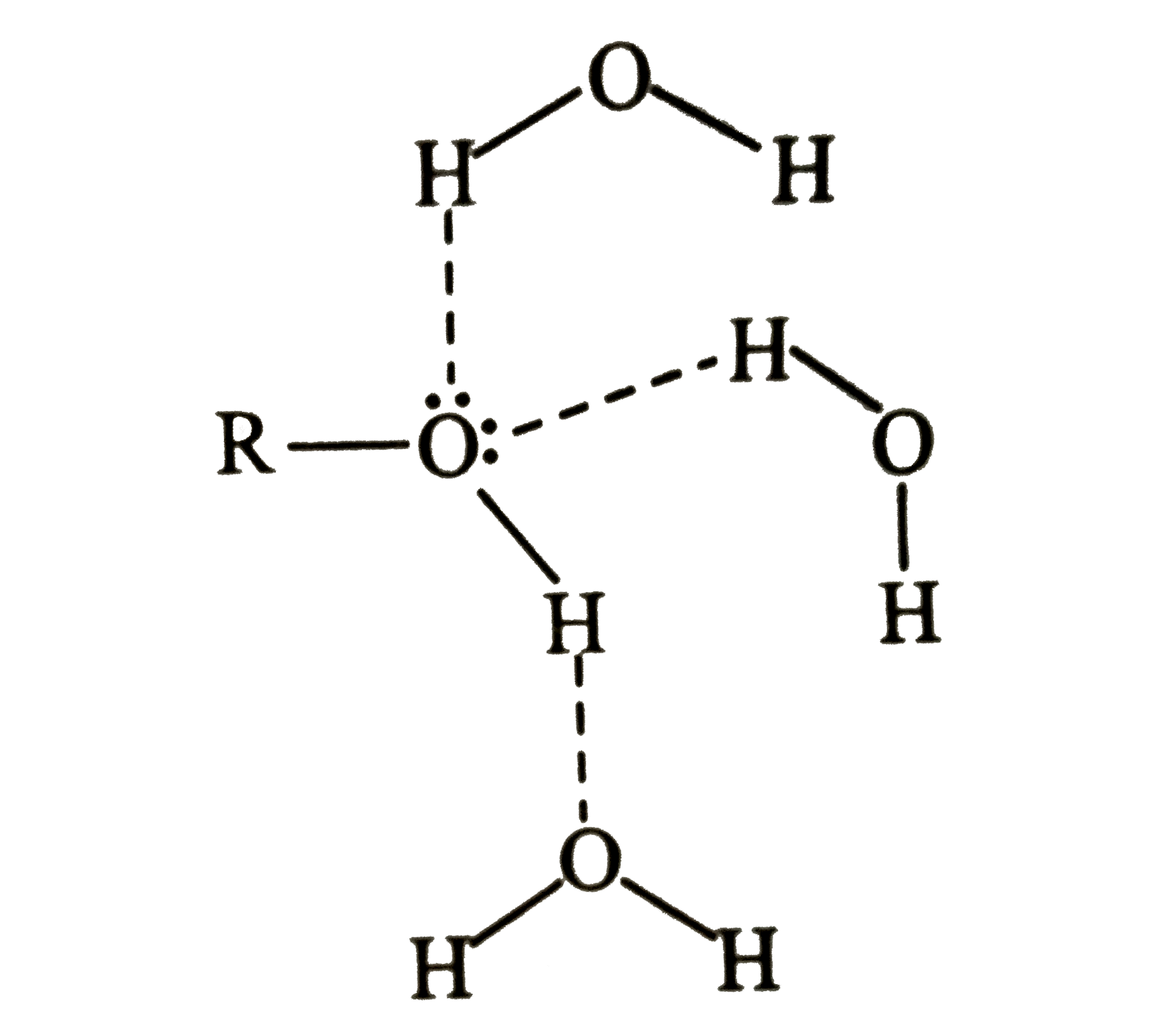
|
|
| 46. |
How is terylene prepared? |
Answer» SOLUTION :The monomers are ethylene glycol and terephthalic acid or dimethylterephthalate. When these monomers are mixed and heated at 500K in the presence of ZINC acetate and antimonytrioxide catalyst, terylene (or dacron) is formed.
|
|
| 47. |
How is terylene or dacron prepared? |
|
Answer» Solution :Terylene is a polyester FIBRE FORMED by the POLYMERISATION of dimethyl terephthalate with ETHYLENE glycol. Dimethyl terephthalate is heated with ethylene glycol at 503 K in the presence of zinc acetate and antimony trioxide as a catalyst when dihydroxydiethyl terephthalate (monomer) is formed, Dihyd- roxydiethyl terephthalate on heating polymerises to give terylene. 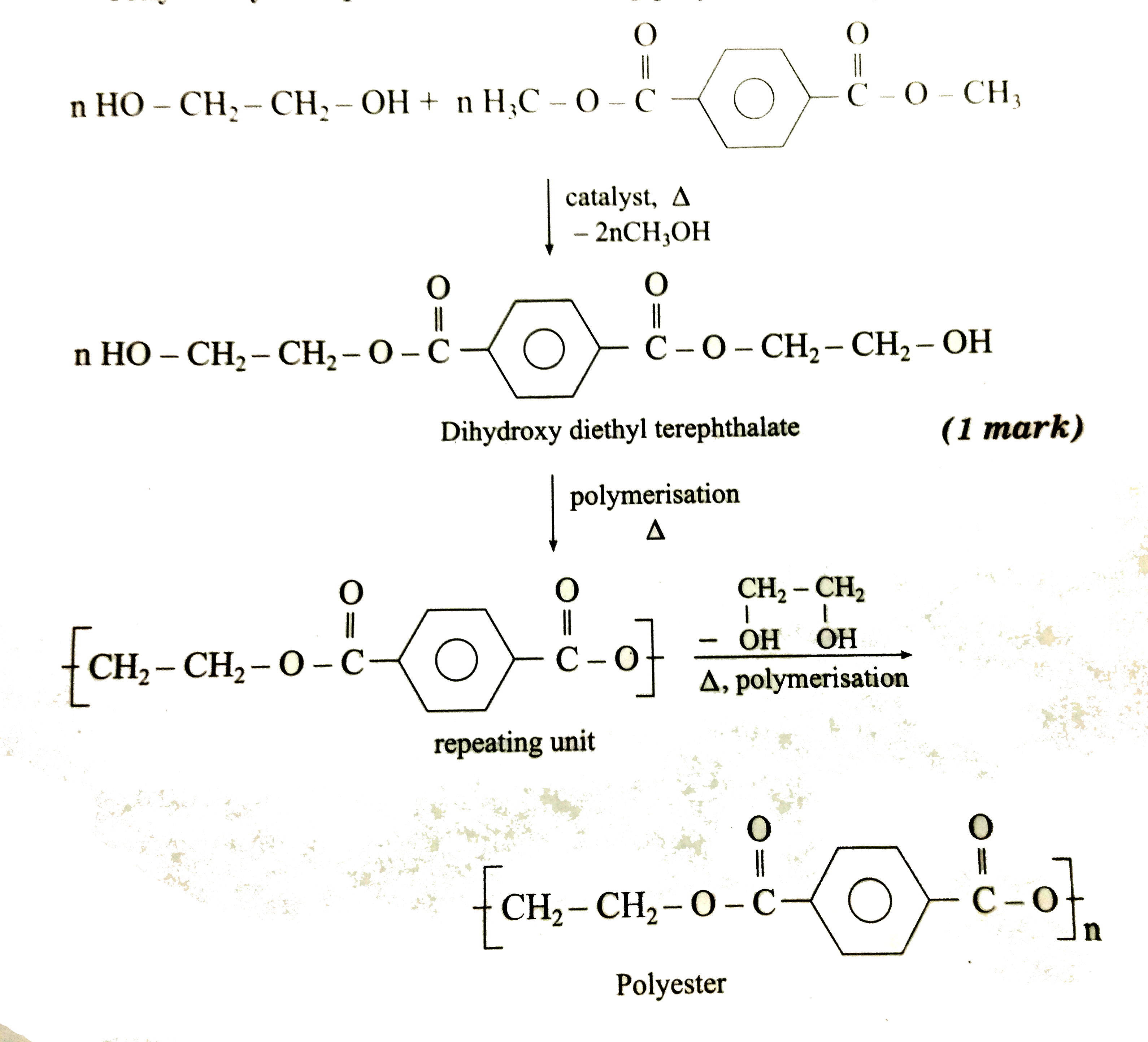
|
|
| 48. |
Howis terylene synthesised ? |
Answer» SOLUTION :TERYLENE is SYNTHESISE bycondensation betweenterephthalicacidand ETHYLENE GLYCOL. 
|
|
| 49. |
How is tertiary butyl alcohol obtained from acetone? |
| Answer» Solution :`underset("Acetone")(CH_(3)-overset(O)overset(||)C-CH_(3))+underset("bromide")underset("METHYL magnesium")(CH_(3)MgBr)rarr CH_(3)-underset(CH_(3))underset("|")overset("OMgBr")overset("|")"C "-CH_(3)overset(H_(2)O //H^(+))rarrunderset("TERT. butyl alcohol")(CH_(3)-underset(CH)underset("|")overset(OH)overset("|")"C "-CH_(3))` | |
| 50. |
How is tautomerism different from resonance ? |
|
Answer» Solution :The skeleton of atoms in any MOLECULE does not CHANGE in resonance. Only the pi electrons UNDERGO delocalisation. Tautomerism involves the migration of atoms and the isomers are in dynamic EQUILIBRIUM. |
|