

Saved Bookmarks
This section includes 7 InterviewSolutions, each offering curated multiple-choice questions to sharpen your Current Affairs knowledge and support exam preparation. Choose a topic below to get started.
| 1. |
How is acetone prepared from isopropyl alcohol? |
|
Answer» SOLUTION :Acetone is prepared by the oxidation of isopropyl alcohol with acidified potassium dichromate. `underset("Isopropyl alcohol")(H_(3)C-underset(OH)underset(|)overset(H)overset(|)C-CH_(3)) underset(H_(2)SO_(4))overset(K_(2)Cr_(2)O_(7))to underset("Acetone")(CH_(3)-underset(O)underset(||)C-CH_(3))+H_(2)O` |
|
| 2. |
How is acetone obtained from ethanol? |
| Answer» Solution :`underset("Ethanol")(CH_(3)CH_(2)OH)overset(Cu)underset(573K)RARR underset("ETHANAL")(CH_(3)-overset(O)overset(||)C-H)overset((i) CH_(3)MgBr)underset((ii)H_(2)O //H^(+))rarrunderset("PROPAN -2- ol")(CH_(3)-overset(OH)overset("|")"CH"-CH_(3))overset(Cu)underset(573K)rarrunderset("Acetone")(CH_(3)-overset(O)overset(||)C-CH_(3))` | |
| 3. |
How is acetone obtained from 2 - bromopropane? |
| Answer» Solution :`underset("2 - Bromopropane")(CH_(3)-underset(Br)underset(|)CH-CH_(3)+KOH(aq))RARR underset("Propan - 2 - ol")(CH_(3)-underset(OH)underset("|")"CH"-CH_(3))overset(CU)underset(573K)rarr underset("ACETONE")(CH_(3)-underset(O)underset(||)C-CH_(3))` | |
| 4. |
How is acetone obtained from 2-bromopropane? |
Answer» SOLUTION :
|
|
| 5. |
How is acetic acid prepared from amides and esters? |
|
Answer» SOLUTION :(i) `CH_(3)-overset(O)overset(||)(C)-NH_(2)overset(H_(2)O)toCH_(3)-overset(O)overset(||)(C)-OH+NH_(3)` (ii) `UNDERSET("methyl acetate")(CH_(3)-overset(O)overset(||)(C)-OCH_(3))underset(H^(+)orOH^(-))overset(HOH)tounderset("acetic acid")(CH_(3)-overset(O)overset(||)(C)-OH+CH_(3)OH)` |
|
| 6. |
How is acetic anhydride formed ? |
Answer» Solution :ACETIC anhydride is FORMED, when acetic acid is TREATED with PHOSPHORUS pentoxide.
|
|
| 7. |
How is acetic acid converted to formic acid ? |
|
Answer» SOLUTION :The sequence of steps are decarboxylation , chlorination , base hydrolysis and oxidation . `CH_(3) COOH OVERSET(NaOH) underset(CaO) (to) CH_(4) overset(Cl_(2)) underset("light")(to) CH_(3) Cl overset(aq NaOH)(to) CH_(3) OH overset(K_(2) Cr_(2) O_(7)) underset(H_(2) SO_(4)) (to) HCOOH` |
|
| 8. |
How is acetic acid converted separately to methylamine and ethyl amine? |
|
Answer» Solution :On heating with ammonia , acetic acid gives acetamide . Acetamide on heating with BROMINE in presence of `NaOH` gives methyl amine and on reduction with `LiAlH_(4)` gives ethyl amine . `CH_(3) CO NH_(2) OVERSET(Br_(2)) underset(NaOH)(to) CH_(3) NH_(2)` `CH_(3) CO NH_(2) overset(LiAlH_(4))(to) CH_(3) CH_(2) NH_(2)` |
|
| 9. |
How is acetaldehyde prepared by the ozonolysis of CH_(3)CH=CHCH_(3)? |
Answer» Solution :OZONE forms addition product with olefin called OZONIDE, which on REDUCTIVE CLEAVAGE GIVES aldehyde. 
|
|
| 10. |
How is acetanilide prepared from aniline ? |
Answer» SOLUTION :
|
|
| 11. |
How is acetaldehyde distinguished from acetone? |
| Answer» SOLUTION :Acetaldehyde GIVES silver NITRATE on TREATING with ammonical silver nitrate solution (Tollen.s reagard). Acetaldehyde gives a red precipitate on treating with ammonical cuproic salt solution complexed with tartrate (Fehling.s solution) Acetone does not react with Tollen.s REAGENT and Fehling.s solution | |
| 12. |
How is a peptide bond formed between two amino acida ? |
|
Answer» Solution :When - `NH_(2)` group one-Amino acid reacts with - COOH group of another with ELIMINATION of a molecule of water . OR By a CONDENSATION reaction between two-Amino ACIDS with elimination of a molecule of water. OR When the basic group or one-Amino acid reacts with acidic group of the other, by eliminating AMOLECULE of water. |
|
| 13. |
How is a mixture of oxides of Aland Fe separated ? |
|
Answer» Solution :`Fe_(2)O_(3)`is basic and `Al_(2) O_(3)`is amphoteric. HENCE aqueoussolution ofcaustic soda or soda ash is USED to dissolve`Al_(2) O_(3)`,whichformssolublemetal ALUMINATE . `Fe_(2)O_(3)`remains as a RESIDUE. It is separtedfrom solution by filteration. |
|
| 14. |
How is a fuel cell represented ? |
|
Answer» |
|
| 15. |
How is 2,4-dinitrophenylhydrazine prepared from chlorobenzene? |
Answer» SOLUTION :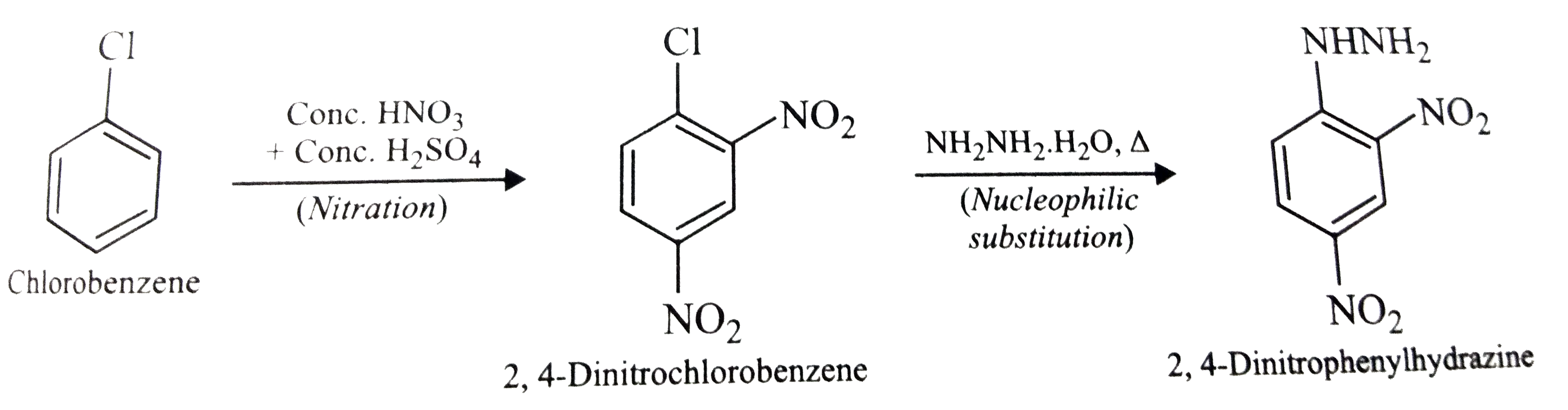
|
|
| 16. |
How is 1-propoxypropane synthesised from propan-1-ol? Write mechanism of this reaction. |
|
Answer» Solution :`to` (i) `UNDERSET("Propan-1-ol")(3CH_(3)CH_(2)CH_(2)OH+ PBr_(3)) to underset("1-Bromoprapane")(3CH_(3)CH_(2)B+ H_(3)PO_(3))` (II) `underset("Propan-1-ol")(2CH_(3)CH_(2)CH_(2)OH)+ 2NA to underset("Sodiumpropoxide")(2CH_(3)CH_(2)CH_(2)O^(-)Na^(+)+H_(2))` 
|
|
| 17. |
How is 1-propoxypropane synthesized from propan-1-ol? |
Answer» SOLUTION :The FOLLOWING TWO METHODS can be USED: 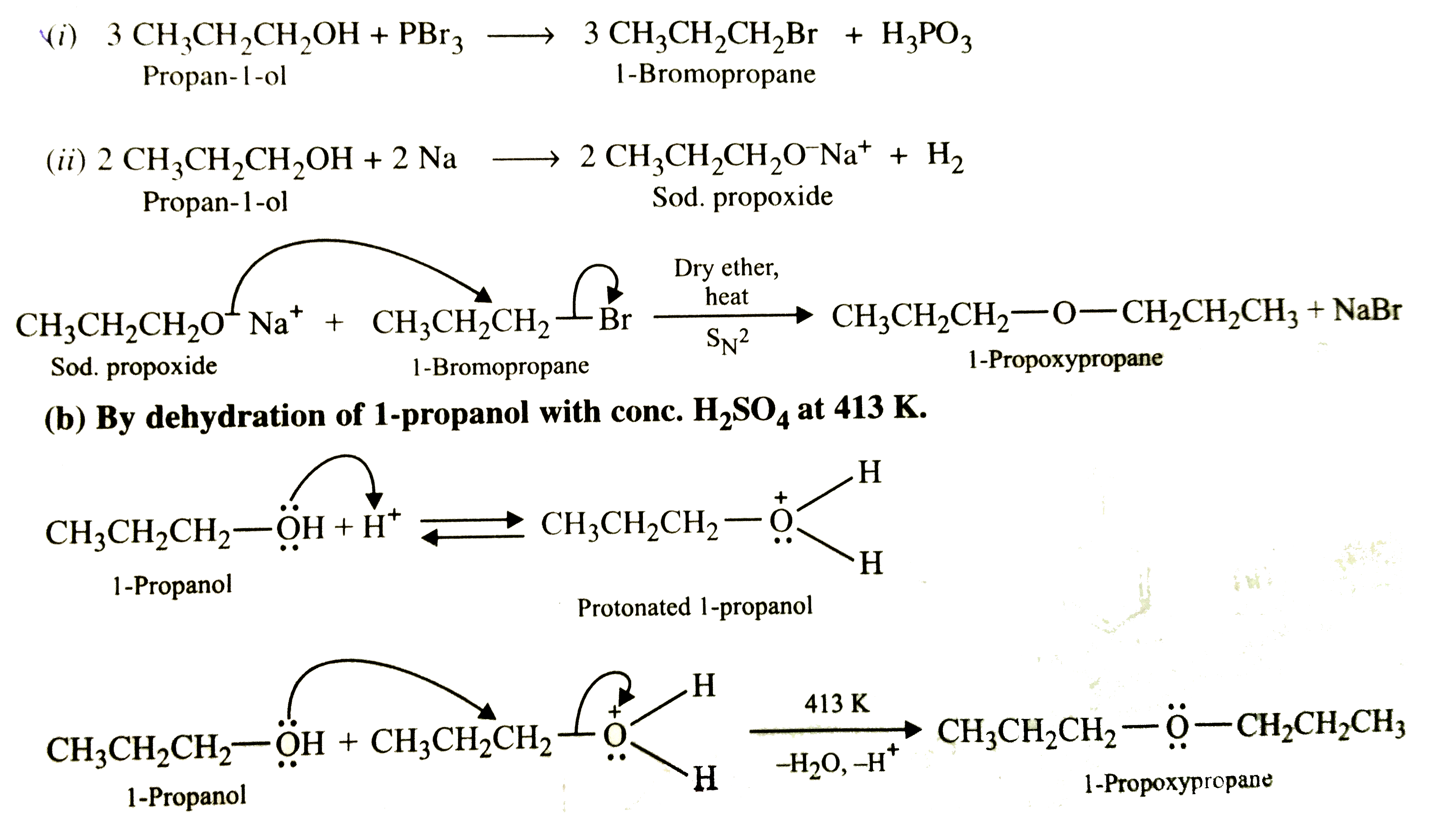
|
|
| 18. |
How is 1 - propoxypropane synthesised from propan -1 - ol? Write mechanism of this reaction? |
|
Answer» Solution :(a) 1 - PROPOXYPROPANE can be synthesised using Williamson synthesis as FOLLOWS : (i) `underset("Propan - 1 - ol")(3CH_(3)CH_(2)CH_(2)OH)+PB r_(3)RARR underset("1 - Bromopropane")(3CH_(3)CH_(2)CH_(2)Br+H_(3)PO_(3))` (ii) `underset("Propan - 1 - ol")(2CH_(3)CH_(2)CH_(2)OH)+2Na rarr underset("Sodium propoxide")(2CH_(3)CH_(2)CH_(2)O^(-)Na^(+))+H_(2)`  (B) It can be also be synthesised by dehydration of 1 - propanol with CONC. `H_(2)SO_(4)` at 413 K. 
|
|
| 19. |
How is 1-iodobutane obtained from 1-butene? |
|
Answer» Solution :Through KHARASCH EFFECT and halide exchange, 1-iodobutane is OBTAINED. `CH_3CH_2CH =CH_2+HBr overset("Peroxide")(rarr)` `CH_3CH_2CH_2CH_2Br underset("reflux")overset("NAI, acetone")(rarr) CH_3CH_2CH_2CH_2I + NaBr`. |
|
| 20. |
How high a column of air would be necessary to cause the barometer to read 76 cmHg, if the atmosphere were of uniform density 1.2 kg//m^(3) ? The density of Hg = 13.6 xx 10^(3) kg//m^(3). |
|
Answer» Solution :Let the height of the air column be h metres and acceleration due to GRAVITY, G `"metre s"^(-2)`. `therefore` PRESSURE corresponding to `76 cm(0.76 m)` of `Hg = 0.76 xx (13.6 xx 10^(3)) xx g` and pressure corresponding to .h. metres of air `= h xx 1.2 xx g`. THUS, `h xx 1.2 xx g = 0.76 xx 13.6 xx 10^(3) xx g` or h = 8613 metres. |
|
| 21. |
How H_(2)S is liberated in laboratory |
|
Answer» `FeSO_(4)+H_(2)SO_(4)` |
|
| 22. |
How iodoform is distinguished from chloroform? |
| Answer» SOLUTION :Chloroform is a SWEET smelling colourless liquid while iodoform is an YELLOW crystalline solid having a pungent characteristic small. lodoform gives yellow precipitate with silver nitrate solution. Chloroform does not give precipitate with silver nitrate solution. | |
| 23. |
How glucose is prepared from cane sugar ?Write the formula of the complex copper (II) hexacyano ferrate (II). |
|
Answer» Solution :PREPARATION of glucose from cane sugar. `underset("Cane sugar")(C_(12)H_(22)O_(11))+H_(2)O overset("dil. HCl or")(underset(underset(Delta "alcoholic")("dil." H_(2)SO_(4)))rarr) underset("Glucose")(C_(6)H_(12)O_(6))+underset("FRUCTOSE")(C_(6)H_(12)O_(6))` On COOLING the reaction mixture, glucose separate out because it is less soluble in alcohol and fructose remains in the solution crystals of glucose are then filtered and purified by recrystallization. Formula of complex copper (II) hexacyano ferrate (II) is `Cu_(2)[Fe(CN)_(6)]`. |
|
| 24. |
How is Gold-sol prepared by Bredig's-arc method? |
Answer» SOLUTION :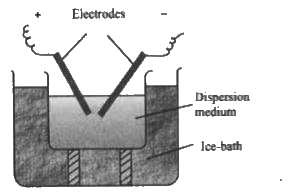 An electric arc is struck between electrodes of the METAL immersed in the dispersion medium. The HEAT produced vapourises the metal which condenses to form particles of COLLOIDAL SIZE. |
|
| 25. |
How Fenton's reagent acts on tertiary amines ? |
| Answer» SOLUTION :It OXIDISES only TERTIARY AMINES to tertiary AMINE N-oxide. | |
| 26. |
How ethylene is obtained from ethyl alcohol ? Give equation. |
| Answer» SOLUTION :`CH_3CH_2OHoverset(KOH_(ALC))rarrCH_2=CH_2` | |
| 27. |
How ethyl cyanide is converted to diethyl ketone? What are the special features of the conversion? |
| Answer» SOLUTION :Thorpe.s CONDENSATIO | |
| 28. |
How ethanol is mamufactured from molasses. |
|
Answer» Solution :Sugar in the molasses (SUCROSE) is converted into glucose and fructose in the PRESENCE of the enzyme INVERTASE. `underset("Sucrose")(C_(2)H_(22)O_(11))+H_(2)O overset("Invertase")to underset("Glucose")(C_(6)H_(12)O_(6))+underset("Fructose")(C_(6)H_(12)O_(6))` Glucose and fructose UNDERGOES fermentation in the presence of enzyme zymose. `underset("Glucose")(C_(6)H_(12)O_(6)) overset("Zymase")to underset("Ethanol")(2C_(2)H_(5)OH)+2CO_(2)` |
|
| 29. |
How E_("cell") of the Daniel cell affected by increasing the concentration of Cu^(2+) and Zn^(2+)? |
| Answer» SOLUTION :As `[CU^(2+)]` INCREASES `E_("CELL")` increases and as `[Zn^(2+)]` increases `E_("cell")` decreases. | |
| 30. |
How does xenon atom form compounds with fluorine even though the xenon atom has a closed shell configuration ? |
| Answer» Solution :Xenon can form compounds with fluorine due to the EXCITATION of 1, 2 or 3 electrons from the 5p orbitals of Xe to VACANT 3d-orbitals thus, making 2, 4 or 6 half-filled orbitals available for bond FORMATION. | |
| 31. |
How does vulcanization change the character of natural rubber ? |
| Answer» SOLUTION : It introduce SULPHUR BRIDGE or cross-link between polymer chain. | |
| 32. |
How does vulcanisation change the character of natural rubber? |
| Answer» Solution :Natural RUBBER is made hard and more elastic by VULCANISATION. It has more wear and tear RESISTANT properties. It is USED for automobile tyres. | |
| 33. |
How does urea react with? (a) Nitrous acid, (b) Dilute NaOH, (c) Sodium hypobromite, (d) Malonic ester, (e) Hydrazine, (t) Acetyl chloride, (g) Succinic acid, (h) Acetoacetic ester. |
Answer» SOLUTION : 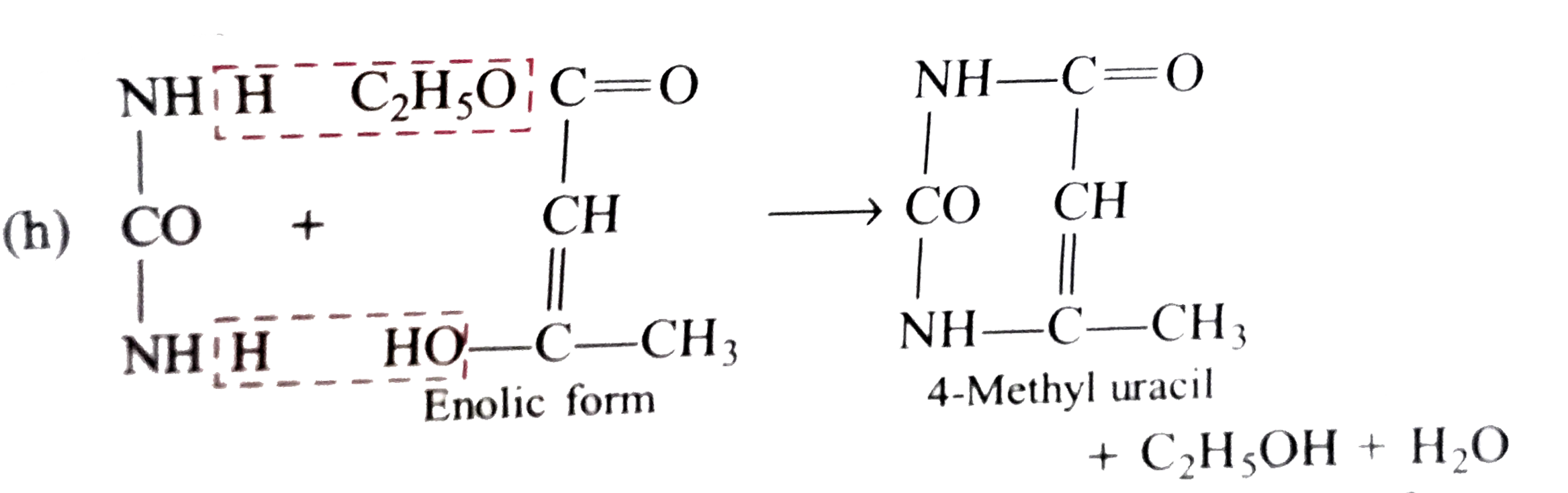
|
|
| 34. |
Answer all the questions each question carries one mark. How does the volume change on mixing two volatile liquids to form an ideal solutions? |
| Answer» Solution :No CHANGE in the volume/Remains same /`DELTAV` of MIXING is zero/`DeltaV_("Mixing") = 0`. | |
| 35. |
How does the value of rate constant vary with reactant concentration ? |
|
Answer» `k PROP (C^(n-1))/(n+1)` |
|
| 36. |
How does the vapour pressure of a liquid change with intermolecular force of attraction ? |
|
Answer» Solution :The vapour pressure of liquid DECREASES with INCREASE in intermolecular FORCE of attraction `IMPLIES` Vapour pressure`prop`(1)/(Intermolecular force of attraction |
|
| 37. |
How does the value of rate constant vary with reactant constant. |
|
Answer» SOLUTION :For `n^(th)` ORDER REACTION `K prop (1)/(C^(N-1))` |
|
| 38. |
How does the value of rate constant vary with reactant concentration? |
| Answer» SOLUTION :Rate CONSTANT does not vary with REACTANT concentration. | |
| 39. |
Answer all the questions each question carries one mark. How does the size of blood cells change when placed in an aqueous solution containing more than 0.9% (m/v) sodium chloride? |
| Answer» Solution :SHRINKS or DECREASES or DIMINISHES or CONTRACTS or reduces. | |
| 40. |
How do double bonds in rubber molecules influence their structure and reactivity ? |
Answer» SOLUTION :Natural rubber is cis-polyisoprene obtained by 1, 4-polymerization of isoprene units.  This polymer has double bonds between `C_2` and `C_3` of each isoprene unit. These cis-bonds donot allow the polymer chains to COME CLOSER. Hence, intermolecular forces are QUITE WEAK. Consequently, natural rubber, i.e., cis- polyisoprene has a randomly coiled structure and hence shows elasticity. |
|
| 41. |
How does the presence of double bonds in rubber influence their structure and reactivity ? |
| Answer» Solution :Natural RUBBER is a cis-polyisoprene. These cis- double bonds do not allow to polymer UNIT to come close for effective interaction. Hence rubber show ELASTICITY. | |
| 42. |
How does the presence of double bonds in rubber molecules influence their structure and reactivity ? |
Answer» SOLUTION :Natural rubber is CIS - polyisoprene and is obtained by 1,4- POLYMERIZATION of isoperene units. In this polymer , double bonds are located between `C_2` and `C_3` of each isoprene unit . These cis- double bonds do not allow the polymer chains to COME closer for effective interactions and hence intermolecular forces are quite WEAK. As a result, natural rubber , i.e., cis-polyiosoprene has a randomly coiled structure as hence shows elasticity.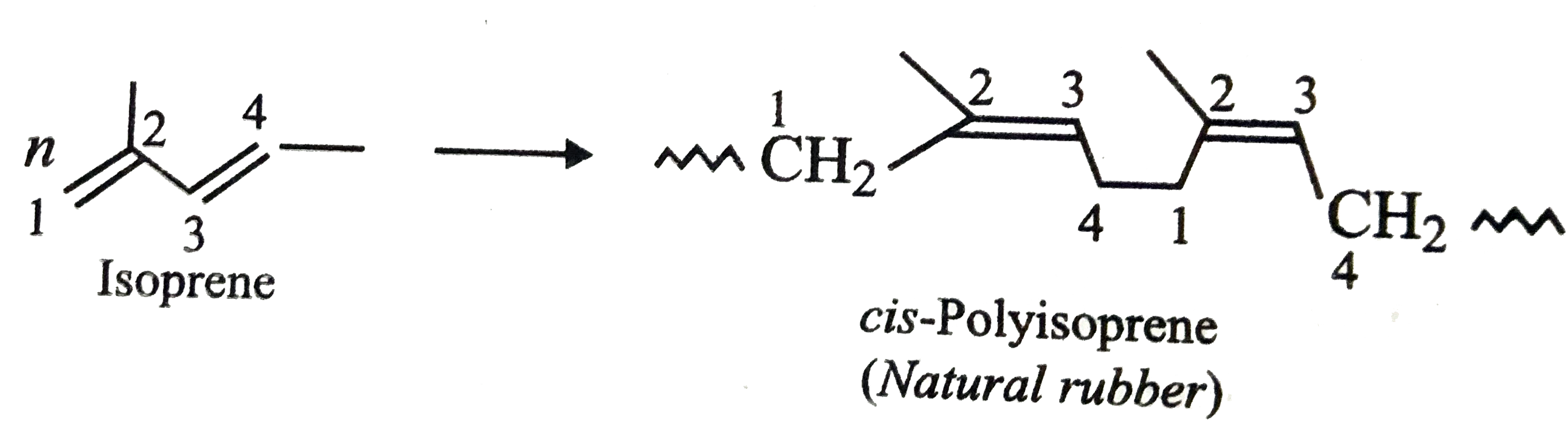
|
|
| 43. |
How does the presence of benzoquinone inhibit the free radical polymerization of a vinyl derivative ? |
Answer» Solution :Benzoquinone REACTS withradical of the growing polymer chain (R.) to FORM a new radical (I) which is extremely unreactive since it is highly stabilized by resonance. Because of the lack of reactivity of this new radical further GROWTH of the polymer chain is interupted and HENCE the raction stops. 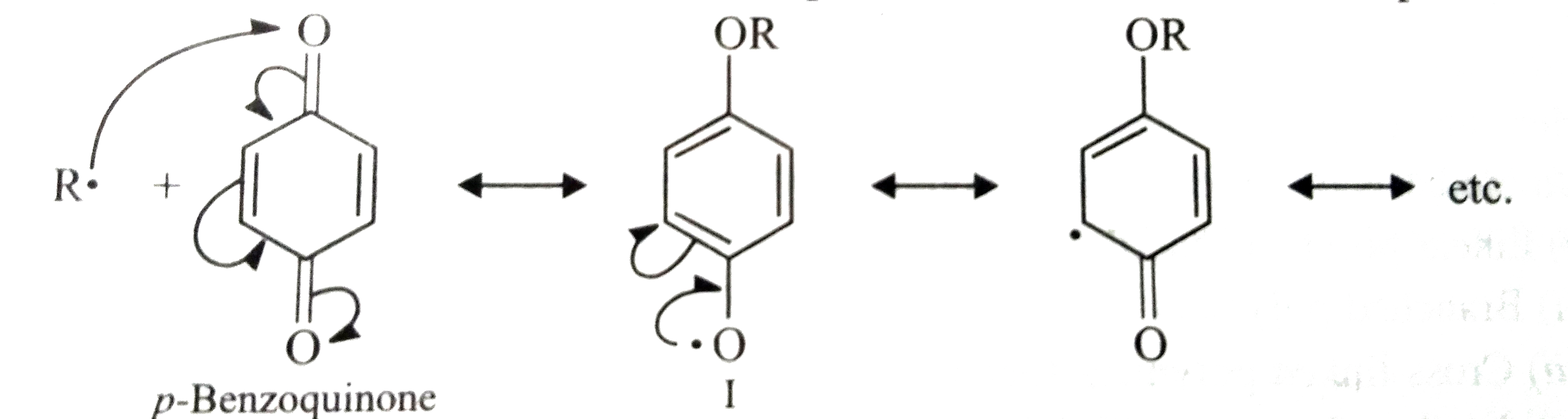
|
|
| 44. |
How does the presence of carbon tetrachloride influence the course of vinylic free radical polymerisation ? Explain with example |
| Answer» SOLUTION :For ANSWER, CONSULT SECTION 4 | |
| 45. |
How does the precipitation of colloidal smoke take place in Cottrell precipitator ? |
| Answer» Solution :Charged smoke particles are PASSED through a CHAMBER CONTAINING plates with charge opposite to that of smoke particles, in the Cottrell precipitator. On contact with the plates, the particles lose their charge and get precipitated. | |
| 46. |
How does the precipitation of colloidal smoke take place in cottrell precipitation ? |
| Answer» Solution :Smoke is a colloidal solution of solid particles. Such as carbon, arsenic compounds, dust ETC. in air. The smoke, before it COMES out from the chimney is led through a chamber containing plates having a charge opposite to that carried by smoke particles. The particles on coming in contact with these plates lose their charge and get precipitated. The particles thus settle down on the FLOOR of the chamber. The PRECIPITATION is called cottrell PRECIPITATOR. | |
| 47. |
How does the physisorption and chemisorption of a gas on a solid surface vary with pressure ? Illustrate with the help of relevant graphs. |
Answer» Solution :Physical ADSORPTION of a GAS on solid increases with increase of PRESSURE. Chemisorption of a gas on a solid first increases with increase of pressure and then becomes constant. This is illustratedwith a GRAPH of x/m and p for the TWO kinds of Fig adsorption. 
|
|
| 48. |
How does the molar conductivity of KCl solution vary with increasing concentration ? |
| Answer» SOLUTION :Molar CONDUCTIVITY of KCL solution DECREASES with increase in CONCENTRATION. | |
| 49. |
How does the ionic // covalent character of the compounds of a transition metal vary with its oxidation state? |
| Answer» Solution :As the oxidation state increases, more and more valence shell electrons are involvedin bonding. The ATOMIC core becomesless shielded resulting in the increased ATTRACTION on the electrons. Because OFTHIS, ionic character of bonds decreases with the increase in oxidation state. | |
| 50. |
How does the inter-particle forces help in characterising the properties of (a) potassium metal and (b) solid argon? |
|
Answer» SOLUTION :(a) Potassium is a metallic solid. Atoms of potassium are held by metallic BONDS. Since the size of atom is more and number of valence electrons is less, the metallic bonds are weak. Hence it is a soft solid with low HEAT of vapourisation. It is a good ELECTRICAL conductor. (b) Solid argon is a molecular solid. Argon atoms are held by weak van der waal.s forces. It is soft solid with low melting point. It is not an electrical conductor, because of ABSENCE free electrons. |
|