

Saved Bookmarks
This section includes 7 InterviewSolutions, each offering curated multiple-choice questions to sharpen your Current Affairs knowledge and support exam preparation. Choose a topic below to get started.
| 1. |
How does the ionic/covalent character of the compounds of a transition metal vary with its oxidation state ? |
| Answer» Solution :With the increase in oxidation state, more and more electrons of the valence shell get involved in BONDING. The atomic core becomes less shielded resulting in the increased ATTRACTION on the electrons. HENCE, IONIC character of the bonds decreases with increase in oxidation state. | |
| 2. |
How does the formula C_(12)H_(22)O_(11) violate Dalton's atomic theory? |
| Answer» SOLUTION :The RATIO in which C, H and O COMBINE is whole number ratio but not a SIMPLE ratio. | |
| 3. |
How does the energy gap between successive energy levels in an atom vary from low to high n values? |
|
Answer» All energy gaps are the same |
|
| 4. |
How does the enthalpy change during the formation of a non-ideal solution two liquids showing positive deviation from Raoult's law? |
| Answer» SOLUTION :ENTHALPY INCREASES | |
| 5. |
How does the doping increase the conductivity of semiconductors ? |
|
Answer» Solution : In semiconductors doping can be done with either electron rich or electron deficient impurities. Addition of such impurities cause the electronic defects in a CRYSTAL STRUCTURE, which enhances the electrical conductivity. When SILICON is doped with electron rich impurities, the extra ELECTRONS become delocalized. The electrical conductivity is increased by negatively charged electron and HENCE it is called n-type semiconductor. The electron deficient impurities enhance electrical conductivity through holes. Hence, it is called p-type semiconductor. |
|
| 6. |
How does the catalyst act according to intermediate complex theory? |
| Answer» Solution :A CATALYST PARTICIPATES in a chemical REACTION by FORMING temporary bonds with the reactants RESULTING in an intermediate complex. | |
| 7. |
How does the branching of hydrocarbon chain of synthetic detergents affect their biodegradability ? |
|
Answer» Solution :Detergents having highly branched hydrocarbon chains cause pollution in rivers. The reason being that side chains stop bacteria from attackingand BREAKING the chains. Thus, lesser the branching more is the biodegradability i.e., detergentswith longstraight hydrocarbon chains are more easily degraded than those havingbranchedhydrocarbon chains. 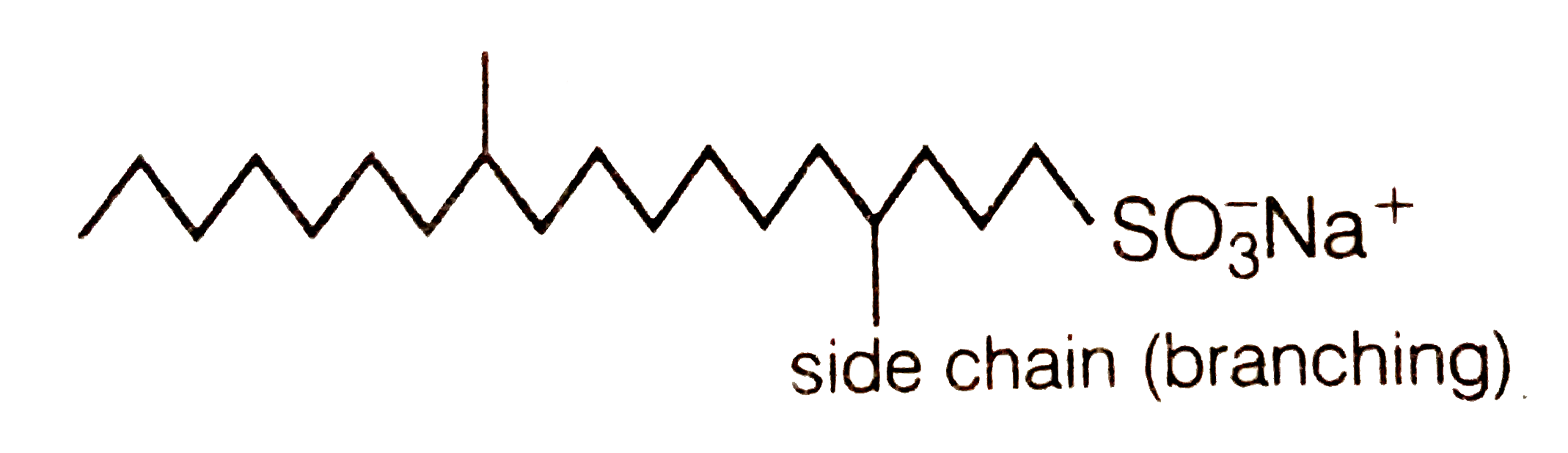 Since UNBRANCHED (i.e., straight) chains are more PRONE to attack by bacteria, therefore in most of the detergents used these days, the breaching is kept to be minimum, so that the detergents BECOME easily biodegradable. |
|
| 8. |
How does the adsorption of a gas on the surface of solid very with temperature ? |
| Answer» | |
| 9. |
How does Sulphuric acid react with the following : (a) Al (b) KNO_(3) (c ) NaBr (d) C_(6)H_(6) |
|
Answer» Solution :(a) `AL:2Al+3H_(2)SO_(4)rarr underset("(Aluminium Sulphate)")(Al_(2)(SO_(4))_(3)+3H_(2)uarr)` (b) `KNO_(3):KNO_(3)+H_(2)SO_(4)rarr underset("(POTASSIUM bisulphate)")(KHSO_(4)+HNO_(3))` (C ) `NaBr:2NaBr+3H_(2)SO_(4)underset("(Sodium bisulphate)")(rarr 2NaHSO_(4))+2H_(2)O+Br_(2)+SO_(2)` (d) `C_(6)H_(6): underset("Benzene")(C_(6)H_(6))+H_(2)SO_(4)rarr underset("Benzene sulphonic acid")(C_()H_(5)SO_(3)H+H_(2)O)` |
|
| 10. |
How does sprinkling of salt help in clearing the snow coverte roads in hilly areas ? Explain the phenomenon involved in the process. |
| Answer» SOLUTION :When salt is spread over covered ROADS, depression in FREEZING POINT of water takes place, At the ambient temperature, snow starts melting and it HELPS in clearing the roads. | |
| 11. |
How does sprinkling of salt help in clearing the snow - convered roads in hilly areas ? Explain the phenomenon involved in the process. |
| Answer» Solution :The PHENOMENON involved in clearing the snow - covered roads in hilly areas is .Depression in FREEZING point of WATER when a non - VOLATILE solute is dissolved in it.. THUS when salt is spread over snow covered roads, snow starts melting from the surface because of the depression in freezing point of water and it helps in clearing the roads. | |
| 12. |
How does sodium cyanide act as depresant in preventing ZnS from forming the froth ? |
|
Answer» Solution :Sodium CYANIDE combines with ZnS to form a COMPLEX `Na_2 [Zn(CN)_4]` on the surface of ZnS and therefore, it PREVENTS it from FORMING the froth . ` ZnS + 4NaCN to underset("tetracyanidozincate (II)")underset("Sodium")(Na_2 [Zn(CN)_4]) + Na_2 S` |
|
| 13. |
How does sprinkling of salt help in clearing the snow covered roads in hilly areas ? Explain the phenomenon involved in the process. |
| Answer» Solution :When salt is spread over SNOW covered roads, snow starts melting from the surface because ofthe DEPRESSION in freezing point of water. Now, water will freeze at a lower temperature. At the PREVAILING temperature, water will remain as liquid and not in the FORM of ICE. This helps in clearing the roads. | |
| 14. |
How does soap help in washing clothes? |
| Answer» Solution :SOAP forms micelles around grease and dust particles. The lyophobic hydrocarbon parts of the soap are oriented towards grease droplets while lyophilic `(COO^(-))` parts are oriented towards WATER. Water WASHES these micelles ALONG with DIRT. | |
| 15. |
How does pressure influence the solubilityt of a gas in a liquid ?State the law which governs it. |
| Answer» SOLUTION :Solubility INCREASES with rise in pressure ACCORDING to HENRY's law. | |
| 16. |
How does Primary amine undergo carbyl amine reaction? Give chemical equation. |
|
Answer» Solution :Primary amines when heated with chloroform and alcoholic KOH give isoyanideshaving very unpleasant smell. The reaction is CALLED as Carbylamine reaction. ` underset(1^(@) - " Amine")(R-NH_2) + underset(Alc)(CHCl_3 + 3KOH) underset("Alkyl isocyanide") overset(Delta)to R - NC + 3KCL + 3H_2O` |
|
| 17. |
How does phenol react with Conc.HNO_3? Give equation. |
Answer» SOLUTION :When phenol is heated with concentrated nitric ACID, 2, 4, 6-trinitrophenol (picricacid) is FORMED. 
|
|
| 18. |
How does phenol react with cone. Nitric acid? Give equation. |
Answer» Solution :With CONE, NITRIC ACID PHENOL is CONVERTED to 2,4,6-trinitrophenol (picric acid).
|
|
| 19. |
How does phenol react with conc. Nitric acid ? Give equation. |
Answer» Solution :PHENOL reacts with conc. `HNO_(3)` in the presence of conc. `H_(2)SO_(4)` to give 2, 4, 6 trinitrophenol called picric acid. 
|
|
| 20. |
How does phenol react with conc. nitric acid? Give equation. |
Answer» Solution :When PHENOL is heated with a mixture of concentrated NITRIC acid and concentrated SULPHURIC acid. 2, 4,6-trinitro phenol is OBTAINED called picric acid. 
|
|
| 21. |
How does phenol react with bromine water? |
Answer» SOLUTION :PHENOL an reacting with `Br_(2)` water GIVES 2,4,6- Tribromo phenol. <BR> 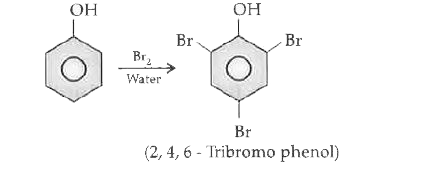
|
|
| 22. |
How does PCl_(3) reacts with the following reagents? (i) C_(2)H_(5)OH (ii) C_(2)H_(5)COOH |
|
Answer» Solution :(i) `C_(2)H_(5)OH+PCl_(3)RARR C_(2)H_(5)Cl+H_(3)PO_(3)` (ii) `C_(2)H_(5)COOH+PCl_(3)rarr C_(2)H_(5)COCl+H_(3)PO_(3)` |
|
| 23. |
How does osmotic pressure depend upon temperature ? |
| Answer» SOLUTION :INCREASES with RISE in TEMPERATURE. | |
| 24. |
How does NH_(3) react with the following? CH_(3)CHO |
|
Answer» Solution :`NH_(3)" with "CH_(3)CHO` : Acetaldehyde REACTS with `NH_(3)` to form aldimine. `CH_(3)CHO+NH_(3)toH_(3)C-underset(H)underset(|)overset(NH_(2))overset(|)(C)-OHoverset(-H_(2)O)tounderset("Aldimine")(CH_(3)-CH=NH)` |
|
| 25. |
How does nitrobenzene is reduced to aniline ? Give equation. |
Answer» SOLUTION :Nitrobenzene reduced to aniline by passing hydrogen GAS in the PRESENCE of FINEST divided nickel, pallodium or platinum. 
|
|
| 27. |
how does molarity changes with temperature? |
| Answer» SOLUTION :MOLARITY DECREASES with INCREASE in TEMPERATURE. | |
| 28. |
How does ketone react with ethylene glycol. Write chemical equation for the reaction. |
Answer» SOLUTION :KETAL is FORMED, 
|
|
| 29. |
How does it become possible to cause artificial rain by spraying silver iodide on the cloudes ? |
| Answer» Solution :CLOUDS CONTAIN water PARTICLES which are colloidal in nature and carry CHARGE. AgI, being an ELECTROLYTE, brings about coagulation of ccolloidal water particles. | |
| 30. |
How does it become possible to cause artificial rain by spraying silver iodide on the clouds ? |
| Answer» Solution :CLOUDS are colloidal in nature and carry a charge. On SPRAYING SILVER iodide which is an ELECTROLYTE, the charge on the colloidal particles is NEUTRALISED. Clouds coagulate to form rain. | |
| 31. |
How does it affect properties of protein ? |
| Answer» Solution :On heating or on treatment with MINERAL acids, ELECTROLYTES etc. the water SOLUBLE GLOBULAR proteins undergo coagulation resulting in the loss of biological activity to give water fibrous proteins. This process is called DENATURATION of proteins. | |
| 32. |
How does iodobenzene react with copper powder ? What is the name of the reaction ? |
Answer» SOLUTION : The REACTION is CALLED Ullmann.s reaction. |
|
| 33. |
How does hotand concentrated sulphuric acid react with aluminium metal. |
|
Answer» SOLUTION :Aluminium SULPHATE and sulphur DIOXIDE formed. `2Al+6H_(2)SO_(4)rarr Al_(2)(SO_(4))_(3)+6H_(2)O+3SO_(2)` |
|
| 34. |
How hot and concentrated sodium hydroxide reacts with chlorine gas ? |
| Answer» Solution :`underset("(HOT & CONC)")(6NaOH+3Cl_(2))RARR 5NaCl+underset("(Sodium chlorate)")(NaClO_(3)+2H_(2)O)` | |
| 35. |
How does Henry's constant (K_(H)) of a gas in a particular solvent vary with temperature? |
| Answer» Solution :According to Henry'slaw `p_(A)=K_(H)x_(A).` With INCREASE of TEMPERATURE, solubility of a gas DECREASES at the same partial pressure, i.e., `x_(A)` decreases. HENCE, at constant `p_(A),K_(H)` increases. Thus, `K_(H)` increases with increasesof tempeature | |
| 36. |
How does H_(2)SO_(4)react with KCl and KBr? |
|
Answer» Solution :`H_(2)SO_(4)` is WEAKER oxidant than Cl, but STRONGER oxidant than `Br_(2)`. `H_(2)SO_(4)`LIBERATES HCl with KCl, but does not give `Cl_(2)`. `H_(2)SO_(4)+2KClrarr2HCl+K_(2)SO_(4)` `H_(2)SO_(4)` liberates HBr with KBr, which is finally oxidised to `Br_(2)`. `2H_(2)SO_(4)+2KBr rarr K_(2)SO_(4)+2H_(2)O+SO_(2)+Br_(2)` |
|
| 37. |
How does H_(2)-O_(2) fuel cell operate? |
|
Answer» SOLUTION :At anode: `2H_(2)(g)+4OH^(-)(AQ)to4H_(2)O+4e^(-)` At cathode: `UNDERLINE(O_(2)(g)+2H_(2)O(e)+4e^(-)to4OH^(-)(aq))` |
|
| 38. |
How does glycerol react with (i) PCl_(5) (ii) KHSO_(4). |
|
Answer» Solution :When glycerol is HEATED with dehyrating agents such as CON. `H_(2)SO, KHSO_(4)` etc……., it UNDERGOES dehydration to form acrolein. `underset("Propan-1,2,3- triol") underset(CH_(2)-OH)underset(|)overset(CH_(2)OH)overset(|)(CH-OH) overset(KHSO_(4))underset(A) to underset(CHO)underset(|)overset(CH_(2)) overset(||)CH` |
|
| 39. |
How does free energy change explain the criterion of spontaneity? |
|
Answer» Solution :The total entropy CHANGE for a system and its surroundings ACCOMPANYING a process is given by, `DeltaS_("total") = DeltaS_("system") +DeltaS_("surr")` By second law, for a spontaneous process, `DeltaS_("total") gt 0`. If `+DeltaH` is the enthalpy change (or enthalpy increase) for the process, or a reaction at CONSTANT temperature (T) and pressure, then enthalpy change (or enthalpy decrease) for the surroundings will be `-DeltaH` . `thereforeDeltaS_(Surr) = (-DeltaH)/(T)` `becauseDeltaS_("total")= DeltaS_("system") + DeltaS_(surr)` `thereforeDeltaS_("total") =DeltaS_("system") -(DeltaT)/(T)` `thereforeT DeltaS_("total") = T DeltaS_("system") - DeltaH` `therefore - T Delta S_("total") = - T Delta S_("System") -DeltaH` `therefore -T Delta S_("total") = DeltaH - T DeltaS_("system")` By Gibbs equation, `DeltaG = DeltaH -T DeltaS` By comparing above two equations, `therefore DeltaG = -T DeltaS_("total")` As `DeltaS_("total")` increase, `DeltaG` decrease. For a spontaneous process, `DeltaS_("total") gt 0` which is according to second law of thermodynamics. `thereforeDeltaG lt 0` Hence in a spontaneous process, Gibbs free energy decreases `(DeltaG lt 0)` while entrophyincrease `(DeltaS gt 0)` . Therefore for a non-spontaneous process Gibbs free energy INCREASES `(Delta G gt 0)`. It can be concluded that for a process at EQUILIBRIUM,`Delta G = 0` Hence (i) For the spontaneous process, `DeltaG lt0`. (ii) For the non-spontaneous process, `DeltaG gt 0`. (iii) For the process at equilibrium, `DeltaG =0`. |
|
| 40. |
How does formaldehyde react with CH_(3)MgI followed by hydrolysis |
|
Answer» SOLUTION :With `CH_(3)MGI` : FORMALDEHYDE gives PRIMARY alcohol. 
|
|
| 41. |
How does ethyl bromide react with sodium ethoxide?? |
|
Answer» Solution :diethyl ETHER is FORMED: `underset(Ethyl BROMIDE)(C_2H_5Br)+NaOC_2H_5rarrC_2H_5OC_2H_5+NaBr` |
|
| 42. |
How does ethyl bromide react with metallic sodium in dry ether? |
Answer» SOLUTION : BUTANE is OBTAINED: 
|
|
| 43. |
How does ethyl bromide react with sodium ethoxide? |
|
Answer» Solution :DIETHYL ETHER is formed: `underset(ETHYL BROMIDE)(C_2H_5Br)+NaOC_2H_5rarrC_2H_5OC_2H_5+NaBr` |
|
| 45. |
How does entropy change in the following processes? Explain. (a) freezing of a liquid (b) sublimation of a solid (c) dissolving sugar in water (d) condensation of vapour. |
|
Answer» Solution :(a) Freezingof a liquid resultin decrease in randomness anddiorder , hencedecrease, `DELTAS gt 0`. (b) Sublimation of a solid CONVERTS it into VAPOUR where uhemolecules or atoms are free to move randomly. Hence DISORDER increases ACCOMPANYING increase in entropy, `DeltaS gt 0` (c) Dissolving sugar in water separates the molecules of sugar in the solution increasing disorder and entropy, `DeltaS gt 0` (d) Condensation of vapour decreases the disorder and randomness, hence entropy, `DeltaS gt 0` . |
|
| 46. |
How does en ect as a cheating ligand with Cu(II) ion? |
Answer» Solution :Ethane-1, 2-diamne is involved in the formation of a CYCLIC RING with CU(II) ion. It is therefore, a cheating LIGAND. 
|
|
| 48. |
How does electronegativity of Halogens vary down the group? |
| Answer» SOLUTION :ELECTRONEGATIVITY DECREASES from FLUORINE to IODINE. | |
| 49. |
How does electronegativity of group - 16 elements changes down the g roup? |
| Answer» SOLUTION :ELECTRONEGATIVITY DECREASES down the GROUP. | |
| 50. |
How does electrical resistivity of the following classes of materials vary with temperature ? Semiconductor, metallic conductor, super conductor. |
|
Answer» Solution :Electrical resistivity of materials MAY vary with temperature as : (i) Semiconductors : decreases (ii) Metallic CONDUCTORS : INCREASES (III) Super conductors : increases. |
|