

Saved Bookmarks
This section includes 7 InterviewSolutions, each offering curated multiple-choice questions to sharpen your Current Affairs knowledge and support exam preparation. Choose a topic below to get started.
| 1. |
How does EDTA help as a cure for lead poisoning? |
| Answer» Solution :CALCIUM in Ca-EDTA complex is replaced by LEAD in the body. The more SOLUBLE compled lead-EDTA is ELIMINATED in urine. | |
| 2. |
How does DNA replicate ? Describe the mechanism of replication. How is the process responsible for preservation of heredity ? |
|
Answer» SOLUTION :1. Replication . It is the property of a molecule to synthesis another molecule. DNA has a unique property of DUPLICATE or replicate itself i.e. it can bring about the synthesis of another DNA molecule. In this process, the two strands of DNA helix unwind and each strand serves as a template for the synthesis of a new strand. Due to unique specificity of BASE pairing, the newly synthesised complementary strand in each case is an exact COPY of the original strand separated from it. As a result, two double stranded DNAmolecules are formed, one of the strand comes from the parent DNA molecule and the other is newly synthesised. Each DNA is exact replica of the parent. This is shown in Fig. 2. Process responsible for preservation of heredity. The double helix of DNA is the store house of the heredity information of the organism. This information is in the coded form as the sequence of bases along the POLYNUCLEOTIDE chain. Since DNA has only four different bases, the genetic message can be compared to a language which has only four letters A, C, G and T. 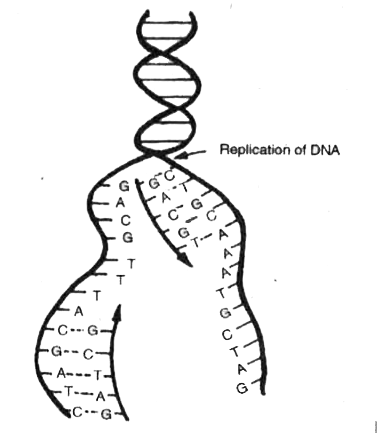
|
|
| 3. |
How does conductivity of a solution varies with dilution ? |
|
Answer» Solution :The molar conductance of an electrolytic solution decreases with increase in concentration. At low concentrations, the molar conductivity of strong electrolytes is found to obey, the following equation : `^^_(m)=^^_(m)^(oo)-bsqrtC` where b is a CONSTANT and `^^_(m)` is called the molar conductivity at infinite dilution. Thus, `^^_(m)=^^_(m)^(oo)` at infinite dilution, i.e., when `Cto0` The variation of molar conductivity with concentration can be studied by plotting the values of `^^_(m)` against square root of concentration `(sqrtC)`. It has been observed that the variation of `^^_(m)` with concentration depends to a great extent on the type of electrolyte. In CASE of strong electrolytes, the CHANGE in `^^_(m)` with `(sqrtC)` is small. In case of strong electrolytes, the plots can be extrapolated to zero concentration. This gives the limiting value of molar conductance when the CON- centration approaches zero and this value is called, molar conductance at infinite dilution. The plot of `^^_(m)` versus `(sqrtC)` for KCI solution is shown in Fig. It is DENOTED by `^^_(m)^(oo)`. However, in the case of weak electrolytes, we cannot obtain the molar conductance at infinite dilution `(^^_(m)^(oo))` by extrapolation of the `^^_(m)` versus `(sqrtC)` plots. The behaviour of `CH_(3)COOH` solution is also shown in figure. 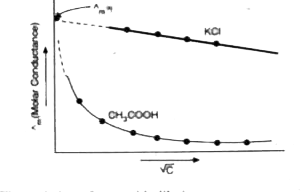 The variation of `^^_(m)` with dilution can be explained on the basis of number of ions in solution. The number of ions furnished by an electrolyte in solution depends upon the degree of dissociation with dilution. With the increase in dilution, the degree of dissociation increases and as a result molar conductance increases. (`^^_(m)^(oo)` corresponds to degree of dissociation equal to 1 i.e., the whole of the electrolyte dissociates.) The degree of dissociation may be defined as `alpha=(^^_(m)^(c))/(^^_(m)^(oo))` Where `alpha` is the degree of dissociation, `^^_(m)` is the the molar conductance at concentration C and `^^_(m)^(oo)` is the molar conductance at infinite dilution. However, in the case of strong electrolytes, there is no increase in the number of ions with dilution because strong electrolytes are completely ionised in solution at all concentrations (by definition). But there are strong forces of attraction between the ions of opposite charges called inter-ionic forces. Due to these inter-ionic forces, the conducting power of the ions is less in concentrated solutions. With dilution, the ions go far apart from one another and inter-ionic forces decreases. Therefore, molar conductance increases with dilution. |
|
| 4. |
How does concentrated H_(2)SO_(4) react with PCl_(5)? |
|
Answer» SOLUTION :CONCENTRATED sulphuric acid reacts with phosphorous PENTACHLORIDE to GIVE chloro sulphuric acid which further reacts with phosphorous pentachloride to give sulphuryl CHLORIDE. `HO-SO_(2)-OH+PCl_(5)rarr Cl+SO_(2)-OH+POCl_(3)+HCl` `underset("(Chloro sulphuric acid)")(Cl-SO_(2)-OH)+underset("(Sulphuryl chloride)")(PCl_(5)rarr Cl-SO_(2)-Cl+POCl_(3)+HCl)` |
|
| 5. |
How does benzene reacts with excess of chlorine? |
Answer» Solution :If excess of halogen is USED then a second halogen atom is introduced in the ring MOSTLY at `o^(-)` and `p^(-) POSITION. 
|
|
| 6. |
How does chemisorption vary with temperature. |
| Answer» SOLUTION :INCREASES with INCREASE in temperature/First increases then DECREASES | |
| 7. |
How does chemical adsorption of a gas on a solid vary with temperature? |
Answer» Solution :Chemical ADSORPTION FIRST INCREASES with increase in TEMPERATURE and then it decreases, if the pressure remains constant. 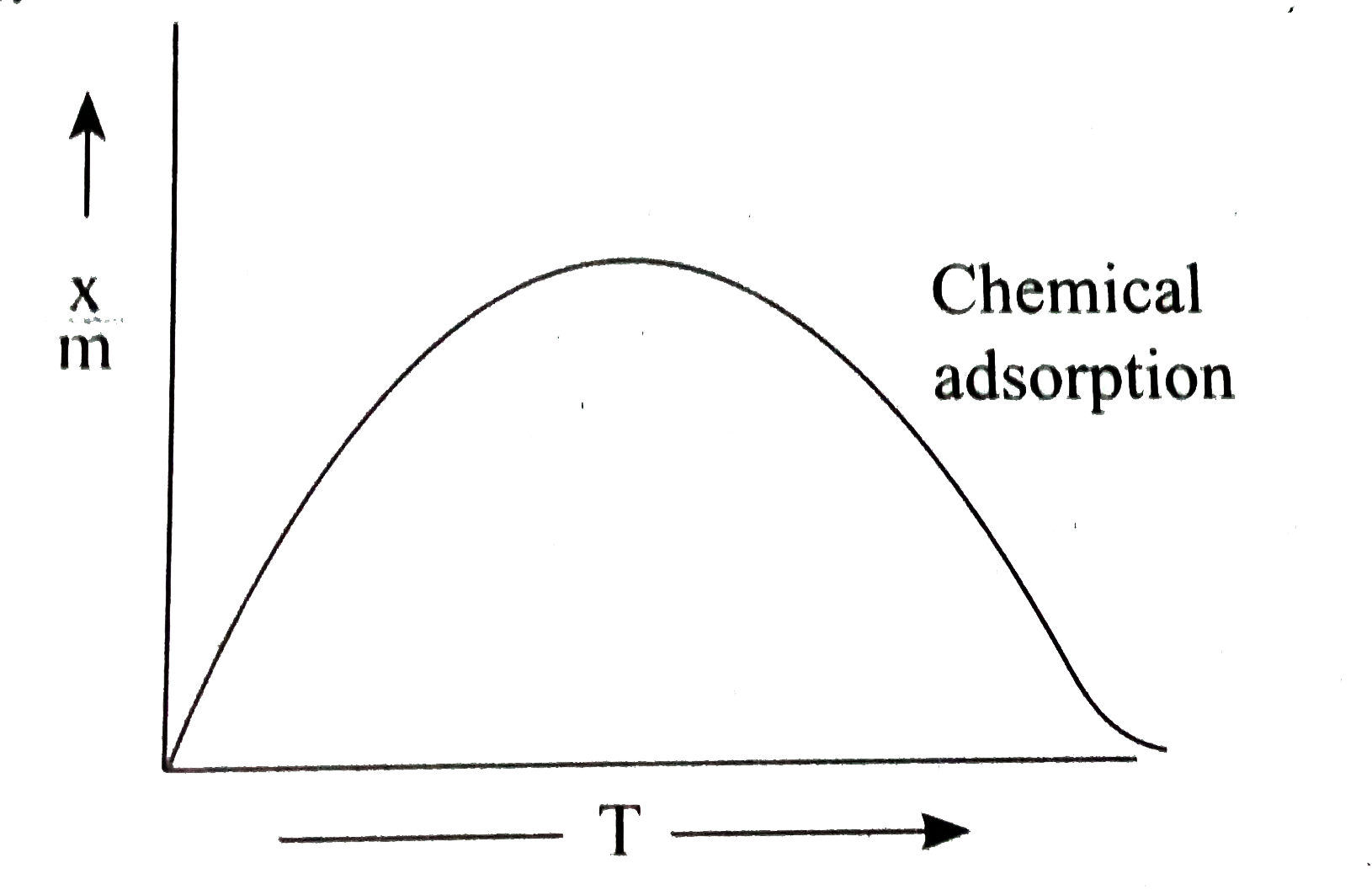
|
|
| 8. |
How does cathodic protection of iron operate ? |
| Answer» Solution : More reactive metal acts as ANODE i.e., loses ELECTRONS. Thus, it PREVENTS the OXIDATION of IRON. | |
| 9. |
How does BF_3 act as a catalyst in industrial process ? |
Answer» SOLUTION :It is because it is electron DEFICIENT. For EXAMPLE, it produces electrophile on reaction with `CH_3Cl`. 
|
|
| 10. |
How does benzenediazonium chloride react with NaNO_2"/"Cu^+ |
|
Answer» Solution :DIAZONIUM salt when treated with SODIUM NITRITE in the presence of cuprous ion as a catalyst forms nitro compounds. `C_6H_5N_2Cl underset(Cu^+)overset(NaNO_2)(to)C_6H_5NO_2` |
|
| 11. |
How does benzenediazonium chloride react with KCN |
Answer» Solution :The DIAZONIUM salt solution when TREATED with cuprous cyanide/potassium cyanide mixture, PHENYL cyanide is FORMED. 
|
|
| 12. |
How does benzenediazonium chloride react with KI |
|
Answer» SOLUTION :Aqueous solution of DIAZONIUM salt reacts with POTASSIUM iodide solution to FORM Iodobenzene. `{:(C_6H_5-N_2Cl toC_6H_5I+N_2+KCl),(" IK[Iodide ANION is the uncleophile] "):}`. |
|
| 13. |
i) How does benzaldehyde reacts with acetophenone in presence of a dilute alkali? ii) Name the product formed when acetaldehyde reacts with HCN. |
|
Answer» SOLUTION :Explanation Equation OR Self explanatory equation BENZALDEHYE REACTS with Acetophenone with dilute NaOH undergo CROSS ALDOL condensationbenzalacetophenone. 
|
|
| 14. |
How does atomic radii changes in group - 18 elements ? |
| Answer» SOLUTION :INCREASES down the GROUP. | |
| 15. |
How does aspirin act as analgesic ? |
| Answer» Solution :ASPIRIN inhibits the SYNTHESIS of PROSTAGLANDINS which cause pain. | |
| 16. |
How does aspirin act as an analgesic ? |
| Answer» Solution :Aspirin INHIBITS the synthesis of prostaglandins which STIMULATE inflammation of the TISSUE and cause pain | |
| 17. |
How does atomic and ionic radii changes with in the group - 16 elements? |
| Answer» Solution :ATOMIC and IONIC radii in group - 16 ELEMENTS decreases down the group due to INCREASE in the number of shells. | |
| 18. |
How does anisole react with bromine in ethanoic acid ? Give equation. |
Answer» Solution :ANISOLE reacts with BROMINE in ethanoic ACID GIVE orthobromo anisole and parabromoanisole. 
|
|
| 19. |
How does an increase in temperature affect both physical as well as chemical adsorption ? |
| Answer» SOLUTION :PHYSICAL ADSORPTION decreases with increase of temperature while CHEMICAL adsorption increases with increase of temperature. | |
| 20. |
How does ammonia react with a solution ofCu^(2+) ? |
| Answer» SOLUTION :Excess ammonia REACTS with `Cu^(2+)` to FORM a deep blue coloured COMPLEX. `Cu^(2+)(aq)+4NH_4OHto[Cu(NH_3)_4]^(2+)+4H_2O` | |
| 21. |
How does ammonia reacts with a solution of Cu^(2+)? |
|
Answer» Solution :When AMMONIA (aqueous Solution is ammonium hydroxide) reacts with a solution of `Cu^(2+)`, a deep blue solution is obtained due to the formation of tetraamine COPPER (II) ion. `Cu_((aq))^(2+)+4NH_(4)OH_((aq))rarrunderset("(Deep blue solution)")UNDERSET("Tetramminecopper (II) ion")([Cu(NH_(3))_(4)]^(2+)+4H_(2)O)` |
|
| 22. |
How does ammonia react with a solution of Cu^(2+) ? |
|
Answer» Solution :`Cu^(2+)` ons react with excess of ammonia to FORM a deep blue coloured COMPLEX, according to the following REACTION : `Cu^(2+)(AQ) + 4NH_4OH(aq) to underset({:("Tetrammine"),("copper (II) ion"),("(Deep blue)"):})([Cu(NH_3)_4]^(2+))+4H_2O` |
|
| 23. |
How does ammonia react with (a) Excess Cl_(2) (b) Na (c ) CuSO_(4) (d) O_(2)//Delta |
|
Answer» Solution :(a) Reaction with Excess `Cl_(2)` : `4NH_(3)+3Cl_(2) rarr underset("(NITROGEN TRICHLORIDE)")(NCl_(3))+underset("(ammonium chloride)")(3NH_(4)Cl)` (b) Reaction with `Na` : `2Na+2NH_(3)rarr underset("(Sodamide)")(2NaNH_(2))+H_(2)` (c ) Reaction with `CuSO_(4)` : `CuSO_(4)+4NH_(3) rarr underset("(Deep blue colour complex)")([Cu(NH_(3))_(4)]SO_(4))` (d) Reaction with `O_(2):` `4NH_(3)+3O_(2)overset(Delta)hArr underset("(Nitrogen)")(N_(2))+6H_(2)O` |
|
| 25. |
How does AlCl_(3) reacts with following reagents? (i) H_(2)O (ii) NH_(4)OH (iii) NaOH |
|
Answer» Solution :(i) When aluminium CHLORIDE reacts with water to form aluminium hydroxide `AlCl_(3)+3H_(2)OtoAl(OH)_(3)+34HCl` (ii) With ammonium hydroxide, aluminium chloride forms aluminium hydroxide. `AlCl_(3)+3NH_(4)Ohto Al(OH)_(3)+3NH_(4)Cl` (III) With excess of sodium hydroxide `AlCl_(3)` produces sodium META aluminate. `AlCl_(3)+4NaOHtoNaAlO_(2)+2H_(2)O+3NaCl` |
|
| 26. |
How does acidified KMnO solution react with the following: (i) FeSO_(4) (i) SO_(2) (ii) Oxalic acid (iv) KI (v) H_(2)O_(2) |
|
Answer» Solution :(i) `2KMnO_(4)+ 8H_(2)SO_(4)+ 10FeSO_(4) to K_(2)SO_(4)+ 2MnSO_(4)+ 8H_(2)O+ 5Fe_(2)(SO_(4))_(3)` (ii) `2KMnO_(4)+ 5SO_(2)+2H_(2)O to K_(2)SO_(4)+ 2MnSO_(4)+ 2H_(2)SO_(4)` (iii) `2KMnO_(4)+ 3H_(2)SO_(4) + 5H_(2)C_(2)O_(4) to K_(2)SO_(4) +2MnSO_(4)+ 10CO_(2)+ 8H_(2)O` (iv) `2KMnO_(4)+ 8H_(2)SO_(4)+ 10KI to 6K_(2)SO_(4)+ 2MnSO_(4)+ 5I_(2)+ 8H_(2)O` (V)`2KMnO_(4)+ 3H_(2)SO_(4)+ 5H_(2)O to K_(2)SO_(4)+ 2M_(4)SO_(4)+ 8H_(2)O+ 5O_(2)` |
|
| 27. |
How does Acetyl chloride react with Anisole in presence of anhydrous aluminium chloride catalyst. Write the chemical equation of the reaction. |
Answer» SOLUTION :
|
|
| 28. |
How does a transition metal ion acquire a colour? |
|
Answer» SOLUTION :(1) The transitionmetal ions hashaveincompelety filled(n-1) d-orbitlas. (2)d-orbitalsare degenerteorbitals, i.e., all fivesuborbitals of d-orbitalsnamely `d_(xy) , d_(yz), d_(x^(2) - y^(2)), d_(z^(2))` havenearly equal energy in a free METAL ions. (3) Incompounds , in the pressnceof anionsor complexingligands,degenergyis lostand these fivedegenerate d-orbitalssplits into twogroupsas follows. (i)ONEGROUP of d-orbitalshave lowerenergyand consistsof three orbitals NAMELY `d_(xy)d_(xy)` and `d_(xy)` .THEYARE called`t_(2g)`orbitals . (ii) The secondgroupof d-orbitalshavehigherenergyand consisttwo orbitals `d_(x^(2) - y^(2))`and `d_(z^(2))`and they are called `e_(g)` orbitals. 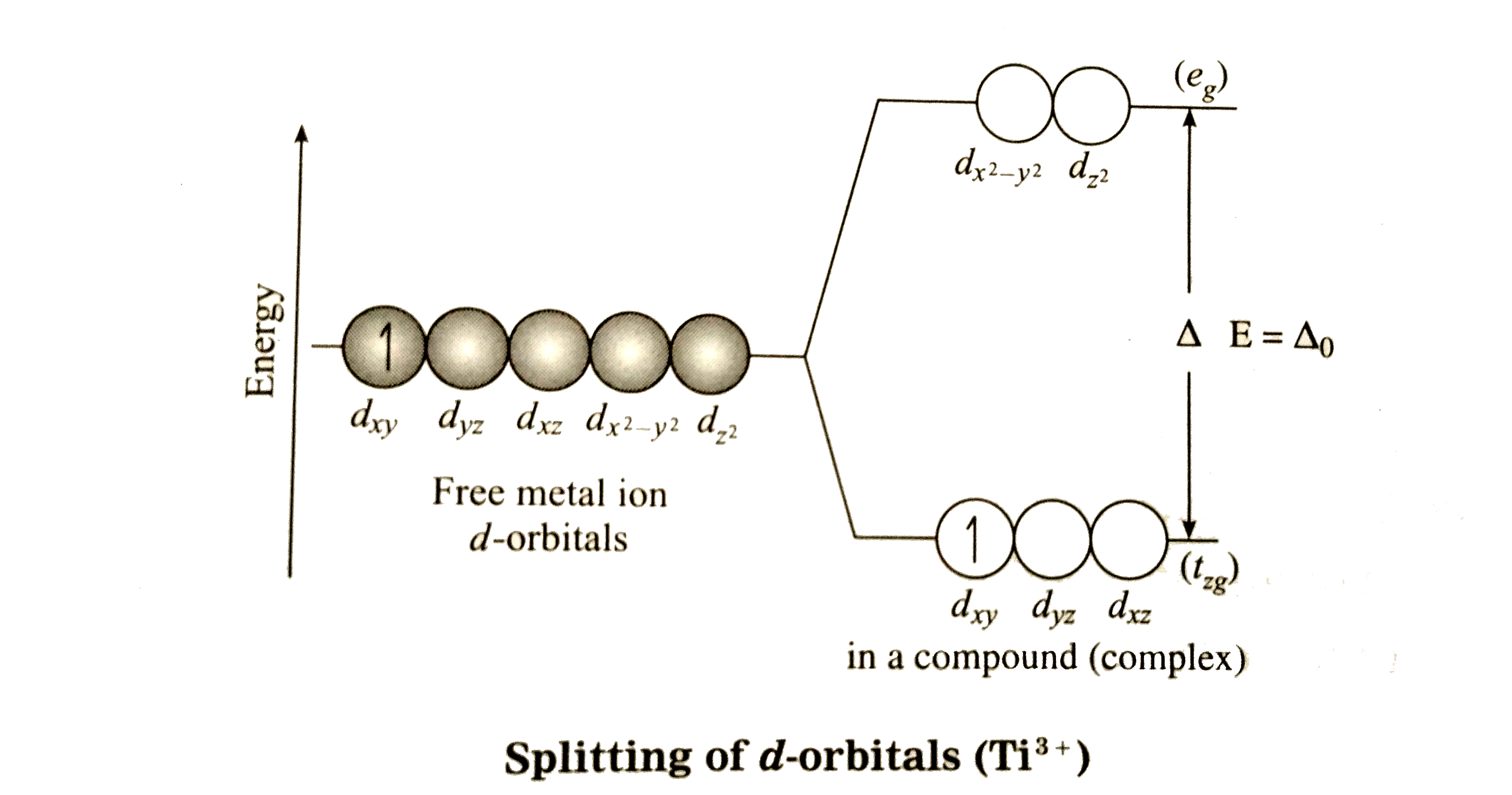 (4) They energydifferenec `DeltaE` betweenthesetwosets of d-orbitalsis calledcrystal be field splittingenergy (CFSE). (5) `DeltaE`has verysmallvalueequal tothe energyof electromagneticradiationin the visibleregion `(DeltaEhu = (hc)/(lambda))` (6) There ariesea transitionof oneor moreunpaired electronsform `t_(2g)` orbitalsto `e_(g)` orbitalsdueto theabsorptionof radiation in thevisible region. (7) When theelectron d-orbitals`(t_(2g))`it transmits thelightthatiscomplementaryin colour to colourof radiationabsorbed. Thisimpartsa characteristiccolourto thecompoundor a metal ion. Forexamplein the figurethetransitionof one elecrons`(3d^(1))`in thecomplex `[Ti(H_(2)O)_(6)]^(3+)`is shown. |
|
| 29. |
How does a solid catalyst enthane the rate of combination of gaseous molecules ? |
| Answer» Solution :As the GASEOUS molecules of the reactants are adsorbed on the surface of solid catalyst, their concentration on the surface INCREASES and they lie close to each other. Greater the concentration, faster is the reaction. CLOSENESS of reactant molecules to each other also given them a better chancel to react. Moreover, ADSORPTION is an exothermic PROCESS. The heat released further increases the rate of reaction. | |
| 30. |
How does a solid catalyst enhance the rate of combination of gaseous molecules ? |
| Answer» Solution :When gaseous molecules come in contact with the surface of a solid catalyst, a weak chemical COMBINATION between the surface of the catalyst and gaseous molecules takes place. This INCREASES the concentration of the reactants on the surface. According to the LAW of mass action, rate of a reaction is propotional to the concentration of the reactants. With increased concentration of the reactants, the reaction takes place faster. Also adsorption PROCESS is exothermic, it releases energy which helps in further increasing the rate of reaction. | |
| 31. |
How does a delta form at the meeting place of sea and river water? |
| Answer» Solution :River water is a colloidal solution of clay and SEA water CONTAINS a lot of electrolytes. COAGULATION takes PLACE at the meeting place of sea and river water. The coagulated clay forms DELTA. | |
| 32. |
How does a delta form at the meeting place of sea and river water ? |
| Answer» Solution :The colloidal particles of MUD and clay in the river GETS COAGULATED by the ELECTROLYTES present in the SEA water. Which results in the formation of delta. | |
| 33. |
How does a catalyst work? |
| Answer» SOLUTION :It accelerates a reaction by providing an ALTERNATIVE PATH having lower activation ENERGY. | |
| 34. |
How do you show the presence of followingin glucosemolecule : (i) Unbrached skeleton of six carbon atoms . (ii) Carbonyl group. |
|
Answer» SOLUTION :(i) Whenglucoseis reduced with HI ACID with P it FORMED hexane. It shows that Glucose contain6 carbon atom chain . (II) Glucosegets oxidised by brominewater to gluconicacid CONTAINS the presene of carbonylgroup. |
|
| 35. |
How do you show that glucose contains a linear chain of six carbon atoms. |
|
Answer» Solution :When GLUCOSE is heated with `HI`, it gives a n - hexane, which INDICATES glucose contains a linear chain of six carbon atoms. `underset("Glucose")({:(""CHO),("|"),(" "(CHOH)_(4)),("|"),(""CH_(2)OH):})+HI overset(Delta)rarrunderset("n - hexane")(CH_(3)-CH_(2)-CH_(2)-CH_(2)-CH_(2)-CH_(3))` |
|
| 36. |
How do you represent energy of activation? |
| Answer» SOLUTION :`E_(a)` | |
| 37. |
How do you prepare HCl in the laboratory? |
|
Answer» SOLUTION :`HCl` is PREPARED in the labortory by heating sodium chloride with conc. `H_(2)SO_(4)`. `NaCl+H_(2)SO_(4)overset(420K)rarr NaHSO_(4)+HCl` `NaHSO_(4)+NaCl overset(823K)rarr Na_(2)SO_(4)+HCl` `HCl` gas is dried by PASSING through conc. `H_(2)SO_(4)`. |
|
| 38. |
How do you prepare diethyl ether by dehydration of ethanol. |
|
Answer» Solution :When ETHANOL is heated with conc. `H_(2)SO_(4)` at 414K, diethyl ETHER is formed. `2C_(2)H_(5)OH overset("conc. "H_(2)SO_(4))underset("414 K")to C_(2)H_(5)-O-C_(2)H_(5)` diethyl ether. |
|
| 39. |
How do you prepare acetophenone from benzene? |
Answer» Solution :Benzene on reaction with ACETYLCHLORIDE in presence of anhydrous `AlCl_(3)` GIVES ACETOPHENONE. 
|
|
| 40. |
How do you explain the presence of five-OH groups in glucose molecule ? |
| Answer» Solution :We obtain a pentaacetate on treatment with acetic ANHYDRIDE which SHOWS the presence of FIVE -OH groups. | |
| 41. |
How do you explain the presence of five -OH groups in glucose molecule ? |
| Answer» Solution :GLUCOSE on acetylation with acetic ANHYDRIDE forms a penta-derivative which confirms the PRESENCE of five-OH groups in glucose MOLECULE. | |
| 42. |
Howdo you explain the presenceof an aldehydicgroup in a glucosemolecule ? |
| Answer» SOLUTION :Glucosereacts with HYDROXYLAMINE to form a monooximeand ADDS onemolecule of hydrogencyanide to givecyanohydrin . THUS,it conitans a carbonyl group whichcan be an aldehyde or a KETONE. On mildoxidationwithbrominewater , glucosegiven gluconic acidwhichis a sixcarbon carboxylicacid . This indicates that carbonyl group presentin glucoseinan aldehydicgroup. | |
| 43. |
How do you explain the presence of an aldehydic group in a glucose molecule ? |
| Answer» Solution :Glucose reacts with hydroxylamine `(NH_2OH)` to form a monoxime and adds one molecuole of hydrogen cyanide (HCN) to give a CYANOHYDRIN. Therefore, glucose contains a carbonyl group which can be EITHER an aldehyde or a ketone. On mild oxidation with `Br_(2)-H_(2)O`, glucose GIVES a carboxylic acid , i.e, gluconic acid containing the same carbon atoms as present in glucose. This INDICATES that the carbonyl group presnet in glucose is an aldehydic group and not a ketonic group. For structure of oxime , cyanohydrin and gluconic acid. | |
| 44. |
How do you explain the presence of all the six carbon atoms in glucose in a straight chain? |
|
Answer» SOLUTION :On HEATING with HI, glucose gives 1-hexane. Glucose ` UNDERSET(DELTA)overset(HI) toCH_(3)CH_(2) underset("n-hexane")(CH_(2)CH_(2))CH_(3)` |
|
| 45. |
How do you explain the presence of all the six carbon atoms in glucose in a straight chain ? |
|
Answer» Solution :Glucose on prolonged heating with HI gives n-hexane `HOCH_(2)CHOHCHOHCHOHCHOHCHOoverset(HI("EXCESS"))underset("Prolonged heating ")to underset("n-Hexane")(CH_(3)CH_(2)CH_(2)CH_(2)CH_(2)CH_(3))` |
|
| 46. |
How do you explain the geometry of the molecules on the basis of Valence bond Theory ? |
|
Answer» Solution :The valence bond theory explains the SHAPE, the formation and directional properties of bonds in poly atomic molecules like `BeCl_(2), BCl_(3), CH_(4), NH_(3), H_(2)O`, etc. in terms of overlap and hybridisation of atomic ORBITALS. E.g., in `BeCl_(2)`, Be is the central atom. Its atomic number is 4. Therefore its ground state electron configuration is `1s^(2)2s^(2)`. In order to explain the formation of `BeCl_(2)`, SP hybridisation is to be assumed for Be in its excited state. The excited state configuration of Be is `1s^(2)2s^(1)2p_(x)^(1)2p_(y)^(0)2p_(z)^(0)`. As a result of which two sp HYBRID orbitals will form on it. Now the two sp hybrid orbirtals overlap Head-Head with `3p_(z)` orbitals of two chlorine atoms forming two sigma bonds. The molecule is linear and the bond angle is `180^(@)`. 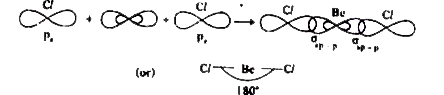 In `BCl_(3)` the central atom is boron. Its atomic number is 5. Therefore its ground state electron configuration is `1s^(2)2s^(2)2p_(x)^(1)2p_(y)^(0)2p_(z)^(0)`. Form this configuration it is evident that it exhibits mono-valency. The first excited state configuration of B is `1s^(2)2s^(1)2p_(x)^(1)2p_(y)^(0)2p_(z)^(0)`. Since, there are two half-filled orbitals, the valency of Boron is 3. In order to explain the formation of `BCl_(3)` molecule `sp^(2)` hybridisation is to be assumed to boron atom in its excited state I. As a result of which three `sp^(2)` hybrid orbitals will form on it. Now, the three `sp^(2)` hybrid orbitals of 'B' atom overlap Head - Head with `3p_(z)` orbitals of three Cl atoms forming three sigma bonds. 'The shape of the molecule is plane triangular is plane triangluar and the bond angle is `120^(@)`. 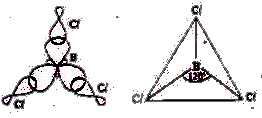 `CH_(4)` (Methane) : In `CH_(4)` the central atom is carbon. Its atomic number is 6. Therefore the electron configuration is `1s^(2)2s^(2)2p^(2)(2p_(x)^(1),2p_(y)^(1),2p_(z)^(@))`. In order to explain the formation of four bonds excited state configuration `(1s^(2)2s^(1)2p_(x)^(1)2p_(y)^(1)2p_(z)^(1))` is to be taken. From this configuration, we can say that carbon can form four bonds. `[Ex. CH_(4)]` 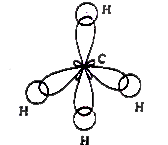 In the formation of methane molecule the central carbon atom undergoes `sp^(3)` hybridisation in its excited state `(1s^(2)2s^(1)2p_(x)^(1)2p_(y)^(1)2p_(z)^(1))`. As a result of which four `sp^(3)` hybrid orbitals form on it. Each of them contains an unpaired electron. Now, these four hybrid orbitals overlap Head-Head with 1s orbitals of four hydrogen atoms forming `CH_(4)` molecule. The strucrture of the molecule is tetrahedral. The bond angle is `109^(@)28'`. Since there are no lone pairs, there is no DISTORTION in the structure of the molecule. `NH_(3)` (Ammonia) in `NH_(3)` molecule, one `sp^(3)` orbital contains a lone pair of ELECTRONS. There will be repulsions between the lone pair and bond pair electrons. These are stronger than bp - bp repulsions. `(l.p-b.p gt b.p-b.p)`. So the bond pairs are pushed together. Hence the bond angle decreases from tetrahedral angle. The molecule assumes a pyramidal shape. 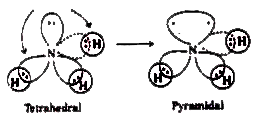
|
|
| 47. |
How do you explain the functionality of a monomer? |
| Answer» Solution :Functionality of a MONOMER is the number of BONDING SITES in it. For example, the functionality of ethene, vinyl chloride and styrene is TWO because these molecules have two reactive sites whereas the functionality of glycerol and phenol is three because they have three reactive sites. | |
| 48. |
How do you explain the functionality of a monomer ? |
| Answer» Solution :Functionality MEANS the NUMBER of bonding sites is a MOLEUCLE. For EXAMPLE , the functionality of ehtene, propene , acrylonitrile is one while that of 1,3-butadiene , adipic acid , terephthalic acid , hexamethylenediamine is two. | |
| 49. |
How do you explain the fluidity of liquids and gases and rigidity of solids ? |
| Answer» SOLUTION :Fluidity means ability to flow. Fluidity of LIQUIDS and GASES can be explained in terms of the freedom of molecules to move about. In the case of solids, the molecules are not free to move about. They can only oscillate about their MEAN position. | |
| 50. |
How do you explain the formation of furanose structure for fructose while glucose forms pyranose structure with same molecular formula C_6H_12O_6 ? |
Answer» Solution :D-glucose , an aldohexose GIVES the characteristics reactions of aldehydic group (e.g., with HCN tollen's reagent, fehling reagent etc.,) but penta acetate of D-glucose does not give these reactions. It means that either - CHO group is absent or it is not available for the chemical reactions in penta ACETYL glucose . Infact , the aldehydic group is a PART of HEMIACETAL structure which penta acetyl glucose has. So , it not available for REACTION. 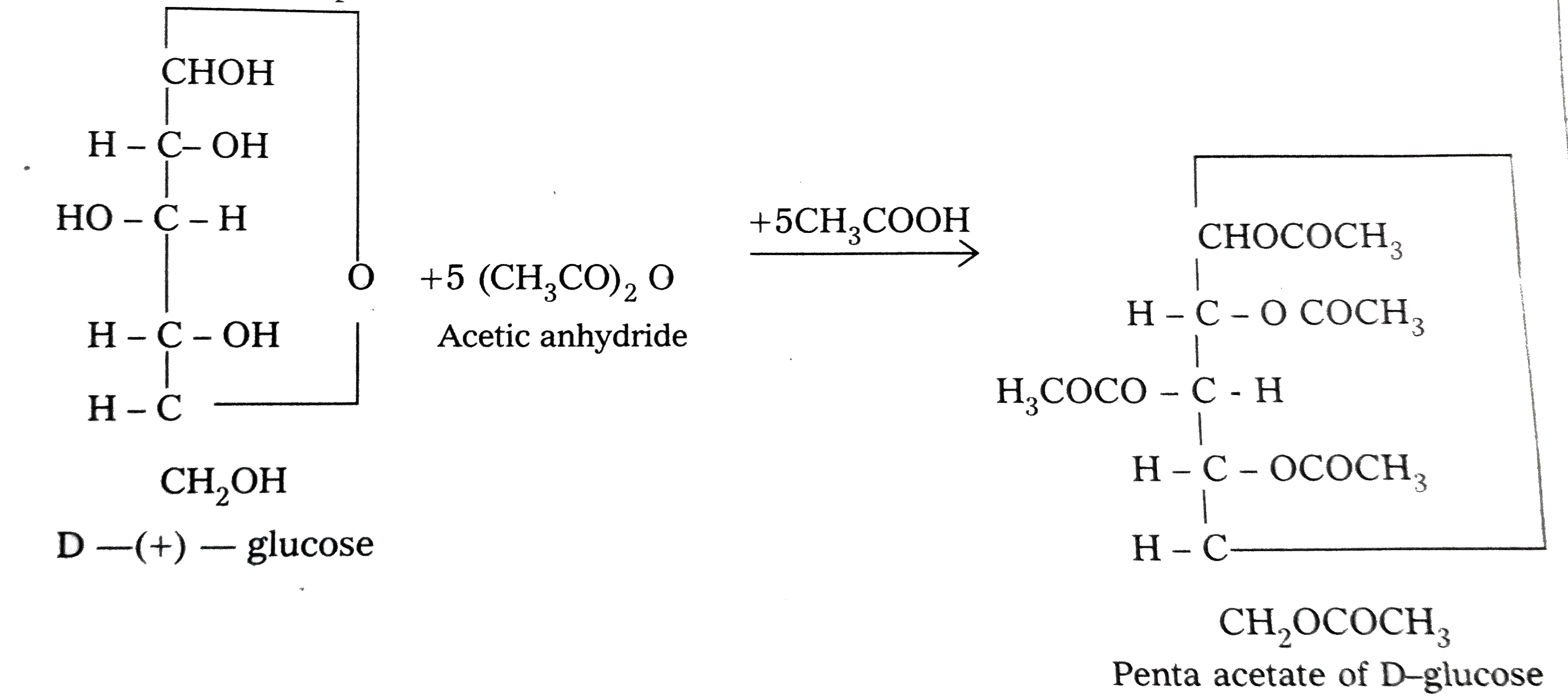
|
|
