

Saved Bookmarks
This section includes 7 InterviewSolutions, each offering curated multiple-choice questions to sharpen your Current Affairs knowledge and support exam preparation. Choose a topic below to get started.
| 1. |
How do you explain the amphoteric behaviour of amino acids ? |
Answer» SOLUTION : Amino acids exist as zwitter ions. The ACIDIC character of the amino acids is due to the `OVERSET(+)(N)H_3` GROUP while the BASIC character is due to the `COO^(-)`group.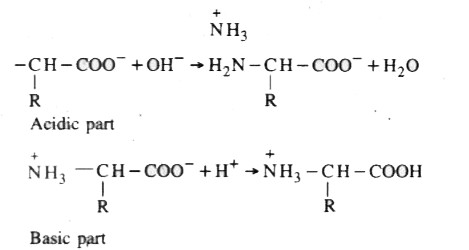
|
|
| 2. |
Howdo you explain the absence of aldehydegroupin the penetaacetateof D - glucose ? |
|
Answer» |
|
| 3. |
How do you explain the absence of aldehyde group in the pentaacetate of D-glucose ? |
Answer» Solution :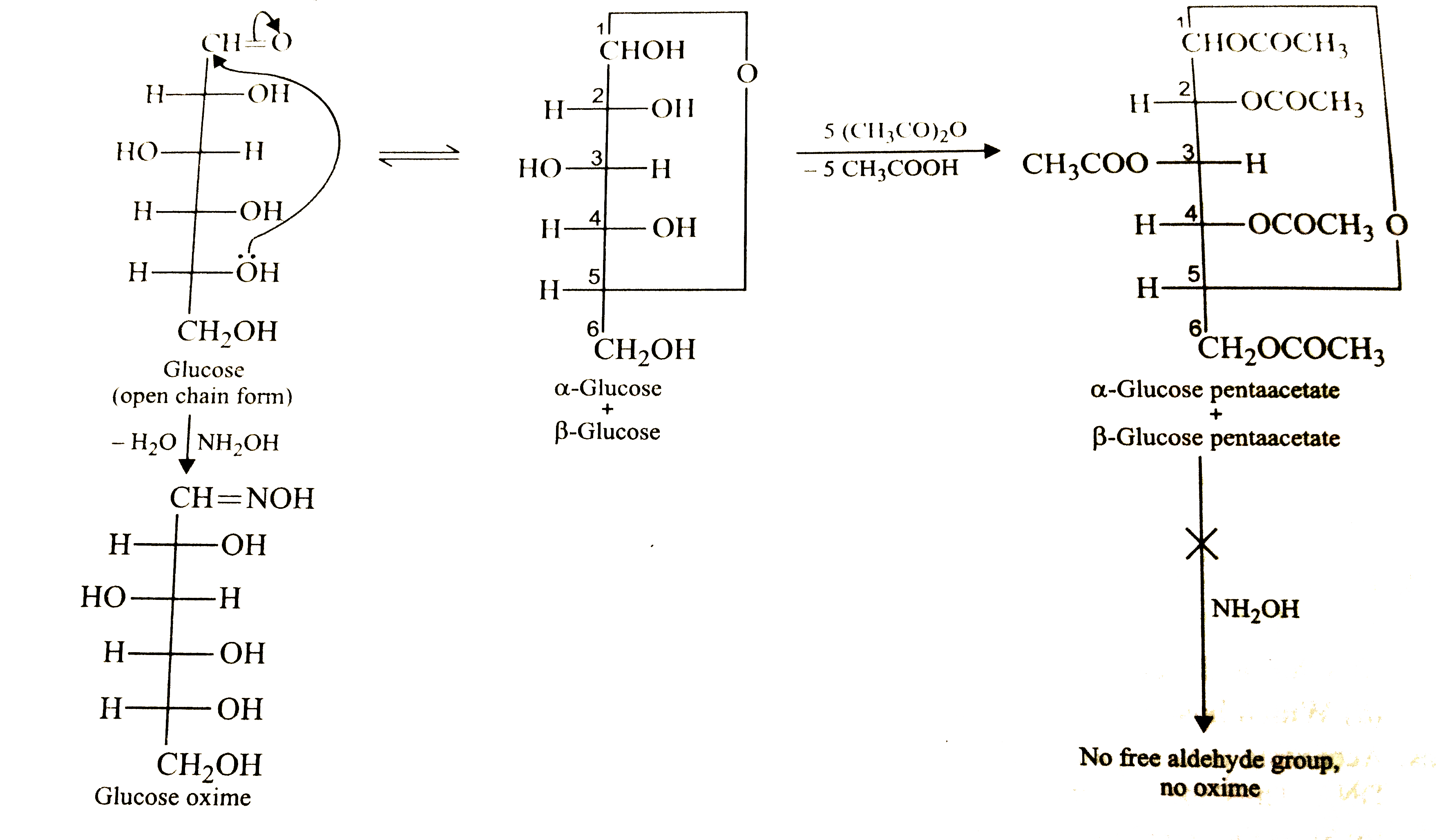 corresponding oxime . Thus , glucose contains an aldehydic group. In contrast, when glucose is reacted with acetic anhydride. Anhydride , the OH group at `C-1`, along with the four other OH GROUPS at `C-2,C-3,C-4` and `C-6` form a PENTAACETATE. Since the pentaacetate of glucose does not CONTAIN a free OH group at `C-1` , it cannot get hydrolysed in aqueous solution to PRODUCE theopen CHAIN aldehydic form and hence glucose this proves that glucose pentaacetate does not contain the aldehyde group. |
|
| 4. |
How do you distingush between benzaldehyde and acetophenone? |
|
Answer» Solution :Two REAGENTS are USEFUL to distinguish (b) Tollen.s reagent which REACT with benzaldehyde, but not acetophenone (b) Iodoform REACTION gives yellow precipitate with acetophenone, but not benzaldehydes |
|
| 5. |
How do you estimate ozone quantitatively? |
| Answer» Solution :When ozone reacts with an EXCESS of potassium iodide solution buffered with a BORATE BUFFER (PH = 9.2), iodine is liberated which can be titrated against a standard solution of SODIUM thiosulphate. This is a quantitative method for estimating oxygen gas. | |
| 6. |
How do you distinguish formic acid from acetic acid? |
Answer» SOLUTION :
|
|
| 7. |
How do you distinguish between the following pairs of isomers? [Cr(NH_(3))_(5)Br]CI and [Cr(NH_(3))_(5)CI]Br [CO(NH_(3))_(6)][Cr(NO_(2))_(6)] and [Cr(NH_(3))_(6)] [CO(NO_(2))_(6)] |
|
Answer» Solution :The isomers can be distinguished by using `AgNO_(3)` reagent. One gives curdyprecipitate of AgCl soluble in ammonia while the other will form light yellow precipitate of AgBr partly soluble in ammonia (II) The isomers can be distinguished by passing their aq. solutions through a cation exchanger. In the isomer `[CO(NH_(3))_(6)] [Cr(NO_(2))_(6)]`, the cation `[CO(NH_(3))_(6)]6(3+)` will be REPLACED by `H^(+)` ions from the resin. The resulting solution will THUS CONTAIN `H_(3) [Cr(NO_(2))]`In the other case, the resulting solulion after PASSAGE through the exchanger will contain `H_(3) [Co(NO_(2))_(6)]`. On adding KCl solution, `[CO(NO_(2))_(6)]^(3+)` ion will give an yellow precipitate of potassium cobaltinitrate, `K_(3)[CO(NO_(2))_(6)]` Hence, the resulting solutions obtained from the two isomers can be distinguished. |
|
| 8. |
How do you distinguish between methyl alcohol and ethyl alcohol ? |
| Answer» Solution :Using IODINE and alkali, METHYL alcohol and ethyl alcohol can be distinguished. Only ethyl alcohol GIVES YELLOW precipitate of iodoform. Methyl alcohol does not form iodoform. | |
| 9. |
How do you distinguish between methyl alcohol and ethyl alcohol? |
| Answer» SOLUTION :Using iodine and ALKALI methyl alcohol and ETHYL alcohol can be distinguished. Only ethyl alcohol gives yellow precipitate of iodoform. Methyl alcohol does not FORM iodoform. | |
| 10. |
How do you distinguish between CH_(3)CH=CHCl, CH_(3)CH_(2)CH_(2)Cl and CH_(2)=CH-CH_(2)Cl ? |
|
Answer» Solution :The Cl in `CH_(2)= CHCH_(2)Cl` is very reactive. This reacts rapidly with `AgNO_(3)` in the cold to GIVE a white precipitate of AgCl. `CH_(3)CH_(2)CH_(2)Cl` GIVES white precipitate when warmed with `AgNO_(3)` as it is comparatively less relative, `CH_(3)CH= CHCl` is inert and does not form white precipitate with `AgNO_(3)`. |
|
| 11. |
How do you distinguish between CH_3CH = CHCl , CH_3CH_2Cl and CH_2=CH-CH_2Cl? |
|
Answer» SOLUTION :The CL in `CH_2 = CHCH_2Cl` is very reactive. This reacts rapidly with `AgNO_3` in the cold to give a white precipitate of AgCl. `CH_3CH_2CH_2CI` gives white precipitate when WARMED with `AgNO_3` as it is comparatively less reactive. `CH_3CH = CHCI` is INERT and does not form white precipitate with `AgNO_3`. |
|
| 12. |
How do you distinguish between Br^(ɵ) and NO_(3)^(ɵ) ions? |
| Answer» Solution :TREAT the salt with CONC. `H_(2)SO_(4)` pass the reddish-brown gas evolved through `FeSO_(4)` solution if it turns BLACK it is `NO_(3)^(ɵ)` in case it does not turn black, the anion is `Br^(ɵ)`. | |
| 13. |
How do you differentiate between Fe^(3+) and Cr^(3+)in qualitative analysis group III ? |
|
Answer» By taking excess of `NH_4OH` |
|
| 14. |
How do you determine Sulphur , Phosphorous and Oxygen quantitatively in an organic compound ? |
|
Answer» Solution :Estimation of Oxygen : A known weight of organic compound is DECOMPOSED by heating in a STREAM of nitrogen gas . The mixture of gaseous products containing oxygen is passed over red hot cake to convert all oxygen in those oxides to CO . Then the mixture is passed through hot iodine pentoxide to convert CO into `CO_(2)` and iodine liberates . Compound `overset("heat")(to)O_(2) +` other gaseous products `2 C + O_(2) overset(1373 K)(to) 2 CO, I_(2) O_(5) + 5 CO to I_(2) + 5 CO_(2)` (red hot ) Calculation : Mass of organic compound = a g Mass of carbon oxide = b g 44 g of `CO_(2)` CONTAINS 32 g of oxygen . `therefore` b g of `CO_(2)` contains ................. ? `= (b xx 32)/(44)` g of oxygen a g of organic compound contains `(b xx 32)/(44)` g of `O_(2)` . `therefore ` 100 g of organic compound contains ......... ? `(100 xx b xx 32)/(a xx 44)` of oxygen (% of oxygen ) |
|
| 15. |
How do you define chemical kinetics? |
| Answer» Solution :It is the study of chemical reactions with respect to reaction rates, EFFECT of VARIOUS variables, REARRANGEMENT of ATOMS and formation of intermediates. | |
| 16. |
How do you convert the following : Phenol to Anisole |
Answer» SOLUTION :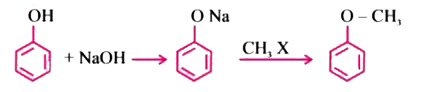 `CH_(3)CH_(2)OH overset(PC C," Heat")to CH_(3)-CHO overset((i)CH_(3)MgBr(ii)H^(+)) to CH_(3)CH(OH)-CH_(3)` |
|
| 17. |
How do you convert the following? Toluene to Benzoic acid |
Answer» SOLUTION :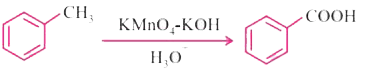
|
|
| 18. |
How do you convert the following : (i) Aniline to benzene (ii) Ethanamide to methanamine (iii) Nitrobenzene to aniline ? |
Answer» Solution :(i)  (ii) `UNDERSET("Ethanamide")(CH_(3)-overset(overset(O)(||))(C)-NH_(2))+Br_(2)+4NaOH RARR underset("Methanamine")(CH_(3)NH_(2))+Na_(2)CO_(3)+2NaBr+2H_(2)O` (iii) 
|
|
| 19. |
How do you convert the following : Ethanol to Propan-2-ol |
Answer» SOLUTION :
|
|
| 20. |
How do you convert the following: a. Ethanal to Propanone b. Toluene to Benzoic acid |
Answer» SOLUTION :
|
|
| 21. |
How do you convert the following? Ethanal to Propanone |
Answer» SOLUTION :
|
|
| 22. |
How do you convert : (i) Chlorobenzene to biphenyl (ii) Propene to 1-iodopropane (iii) 2-bromobutane to but-2-ene. |
Answer» Solution :(i) Chlorobenzene to biphenyl (Fittig reaction) <BR> (II) Propene to 1-iodopropane (ANTI- Markovnikov ADDITION) `CH_(3)CH = CH_(2) underset("Peroxide")overset(HI) to underset("1-Iodopropane") (CH_(3)CH_(2)CH_(2)I)` (III)2-bromobutane to but-2-ene `CH_(3)CH_(2)underset(Br)underset(|)CHCH_(3) overset("Alc.KOH") to underset("But -2-ene") (CH_(3)CH = CHCH_(3)) ` |
|
| 23. |
How do you convert ethanoic acid to methane? Write equation. |
|
Answer» Solution :Ethanoic acid is HEATED soda lime, sodium ethanoate formed undergoes decarboxylation to form Methane. OR By HEATING it with soda lime. `CH_(3)COOHunderset(H_(2)O)overset(NaOH)(to)CH_(3)COONaunderset(DELTA)overset("Soda lime")(to)CH_(4)` OR `CH_(3)COOH+NaOHoverset(H_(2)O)(to)CH_(3)COONa+H_(2)O` `CH_(3)COONa+NaOHoverset(DeltaCaO)(to)CH_(4)+Na_(2)CO_(3)` |
|
| 24. |
How do you convert ethane nitrite to ethanamine ? Give equation. |
| Answer» Solution :`underset("Ethannitrile")(CH_(3).CN+4[H]) overset("Reduction")(RARR)underset("ETHANAMINE")(CH_(3).CH_(2).NH_(2))` | |
| 25. |
How do youclassify polymers basedon source ? |
|
Answer» Solution :Polymers can be classifiedbased on sourceas under . (i) Natural polymers: Thesepolymersare foundin plantsand animlas . Exampleare proteins, CELLULOSE, strach , resins and rubber . (II) Semi - synthetic polymers : Cellulosederivativessuch as celluloseacetate (RAYON) and cellulosenitrate , etc . are theusual EXAMPLES of thesub - categroy. (iii) Syntheticpolymers: A varietyof syntheticpolymers such as plastic (polythene), synthetic fibres( nylon 6,6) and synthetic rubbers(Buna - S) are exampleof MAN - madepolymers extensively used in dailyin daily lifeas wellas in industry. |
|
| 26. |
How do you convert: 2-Bromobutane to but-2-ene? |
|
Answer» SOLUTION :2-Bromobutane on heating with alc. KOH undergoes dehydrohalogenation to give but-2-ene as the MAJOR product in accordance with saytzeff rule. `underset("2-Bromobutane")(CH_(3)-underset(Br)underset(|)(C)H-CH_(2)CH_(3))underset("(-HBR) Saytzeff rule")overset(KOH(alc.),DELTA)to underset("But-2-ene (major product)")(CH_(3)-CH=CH-CH_(3))+underset("But-1-ene (minor product)")(CH_(3)CH_(2)CH=CH_(2))` |
|
| 27. |
How do you convert benzamide to benzoic acid? |
Answer» SOLUTION : When benzamide is HEATED with dil acid HYDROLYSIS TAKES place to form benzoic acid. 
|
|
| 28. |
How do you convert ethane nitrile into ethanoic acid? |
| Answer» SOLUTION :`CH_(2)H_(3^(-))CN underset(H_(2)O)overset(H^(+))(to)CH_(3)-overset(O)overset(||)(C)-NH_(2)underset(Delta)overset(H^(+) "or" OH^(-))(to)CH_(3)COOH` | |
| 29. |
How do you convert benzoic acid to benzamide? Write the reaction. |
Answer» SOLUTION :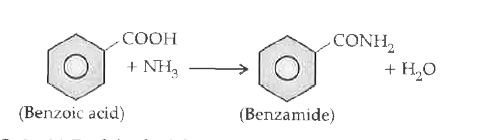
|
|
| 30. |
How do you account of the reducing behaviour for H_(3)PO_(2) ? |
| Answer» Solution :The acids which P-H bond have STRONG reducing properties . In `H_(3)PO_(2)` two H ATOM are BONDED directly to P atom which imparts reducing character to the acid. | |
| 31. |
How do you account for the reducing behaviour of H_(3)PO_(2)?Why are pentahalides more covalent than Trihalides? (iii) Bond angle in PH, is higher than that in PH_(3) Why? (iv) What is the basicity of H_(3)PO_(4)? |
|
Answer» Solution :(i)The structure of `H_(3)PO_(2)` has two P-H bonds. Due to the presence of these P-H bonds, H3PO, acts as a strong reducing agent. For example, it reduces A educes `AgNO_(3)` to metallic Ag and arenediazonium salts to arenes. `4AgNO_(3)+H_(3)PO_(2)+2H_(2)Oto4Ag+H_(3)PO_(4)+4HNO_(3)` (ii)The elements of group 15 have five electrons (two in the s- and three in the p-orbitals) in their respective Valence shells. Since it is difficult to lose all the three electrons to form Eo or even more difficult to lose all the five valence electrons two S- and three p.) to E ions, therefore, HIGHER elements have no tendency to form ionic compounds. Instead they form covalent compounds by sharing of electrons. Since elements in the +5 oxidation state have less tendency to lose electrons than in the +3 oxidation state, therefore elements in the +5 oxidation have more tendency to share electrons than in the +3 oxidation state. Thus, elements in the +5 oxidation state are more covalent than in the +3 oxidation state. In other words, pentahalides are more covalent than trihalides. (iii)P in `PH_(3)` is sp -hybridized. It has three bond pairs and one lone pair around P. Due to stronger lone pair - bond pair repulsions than bond pair repulsions, the tetrahedral angle decreases from `109^(@)` - 28" to 93.6". As a result, `PH_(3)` is Pyramidal. However, when it reacts with a PROTON, it forms PH, ion which has four bond pairs and no lone pair. Due to the absence of lone pair - bond pair repulsions and presence of four identical bond pair - bond pair interactions, PH assumes tetrahedral geo-metry with a bond angle of `109^(@) -28`.. This EXPLAINS why the bond angle inhigher than in `PH_(3)` 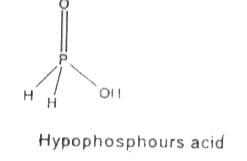 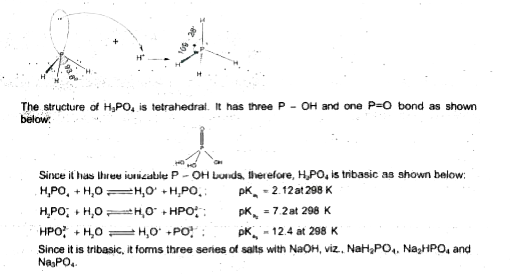
|
|
| 32. |
How do you account for the reducing behaviour of H_(3)PO_(2) ? Or (i) Draw the structure of phosphinic acid (H_(3)PO_(2)). (ii) Write a chemical reaction for its use as a reducing agent. |
|
Answer» Solution :The structure of `H_(3)PO_(2)` has two P-H bonds. Due to the presence of these P-H bonds, `H_(3)PO_(2)` acts as a strong reducing agent. For example, it reduces `AgNO_(3)` to metallic Ag and arenediazonium salt to ARENES. `{:(""4 AgNO_(3) + H_(3)PO_(2) + 2H_(2)O RARR 4 Ag + H_(3)PO_(4) + 4 HNO_(3)),(underset("Benzenediazonium chloride")(2 C_(6)H_(5)N_(2)CI)+H_(3)PO_(2)+2H_(2)O rarr underset("Benzene")(2C_(6)H_(6))+H_(3)PO_(4)+2N_(2)+2HCI):}` 
|
|
| 33. |
How do you account for the reducing behaviour of H_3PO_(2)on the basis of its structure ? |
|
Answer» <P> SOLUTION :In `H_3PO_(2)` , two H atoms are BONDED direcuy to P atom which imparts REDUCING character to the acid. |
|
| 34. |
How do you account for the miscibility of ethoxyethane with water? |
Answer» Solution :SOLUBILITY or miscibility of ethoxyethane with WATER is due to H-bonding between H-atoms of `H_(2)O` and O ATOM of ethoxyetane as SHOWN below: 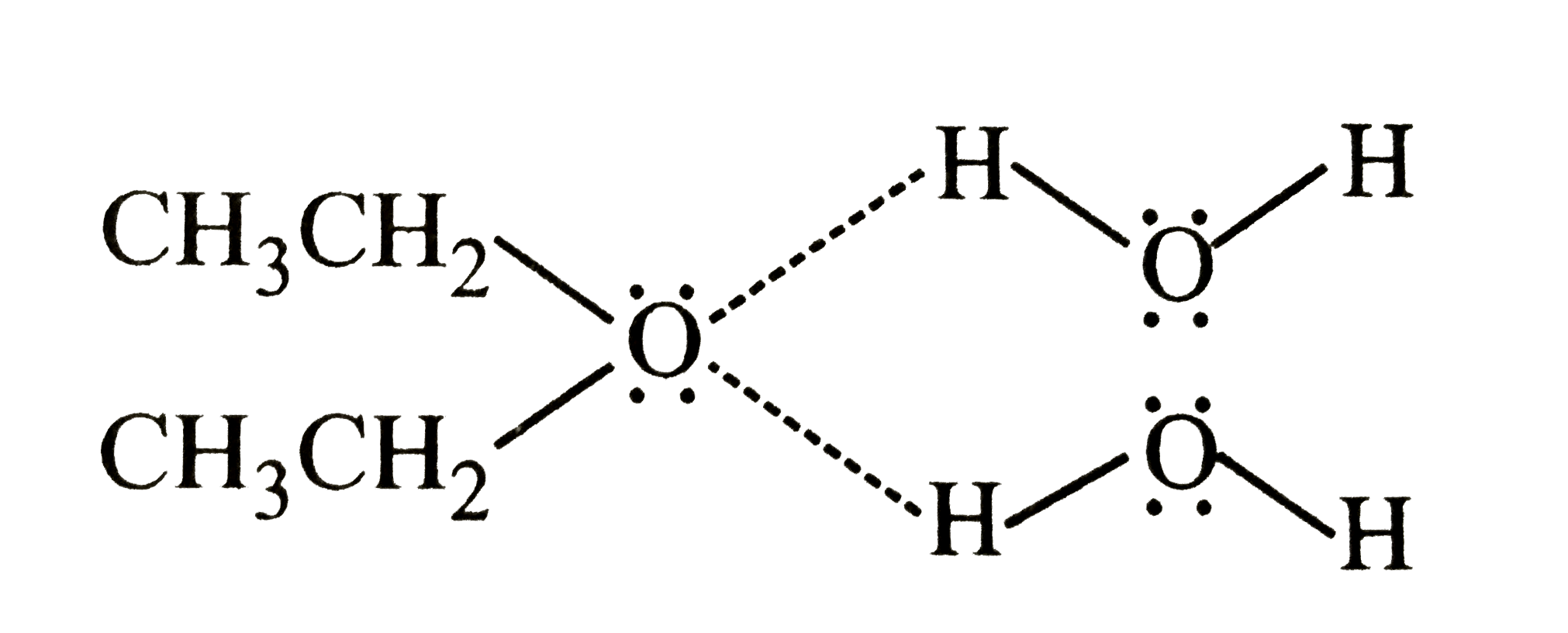
|
|
| 35. |
How do you account for the indicated molecular geometry for the following compounds in terms of valence bond theory. [Aucul_(4)]^(-) - square-planar, [Fe(CN)_(6)]^(3-) - octahedral, [GaCl_(4)]^(-) tetrahedral, [Nicia) tetrahedral |
Answer» SOLUTION : 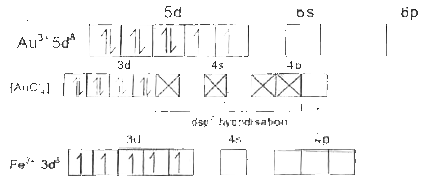 
|
|
| 36. |
How do you account for the following: (i) all scandium salts are white ? (ii) the first ionisation enthalpies of 5d transition elements are higher than those of the 3d and 4d transition elements in respective groups ? |
|
Answer» Solution :(i) In scandium salts, scandium has +3 OXIDATION state, `Sc^(3+)` does not have unpaired ELECTRONS and THEREFORE there is no d-d transition. Hence its salts are white. (ii) DUE to poor SHIELDING effect of 5d and 4f- electrons, the effective nuclear charge increases. Hence ionisation enthalpy of 5d transition elements is more than that of 3d and 4d-elements in respective groups. |
|
| 37. |
How do you account for the following ? (a) Boilling points of aldehydes lie between parent alkanes (b) Aldehydes and ketones have high dipole moments (c) NaHSO_(3) is used for the purification aldehydes and ketones (d) Iodoforms is obtained byt he reactionof acetone with hypoiodite but not with iodide (e) Hydrazones of aldehydes and ketones are not prepared in highly acidic medium |
|
Answer» Solution :Alkanes have low boiling points as no hydrogen bonding and no dipole- dipole- attractive forces are present. Alcohols have high boiling points as intermolecular hydrogen bonding is present. In aldehydes, dipole-dipole FORECES are present due to polar nature of CARBONYL group. Thus, boiling points of aldehydes lie between alkanes and alcohols. (b) The dipole moment is due to the large contribution of the polar structure (REASONANCE) to the hybrid. 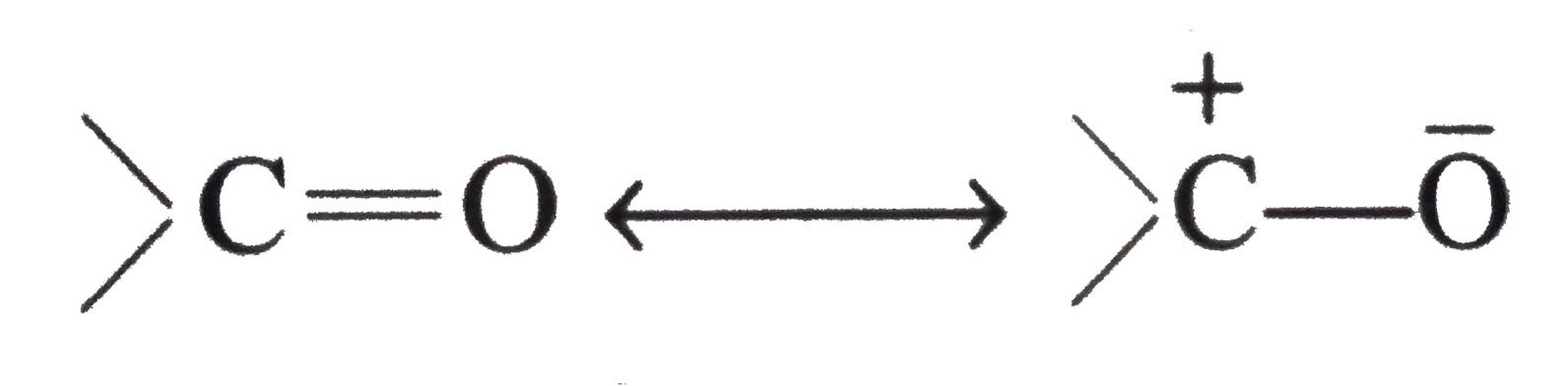 (c) Aldehydes and ketones form insoluble crystalline compound with`NaHSO_(3)` which can be filtered. These on distillation with saturated solution of `Na_(2)CO_(3)` agian give rthe aldehyde or ketone.  (d) The reaction is initiated by the replacement of methyl protons `(H^(+))` by `I^(+)` `CH_(3)COCH_(3)+3IO^(-)rarrCOCH_(3)+3OH^(-)` (e) In highly acidic medium, the protonationof hydrazine decreases its nucleophilic character. |
|
| 38. |
How do youaccount for thefollowing?(a) Alkanes are accountfor thefollowing ? (B) chorination of methanedoesno chemical reagents . ( C)iodinatio of methaneoccursof methaneocursin presenceof iodicacid . (d) why thecreackedgasolineis consideredto besuperior to staught distilled gasoline ( e) theboilingpointsof branched chainalkanesarelower thanthan theirnormalisomers . ( f) Alkanes containingeven numberof carbon atoms have higher than expected point . (g) Although combustion of alkanes is a strongly exo0thermic proces it doesnot occur at moderate temperature (h) thetraethyl lead Pn (CH_(2) H_(5) )_(4)initiales the chlorinationof methanein thedarlk at 423 K . (j) why doesan oil slick form on thesurface of the ocean aftera spill ? ( j) Atetriary carbon atomcan be oxidisedwithrelativeease . (K) Out of 2-methyhexaneand 2,2- dimethylbutanewhichone hashigherpointand whichone has higherboiling point? |
|
Answer» Solution :(A) Alkanes haveno reactionsites due to C-C and C-H non polar BONDS where thechemicalregentscan attack . ( B)Chlorinationis a freeradicalsubstition , to get chorine freeradicals fromCl_(2) moleculesenergyis requiredwhichis notavailableindark. ( C) Iodinationis areversiable processtodecomposehydrogeniodine , oneof theproducts,anoxidisingagent i.e, iodicacidisrequired , `(5HI+HIO_(3)to 3I_(2) +3H_(2)O)` (D) Creakedgasolineposseses branchedchainhydrocarbons whichhavehigheroctanenumberthe straightdistilleddistilledgasoline possesmainlystright chain hydrocarbons . ( E)theintermolecularforcesareweaker inbranchedchainisomers dueto lowsurfacearea andtherefore, havelowerboilingpoints . ( f)Alkaneswitheven numberof carbon atomspackin amanner todueto lowsurfacearea andtherefore, haveslightlyhigermelting points. (G) thereactionis veryslowat room temperaturebecauseof a veryhighenergyfo activation . (H) `Pb(C_(2)H_(5))_(4)` undergoesthermolhomolysisof C-Pb bondat423K , thefreeradical `CH_(3)CH_(2)`thengenertates `overset(*)Cl`whichbringschlorination of methanein dark. (i) Alanes , thechiefbeing constituent of petroleiumare insolubleand have a lowerdensitythanwater , (j)Alkylgroup beingelectron releasinggoupincreasetheelectron DENSITY at tertiary carbon atom which helpseasy oxidation . (K)the moreis branching HIGHER is the melting POINT and loweristhe boilingpoint, somelting point of 2,2,-dimehtylbutane (morebeanching ) ishigerthanthat of 2- methyhexane(lessbranching ): but the boilingpointof 2-methyhexane is higer thanthatof 2,2 dimethylbutane . |
|
| 39. |
How do you account for the basicity of |
| Answer» SOLUTION :`H_3PO_3` MOLECULE CONTAINS only TWO P-OH BONDS. These only are ionisable. | |
| 40. |
Howdoweseparate twosulphideoresbyFrothFloatationMethod ?Explainwithanexample. |
|
Answer» Solution : Twosulphideorescan beseparated byadjustingproportion ofoiltowateror byusingdepressantswhichpreventonetypeofsulphide oreparticlesfromformingthefrothwithairbubbles. Forexamples, incaseofanorecontaining ZnS andPbS,thedepressantNaCN is used.Itformssolublecomplex withZnS, `4 NaCN+ZnS tounderset ("(solublecomplex)") underset ("Sod. tetracynozincate (II)")(Na_ 2 [ZN (CN)_4])+Na_ 2S` andthuspreventsit fromformingafrothwhilePbs formsthefrothandhencecan beseparatedfromZnS. |
|
| 41. |
How do you acccount for the fact that unlike phenol,2,4-dinitrophenol and 2,4,6-trinitrophenol are soluble in aqueous sodium carbonate solution? |
| Answer» Solution :Due to the strong electron-withdrawing nature of `-NO_(2)` groups, both 2,4-dinitrophenol and 2,4,6-trinitrophenol are more acidic than carbonic acid and HENCE DISSOLVE in AQ. `Na_(2)CO_(3)` solution to form the corresponding sodium salts with the EVOLUTION of `CO_(2)`. | |
| 42. |
How do we separate two sulphide ores by froth floatation method? |
|
Answer» by USING excess of PINE oil |
|
| 43. |
How do we make transparent soaps ? |
| Answer» SOLUTION :These are made by dissolving soap in ETHANOL and then EVAPORATING the EXCESS SOLVENT. | |
| 44. |
How do we differentiate between CO_(3)^(2-) and SO_(3)^(2-) in dilute H_(2)OSO_(4) group ? ( Note : These are sodium salts ? |
|
Answer» By passing gas liberated with DILUTE `H_(2)SO_(4)` through LIME water. `CaCO_(3)+CO_(2)+H_(2)OrarrCa(HCO_(3))_(2)("soluble")` `SO_(3)^(2-)+2H^(+)rarrSO_(2)+H_(2)O,Ca(OH)_(2)+SO_(2)rarr CaSO_(3)darr("white")+H_(2)O` `CaSO_(3)+H_(2)O+SO_(2)rarrCa(HSO_(3))_(2)("soluble")`. `(2)CO_(3)^(2-)+2H^(+)rarrCO_(2)+H_(2)O,Cr_(2)O_(7)^(2-)+H^(+)+CO_(2)rarr"No reaction"` `SO_(3)^(2-)+2H^(+)rarrSO_(2)+H_(2)O,Cr_(2)O_(7)^(2-)+2H^(+)+3SO_(2)rarr2Cr^(3+)("green solution")+3SO_(4)^(2-)+H_(2)O` `(3)Pb^(2+)+OS_(3)^(2-)rarrPbSO_(3)darr("white"),2Pb^(2+)+2CO_(3)^(2-)+H_(2)Orarrubrace(Pb(OH)_(2)darr+PbCO_(3)darr)_("while")+CO_(2)` `(4) 2Ag^(+)+CO_(3)^(2-)rarrAg_(2)CO_(3)darr("white")"",""2Ag^(+)+SO_(3)^(2-)rarrAg_(2)SO_(3)darr("white")` |
|
| 45. |
How do we differentiate between Fe^(3+) and Cr^(+) in group III |
|
Answer» By taking EXESS of `NH_(4)OH` solution |
|
| 46. |
How do the oxidation states of the elements vary in the transition series? |
|
Answer» Solution :In the beginning of the series, very less number of d-electrons are available for the chemical bonding. Hence, less number of oxidation states are shown by elements present at the beginning of series. Ex: Scandium `(d^(1))` is known only in (+3). Titanium `(d^(2))` exists in (+2), (+3) and (+4). However, Ti(IV) is more stable than Ti(III) or Ti(II). At the end of the series, there are too many d-electrons and d-orbitals are completely occupied. Ex: Zn and Cu hence, there are very less number of orbitals available to share electrons with others for higher valance. Hence, these elements show very less number of oxidation states. Ex: Zn(II) is only known while copper is known to exist in Cu(I) or Cu(II). The greatest number of oxidation states of the elements are known in the middle of the series. Ex: Mn shows oxidation state from (+2) to (+7). The stability of the higher oxidation states corresponds in value to the SUM of s and d-electrons upto manganese adn then decreases abruptly. Ex `Ti^(IV) O_(2), V^(V) O_(2_(+)), Cr_(VI) O_(4)^(2-), Mn^(VII) O_(4)^(-), Fe^(II, III), Co^(II, III), Ni^(II), Cu^(I, II), Zn^(II)` The ELMENTS showing more than one oxidation states have the difference on oxidation state of unity. This is opposite to the oxidation states shown by non-transition elements which normally differs by two. Ex: `V^(II), V^(III), V^(IV), V^(V)`. Down the group, the stability of elements in higher oxidation states increases because the removal of electrons from d-orbitals becomes easy. Ex: Mo(VI) and W(VI) are found to be more stable than Cr(VI). As a result, Cr(VI) in the form of dichromate act as strong oxidizing agent in acidic medium where as `MoO_(3) and WO_(3)` are not. Thus in p-block elements, the lower oxidation states is favoured by higher members of the group due to inner PAIR effect while in transiition elements from group -4 to group -10, higher members show high oxidation state. Low oxidation states are found when a complex compound has ligands capable of `PI`-acceptor character in addition to `sigma`-bonding Ex: In `Ni(CO)_(4) and Fe(CO)_(5)`, the oxidation state of nickel and iron is zero. |
|
| 47. |
How do the following factors affect the rate constant of a reaction? (1) concentration of the reactant, (2) temperature and (3) catalyst. |
| Answer» Solution :(1) RATE constant is independent of the concentration of reactant . (2) Its value increases with rise in temperature and DECREASES with lowering of temperature. (3) Its value changes in presence of a catalyst. | |
| 48. |
How do the following properties change in group - 1 and in the third period? Explain with example. (b) IE |
|
Answer» Solution :Ionisation Energy: As we move from top to BOTTOM of group-1 ELEMENTS the atomic radius increases gradually. So the distance from the NUCLEUS to the OUTER electrons increases. This results in the decreases in nuclear attraction on outer electrons. Hence ionisation energy decreases from Li to Cs as we move down the group. While MOVING from left to right along 3rd period atomi radius decreases and effective nuclear charge increases gradually. So ionisation energy increases in the 3rd period form Na to Cl. |
|
| 49. |
How do the following properties change in group - 1 and in the third period? Explain with example. (c ) EA |
|
Answer» Solution :Electron Affinity : As we move down the group - 1 elements atomic RADIUS increases gradually. DUE to this reason the ATTRACTION between the added electron and the nucleus decreases. Hence electron affinity decreases from Li to Cs. In the 3rd period while we are moving from LEFT to right the atomic radius decreases and effective nuclear charge increases gradually. So the attraction between added electron and the nucleus increases gradually. Hence electron affinity increases from Na to CL with certain exceptions. |
|
| 50. |
How do size of particles of adsorbent, pressure of gas and prevailing temperature influence the extent of adsorption of a gas on a solid ? |
|
Answer» Solution :(i) SMALLER the size of the particles of the adsorbent,K GREATER is the surface area, greater is the adsorption. (II) At constant temperature, adsorption first increases with increase of pressure and then ATTAINS equilibrium at high pressures. (iii) In physical adsorption, it decreases with increase of temperature but in chemisorption, first it increases and then decreases. |
|