

Saved Bookmarks
This section includes 7 InterviewSolutions, each offering curated multiple-choice questions to sharpen your Current Affairs knowledge and support exam preparation. Choose a topic below to get started.
| 1. |
How do the airbags installed in the dashboard of your car work ? |
|
Answer» Solution :When accident occurs, the sensor provided in the car detects the collision. It sends an electrical signal which overheats and ignites sodium azide `(NaH_(3))` placed in the airbag. Sodium azide is a fast burning fuel that produces large amounts of `N_(2)` gas which goes through FILTERS and fills the NYLON airbag. The airbag then hits your head and protects you from injury. `2NaN_(3) rArr 2 Na + 3 N_(2)` After your head hits the nitrogen filled bag, it deflates by releasing the gas through tiny holes. The cloud of SMOKE that fills the vehicle is actually talcum powser or corn starch. The powder prevents the bag from sticking to itself, while it is folded inside the car. The `N_(2)` gas that is released is absolutely harmless because `N_(2)` constitutes about 79% of the air that we inhale. One just needs to open the doors or windows for the gas and powder to ESCAPE. |
|
| 2. |
How do size of particles of adsorbent, pressure of a gas and prevailing temperature influence of extent of adsorption of a gas on a solid? |
|
Answer» Solution :(i) Effect of size of the particles of adsorbent: GREATER the specific area of the solid available for adsorption of adsorbent, greater would be its adsorbing power. That is why porous or finely divided forms of ADSORBENTS more strongly. However, the size of pores should be large enough to allow the diffusion of gas MOLECULES. (ii) Effect of PRESSURE: Increase in pressure initially increases the adsorption which later attains equilibrium at high pressure. `(x)/(m)=KP^(1/n)( n gt 1)` |
|
| 3. |
How do primary, secondary and tertiary amines react with nitrous acid? |
|
Answer» Solution :(i) Primary amines react with nitrous acid to form ALCOHOLS and NITROGEN GAS `{:(CH_3NH_2+O=N-OH to [CH_3-N=N-OH] to CH_3OH+N_2),(" Primary amineunstable "):}` Aliphatic DIAZONIUM compound is unstable because of absence of resonance stabilisation. (ii) Secondary amines react with nitrous acid to form N-nitroso amines which are WATER insoluble yellow oils. `{:((CH_3)_2NH+HO-N=O to (CH_3)_2N-N=O),(" Secondary amineN-nitroso dimethyl amine - yellow oil (insoluble in water)"):}` (iii) Tertiary amines react wtih nitrous acid to form trialkyl ammonium nitrite salts which are soluble in water. `{:((CH_3)_3N+HONO to (CH_3)_3NH^+ NO_(2)^-),(" Tertiary aminetrimethyl ammonium nitrite (salt soluble in water)"):}`. |
|
| 4. |
How do polar solvents help in the first step in S_(N)1 mechanism? |
| Answer» Solution :The FIRST step in `S_(N)1` REACTIONS INVOLVES the formation of carbocations. Polar solvents stabilize the carbocations thus formed by SOLVATION and hence favour the `S_(N)1` mechanism. | |
| 5. |
How do primary, secondary and tertiary alcohols differ in terms of their oxidation ? |
|
Answer» Solution :OXIDATION of alcohols with acidified `K_(2)Cr_(2)O_()` GIVES different oxidation products (i) `underset("Ethanol")(CH_(3)-CH_(2)OH overset((O))underset(-H_(2)O) to underset("Acetaldehyde")(CH_(3)-CHO overset((O)) to underset("Acetiec acid")(CH_(3)COOH)` (ii) `CH_(3)-underset(OH)underset(|)CH-CH_(3) overset((O))underset(-H_(2)O) to CH_(3)-CH_(3)COOH` (iii) `CH_(3)-underset(CH_(3))underset(|)overset(CH_(3))overset(|)C-OH overset((O))underset(-H_(2)) to CH_(3)-underset("2-methyl propane")underset(|)C=CH_(2) overset(O) to CH_(3)- underset("ACETIC acid") underset(CH_(3)COOH) underset(darr)(CO)-CH_(3) + underset("Formic acid")+HCOOH` |
|
| 6. |
How do omeprazole and lansoprazole act as antacids ? |
| Answer» SOLUTION :They PREVENT the RELEASE of HCL in the STOMACH. | |
| 7. |
How do nature of the reactant influence rate of reaction? Nature and state of the reactant: |
|
Answer» SOLUTION :We know that a chemical reaction involves breaking ofcertain existing bonds of the reacting and forming new borns which lead to the product. The net energy involved is this process in dependent on the nature of the reactantand hence rates are different for or different reactants . Let us compare the following two reaction that we CARRIED out in in VOLUMETRIC analysis. 1.Redox reaction between ferrous ammonium sulphate (FAS) and `KMnO_4` 2. Redox reaction between oxalic acid and `KMnO_4` The oxidation of oxalate ion by `KMnO_4`is relatively slow compare to the reaction between `KMnO_4 and Fe^(2+)`In fact heating is required for the reaction between `KMnO_4`and Oxalate ion and is carried out at around `60^@C` The physical state of the reactantalso playsan influence role to influence the rate of reactions. Gas phase reaction are fast as compare to the reaction involving Solid for liquid reactants. For example, reaction of sodium metalwith iodine vapours is faster than the reaction between solidsodium and solid iodine . Let us consider ANOTHER example that we carried out in inorganic qualitative analyses of of lead salts. If we mix the AQUEOUS solution of colorless potassium iodide with the colour sodium of lead nitrate. Precipitation ofyellowlead iodide take place instantaneously, whereas if we mix the soild lead nitrate with solid potassium iodide. Yellow coloration will appear slowly 
|
|
| 8. |
How do nature of the reactant influence rate of reaction ? |
|
Answer» Solution :(i) The chemical reaction INVOLVES breaking of CERTAIN existing bonds of the REACTANT and forming new bonds which lead to the formation of product. (ii) The net ENERGY involved in this process is dependent on the NATURE of the reactant and hence the rates are different for different reactants. |
|
| 9. |
How do metallic and ionic substances differ in conducting electricity ? |
| Answer» Solution :In METALLIC conductors, the FLOW of electricity is DUE to flow of electrons and in IONIC substances, the flow of electricity is due to flow of IONS. | |
| 10. |
How do ethers react with HI? Give the significance of the reaction. |
|
Answer» Solution :Ethers can UNDERGO nuclophilic substitution reactions with HBr or HI. HI is more reactive than HBr. `UNDERSET("methoxy ether") (CH_(3)-O-CH_(2)-CH_(3)) + HIoverset(Delta) to underset("iodo methane") (CH_(3)I) + underset("ETHANOL")(CH_(3)-CH_(2)-OH` `underset("methoxy BENZENE")(C_(6)H_(5)-O-CH_(3)+HI) to underset("PHENOL")(C_(6)H_(5)) - OH + underset("iodomethane") (CH_(3)I)` |
|
| 11. |
How do epimers differ from anomers ? |
| Answer» Solution :Carbohydrates which differ in configuration at the glycosidic carbon (i.e.,`C_1` in aldoses and `C_2` in ketoses) are called anomers while those which differ in configuration at any carbon other than glycosidic carbon are called EPIMERS. For example , `alpha`-D- glucose and `beta`-D-glucose are anomers since they differ in configuration at `C_1` (glycosidic carbon) while glucose and mannose are called epimers since they differ in configuration at `C_2` (other than the glycosidic carbon `C_1`). In other words, glucose and MANOSE are `C_2` -epimers. SIMILARLY , we can SHOW that glucose and galactose are `C_4` -epimers since they differ in configuration only at `C_4`. | |
| 12. |
How do enzymes help a substrate to be attacked by the reagent effectively ? |
| Answer» Solution :The active sites of ENZYMES hold the substance in a suitable position so that it can be ATTACKED by the REAGENT EFFECTIVELY. | |
| 13. |
How do enzymes catalyse a chemical reactio in the living system ? Explaindrug target interaction taking the example of eneyme as target. |
|
Answer» Solution :In the catalytic activity, enzymes perform the following two major functions (i) The first function of an enzyme is to hold the substrate molcule for a chemical reaction. The active sites of the enzymes hold the substrate molecule in a sultable position, so that it can be attacked by teh REAGENT effectively. the substrate molecules bind to the amino acid residues of the protein present the active site of the enzyme through a variety of interactions such as hydrogen bonding. dipole-dipole intreaction, van der Waal's interactions and IONIC bonding. These binding forces shuld be strong enough to hold the substrates long enough so that the enzymes can catalyse the reaction, but weak enough to allow the products to depart after their formation. 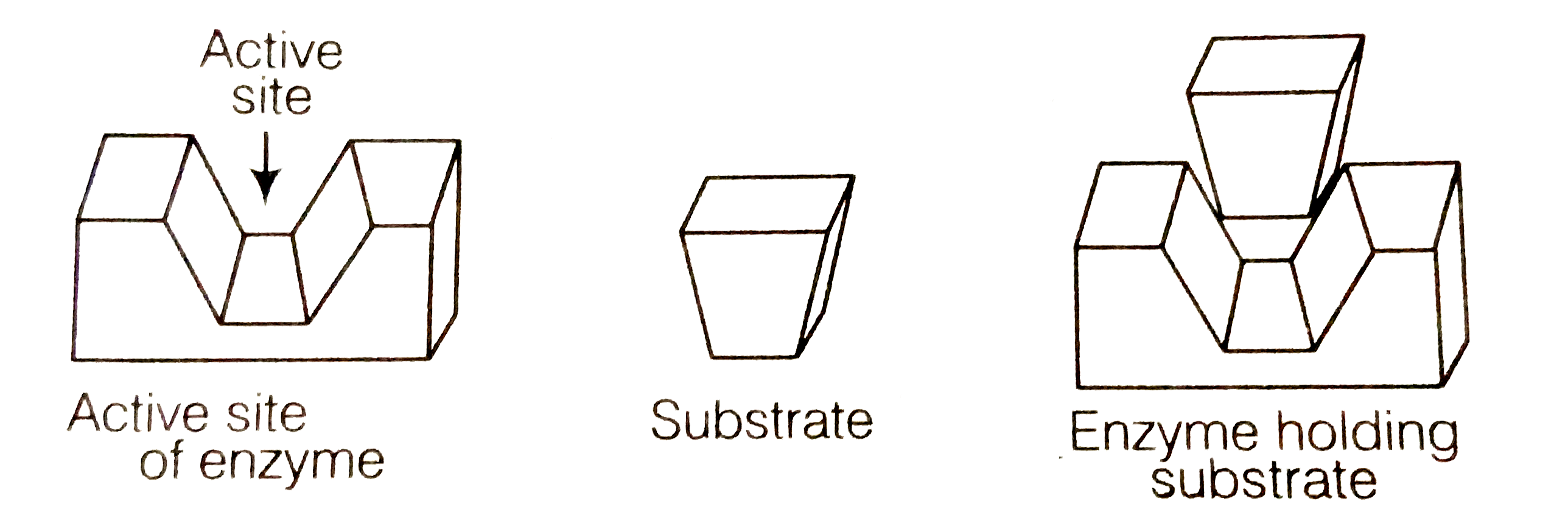 (ii) The substrate molecules bind to the amino acid residues of the protein present on the active site of enzyme. These PROVIDES free amino groups to attack the substrate and bring abou the chemical reaction. If the aminoacid serineis present nearby the substrate held on the active site, them its-OH group is free to act as a nucleophile in the enzyme catalysed reaction. 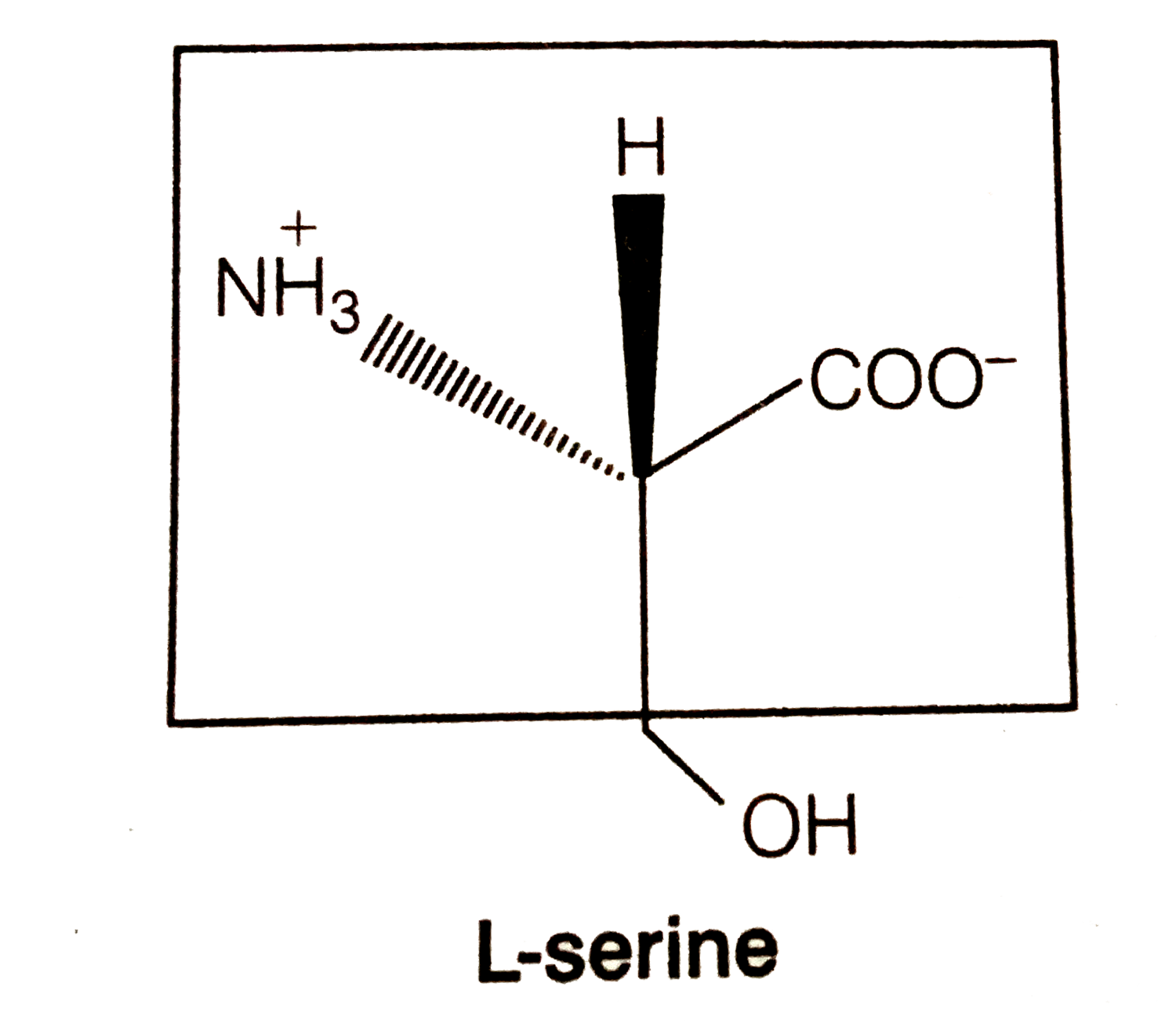 The part of the amino acid when lies outside the box act as a nucleophile in enzyme catalysed REACTIONS, but the part of the amino acid which is enclosed in the box is involved in the formation of peptide bond in protein molcule. |
|
| 14. |
How do enzyme inhibitors work ? Distinguish between competitive and non- competitive enzyme inhibitors. |
|
Answer» Solution :An enzyme INHIBITOR either BLOCKS the active site of enzyme or changes the shape of the active site by binding at an allosteric site. They are of TWO types : (i) Competitive enzyme inhibitor competes with natural substance for theirattachment on the active sites of enzymes. (ii) Non-competitive enzyme inhibitor binds at allosteric site and changes THESHAPE of the active site in such a way that the SUBSTRATE cannot recognize it. |
|
| 15. |
How do emulsifying agents stabilize the emulsion ? |
| Answer» SOLUTION :The INTERFACIAL film is FORMED by the emulsifying agent between SUSPENDED particles and the medium. | |
| 16. |
How do emulsifiers stabilise emulsion ? Name two emulsifiers. |
|
Answer» SOLUTION :For stabilisation of an EMULSION a third component called emulsifying agent is usually added. The emulsifying agent forms an interfacial FILM between suspended particles and the medium. The principal emulsifying agent for O/W emulsion are protein, gums, natural and SYNTHETIC soaps etc. and for W/O heavy metal salt of fatty acids, LONG chain alcohols, lampblack etc. |
|
| 17. |
How do emulsifying agents stabilise the emulsion ? |
| Answer» Solution :The emulsifying agent forms an interfacial LAYER between SUSPENDED particles and the dispersion medium THEREBY stabilising the emulsion. | |
| 18. |
How do concentrations of the rectant influence the rate of reaction ? |
|
Answer» SOLUTION :(i) The rate of a reaction increases with the increase in the concentration of the reactants. (II) According to this THEORY, the rate of a reaction depends upon the number of collisions between the reacting MOLECULES. (III) Higher the concentration, greater is the possibility for collision and hence increase the rate. |
|
| 19. |
How do carbonyl compounds react with HCN. Give mechanism of the reaction. |
Answer» Solution :Aldehydes and ketones react with HCN to form ADDITION compounds CALLED cyanohydrins. 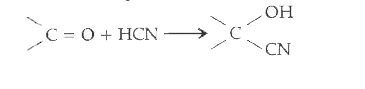 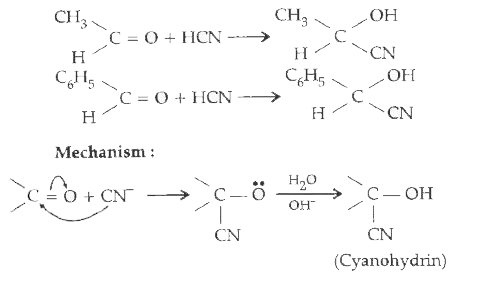
|
|
| 20. |
How do concentration of the influence the rate of reaction ? |
| Answer» Solution :The rate of a reaction increases with the concentration of the reactants . The EFFECT of concentration is expected on the basis of collision theory of reaction rates. ACCORDING to this theory. The rate of a reaction depend up to NUMBER of collisionsbetween the the reacting molecules.Higher the concentration , greater is the possibility of collision and HENCETHE rate. | |
| 21. |
How do carbohydrates act as a source of energy ? |
| Answer» SOLUTION :Becauseby DECOMPOSITION of CARBOHYDRATES ourbodygets ENERGY. | |
| 22. |
How do aquasol and aerosol differ? |
| Answer» Solution :(i) In both aquasol and AEROSOL, the dispersed phase is solid. But they differ in the dispersion medium. (II) In aquasol, dispersion medium is water WHEREAS in aerosol, dispersion medium is GAS. | |
| 23. |
How do antiseptics differ from disinfectants? Name a substance which can be used as a disinfectant as well as an antiseptic. |
|
Answer» Solution :Antiseptics are APPLIED to LIVING tissues such as wounds, CUTS , ULCERS and diseased skin surfaces. Disinfectants are applied to inanimate objects such as FLOORS, drainage systems, instruments etc. A 0.2 percent solution of phenol is an antiseptic. One percent solution phenol is a disinfectant. |
|
| 24. |
How do antiseptics differ from disinfectants? Give one example of each. |
|
Answer» SOLUTION :Antiseptics and disinfectants are the chemicals which either kill or prevent the GROWTH of microorganisms, antiseptics are applied to the living tissues such as wounds, CUTS, ulcers and diseased spin surfaces, while disinfectants are applied on floors, drainage systems. Example of antiseptics - Bithionol `0.1%` PHENOL example of disinfectant : `1%` phenol |
|
| 25. |
How do antiseptics differ from disinfectants ? Give one example of each. |
|
Answer» Solution :Antiseptics are APPLIED to the LIVING tissues such as wounds, cuts, ulcers and diseased skin SURFACES.. Disinfectants are applied to inanimate objects such as FLOORS, drainage system, INSTRUMENTS etc. Antiseptics drug : Furacine, soframicine. Disinfectants : Chlorine in the concentraction 0.2 ot 0.4 ppm inaaqueous solution. |
|
| 26. |
How do antiseptics differ from disinfectants? |
Answer» SOLUTION : 
|
|
| 27. |
How do antiseptic differ from disinfectants ? How does an antibiotic differe from these two ? |
|
Answer» Solution :(i) Both antiseptics and DISINFECTANTS kill or prevent growth of micro-organisms. Antiseptics are applied to LIVING tissues (cults, wounds). But disinfectants are applied to inanimate objects only (floor, INSTRUMENTS). The same substance can act as an antiseptic as well as a disinfectant by varying the concentration of the soluton used. For example, 0.2% solution of phenol ACTS as an antiseptic and its 1% solution is a disinfectant. (ii) An antibiotic is a chemical substance which kills and prevents growth of micro-organisms . These SUBSTANCES are produced by micro-organisms. |
|
| 28. |
How do amino acids form proteins ? |
| Answer» Solution :`ALPHA`-AMINO acids undergo condensation REACTION between `-NH_(2)` group of one acid and `-COOH` group of the other with elimination of `H_(2)O` MOLECULE. | |
| 29. |
How do amino acids form proteins? |
| Answer» Solution : Proteins are made up of AMINO acids through the formation of PEPTIDE linkage. Condensation takes place between `-NH_(2)` group of one ACID MOLECULE and-COOH of another acid molecule to FORM peptide linkage. | |
| 30. |
How DeltaT_f is related with molality ? |
|
Answer» Solution :Depression in FREEZING point, `Delta T _f = K_f "MOLALITY" (m)` , where `K_f=`MOLAL depression CONST. or cryoscopic constant. |
|
| 31. |
How cyanides are identified from isocyanides? |
| Answer» SOLUTION :HYDROLYSIS of cyanides GIVES carboxylic ACIDS, whereas hydrolysis of isocyanides produces primary amines. On reduction, cyanides give primary amines whereas isocyanides give secondary methyl amines. | |
| 32. |
How copper is refined by electrolytic method? |
|
Answer» Solution :Impure copper is MADE as anode and thin sheet of pure copper is made as CATHODE. ACIDIFIED copper SULPHATE solution is taken as electrolyte. On passing electric current, pure copper DEPOSITS on the cathode. At anode: ` Cu rarr Cu^(2+) + 2e` ,At cathode: `Cu^(2+) + 2e rarr Cu` |
|
| 33. |
How coordination compounds are used in analytical chemistry ? |
| Answer» Solution :(i) Multidentate ligand, EDTA. forms highly stable complexes with metal IONS LIKE `Ca^(2+)` and `Mg^(2+)`. This is USED to estimate the hardness of water by a simple titration METHOD using EDTA -solution. A confirmatory test for the detection of copper (II) involves the formation of a deep-blue coloured complex, `[Cu(NH_3)_4]^(2+)` , on addition of ammonia, solution to a solution of copper (II) salt.`Cu^(2+)+4NH_3rarr[Cu(NH_3)_4]^(2+)` Tetra - ammine copper (n) ion. | |
| 34. |
How colloids are used in (i) Tanning of leather (ii) Rubber industry (iii) Sewage disposal. |
|
Answer» SOLUTION :(i) Tanning of LEATHER: Skin and hides are protein containing positively charged particles which are COAGULATED by adding tannin to give hardened leather for further application. Chromium salts are used for tanning of leather. Chrome tanning can produce soft and polishable leather. (ii) Rubber industry: Latex is the emulsion of natural rubber with negative particles. By HEATING rubber with sulphur, vulcanized rubbers are produced for tyres, tubes etc. (iii) Sewage disposal: Sewage containing dirt, mud and wastes dispersed in water. The passage of electric current deposits the wastes materials which can be used as a MANURE. |
|
| 35. |
How concentrate ores of tin containing FeCrO? |
|
Answer» Froth FLOATATION |
|
| 36. |
How catalyst increases rate of a reaction. |
Answer» Solution :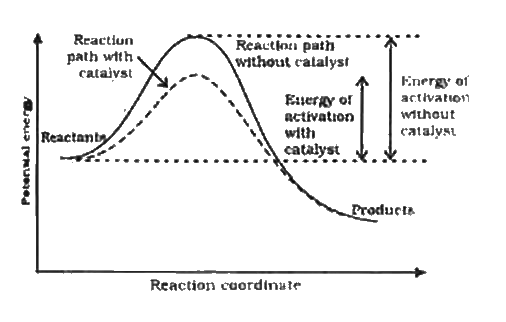 Catalyst provides an alternate PATHWAY by reducing the activation energy and LOWERING the energy BARRIER. More molecules enters the threshold energy state leading to chemical reaction and hence increases the RATE. |
|
| 37. |
How does carbon monoxide emitted by automobiles prevents transport of oxygen in the body tissues ? |
|
Answer» By changing oxygen into carbon dioxide |
|
| 38. |
How catalyst affects the rate of reaction ? |
| Answer» SOLUTION :It increases the RATE of reaction by LOWERING the activation energy of the REACTANTS. | |
| 39. |
How can you separate H_(2) or D_(2) from He? |
| Answer» SOLUTION :Red hot palladium is cooled in an atmosphere of He MIXED with `H_(2) or D_(2)`. Consequently, large AMOUNT of `H_(2) or D_(2)` gets adsorbed by palladium but notHe. When palladium is heated, occluded `h_(2) or D_(2)` gets liberated as free HYDROGEN or deuterium . | |
| 40. |
How can you separate alumina from silica in a bauxite ore associated with silica ? Give equations, if any. |
|
Answer» SOLUTION :Note: If the impurity of silica is present in considerable amounts, then it is removed by Serpeck.s process. In this process the ore is mixed with coke and heated at `1800^@C` in presence of nitrogen, where AIN is formed. `Al_2O_3 + 3C + N_2 to 2AIN + 3CO` `SiO_2` is reduced to silica that GETS volatillised off at `1800^@C`. `SiO_2 + 2C to SI + 2CO`. |
|
| 41. |
How can you separate alumina from silica in a bauxite ore associated with silica? Give equations, If any. |
|
Answer» Solution :Pure alumina may be separated from bauxite by Baeyer.s process as discussed below : The bauxite ore associated with silica is heated with a concentrated (45%) solution of NaOH at 473-523K and 35-36 atmosphere pressure. Under these conditions, alumina dissolves as SODIUM meta-aluminate and silica as sodium silicate leaving behind the impurities. `{:(Al_(2)O_(3)(s)+2NaOH(aq)+3H_(2)O(L)to 2Na[Al(OH)_(4)](aq)),(" AluminaSodium meta-aluminate "),(SiO_(2)(s)+2NaOH(aq)overset(473-523K)(to)Na_(2)SiO_(3)(aq)+H_(2)O(l)),(" SilicaSodium silicate "):}` The resulting solution is filtered to remove the undissolved impurities and neutralised by passing `CO_(2)` GAS. Thereafter, the solution is SEEDED with freshly prepared sample of hydrated alumina when hydrated alumina GETS precipitated leaving sodium silicate in the solution. `{:(2Na[Al(OH)_(4)](aq)+CO_(2)(g)to Al_(2)O_(3).xH_(2)O(s)+2NaHCO_(3)(aq)),("Hydrated alumina "):}` The hydrated alumina is filtered, dried and heated to give back pure `Al_(2)O_(3)`. `{:(Al_(2)O_(3).xH_(2)O(s) overset(1473K)(to) Al_(2)O_(3)(s)+H_(2)O),(" Hydrated aluminaPure alumina"):}`. |
|
| 42. |
How can you separate alumina from silica in a bauxite ore. |
|
Answer» Solution :(i) ALUMINA is separated from silica in a bauxite ore through Baeyer's PROCESS, in which bauazite ore is concentrated by the method of leaching or chemical separation. (ii) Chemical method is employed in case where the ore is to be in a very pureform, e.g., aluminium extraction. Bauxite `(Al_(2)O_(3))`, an ore of aluminium, contains `SiO_(2)` and `Fe_(2)O_(3)` as impurities. When bauxite ore is treated with NaOH, the `Al_(2)O_(3)` goes into solution as sodium meta-ALUMINATE `[Fe_(2)O_(3), SiO_(2), Fe(OH)_(3), etc.]`, which are then filtered off. `Al_(2)O_(3) + 2NAOH rarr underset(underset("(In solution form)")("Sod. meta. aluminate"))(2NaAlO_(2)+ H_(2)O)` (iii) The filtrate (containing sodium meta-aluminate) on dilution, and stirring gives a precipitate of aluminium hydroxide, which is filtered, and ignited to get pure alumina. `NaAlO_(2) + 2H_(2)O rarr underset("Ppt")(Al(OH)_(3)) + NaOH` `2Al(OH)_(3) overset(Delta)rarr underset("Pure")(Al_(2)O_(3)) + 3H_(2)O` |
|
| 43. |
How can you separate alumina from bauxite ore associated with silica ? Give equations. |
|
Answer» Solution :Bauxite, a principal ore of aluminium contains silica, iron oxide and titanium oxide as impurities. The ore is digested with a concentrated solution of NaOH at 473-523 K and 35 - 36 bar pressure.`Al_2O_3` is leached out as sodium aluminate and silica as sodium silicate while impurities are left behind. `RAl_2O_3(s)+ 2NaOH(AQ) + 3H_2O to 2Na[Al(OH)_4](aq)` The aluminate in the solution is neutralised by passing `CO_2` gas and hydrated `Al_2O_3` is precipitated. `2Na[Al(OH)_4] (aq) + CO_2(g) to Al_2O_3.xH_2O + 2NaHCO_3(aq)` he sodium silicate remains in the solution while hydrated ALUMINA is filtered and dried. The hydrated alumina thus precipitated is filtered, dried and HEATED to give back pure alumina. `underset("Hydrated alumina")(Al_2O_3.x H_2O) overset(1473 K)tounderset("Alumina")(Al_2O_3(s)) + xH_2O` |
|
| 44. |
How can you remove the hard calcium carbonate layer of the egg without damaging its semipermeable membrane ? Can this egg be inserted into a bottle with a narrow neck with a narrow neck without distorting its shape? |
Answer» Solution :The HARD `CaCO_(3)` layer of the egg can be removed by placing it in HCl acid so that `CaCO_(3)` layer DISSOLVES. Yes, it can be INSERTED into a bottle with narrow NECK through the following steps. 
|
|
| 45. |
How can you remove the hard calcium carbonate layer of the egg without damaging its semi - permeable membrane ? Can this egg be inserted into a bottle with a narrow neck without distorting its shape ? Explain the process involved. |
|
Answer» Solution :(i) When egg is placed in dilute mineral acid solution (preferably dilute HCl solution), the hard external `CaCO_(3)` layer of the egg dissolves out / REMOVED without damaging its semi - permeable membrane. (ii) Yes, this egg can be inserted into a bottle with a narrow neck without distorting is shape. The process involved utilising phenomenon of osmosis is explained as below - Egg is placed in mineral acid solution - after some time egg is removed and placed in a hypertonic solution * - size of the egg gradually decreases after some time and it shrivels due to osmosis. Since the egg has shrivelled it can, now be inserted EASILY into a bottle with narrow mouth. The egg is, therefore, placed in a bottle with narrow neck & then a hypotonic solution is filled into this bottle. On adding hypotonic solution **, egg regains shape due to osmosis. Hypertonic solution - is a solution with higher salt concentration than that of the normal BODY cells so that the solvent / water is drawn out of the cell by osmosis , or any solution with higher OSMOTIC pressure than another solution is called ..Hypertonic solution... 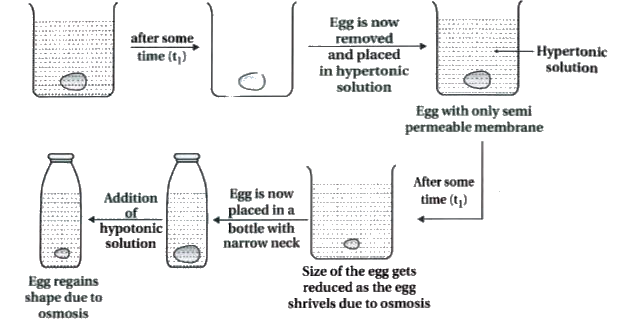 Hypotonic solution is a solution with lower salt concentration than that of the normal body cells so that water / colvent flows into the cell by osmosis, or - hypotonic solutions a solution which has lower osmotic pressure than the other solution. |
|
| 46. |
How can you prepare Cl_2 from HCl and HCl from Cl_2 ? Write reactions only. |
|
Answer» SOLUTION :(i) PREPARATION of `Cl_(2)` from HCl: `4HCl("conc") + MnO_(2)(s) to MnCl_(2)(aq) + Cl_(2)(g) + 2H_(2)O (l)` Deacon.s Process: `4HCl_(g) + O_(2)(g) overset(CuCl_(2))to 2H_(2)O + 2Cl_(2)(g)` By action of `KMnO_(4)` on HCl, `2KMnO_(4) + 16 HCl to 2KCl(aq) + 2MnCl_(2) + 5Cl_(2) + 8H_(2)O` (II) Preparation of HCl from `Cl_(2)`: `H_(2)(g) + Cl_(2)(g) overset(hv) to 2HCl(g)` |
|
| 47. |
How can you prepare Cl_(2) from HCl and HCl from Cl_(2). Write reactions only. |
|
Answer» Solution :HCl can be oxidised to `Cl_(2)` by a number of oxidising agent such as `MnO_(2), KMnO_(4), K_(2)Cr_(2)O_(7)`, etc. `MnO_(2) + 4 HCl rarr MnCl_(2) + Cl_(2) + 2H_(2)O` `Cl_(2)` can be reduced to HCl by its reaction with `H_(2)` in presence of diffused SUNLIGHT. `H_(2) + Cl_(2) overset("Diffused sunlight")rarr 2HCl` |
|
| 48. |
How can you prepare a buffer solutions of pH 9. You are provided with 0.1 M NH_4OH solution and ammonium chloride crystals. (ii) What volume of 0.6 M sodium formate solution is required to prepare a buffer solution of pH 4.0 by mixing it with 100 ml of 0.8 M formic acid . |
|
Answer» Solution :`pOH=pK_b+log([salt t])/([base])` We KNOW that PH+pOH=14 `therefore9+pOH=14` `impliespOH=14-9=5` `5=4.7+log""([NH_4Cl])/([NH_4OH])` `0.3=log".([NH_4Cl])/0.1` `([NH_4Cl])/0.1`= antilog of(0.3) `[NH_4Cl]=0.1M times 1.995` `=0.1995M` `=0.2M` Amount of `NH_4Cl` required to prepare 1 litre 0.2 M solution = Strength of `NH_4Cl times` molar mass of `NH_4Cl` =`0.2 times 53.5` =10.70g 10.70g ammonium chloride is dissolved in water and the solution is MADE up to one litre to get 0.2 M solution. On mixing equal volume of the given `NH_4OH` solution and the PREPARED `NH_4Cl` solution will give a buffer solution with required pH value (pH=9) (II) `pH=pK_a+log".([sal t])/([acid])` `4=3.75+log""([sodium formate])/([formic acid])` [Sodium formate]= number of moles of HCOONa `=0.6 times V times 10^-3` [formic acid]=number of moles of HCOOH `=0.8 times100 times10^-3` `=80 times10^-3` `4=3.75+log""(0.6V)/80` antilog of 0.25=`(0.6V)/80` `0.6V=1.778 times80` `=1.78 times80` `=142.4` `V=(142.4mL)/0.6=237.33mL` |
|
| 49. |
How can you prepare Cl_2 from HCl and HClfrom Cl_2? Write reactions only . |
|
Answer» Solution :HCL can be oxidised to `Cl_2` by a NUMBER of oxidisingagents such as `MnO_2 , K_2Cr_2O_7`,ETC. Reaction with `MnO_2` is given below : `MnO_2 + 4HCl to MnCl_2 + Cl_2 + 2H_2O` `Cl_2` can be REDUCED to HCl by reaction of `H_2` in presence of DIFFUSED sunlight . `H_2 + Cl_2 overset("Diffused sunlight ")to 2HCl` |
|
