

Saved Bookmarks
This section includes 7 InterviewSolutions, each offering curated multiple-choice questions to sharpen your Current Affairs knowledge and support exam preparation. Choose a topic below to get started.
| 1. |
How can O_(3) be measured quantitatively? |
|
Answer» Solution :When `O_(3)` is allowed to react with KI solution in the presence of BORATE buffer (pH 9.2), `I_(2)` is liberated quantitatively. `2I^(-)(aq)+H_(2)O(l)+O_(3)(g)to2OH^(-)(aq)+I_(2)(s)+O_(2)(g)` The AMOUNT of `O_(3)` can be KNOWN by titrating the liberated iodine with a standard solution of sodium thiosulphate using starch as indicator. `underset("odium thiosulphate")(2Na_(2)S_(2)O_(3))+I_(2)tounderset("sodium tetrathionate")(Na_(2)S_(4)O_(6))+2NaI` |
|
| 2. |
How can nitrite ion be distinguished from nitrate ion? |
| Answer» Solution :Nitrate ION gives a brown RING wiith `FeSO_(4)` and conc. Sulphuric ACID. But with nitrite ion a black coloured solution is OBTAINED. | |
| 3. |
How can isobutyl alcohol be converted to t-butyl alcohol ? |
| Answer» Solution :`underset("ISOPROPYL ALCOHOL")(CH_(3)-underset(OH)underset(|)CH-CH_(3)) overset((O)) to CH_(3) -underset("Acetone")underset(||)C-CH_(3) overset(CH_(3)MGBR) to CH_(3) - underset(OMgBr)underset(|)overset(CH_(3))overset(|)C-CH_(3) overset(HOH//H^(+)) to CH_(3) - underset(1-"butyl alcohol") underset(|)overset(CH_(3))overset(|)C-CH_(3)` | |
| 4. |
How can aromatic aldehydes and ketones be prepared by the following reaction ? (i) Reimer-Tiemann reaction , (ii) Friedal Craft reaction , (iii) Etard reaction. |
| Answer» Solution :For ANSWER , CONSULT SECTION 4 and 5. | |
| 5. |
How can a double bond be created in a molecule of a compound which has carbon-carbon single bond ? |
Answer» SOLUTION :A DOUBLE bond can be created in a molecule of a compound CONTAINING carbon-carbon single bond by the given method - 
|
|
| 6. |
How can a colloidal solution be distinguished from the true solution of the same substance ? |
| Answer» SOLUTION :A strong beam of light is PASSED through the given SOLUTIONS. The solution which illuminates the path of light is a COLLOIDAL solution and the solution which does not illuminate the path of light is a true solution. | |
| 7. |
How can a colloidal solution and true solution of the same collour be distiguished from each other ? |
| Answer» SOLUTION :If the solutions are TEKEN in glass beakers and LIGHT is focussed on them, the colloidal solution will scatter light (DE to Tyndall effect) and the path of light becomes visible but no scattering of light OCCURS in ture solution and hence the jpath is not visible. | |
| 8. |
How can a colloidal solution and a true solution of same colour be distinguished from each other? |
|
Answer» Solution :The distinction between TRUE solution and colloidal solution can be MADE by the FOLLOWING methods : (i) A colloidal solution will respond to Tyndall EFFECT while it is not shown by a true solution. (ii) A colloidal solution responds to electrophoresis while it is not shown by a true solution. |
|
| 9. |
How can a carboxylic acid be converted to an amine in one step having one carbon atom less? Or What happens when a mnocarboxylic acid is heated with hydrazoic acid? |
|
Answer» Solution :Carboxylic ACIDS react with hydrazoic ACID `(N_(3)H)` in presence of conc. `H_(2)SO_(4)` to form `1^(@)` amines containing one CARBON atom less than the carboxylic acid. For example `underset("Acetic acid")(CH_(3)COOH)+underset("Hydrazoic acid")(N_(3)H)underset(("Schmidt reaction"))overset(Conc.H_(2)SO_(4),Delta)to underset("Methylamine")(CH_(3)NH_(2))+CO_(2)+N_(2)` |
|
| 10. |
How Buna-S is synthesized ? |
| Answer» Solution :It is obtained by POLYMERISATION of BUTADIENE and STYRENE in the ratia of 3:1 in the PRESENCE of sodium. | |
| 11. |
How bromine can be liberated from KBr Solution? |
|
Answer» SOLUTION :By the OXIDATION of CHLORINE `(Cl_2)` `2KBr_2+ Cl_2 RARR 2KCL + Br_2` |
|
| 13. |
How benzyl chloride can be converted to 2-phenylethanamine? |
| Answer» Solution :`UNDERSET("(7 Carbons)")underset("Benzylchloride")(C_(6)H_(5)CH_(2)CL)overset("ethanolic")underset(NaCN or KCN)rarr underset("Benzylcyanide")(C_(6)H_(5)CH_(2)C-=N)overset(H_(2)//Ni)rarr underset("(8 Carbons)")underset("2 - phenylethanamine")(C_(6)H_(5)CH_(2)CH_(2)NH_(2))` | |
| 14. |
How benzene is converted into benzaldehyde by Gatterman-Koch reaction. |
Answer» Solution :When VAPOURS of `CO and HCl` are PASSED into BENZENE in the PRESENCE of anhydrous `AlCl_(3)//CuCl`, Benzaldehyde is obtained. 
|
|
| 15. |
How benzyl alcohol is obtained from benzyl chloride ? |
Answer» Solution :Benzyl CHLORIDE on BASE HYDROLYSIS gives benzyl ALCOHOL
|
|
| 16. |
How benzaldehyde is converted to (i) m-nitrobenzaldehyde (ii) m-benzaldehyde sulphonic acid (iii) m-chlorobenzaldehyde (iv) Benzoyl chloride |
Answer» SOLUTION :
|
|
| 17. |
How are you able to test sugar in a given sample of wine: |
|
Answer» By MOLISCH's test |
|
| 18. |
How are XeO_3 and XeOF_4 prepared ? |
|
Answer» Solution :Hydrolysis of `XeF_4 and XeF_6` with WATER produces `XeO_3` . `6XeF_4 + 12H_2O to 4Xe + 2XeO_3 + 24HF + 3O_2 ` `XeF_6 + 3H_2O to XeO_3 + 6HF` PARTIAL hydrolysis of `XeF_6` GIVES `XeOF_4`. `XeF_6 + H_2O to XeOF_4 + 2HF` . |
|
| 19. |
How are XeO_(3) and XeOF_(4) prepared ? |
|
Answer» SOLUTION :Hydrolysis of `XeF_(4) and XeF_(6)` with water gives `XeO_(3)` `6 XeF_(4) + 12 H_(2) O RARR 4 Xe + 2 XeO_(3) + 24 HF + 3 O_(2),""XeF_(6) + 3H_(2)O rarr XeO_(3) + 6HF` On the other hand, partial hydrolysis of `XeF_(6)` gives `XeOF_(4)`. `XeF_(6) + H_(2)O rarr XeOF_(4) + 2HF` |
|
| 20. |
How are XeO_3 and XeOF_4prepared ? |
|
Answer» SOLUTION :`XeF_6 + 3H_2O toXeO_3 + 6HF` `XeF_6 + H_2O toXeOF_4 + 2HF` . |
|
| 21. |
How are xenon fluorides XeF_2, XeF_(4) and XeF_(6)obtained ? |
|
Answer» Solution :`underset("excess")(XE(g) + F_(2)(g) overset(673 K)underset(1 BAR) to XeF_(2)(s)` `Xe(g) + underset(1:5 "RATIO") (2F_(2)) (g) overset(873 K)underset(7 bar) to XeF_(4)(s)` `Xe(g) + underset(1:20 "ratio")(3F_(2)) overset(60-70 "bar")underset(573 k) to XeF_(6)(s)` |
|
| 22. |
How are XeF_(2), XeF_(4) and XeF_(6) obtained ? |
| Answer» Solution :Allthese xenon FLUORIDES are PREPARED by directly reaction between XE and `F_(2)` under DIFFERENT conditions. | |
| 23. |
How are xenon fluorides XeF_2 , XeF_4 and XeF_6 obtained ? |
|
Answer» SOLUTION :These xenon fluorides are OBTAINED by direct reaction between `Xe and F_2` , under different CONDITIONS as shown below : `underset("(Excess)")(Xe(g)) + F_2(g) overset(673K, 1 " BAR " )to XeF_2(s)` ` underset("(1 : 5ratio )" ) ( Xe(g) + 2F_2 (g)) ovreset(873 K , 7 " bar ")to Xe F_4 (s)` `underset("(1 : 20 ratio )")(Xe(g) + 3F_2(g)) overset(573 K, 60 - 70 " bar ") to XeF_6 (s)` |
|
| 24. |
How are vitamins classified ? Name the vitamin responsible for the coagulation of blood. |
| Answer» SOLUTION :Vitamin-K is RESPONSIBLE for the COAGULATION of BLOOD. | |
| 25. |
How are vitamins classified ? Name the vitamin responsible for the coagulation of blood ? |
|
Answer» Solution :Vitamins are classified into two groups depending UPON their solubility. (i)Water soluble vitamins : Vitamin B-complex (`B_(1)`, `B_(2)`, `B_(5)`, i.E., NICOTINIC acid, `B_(6)` ,`B_(12)` pan-tothenic acid and folic acid) andvitamic C. (ii) Fat solublevitamins : Vitamins A,D,E and K. They are STORED in liverandadipose (fat storing tissue). However , biotion, i.e., vitami H isneithersolublein waternor in fat. Vitamin K is respeonsibleforcoagulationof blood. |
|
| 26. |
How are vitamins classified ? Name the vitamin responsible for coagulation of blood ? |
|
Answer» Solution :Vitamins are classified into two groups depending upon their solubility in water or FAT. (i) Water soluble vitamins . These include vitamin B-complex (`B_1,B_2,B_3`, i.e., NICOTINIC acid , `B_5` i.e., pantothenic acid `B_6,B_12` and folic acid) and vitamin C. (ii) Fat soluble vitamins . These include vitamins A,D,E and K. They are stored in LIVER and adipose (fat storing TISSUES). However , biotin, i.e., vitamin H is NIETHER soluble in water nor in fat. Vitamin K is responsible for coagulation of blood. |
|
| 27. |
How are vitaminsclassified? Namethe vitamin responsiblefor the coagulaitonof blood… |
|
Answer» (i) Water soluble vitamins - These includevitamin of .B. group (except `B_(12))`) and vitamin.C.. (ii)Fatsolublevitamin - Theseincludevitamin A,D,E and K. Theyare storedin liverand adipose tissues. Vitamin .K. is RESPONSIBLEFOR the coagulationof BLOOD. |
|
| 28. |
How are vitamins classified? |
|
Answer» Solution :Vitamins are classified into two groups based on their solubility in water and in fat. Fat soluble vitamins: These vitamins absorbed best when taken with fatty food and are stored in fatty tissues and LIVES. These vitamins do not DISSOLVE in water. Hence they are called fat soluble vitamins. Vitamin A,D,E & K are fat- soluble vitamins. Water B `(B_1,B_2,B_3,B_4,B_5,B_6,B_7,B_9 & B_12)` and C are READILY soluble in water. These vitamins cant be stored. |
|
| 29. |
Howare vitaminsclassified ? |
|
Answer» Solution :Vitaminsare classified into TOW groups BASEDON theirsolubility in WATERAND in FAT. Theyare , (i) Water - solublevitamins . (ii) Oilor fat- solube vitamins . Water- solublevitamins : Vitamins whichdissolve in the waterare calledwater solubevitaminsExamples : Vitamins of B group and Vitamin C . Oil or fat- solublevitamins : Vitaminswhichdissolvein water are calledoil or fat - solublevitamins . EXAMPLES : VitaminA , D, E and K . |
|
| 30. |
Howaretinandleadpurified ? |
| Answer» SOLUTION :The meltingpointsoftin (505 K ) andlead(600 K ) areverylowandhencethesemetalscan beeasilyrefinedbyliquationprocess. | |
| 31. |
How are transparent soaps manufactured ? |
| Answer» SOLUTION :Transparent soaps are MADE by dissolving the SOAP in ethanol and then EVAPORATING the excess SOLVENT | |
| 32. |
How are the quantam numbers n, l and m arrived at ? Explain the significance of these quantam numbers. |
|
Answer» Solution :To describe an electron completely four quantum numbers were predicted . They are (1) Principal quantum number , n (2) Azimuthal quantum number ,l (3) Magnetic quantum number , `m_(1)` and (4) Spin quantum number , `m_(s)`. a) Principal Quantum Number: 1) This was proposed by Neils Bohr . 2) It is denoted by the letter 'n'. 3) It represents the circular orbits around the nucleus. 4) As the value of n increases the size and energy of the orbit increases. 5) According to number method a has the values 1 , 2 , 3 ..... According to letter method 'n' can be represented by the letters K , L , M , .......... 6 ) In any orbit , the number of sub-orbits = n number of orbitals = `n^(2)` , 7 ) This Quantum number describes the size and energy of the orbit. b) Azimuthal Quantum Number : 1 ) This was proposed by Sommerfeld . 2) It is also known as Angular momentum quantum number . 3) It is denoted by the letter 'l'. 4) This quantum number represents the sub-levels present in the main levels. 5 ) The sub-levels are s , p , d and f . 6) The l values of s , p , d and f sub-levels are 0 , 1 , 2 ans 3 respectively . 7) This first main level contains only one sub-level and it is s . The second main level contains s , p sub-levels . The third main level contains s,p , d sub-levels . The fourth main level contains s, p d and f sub-levels. 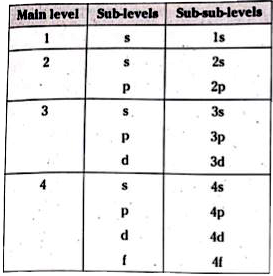 8) The relative values of 1s, 2s,2p etc . can be calculate by adding up their n and 1 values . Ex :1 Energy value of 1s = 1 + 0 = 1 2. Energy value of 2p = 2 + 1 =3 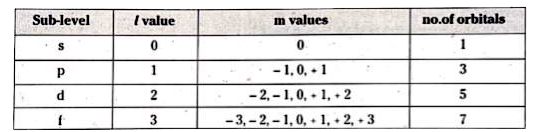 3. Energy value of 3d = 3 + 2 = 5 4. Energy value of 4F = 4+3 = 7 9) This Quantum number describes the shape of the orbital . 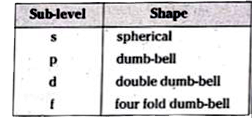 C) Magnetic Quantum Number : 1) This was proposed by Lande . 2) It is denoted by the letter 'm' . 3) This quantum number describes the sub-sub levels of orbitals present in a GIVEN sub-level. 4) `'m_(1)'` has values from -l to + l through '0'. 5) The TOTAL number of 'm' values for given value of 'l' (2l+1) 6) All the orbitals present in a given sublevel possesses the same energy values because they possess the same n and l values . 7) This quantum number describes the orientation of the orbitals in space . d) Spin Quantum Number : 1) It was proposed by Uhlenbeck and Goudsmit. 2) It is denoted by `m_(s)` . 3) This quantum number describes the spin of the revolving electron . 4)`'m_(s)'` value of clockwise electron is`+1//2` and that of anticlockwise electron is`-1//2` . 5) Clockwise revolving electron is represented by `+1//2` and anticlockwise revolving electron is represented by `-1//2` . 6) This quantum number describes the direction of spin of the revolving electron. |
|
| 33. |
How are the radius of nucleus r and mass number (A) related to each other? |
|
Answer» `r=R_@A^(1/2)` |
|
| 34. |
How are the polymers classified on the basis of struture ? |
|
Answer» Solution :On the basis of structure,polymers are cassified into three types:1) Linear polymers : These CONTAINS long and straight chains. E.g.:PVC polythene (high density) etc. 2) Branched chain polymers : These contains linear chains having some branches. E.g. :low density polythene . 3) cross LINKED polymers (or) Network polymers: These are USUALLY formed from bi functional and TRI functional monomers and contain strong covalent bonds between various linear POLYMER chains. E.g.: Bakelite, melamine etc. |
|
| 35. |
How are the polymers classified based on heat treatment? |
|
Answer» SOLUTION :Based on heat treatment polymers are two types. They are thermoplastic polymers and thermosetting polymers. Thermoplastic polymers are addition linear polymers. These soften and melt on heating. They can be remoulded, recast and RESHAPED. EG : PVC, polystyrene, NYLON, etc. Thermosetting polymers are condensation cross linked polymers. These become more HARD on heating. They cannot be remoulded or reshaped, eg : Bakelite, terylene, urea - formaldehyde resin, etc. |
|
| 36. |
How are the metals used as semiconductor, refined? What is the principle of the method used? |
|
Answer» SOLUTION :Metals of high grade like those USED as semiconductors, are refined by Zone REFINING method. Principle : This method is based upon the principle that impurities are more soluble in motlen state of metal than is solid state. |
|
| 37. |
How are the following obtained from benzenediazonium chloride? Phenol |
| Answer» SOLUTION :Conversion of BENZENEDIAZONIUM CHLORIDE to phenol. When are aqueous solution of benzenediazonium chloride is warmed it is hydrolysed to phenol. | |
| 38. |
How are the following conversions effected (i) benzylchloride to benzylalcohol(ii) benzyl alcohol to benzoie acid |
|
Answer» Solution :(i) CONVERSION of BENZYL chloride into benzyl alcohol: `underset(("Benzyl chloride"))(C_6H_5CH_2Cl) OVERSET(aq. NaOH)to underset(("Benzyl alcohol"))(C_6H_5CH_2OH) + NaCl` (ii) Conversion of benzyl alcohol into benzoic acid: `underset(("Benzyl alcohol"))(C_6H_5CH_2OH) underset(2(O))overset(KMnO_4//OH^(o+))to underset(("Benzoic acid"))(C_6H_5COOH)` |
|
| 39. |
How are the following obtained from benzenediazonium chloride? Chlorobenzene |
| Answer» Solution :By Sandmeyer REACTION. BENZENEDIAZONIUM chloride when TREATED with CUPROUS chloride and `HCl` the diazonium group is replaced by CL ion to form chlorobenzene. | |
| 40. |
How are the following interhalogen compounds prepared? (i) ClF_(3) (ii) ICl (iii) BrF_(5). |
|
Answer» Solution :(i) `underset("(EXCESS)")(Cl_(2)+3F_(2))OVERSET(573K)rarr 2ClF_(3)` (ii) `I_(2)+underset("(Excess)")(3Cl_(2))rarr 2ICl_(3)` (iii) `Br_(2)+underset("(Excess)")(5F_(2))rarr 2BrF_(5)` |
|
| 41. |
How are the following conversions effected(a) propanal into butanone (b) Hex-3-yne into hexan-3-one. (c) phenylmethanal into benzoic acid (d) phenylmethanal into benzoin |
Answer» SOLUTION :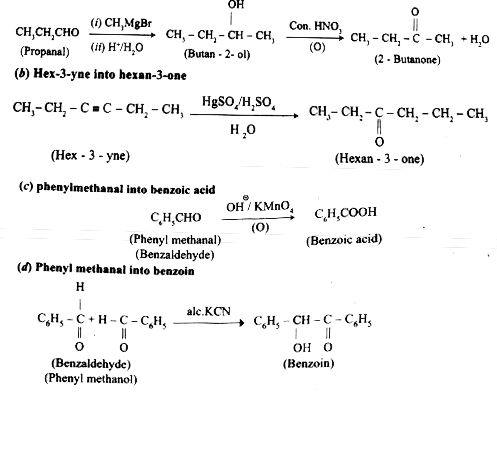
|
|
| 42. |
How are the following conversions effected ? (a) C_(6)H_(5)NH_(2) rarr C_(6)H_(6) (b) C_(6)H_(5)NO_(2)rarr C_(6)H_(5)OH (c) C_(6)H_(5)NH_(2)rarr C_(6)H_(5)I (d) C_(6)H_(5)NH_(2)rarr C_(6)H_(5)NO_(2) |
|
Answer» Solution :(a) `C_(6)H_(5)NH_(2) OVERSET(HNO_(2))UNDERSET(HCl)RARR C_(6)H_(5)N_(2)Cl overset(H_(3)PO_(2))rarr C_(6)H_(6)` (b) `C_(6)H_(5)NO_(2) overset(Sn//HCl)rarr C_(6)H_(5)NH_(2) overset (HNO_(2))rarr C_(6)H_(5)N_(2)Cl overset(H_(2)OO)rarr C_(6)H_(5)OH` (c ) `C_(6)H_(5)NH_(2) overset(HNO_(2))underset(HCl)rarr C_(6)H_(5)N_(2)Cl overset(KI)rarr C_(6)H_(5)I` (d) `C_(6)H_(5)NH_(2) overset(HNO_(2))underset(HCl)rarr C_(6)H_(5)N_(2)Cl overset(NaNO_(2))rarr C_(6)H_(5)NO_(2)` |
|
| 43. |
How are the following conversions carried out? (Write the reactions and conditionsin each case): (i) Ethanol to 2-propanol (ii) Phenol to Acetophenone |
|
Answer» SOLUTION :(i)`underset("Ethanol")(CH_3CH_2OH) underset(573 K)OVERSET(CU)to underset("Ethanal")(CH_3-overset(O)overset(||)C-H) underset((ii) H_2O //H^(+))overset((i)CH_3MgBr)to underset("2-Propanol")(CH_3- overset(OH)overset(|)CH-CH_3)` (ii) 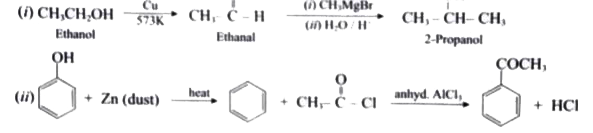
|
|
| 44. |
How are the following conversions carried out? (Write reaction with conditions) (a) 1- propanol to 1-chloro-2- propanol, (b) Phenol to salicylic acid. |
|
Answer» Solution :(a) 1 - propanol to 1-chloro-2-propanal : `UNDERSET("1 - Propanol")(CH_(3)-CH_(2)-CH_(2)OH) overset("conc. "H_(2)SO_(4))underset(443K)rarr underset("Propene")(CH_(3)-CH=CH_(2)+HOCL)rarr underset("1-Chloro -2- propanol")(CH_(3)-underset(OH)underset("|")"CH"-CH_(2)CL)` (b) Phenol to salicylic acid : 
|
|
| 45. |
How are the following conversions effected 1. propanal into butanone 2. Hex-3-yne hexan-3-one 3. phenylmethanal into benzoic acid 4. phenylmethanal into benzoin |
|
Answer» Solution :1. propanal into butanone: `underset(("Propanal"))(CH_(3)CH_(2)CHO)underset((ii)H^(+)//H_(2)O)overset((i)CH_(3)MgBr)tounderset(("Butan-2-ol"))(CH_(3)-CH_(2)-overset(OH)overset(|)(CH)-CH_(3))underset(O)overset(Con.HNO_(3))tounderset(("2 - Butanone"))(CH_(3)-CH_(2)-overset(O)overset(||)C-CH_(3)+H_(2)O)` 2. Hex-3-yne into hexan-3-one: `underset(("Hex-3-yne"))underset(" ")(CH_(3)-CH_(2)-C-=C-CH_(2)-CH_(3))underset(H_(2)O)overset(HgSO_(4)//H_(2)SO_(4))tounderset(("Hexan-3-one"))(CH_(3)-cH_(2)-underset(O)underset(||)C-CH_(2)-CH_(2))-CH_(3)` 3. Phenylmethanal into benzoic ACID: `underset(("Benzaldehyde"))underset(("PHENYL methanal"))(C_(6)H_(5)CHO)underset((O))overset(OH^(Θ)//KMnO_(4))tounderset(("Benzoic acid"))underset(" ")(C_(6)H_(5)COOH)` 4. Phenyl methanal into benzoin: `underset(("Phenyl methanol"))underset(("Benzaldehyde"))(C_(6)H_(5)-underset(O)underset(||)overset(H)overset(|)C+H-underset(O)underset(||)C)-C_(6)H_(5) overset(alc.KCN)tounderset(("Benzoin"))(C_(6)H_(5)-underset(OH)underset(|)(CH)-underset(O)underset(||)C-C_(6)H_(5))` |
|
| 46. |
How are the following conversions carried out? (Write the reactions and conditions in each case): (i) Ethanol to 2 - propanol. (ii) Phenol to Acetophenone. |
|
Answer» Solution :The conversions are achieved as under : (i) ETHANOL to 2 - PROPANOL : `underset("Ethanol")(CH_(3)CH_(2)OH)overset(Cu)underset(573K)rarr underset("Ethanal")(CH_(3)-overset(O)overset(||)C-H)overset((i)CH_(3)MgBr)underset((ii)H_(2)O //H^(+))rarr underset("2 - Propanol")(CH_(3)-overset(OH)overset("|")"CH"-CH_(3))` (ii) Phenol to ACETOPHENONE : 
|
|
| 47. |
How are the following conversions carried out? "Propane" to"Propan-2-ol". |
| Answer» Solution :`underset("PROPENE")(CH_(3)-CH= CH_(2)) underset(DELTA)overset(H_(2)O //^(+))to underset("Propan-2-ol")(CH_(3)-underset(OH)underset(|)CH-CH_(3))` | |
| 48. |
How are the following conversions carried out? Methyl magnesium bromide to 2-Methyl- propan-2-ol. |
Answer» SOLUTION :
|
|
| 49. |
How are the following conversions carried out? (i) "Propene"rarr"Propan -2- ol." (ii) "Benzyl chloride "rarr" Benzyl alcohol." (iii) "Ethyl magnesium chloride "rarr" Propan -1 - ol." (iv) "Methyl magnesium bromide "rarr" 2- Methylpropan -2-ol." |
|
Answer» SOLUTION :(i) Propan - 2 - ol can be prepared from propene by hydration using conc. `H_(2)SO_(4)`. `{:(CH_(3)-CH=CH_(2)+" conc. "H_(2)SO_(4)rarrCH_(3)-CH-CH_(3)),("|"),(""OSO_(3)H),("PropeneIsopropyl hydrogen sulphate"):}` `{:(CH_(3)-CH-CH_(3)+H_(2)Ooverset("Boil")rarrCH_(3)-CH-CH_(3)+H_(2)SO_(4)),("||"),(""OSO_(3)H""OH),("Propan - 2 - ol"):}` 
|
|
| 50. |
How are the following conversions carried out? (i)Phenol to Toluene (ii) Ethanol to 1, 1-dichloroethane. |
Answer» SOLUTION :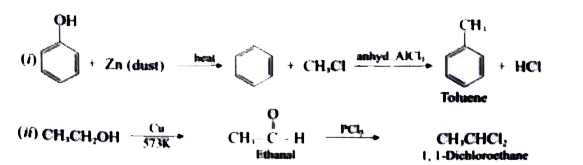 (II) `CH_3CH_2 OH underset(573K)overset(Cu)to underset("Fthanal")(CH_3-overset(O)overset(||)C-H) overset(PCl_5)to underset("1,1 - DICHLOROETHANE")(CH_3CHCl_2)` |
|