

Saved Bookmarks
This section includes 7 InterviewSolutions, each offering curated multiple-choice questions to sharpen your Current Affairs knowledge and support exam preparation. Choose a topic below to get started.
| 1. |
How can you obtain pure alumina from bauxite ore? Write the chemical equations involved. |
|
Answer» Solution :Powdered ore is digested with a concentrated solution of NaOH at 473-523 K and 35-36 bar pressure. Alumina is leached out assodium ALUMINATE. `Al_(2)O_(3)+2NaOH+3H_(2)O to 2NA[Al(OH)_(4)]` The aluminate solution is neutralised by passing `CO_(2)` gas. Hydrated alumina is precipitated. `2Na[Al(OH)_(4)]+CO_(2) to Al_(2)O_(3).xH_(2)O+2NaHCO_(3)` Hydrated alumina is HEATED to get PURE `Al_(2)O_(3)`. `Al_(2)O_(3).xH_(2)O overset(1470K)(to) Al_(2)O_(3)(s) + xH_(2)O`. |
|
| 2. |
How can you obtain iodoethane from ethanol when no other iodine containing reagent except NaI is available in the laboratory? |
|
Answer» Solution :First convert ethanol to chloroethane on treatment with HCl (g) and anhyd. `ZnCl_(2)` ((or bromoethane on treatment with `P+Br_(2)`) and then to iodoethane on treatment with NAI in acetone by Finkelstein reaction. `UNDERSET("Ethanol")(CH_(3)CH_(2)OH)+HCl OVERSET("Anhyd. "ZnCl_(2))to underset("Chloroethane")(CH_(3)CH_(2)Cl+H_(2)O` `underset("Ethanol")(CH_(3)CH_(2)OH)overset(P+Br_(2))to underset("Bromoethane")(CH_(3)CH_(2)Br)` `underset("Chloroethane")(CH_(3)CH_(2)Cl) " or"underset("Bromoethane")(CH_(3)CH_(2)Br)+NaI underset(("Finkelstein reaction"))overset("Acetone")to underset("Iodoethane")(CH_(3)CH_(2)I)+NaCl " or"NaBr` |
|
| 3. |
How can you obtain iodoethane from ethanol when no other iodine containing reagent except NaI is available in the laboratory ? |
|
Answer» Solution :Ethanol is coverted to chloroethane and - CL can be replaced by iodine. `C_(2)H_(5)OH+HCl OVERSET(ZnCl_(2))rarr C_(2)H_(5)Cl overset("NaI/Acetone")rarr C_(2)H_(5)I` |
|
| 4. |
How can you obtain acetyl chloride from acetic acid ? Give equation. |
|
Answer» Solution :When ACETIC ACID reacts with chlorinating AGENTS LIKE `PCl_5`,`PCl_3` or `SOCl_2` acetyl chloride is obtained. `underset"acetic acid"(CH_3COOH+PCl_5)RARE underset"Acetyl Chloride"(CH_3COCl+POCl_3+HCl` |
|
| 5. |
How can you get acetamide from acetyl chloride? |
| Answer» SOLUTION :When a MIXTUREOF `KNO_3` and CONC. `H_2SO_4` is DISTILLED, `HNO_3` is OBTAINED. | |
| 6. |
How can you get ethyl chloride from ethyl alcohol? Give equation. |
| Answer» SOLUTION :`CH_3CH_2OH + SOCl_2 RARR CH_3CHCl +SO_2 +HCL` | |
| 7. |
How can you distinguish between : (i) Ethanol and Propanone, and (ii) Benzoic acid and Phenol ? |
|
Answer» SOLUTION :(i) Ethanol and PROPANONE Propanone on treatment with 2, 4-dinitrophenylhydrazine gives a YELLOW precipitate of 2, 4-dinitrophenylhydrazone. Ethanol does not give this test. (ii) Benzoic acid and Phenol Phenol gives a violet colour with FERRIC chloride solution. Benzoic acid does not give this test. |
|
| 8. |
How can you distinguish between an alcohol and a carboxylic acid. |
|
Answer» Solution :By `NaHCO_(3)` TEST. Carboxylic acids reacts with `NaHCO_(3)` to evolve `CO_(2)` GAS while ALCOHOLS do not. `RCOOH+NaHCO_(2) to RCOONa+CO_(2)+H_(2)O:ROH+NaHCO_(3)to`No reaction |
|
| 9. |
How can you differentiate between addition and condensation poymerisation ? |
| Answer» SOLUTION :In addition polymerisation , the molecules of same or different monomers combine to FORM a large POLYMER without the elimination of some other molecules. In condensation polymerisation , the molecules of two or more bifunctional monomers undergo a series of condensation reactions with the elimination of simple molecules (water , ammonia, alcohol, ETC) | |
| 10. |
How can you differentiate between addition and condensation polymerization ? |
|
Answer» Solution :Addition polymerization : In this type of polymerization , a large number of molecules of the same or different monomers simply add to one ANOTHER leading of the formation of a macromolecule. Addition polymerization generally occurs among molecules containing double and triple bonds. For example , formation of polythene from ethene and PAN from acrylonitrile, etc. Condensation polymerization : In this tpye of polymerization. two or more bifunctional molecules undergo a series of indepedent condensation reactions USUALLY with the elimination of simple molecules like water , alcohol , ammonia , carbon dioxide , hydrogen CHLORIDE , etc. to form a macromolecule, For example , nylon 6,6 is a condensation polymer of HEXAMETHYLENEDIAMINE and adipic acid formed by elimination of water molecules. |
|
| 11. |
How can you determine the rate law of the following reaction? 2NO_((g))+O_(2(g))to2NO_(2(g)) |
|
Answer» Solution :The rate law can be determined by .measring the rate of this reaction as a FUNCTION of initial concentration by keeping the concentration of one of the REACTANTS CONSTANT and changing the concentration DEPENDANCE of rate,rate law can be determined. Example:If the concentraton of NO is doubled ,keeping the concentration of oxygen continously ,the process velocity four time. Which accelerate ,so the rate =k`[NO]^(2)[O_(2)]` and the introduction of the acceleration rule is as follows. `-(1)/(2)(Delta[NO])/(dt)=-(Delta[O_(2)])/(Deltat)=(1)/(2)=(Delta[NO_(2)])/(Deltat)` |
|
| 12. |
How can you differentiate between addition and condensation polymerisation? |
|
Answer» Solution :ADDITION polymerisation: In this type of polymerisation, a large number of molecules of same or different monomers simply add to the other unit, leading to the formation of macromolecule. Addition polymerisation generally occurs among molecules containing double and TRIPLE bonds. Condensation polymarisation: In this type of polymerisation two or more bifunctional molecules undergo a SERIES of independent condensation REACTIONS usually with the ELIMINATION of simple molecules like water, alcohol, ammonia etc. |
|
| 13. |
How can you determine the rate law of the following reaction? 2NO(g)+O_(2)(g) to 2NO_(2)(g) |
|
Answer» Solution :We can measure the RATE of this reaction as a function of initial concentration either by keeping the concentration of one of the reactants constant and changing the concentration of the other REACTANT or by changing the concentration of both reactants. The rate law of the reaction comes out to the Rate `=K[NO]^(2)[O_(2)]` |
|
| 14. |
How can you differentiate between addition and condensation polymerisation ? |
|
Answer» SOLUTION :Addition polymerisation : In this type of polymerisation, a large number of molecules of the same or different monomers add to one another leading to the formation of a MACROMOLECULE without elimination of simple molecule. Addition polymerisation generally occurs among molecules containing double and triple bonds. For example, formation of polythene from ethene and neoprene from chloroprene, etc. Condensation polymerisation : In this type of polymerisation, two or more bifunctional molecules undergo condensation reactions usually with the elimination of simple molecules LIKE WATER, alcohol, ammonia, carbon dioxide, hydrogen chloride, etc., to form a macromolecule. For example, NYLON 6, 6 is a condensation polymer of hexamethylenediamine and adipic acid formed by elimination of water molecules . |
|
| 15. |
How can you determine the rate law of the following reaction ? 2" NO"(g)+"O"_(2)(g)to2" NO"_(2)(g) |
|
Answer» Solution :The rate law can be determined by 'initial rate method' (page `4//31`, 32). KEEPING the concentration of one of the reactants constant and changing the concentration of the other, the EFFECT on the rate of reaction is determined. For example, for the given reaction, (i) Keeping `[O_(2)]` constant, if `[NO]` is DOUBLED, rate is found to become four times. This shows that Rate `prop[NO]^(2)`. (II) Keeping [NO] constant, if `[O_(2)]` is doubled, rate is also found to become double. This shows that Rate `prop[O_(2)].` HENCE, overall rate law will be : Rate `=k[NO]^(2)[O_(2)]`. |
|
| 16. |
How can you determine the atomic mass of an unknown metal if you know its density and the dimension of its unit cell ? Explain. |
|
Answer» Solution :Atomic MASS is related to DENSITY of the solid d, edge length a, number of particles in a unit cell Z by the following equation : Atomic mass, `M=(d"xxa^(3)xxN_(A))/(z)` where `N_(A)` stands for Avogadro.s number `6.022 xx 10^(23)`. By substituting the values of VARIOUS quantities, we can DETERMINE the atomic mass of the element. |
|
| 17. |
How can you convert the following? (i) Phenol to o-hydroxybenaldehyde. (ii) Methanal to ethanol (iii) Phenol to phenyl ethanoate. |
Answer» SOLUTION :(i)  (II)`HCHO to_(DRY ether)^(CH_3MgBr) H -underset(CH_3) underset|oversetHoverset|C-OMgBr to^(H_2O) CH_3CH_2OH` (III) 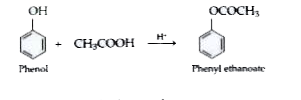
|
|
| 18. |
How can you convert the following : (i) Sodium phenoxide to o-hydroxybenzoic acid (ii) Acetone to propene (iii) Phenol to chlorobenzene |
Answer» SOLUTION :(i) Sodium phenoxide to o-hydroxybenzoic acid 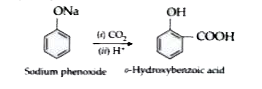 (ii) Acetone to propene `underset("Acetone")(CH_(3)COCH_(3))OVERSET(NaBH_(4))to underset("Propan-2-ol")(CH_(3)CHOHCH_(3))overset(H_(2)SO_(4))to underset("Propane")(CH_(3)CH)=CH_(2)` (III) Phenol to chlorobenzene 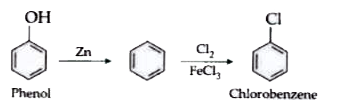
|
|
| 19. |
How can you convert PhCH=CHCOCH_(3) to (i). PhCH=CHCO_(2)H (ii). PhCH=CHCH_(2)CH_(3) (iii). PhCH_(2)CH_(2)CH_(2)CH_(3) (iv). PhCH=CHCH(OH)CH_(3) (v) PhCH_(2)CH_(2)COCH_(3) |
|
Answer» Solution :(i). `I_(2)+NAOH` (ii). `N_(2)H_(4)+OH^(ө),DELTA` (III). `Zn(Hg)//HCl` (iv). `9BBN` (v). `N_(2)H_(4),H_(2)O_(2)//Delta` |
|
| 20. |
How can you convert p-toluidine to 2-bromo-4-methylaniline. |
Answer» SOLUTION :
|
|
| 21. |
How can you convert NaCl structure to CsCl structure and vice versa ? |
| Answer» Solution :NACL structure can be converted to CSCL structure by the application of pressure, WHEREAS the reverse can be done by heating to 760 K. | |
| 22. |
How can you convert benzonitrile from aniline. |
Answer» SOLUTION :
|
|
| 23. |
How can you convert an amide into an amine having one caron less than the starting compound ? (b) Name the reaction. (c) Give the IUPAC name and structure of the amine obtained by the above method if the amide is 3-chlorobutanamide. |
|
Answer» Solution :(a) An amide can be converted into an amine having ONE CARBON less than the starting compound, by heating with bromine and potassium hydroxide. `R-overset(overset(O)(||))(C)-NH_(2)+Br_(2)+NaOH overset(Delta)(rarr)R-NH_(2)+Na_(2)CO_(3)+2NaBr+2H_(2)O` (b) Hoffmann bromamide REACTION. (c) `underset("3-Chlorobutanamide")(overset(4)(C)H_(3)-underset(underset(CL)(|))(overset(3)(C)H)-overset(2)(C)H_(2))-overset(1)(C)ONH_(2)overset(Br_(2)//NaOH)(rarr) underset("2-Chloropropanamine")(CH_(3)-underset(underset(Cl)(|))(overset(2)(C)H)-overset(1)(C)H_(2)-NH_(2))` |
|
| 24. |
How can you convert aniline to iodobenzene. |
Answer» SOLUTION :
|
|
| 25. |
How can you convert an amide into an amine having one carbon atom less than the starting compound? |
|
Answer» SOLUTION :By Hofmann-bromamide reaction, i.e., by heating a `1^(@)` AMIDE with `Br_(2)` and KOH. `underset(1^(@)" Amide")(R-CONH_(2))+Br_(2)+4KOH overset(Delta)to underset(1^(@)" Amine (having one carbon ATOM less than the starting amide)")(R-NH_(2))+K_(2)CO_(3)+2KB r+2H_(2)O` |
|
| 26. |
How can you calculate the density of a cubic crystal whose length of the edge of the unit cell is known? |
|
Answer» Solution :Let the length of the edge of the cell = a pm The volume of the unit cell = `(a pm)^(3)` `= ( a xx 10^(-10)CM)^(3)= a^(3) xx 10^(-30)cm^(3)` `"Density of the unit cell "= ("Mass of unit cell")/("Volume of unit cell")` `"Mass of unit cell" = "Number of atoms in unit cell" xx "Mass of each ATOM" = Z xx m` where Z = number of atoms in unit cell and m = mass of each atom `"Mass of each atom, m" = ("Atomic mass")/("Avogadro number")=(A)/(N_(0))` `"Density" = ( Z xx A)/(a^(3) xx 10^(-30) xx N_(0))GCH^(-3)` Density of unit cell is the same as the density of the substance. |
|
| 27. |
How can you convert 2-chloro butane to 2-butanol? |
Answer» SOLUTION :
|
|
| 28. |
How can you achieve the following interconversions ? |
Answer» SOLUTION :
|
|
| 29. |
How can we remove moisture form glass appartus ? |
| Answer» SOLUTION :This can be DONE by placing anhydrouc `CaCl_(2)` in the APPARATUS which absorbs the MOISTURE. | |
| 30. |
How can we measure the single electrode potential ? Explain with one example. |
Answer» Solution :The absolute value of a single electrode potential cannot be determined experimentally because NEITHER the oxidation nor the reduction can occur by itself. Therefore, we can find only the relative electrode potentials. For this purpose, hydrogen electrode has been selected as the reference electrode and is given arbitrary value of zero in its standard state i.e., `2H^(+)(C=1" mol "l^(-1))+2e^(-)toH_(2)(g)(1atm):E^(@)=0.00V` 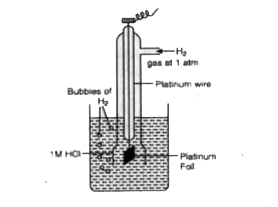 The standard hydrogen electrode consists of PLATINUM wire sealed in a glass tube and has a platinum foil attached to it. The foil is coated with finely DIVIDED platinum and acts as platinum electrode. It is dipped into an acid solution containing `H^(+)` ions in 1 M concentration (1 M HCI). Pure hydrogen gas at 1 atmospheric pressure is constantly bubbled into the solution at constant temperature of 298 K. The surface of the foil acts as a site for the reaction. The following reactions occur in this half cell depending upon whether it acts as an anode or as a cathode. If S.H.E. acts as anode `H_(2)(g)to2H^(+)+2e^(-)` If S.H.E. acts as cathode `2H^(+)+e^(-)toH_(2)(g)` The electrode potential of an electrode can be MEASURED by connecting this half cell with standard hydrogen electrode, whose potential is taken as zero. |
|
| 31. |
How can we make dialysts fast ? |
| Answer» SOLUTION :By applying ELECTRIC FIELD across the PARCHMENT bag. | |
| 32. |
How can we make dialysis fast? |
| Answer» SOLUTION :By applying ELECTRIC FIELD, the dialysis can be MADE FAST. | |
| 33. |
How can the Freundlich adsorption isotherm be represented when the value of n is less than one? |
| Answer» SOLUTION :`(X)/(m) = KP^(N)` | |
| 34. |
How can the following converted : (ii) Benzene to Acetophenone |
Answer» SOLUTION :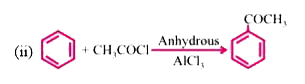 . .
|
|
| 35. |
How can the following conversions be carried out ? (i) Ethanol to Acetone (ii) Benzene to Acetophenone (iii) Benzoic acid to Benzaldehyde. |
|
Answer» SOLUTION :(i) Ethanl to Acetone: `underset("Ethanol")(CH_(3)CH_(2)OH) overset([O])underset(CrO_(3)" or " PCC) to CH_(3)CHO overset(CH_(3)MGBR)to CH_(3) - overset(CH_(3))overset(|)CH-OMgBr overset(H_(2)O)to underset("2-propanol")(CH_(3)-overset(CH_(3))overset(|)CH-OH) overset(CrO_(3)) to CH_(3) -underset("Acetone")(CO)-CH_(3)` (II) Benzene to Acetophenone:  (iii) Benzoic acid to benzaldehyde: 
|
|
| 36. |
How can the following converted : (iii) Benzoic acid to Benzaldehyde. |
| Answer» Solution :`C_(6)H_(5)COOH OVERSET(PCI_5)to C_(6)H_(5)COCI+H_(2)overset(Pd//BaSO_4)to C_(6)H_(5)CHO+HCI`. | |
| 37. |
How can the following conversions be carried out: (i)Aniline to bromobenzene (ii) Chlorobenzene to 2-chloroacetophenone (iii) Chloroethane to butane |
Answer» Solution :(i)Aniline to bromobenzene  (II) Chlorobenzene to 2-chloroacetophenone  (iii) CHLOROETHANE to butane (By Wurtz reaction) `CH_(3)CH_(2) Cl + 2Na + Cl CH_(2)CH_(3) underset("Ether") overset("Dry") to underset("Butane")(CH_(3)CH_(2)CH_(2)CH_(3)` |
|
| 38. |
How can the following converted : (i) Ethanol to Acetone |
Answer» SOLUTION :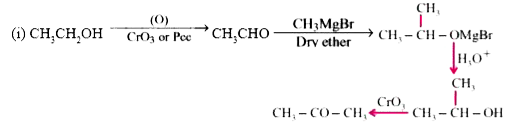 . .
|
|
| 39. |
How can the following conversion be effected? Nitrobenzene to anisole. |
| Answer» SOLUTION :`{:(C_6H_5NO_2overset(SN"/"HCL)(to)C_6H_5NH_2underset(HCl)OVERSET(NaNO_2)(to)C_6H_5N_2Cloverset(CH_3OH)(to)C_6H_5-O-CH_3),("NitrobenzeneAnilineBenzene DIAZONIUM chlorideAnisole"):}`. | |
| 40. |
How can the following conversion be effected ? (a) phenol to phenolphthalein (b) phenol to benzene |
Answer» SOLUTION :(i) On heating PHENOL with phthalic anhydride in presence of CONC. `H_(2)SO_(4)`, phenolphthalein is obtained. 
|
|
| 41. |
How can the following conversion be effected? Benzene diazonium chloride to ehtyl benzene. |
| Answer» SOLUTION :`{:(C_6H_5N_2Clunderset(Cu_2Br_2)OVERSET(HBR)(to)C_6H_5Brunderset(C_2H_5Br)overset(NA)(to)C_6H_5-C_2H_5),("Anilinedry ETHER"):}`. | |
| 42. |
How can the following conversion be effected? Chloro benzene to phenyl hydrazine |
| Answer» SOLUTION :`{:(C_6H_5Clunderset(-HCL)overset(NH_3)(to)C_6H_5NH_2underset(HCl)overset(HNO_2)(to)C_6H_5N_2Cloverset(Sn"/"HCl)(to)C_6H_5NHNH_2),("Chloro benzene diazonium chlorideAnilineBenzenePhenyl HYDRAZINE"):}`. | |
| 43. |
How can the following conversion be effected? Aniline to bezoic acid. |
| Answer» SOLUTION :`{:(C_6H_5NH_2underset(HCl)OVERSET(HNO_2)(to)C_6H_5N_2Clunderset(CU(CN)_2)overset(KCN)(to)C_6H_5CNoverset(H_2O)(to)C_6H_5COOH),("AnilineBenzene diazonium chlorideCyanobenezeneBenzoic ACID"):}`. | |
| 44. |
How can the following conversion be effected ? (a) Nitrobenzene to anisole (b) Chloro benzene to phenyl hydrazine (c) Aniline to benzoic acid (d) Benzene diazonium chloride to Ethyl benzene |
|
Answer» Solution :`C_(6)H_(5)NO_(2) overset(Sn//HCl)RARR C_(6)H_(5)NH_(2) overset(HNO_(2))underset(HCl)rarr C_(6)H_(5)N_(2)Cl overset(CH_(3)OH) rarr C_(6)H_(5)OCH_(3)` `C_(6)H_(5)Cl overset(NH_(3))underset(HCl)rarr C_(6)H_(5)NH_(2) overset(HNO_(2))underset(HCl)rarr C_(6)H_(5)N_(2)Cl overset(Sn//HCl)rarr C_(6)H_(5)NHNH_(2)` `C_(6)H_(5)NH_(2) overset(HNO_(2))underset(HCl)rarr C_(6)H_(5)N_(2)Cl overset(KCN) underset(Cu_(2)(CN)_(2))rarr C_(6)H_(5)CN overset(H_(3)O^(+))rarr C_(6)H_(5)COOH` `C_(6)H_(5)N_(2)Cl overset(HBR) underset(Cu_(2)Br_(2))rarr C_(6)H_(5)Br underset(underset("dry ether")(C_(2)H_(5)Br))overset(NA)rarr C_(6)H_(5)-C_(2)H_(5)` |
|
| 45. |
How can the following be obtained : 2-butanol from ethanol ? State the conditions for the involved reactions. |
|
Answer» Solution : STEPS involved in the conversion of ethanol to 2-butanol are GIVEN below : `underset("Ethanol")(CH_(3)CH_(2)OH) OVERSET(Cu)underset(573 K) to CH_(3)-underset("Ethanol")(CH_(3)-overset(O)overset(||)C)-H+C_(2)H_(5)MgBr to CH_(3) - overset(OMgBr)overset(|)CH -C_(2)H_(5)overset(H_(2)O //H^(+))to CH_(3) -underset(2-"Butanol")overset(OH)overset(|)(CH)-C_(2)H_(5)` |
|
| 46. |
How can the constants k and n of the freundlich adsorption equation be calculated ? |
| Answer» Solution :According to Freundlich equation,l `x/m=kP^(1//m).` Therefore, `LOG ""x/m=log k +1/N log P.` THUS, on plotting `log ""x/m` vessus log P, we will GET a straight line whose slope `=1/n` and intercept on y-axis= log k. Hence, measuring the slope and the intercept, k and n can be CALCULATED. | |
| 47. |
How can sulphide ions be distinguished from sulphite ions? |
| Answer» SOLUTION :`AgNO_(3)` forms white ppt. with SULPHITE IONS while a black precipitate is obtained with sulphide ions. `BaCl_(2)` gives white ppt. with sulphite ions while no ppt. is obtained with sulphide ions. `FeCl_(3)` solution gives a red colouration with sulphite ions and a black ppt. is formed with sulphide ions. | |
| 48. |
How can propan-2-one be converted to tertiary butyl alcohol ? |
Answer» Solution :`to` The propan-2-one can be converted to TERTIARY butyl alcohol by REACTION with Grignard REAGENT `CH_(3)MgX (X = CI, BR, I)`. 
|
|
| 49. |
How can physisorption be distinguished from chemisorptions ? |
| Answer» SOLUTION :PHYSISORPTION arises because of van der WAAL's forces, not specific and reversible while chemisorption is caused by chemical bond FORMATION , highly specific and IRREVERSIBLE. | |