Saved Bookmarks
This section includes 7 InterviewSolutions, each offering curated multiple-choice questions to sharpen your Current Affairs knowledge and support exam preparation. Choose a topic below to get started.
| 1. |
HI cannot be prepared by adding conc. H_(2) SO_(4) to iodides because |
|
Answer» HI is a stronger ACID than `H_(2) SO_(4)` |
|
| 2. |
Heating rubber with sulphur is known as |
|
Answer» GALVANISATION |
|
| 3. |
HI can not be prepared by which of the following methods ? |
|
Answer» `Pl_(3) + H_(2)O to ` |
|
| 4. |
Heatingpyrites to removesulphur is called |
|
Answer» SMELTING |
|
| 5. |
HgS issoluble in aque regain forming HgCI_(2) What happens if Cu ruranings are added to HgCI_(2)? |
| Answer» Solution :`HgCI_(2) + Cu RARR CuCI_(2) + Hg + Hg` is deposite on `Cu` | |
| 6. |
HgS_((s)) + O_(2(g)) rarr Hg_((l)) +SO_(2) uarr The above reaction is an example of _______ reduction. |
|
Answer» metal |
|
| 7. |
Heating pyrites to remove sulphur is called |
|
Answer» SMELTING |
|
| 8. |
Hg(NO_(3))_(2) overset(Delta) toW + X + O_(2) X + H_(2)O rarr HNO_(2) + HNO_(3) W + HNO_(3) rarr Y + NO + H_(2)O Y + Na_(2)S_(2)O_(3) ("excess") rarr 2 + NaNO_(3) |
|
Answer» `{:("W"," X","Y","Z"),(Hg,N_(2)O,Hg(NO_(3))._(2),Na_(2)[Hg(S_(2)O_(3))_(2)]):}` `2NO_(2) +H_(2)O rarr HNO_(2) +HNO_(3)` `underset((W))(Hg)+4HNO_(3) overset(Delta)rarr underset((Y))(Hg(NO_(3))_(2)) +2NO uarr+2H_(2)O` `Hg(NO_(3))_(2)+underset(("Soluble"))(Na_(2)S_(2)O_(3))rarr Na_(2) [Hg(S_(2)O_(3))_(2)] +2NaNO_(3)` |
|
| 9. |
Heating pyrites in air to remove sulphur is known as |
|
Answer» ROASTING |
|
| 10. |
Heating of rubber with sulphur is known as |
|
Answer» Galvanisaiton |
|
| 11. |
HgO+Cl_(2)+H_(2)O rarr HgOHgCl_(2) + ( X )The oxidation state of central atom of 'X' is |
|
Answer» X is HOCl. Central atom Cl is in `+1` STATE. |
|
| 12. |
HgO do not require reducing agent while isolation because |
|
Answer» HIGH + ve `DELTA G^(@)` |
|
| 13. |
Heating of pyrites in air for oxidation of sulphur is called Heating of ore in presene of air toremove sulphure impurities is called |
|
Answer» Roasting `S+O_(2)toSO_(2)` |
|
| 14. |
HgI_(2)darr+KI hArrK_(2)[HgI_(4)] |
|
Answer» For PRECIPITATE formation formation reaction |
|
| 15. |
Heating of pyrites in presence of air to remove sulphur is called as: |
|
Answer» ROASTING |
|
| 17. |
Heating of pyrites in air for oxidation of sulphur is called |
|
Answer» ROASTING |
|
| 18. |
HgCl_2is reduced to Hg_2Cl_2 by |
|
Answer» `CH_4COOH` |
|
| 19. |
HgCl_(2) givesorange ppt , with (a) ___, whichdissolves in oxicess of itforming (b) ____ called (c ) ____. |
|
Answer» |
|
| 20. |
Heating of pyrite ores in air to remove sulphur is known as : |
|
Answer» Calcination |
|
| 21. |
Heating pyrites to remove sulphur is called : |
|
Answer» Calcination |
|
| 23. |
HgCl_(2) and l_(2) both when dissolved in water containing I^(-) ions, the pair of species formed is…. |
|
Answer» `HG I_(2), I_(3)^(-)` `HgCl_(2) + 4I^(-) rarr [Hg I_(4)]^(2-) + 2Cl^(-)` |
|
| 24. |
Heating of oxalic acid with cone. H_2SO_4 gives: |
|
Answer» `CO+O_2` |
|
| 25. |
HgCl is a covalent compound, sparingly soluble in water, the solubility increase by the addition of chloride ions due to: |
|
Answer» COMMON ion effect |
|
| 26. |
Heating of oxalic acid with conc. H_2 SO_4 gives |
| Answer» SOLUTION :`H_(2)C_(2)O_(4) OVERSET(Conc. H_(2)SO_(4)//Delta)to H_(2)O+Couarr+CO_(2)uarr` | |
| 27. |
HgCI_(2)+ "excess of" KI rarr (A) underset(NH_(3)) to (B) ,(A) and (B)respectively are |
|
Answer»
|
|
| 28. |
Hg_(2)Cl_(2) is black enedby NH_(3) due toformation ofiodideof millon's base |
Answer» 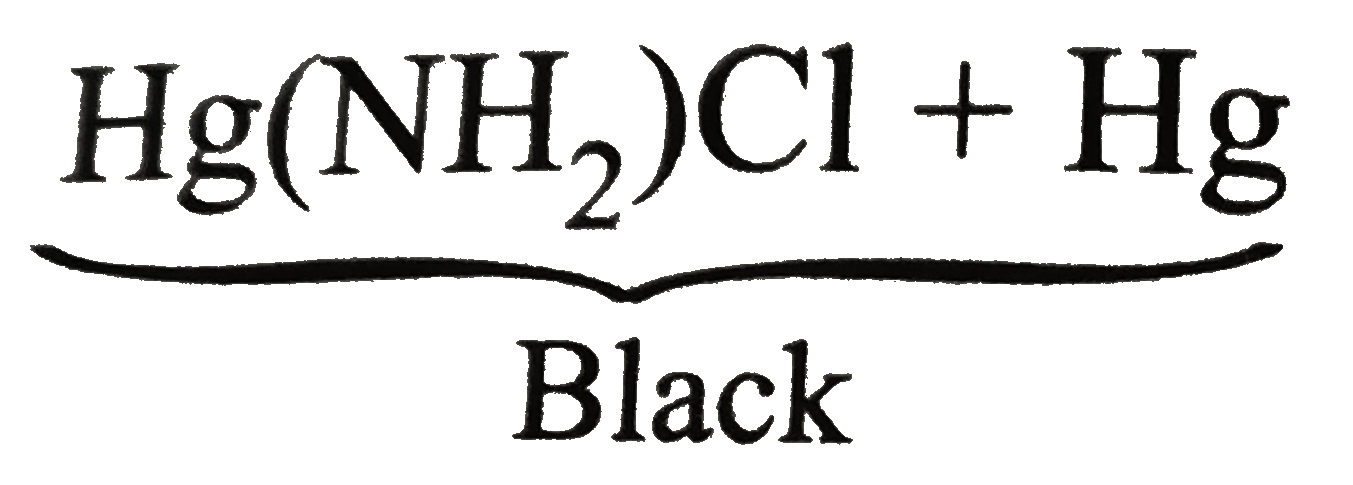
|
|
| 29. |
Heating of ores with flux to remove non fusible mass is called: |
|
Answer» SMELTING |
|
| 30. |
Hg_(2)^(2+) when reacts with H_(2)S, black ppt. (A) formed which when reacts with Na_(2)S followed by filtration leaving behind black ppt. (B). The filitrate with H^(+) gives black ppt. (C). A, B and C are: |
|
Answer» `Hg_(2)S,HG,HGS` |
|
| 31. |
Heating ofpyrites in air to remove sulphur is called : |
|
Answer» CALCINATIONS |
|
| 32. |
Heating of (CH_3 )_2 SiCl_2 in the presence of water gives |
|
Answer» `(CH_3 )_2 Si=O` |
|
| 33. |
Hg_(2)Cl_(2) aprecipitate if (a) ____is greaterthan K_(sp) (Hg_(2)Cl_(2)). |
|
Answer» |
|
| 34. |
Heating of alkanes with fuming sulphuric acid or oleum at high temperature, which forms sulphonic acid, is called |
|
Answer» Nitration |
|
| 35. |
Hg sticks to the surface of glass when it comes into contact with |
| Answer» Answer :D | |
| 36. |
Heating of carbonate ores to remove carbon is called as : |
|
Answer» Roasting |
|
| 37. |
Heating mixture of sodium benzoate and soda-lime gives |
|
Answer» benzene |
|
| 38. |
HF present as impurity in gaseous fluorine can be removed by passing over |
|
Answer» `P_(2)P_(5)` |
|
| 39. |
Heating mixture of Cu_(2)O and Cu_(2)S will give…….. |
|
Answer» `CU+SO_(2)` |
|
| 40. |
HF is not kept inside |
|
Answer» GLASS BOTTLE |
|
| 41. |
Heating in aqueous solution of aluminium chloride to dryness will give |
|
Answer» `Al(OH)Cl_(2)` `AlCl_(3)+3H_(2)O to Al(OH)_(3)+3HCl` On heating it TILL dryness `Al(OH)_(3)` is converted into `Al_(2)O_(3)` 2Al(OH)_(3) overset(Delta) to Al_(2)O_(3)`. |
|
| 42. |
HF present as impurity in gaseous F_2 can be removed by passing over |
|
Answer» `P_2O_5` |
|
| 43. |
Heating a mixture of Cu_2O and Cu_2S will give |
|
Answer» `CU +SO_2` |
|
| 45. |
HF is a weak acid but HCl is a strong acid because: |
|
Answer» HF is less IONIC than HCl |
|
| 46. |
Heating mixture of Cu_(2) O and Cu_(2) S will give |
|
Answer» `CU+ SO_(2)` |
|
| 47. |
Heating mixtureofCu_2 OandCu_ 2 Swill give |
|
Answer» ` CU + SO_2` |
|
| 48. |
Heating Cu_2O and Cu_2S will give : |
|
Answer» `CU + SO_4` |
|
| 49. |
Heating an ore in a regular supply of air in a furnace at a temperature below the melting point is called |
|
Answer» calcination |
|
| 50. |
Heating a mixture of ethyl alcohol and acetic acid in presence of conc. H_(2)SO_(4) produces a fruity smelling compound. This reaction is called |
|
Answer» Neutralisation It is called esterification reaction. |
|