

Saved Bookmarks
This section includes 7 InterviewSolutions, each offering curated multiple-choice questions to sharpen your Current Affairs knowledge and support exam preparation. Choose a topic below to get started.
| 1. |
H_2PO_4^(-) the conjugate base of…….. |
|
Answer» `PO_4^(3-)` ACID 1 base 1 ACI d 2 base 2 `therefore H_2Po_4^(-)` is the CONJUGATE base of `H_3PO_4` |
|
| 2. |
H_(2)O(l)hArrH^(+)(aq)+OH^(-)(aq),DeltaH=+13.7 kcal/mol K_(eq) at 25^(@)C=10^(-14). Calculate K_(eq) at 60^(@)C? |
|
Answer» Solution :`LOG(K_(2))/(K_(1))=(DeltaH)/(2.303R)[1/(T_(1))-1/(T_(2))]` `log(K_(2))/(10^(-14))=(13.7)/(2.303xx2xx10^(-3))[1/298-1/333]` `K_(2)=1.26xx10^(-12)` |
|
| 3. |
{:([(H_(2)O)_(4)Co(O_(2))_(2)Co(H_(2)O)_(4)](SO_(4))_(2)overset[[X]"reagent"]to [(H_(2)O)_(4)Co(O_(2))_(2)Co(H_(2)O)_(4)](SO_(4))),(""(I)""""(II)"):} In both the complex Co hast_(2g)^(6)e_(g^(0)) configuration. Which option is incorrect ? |
|
Answer» Complex (I) is Paramagnetic `(II) O_(2)^(2-)`is diamagnetic |
|
| 4. |
[(H_(2)O)_(8)Fe_(2)(OH)_(2)].(SO_(4))_(2) Calculate the coordination number of central metal, E.A.N., Primary valencies. [If the coordination number is 4, EAN is 18, Primary valency = 2 than answer is 4182.] |
|
Answer» EAN=26-2+10+1=35,P.V. of 1 `OH^(-), 2SO_(4)^(2-)=3` |
|
| 5. |
H_2Oboils at higher temperature than H_2S becauseit is capable of forming : |
|
Answer» IONIC bonds |
|
| 6. |
H_(2)O_(2)toH_(2)O+1/2O_(2)(1storder) Time to time the H_(2)O_(2) solutioni is titrated with standard acidified KMnO_(4). Thedata is Time (min)""0""15 KMnO_(4) ("consumed")""16ml""2ml What is half life in minutes? |
|
Answer» ` C_(0)-X` `0` `K=2.303/15xxlog(16/2),K=2.303/15xx3xx0.3010=0.693/5` `t_(1/2)=(0.693/K),t_(1/2)=(0.693xx5)/0.693=5` |
|
| 7. |
H_(2)O_(2)overset(1st"order")(to)H_(2)O+1/2O_(2). Pressure of O_(2) is recorded as: time (min)"" 10 min ""prop P_(O_(2)) (mm)""120""160 What is half life? |
|
Answer» `C_(0)"P_(0)=0` `(C_(0)-x)""P_(t)=120` `0""P_(alpha)=160` `KX2.303/10="LOG"160/40,t_(1/2)=0.693/k=5` `H_(2)O_(2)toH_(2)O+1/2O_(2)` |
|
| 8. |
H_2O_2 when added to a solution containing KMnO_4 and H_2SO_4 acts : |
|
Answer» As an oxidising AGENT |
|
| 9. |
H_2O_2 restores the colour of old lead paintings , blackenedby the action of H_2S gas, by : |
|
Answer» CONVERTING `PbO_2` TO Pb |
|
| 10. |
H_2O_2 reduces K_3Fe(CN)_6 in |
|
Answer» NEUTRAL solution |
|
| 11. |
H_(2)O_(2) reduces chlorine to chloride. Write the coefficients of all substances in the equation. |
|
Answer» Solution :The EQUATION is GIVEN as `H_(2)O_(2) + Cl_(2) RARR HCl + O_(2)` The balanced equation is `H_(2)O_(2) + Cl_(2) rarr 2HCL + O_(2)` The coefficient of `H_(2)O_(2), HCl` and `O_(2)` are = 1,1,2 and 1 |
|
| 12. |
H_2O_2 on treatment with chlorine gives: |
|
Answer» `H_2` |
|
| 13. |
H_(2)O_(2) on reaction with PbSgives |
|
Answer» PbO |
|
| 14. |
H_2O_2 is prepared in the laboratory when: |
|
Answer» `MnO_2` is added to DILUTE cold `H_2SO_4` |
|
| 15. |
H_(2)O_(2) is formed in the upper atmosphere through the following mechanism H_(2)O+(O) to 2" OH" to H_(2)O_(2) The overall enthalpy change and activation energy for the forward reaction are 72" kJ mol"^(-1) and 77" kJ mol"^(-1) respectively. The activation energy for the decomposition of H_(2)O_(2) to give back H_(2)O and (O) will be |
|
Answer» `5" KJ mol"^(-1)` 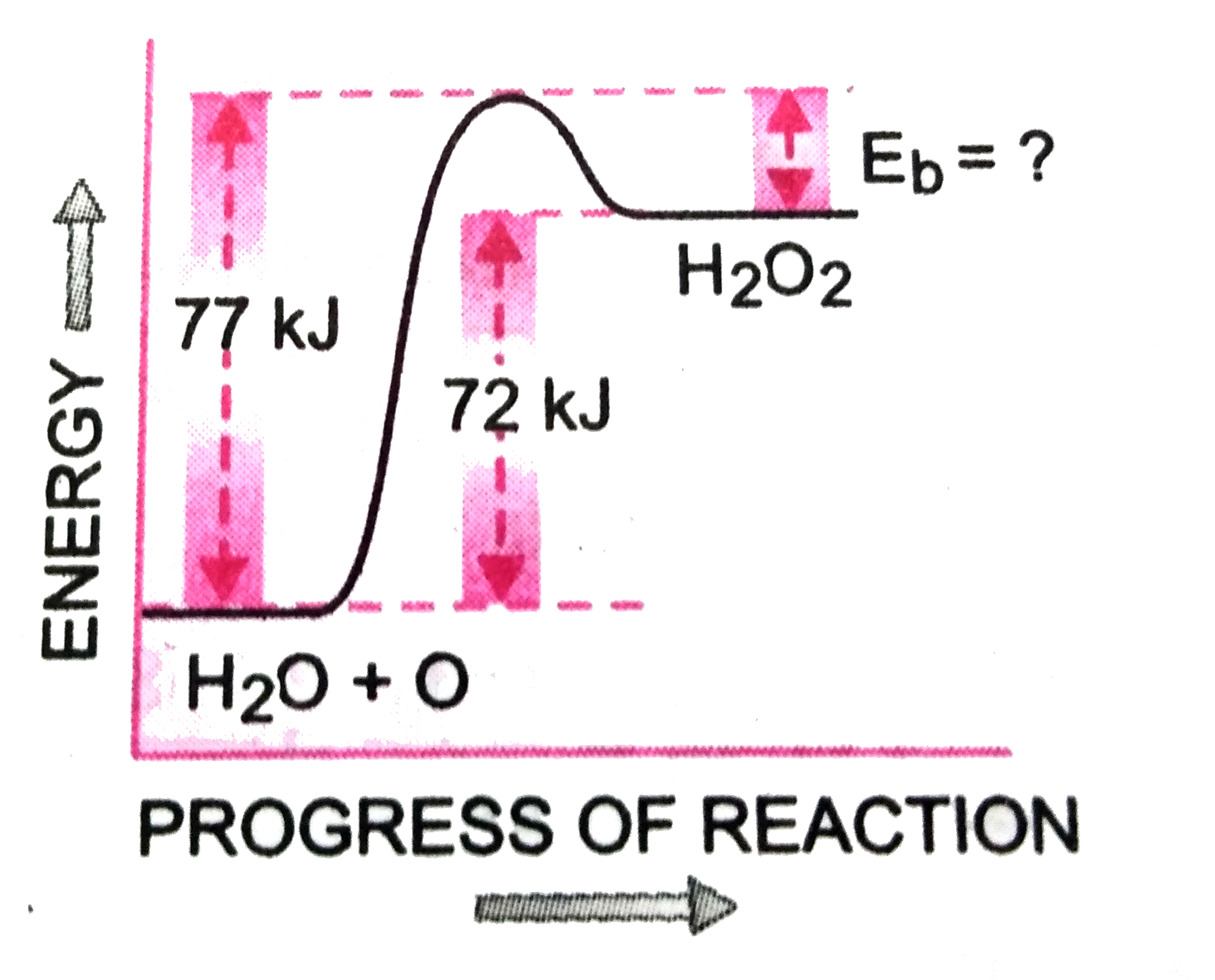
|
|
| 16. |
H_2O_2 is concentrated by: |
|
Answer» STEAM distillation |
|
| 17. |
H_2O_2 is |
|
Answer» an oxidising AGENT `H_2O_2rarrH_2O+O` Reducing behaviour is as `H_2O_2+O rarrH_2O+O_2` |
|
| 18. |
H_(2)O_(2) is |
|
Answer» ANTIBIOTIC |
|
| 19. |
H_2O_2 IS : |
|
Answer» Diamagnetic |
|
| 20. |
H_(2)O_(2)+H_(2)O+1/2O(2) (1st order). Time to time the H_(2)O_(2) solution is titrated with standard acidified KMnO_(4). The data is Time (min ) ""0""15 KMnO_(4)"consumed")""16ml""2ml What is half life in minutes? |
|
Answer» `t_(1)=0""C_(0),t_(2)=15C_(0)-x,t_(3)=alpha""0` `Kxxt=2.303xxlog((C_(0))/(C_(t))),0.693/((t_(1/2)))xx15=2.303xxlog(16/2),(t_(1/2))=(0.693xx16)/(2.303xx3xx0.3010)=5` |
|
| 21. |
H_(2)O_(2) decomposes in an aqueous solution to give H_(2)O and oxygen gas. The rate constant of disappearance is 2xx10^(-2) sec^(-1). Calculate the amount of heat liberated per second initially from 0.5 L "of" 2M H_(2)O_(2) solution (in kJ) H_(2)O_(2) (aq) to H_(2)O (l) + 1/2 O_(2) (g) DeltaH= 100 kJ//"mole" |
|
Answer» |
|
| 22. |
H_2O_2decomposes with first order kinetics in a 3 lit. container. If the pressure developed in 10 min. is 380 mm, the average rate at 27^@C is |
|
Answer» `0.01 M. "MIN"^(-1)` |
|
| 23. |
H_2O_2 converts potassium ferrocyanide to ferricyanide. The change observed in the oxidation state of iron is: |
|
Answer» `FE^(2+)RARRFE^(3+)` |
|
| 24. |
H_2O_2 cannot oxidise |
|
Answer» `O_(3)` |
|
| 25. |
H_(2)O_(2) can be produced by the Ammonium hydrogen sulphate. Reactions occuring in electrolytic cell. NH_(4)HSO_(4) rarr NH_(4)^(+) +H^(+) +SO_(4)^(2-) 2SO_(4)^(2-) rarr S_(2)O_(8)^(2-) +2e^(-) (Anode) 2H^(+) +2e^(-) rarr H_(2) (cathode) (NH_(4))_(2)S_(2)O_(8) +2H_(2)O rarr 2NH_(4)HSO_(4) +H_(2)O_(2) Hydrolysis of Ammonium persulphate Assume 100% yield of hydrolysis reaction. How many moles of electrons are to be passed in order to produce enough H_(2)O_(2) which when reacted with excess of KI then liberated iodine required 100 ml of centimolar Hypo solution. |
|
Answer» `10^(-1)` |
|
| 26. |
H_(2)O_(2) can be produced by the Ammonium hydrogen sulphate. Reactions occuring in electrolytic cell. NH_(4)HSO_(4) rarr NH_(4)^(+) +H^(+) +SO_(4)^(2-) 2SO_(4)^(2-) rarr S_(2)O_(8)^(2-) +2e^(-) (Anode) 2H^(+) +2e^(-) rarr H_(2) (cathode) (NH_(4))_(2)S_(2)O_(8) +2H_(2)O rarr 2NH_(4)HSO_(4) +H_(2)O_(2) Hydrolysis of Ammonium persulphate Assume 100% yield of hydrolysis reaction. What is the current efficiency when 100 Amp current is passed for 965 sec, in order to produce 17 gm of H_(2)O_(2). |
| Answer» ANSWER :D | |
| 27. |
H_2O_2 can be used |
|
Answer» both an OXIDIZING and as a REDUCING AGENT |
|
| 28. |
H_(2)O_(2) cannot be synthesized by |
|
Answer» ADDITION of ice COLD `H_(2)SO_(4) and BaO_(2)` |
|
| 29. |
H_2O_2 and heavy water were discovered respectively by |
|
Answer» THENARD, Urey |
|
| 30. |
H_2O_2 acts as a reducing agent in its: |
|
Answer» REACTION with a FERROUS salt |
|
| 31. |
H_2O_2 acts as antiseptic due to its : |
|
Answer» REDUCING PROPERTY |
|
| 32. |
H_2O_2 acts as an oxidising agent in: |
|
Answer» NEUTRAL medium |
|
| 33. |
H_(2)O_2 solution used for hair bleaching is sold as a solution of approximately 5.0g H_(2)O_(2) per 100mL of the solution.The molecular mass of H_2O_2 is 34. The molarity of this solution is approximately |
|
Answer» `1.5` |
|
| 34. |
H_(2)O is reduce with Sn//HCl. Product formed |
|
Answer» `RNH_(2)` |
|
| 35. |
H_(2)O is hard if it contains |
|
Answer» `NaHCO_(3)` |
|
| 36. |
H_(2)O has a net dipole moment while BeF_(2) has zero dipole moment because : |
|
Answer» `F` is more electronegativity than oxygen 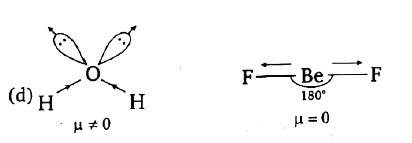
|
|
| 37. |
H_(2)O is dipolar whereas BeF_(2) is not. It is because |
|
Answer» `H_(2)O` involves hydrogen BONDING whereas `BeF_(2)` is a DISCRETE MOLECULE. |
|
| 38. |
H_(2)O is a liquid while H_(2)S is a gas. This is due to : |
|
Answer» DIFFERENCE in the STATE of hybridisations of O and S in their compounds |
|
| 39. |
H_(2)N-NH_(2)-Ph-overset(O)overset(||)C-Cl" (excess)" overset(NaOH)toX,X is |
|
Answer» `H-OVERSET(O)overset(||)C-NH-Ph` |
|
| 40. |
H_2(g)+I_2(g)rarr2HI(g), triangleH=-12.40 kcals, Heat of formation of HI will be |
|
Answer» 12.4 KCALS |
|
| 41. |
H_(2(g))+I_(2(g))hArr2HI_((g)) In this reaction when pressure increases, the reaction direction |
|
Answer» Does not change |
|
| 42. |
H_(2)(g) + I_(2) hArr 2HI(g): Delta H = 12.40 kcal. According to this reaction, heat of formation of HI will be |
|
Answer» 12.4 KCAL |
|
| 43. |
H_(2)(g)+Cl_(2)(g)rarr2HCl(g).DeltaH=-44 kcal2Na(s)+2HCl(g)rarr2NaCl(s)+H_(2)(g), DeltaH=-152 kcalFor the reaction Na(s)+(1)/(2)Cl_(2)(g)rarrNaCl(s),DeltaH= |
|
Answer» `-108 kcal` `Na+(1)/(2)Cl_(2)RARRNACL, DELTAH=-(196)/(2)kcal=-98kcal`. |
|
| 44. |
H_(2(g))+Cl_(2(g))overset(hv)rarr 2HCl_((g)) The reaction proceeds with a uniform rate throughout. What do you conclude ? |
| Answer» SOLUTION :The REACTION is zero order reaction WHOSE RATE is independent on the concentration of REACTANTS. | |
| 45. |
H_2(g)+Cl_2(g)=2HCl(g),triangleH=-44.12 kcal The enthalpy of hydrogen cholride at 298 K is: |
|
Answer» `-44.12` |
|
| 46. |
H_(2)(g) and O_(2)(g)have a very strong tendency to react with each other. However, keepingthem in the same container at room temperature, do not produce water. Explain. |
| Answer» SOLUTION :Because the VALUE of activation ENERGY for the REACTION is very high | |
| 47. |
H_2(g)+Cl_2(g)→2HCl(g), triangleH298K=-22.06 kcals, For this reaction, △U is equal to: |
|
Answer» `-22.06 + 2 xx 10^-3 xx298 xx 2 KCAL` |
|
| 48. |
H_(2)(g)+(1)/(2)O_(2)(g)to H_(2)O(l) , Delta H at 298 K = - 285.8 kJ The molar enthalpy of vapourization of water at 1 atm and 25^(@)C is 44 kJ. The standard enthalpy of formation of 1 mole of water vapour at is |
|
Answer» `-241.8 KJ` |
|
| 49. |
{:[(H_(2)(g)+(1)/(2)O_(2)(g)=H_(2)O(g),DeltaH=-241.8kJ),(CO(g)+(1)/(2)O_(2)(g)=CO_(2)(g),DeltaH=-283 kJ):}] the heat evolved in the combustion of 112 litres of water gas (mixture of equal volumes of H_(2) and CO) is |
|
Answer» `241.8` KJ |
|
| 50. |
H_(2)(g)+(1)/(2)O_(2)(g)rarrH_(2)O(l), DeltaH " at "298 K=-285.8 kJThe molar enthalpy of vaporization of water at 1 atm and 25^(@)C is 44 kJ. The standard enthalpy of formation of 1 mole of water vapour at 25^(@)C is |
|
Answer» `-241.8` KJ `H_(2)O_((l))rarrH_(2)O_((G)),DeltaH=44 kg` `THEREFORE H_(2)+(1)/(2)O_(2)rarrH_(2)O_((g)),DeltaH^(@)=-241.8 kJ`. |
|