

Saved Bookmarks
This section includes 7 InterviewSolutions, each offering curated multiple-choice questions to sharpen your Current Affairs knowledge and support exam preparation. Choose a topic below to get started.
| 1. |
Give the IUPAC name of n-propyl cyanide. |
| Answer» SOLUTION :BUTANENITRILE | |
| 2. |
Given : H^(+)(aq, 1M)+e rarr(1)/(2)H_(2)("g, 1atm"), E^(@)=0.00V Hg_(2)Cl_(2)(s)+2e rarr Hg(l) +2Cl^(-)(aq, 1M), E^(@)=+0.27V In which of following galvanic cell, the given reaction occurs - H_(2)"(g, 1atm)"+Hg_(2)Cl_(2)(s)rarr 2Hg(l)+2H^(+)(1M)+2Cl^(-)(1M) |
|
Answer» `Hg|Hg_(2)Cl_(2)(s)|Cl^(-)(1M)||H^(+)(1M)H_(2)("G, 1atm")|PT` |
|
| 4. |
Given H for the process Li(g) to Li ^(+3) (g) + 3e ^(-)is 19800 Kj/mol & IE_(1) for Li is 520 then IE_(2)& IE_(3) of LI ^(+) are respectively (approx, value): |
|
Answer» |
|
| 5. |
Give the IUPAC name of (i) CH_(3)CH(OH)CH_(2)OH (ii) HO -CH_(2)-CH_(2)-OH (iii) CH_(3)-overset(OH)overset(|)CH-COOH |
|
Answer» SOLUTION :(i)Propane -1,2-diol (ii) ETHANE -12-diol (iii) 2-Hydroxy PROPANOIC ACID |
|
| 7. |
Given Fe^(2+)+2e^(-) Leftrightarrow Fe ""E^(0)=-0.44V Co^(2+)+2e^(-) Leftrightarrow Co""E^(0)=0.28V Ca^(2+)+2e^(-) Leftrightarrow Ca""E^(0)=-2.87V Cu^(2+)+2e^(-) Leftrightarrow E^(0)=+0.337V Which is tha most electropositive metal?. |
|
Answer» Fe |
|
| 8. |
Give the IUPAC name of each of the following and classify them as 1^(@), 2^(@) and 3^(@) (a) CH_(3)(CH_(2))_(3)CHOHCH(CH_(3))_(2) , (b) (CH_(3))_(3)C-CH_(2)OH ( c) (CH_(3))_(2)C-underset(C_(6)H_(5)) underset(|)C-OH (d) BrCH_(3) - underset(OH) underset(|)CH_(2)-CH - C(CH_(3))_(3) (e) CH_(2)=CH-CHOHCH (f) PhCH_(2)OH (g) HOCH_(2)CH_(2)CH_(2)CH_(2)C_(6)H_(5) (h) (C_(2)H_(5))_(2)COH |
|
Answer» SOLUTION :(a) 2-methyl-heptan -3-ol `(2^(@))` (B) 2-2-DIMETHYL-propan-1-ol-`(1^(@))` ( c) 2-phenyl-2-propanol `(3^(@))` (d) 2,2 -dimethyl -5-bromo-3-pentanol `(2^(@))` (e) I-Butene -3-ol `(2^(@))` (f) Phenyl methanol `(1^(@))` (g) 4-phenyl -1-butanol `(1^(@))` (h) 3-ethyl-3-pentanol `(3^(@))` |
|
| 9. |
Given general electronic configuration of inner transition elements. |
| Answer» SOLUTION :`(n-2)F^(1-14)(n-1)d^(0-1)NS^(2)` | |
| 10. |
Give the IUPAC name of H_(2)N-underset(1)(CH_(2))-underset(2)(CH_(2))-underset(3)(CH)=underset(4)(CH_(2)) . |
| Answer» SOLUTION :But-3-en-t -AMINE. | |
| 11. |
Givenfor Sn^(4+)//Sn^(2+) standard reduction potential is 0.15 V and for Au^(3+) //Au standard reductionpotentialis 1.5 V for the reaction 3 Sn^(2)+2 Au^(3+) rarr 3Sn^(4+)+2ASu The value of E_(cell)^(@) is |
|
Answer» `+1.35` |
|
| 12. |
Give the IUPAC name of follwing compounds C_6H_5-NC |
| Answer» SOLUTION :PHENYL CARBYLAMINE | |
| 13. |
Given four uses of emulsions. |
|
Answer» Solution :Uses of emulsions : (i) The concentration of sulphide ore particles by froth FLOATATION process is based on emulsification. (ii) Milk is an emulsion of FAT in water. It is an important constituent of our daily diet (iii) CLEANING ACTION of soaps and detergents is due to the formation of an emulsion between OILY dirt and soap (or detergent) solution. (iv) Cosmetics, ointments, lotions, hair dyes etc are more effective in the form of emulsions. |
|
| 14. |
Give the IUPAC name of Crotonaldehyde |
| Answer» SOLUTION :2-Butenal | |
| 15. |
Given Fe^(3+)(aq)+e ^(-)toFe ^(2+)(aq), E ^(@) =+0.77V Al ^(3+) (aq)+ 3e ^(-)to Al(s),E^(@)=-1.66V Br_(2) (aq)+ 2e^(-) to 2Br,E^(@)=+ 1.09V Considering the electrode potentials, which of the following represents the correct order of reducing power? |
|
Answer» `FE ^(2+)LT Al lt Br^(-)` `Al lt Fe^(2+) lt Br ^(-)` |
|
| 16. |
Give the IUPAC name of [CoCl_2 (NH_3)_4] Cl.Draw cis and trans isomers of [Co Cl_2 (NH_3)_4]^+ion. |
Answer» SOLUTION :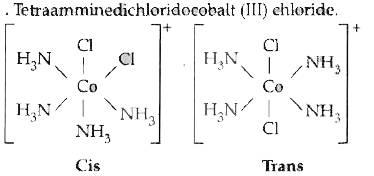
|
|
| 17. |
[Given: E_(Zn^(2+)|Zn)^(@)=-.0.76V K_(f)[Cu(NH_(3))_(4)]^(+2)=4xx10^(11) E_(Cu^(2+)|Cu)^(@)=0.34V The emf of cell at 200K is: [Given: (2.303xxR)/(F)=2xx10^(-4) and assume that E^(@) values are independent of temperature.] |
|
Answer» 1.7V |
|
| 18. |
[Given: E_(Zn^(2+)|Zn)^(@)=-.0.76V K_(f)[Cu(NH_(3))_(4)]^(+2)=4xx10^(11) E_(Cu^(2+)|Cu)^(@)=0.34V At what conc. Of Cu^(+2), emf of the cell will be zero (at 298K) at conc. Of Zn^(+2) is remaining same? |
| Answer» Answer :A | |
| 19. |
Give the IUPAC name of : Cl-CH_3-CH-CH_2-CH_3 |
| Answer» SOLUTION :2-chlorobutane | |
| 21. |
Given E_(Zn^(+2)|Zn)^(@)=-0.76V K_(f)[Cu(NH_(3))_(4)]^(+2)=4xx10^(11) E_(Cu^(+2)|Cu)^(@)=0.34V Answer the following. Q. When 1 mole NH_(3) added to cathode compartment than emf of cell is (at 298 K) |
|
Answer» 0.81 V `K_(F)=4.0xx10^(11)=(0.2)/(x xx(0.2)^(4))=(1)/(x xx(0.2)^(3))` `x=(10^(-11))/((0.2)^(3)xx4)` `x=3.125xx10^(-10)` `[Cu^(+2)]=3.125xx10^(-10)` `E_(cell)=0.75+0.34-(0.0591)/(2)log((2)/(3.125xx10^(-10))` `=1.1-(0.0591)/(2)(10-0.194)=1.1-0.29=0.81"volt"` |
|
| 22. |
Give the IUPAC name of [(CH_(3))_(2)CH]_(3)COH. |
Answer» Solution :EXPAND thhe GIVEN condensed FORMULA into COMPLETE structural formula. 
|
|
| 23. |
Given E^(@)(Zn^(2+)//Zn)=-0.76V E^(@)(Ni^(2+)//Ni)=-0.25V Calculate the EMF of the cell where the following reaction is taking place Zn_((s))+Ni_((aq))^(2+)toZn_((aq))^(2+)+Ni_((s)) |
|
Answer» `0.51V` `=-0.25-(-0.76)=+0.51V` |
|
| 24. |
Give the IUPAC name of CH-=C-CH=CH_(2) |
| Answer» SOLUTION :But-1-en-3-yne | |
| 25. |
Give the IUPAC name of CH_(3)-underset(CH_(3))underset(|)N-CH_(3) |
| Answer» SOLUTION :N, N-Dimethylmethamine. | |
| 26. |
Given: E_(Zn^(+2)//Zn)^(@) =- 0.76V E_(Cu^(+2)//Cu)^(@) = +0.34V K_(f)[Cu(NH_(3))_(4)]^(2+) = 4 xx 10^(11) (2.303R)/(F) = 2 xx 10^(-4) When 1 mole of NH_(3) added to cathode compartement than emf of cell is (at 298K): |
|
Answer» `0.81 V` |
|
| 28. |
Given example of first order reaction. |
| Answer» Solution :`2" N"_(2)"O"_(5)TO4" NO"_(2)+"O"_(2)," RATE"=K[N_(2)O_(5)]`. | |
| 29. |
Give the IUPAC name for the following ethers and classify them as simple or mixed. |
Answer» Solution :(i) `CH_3-CH_2-O-CH_2-CH_2-CH_2-CH_3-=`1-ethoxy butane (mixed ether) 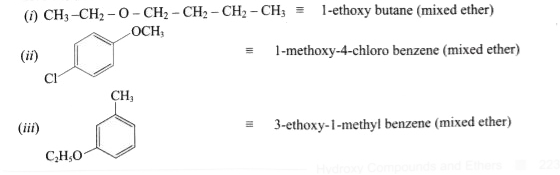 (iv) `CH_3-underset(CH_3)underset(|)overset(CH_3)overset(|)C-O-overset(CH_3)overset(|)underset(CH_3)underset(|)C-CH_3-=`2-methyl propoxy - 2- propane (simple ether) (v) `CH_2= CH-underset(Cl)underset(|)CH-O-CH_3-=`3-ehloro-3-methoxy PROP - 1 - ene(mixed ether) (vi) dibenzyl ether`-= C_6H_5CH_2 - O- CH_2C_6H_5`(simple ether) (vii) vinyl allyl ehter `-=CH_2 = CH - O - CH_2 - CH = CH_2` (mixed ether) |
|
| 31. |
Given examples for first order reaction. |
|
Answer» Solution :(i) All radioactive transformations FOLLOWS first order kinetic. For example, `._(92)U^(238)rarr ._(90)U^(234)+ ._(2)He^(4)` (II) Decomposition of sulphuryl chloride in the gas phase proceeds by first order kinetics. `SO_(2)Cl_(2(g))rarr SO_(2(g))+Cl_(2(g))` (iii) Inversion of sucrose in acidic aqueous medium follows first order reaction. `C_(12)H_(22)O_(11)+H_(2)O overset(H^(+))rarr C_(6)H_(12)O_(6)+C_(6)+C_(6)H_(12)O_(6)` |
|
| 32. |
Given : E_(Pb^(2+)|Pb)^(@)=-0.13V and E_(Fe^(2+)|Fe)^(@) =-0.44V at 25^(@)C. In a aqueous solution containing Pb^(2+) and Fe^(2+) ions, concenraction of each ion is 1M. If Pb and Fe power are added to the this soltuion, then in the solution - |
|
Answer» amount of PB will DECREASE |
|
| 33. |
Given enthalpy of formation of CO_2(g) and CaO(s) are -94.0 kJ and -152 kJ respectively and the enthalpy of the reaction,CaCO_3(s)rarrCaO(s) + CO_2(g) is 42 kJ. The enthalpy of formation of CaCO_3(s) is: |
|
Answer» `-42 KJ` |
|
| 35. |
Give the IUPAC name for methyl salicylate. |
|
Answer» METHOXY BENZOIC acid 
|
|
| 36. |
Given electrode potentials: Fe^(3+) + e^(-) rarr Fe^(2+) : E^(o) =0.771 V and I_(2) 2e^(-) rarr 2I^(-), E^(o) = 0.556 V then E^(o) for the cell reaction 2 Fe^(3+) 2I ^(-) rarr 2 Fe^(2+) + l_(2) will be: |
|
Answer» `(2XX 0.771 - 0. 536)= 1.006 ` VOLT |
|
| 37. |
Give the IUPAC name and structure of the compound formed when 3-chlorobutanamide is treated with Br_(2) and KOH. |
|
Answer» Solution :`UNDERSET("3-Chlorobutanamide")(CH_(3)-underset(CL)underset(|)(C)H-CH_(2)-underset(O)underset(||)(C)-NH_(2))+Br_(2)+5KOH overset(Delta)to underset("1-Amino-2-propanol")(CH_(3)-underset(OH)underset(|)(C)H-CH_(2)-NH_(2))+K_(2)CO_(3)+2KBr` Under the basic conditions of the reaction, C-Cl also gets hydrolysed to give C-OH. |
|
| 38. |
Given E_(Fe^(3+)//Fe)^(o)=-0.036V,E_(Fe^(2+)//Fe)^(o)=-439V the value of standard electrode potential for the change, Fe_((aq))^(3+)+e^(-)toFe^(2+)(aq) will be |
|
Answer» `-0.072V` `Fe^(+2)+2e^(-)toFe,DeltaG_(2)=-2xxFxxE_(Fe^(2+)//Fe)^(0)` `Fe^(3+)+E^(-)toFe^(2+),DeltaG=DeltaG_(1)-DeltaG_(2)` `DeltaG=3xx0.036F-2xx0.439xxF=-1xxE_((Fe^(3+)//Fe^(+2)))^(o)xxF` `E_((Fe^(3+)//Fe^(+2)))^(o)=2xx0.439-3xx0.036` `=0.878-0.108=0.770V` |
|
| 39. |
Give the IUPAC name and oxidation number and co-ordination number of the following complex compounds. |
|
Answer» Solution :(i) `[Co(en)_(3)]^(3+)` Tris(ETHANE) -1,2,idiamine)cobalt(III) ion co-ordination no. 6 oxidation no. + 3 (ii) `K_(4)[Fe(CN)_(6)]` Potassium hexacyanidoferrate (II) CO-ordination no. 6 oxidation no. +2 (iii) `[Co(C_(2)O_(4))_(3)]^(3-)` Trioxalatocobaltate no. 6 oxidation no. + 3 (iv) `Na[Co(CO)_(4)]` Sodium tetracarobnylcobaltate - (-1) Co-ordination no. 4 oxidation no. -1 (v) `[Pt(NH_(3))_(2)(NO_(2))(CL)_(2)Br]` Diamminebromidodicloridonitrito-N-platinum (IV) Co - ordination number 6Oxidation number 4 (vi) `K[Au(CN)_(4)]` POtassium tetracyanidoaurate (III) Co-ordination no.4 oxidation number + 3 (vii) `[Co(C_(2)O_(4))_(2)(en)]^(-)` Ethane-1,2-diaminedioxalatocaobaltate (III) ion Co-ordination no. 6 oxidation no. +3 (viii) `[CO(NH_(3))_(5)(ONO)]Cl_(2)` Pentaamminenitrito - O -Cobalt (III) chloride `C.N rarr 6 "" O.N rarr 3` (ix) `K[Pt(Cl)_(3)NH_(3)]` POtassium amminetrichloridoplatinate(II) `C.N rarr 4 ""O.N rarr 2` (x) `[Co(Br)_(2)(en)_(2)]Cl` Dibromidobis-(Ethane - 1,2-diamine)cobalt (III) chloride `C.N rarr 6 "" O.N rarr +3` (xi) `[CrCl_(2)(H_(2)O)_(4)]NO_(3)` Tetraaquadichloridochromium(III) NITRATE `C.N rarr 6 ""O.N rarr +3` (xii) `[Co(CO_(3))(NH_(3))_(5)]Cl` Pentamminecarbonatocobalt (III) chloride `C.N rarr 6 ""O.N rarr +3` (xiii) `[FeCl_(2)(en)_(2)Cl` Dichloridobis - (ethylenediamine) iron (III) chloride `C.N rarr 6 ""O.N rarr 3` |
|
| 40. |
Given E_(Fe^(3+)//Fe)^(@)=-0.036V,E_(Fe^(2+)//Fe)^(@)=-0.439V. The value of E_(Fe^(3+)//Fe^(2+))^(@) will be |
|
Answer» `-0.072V` |
|
| 41. |
Give the IUPAC name and electronic configuration of central metal atom in terms of t_(2g) and e_(g) of K_(4)[Mn(CN)_(6)]. |
|
Answer» SOLUTION :Potassium hexacyanomanganate(II) ELECTRONIC config : `t_(2g)^(5)" "e_(G)^(0)` |
|
| 42. |
Given electrode potentials are , Fe^(3+) + e to Fe^(2+), E^@ = 0.771V"" I_2 + 2e to 2I^(-), E^@ = 0.536 V, E^@ cell for the cell reaction, 2Fe^(3+) + 2I^(-) to 2Fe^(2+) + I_2 is |
|
Answer» `0.536 - 0.771 = - 0.236 V` |
|
| 43. |
Give the IUPAC name and common name of |
Answer» Solution :The IUPAC NAME of  is 2 -hydroxybenecarbaldehyde (or) 2 - hydroxybenzaldehyde is 2 -hydroxybenecarbaldehyde (or) 2 - hydroxybenzaldehyde Common name of 2- hydroxybenzaldehyde is salicyladehyde. |
|
| 44. |
Give the IUPAC and common name of vinyl cyanide (CH_2=CHCN). |
| Answer» SOLUTION :IUPAC NAME: Prop-2-ennitrile COMMON name : ACRYLONITRILE. | |
| 45. |
Given E_(Cr^(3+)//Cr)^(o)=-0.72V,E_(Fe^(2+)//Fe)^(o)=-0.42V. The potential for the cell Cr|Cr^(3+)(0.1M)||Fe^(3+)(0.01M)|Fe is |
|
Answer» 0.339V `=(-0.42+0.72)-(0.059)/(6)"log"((0.1)^(2))/((0.01)^(3))([CrtoCr^(3+)+3overline(e)]xx2,[Fe^(2+)+2overline(e)toFe]xx3)/(2Cr+3Fe^(++)to2Cr^(3+)+3Fe` `E_(cell)=0.30-(0.059)/(6)"log"(10^(-2))/(10^(-6))=0.30-(4xx0.059)/(6)LOG10` `=0.30-0.0393=0.2607`VOLT. |
|
| 46. |
Give theionicreactionof electrolytic ofaqueoussolutionof KMnO_(4) |
|
Answer» Solution :In themethodaqueoussolutionof potassiummanganateis electrolyzedin thepresenceoflittlealkali. `K_(20MnO_(2)hArr2K^(+)+ MnO_(4)^(2-)` `H_(2)O hArrH^(+) +OH^(-)` Manganateions are converted intopermanganateions at anode. `MnO_(4)^(2-)hArrMnO_(4)^(-)+ e^(-)` `H_(2)` isliberatedat the cathode. `2H^(+)+ 2e^(-)to H^(2) ` Thepurplecoloured solutionis concentratedby evaporationand formcrystalsof potassiumpermanganateon COOLING . |
|
| 47. |
Given: E_(Cr^(3+)//Cr)^(@)=1.33 V, E_(Cl//Cl^(-))^(@) =1.36V CIBasedon the data given above, strongest oxidising agent will be : |
|
Answer» `Cl` |
|
| 48. |
Give the information about drugs and explain classification of them. |
|
Answer» Solution :Drugs are chemicals of low molecular masses `(-100 - 500u)`. These interact with macromolecular targets and PRODUCE a biological response. When the biological response is THERAPEUTIC and useful. These chemicals are called medicines and are used in diagnosis, prevention and treatment of DISEASES. Most of the drugs used as medicines are potential poisons, if taken in doses HIGHER than those recommended. Use of chemicals for therapeutic effect is called chemotherapy. |
|
| 49. |
Give the industrial preparation of acetic anhydride. How many other anhydrides be prepared from acetic anhydride? |
|
Answer» Solution :`CH_(3)COOH+underset("Ketene")( H_(2)C=C=O)to(CH_(3)CO)_(2)O` [Ketene is prepared by PYROLYSIS of acetone, `CH_(3)COCH_(3)OVERSET(973K)toCH_(4)+CH_(2)=C=O`] When the mixture of acetic anhydride and the carboxylic actd is distilled, anhydrides are FORMED. `2RCOOH+(CH_(3)CO)_(2)Oto(RCO)_(2)O+2CH_(3)COOH` |
|
| 50. |
Given, E_(Cr^(3+)//Cr)^(0)=-0.74V,E_(MnO_(4)^(-)//Mn^(2+))^(0)=1.51V, E_(Cr_(2)O_(7)^(2-)//Cr^(3+))^(0)=1.33V,E_(Cl//Cl^(-))^(0)=1.36V, from above given information decide which is strong oxidizing agent ? |
|
Answer» `CL^(-)` `MnO_(4)^(-)+5e^(-)+8H^(+)toMn^(2+)+4H_(2)O` `Cl+e^(-) to Cl^(-)` `Cr_(2)O_(7)^(2-)+14H^(+)+6E^(-) to 2Cr^(3+)+7H_(2)O` `Cr^(3+)+3e to Cr`. |
|