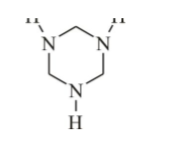
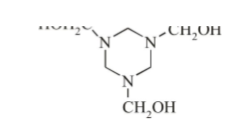
Saved Bookmarks
This section includes 7 InterviewSolutions, each offering curated multiple-choice questions to sharpen your Current Affairs knowledge and support exam preparation. Choose a topic below to get started.
| 1. |
Formaldehyde reacts with ammonia to give :- |
|
Answer» `H_2C=NH` |
|
| 2. |
Formaldehyde on treatment with_____gives an_______and salt of a carboxylic and this reaction is called_____. |
| Answer» Solution :Conc. NaOH or KOH, ALCOHOL, CANNIZZARO REACTION. | |
| 3. |
Formaldehyde polymerises from 6 to 100 molecules to form: |
|
Answer» Formalin |
|
| 4. |
Formaldehyde on condensation in presence of Ca(OH)_2 gives: |
|
Answer» Formose |
|
| 5. |
Formaldehyde is one of the products obtained on ozonolysis of a compound. The presence of which of the following groups is proved by this observation- |
|
Answer» VINYL group 
|
|
| 6. |
Formaldehyde is used for _____ and _____ |
| Answer» SOLUTION :PREPARATION of FORMALIN, for the MANUFACTURE of BAKELITE, | |
| 7. |
Formaldehyde is used as |
|
Answer» SOLVENT |
|
| 9. |
Formaldehyde gives an additive product with methyl magnesium iodide which o aqueous hydrolysis gives |
|
Answer» ISOPROPYL alcohol 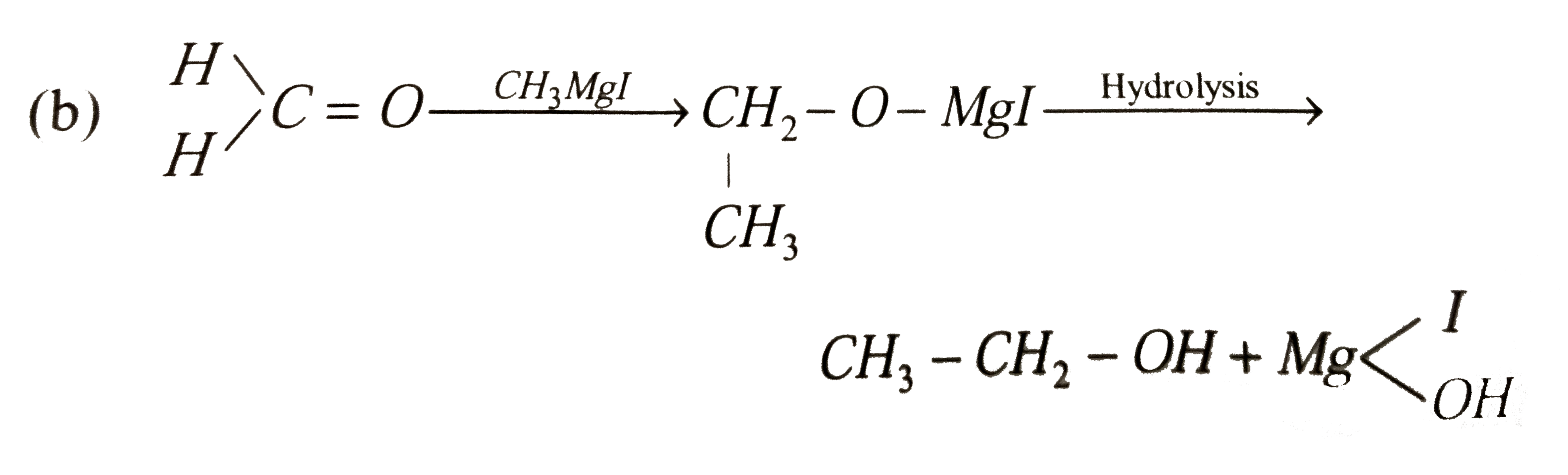
|
|
| 10. |
Formaldehyde [HCHO] Undergoes Cannizzaro reaction: Give reason. |
| Answer» SOLUTION :Due to the ABSENCE of `mu` - HYDROGEN atom. | |
| 11. |
Formaldehyde gives an additive product with methyl magnesium iodide which on aqueous hydrolysis give: |
|
Answer» ISOPROPYL alcohol |
|
| 12. |
Formaldehyde gives an additionproduct with methyl magnesium iodide which on acid hydrolysis gives |
|
Answer» `CH_(3)OH` |
|
| 13. |
Formaldehyde can be manufactured from: |
|
Answer» NATURAL gas |
|
| 14. |
Formaldehyde andformic acid can be distinguished using |
|
Answer» TOLLEN reagent `HCHO+NaHCO_(3)to`No REACTION. |
|
| 15. |
Formaldehyde can be distinguished from acetaldehyde by the reagent- |
|
Answer» Fehling.s solution |
|
| 16. |
Formaldehyde and R- MgX gives, |
|
Answer» `1^(@)` ALCOHOL |
|
| 17. |
Formaldehyde and formic acid can be distinguished from each other by treating with : |
|
Answer» Tollen's REAGENT |
|
| 18. |
Formic acid and formaldehyde can be distinguished from each other by |
|
Answer» Tollen.s reagent |
|
| 19. |
Formaldehyde and formic acid can be distinguished by: |
|
Answer» TOLLEN's reagent |
|
| 20. |
Formaldehyde and formic acid can be distinguished by : |
|
Answer» Tollen's reagent |
|
| 21. |
Formaldehyde. |
|
Answer» SOLUTION :(1) Formaldehyde (formation ) is used as a disinfectant. (2) It is used as a preservative of biological specimens. (3) Itis used for silverring mirrores. (4) The most IMPORTANT used of formaldehyde is in the preparation of VARIETY of plastics and resins. (5) It is used in Bakelite and binders in plywoods. |
|
| 22. |
Formaldehyde and benzaldehyde give Cannizaro reaction but acetaldehyde does not - account for this. |
|
Answer» SOLUTION :(i) Cannizzaro reaction is a redox reaction which takes place only in aldehydes which do not have `alpha` - HYDROGEN ATOM. (ii) Formaldehyde (HCHO) and BENZALDEHYDE `(C_(6)H_(5)CHO)` do not have `alpha` - hydrogen atom and so they undergo Cannizzaro reaction. (iii) But acetaldehyde `CH_(3)CHO` contains `3alpha` - H atoms and it does not undergoo Cannizzaro reaction. |
|
| 23. |
Formaldehyde and formic acid are distinguished by treating with |
|
Answer» Tollen's reagent |
|
| 24. |
Formaldehyde + ammoniatoY , the product Y is |
|
Answer» methanol `6HCH = O + 4NH_(3) to (CH_(2))_(6) N_(4) + 6H_(2) O`. Formaldehyde Hexamethylene tetramine Thus in this reaction , the PRODUCT Y is hexamethylene tetramine `[(CH_(2))_(6)N_(4)]` |
|
| 25. |
Form the givenT-Sdiagram of a reversiblecarnot engine, find(i) work deliveredbyenginein one cycle (ii)heat taken from thesource in eachcycle . (iii) DeltaS_(sink) in eachcycle . |
|
Answer» Solution :(i) `W_(AB) = - nRT ln.(V_(2))/(V_(1))` `DeltaS =(q_(REV))/(T) = - (W_(AB))/(T)` `rArr - W_(AB) = TDeltaS = 600 xx100` `""- W_(BC) = -.^(n)C_(v)(T_(1) - T_(2))` `""- W_(CD) = TDeltaS =300 xx(-100)` `""- W_(DA)= - .^(n)C_(v) (T_(2) - T_(1))` net work deliveredduringone cycle `= - W_(AB) - W_(BC) - W_(CD) - W_(DA) = 300 xx 100 = 30 kJ` Note:Network DONE = area of therectangle (ii) `(W_("net"))/(q) = eta""and "" eta= (600-300)/(600) =(1)/(2)` `rArr q=` "heta takenfrom thethe source"`(-W_("net"))/(1//2) = (30kJ)/( 1//2) = + 60 kJ` (III) `DeltaS_("sink") = - (Q_("sink"))/(T) ""also""(q_("source") + q_("sink"))= 30` `""q_("source") = 600 "" rArr ""q_("sink") = - 30 kJ` `rArr ""DeltaS_("sink") = (-q_("sin K"))/(T) = (_(-30000J))/(100) = 100 J//K` |
|
| 26. |
For H-atom, the energies of electronic levels depend upon |
|
Answer» n+L VALUES |
|
| 27. |
For xAtoyB (gaseous phase) reaction rate of reaction is doubled when [A] is quadrapled. Then 'rate law' is given by |
|
Answer» RATE `=K[A]^(2)` |
|
| 28. |
For xA+yBto products, change of concentration of either A or B brings no change in reaction rate. Then |
| Answer» Answer :D | |
| 29. |
For XtoY(k_(t+10))/(k_(t))=3. If the rate constant at 300 k is Q "min"^(-1), at what temperature rate constant becomes 9Q "min"^(-1)? |
| Answer» Answer :A | |
| 30. |
For which type of reactions,order and molecularity have the same value? |
| Answer» Solution :For elementary REACTION ORDER and MOLECULARITY have the same value. | |
| 31. |
For which vitamin liver is not the source ? |
|
Answer» VITAMIN - `B_(1)` |
|
| 32. |
For which type of reactions, order molecularity have the same value ? |
| Answer» SOLUTION :For ELEMENTARY REACTIONS, ORDER = MOLECULARITY. | |
| 33. |
For which type of reactions, order and molecularity have the same value? |
| Answer» SOLUTION :If the REACTION is an ELEMENTARY reaction, ORDER is the same as MOLECULARITY. | |
| 34. |
For which transition metal ions spin paired or complexes possible: |
| Answer» Answer :D | |
| 35. |
For which transition metal ions are high spin or spin free complexes possible |
| Answer» Answer :D | |
| 36. |
For which, the formula alpha = lambda_(v)/lambda_(infty) does not hold good? |
|
Answer» `CH_(3)COOH` |
|
| 37. |
For which system at equilibrium , at constant temperature , will the doubling of the volume cause a shift to the right |
|
Answer» <P>`P Cl_(5) hArr PCl_(3) (g) + Cl_(2) (g)` |
|
| 38. |
For which system at equilibrium, at constant temperature, will the doubling of the volume cause a shift to the right: |
|
Answer» `H_2(G) + Cl_2(`g) HARR 2HCL(g) |
|
| 40. |
For which salt the pH OF its solution does not change the dilution: |
|
Answer» `NH_4Cl` |
|
| 41. |
For which reduction, ore should be partially roasted is :- |
|
Answer» Smelting |
|
| 42. |
For which reaction ( s) given fact( s ) is // are correct ? |
|
Answer» `H_(2)S + H_(2) O RARR H_(3) O^(+) + HS^(-) K _(C )` is ionization constant of acid |
|
| 43. |
For which reaction,∆S will be maximum ? |
|
Answer» `CA(s)+1/2O_2(G)rarrCaO(s)` |
|
| 44. |
For which reaction K_p is less than K_c: |
|
Answer» `N_2O_4 HARR 2NO_2` |
|
| 45. |
For which reaction, (deltaH > deltaU)? ( delta H= change in enthalpy,delta U = change in internal energy) |
|
Answer» `[Fe(s) + 5 CO(G) rarr Fe(CO)_5(l)]` |
|
| 46. |
For which reaction from the following , will be maximum entropy change: |
|
Answer» `CA(s) +(1)/(2)O_(2)(G) rarr CaO(s)` |
|
| 47. |
For which reaction from the following, DeltaS will be maximum |
|
Answer» `Ca(s)+(1)/(2)O_(2)(G)rarrCaO(s)` |
|
| 48. |
For which reaction is K_p = K_c : |
|
Answer» `2NOCL(G) ⇌2NO(g) + Cl_2(g) |
|
| 49. |
For which reaction Delta H = Delta U ? |
|
Answer» `H_(2(g))+1/2 O_(2(g))rarrH_(2)O_((1))` |
|
| 50. |
For which reaction change of entropy will be positive |
|
Answer» `H_(2(G))+I_(2(g))iff2HI_((g))` Entropy of gas `GT` liquid `gt` solid. |
|