

Saved Bookmarks
This section includes 7 InterviewSolutions, each offering curated multiple-choice questions to sharpen your Current Affairs knowledge and support exam preparation. Choose a topic below to get started.
| 1. |
Formation of ethylene from ethyl bromide is a case of : |
|
Answer» ADDITION reaction |
|
| 2. |
Formation of free radical in food material is protected by adding |
|
Answer» Dulacin |
|
| 3. |
Formation of ester from alkyl halide and RCOOAg is, |
|
Answer» ELECTROPHILIC SUBSTITUTION |
|
| 4. |
Formation of distributed derivaties from mono substituted benzene results the following number of isomers |
|
Answer» One |
|
| 5. |
Formation of diethyl ether from ethanol is based on a |
|
Answer» DEHYDRATION reaction |
|
| 6. |
Formation of diethyl ether from ethanol is based on a : |
|
Answer» DEHYDROGENATION reaction |
|
| 7. |
Formation of complex compound can be detected by: |
|
Answer» Change in COLOUR |
|
| 8. |
Formation of coloured solution is possible when metal ion in the compound contain |
|
Answer» lone pair of electrons |
|
| 9. |
Formation of complex compound can be detected by |
|
Answer» (a) CHANGE in colour |
|
| 10. |
Formation of chlorobenzene from benzene diazonium salts in presence of CuCl/HCl is called |
|
Answer» Wurtz-fitting REACTION. |
|
| 11. |
Formation of cheese from milk is not |
|
Answer» denaturation |
|
| 12. |
Formation of but-2-ene as major product by dehydration of butan-2-ol is according to ___________. |
|
Answer» MARKOWNIKOFF's rule |
|
| 13. |
Formation of bromobenzene from benzenediazonium chloride on treatment with CuBr/HBr is called _____reaction. |
| Answer» SOLUTION :SANDMEYER REACTION. | |
| 14. |
Formation of amylene oxide ring in glucose is an indication that ring in glucose is at: |
|
Answer» `C_1` and `C_5` |
|
| 15. |
Formation of alkene by removal of water molecule from alcohol is called ...... of alcohol. |
|
Answer» Hydration |
|
| 16. |
Formation of alkane by the action of Zn on alkyl halide is called: |
|
Answer» WURTZ REACTION |
|
| 17. |
Formation of alkane by the action of Zn on alkyl halide is called- |
|
Answer» Frankland reation |
|
| 18. |
Formation of acetaldehyde from ethanol is known as |
|
Answer» OXIDATION |
|
| 19. |
Formation of alkane by the action of zinc on alkyl halide is called : |
|
Answer» Frankland REACTION |
|
| 20. |
Formation of a solution from two components can be considered as (1). pure solventtoseparated solvennt molecules, DeltaH_(1) (2). Pure solute toseparated solute molecules, DeltaH_(2) (3). Separated solvent and solute moleculestosolution, DeltaH_(3) Solution so formed will be ideal if |
|
Answer» `DeltaH_("SOLN")=DeltaH_(1)-DeltaH_(2)-DeltaH_(3)` `DeltaH_("solution")=DeltaH_(1)+DeltaH_(2)+DeltaH_(3)` |
|
| 21. |
Formation of a solution from two components can be considered as (i) pure solvent rarr separated solvent molecules, DeltaH_(1) (ii) pure solute rarr separated solute molecules, DeltaH_(2) (iii) separated solvent and solute molecules rarr solution, DeltaH_(3). Solutionso formed will be ideal if |
|
Answer» `DeltaH_("soln")=DeltaH_(1)+DeltaH_(2)+DeltaH_(3)` |
|
| 22. |
Formation of acetaldehyde from ethanol is called: |
|
Answer» Addition |
|
| 23. |
Formation of a solution from two componenets can be considered as : (i) pure sovent rarr separated solvent molecules, /_\H_(1) (ii) Pure solute rarrseparated molecules,/_\H_(2)(iii) separated sovent andsolute moleculesrarrsolution, /_\H_(3) solution so formed will be ideal if : |
|
Answer» `DeltaH_("SOLN") = DeltaH_(3)- DeltaH_(1)-DeltaH_(2)` `DeltaH_("soln") = DeltaH_(1) +DeltaH_(2) + DeltaH_(3)`. |
|
| 24. |
Formation of a bridge bond is best explained by molecular orbital theory. According to which a bridge bond is formed by filling electrons into molecular orbital which spread over three nuclei hence such bonds are speciified as three centered bond. Q. In which of the following compound hybridization of bridging atom is differennt from hybridisation of central atom: |
|
Answer» `Al_(2)(NH_(2))_(6)` |
|
| 25. |
Formation of a bridge bond is best explained by molecular orbital theory. According to which a bridge bond is formed by filling electrons into molecular orbital which spread over three nuclei hence such bonds are speciified as three centered bond. Q. Which of the following compound is having number of atoms in same plane? |
|
Answer» `Al_(2)Me_(6)` |
|
| 26. |
Formation of a bridge bond is best explained by molecular orbital theory. According to which a bridge bond is formed by filling electrons into molecular orbital which spread over three nuclei hence such bonds are speciified as three centered bond. Q. In which of the following dimer emtpy atomic orbit of central atom of monomer does not involve in hybridization: |
|
Answer» `Ga_(2)H_(6)`<BR>`Al_(2)Br_(6)` |
|
| 27. |
Formation of 1^@ and secondary structure of proteins involves inkages |
|
Answer» PEPTIDE LINKAGE, H-BOND |
|
| 28. |
Formation ether from ethanol based on |
|
Answer» dehydration |
|
| 29. |
Formality unit is used in which scientific field ? |
|
Answer» PHARMACY |
|
| 30. |
Formationfo alkane by actionofZinc and alkyl haide called : |
|
Answer» WURTZ REACTION |
|
| 31. |
The formation of cyanohydrin from a ketone is an example of |
|
Answer» eelectrophilic addition |
|
| 32. |
Formalin is a 40% aqueous solution of :Methanol,Ethanol,Methanal,Ethanal. |
|
Answer» Methanol |
|
| 33. |
Formalin is an aqueous solution of : |
|
Answer» FORMIC ACID |
|
| 34. |
Formalin is a |
|
Answer» `100%` SOLUTION of HCHO |
|
| 35. |
Formalin is 40% aqueous solutions of |
|
Answer» METHANAL |
|
| 36. |
Formalin is: |
|
Answer» Formaldehyde |
|
| 37. |
Formalin is |
|
Answer» `HCHO` |
|
| 38. |
Formalin is 40% aqueous solution of |
|
Answer» Methanal |
|
| 39. |
Formalin is 40% aqueous solution of : |
|
Answer» METHANAL |
|
| 40. |
Formaldehyde when treated with KOH gives methanol and potassium formate. The reaction is known as : |
|
Answer» PERKIN's REACTION |
|
| 41. |
formaldehyde when treated with conc.KOH gives |
|
Answer» `CH_3CHO` |
|
| 42. |
Formaldehyde undergoes Cannizzaro's reaction while acetaldehyde gives aldol condensation. Explain. |
| Answer» Solution :Formaldehyde has no `ALPHA`-HYDROGEN ATOM while acetaldehyde has. | |
| 43. |
Formaldehyde to ethanol |
Answer» SOLUTION :FORMALDEHYDE to ETHANOL : 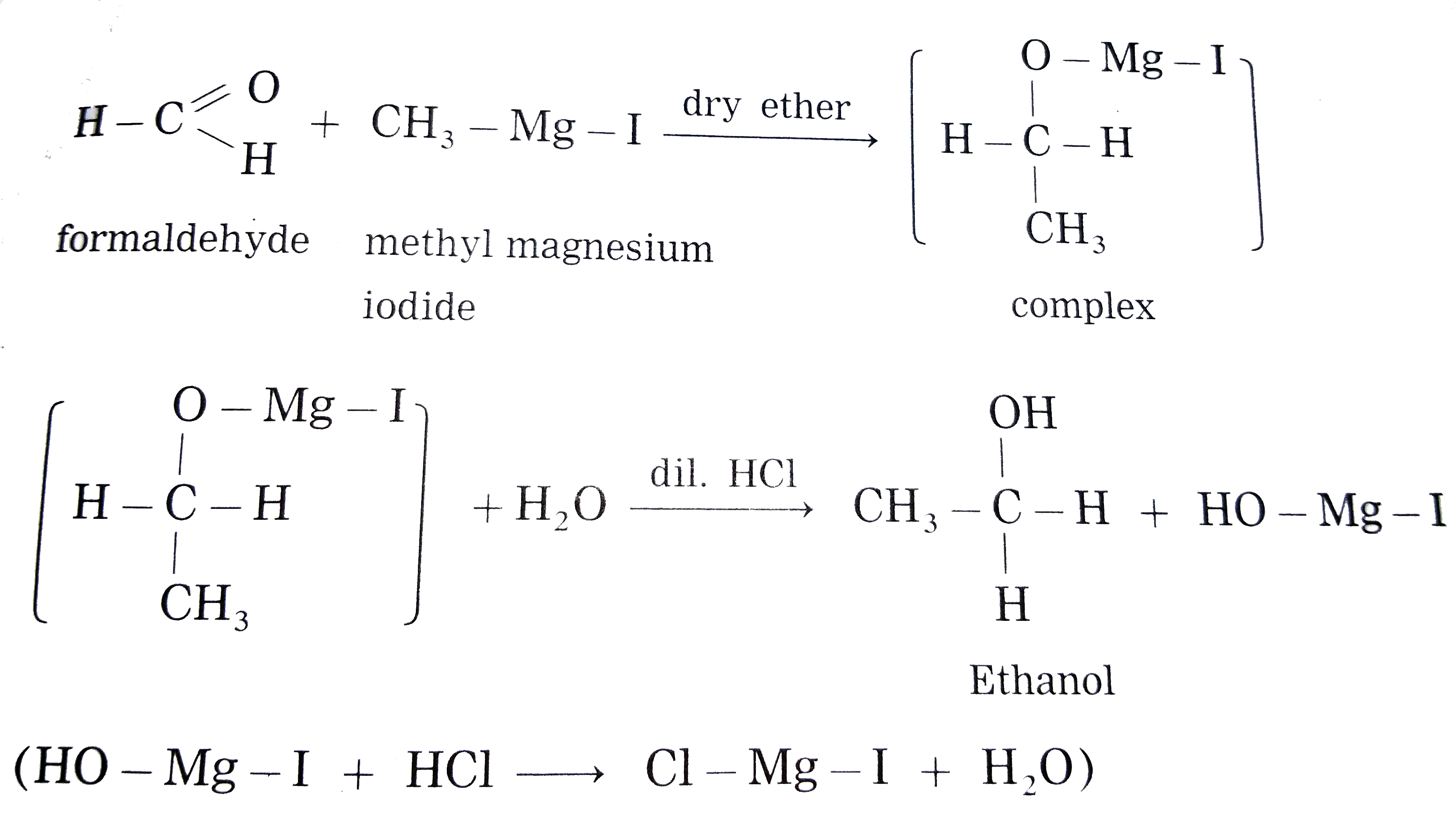
|
|
| 44. |
Formaldehyde reacts with NH_3 to give |
|
Answer» hexamethylenetetramine |
|
| 45. |
Formaldehyde reacts with NH_(3) to form urotropine which has the composition |
|
Answer» `(CH_(2))_(5)N_(5)` |
|
| 46. |
What happens when formaldehyde reacts with ammonia? |
| Answer» SOLUTION :UROTROPINE | |
| 47. |
Formaldehyde reacts with NaOH (50%). Which one pair of products will be obtained? |
|
Answer» `CH_(3)COOH+CH_(3)OH` |
|
| 48. |
Formaldehyde reacts with ammonia to give |
|
Answer» AMINO methane |
|
| 49. |
Formaldehyde reacts with ammonia to form .................. which is used to treat urinary infection. |
| Answer» SOLUTION : UROTROPINE (or) HEXAMETHYLENE tetramine | |
| 50. |
Formaldehyde polymerizes to form glucose according to the reaction 6HCHOiffC_(6)H_(12)O_(6) The theoretically computed equilibrium constant for this reaction is found to be 6xx10^(22). If 1 M solution of glucose dissociates according to the above equilibrium, the concentration of formaldehyde in the solution will be |
|
Answer» `1.6XX10^(-2)M` `K=([C_(6)H_(12)O_(6)])/([HCHO]^(6))i.e.,6xx10^(22)=(1)/([HCHO]^(6))` or `[HCHO]=((1)/(6xx10^(22)))^(1//6)=1.6xx10^(-4)M` |
|