Saved Bookmarks
This section includes 7 InterviewSolutions, each offering curated multiple-choice questions to sharpen your Current Affairs knowledge and support exam preparation. Choose a topic below to get started.
| 1. |
For a first order reaction half life period t(1/2)is independent of initial concentration of its reacting species. What is meant by half life period of a reaction? |
| Answer» SOLUTION :The TIME REQUIRED to reducethe concentration of its initial VALUE is called half life period`t_(1/2)`. | |
| 2. |
For a first order reaction, half life does not depend on............. |
| Answer» SOLUTION :INITIAL CONCENTRATION | |
| 3. |
For a first order reaction, derive expression for the degree of dissociation of the reactant in the exponential form. |
| Answer» SOLUTION :`(X)/(a)=1-e^(-KT)` | |
| 4. |
For a first order reaction -(d[A])/(dt)=K[A]_(0), the reaction is carried out by taking 100mol//L then concentration of A decayed after time (1)/(K) is : |
|
Answer» `53.21 mol//L` `=(100)/(e )=(100)/(2.718)=36.79mol//L` `:.[A]` decayed `=16.21` |
|
| 5. |
For a first order reaction AtoB the reaction rate at reactant concentration of 0.01 M is found to be 2.0xx10^(5)Msec^(-1). The half life period of the reaction is [Give your answere divide by 247] |
|
Answer» |
|
| 6. |
For a first order reaction Ato products 93.75% of A initilly taken (2M), reacts in 80 min, then |
|
Answer» Rate constant is `3.465xx10^(-2)"min"^(-1)` `=2.303/80xx4xx0.3010=0.03466=3.466xx10^(-2)"min"^(-1),rK.[A]=3.416xx10^(-2)xx2=6.93xx10^(-2)` m/min |
|
| 7. |
For a first order reaction (A)to products the concentration of A changes from 0.1 M to 0.025 M in 40 minutes. The rate of reaction when the concentration of A is 0.01 M is |
|
Answer» `3.47xx10^(-4)`M/in |
|
| 8. |
For a first order reaction at 27^(@)C the rato of time required for 75% completion of 25% completion of reaction is |
|
Answer» 3 |
|
| 9. |
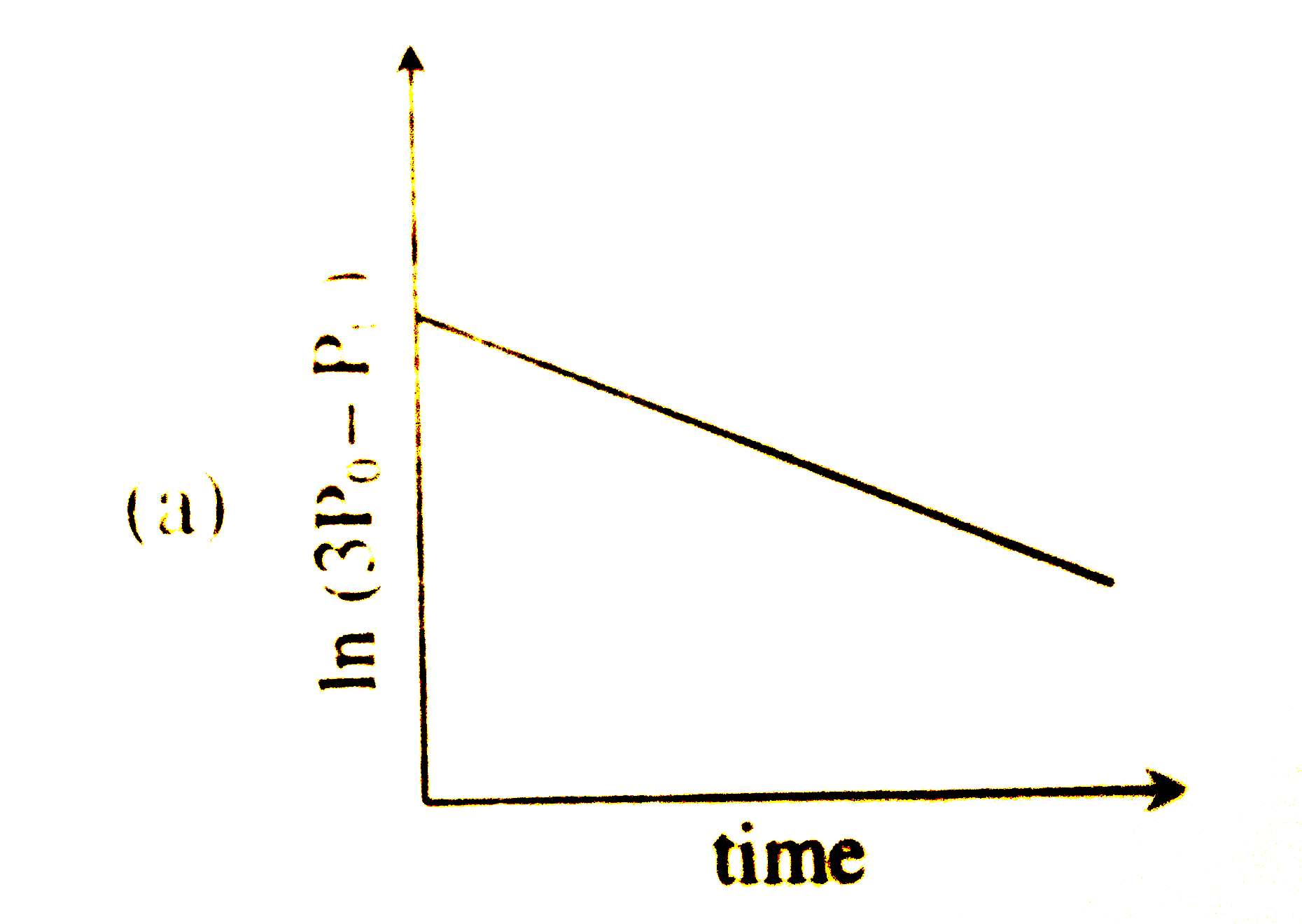
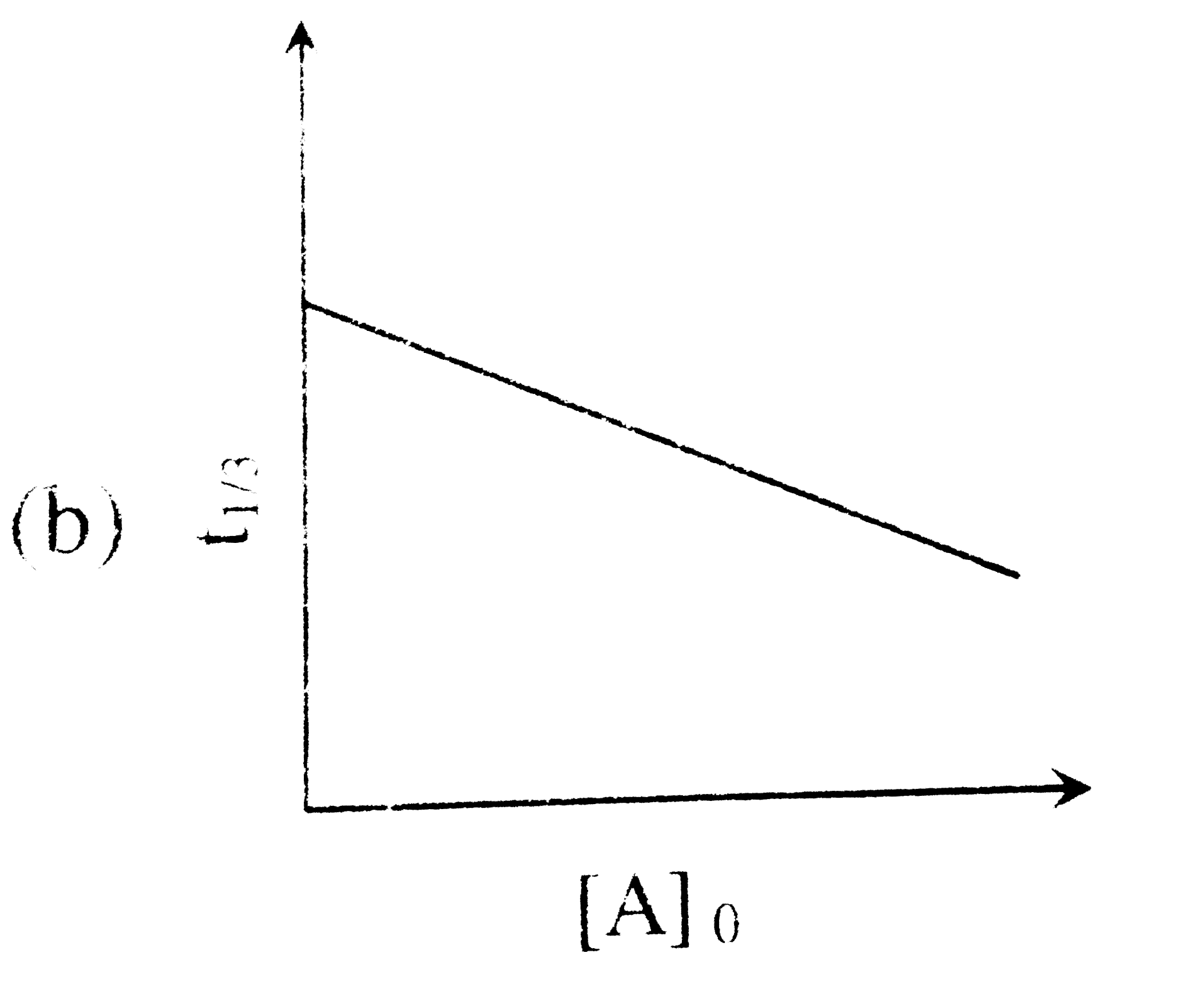
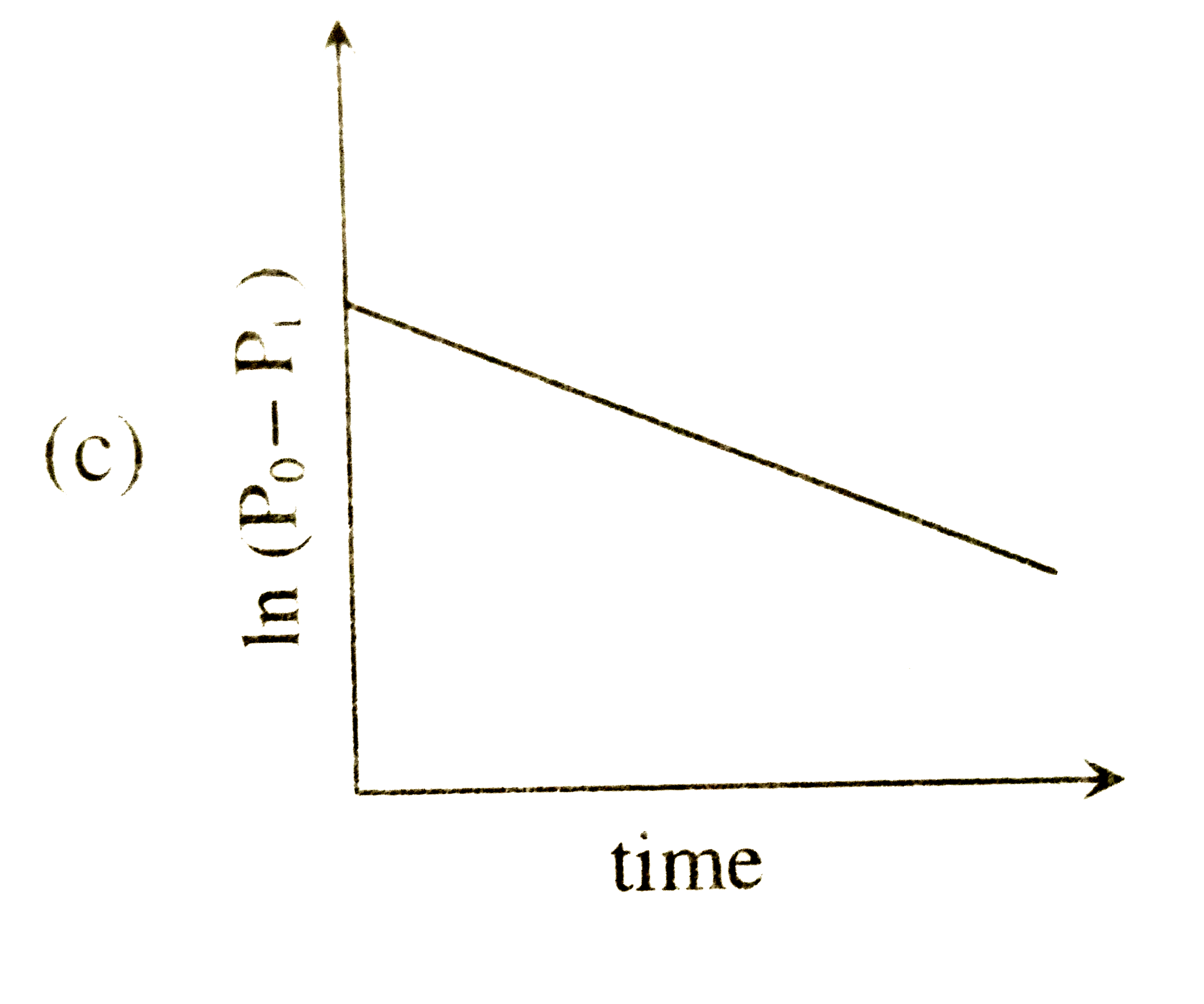
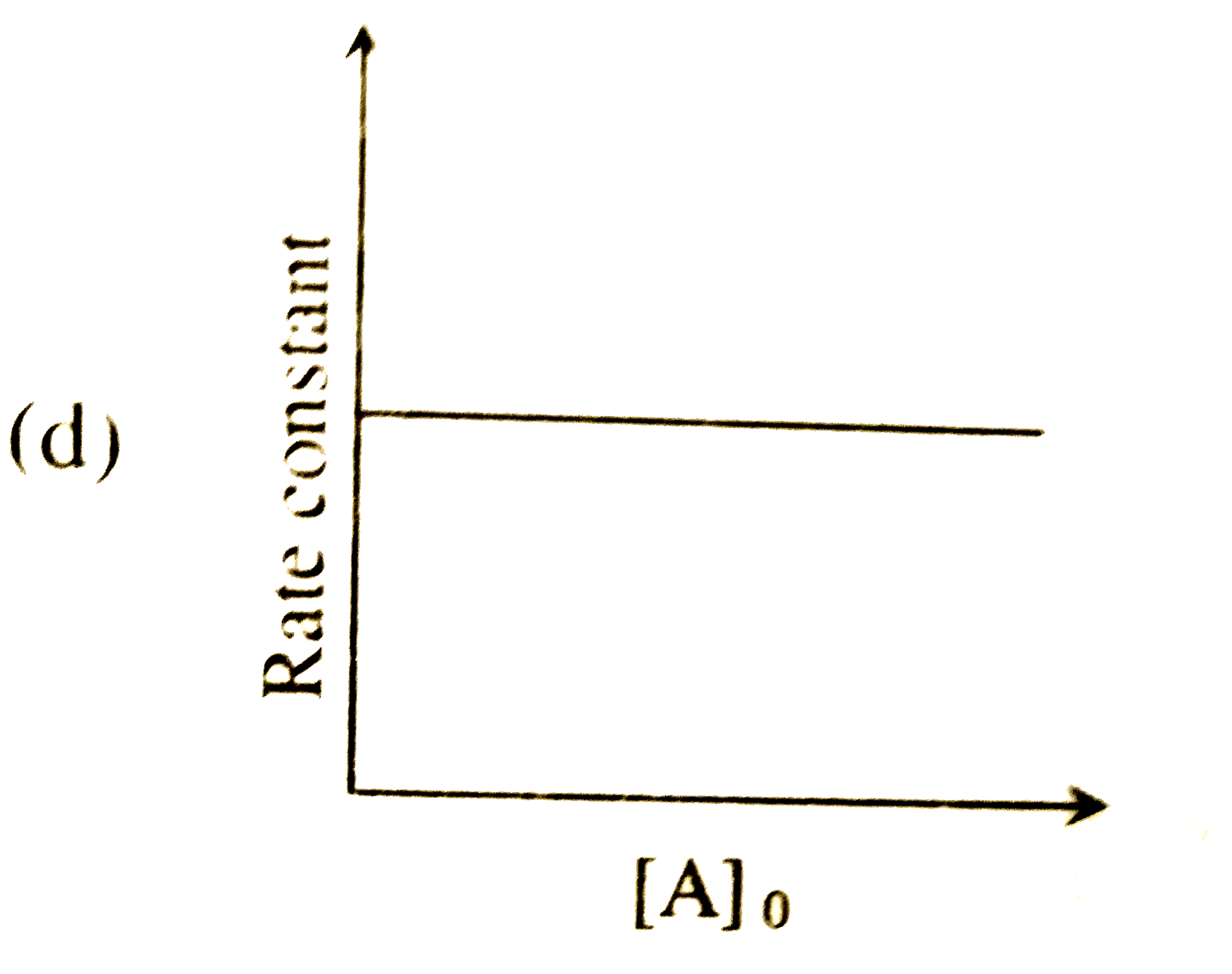
For a first order reaction A(g) to 2B(g) + C(g) at constant volume and 300 K, the total pressure at the beginning (t=0) and at time t and P_(0) and P_(t) respectively, Initially, only A is present with concentration [A]_(0) and t_(1//3) is the required for the partial pressure of A to reach 1//3rd of its initial value. The correct option(s) is are (Assume that all these gases behave as ideal gases) |
|
Answer»
time =0 `P_(0)`  For first order reaction, `t=1/k In P_(0)/(P_(0)-x)` `t=1/k In (P_(0))/(P_(0) - (P_(t)-P_(0))/2)` `=1/k In (2P_(0))/(2P_(0) - P_(t) + P_(0))` `kt = In (2P_(0))/(3P_(0)-P_(t))` `= In 2P_(0) - In(3P_(0)-P_(t))` or `In (3P_(0)-P_(t)) = In 2P_(0)-kt` Graph between in `(3P_(0)-P_(t)) = In 2P_(0)-kt` Graph between in `(3P_(0)-P_(t))` Vs t is a straight line with NEGATIVE slope `therefore` Graph(a) is a correct option. Since rate constant (k) is independent of initial concentration `therefore` graph (d) is also a correct option. |
|
| 10. |
For a first order reaction ArarrB the rate constant is x "min"^(-1) . If the initial concentration of A is 0.01 M, the concentration of A after one hour is given by the expression. |
|
Answer» `0.01e^(-x)` `k=(1/t)ln(([A_0])/([A]))` `e^(kt)=(([A_0])/([A]))` `[A]=[A_0]e^(kt)` In this case `k = x "min"^(-1)and [A_0]=0.01M` `=1xx10^(-2)M` t = 1 HOUR = 60 min `[A]=1xx10^(-2)(e^(-60x))` |
|
| 11. |
For a first order reaction at 27^@C, the ratio of time required for 75% completion to 25% completion of reaction is |
|
Answer» `3.0` |
|
| 12. |
For a first-order reaction, Aoverset(k)toB, the degree of dissociation is equal to |
|
Answer» `e^(-kt)` |
|
| 13. |
For a first order reaction A(g) to 2 B (g) + C(g) at constant volume and 300 K , the total pressure at the beginning (t = 0 ) and at time t are P_(0) and P_(t), respectively , Initially , only A is present with concentration [A]_(0) and t_(1//3) is the time required for the partial pressure of A to reach 1//3^(rd) of its initial value , the correct option (s) is (are) (Assume that all these gases behave as ideal gases) |
|
Answer»
t = 0 `"" P_(0)` t = t `"" P_(0) - P "" 2P "" P` `P_(0) + 2P = P_(t)` `K = (1)/(t)` LN `(P_(0))/(P_(0) - P) = (1)/(t)` ln `(P_(0))/(P_(0) - ((P_(t) - P_(0))/(2))` `K = (1)/(t)` ln `(2P_(0))/(3P_(0) - P_(t)) implies - Kt` + ln `2 P_(0)`= ln `(3P_(0) - P_(t))` and `t_(1//3) = (1)/(K)` ln `(P_(0))/(P_(0)//3) = (1)/(K)` ln 3 = constant RATE constant does not depends on concentration |
|
| 14. |
For a first order reaction A to P , the temperature (T) dependent rate constant (k) was found to follow the equation log k = -(2000) (1)/(T) + 6.0 . The pre-exponential factor A and the activation energy E_(a) , respectively , are |
|
Answer» `1.0 xx 10^(6) s^(-1)` and `9.2 K J mol^(-1)` LN k = ln A `- (E_(a))/(RT)` `2.303` log k = `2.303` log `A - (E_(a))/(RT)` log k `= (-E_(a))/(2.303R) xx (1)/(T) + ` log A `"" … (i)` log k = `-(2000) (1)/(T) + 6 "" … (ii)` On comparing equation (i) and (ii) `(-E_(a))/(2.303R) = -2000` `E_(a) = 2.303 xx 8.314 xx 2000 = 38.29 kJ` M and log `A = 6 implies A = 10^(6)` |
|
| 15. |
For a first order reaction : A(g) rarr B(g) + C(g)+ D(g) Occurring at 1 bar pressure and 300 K if initial volume of the container containing only A is V_(0) and after 10 minutes it is V_(10) then average life of A will be (in minutes) : |
|
Answer» `0.1"LN"(2V_(0))/(3V_(0)-V_(10))` |
|
| 16. |
For a first order reaction A to P, the temperature (T) dependent rate constsant (k) was found to follow the equation logk=-(2000)(1)/(T)+6.0 The per-exponential factor A and the activation energy E_(a), respectively, are |
|
Answer» `1.0xx10^(6)s^(-1)" and "9.2" kJ mol"^(-1)` COMPARING with log `k=log A - E_a/(2*303RT)` `log A=6, i.e., A = 10^(6)s^(-1)" and "E_a/(2*303R)=2000` or `E_a=2000xx2*303xx8*314" J mol"^-1` `= 38294" J mol"^-1 = 38*3" kJ mol"^-1` |
|
| 17. |
For a first order reaction (A) toproducts the concentration of A changes from 0.1M to 0.025M in 40 minutes. The rate of reaction of when the concentration of A is 0.01M is: |
|
Answer» `1.73times10^(-5)M*mi n^(-1)` Rate`=k[A]=3.47times10^(-2)times0.1=3.47times10^(-4)`M/min |
|
| 18. |
For a first order reaction A toproduct the rate of reaction at [A] = 0.2 mol l^(-1) is 1.0 xx 10^(-2) "min"^(-1) . The half life period for the reaction is |
|
Answer» 832 s `t_(1//2) = (0.693)/(0.05)` = 13.86 MINT = `13.86 xx 60 = 831.6` sec . |
|
| 19. |
For a first order reaction : A to nB (with n-possibly fractional), the concentration of the product varies with time as (A_(0) is the concentration of A at time t=0). |
|
Answer» `[B]=nA_(0)(1-E^(-2kt))` |
|
| 20. |
For a first order reaction A to Bthe reaction rate at reactant concentration of 0.01 M is found to be 2.0 xx 10^(-5) mol L^(-1) s^(-1) . The half life period of the reaction is |
|
Answer» SOLUTION :R = k[A] `2 xx 10^(-5) = k xx 10^(-2)` `k= 2 xx 10^(-3) sec^(-1)` `t_(1//2) = (0.693)/(k) = (0.693)/(2 xx 10^(-3)) = (693)/(2) = 347` sec . |
|
| 21. |
For a first order reaction A toB the reaction rate at reactant concentration of 0.01 M is found to be2.0xx10^(-5) M sec^(-1) . The half life period of the reaction is [Give your answer divide by 347]:- |
|
Answer» |
|
| 22. |
For a first order reaction AtoB the reaction rate at reactant concetration of 0.01 M is found to be 2.0xx10^(-5)mol L^(-1)s^(-1). The half life period of the reactionis |
| Answer» Answer :D | |
| 23. |
For a first order reaction A rarr Products, the rate of reaction at [A] = 0.2 M is 10^-2 mol litre^-1 min^-1. The half life period for the reaction is: |
| Answer» Answer :A | |
| 24. |
For a first order reaction A rarr B, A is optically active and B is optically inactive, and following experimental data were observed : |{:("Time","0","60 min",oo),("Optical Rotation",82^(@),22^(@),2^(@)):}| If some impurity, find optical rotation after 2 hours : |
|
Answer» `7^(@)` |
|
| 25. |
For a first order reaction (A) rarr products the concentration of A changes from 0.1 M to 0.025 M in 40 minutes . The rate of reaction when the concentration of A is 0.01 M is : |
|
Answer» `1.73xx10^(-4) M//MIN` `k = (2.303)/(40) "log"(0.1)/(0.025) = 0.03466` Rate =`k[A] = 0.03466xx0.01` `=3.466xx10^(-4) M "min"^(-1)` |
|
| 26. |
For a first order reaction A rarr product with initial concentration x " mol L'^(-1) m has a half life period of 2.5 hours. For the same reaction with initial concentration . (x/2) " mol L"^(-1) the half life is ...... |
|
Answer» `(2.5xx2)` hours `t_(1//2) = (0.693)/K` `t_(1//2)` does not depend on the initial concentration and it remains constant (WHATEVER may be the initial concentration ) |
|
| 27. |
For a first-order reaction |
|
Answer» the degree of dissociation = `(1-e^(-KT))` |
|
| 28. |
For a first order reaction |
|
Answer» the degree of DISSOCIATION is equal to `(1-e^(-kt))` |
|
| 29. |
For a first order reaction , |
|
Answer» The DEGREE of dissociation is equal to `(1 - e^(-kt))` Kt = `log_(e)(1)/((1-alpha)) = -log_(e) (1- alpha) ` or `e^(-kt) = 1 - alpha ` `therefore a = 1 - e^(-kt)` The Arrhenius equation , is `k = AE^(-E_(a)//RT)` Plot of reciprocal concentration of the reactant v/s time is linear . Dimensions of pre-exponential factor 'A' are equivalent to dimensions of K ,which is `T^(-1)` for a first order reaction . |
|
| 30. |
For a first order process, (-Ea)/(RT)value is -23.03, then value of K/A is |
|
Answer» `10^(2.303)` |
|
| 31. |
For a first order polymerisation reaction: nA(g) to A_(n) (g) occuring at constant volume and temperature the half-life of polymerisation of 'A' is 20 min. If the total pressure of system is 2atm at t=0 "and" 1.2 "atm at" t= 20 "min". then the value of 'n' is : |
|
Answer» |
|
| 32. |
For a first order process A toB, rate constant k_1 = 0.693 "min"^(-1) & another first order process Cto D , k_2 = x "min"^(-1). If 99.9% of C to D requires time same as 50% of reaction A toB , value of x? |
|
Answer» 0.0693 |
|
| 33. |
For a first order homogeneous gaseous reaction Ato2B+C, if the total pressure after time t was P_(t) and after a long time (to to oo) was P_(oo) then k in terms of P_(t),P_(oo) and t is |
|
Answer» `k=2.303/tlog((P_(oo))/(P_(oo)-P_(t)))` `P_(0)""0""0` `(P_(0)-x)""2X""x` `0""2P_(0)""P_(0)` So `x=((3Pt-P_(alpha))/6),P_(0)=(P_(alpha))/3,K=2.303/txxlog((P_(0))/(P_(0)-x))=2.303/txxlog[(P_(alpha))/3xx6/(3(P_(alpha)-P_(t)))]` `=2.303/txxlog[(2P_(alpha))/(3(P_(alpha)-P_(t)))]` |
|
| 34. |
For a first order decomposition of N_(2)O_(5)(g) to give NO_(2)(g)and O_(2)(g), what will be the rate constant if at initial instant, after 10 minutes and after a very long time, tolal pressure is 200 mm of Hg, 325 mm of Hg and 450 mm of Hg? |
|
Answer» 0.693min^(-1)` |
|
| 35. |
For a first order chemical reaction : A rarr P. The correct statement(s) is/are : |
|
Answer» The extent of REACTION completed at any time 't' is dependent on initial concentration of the REACTANT. |
|
| 36. |
For a f-orbital the values of m_l are |
|
Answer» `-1,0,+1` |
|
| 37. |
For a diprotic acid, which of the following is true for 1^(st) and 2^(nd) ionization constants (K_(a_(1)) and K_(a_(2))) |
|
Answer» `K_(a_(1)) = K_(a_(2))` The reason for this is that it is more DIFFICULT to remove a positively charged PROTON from a negative ION due to ELECTROSTATIC forces. For e.g., `H_(2)X_((AQ)) overset(K_(a_(1)))hArr H_((aq))^(+) + HX_((aq))^(-)` `HX_((aq))^(-) overset(K_(a_(2)))hArrH_((aq))^(+) + X_((aq))^(2-)` |
|
| 38. |
For a disproportionationreaction the onlycorrect combination is - |
| Answer» Answer :D | |
| 39. |
For a dilute solution , Raoult's law states that: |
|
Answer» The LOWERING of vapour PRESSURE is equle to the MOLE fraction of solute |
|
| 40. |
For a dilute solution, Raoult's law states that: |
|
Answer» The relative LOWERING of vapour pressure is equal to the mole fraction of solute. |
|
| 41. |
For a dilute solution , Raoult.s law states that: |
|
Answer» The LOWERING of vapour pressure is equle to the MOLE fraction of solute |
|
| 42. |
For a dilute solution having molality m of of a given solute in a solvent of mol.wt.M,b.pt. T_(b) and heat of vaporisation per mole DeltaH:[(aT_(b)/(am)]_(mrarr0) is equal to : |
|
Answer» Molal elevation constant of SOLVENT |
|
| 43. |
For a dilute solution of a strong electrolyte, which of the folllowing facts is correct? |
|
Answer» The GRAPH between ` lambda_m` and C is LINEAR 
|
|
| 44. |
For a dilute solution, lowering of vapour pressure prop mole fraction of the solute or, lowering of vapour pressure = K xx mole fraction of the solute, where K is |
|
Answer» a CONSTANT for the solute |
|
| 45. |
For a dilute solution having molality m for a given solute in a solvent of mol. Wt. M,b.pt. T_(b) and heat vaporisation per mole DeltaH, [(delT_(b))/(delm)]_(mrarr 0) is equal to |
|
Answer» Molal elevation constant of solvent |
|
| 46. |
For a dilute solution containing 2.5 g of a non-volatile, non-electrolytic solute in 100 g of water, the elevation in boiling point at 1 atm pressure is 2^(@)C. Assuming concentration of the solute is much lower than the concentration of the solvent, the vapour pressure (mm of Hg) of the solution is (take K_(b)="0.76 K kg mol"^(-1)) |
|
Answer» <P>724 `(p^(@)-p_(s))/(p^(@))=x_(2)=(n_(2))/(n_(1)+n_(2))=(n_(2))/(n_(1))""(" as " n_(2) lt lt n_(1))` `=(w_(2)//M_(2))/(w_(1)//M_(1))` `(760-p_(s))/(760)=(2.5//9.5)/(100//18)=0.047` `or 760-p_(s)=760xx0.047=35.7` `or""p_(s)=724.3mm` |
|
| 47. |
For a dilute solution containing 2.5 g of non-electroyte solute in 100g of water , the elevation in boiling point at 1 atm pressure is 2^(@)C . Assumingconcentration of solute is much lower than the concentration of solvent, the vapour pressure (mm of Hg) of the solution is (take K_(b)=0.76 "mol"^(-1)) |
|
Answer» 724 |
|
| 48. |
For a decomposition reaction, the values of rate constant k at two different temmperature are given below: k_(1)=2.15xx10^(-8)"L mol"^(-1)s^(-1) at 650 K k_(2)=2.39xx10^(-7)"L mol"^(-1)s^(-1) at 700 K Calculate the value ofactivation energy for this reaction. [R=8.314JK^(-1)"mol"^(-1)] |
|
Answer» Solution :Substitute the values in the Arrhenius equation given below: `"log"(k_(2))/(k_(1))=(E_(a))/(2.303R)[(T_(2)-T_(1))/(T_(1)T_(2))]` `"or log"(2.39xx10^(-7))/(2.15xx10^(-8))=(E_(a))/(2.303xx8.314)[(700-650)/(650xx700)]` `"ORLOG "11.116=(E_(a))/(19.147)xx(50)/(650xx700) or 1.0461=(E_(a))/(19.147)xx(50)/(455000)` or`E_(a)=(1.0461xx19.147xx455000)/(50)=182270J or 182.27kJ` |
|
| 49. |
For a dilute solution containing 2.5 g of a non-volatile non-electrolyte solution in 100g of water, the elevation in boiling point at 1 atm pressure is 2^(@)C. Assuming concentrationof solute is much lower than the concentration of solvent, the vapour pressure (mm of Hg) of the solution is: (take k_(b) = 0.76 K kg mol^(-1)) |
|
Answer» 724 `2=0.76xxm ""IMPLIES""m=2/0.76` `m=(w_(2)xx1000)/(M_(2)xxW_(1)("in grams"))=2.5/(M_(2)xx100)xx1000` `2/0.76=(2.5xx10)/(M_(2))impliesM_(2)=(2.5xx10)/2xx0.76` `(p_("SOLVENT")^(@)-p_("solutte"))/(p_("solvent")^(@))=x_("solute")` `p_("solvent")^(@)=1atm=760` MM Hg `(760-p_("solvent")^(@))/760=(2.5//M_(2))/(100//18)` `760-p_("solute")=(2.5xx2)/(2.5xx10xx0.76)xx18/100xx760` `760-p_("solute")=36impliesp_("solute")=724` mm hg |
|
| 50. |
For a dilute solution containing 2.5 g of a non-volatile non-electrolyte solute in 100 g of water, the elevation in boiling point at 1 atm pressure is 2^(@)C. Assuming concentration of solute is much lower than the concentration of solvent, the vapour pressure (mm of Hg) of the solution is (take K_(b)=0.76"K kg mol"^(-1)) |
|
Answer» Solution :`Delta T_(b)=K_(b)xx m` `2=(0.76xx2.5//M)/(0.1)rArr M=9.5` Since solute is present in less amount `(P^(@)-P_(s))/(P^(@))=(n)/(N)` `(760-P_(s))/(760)=(2.5//9.5)/(100//18)rArr P_(s)=724` |
|