Saved Bookmarks
This section includes 7 InterviewSolutions, each offering curated multiple-choice questions to sharpen your Current Affairs knowledge and support exam preparation. Choose a topic below to get started.
| 1. |
Following reactions can occur at cathode during the electrolysis of aqueous silver nitrate solution using Pt electrodes : Ag^(+)""_((aq)) ""^(+e^(-))to Ag""_((s)),E^(@)=0.80V H^(+)""_((aq)) ""^(+e^(-))to 1/2H_(2(g)),E^(@)=0.00V On the basis of theri standars electrode protential values, which reaction is feasible at cathode and why ? |
| Answer» Solution :`Ag^(+)+E^(-)TOAG(s).` This reaction is feasible because `E^(@)` value for `Ag^(+)//Ag` is more than that of `H^(+)//H_(2).` Higher the value of `E^(@),` more easy it will be to converty ION inot its FREE STATE. | |
| 2. |
Following reaction(s) is/are involved in thermite process : |
|
Answer» `3Mn_(3)O_(4) + 8Al RARR 9Mn + 4Al_(2)O_(3)` |
|
| 3. |
Following reaction takes place in one step : 2" NO "(g)+O_(2)(g)iff2" NO"_(2)(g) How will the rate of the above reaction change if the volume of the reaction vessel is diminished to one-third of its original volume ? Will there be any change in the order of the reaction with reduced volume ? |
|
Answer» SOLUTION :RATE `=k[NO]^(2)[O_(2)]` Suppose initially, moles of NO = a, moles of `O_(2)=B`, volume of the vessel = V L. Then `[NO]=(a)/(V)M,""[O_(2)]=(b)/(V)M:."Rate"(r_(1))=k((a)/(V))^(2)((b)/(V))=k(a^(2)b)/(V^(3))""...(i)` New volume = `V//3`. `:." New concentrations ":[NO]=(a)/(V//3)=(3a)/(V),[O_(2)]=(b)/(V//3)=(3b)/(V)` `:." New rate"(r_(2))=k((3a)/(V))^(2)((3b)/(V))=(27ka^(2)b)/(V^(3))""...(ii)` `:.(r_(2))/(r_(1))=27" or "r_(2)=27r_(1)," i.e., rate becomes 27 times"` There is no effect on the order of REACTION. |
|
| 4. |
Following reaction is occurred in button cell. (i) Ag_(2)O+H_(2)O +2e^(-)to2Ag+2OH^(-) (ii) Zn to Zn^(2+)+2e^(-) then calculate DeltaG^(Theta) [E_(Zn^(2+)|Zn)^(Theta)=-0.76V,E_((Ag^(+)|Ag))^(Theta)=0.34V |
|
Answer» |
|
| 5. |
Following reaction occurring in an automobile .^(2)C_(8)H_(18)(g)+25O_(2)(g)rarr16CO_(2)(g)+18H_(2)O(g). The sign of DeltaH, DeltaS and DeltaG would be |
|
Answer» `+, -, +` |
|
| 6. |
Following reaction is of the type R-O-R' + HBr overset"Cold"to R-Br +R' -OH If R' is 3^@ alkyl group and R is 1^@ alkyl group , then |
|
Answer» `S_N` 1 with TERTIARY alkyl group |
|
| 7. |
Following passage describes charcterstics of colloids. Answer the questions at the end of it. Lyophilic colloidal sols are much more stable than lyophobic colloidal sols. This is due to the extensive solvation of lyophilic colloidal sols, which forms a protective layer outside it and thus prevents it from forming associated colloids. Lyophillic colloidal sols also protect lyophobic colloidal sols from precipition by the action of electrolytes. This is due to formation of a protective layer by lyophilic sols outside lyophobic sols. Lyophilic colloidal sols are called protective sols. Gelatin (lyophilic) protects gold sol (lyophobic) from coagulaion on the addition of sodium chloride solution. Protective powers of different colloidal sols are measured in terms of 'gold number' (Zigmody). It is defined as the amount of protective sol in milligrams that prevents the coagulation of 10 mL of a given gold sol on adding 1 mL of 10 percent sodium chloride. Thus smaller the gold number of a lyophillic sol, the greater is the protective power. [AgI]I^(-) collodial sol can be coagulated by the addition of a suitable cation. 1 mol of [Agl]I^(-) requires mol of AgNO_3, Pb(NO_3)_2 and Fe(NO_3)_3 as |
|
Answer» `1, 1, 1` |
|
| 8. |
Following problem is based on thermodynamic law. Answer the questions given at the end of it. The second law of thermodynamics is a fundamental law of science. In this problem we consider the thermodynamics of an ideal gas, phase transition and chemical equilibrium. Three moles of CO_(2) gas expands isothermally (in thermal contact with the surroundings, temperature =15^(@) C) against a fixed external pressure of 1.00 bar. The initial and final volumes of the gas are 10.0 L and 30.0 L, respectively. Change in entropy of the universe is |
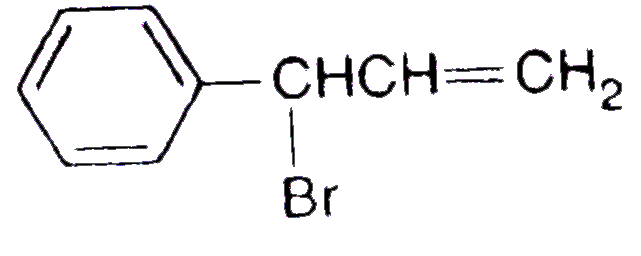
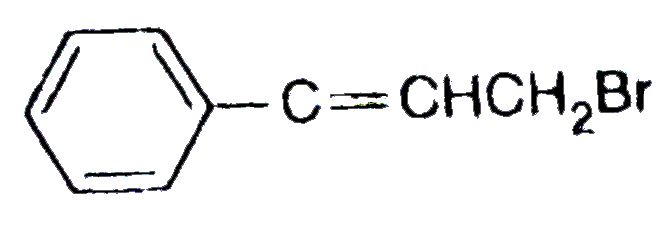
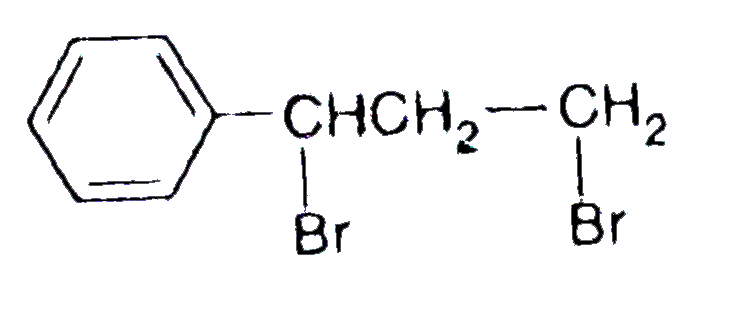
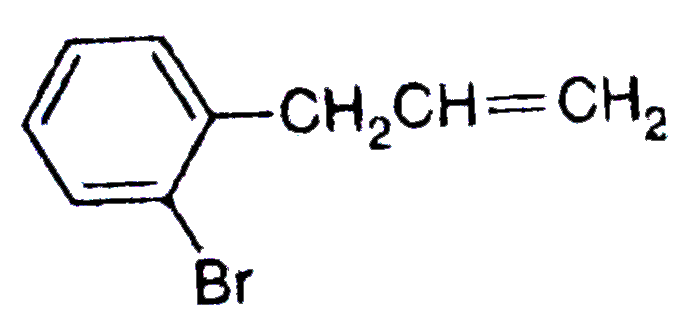
|
Answer» `34.34 JK^(-1)` |
|
| 9. |
Following passage describes charcterstics of colloids. Answer the questions at the end of it. Lyophilic colloidal sols are much more stable than lyophobic colloidal sols. This is due to the extensive solvation of lyophilic colloidal sols, which forms a protective layer outside it and thus prevents it from forming associated colloids. Lyophillic colloidal sols also protect lyophobic colloidal sols from precipition by the action of electrolytes. This is due to formation of a protective layer by lyophilic sols outside lyophobic sols. Lyophilic colloidal sols are called protective sols. Gelatin (lyophilic) protects gold sol (lyophobic) from coagulaion on the addition of sodium chloride solution. Protective powers of different colloidal sols are measured in terms of 'gold number' (Zigmody). It is defined as the amount of protective sol in milligrams that prevents the coagulation of 10 mL of a given gold sol on adding 1 mL of 10 percent sodium chloride. Thus smaller the gold number of a lyophillic sol, the greater is the protective power. 0.025g of starch sol is required to prevent coagulation of 10ml gold sol when ImL of 10% Nacl solution is present. What is gold number of starch sol |
|
Answer» 0.025 |
|
| 10. |
Following options contain the pairs of the name of reaction and the name of final product, which pair is incorrect ? |
|
Answer» Kolbe-Smitt reaction 2-Hydroxy BENZOIC acid |
|
| 11. |
Following passage describes charcterstics of colloids. Answer the questions at the end of it. Lyophilic colloidal sols are much more stable than lyophobic colloidal sols. This is due to the extensive solvation of lyophilic colloidal sols, which forms a protective layer outside it and thus prevents it from forming associated colloids. Lyophillic colloidal sols also protect lyophobic colloidal sols from precipition by the action of electrolytes. This is due to formation of a protective layer by lyophilic sols outside lyophobic sols. Lyophilic colloidal sols are called protective sols. Gelatin (lyophilic) protects gold sol (lyophobic) from coagulaion on the addition of sodium chloride solution. Protective powers of different colloidal sols are measured in terms of 'gold number' (Zigmody). It is defined as the amount of protective sol in milligrams that prevents the coagulation of 10 mL of a given gold sol on adding 1 mL of 10 percent sodium chloride. Thus smaller the gold number of a lyophillic sol, the greater is the protective power. Gold number of haemoglobin is 0.03. Hence, 10 mL of gold sol will require haemoglobin so that gold is not coagulated by ImL of 10% NaCl solution |
|
Answer» 0.03 MG |
|
| 12. |
Followingmechanism has been proposed for a reaction , |
|
Answer» `r=K[A]^2[B]` |
|
| 13. |
Followingmechanism has been proposed for a reaction , ,The rate law expression for the reaction |
|
Answer» `r=K[A]^2[B]` |
|
| 14. |
Following is the titration curve of CH_3 COOHagainst NaOH added with phenolphthalein as the indicator. K_("in") value of phenolphthalein is 4.0 xx 10^(10) Choose the incorrect statement. |
|
Answer» It begins to change colour from the pH 9.4. thus, it isthe equivalencepointpH .colourchangestartsfrom`(pK_(I n) -1)` andcompleteat `(pK_(I n )+1)` |
|
| 15. |
Following is the substitution reaction in which -CN replaces -Cl. R-Cl+underset("alcoholic")(KCN)underset(Delta)toR-CN+KCl To obtain propanonitrile,R-Cl should be |
|
Answer» CHLOROETHANE `CH_(3)CH_(2)Cl+underset(("Aalcoholic"))(KCN)underset(DELTA)tounderset(("propanonitrile"))(CH_(3)CH_(2)CN)+KCL`. |
|
| 16. |
Following is the substitution reaction in which -CN is replaced by - Cl underset("alconolic ")(R-Cl + K - CN) overset(Delta)(to)R - CN + KClTo obtain propane nitrite, R – Cl should be |
|
Answer» CHLORO ethane 
|
|
| 17. |
Following is the graphical presentation of volumes occupied by different gases at S.T.P. Which is/are not placed at correct position? |
|
Answer» `H_(2), He` 2 g of `H_(2)` at S.T.P. = 22.4 L 1 g of `H_(2)` at S.T.P. = 11.2 L 4 g of He at S.T.P. = 22.4 L 17 g `NH_(3)` at S.T.P. = 22.4 L 3g of `NH_(3)` at S.T.P. = 3.95 L 16 g of `CH_(4)` at S.T.P. = 22.4 L 4 g of `CH_(4)` at S.T.P. = 5.6 L |
|
| 18. |
Following is hydrated maximum at the position At which position the following compound will be maximum hydrated? |
|
Answer» 1 |
|
| 19. |
Following is first order reaction: N_(2)O_(5) ("solution") to2NO_(2) ("solution")+(1)/(2)_(O_(2)(g))In which CCl_(4) is a solute .It is k=5.0xx10^(-4)S^(-1) The concentration of N_(2)O_(5) in initial is 0.25 mol L^(-1) (i)What will be the rate of reaction initially? (ii)Calculate half life (t_(1)/(2)) (iii)How much time require to compute 75 % reaction ? (iv)Calculate the concentration of N_(2)O_(5) and NO after 30 min . |
|
Answer» SOLUTION :(i)`1.25xx10^(-4)` mol `L^(-1) s^(-1)` (ii) `t_((t)/(2))=1386s` (iii) 2773 s (IV) `[N_(2)O_(5)]=0.1 mol L^(-1)` and `[]NO_(2)=0.30 mol L^(-1)` |
|
| 20. |
Following is a first order gas phase reaction: A_((g))toB_((g))+C_((g)).At t time ,total pressure =p_(t) and partial pressure of A=p_(A) atm.So,derive the integrated rate equation for this reaction . |
|
Answer» <P> Solution :Suppose,the partial pressure of A,B and C are `p_(A),P_(B)` and `p_(c)` respectively so,`p_(t)=p_(A)+p_(B)+p_(C)`Ifx atm be the decrease in pressure of A at time t and one MOLE each of B and C is being formed,the increase in pressure of B and C will also be x atm each. These expression is in following equation  So,total pressure (`p_(i)`-x+x+x)=`p_(t)` `therefore p_(i)+x=p_(t)` `therefore x=(p_(i)-p_(i)` atm) Thus at equilibrium `p_(A)=(p_(i)-x)` atm At initially t=0 time `p_(i)=[R]_(0)` For FIRST order reaction `k=(2.303)/(t)` LOG `([R]_(0))/([R]_(t))` `therefore k=(2.303)/(t)` log `(p_(i))/((2p_(i)-p_(i)))` |
|
| 21. |
Following ions are given : Cr^(2+), Cu^(2+), Cu^(+), Fe^(2+),Fe^(3+),Mn^(3+) Identify the ion which is (i) a strong reducing agent. (ii) unstable in aqueous solution. (iii) a strong oxidising agent. Give suitable reason in each. |
|
Answer» Solution :(i) `Cr^(2+)` is a strong reducing agent because `E_(Cr^(3+)//Cr^(2+)=-0.41 V.)^(o)` The values with other metal IONS are positive. (ii) `Cu^(+)` ion is unstable in aqueous solution because the ENTHALPY of hydration `Cu^(+)` ion is very small. (iii) `Cu^(2+)` is a strong oxidising agent because it has a tendency to GET REDUCED with `E^(o)` value of `+0.34` V. |
|
| 22. |
Following interconversion was done by Vandana and Upasana in ICL(International chemical Laboratory) New York. HC-=C-Hoverset(?)rarr DC-=C-CH_(2)-CH_(2)-OH Vandana's method : (P) CH_(3)MgBr (1 aq.) "followed by" " and " NH_(4)Cl (Q)CH_(3)MgBr(1eq.) followed by DOD. UPASANA's method (P) CH_(3)MgBr(excess)(Q)Cl-CH_(2)CH_(2)-Cl (R)Aq.KOH(S)D_(2)O Find out the correct statement(s) based on above formation. |
|
Answer» VANDANA's method is correct and upasana's method is wrong |
|
| 23. |
Following graphs are obtained when different gases are subjected to change in pressure at constant temperature. Identify the option which has correctly matched gas wth the graph. |
|
Answer» `1 rarr O_(2), 2 rarr H_(2), 3 rarr He` |
|
| 24. |
Following gases have equal masses at the same temperature, pressure and volume. The maximum work is done by ________________. |
|
Answer» oxygen |
|
| 25. |
Following flow diagram represents the extraction of aluminium from bauxite, Coke powder is spreaded over the molten electrolyte to: |
|
Answer» PREVENT the loss of HEAT by rediation from the surface. |
|
| 26. |
Following flow diagram represent the extraction of aluminium form bauxite. The purpose of adding cryolite is : |
|
Answer» To increase the electrical conductivity of pure aluminium |
|
| 27. |
Following flow diagram represent the extraction of aluminium form bauxite. Select the incorrect statement. |
|
Answer» Bauxite is purified by Hall's , Serpeck's and Baeyer's processes (A)Red bauxite CONTAINING the impurity of oxide of iron is removed by using Hall's and Baeyers methods while white bauxite containing the impurity of silica is removed by using serpeck's method. (B)`Na_3AlF_6and CaF_2` lowers th melting point and increase the electrical conductivity of molten `Al_2O_3` (C )`2Al(OH)_3underset("In absence of air")overset(Delta)to Al_2O_3+3H_2O(g)darr`. It is CALLED as calcination process. |
|
| 28. |
FollowingequationillustratesC_6 H_5 Cl+ 2 NaOHunderset( 200a t m ) overset( 200-250^@ C ) toC_6 H_5 Ona + H_2 O |
|
Answer» DOW's PROCESS |
|
| 29. |
Following data is known about melting of a compound AB. DeltaH=9.2 kJ mol^(-1), DeltaS=0.008 kJ K^(-1) mol^(-1). Its melting point is |
| Answer» Solution :`T_(m)=(DeltaH_("FUSION"))/(DeltaS_("fusion"))=(9.2)/(0.008)=1150 K`. | |
| 30. |
Following data is obtained for the reaction, N_(2)O_(5) to 2NO + 1/2O_(2) a) Show that the reaction is of first order b) Calculate the half life period. |
|
Answer» Solution :a) For first ORDER reaction `k=2.303/t log a/(a-x)` `k_(1) = 2.303/(300s) (log) ([1.6 xx 10^(-12)])/([0.8 xx 10^(-2)])= (2.303)/(300s) xx LOG2 = 2.303/(300s)xx (0.3010) = 2.3 xx 10^(-3)`s `k_(2)= (2.303)/(600s)(0.6021) = 2.3 xx 10^(-3)`s Since the magnitude of the RATE constant reamains the same, the reaction is of first order. b) `t_(1//2) = 0.693/k = 0.693/(2.3 xx 10^(-3)s) = 301.30`S |
|
| 31. |
Following compounds are given to you: 2-bromopentane, 2-bromo-2-methylbutane, 1-bromopentane (iii) Write the compound which is most reactive towards beta-elimination reaction. |
| Answer» SOLUTION :2-bromo-2-methylbutane is most reactive towards `BETA` elimination REACTION. This is because tertiary ALKYL halides on dehydrohalogenation form most SUBSTITUTED alkene. | |
| 32. |
Following compounds are given to you:2-Bromopentane, 2-Bromo-2-methylbutane, 1-Bromopentane (i) Write the compound which is most reactive towards S_(N)2reaction. (ii) Write the compound which is optically active. (iii) Write the compound which is most reactive towards beta-elimination reaction. |
|
Answer» Solution :`underset("2-Bromopentane") (CH_(3)- CH_(2) - CH_(2) - underset(H) underset(|)overset(Br) overset(|) C -CH_(3)) underset("2 -Bromo-2-methylbutane") (CH_(3) - CH_(2) - underset(CH_(3))underset(|)overset(Br)overset(|)C - CH_(3)) underset("1-Bromopentane") (CH_(3) - CH_(2) - CH_(2) - CH_(2) - CH_(2) - Br) ` (i) 1-Bromopentane is most REACTIVE towards SN2 reaction because it is a primary ALKYL halide. (II) Compound 2-Bromopentane is optically active because it contains an asymmetric carbon atom. `CH_(3) - CH_(2) - CH_(2) - underset(H) underset(|) overset(Br) overset(|)(C^(***)) - CH_(3) ` (iii)2-Bromo-2-methylbutane is most reactive towards b-elimination because it gives the alkene with greatest number of alkyl GROUPS attached to the double bond. `CH_(3) - CH_(2) - underset(CH_(3))underset(|) overset(Br) overset(|)C - CH_(3) overset("Alc.KOH") to CH_(3) - CH = underset(CH_(3)) underset(|) C - CH_(3) ` |
|
| 33. |
Following compounds are given (i) CH_(3)CH_(2)OH (ii) CH_(3)COCH_(3) (iii) CH_(3)-underset(CH_(3))underset(|)(C)HOH (iv) CH_(3)OH |
|
Answer» (i), (iiii) and (iv) |
|
| 34. |
Following compounds are given 1.CH_(3)CH_(2)OH 2. CH_(3)COCH_(3) 3.CH_(3)-underset(CH_(3))underset(|)CHOH 4.CH_(3)OHWhich of the above compound (s) on,beingwarmed with iodine solution and NaOH, will give iodoform |
|
Answer» 1,3 and 4 |
|
| 35. |
Following compounds A and B have similar structure with delocalization of pi-electrons system. (A)(PNCl_(2))_("x/2")(B)(CH)_(x) If value of x is 6, then calculate value of "P+Q", where 'P' is total no. of sigma-bonds in compounds A and B and 'Q' is total no. of pi bonds in compounds A and B. |
Answer» 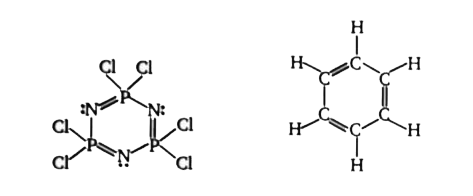
|
|
| 36. |
Write the common and IUPAC names of (i) CH_3-CH=CH-CHO (ii) CH_3-CH(OH)-CH_2-CHO (iii) (CH_3)_2C(OH)CH_2CH_3. |
|
Answer» i and II |
|
| 37. |
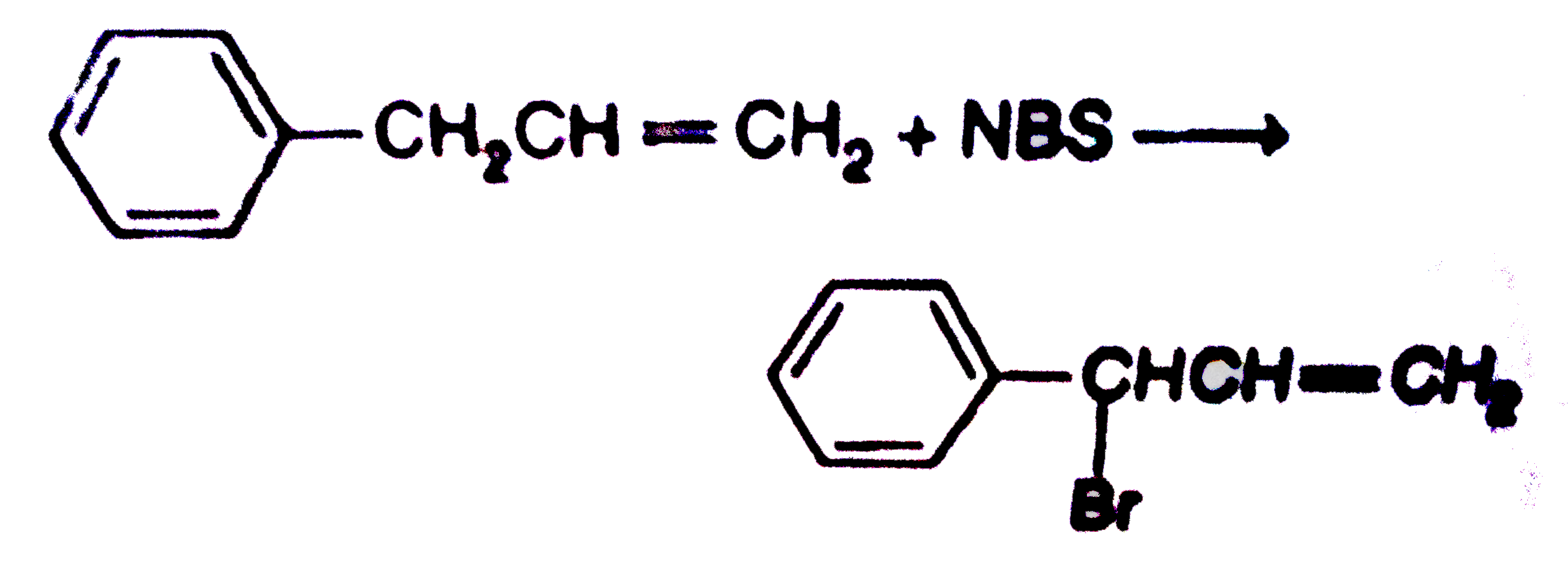
Following compound is treated with NBS: Compound formed A is |
|
Answer»
|
|
| 38. |
Following compound can be named as CH_3-O-(CH_2)_4CH_3 |
|
Answer» 3-methoxypentane |
|
| 39. |
Following cell has EMF 0.7995 V . Pt| H_(2) (1) atm) |HNO_(3) (1M)|| AgNO_(3) (1 M)| Ag If we add enough KCl to Ag cell so that the final Cl^(-) is 1 M . Now the measured emf of the cell is 0.222 V . The K_(sp) of AgCl would be - |
|
Answer» `1 xx 10^(-9.8)` `E = E^(@) - (0.0591)/(2) "log" ([H^+]^(2))/(P_(H_(2)) xx [Ag^(+)]^(2))` `0.222 = 0.7995 - (0.0591)/(2) "log" (1)/([Ag^(+)]^(2))` `[Ag^(+)] = 10^(-9.8)` `K_(SP) = [Ag^(+)] [CL^(-)] = (10^(-9.8)) xx (1) = 10^(-9.8)` |
|
| 40. |
Following are two first order reactions with their half times given at 25^(@)C A overset(t_(1//2) = 30 "min")(to) Products B overset(t_(1//2) = 40 "min") (to)Products The temperature coefficients of their reaction rates 3 and 2 , respectively , between 25^(@)C and 35^(@)C . if the above two reactions are carried out taking 0.4M of each reactant but at different temperatures 25^(@)C for the first reaction and 35^(@)C for the second reaction , find the ratio of the concentration of A and B after an hour |
|
Answer» 0.4 M of `B overset(20 "min")(to) 0.2M overset(20 "min") (to) 0.1 M overset(20 "min")(to) 0.05` (for B) `"("(-d[B])/(dt)` will be DOUBLED and hence `t_(1//2)` will be halved) `THEREFORE ([A])/([B]) = 2` |
|
| 41. |
Following beta ketoacid will not undergo decarboxylation on heating Give reasons. |
Answer» Solution :The carbon at bridge HEAD position cannot be `SP^(3)` hybridizedaccoding to Bredt.s RULE. This rule is violated if the give `beta-` ketoacid undergoes decarboxylation on heating. 
|
|
| 42. |
Following are the values of E_(a) and DeltaH for three reactions carried out at the same temperature : I : E_(a) =20 kJ mol^(-1), DeltaH =-60 k J mol^(-1) II : E_(a)=10 kJ mol^(-1), DeltaH =-20 kJ mol^(-1) III: E_(a) =40 kJ mol^(-1) , DeltaH =+15 kJ mol^(-1) If all the three reaction have same frequency factor then fastest and slowest reations are : |
|
Answer» `{:("FASTEST",,"Slowest"),(I,,II):}` |
|
| 43. |
Following are the transition metal ions of3d series : Ti^(4+),V^(2+), Mn^(3+), Cr^(3+) (Atomci number : Ti = 22, V = 23 , Mn = 25 , Cr = 24) Anser the following : (i) Which ion is most stable in aqueous solution and why ? (ii) Whichion is a strong oxidizing agent and why ? (iii) Which ion is colourless and why ? |
|
Answer» Solution :(i) Their electronic configuration are `:` `Ti^(4+)= 1s^(2) 2s^(2) 2p^(6) 3s^(2) 3p^(6)` `V^(2+) =1s^(1)2s^(2)2p^(6) 3s^(2) 3p^(6) 3d^(3)` `Cr^(3+) = 1s^(2) 2s^(2) 2p^(6) 3s^(2) 3p^(6) 3d^(3)` `Mn^(3+) =1s^(2) 2s^(2) 2p^(6) 3s^(2) 3p^(6) 3d^(4)` Thus , `Ti ^(4+)` is the most STABLE because it has noble gas configuration. (ii) Oxidizing agent is the substance which itself is reduce most easily, i.e., can gain ELECTRON easily. `V^(2+)` and `Cr^(3+)` are also stablebecause they have filled `t_(2g)` level (i.e., `t_(2g)^(3))` discussed in unit 9. Thus, `Mn^(3+)` can gain electron easily. Moreover `Mn^(2+)` is more stable than `Mn^(3+)` . Hence, `Mn^(3+)` is the strongest oxidizing agent. (iii) Ions are COLOURED if they have incompletely filled d-orbitals. Those with fully - filled or empty d-orbitals are coloureless . As` Ti^(4+)` has empty d-orbitals, hence it is colourless. |
|
| 44. |
Followingare the reaction and conclusions related to radioactive disintegration with initial moles of each species being 10. |
Answer» SOLUTION :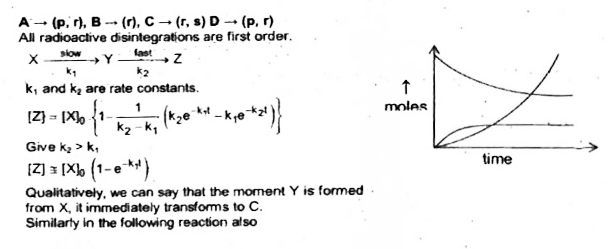 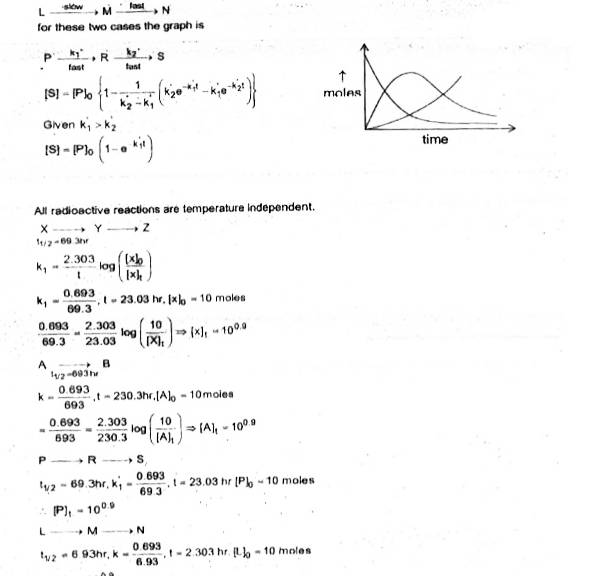
|
|
| 45. |
Following are the events taking place to explain adsorption theory I : Desorption II : Diffusion of the reactants along the surface III : adsorption of the reactants IV : formation of the activated surface complex These events are taking place in the following order |
|
Answer» I, II, III, IV |
|
| 46. |
Following are the atoms having the number of neutrons and protons as given below : Select correct conclusion (s) : |
|
Answer» A , B ANDC, are isotopes for isotones .n. is same , for isodiapheres (A - 2Z) is same |
|
| 47. |
Following are neutral oxides except ....... |
|
Answer» `N_2O` |
|
| 48. |
Following are equimolal (=equimolar) aqueous solutions. (A) 1 m glucose (B) 1 m NaCI © 1 m BaCI_(2)(D) 1 m Na_(3)PO_(4) € 1 m benzoic acid Assume 100%ionisation in B, C, D and 100% dimer formation in E, arrange the following in increasing (i)boiling point (ii) freezing point (iii) osmotic pressure |
Answer» Solution : (i) Boiling point of solution `T_(B)=T_(b)+(DeltaT_(b))=T_(0)+i m K_(b)` Greater the value of more is the boiling point Increasing order of boiling point is : `EltAltBltCltD` (ii) Freezing point of solution `T_(f)=T_(0)=im K_(f)` Greater the volume of i, LESSER is the freezing point: `DltCltBltAltE` Osmotic PRESSURE of solution `pi=i` CRT Greater the value of i more is the osmotic pressure. Increasing order of osmotic pressure is : `EltAltBltCltD`. |
|
| 49. |
Following are equimolal (=f equimolar) aqueous solutions (A) 1 m glucose (B) 1m NaCl (C) 1m BaCl_(2) (D) 1m Na_(3)PO_(4) (E) 1m benzoic acid. assume 100% ionisation in B,C,D and 100% dimer formation in E arrange them in increasing (1) boiling point, (2) freezing point, (3) osmotic pressure, (4) vapour pressure.\ |
Answer» 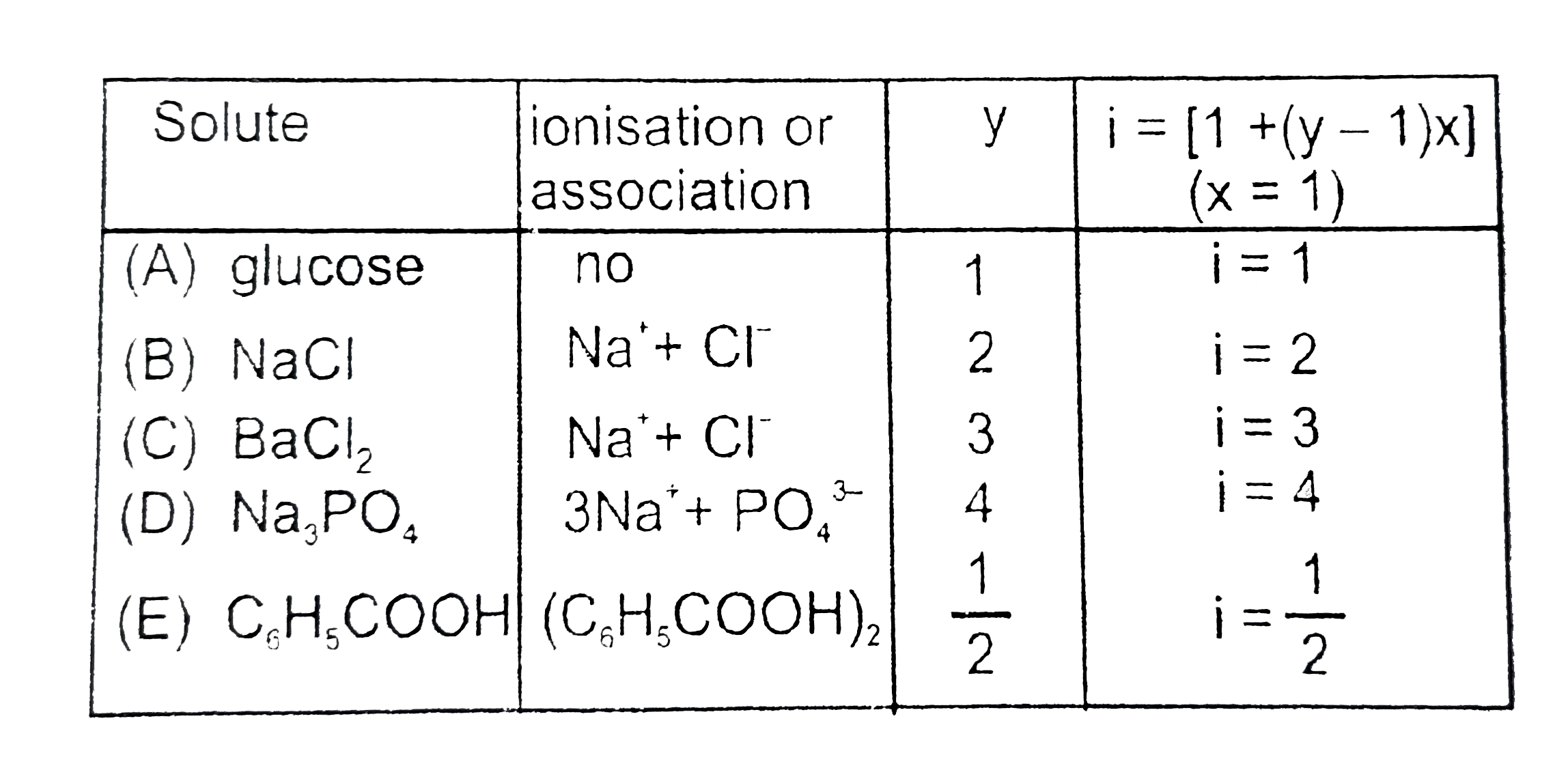 (1) Boiling point of solution `T=T_(0)+(DeltaT_(b))` `DeltaT_(b)=mK_(b)i` ltbRgt THUS, greater the value of `i`, greater the value of `DeltaT_(b)` and boiling point of solution. `therefore EltAltBltCltD` (2) Freezing pont of solution `T=T_(B)-(DeltaT_(f))` `DeltaT_(f)=mK_(f)i` Thus, greater the value of `i`, greater the value of `DeltaT_(f)` but smaller the value of freezing point. Thus, `EltAltBltCltD` (4)Vapour pressure of solution `P_("solution")=P_("solvent")^(0)-DELTAP` `(DeltaP)/(P^(0))=X_("solute")=(n_(1)i)/(n_(1)i+n_(2))=(n_(1)i)/(n_(2))` `therefore` The greater the value of `i`, greater the value of `Delpap` hence, smaller the value of vapour pressure of solution. Thus, `DltCltBltAltE`. |
|
| 50. |
Following are a group of compounds showing acidic behaviour: Phenols are less acidic than carboxylic acids. Why? |
|
Answer» |
|