

Saved Bookmarks
This section includes 7 InterviewSolutions, each offering curated multiple-choice questions to sharpen your Current Affairs knowledge and support exam preparation. Choose a topic below to get started.
| 1. |
Explain about the variation of molar conductivity with concentration by Kohlraush studies? |
|
Answer» Solution :Kohlraush OBSERVED that, INCREASE of molar conductance of an electrolytic solution with the increase in dilution. He deduced the following EMPIRICAL relationship betwee the molar conductance `(Lambda_m)` and concentration of the electrolyte (c ) `Lambda_m = Lambda_m^@ - ksqrt(c )` For strong ELECTROLYTES such as `KCl, NaCl` the plot `Lambda_m V_s sqrt(c )`, gives a straight line. It is ALSO observed that the plot is not a linear one for weak electrolyte. 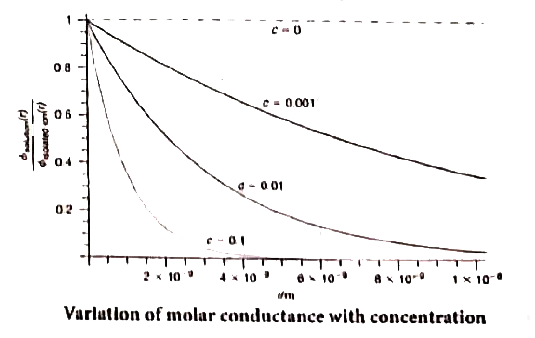
|
|
| 2. |
Explain about the variation of melting point among the transition metal series. |
|
Answer» SOLUTION :(i) As we move from left to right along the transition metal series, melting point first increases as the number of unpaired d ELECTRONS available for metallic bonding increases, reach a MAXIMUM value and then decreases, as the d electron pairs up and become less available for bonding (ii) For example, in the first series the melting point increases from Scandium to a maximum of 2183 K for Vanadium, which is close to 2180K for chromium. (III) Manganese in 3d series and has low melting point. The maximum melting point at about the MIDDLE of transition metal series indicates that d configuration is favorable for strong interatomic attraction. |
|
| 3. |
Explain about the types of coordination compound based on kind of ligands? |
|
Answer» SOLUTION :`(i)` A coordination compound in which the central METAL ion / atom is coordinated to only one kind of ligands is CALLED homoleptic complex, e.g, `[Co(NH_(3))_(6)]^(3+)` (ii) The central metal ion/atom is coordinated to more than one kind of ligands is called a heteroleptic complex. eg, `[Co(NH_(3))_(5)Cl]^(2+)` |
|
| 4. |
Explain about the variation of atomic radius along a period of 3d series. |
|
Answer» Solution :(i) In general, atomic radius decreases along a period. But for the 3d transition elements, the EXPECTED decrease in atomic radius is observed from Sc to V, THEREAFTER upto Cu the atomic radius nearly remains the same. (ii) As we move from Sc to Zn in 3d series, the extra electrons are added to the 3d orbitals, the added 3d electrons only partially shield the increased nuclear charge and hence the effective nuclear charge increases SLIGHTLY, (iii) However, the extra electrons added to the 3d sub shell strongly repel the 4s electrons and these two FORCES are operated in opposite direction and as they tend to balance each other, it leads to constancy in atomic radii. |
|
| 5. |
Explainabout thetypes ofRNA molecules . |
|
Answer» Solution :(i) Ribonucleicacids aresimilarto DNA. CELLS contain upto eight times high QUANTITY of RNA than DNA . RNA is foundin largeamountin the cytoplasm anda lesser amountin thenucelus. (ii) RNA molecules are classifiedaccording to theirstructureand function intothree majortypes. (a) Ribosomal RNA (r-RNA) . (b)Messenger RNA (m-RNA) . (C) Transfer RNA (t-RNA). (III) r-RNA : r-RNA is mainly found in cytoplasmand in ribosomes , which contain 60% RNA and 40% protein. Ribosomer arethe sitesat whichprotein synthesis takes place. (iv) t - RNA :t - RNAmolecules havelowestmolecular weightof all nucleicacids. Theyconsistof 73-94 nucleotides in a single chain . The funtionof t - RNA is to carry amino acids to thesitesof protein synthesis on ribosomes. (v) m - RNA : - RNA is presentin small quanity andveryshort lived . They are singlestranded and their synthesis take place on DNA. The synthesis m - RNA from DNA strandis calledtranscription . m - RNA carriesgeneticinformationfor DNA to theribosomers for proteinsythesis. |
|
| 6. |
Explain about the sulphonation reaction of aniline. |
Answer» SOLUTION :Aniline REACTS with Conc. `H_(2)SO_(4)` to FORM anilinium hydrogen sulphate which on heating with `H_(2)SO_(4)` to 453-473 K gives p-aminobenzene sulphonic acid, commonly known as sulphanilic acid, as the major product. 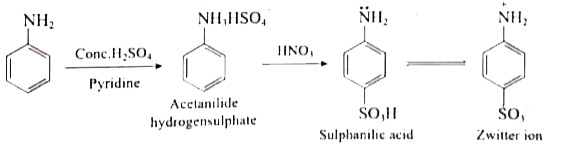
|
|
| 7. |
Explain about the structure of methanol. |
|
Answer» Solution :(i) In METHANOL, one of the sps hybridised orbital of oxygen linearly overlap with the sp3 hybridised orbital of CARBON to Torm a C-O, `sigma` bond and another `sp^3` hybridised orbital linearly overlap with ls orbital of hydrogen atom to FORM a O - H`sigma` bond. (II) 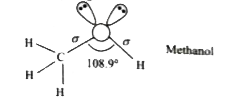 (iii)The remaining two `sp^3` hybridised orbitals of oxygen are occupied by two LONE pairs of electrons. Due to the lone pair - lone pair repulsion, the C-O-H bond angle in methanol is reduced to `108.9^@` from the regular tetrahedral bond angle of `109.5^@`. |
|
| 8. |
Explainaboutthe structure of proteins. |
|
Answer» Solution :(i) Protein are polymersof amino acids. Their three dimensional structure dependsmainlyon thesequenceof aminoacids . Theprotein structurecan bedescribed at fourhierarchal levels called primary secondary , tertiaryandquatenarystructures . Primary structure of proteins: - Protein arepolypeptidechains made upof amino acidsconnected through peptidebonds. The relativearrangementof theaminoacidsin thepolypeptide chain is calledthe primarystructureof the protein.  Secondarystructureof proteins :The aminoacidsin the polypeptidechainforms highlyregularshapes through bondbetweenthe carbonyloxygen and theneighobouringaminehydrogen of themainchain. `alpha` - Helix and `beta` - strands or sheets are twomostcommonsubstructureformed byproteins. `alpha` - Helix: - In the `alpha`sub - structuretheamino acidsarearrangend in a righthanded helical (sprial) structure andare stabilisedby thehydrogen bond. The sidechains of the residues protrudeoutsideof thehelxi. Each turn of an `alpha` - helix containsabout 3.6 resisdues and is about5.4 long. `beta` - Strands :-Strands areextended extended peptidechainrather thancoiled. The hydrogen bond occur betweenmain chain carbonyl group one suchstrandand theamino group ofthe adjacentstrandresultingin thefromationof a SHEET likestructure . Thisarrangement is called `beta` - sheets. TERTIARYSTRUCTURE : The secondarystructure element (`alpha` - helix& `beta` - sheets ) further foldsto forma three dimensional arragement . Thistertiary structureof proteins are stabilised bythe interactions between the sidechains of theaminoo acids. These interactions INCLUDE thedisulphdebridgesbetween cysteine residues, electrostatic ,hydrophobic , hydrogenbondsand van der Waalsinteractions. Quaternay Structure : Theoxygen transportingprtotein ,haemoglobin CONTAINS fourpolypeptide chains whileDNA POLYMERASE enzyme that makecopies of DNA, has tenpolypeptidechains. In theseproteins the individual polypeptidechainsinteracts witheachother to form the multimericstructure whihcknowas quaternarystructure. Theinteractionsthatstabilises the tertiarystructures alsostabilised thequaternarystructures. |
|
| 9. |
Explain aboutthe structure of Fructose . (OR) Elucidate the structure of Fructose . |
|
Answer» Solution :(i) ELEMENTAL analysis and molecularweight determinationof FRUCTOSE show thatit has themolecularformula `C_(6)H_(12)O_(6)`. (ii) Fructoseon reducing with HI and red phosphorus givesa mixture of n - hexane (majorprodcut) and 2 - iodohexane(minor product) . This reactionthatthesixcarbon atoms in fructoseare ina straight CHAIN.  (iii) Fructosereacts with`NH_(2)OH` and HCN . It Shows the presence of carbonylgroup in themolecules of fructose . (iv)Fructosereactswithacetic anhydride inn the presence of phyridine to form penta acetate .Thisreactionindicatesthe presence of fivehydroxylgroup in a fructosemolecule. (v) Fructose is notoxidized bybrominewater . This rules outthe possibilityof presence of analdehyde (-CHO) group. (vi)Partial reduciton of fructosewith sodium amalganand waterproduces mixtureof sorbitol andmannitol whichareepimers at second carbon. New asymmericcarbon is formedat C - 2. Thiconfirmsthe presenceof keto group.  (vii) On oxidation withnitricaicd,it gives glycolic acid and tartaricacids whihcontainssmallernumberof carbon atoms thanin fructose .  This shows thata ketogroupis present in C- @ . Italosshownthe presenceof 10 alcoholicgroups atC - 1and C - 6 . From the above reactionthe structureof fructose is . 
|
|
| 10. |
Explain about the structure of carbonyl group. |
|
Answer» Solution :(i) The carbonyl carbon `- undersetoverset(||)(O)(C ) -`is `sp^2`hybridised and carbon – oxygen bond is similar to carbon – carbon double bond in alkenes. The carbonyl carbon forms three o bonds using their three `sp^2`hybridised orbital. One of the sigma bond is formed with oxygen and the other two with hydrogen and carbon (in aldehydes) or with two carbons (in ketones). All the three `sigma`bonded ATOMS are lying on the same plane. (ii) The fourth valence electron of carbon remains in its unhybridised . 2p . orbital which lies perpendicular to the plane and it overlaps with 2p orbital of oxygen to form a carbon – oxygen bond (iii) The oxygen atom has two non-bonding pairs of electrons, which occupy its REMAINING two P orbitals. Oxygen, the second most electro negative atom attracts the shaired pair of electron between the carbon and oxygen TOWARDS itself and hence the bond is POLAR. This polarisation CONTRIBUTES to the reactivity of aldehydes and ketones. |
|
| 11. |
Explain about the structrue and uses of Mitomycin. |
|
Answer» SOLUTION :(i) Miltomycin C, and anitcancer agent used to treat stomach and colon cancer, contains an AZIRIDINE ring. (II) The aziridien functional group participates in the drug.s degradation by DNA, RESULTING in the DEATH of cancerous cells. 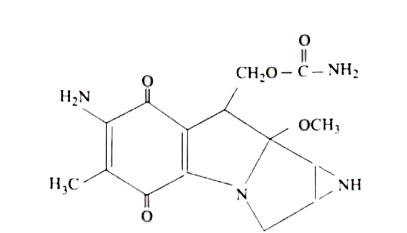
|
|
| 12. |
Explain about the strength of acid on the basis of K_a value. |
|
Answer» Solution :(i) `K_a` is called the ionisation CONSTANT or dissociation constant of the acid. It measures the strength of an acid. (ii) Acids such as `HCl,HNO_3` are almost COMPLETELY ionised and hence they have high `K_a` value i.e, `K_a` for HCl at `25^@C` is `2 times 10^6` (iii) Acids such formic acid and acetic acid are partially ionised in solution and have LOW `K_a` value i.e., `K_a` for acetic acid `1.8 times 10^-5` at`25^@C` (iv) Acids with `K_a` value greater than ten are considered as strong acids and LESS than one considered as weak acids. |
|
| 13. |
Explain about the reaction mechanism of methoxy ethane with HI. |
|
Answer» Solution :Ethers can UNDERGO nucleophilic substitution reactions with HI. `underset("METHOXY ethane")(CH_3-O - CH_2) - CH_3 + HI overset(Delta)to underset("iodo methane")(CH_3I) + underset("ethanol")(CH_3-CH_2-OH)` Ethers having primary alkyl GROUP undergo `SN^2` reaction whereas tertiary alkyl ETHER undergo `SN^1` reaction. Protonation of ether is followed by the attack of halide ion. The halide ion preferentially attacks the less sterically hindered of the two alkyl groups which are attached to etherial oxygen. 
|
|
| 14. |
Explain about the oxidation reaction of Glycerol with different oxidising reagents. |
|
Answer» Solution :(i) Oxidation of GLYCEROL with dil. `HNO_3` gives glyceric acidand tartronic acid. (ii) Oxidation of glycerol with Conc. `HNO_3` gives mainly glyceric acid. (iii) Oxidation of glycerol with bismuth nitrate gives as meso OXALIC acid. (iv) Oxidation of glycerol with `Br_2//H_2O` (or) NaBr (or) Fenton reagent `(FeSO_4 + H_2O_2)` gives a mixture of glyceraldehyde and DIHYDROXY acetone(GLYCEROSE). (v) On oxidation with HIO4 or Lead tetra acetate (LTA) it gives formaldehyde and formic acid. (vi) Acidified `KMnO_4` Oxidises glycerol into oxalicacid. 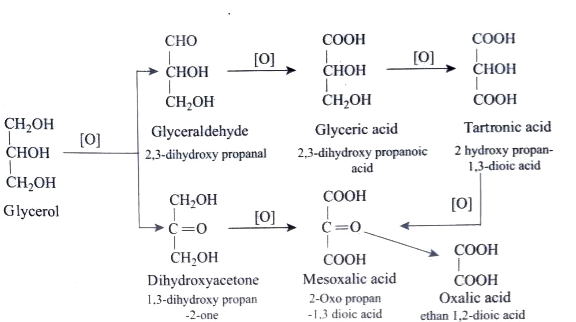
|
|
| 15. |
Explain about the oxidation state of Lanthanoids. |
|
Answer» SOLUTION :(i) The common oxidation state of lanthanoids is +3. In addition to that some of the lanthanoids ALSO show either +2 or +4 oxidation states. (ii) `Gd^(3+)` and `Lu^(3+)` ions have extra stability, it is due to half filled and completely filled f-orbitals. (III) Cerium and terbium attain `4f^(7)` and `4f^(14)` configurations respectively in the +4 oxidation states. (iv) `Eu^(2+)` and `Yb^(2+)` ions have exactly half filled and completely filled f orbitals. (v) Lu shows only +3 oxidation state. (vi) Ce, Pr, Nd, Tb and Dy EXHIBIT +3 and +4 oxidation states. (vii) Nd, Sm, Eu, Tm, Yb exhibit +2 oxidation states also. |
|
| 16. |
Explain about the oxidation state of actinoids. |
|
Answer» Solution :(i) The most COMMON oxidation state of actinoids is +3. (ii) In addition to that actinoids show variable oxidation states such as +2, +3, +4, +5, +6 and +7. (iii) The elements Americium (Am) and Thorium (Th) show COMPOUNDS. (iv) Th, Pa, U, Np, Pu and Am show +5 oxidation states, (V) Np and Pu exhibit +7 oxidation state. |
|
| 17. |
Explain aboutthe nature , classification and propertiesof lipids (or) writea noteaboutlipids . |
|
Answer» Solution :(i) Lipids are organicmolecules thatare solublein organicsolvents suchaschloroformandmethanoland are insolube in water . Lipids means fat. Theyaretheprincipalcomponentof cellmembrane including cellwalls . (II)Lipidsact asenergysourcefor livingsystem . Fat provide2-3fold higherenergycomparedto CARBOHYDRATE or proteins. (iii) Basedon theirstructure, lipids can beclassifiedas simple lipids, compoundlipids andderived lipids . (iv) Simplelipids CANBE furtherclassifedinto ,fats ,which areester of longchainfattyacidsfats ,withglycerol(triglycerides ) andwaxeswhichare ESTERS offattyacidwith longchainmonohydric alcohols ( Bee wax). (v) Compoundlipidsare the esterof simplefattyacidwithglycerolwhichcontainadditionalgroup. Basedon the groups , attached, theyare furtherclassifiedinto phospholipids , glycolipidsand lipproteins . Phospho lipidscontain a phospho esterlinkagewhilethe GLYCOLIPIDS containa sugr molecule attached . Thelipo proteins are complexes of lipidswithproteins . |
|
| 18. |
Explain about the mechanism of intermolecular dehydration of ethanol with conc.H_2SO_4 at 413 K. |
|
Answer» SOLUTION :When ethanol reacts with CONC. `H_2SO_4` at 413 K, inter nolecular DEHYDRATION takes place and the product formed is Ethoxy ETHANE. Mechanism : 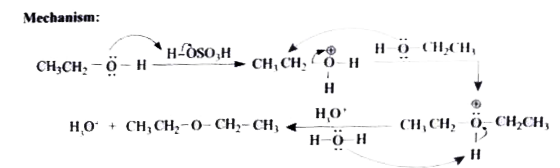
|
|
| 19. |
Explain about the metallic behaviour of d-block elements. |
|
Answer» SOLUTION :(i) All the TRANSITION elements are metals. They are good CONDUCTORS of HEAT and electricity. Of all the known elements, silver has the highest electrical conductivity at room temperature, (ii) Most of the transition elements are hexagonal CLOSE packed, cubic close packed or body centered cubic which are the characteristics of true metals. |
|
| 20. |
Explain about the mechanism involved in Williamson's synthesis. |
|
Answer» Solution :When an ALKYL halide is HEATED with an ALCOHOLIC solution of sodium alkoxide, the corresponding ether is FORMED. This reaction involves `SN^2` mechanism. `CH_3 - Ona + Br - C_2H_5 overset(Delta) to CH_3 - O - C_2H_5 + NaBr` Mechanism: `CH_3-O^(-) NA^(+) + CH_3 - CH_2 - Br underset(Delta)overset(-NaBr)toCH_3 - underset("Methoxy ethane")(CH_2-underset(* *)overset(* *)O - CH_3)` |
|
| 21. |
Explain about the magnetic properties of transition elements, |
|
Answer» Solution :(i) Most of the compounds of transition elements are paramagnetic. (ii) Materials with no elementary magnetic dipoles are diamagnetic. In other words a species with all paired electrons exhibits DIAMAGNETISM. (iii) Paramagnetic solids having unpaired electrons possess magnetic dipoles which are isolated from one another. (iv) Ferromagnetic materials have domain structure and in each domain the magnetic dipoles are arranged. But the spin dipoles of the adjacent domains are randomly oriented. Some transition elements or ions with unpaired d electrons show FERROMAGNETISM. (V) 3d transition metal ions in paramagnetic solids often have a magnetic dipole MOMENTS corresponding to the electron spin contribution only. So the magnetic moment of the ion is given by `mu= sqrt(S(S+1))mu_(B)` Where g = 2, S is the TOTAL spin quantum number of the electrons. `mu_(B)` - Bohr Magneton. For an ion with .n. unpaired electrons `S= (n)/(2)` Therefore the spin only magnetic moment is `mu = 2sqrt((n)/(2)((n)/(2)+1))mu_(B)` `mu= 2sqrt((n(n+2))/(4))mu_(B)` `mu= sqrt(n(n+2))mu_(B)` |
|
| 22. |
Explain about the ionisation of weak acid and how K_a is derived? |
|
Answer» Solution :(i) WEAK ACID are partially dissociated in water and there is an equilibrium between the undissociated acid and its dissociated IONS. (ii) Consider the following of weak monobasic acid HA in water `HA+H_2O leftrightarrow H_3O^(+)+A^-`………(i) (iii) Applying law of chemical equilibrium , the equilibrium constant `K_c` is given by the expression `K_c=([H_3O^+][A^-])/([HA][H_2O])`........(2) (iv) In dilute solutions, water is presentin large excess,hence its concentration may be taken as constant say K. Further `H_3O^+` indicates hydrogen ions,for SIMPLICITY it may be replaced by `H^+`. So the EQUATION (2) becomes `K_c=([H^+][A^-])/([HA])`........4 The constant `K_a` is called dissociation constant of weak acid. |
|
| 23. |
Explain about the hydrolysis of salt of strong base and weak acid.Derive the value of K_h for that reaction. |
|
Answer» Solution :Let us consider the reaction between sodium hydroxide and ACETIC acid to GIVE acetate and water `NaOH_(aq)+CH_3COOH_(aq) leftrightarrow CH_3COONa_(aq)+H_2O_(l)` (II) In aqueous solution `CH_3COONa` is completely dissociated as follows. `CH_3COONa_(aq) to CH_3COO^(-) (aq)+NA^(+) (aq)` (iii) `CH_3COO^-` is a conjugate base of the weak acid `CH_3COOH` and its has a tendency with `H^+` from water to produce unionised acid. But there is no such tendency for `Na^+` to react with `Oh^-` (iv) `CH_3COO^(-) (aq) +H_2O_(l) leftrightarrow CH_3COOH_(aq)+OH^(-) (aq)` and therefore `[OH^-] gt [H^+]` in such case the solution is basic due to the hydrolysis and pH is greater than 7. Relationship between equilibrium basic to the hydrolysis constant and the dissociation constant of acid is derived as follows : `K_h=([CH_3COOH[OH^-]])/([CH_3COO^-][H_2O])` `K_h=([CH_3COOH[OH^-]])/([CH_3COO^-])`....(i) `CH_3COOH (aq) leftrightarrow CH_3COO^(-) (aq) +H^(+) (aq)` `K_h=([CH_3COO^-][H^+])/([CH_3COOH])` ...........(ii) Equation (1) `times `(2) `K_h.K_a=[H^+][OH^-]` `[H^+]=[OH^-]=K_w` `therefore K_h.K_a=K_w` `K_h` VALUE in terms of degree of hydrolysis (H) and the concentration of salt (c) for the equilibrium can be obtained as in the case of Ostwaid.s dilution law `K_w=h^2C` and `[OH^-]=sqrt(k_h.C)` |
|
| 24. |
Explain about the hydrolysis of salt of strong acid and weak base . Derive K_b and pH for that solution. |
|
Answer» SOLUTION :(i) Consider a REACTION between STRONG acid HCl and a weak base `NH_4OH` to produce a salt `NH_4Cl` and water `HCl(aq)+NH_4OH(aq) leftrightarrowNH_4Cl(aq)+H_2O_(l)` `NH_4Cl_((aq)) to NH_4^(+) (aq) +CL^(-) (aq)` (ii) `NH_4^(+)` is a strong conjugate acid of the weak base `NH_4OH` and its has a tendency to react with `OH^(-)` from water to produce unionised `NH_4` as below `NH_4^(+) (aq) toNH_4OH_((aq))+H^(+) (aq)` (iii) There is no such tendency shown by `Cl^-` and therefore `[H^+] gt [OH^-]` the solution is acidic and the pH is less than 7. (iv) In the salt hydrolysis of strong base and weak acid, we have to derive a relationship between `K_a and K_b` as (v) `K_h.K_b=K_w` `K_h=h^2C and [H^+]=sqrt(kh.C)` `therefore[H^+]=sqrt((K_w.C)/K_b)` `pH=-log[H^+]` `=-log[(K_w.C)/K_b]^(1//2)` `=-1/2logK_w-1/2log C+1/2 log K_b` `pH=7-1/2 pK_b -1/2 log C` |
|
| 25. |
Explain about the importance and application of coordination complexes. |
|
Answer» Solution :`(1)` Phthalo blue- a bright blue pigment is a complex of copper (II) ion and it is used in printing ink and packaging industry. `(2)` Purification of Nickel by Mond.s process involves formation of `[Ni(CO)_(4)]` which yields `99.5%` pure on decomosition. `(3)` EDTA is used as a chelating ligand for the separation of lanthanides, in softening of HARDWATER and also in removing lead poisoning. `(4)` Coordination complexes are used in the extraction of silver and gold from their ores by forming soluble cyano complex. These cyano complexes are reduced by zinc to yield metals. This process is called Mac-Arthur Forrest cyanide process. `(5)` Some metal ions are estimated more accurately by complex formation. For e.g., `Ni^(2+)` presentin Nickel chloride solution is estimated accurately forming an insoluble complex called `[Ni(DMG)_(2)]`. `(6)` Many of the complexes are used as catalyst in organic and inorganic reactions. For e.g., `(i)` Wilkinson.s Catalyst -`[(PPh_(3))_(3)RhCl]` is used for hydrogenation of alkenes. `(ii)` Ziegler-Natta Catalyst `[TiCl_(4)+Al(C_(2)H_(5))_(3)]` is used in the polymerisation of ETHENE . `(7)` In photography, when the developed film is washed with sodium thio sulphate solution (hypo), the negative film gets fixed. Undecomposed `AgBr` forms a soluble complex called sodium dithio sulphate argentate (I) which can be removed easily by WASHING the film with water. `AgBr+2Na_(2)S_(2)O_(3) to Na_(3)[Ag(S_(2)O_(3))_(2)]+2NaBr` |
|
| 26. |
Explain about the hydrolysis of salt of strong acid and a strong base with a suitable example. |
|
Answer» Solution :(i) Let us consider the neutralisation reaction between NAOH and `HNO_3` to give water `NaOH(aq) +HNO_3(aq) to NaNO_3 (aq)+H_2O_l` (ii) The salt `NaNO_3` completely dissociated in water to produce `Na^(+) and NO_3^(-)` ions `NaNO_(aq) to^(H_2O) Na^(+) (aq) +NO_3^(-) (aq)` (iii) water dissociates to a small extent as `H_2O_l leftrightarrow H^(+) (aq)+OH^(-) (aq)` Since `[H^+]=[OH^-]` water is neutral. (iv) `NO_3^(-)` ion is the conjugate base of strong acid `HNO_3` and HENCE it has no tendency to react with `H^+` (V) Similarly `Na^+` is the conjugate acid of the strong base NaOh and it has no tendency to react with `Oh^-` (vi) It means that there is no hydrolysis, In such case `[H^+]=[OH^-]`, ph is MAINTAINED and there fore the solution is neutral. |
|
| 27. |
Explain about the geometrical isomerism of octahedral complexes with suitable example. |
Answer» Solution :`(i)` Octahedral COMPLEXES of the type `[MA_(2)B_(4)]^(n+-)`, `[M(x x)_(2)B_(2)]^(n+-)` SHOWS cis-trans isomerism. Hence A and B are monodentate ligands and `x x` is bidentate ligand with two same kindof donor atoms. In the octahedral complex, the position of ligands is indicated by the following numbering scheme. 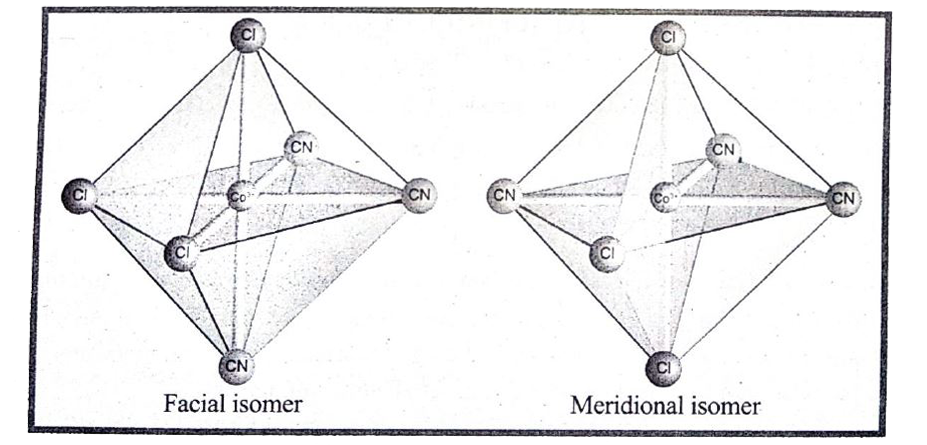 `(ii)` The POSITIONS `(1,2)(1,3)(1,4)(1,5),(2,3)(2,5)(2,6),(3,4)(3,6),(4,5)(4,6)` and `(5,6)` are identical and if two similar groups are present in any one of these positions, the isomer is referred as a cis-isomer. `(III)` Similarly positions `(1,6),(2,4)` and `(3,5)` are identical and if similar groups (or) ligands are present in these positions it is referred as a trans-isomer. `(iv)` Octahedral complex of the type `[MA_(3)B_(3)]^(n+-)` also shows geometrical isomerism. If thethree similar ligands (A) are present in the cornersof one TRIANGULAR face of the octahedronand the other `3` ligands (B) are present in the opposite triangular face, then the isomer is referred as a facial isomer (fac isomer). `(v)` If the three similar ligands are present around the meridian which is an imaginary semicircle from one apex of the octahedral to the opposite apex, the isomer is called a meridional isomer (mer is omer). This is called a meridional because each set of ligands can be regarded as lying on a meridian of an octahedran. |
|
| 28. |
Explain about the geometrical isomerism in complexes having coordination number 4. |
|
Answer» Solution :`(i)` Geometrical isomerism exists in heteroleptic complexes due to different POSSIBLE three diamensional spatial arrangements of the ligands around the central metal atom . This type of isomerism exist in square planar TETRAHEDRAL complexes. `(ii)` In square planar complexes of the form `[MA_(2)B_(2)]^(n+-)` and `[MA_(2)BC]^(N+)` where `A,B` and `C` are monodentate ligands and `M` is the central metal ion /atom. `(iii)` SIMILAR groups (A or B) present either on same side or on the opposite side of the central metal atom (M) give rise to two different geometrical isomers and they are called CIS and trans isomers respectively. `(iv)` The square planar complex of the `[M(XY)_(2)]^(n+-)` where `XY` is a bidentate ligand with two different coordinating atom also shows cis-trans isomerism . `(v)` Square planar complex of the form `[MABCD]^(n+)` also shows cis-trans isomerism. In this case, by considering any one of the ligands `[A,B,C,D]` as a reference , the rest of the ligands can be arranged in three different ways leading to three geometrical isomers. 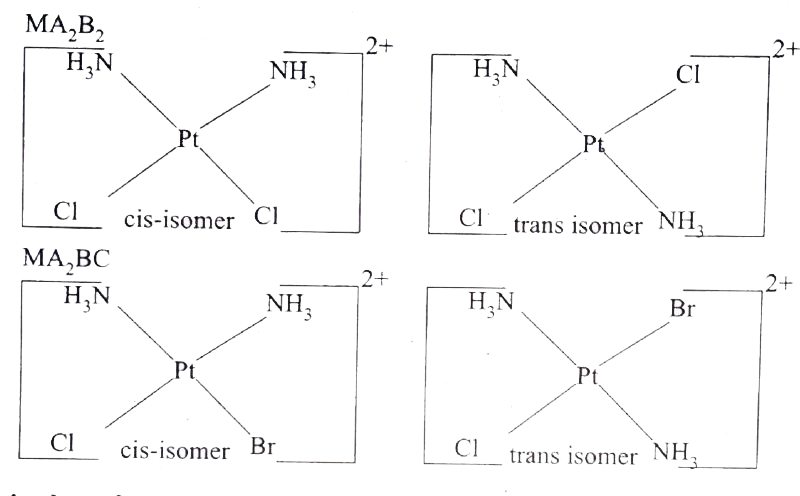
|
|
| 29. |
Explain about the factors that affecting the reaction rate . The rate of a reaction is affected by the following factors . |
|
Answer» Solution :(i) Natural and state of the reactant (a) A chemical reaction involves breaking of certain bonds of the reactant and forming new bones which lead the product . The net energy involved in this process is dependenton the nature of the reactantand hence the rates are different for different reactants. (b) Gas phase reaction are faster as compared to the reactions involving soild or liquid reactants for example,reaction of sodium metal with iodine vapoursis faster than the reaction between solid sodium and solid iodine. (ii) Concentration of the reactant The rate of reaction increases with the INCREASE in the concentration of the reactans. According to collision, THEORY the rate of the reaction depends upto the number of collisions between the reacting molecules . Higher the concentration , greater is the possibility of collision and hence the rate . (iii)Effect of surface area of reactant: In heterogeneous reactions, the surface area of the soild reactantsplay an important role in deciding the rate . for a given MASS of reactant. when the practicalsize decrease surface area increases. Increase is surface area of reactant leadsthe more collision per litre per second hence the rate of reaction is increased. For example.powered Calcium carbonate reacts much faster with dilute HCI then with the same mass of `CaCO_3`as marble . (iv) Temperature : For many reactions near room temperature, the reaction rate tends to double when thetemperature is increased by `10^@C` .For EG. Reaction between `H_2and O_2`to from`H_2O`takes place only when amln electric Spark is passed so when the temperature increases, the rate of the reaction also increase. Effect of presence of catalyst (a) A catalyst is substance which alters the of a reaction without itself undergoing any permanent chemical change . They may PARTICIPATE in the reaction , but again regenerated and the and of the reaction. (b) In the presence of a catalyst , the energy of activation is lowered and hence grater number of molecules can cross the energy barrier nad change over to products , thereby increasing the rate of the reaction. |
|
| 30. |
Explain about the factors affecting electrolytic conductance. |
|
Answer» Solution :`•` If the interionic between the oppositely charged ions of solute increases, the conductance will decrease. `•` SOLVENT of HIGH dielectric constant show high conductance in solution. `•` Conductance is inversely proportial to the viscoity of the medium. i.e., CONDUCTIVITY increases with the decrease in viscosity. `•` If the temperature of the electrolytic solution increases, conductance also increases. `•` MOLAR conductance of a solution increase with increase in dilution. This is becuase, for a strong electrolyte , inter ionic force of ATTRACTION decrease with dilution. For a weak electrolyte, degree of dissociation increases with dilution. |
|
| 31. |
Explain about the dry distillation of Calcium ethanoate. |
Answer» SOLUTION :CALCIUM ethanoate on dry distillation GIVES propanone as PRODUCT. 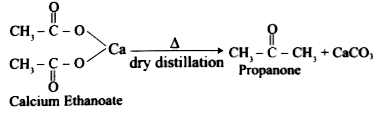
|
|
| 32. |
Explainaboutthe cyclic structure of fructose? |
Answer» SOLUTION :Fructoseforms a fivemembered ringsimilar to furan.Henceit is calledfuranoseform. Whenfurctoseis acomponentof a sacchardieasin SUCROSE, it usuallyoccursin furanoseform .
|
|
| 33. |
Explain about the construction and uses of mercury button cell. |
|
Answer» SOLUTION :(i) Mercury button cell : `{:("ANODE",:,"Zinc Amalgamated with mercury"),("Cathode",:,HgO " MIXED with graphite"),("Electrolyte",:,"Paste of KOH and ZnO"):}` (ii) Oxidation occurs at anode : `overset(2+)(HgO_(s)) + H_2O_((l)) + 2e^(-) to Hg_((l)) + 2OH_((aq))^(-)` Overall reaction is `Zn_((s)) + HgO_((s)) to ZnO_((s)) + Hg_((l))` (iv) Cell emf : about 1.35 V (v) Uses : It has HIGHER capacity and longer life. It is used in pacemakers, electronic watches, cameras.  . .
|
|
| 34. |
Explain about thecomposition and structureof nucleicacids . |
|
Answer» Solution :(i) Nucleic acids arebiopolymers of nucleotides. Controlledhydrolysis of DNA and RNA YIELDS three componentsnamely a nitrogeneousbase , a pentosesugarand phosphategroup. (ii) Nitrogenbase: - (a) Theseare nitrogen containing organic compounds whichare derivatives of tow parentcompounds , pyrimidine and purine . (b)BothDNAand RNA havetwo majorpurinebases,ADENINE (A) andguanine (G). In both DNAand RNA , oneof the pyrimidinesis cytosine (C),but thesecondpyrimidineisthymine (T) in DNA and uracil (U) in RNA. (iii) Pentose Sugar : -Nucleicacidshave two types ofpentoses. The recurring deoxyribonucleotide units of DNA contain 2- deoxy - D- riboseand theribonucleotide units of RNA containD - ribose . In nucleotides, bothtypes of pentoseare in their `beta` - furanose form. (IV) Phosphate group : - Phosphoricacidformsphsophor diester bondbetweennucleotides . Basedon the numberof phsphate group presentin thenucleotides, theyare classsifiedmono nucleotide, dinucleotide and trinucleotide . The molecule withoutthe phosphate group is calleda nucleoside. Anucelotide is derivedform a nucleulewithout the phosphategroup is calleda nucleoside . Anucleotideis derivedforma nucleoside by theaddtiton ofa molecule ofphosphoricacid . (vi) Sugare + Base `to`Nucleoside . Nucleoside +Phosphate `to` Nucleotide. Nucelotide`to` Polynucelotide(Nucleic ACID ). |
|
| 35. |
Explain about the classification of metal carbonyls with suitable examples. |
|
Answer» Solution :`(i)` BASED on the number of metal atoms present. Depending upon the number of metal atoms present in a metalic carbonyl , they are classified as follows. `(a)` Mono nuclear carbonyls :- These compounds contain only one metal atom and have simple structure. for e.g.,`[Ni(CO)_(4)]` Nickel tetra carbonyl is tetrahedral, `[Fe(CO)_(5)]` Iron pentacarbonyl is trigonalbipyramidal. `[Cr(CO)_(6)]` Chromium hexacarbonyl is octahedral. `(b)` Poly nuclear carbonyls- Metallic carbonyls containing two or more metal atoms are called poly nuclear carbonyls. Poly nuclear metal carbonyls may be Homenuclear `-([Co_(2)(CO)_(6)]`, `[Mn_(2)(CO)_(10)])`, `[Fe_(3)(CO)_(12)])` Hetero nuclear - `([MnCo(CO)_(9)]`, `[MnRe(Co)_(10)])` `(II)` based on structure The structures of binuclear metal carbonyls in involve either metal-metal bonds or bridging`Co` groups or both. The carbonyls ligands that are attached to only one metal atom are referred to as terminal carbonyl groups, WHEREAS those attached to two metal atoms simultaneously are called bridging carbonyls. Depending upon the structures of metalmetal carbonyls they are classified as follows : `(a)` Non bridges metal carbonyls These metal carbonyls do not contain any bridgingcarbonyl ligand. They may be of two types `(i)` Non-bridged metal carbonyle which contain only terminal carbonyls. Example : `[Ni(CO)_(4)]`  `(ii)` Non-bridged metal carbonyls which contain terminal carbonyls as well as Metal- Metal bonds. For examples, The structure of `Mn_(2)(CO)_(10)`. Contains one metal -metal bond, so the formula is more correctly represented as `(CO)_(5)Mn-Mn(CO)_(3)`.  `(b)` Bridged carbonlys : These metal carbonyl contain one or more bridging carbonyl ligands ALONG with terminal carbonyl ligands and one or more metal -metal bonds . For example : `Fe(CO)_(9)` Di -iron ennea carbonyl molecule consists of three `CO` ligands , six terminal `CO` groups and single `Fe-Fe Delta` bond formed by weak coupling of the unpaired electrons present in two `3d` orbitals of `2 Fe` atoms. The bond represented by dotted line is called fractional single bond. 
|
|
| 36. |
Explain about the classification of colloids based on the physical state of dispersed phase and dispersion medium with example. |
Answer» SOLUTION :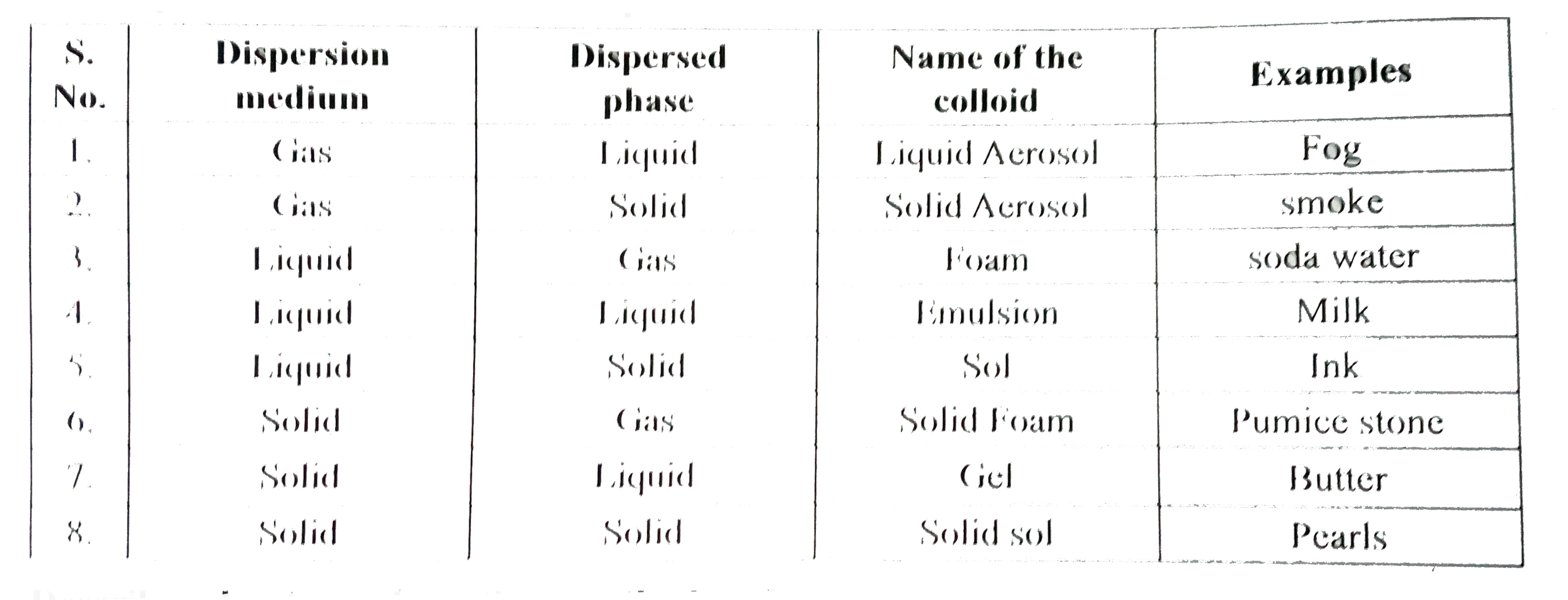
|
|
| 37. |
Explain about the classification of drug based on the site of action. |
|
Answer» Solution :(i) The drug molecule interacts with biomolecules such as enzymes, receptors which are referred as drug targets. The drug is classified based on the drug TARGET with which it binds. (ii) This CLASSIFICATION is highly specific compared to others. These compounds often have a COMMON MECHANISM of action, as the target is the same. |
|
| 38. |
Explain about the bromination of pheno. |
Answer» Solution :(i) Phenol REACTS with bromine WATER to give a white PRECIPITATE of 2,4,6-tri bromo phenol. 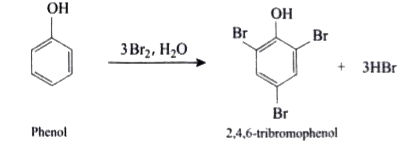 (ii) When phenol react with `Br_2` in the presence of `CS_2 " to "C Cl_4` at 278 K, a mixture of ORTHO and para bromo phenols are formed. 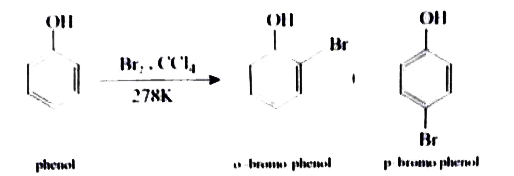
|
|
| 39. |
Explain about the bonding in metal carbonyls. |
|
Answer» Solution :`(i)` In metal carbonyls, the BOND between metal atom and the carbonyl ligand consists of two components.The first component is an electron pair donation from the carbon atom of carbonyl ligand into a vacant `d`-orbital of central metal atom. This electron pair donation forms `M OVERSET(sigma bond)(larr)CO` sigma bond. `(ii)` This `sigma` bond formation increases the electron density in metal `d` orbitals and makes the metal electron rich. `(iii)` In order to compensate for this increased electron density, a filled metal d-orbital interacts with the EMPTY `pi` orbital on the carbonyl ligand and transfers the added electron densityback to the ligand. This second component is called `pi` back bonding . `(iv)` Thus in metal, carbonyl, electron density moves from ligand to metal through `sigma` bonding and from metal to ligand through `Pi` bonding, this synergic effect ACCOUNTS for strong `M larr CO`bond in metal carbonyls. |
|
| 40. |
Explain about the causes of lanthanide contraction. |
|
Answer» Solution :(1) As we MOVE from one element to another in 4f series ( Ce to Lu) the nuclear charge INCREASES by one unit and an additional electron is added into the same inner 4f sub-shell. (ii) 4f sub-shell have a diffused shapes and therefore the shielding effect of 4f electrons are relatively POOR. Hence, with increase of nuclear charge, the valence shell is pulled slightly towards nucleus. (iii) As a result, the effective nuclear charge EXPERIENCED by the 4f elelctorns increases and the size of `Ln^(3+)` ions decreases. |
|
| 41. |
Explain about the application of ion exchange resins in adsorption. |
|
Answer» Solution :• Ion exchange RESINS are working only based on the process of ADSORPTION. • Ion exchange resins are used to demineralise WATER. This process is carried out by passing water through two columns of cation and ANION exchange resins. `UNDERSET("resin")(2RSO_3H)+underset("minerals in water ")(Ca^(2+)(Mg^(2+))) to underset("resin with mineral")((RSO_3)_2 Ca(Mg)+2H^(+))` 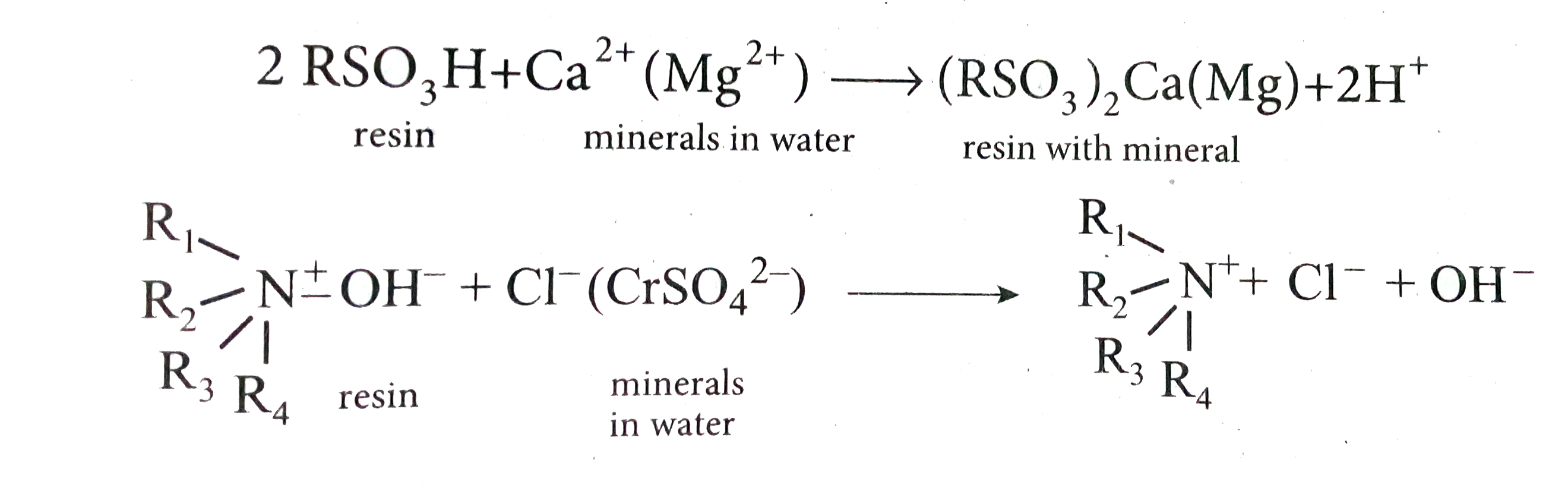
|
|
| 42. |
Explainabouttehh structure,natureand properties of sucrose . |
|
Answer» SOLUTION :(i) Surcose commonlyknown astable sugaris the mostabuandantdisaccharide . Itis obtainedmainly form jucieof SUGAR caneand sugarebeets Insectssuchas honeybeens have theenzyme invetasethat catalyses the hydrolysis ofinto glucose and fructose mixture . (ii) Honey is primary a mixtureof glucose ,fructoseand sucrose . On hydrolysissurcose YIELDS equalamountof glucoseand fructoseunits . `"Sucrose" underset(H_(2)O)overset("invertase") to "Glucose + Fructose"` (iii)Sucrose`(+66.6^(@))` and glucose`(52.5^(@))`are dextrorotorycompounds while fructoseislevo rotatory ` ( - 92.4^(@))` (iv) Duringhydrolysis of sucrosethe opticalrotation of thereactionmixturechaangesfrom dextroto levo. Hencesucrose is alsoas invert sugar. (v) Structure:  In sucrose CL of `alpha`- D glucoseis joined to C2 of D - Fructose . Theglycosidc bondthus formedis called`alpha , 1,2`- glucosidicbond. Sinceboth thecarbonyl carboms areinvolved in the glycosidicbonding , surcoseis a non - REDUCINGSUGAR . |
|
| 43. |
Explain about the acid (or) basic hydrolysis of ethyl nitrite. |
| Answer» Solution :`CH_(3)-UNDERSET("Ethyl nitrite")(CH_(2)-O)-N=O+HOH underset(("or")OH^(+))OVERSET(OH^(-))(to)CH_(3)-underset("Ethanol")(CH_(2)OH)+HN_(2)` | |
| 44. |
Explain about Schiff's reagent test? |
| Answer» Solution :Dilute solution of ALDEHYDE when added to Schiff.s reagent (Rosaniline hydrochloride dissolved in water and its red colour decolourised by passing `SO_2`) yields its red colour. This is known as Schiffs. test for aldehyde. Ketones do not GIVE this test. Acetone however gives a POSITIVE test but SLOWLY. | |
| 45. |
Explain about SHE (Standard Hydrogen Electrode). |
|
Answer» Solution :(i) It is impossible to measure the emf of a single electrode, but we can measure the potential difference between two electrodes `(E_("cell"))` using a VOLTMETER. (ii) To calculate the emf of a single electrode, we need a reference electrode whose emf is known. For that purpose, Standarad Hydrogen Electrode (SHE) is used as the reference electrode. (iii) SHE has been assigned an orbitary emf of exactly zero volt. (IV) It consists of platinum electrode in CONTACT with IM HCl solution and 1 atm hydrogen gas. (v) The hydrogen gas bubbled through the solution at `25^@C`, SHE can act as cathode as well as an anode. (vi) The HALF cell reactions are given below: If SHE is used as a cathode, the reduction reaction is `2H_(aq,1M)^(+) + 2e^(-) to H_(2(g, 1atm)) E^@ = 0` volt. If SHE is used as an anode, the oxidation reaction is `H_(2(g, 1atm)) + 2H_((aq, 1M))^(+) + 2e^(-)E^(@) = 0` volt. 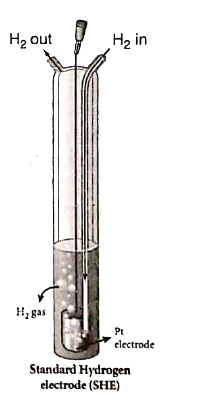
|
|
| 46. |
Explain about soaps in detail. |
|
Answer» Solution :Soaps are the detergents used since long. Soaps used for cleaning purpose are sodium or potassium salts of long chain fatty acids, e.g., stearic, oleic and palmitic acids. Soaps CONTAINING sodium : Soaps containing sodium salts are FORMED by heating fat with aqueous sodium hydroxide solution. This reaction is known as saponification. Chemical reaction of soap making :  In this reaction, esters of fatty acids are hydrolysed and the soap obtained remains in COLLOIDAL FORM. It is precipitated from the solution by adding sodium chloride. The solution left after removing the soap contains glycerol, which can be recovered by fractional distillation. Only sodium and potassium soaps are soluble in water and are used for cleaning purposes. GENERALLY potassium soaps are soft to the skin than sodium soaps. These can be prepared by using potassium hydroxide solution in place of sodium hydroxide. |
|
| 47. |
Explain about protective action of colloid. |
|
Answer» Solution : (i) Lyophobic sols are precipitated readily even with SMALL AMOUNT of electrolytes. But they are stabilised by the addition of small amount of lyophillic colloid. (ii) A small amount of gelatine sol is added to gold sol to protect gold sol. (III) Gold number is a measure of protecting power of a colloid. Gold number is defined as the number of MILLIGRAMS of hydrophillic colloid that will just prevent the precipitation of 10ml of gold sol on the addition of 1 ml of 10% NaCl solution. SMALLER the gold number, greater the protective power. |
|
| 48. |
Explain about phase transfer catalysis. |
|
Answer» Solution :(i) Consider the reactant of a reaction is present in one solvent and the other reactant is present in an another solvent. The reaction between them is very slow, if the solvents are immisible. (ii) As the solvents form separate phases, the reactants have to migrate across the boundary to react. But MIGRATION of reactants across the boundary is not easy. For such situation, a third solvent is added which is miscible with both. So, the phase boundary is eliminated the reactants freely mix and react fast. (iii) But for large scale preparation of any product, use of a third solvent is not convenient as it may be expensive. For such problems, phase transfer catalysis PROVIDES a simple solution, which avoids the use of solvents. (iv) It directs the use of a phase transfer catalyst (a phase transfer reagent) to facilitate transport of a reactant in one solvent to other solvent where the second reactant is present. As the reactants are now brought together, they rapidly react and form the product. (v) Example : Substitution of `Cl^(-) and CN^(-)`in the following reaction. `underset("organic phase ")(R-Cl) + underset("aqueous phase")(NaCN) to underset("organic phase ")(R-CN) + underset("aqueous phase")(NaCl)` R Cl=1- CHLORO octane R CN=1- cyano octane (vi) By direct heating of two phase mixture of organic 1- chloro octane with aqueous sodium cyanide for several days, 1-cyano octane is not obtained. However, if a small AMOUNT of quarternary ammonium salt like TETRA alkyl ammonium cation which has hydrophobic and hydrophilic ends, transports `CN^(-)` from the aqueous phase to the organic phase using its hydrophilic end and facilitates the reactions with 1-chloro octane as shown below `{:(NaCN, + , R_4N^(+)Cl^-, to, R_4N^(+)CN^(-) ,+,Cl^(-)),("aqueous phase ",,,,"It move to organic phase",,),(R_4N^(+)CN^(-),+,R-Cl, to , RCN , +, R_4N^(+)Cl^(-)),("Both in organic phase",,,,"Organic phase",,"(It moves to aqueous phase releases "CN^(-)" again picks up " CN^(-) " and transport it )"):}` (vii) So phase transfer catalyst, speeds up the reaction by transporting one reactant from one phase to another. |
|
| 49. |
Explain about mechanism involved in the dehydration of tertiary alcohols. |
|
Answer» SOLUTION :Tertiary ALCOHOLS undergo DEHYDRATION by Ej mechanism. It involves the FORMATION of a carbocation. Step : 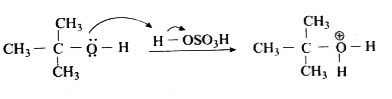
|
|
| 50. |
Explain about (i) Liquid aerosol (ii) solid aerosol with example. |
Answer» SOLUTION :
|
|