

Saved Bookmarks
This section includes 7 InterviewSolutions, each offering curated multiple-choice questions to sharpen your Current Affairs knowledge and support exam preparation. Choose a topic below to get started.
| 1. |
Explain, bromobenzene is o, p directing for substitution reactions. |
|
Answer» Solution :The bromine is a weakly deactivating ATOM because it donates the electrons to the ring by resonance and withdrawinductively (-I). Due to -I EFFECT bromine atom withdraws electrons from the benzenering hence tends to deactivate the benzene ring. As a result the electro-philic SUBSTITUTION reactions OCCUR slowly and under drastic conditions. 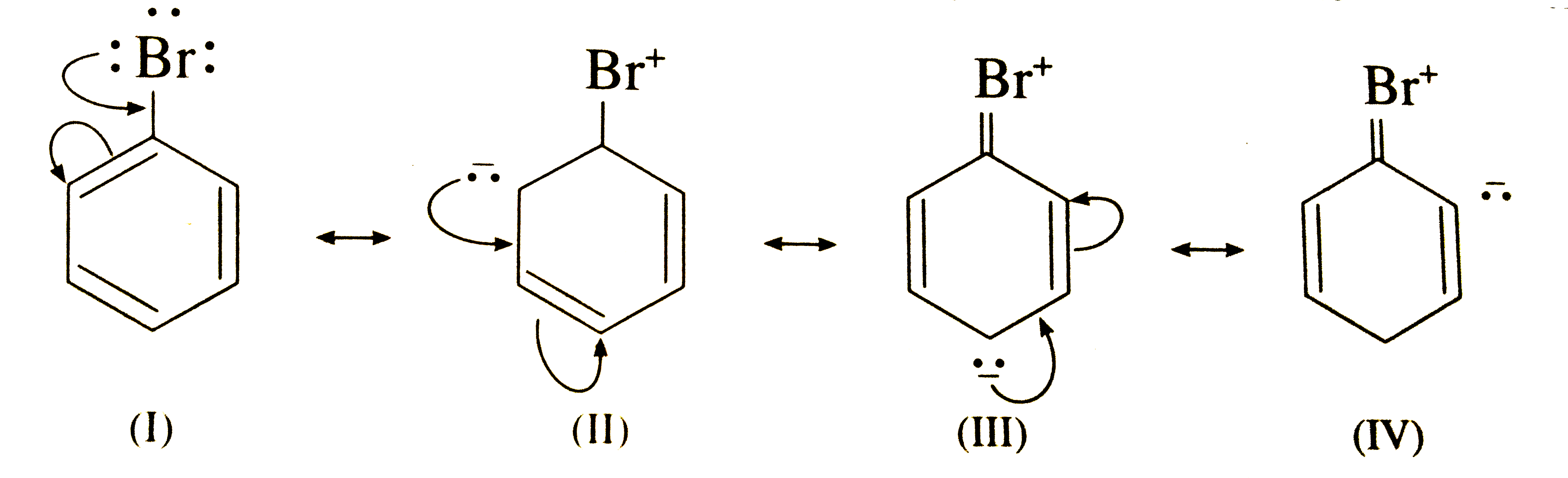 The resonating structures (II, III and IV) of bromobenzene shows negative charge at ortho and para positions. This INDICATES that electron density is relatively more at ortho and para positions. The inductive effect and resonance effect compete each other. However, inductive effect is stronger than resonance effect. Hence in bromobenzene, the reactivity is controlled by the stronger-I effect and the o, p orientation is controlled by the weaker resonance effect. |
|
| 2. |
Explain the influence of Planck's quantum theory on Bohr's model of structure of atom. |
|
Answer» Solution :Planck's Quantum Theory : (1) The emission of radiation is due to vibrations of charged particles (ELECTRONS )in the BODY. (2)The emission of a radiation is not continuous , but in discrete packets of energy called 'quanta' . This emitted radiation propagates in the form of waves . (3)The energy ASSOCIATED with each quantum (E) is given by `E=hupsilon` , where `upsilon` is the frequency of radiation and h is Planck's constant `(h=6.63xx10^(-27)"ergs")` (4) A body can emit or absorb either one quantum`(hupsilon)` of energy or some whole number multiples of it . Success of Planck's Quantum Theory : This theory successfully explains the black body RADIATIONS . A black body is a perfect absorber and also a perfect raditor of radiations . Explanation of Graph : The radiations emitted by a hot black body , when passed through a prism , produce a spectrum of different wavelengths . A plot of the 'intensity ' of radiation ' against 'wavelength ' gives a curve. Such curves obtained at different temperatures of a black body are shown in the graph . The following conclusions can be drawn from a study of the shapes of the curves . 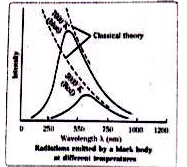 (i) At a given temperature , the intensity of radiation increases with wavelength, reaches a maximum and then decreases . (ii) As the temperature increases , the peak of the curve (maximum point in curve )shifts to lower wavelengths . The WAVE theory of light ' could not explain the above experimental results , satisfactorily . |
|
| 3. |
Explain briefly the formation of the products giving the structures of the intermediates |
|
Answer» |
|
| 4. |
Explain briefly the method for preparing gold sol. |
Answer» Solution :Gold sol is prepared by Bredig.s arc METHOD. In this method, the two electrodes of the METAL are DISPERSED in dispersion MEDIUM, e.g. water. The dispersion medium is kept cooled by surrounding it with a FREEZING mixture. 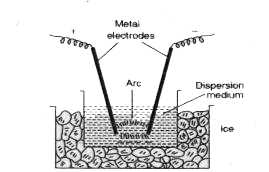 An electric arc is struck between the electrodes. The tremendous heat generated by the arc vapourises the metals which are condensed immediately in the liquid to give colloidal solution. The colloidal solution prepared is stabilised by adding a small amount of KOH to it. |
|
| 5. |
Explain briefly the collision theory of bimolecular reactions. |
|
Answer» Solution :(i) Collision theory is based on the kinetic theory of GASES. According to this theory, chemical reaction occurs as a result of collisions between the reacting molecules. (ii)Let us understand this theory by considering the following reaction. `A_(2)(g)+B_(2)(g)rarr 2AB(g)`  (iii)If we consider that, the reaction between `A_(2)` and `B_(2)` molecules proceeds through collisions between them, then the rate would be proportional to the number of collisions PER second. (iv)Rate `prop` number of molecules colliding per litre per second (collision rate). (v) The number of collisions is directly proportional to the concentraction of both `A_(2)` and `B_(2)`. Collision rate `prop [A_(2)][B_(2)]` Collision rate `= Z [A_(2)][B_(2)]` (vi)Where, Z is a constant The collision rate in gases can be calculated from kinetic theory of gases. (vii) For a gas at room temperature (298 K) and 1 atm pressure, each molecule undergoes approximately `10^(9)` collisions per second, 1 collision in `10^(-9)` second. (viii) THUS, if every collision resulted in reaction, the reaction would be complete in `10^(-9)` second. In actual practice this does not happen. (ix) It implies that all collisions are not effective to lead to the reaction. In order to react, the colliding molecules must possess a minimum energy called activation energy. (x) The molecules that collide with remain intact and no reaction occurs. (xi) Fraction of effective collisions (f) is given by the following expression `f=e^((-E_(2))/(RT))` (xii)To understand the magnitude of collision factor (f), Let us calculate the collision factor (f) for a reaction having activation energy of `100 "kJ mol"^(-1)` at 300 K. `-((100xx10^(3)"J mol"^(-1))/(8.314 "J K"^(-1)mol^(-1)xx300 K))` f = e `f=e^(-40)~~ 4xx10^(-18)` (xiii)Thus, out of `10^(18)`collisions only four collisions are sufficiently energetic to convert reactants to products. (xiv) This fraction of collisions is further reduced due to orientation factor i.e., even if the reactant collide with SUFFICIENT energy, they will not reactunless the orientation of the reactant molecules is suitable for the formation of the transition state. (xv) The figure illustrates the importance of proper alignment of molecules which leads to reaction.  (xvi)The fraction of effective collisions (f) having proper orientation is given by the steric factor p. `rArr "Rate " = p xx e^((-Ea)/(RT))xx Z[A_(2)][B_(2)]""`....(1) As per the rate LAW, Rate `= k [A_(2)][B_(2)] ""`....(2) Where k is the rate constant On comparing equation (1) and (2), the rate constant k is `k=p Z e^((-Ea)/(RT))` |
|
| 6. |
Explainbriefly how +2statesbecomesmoreand morestablein thefirsthalf of the firstrowtransition elementswithincreasingatomicnumber . |
|
Answer» SOLUTION :(i)It can beeasilyobservedthatexceptSc allothermetalsposses+2oxidatinstate. (ii)Also , on movingfrom SC toMn, theatomicnumberincreasingfrom 21 to 25 (iii)thismeansthe numberof electronsin the3d-orbitalalsoincreasesfrom1 to 5 . `Sc^(+2)= d^(1)` `Ti^(+2) = d^(2)` `V^(+2) = d^(3) ` `CrT^(+2) = d^(4)` `Mn^(+2) = d^(s)` (iv) + 2Oxidationstate isattained BYTHE loss ofthe two4 electrons by these metals (v)Sincethe numberof d electron in(+2)statealsoincreasesfrom `Ti^(+2)` to `Mn^(+2)`thestability of +2stateincreases (vi) As aresultd-orbitalis becomingmoreand morehalf- filled . |
|
| 7. |
Explain briefly how +2 states becomes more and more stable in the first half of the first row transition elements with increasing atomic number. |
|
Answer» Solution :`""_(21)SC ""_(22)TI""_(23)V""""_(24)Cr""_(25)Mn` Sc(Z=21)`1S^(2)2s^(2)2p^(6)3s^(2)3P^(6)4s^(2)3d^(1)` `Sc^(2+) [Ar] 3d^(1)Cr^(2+) [Ar] 4s^(1)3d^(1)` `Ti^(2+) [Ar] 3d^(2)Mn^(2+) [Ar] 3d^(5)` `V^(2+)[Ar]3d^(3)` With the increase in the atomic number, the d-orbital becomes HALF filled and they becomes more stable. |
|
| 8. |
Explain briefly seven types of unit cell. Seven types of unit cell, |
|
Answer» SOLUTION :(i) Cubic- `NaCl` (ii) Tetragonal- `TIO_(2)` (III) Orthorhombic - `BaSO_(4)` (iv) Hexagonal- `ZnO` (v) Monoclinic - `PbCrO_(4)` (vi) Triclinic - `H_(3)BO_(3)` (VII) Rhombohedral- Cinnabar They differ in the arrangement of their crystallographic axes and angles. Corresponding to the above seven, Bravis defined 14 possible crystal system as shown in the FIGURE. 
|
|
| 9. |
Explain briefly how +2 state becomes more and more stable in the first half of the first rowtransition elements with increasing atomic number. |
| Answer» Solution :Except scandium ( which shows an OXIDATION state of `+3)` , all other FIRST row transition elements show an oxidation state of `+2`. This is due to loss of two 4s ELECTRONS. In the first half, as we move from `Ti^(2+)` to `Mn^(2+)` , the electronicconfiguration changes from `3D^(2)` to` 3d^(5)` , i.e., more and more of d-orbitals are half- filled imparting greater and greater STABILITY to `+2` state. In the second half, i.e.,electrons in the 3d orbitals pair upand th enumber of half - filled orbital decreases. Hence, the stability of `+2` state decreases. | |
| 10. |
Explain briefly how +2 state becomes more and more stable in the first half of the first row transition elements with increasing atomic number ? |
| Answer» Solution :Except secandium (which shows an OXIDATION state of +3), all other first row transition elements show an oxidation state of +2. This is due to loss of two 4s electrons. In the first HALF, as we move from `Ti^(2+)` to `Mn^(2+)`, the electronic configuration changes from `3D^(2)` to `3d^(5)`, i.e., number of half-filled d-orbitals increases imparting greater and greater STABILITY to +2 state. In the second half, i.e., `Fe^(2+)` to `Zn^(2+)`, the electronic configuration changes from `3d^(6)` to `3d^(10)`, i.e., the number of half-filled orbital DECREASES. Hence, the stability of +2 state decreases. | |
| 11. |
Explain briefly how +2 state becomes more and more stable in the first half of the first row transition elements with increasing atomic number? |
|
Answer» Solution :Element (+2 state)`""_(21)Se^(2+) ""_(22)Ti^(2+) ""_(23)V^(2+) ""_(24)Cr^(2+) ""_(25)MN^(2+)` Electronic configuration `3D^1 3d^2 3d^3 3d^4 3d^5`. In all the elements listed, the removal of two 4S-electrons (in `Cr^(2+)`, i.e., from 4s and LE from 3d), the 3d-orbitals get gradually occupied. Since, the number of empty d-orbitals increases with increase in ATOMIC number of cations, so the stability of the cations `(M^(2+))` increases from `Sc^(2+)` to `Mn^(2+)`. |
|
| 12. |
Explain Boron neutron capture therapy. |
|
Answer» Solution :(i)The affinity of boron -10 for neutrons is the basis of a technique known as born neutron capture THERAPY (BNCT) of treating patients suffering from brai tumours. (ii) It is based on the nuclear reaction that occurs when boron -10 is irradiated with low-energy on the nuclear reaction that occurs when borin -10 is irradiated with low- energy THERMAL neutorna to give high linear energy `alpha`- particles and a Li-particles. (iii) Boron compounds are injected into a patient with a brain tumour and the compunds collect preferentially in the tumour. The tumour area is then irradiated with thermal neutron and results int eh release of an alpha-particle that damages the tissue in the tumour each TIME a boron -10 nucleus captures a neutron. (iv) In this way damages can be limited preferentially to the tumour, leaving the normal brain tissue less affected. (v) BNCT has also been studied as a treatment for several other tumours of the HEAD and NECK, The breast, the prostate, the bladder and the liver. |
|
| 13. |
Explain bonding in coordination compounds in terms of werners postulates . |
| Answer» SOLUTION :for ANSWER CONSULT, SECTION 9. | |
| 14. |
Explain boiling point of elevation constant for a solvent or Ebullioscoplc constant. |
|
Answer» SOLUTION :We know that , `Delta T_(b) = K_(b)`m where m = 1, `Delta T_(b) = K_(b)` . Thus, elevation of boiling CONSTANT is equal to the elevation in boiling point when 1 MOLE of a solute is dissolved in 1 kg of SOLVENT. It is also called EBULLIOSCOPIC constant. |
|
| 15. |
Explain bleaching action of chlorine. Or Cl_(2) acts as a bleaching agent. Or Bleaching of flowers by chlorine is permanent while that by sulphur dioxideis temporary. Explain. |
|
Answer» SOLUTION :In presence of moisture or in aqueous solution, `Cl_(2)` releases nascent oxygen which oxidises organic colouring material to colourless material. Thus, bleaching by `Cl_(2)` is by oxidation and hence permanent. `{:(""Cl_(2) + H_(2)O rarr 2 HCl + [O] ("nascent oxygen")),("Coloured material" + [O] rarr "Colourless material"):}` In contrast, in presence of moisture, `SO_(2)` liberates nascent hydrogen which REDUCES coloured material to colourless material. Thus, bleaching by `SO_(2)` is by reduction and hence temporary. `{:(""SO_(2)+2H_(2)O rarr H_(2)SO_(4) + 2 [H] ("nascent hydrogen")),("Colourless substance" + [H] rarr "Colourless material"):}` |
|
| 16. |
Explain biological oxidation with an example. |
|
Answer» Solution :Biological oxidation is the fermentation of the food consumed by an animal produces ALCOHOL. To detoxify the alcohol, theliver produces an enzyme CALLED alcohol dehydrogenase (ADH). Nicotinamide ADENINE dinucleotide (NAD) present in the animals ACTS as a oxidising agent and ADH catalyses the oxidation of toxic alcohols into non-toxic aldehyde. `underset("Ethanol")(CH_3-CH_2OH) + NAD^(+) overset("ADH")to underset("Ethanal")(CH_3CHO) + NADH + H^(+)` |
|
| 17. |
Explain Baltz- schieman reaction. |
|
Answer» Solution :When benzene diazonium CHLORIDE is treated with fluoroboric acid, benezene diazonium tetra fluoroborate is precipitated which on heating decompises to give FLUOROBENZENE. `C_(6)H_(5)N_(2)""^(+)Cl^(-)+underset("Fluoroboric acid")(HBF_(4))tounderset("Benzenediazonium fluoroborate")(C_(6)H_(5)-N_(2)""^(+)BF_(4)^(-) OVERSET(DELTA)(to) underset("Fluorobenzene")(C_(6)H_(5)-F)+N_(2)uarr+BF_(3)` |
|
| 18. |
Explain auto-oxidation of ether. |
|
Answer» Solution :When ethers are stored in the presence of atmospheric oxygen, they slowly oxidise to FORM hydroperoxides and dialkylperoxides.These are explosive in NATURE. Such a spontaneous OXIDATION by atmospheric oxygen is called AUTOOXIDATION. `CH_(3)-CH_(2)-O-CH_(2)-CH_(3) overset("oxygen"(O))underset("slow") to CH_(3)-underset("1-ethoxyethyl hydroperoxide")(CH_(2))-O-overset(O-O-H)overset(|)CH-CH_(3)+ CH_(3) - CH_(2)-underset("diethylperoxide")(O-O-CH_(2)-CH_(2))` |
|
| 19. |
Explain average rate or reaction for hypothetical Rto P reaction. |
|
Answer» Solution :Consider a hypothetical reaction ,assuming that the volume of the system remain constant. Reaction:`RtoP` Suppose at `t_(1)` time concentration of R=`[R]_(1)` Suppose at `t_(2)` time concentration of R=`[R]_(2)` So `Deltat=(t_(2)-t_(1))` Decrease in concentration of reactant `DeltaR=[R]_(2)-[R]_(1)` `therefore` The rate of decrease in concentration of reactant `R=-(Delta[R])/(Deltat)=("decrease in concentration of R")/("time required for that")` ......(i) At `t_(2)` time concentration of product =`[P]_(1)` So in `Deltat=(t_(1)-t_(1))` INCREASE in concentration of product is `DeltaP=[P]_(2)-[P]_(1)` `P=("Increase in concentration of P")/("time require for that")+(Delta[P])/(Deltat)`.....(ii) From EQUATION (i) and (ii) `"Average rate"=(Delta[R])/(DETAT)=+(Delta[P])/(Deltat)` Note:(i)In equation [ ]indicate concentration . (ii)Since `Delta[R]` is negative QUANTITY (as concentration is decreasing).It is multipled with -1 to make the rate of reaction a positive quantity. |
|
| 20. |
Explain Auto reduction. |
|
Answer» SOLUTION :Simple roasting of some of the ores give the CRUDE STANDARD Crude metal.In such cases,the use of reducing agents is not necessary .For EXAMPLE ,mercury is obtained by roasting of its ore CINNABAR (HgS) `HgS_((s))+O_(2(g))toHg_(1)+SO_(2)` |
|
| 21. |
Explain as to why haloarenes are much less reactive than haloalkenes towards nucleophilic substitution reactions. |
|
Answer» Solution :HALOARENES are less reactive than HALOALKANES towards nucleophilic SUBSTITUTION due to the following reasons : (i) Resonance EFFECT : Due to resonance with benzene ring, there is partial double bond character in C-Cl bond. Bond cleave in haloarenes is difficult compared to that in haloalkanes. (II) Difference in hybridisation of carbon atom in C-X bond : Carbon attached to halogen in haloalkanes is `sp^(3)`hybridised while that in haloarene is `sp^(2)`hybridised. `sp^(2)`hybridised carbon is more electronegative because of greater s character, it holds the electrons more tightly, giving less charge to halogen. (iii) It is difficult for electron rich nucleophiles to approach electron rich benzene ring in haloarenes. |
|
| 22. |
Explain Artificial Sweetening Agents. |
|
Answer» Solution :Sucrose : It add to calorie intake and therefore many people prefer to use artificial sweeteners. Some other commonly marketed artificial sweeteners are given in below table.  Aspartame : It is the most successful and widely used artificial sweetener. It is roughly 100 times as sweet as cane sugar. It is methyl ester of dipeptide formed from aspartic acid and phenylalanine. Use of aspartame is limited to cold foods and soft drinks because it is unstable at cooking temperature. Saccharin : It is called ortho-sulphobenzimide, also called saccharin, is the first POPULAR artificial sweetening agent. It has been used as a sweetening agent ever since it was discovered in 1879. It is about 550 times as sweet as cane sugar. It is excreted from the body in URINE unchanged. It appears to be entirely inert and harmless when taken. Its use is of great value to diabetic persons and people who need to control intake of calories. Sucralose : Sucralose is TRICHLORO derivative of sucrose. Its appearance and taste are like sugar. It is stable at cooking temperature. It does not provide calories. Alitame : It is high potency sweetener, although it is more stable than aspartame, the control of SWEETNESS of food is DIFFICULT while using it. |
|
| 23. |
Explain applications of Ellingham diagram in the selection of a reducing agent for the reductionof metal oxides. |
|
Answer» SOLUTION :(1) `DeltaG` for the formation of `Al_(2)O_(3)` is `-1080 kJ "mol"^(-1)` Which is more negativehence `Al_(2)O_(3)` is more stable, while `DeltaG` for the formation of `Cr_(2)O_(3)` is `-675 kJ "mol"^(-1)` WHICHIS comparatively less stable, and lies above `Al_(2)O_(3)` in Ellingham diagram. Hence `Al` is used to reduce `Cr_(2)O_(3)` to metal `Cr.` `Cr_(2)O_(3) + 2Al rarr Al_(2)O_(3)+2Cr DeltaG = - 421 kJ` `DeltaG = -1080 - (-675) = - 405 kJ "mol"^(-1)` Therefore any metal can reduce other metal oxide above it in the diagram. (2) The metal OXIDES having low negative values of `DeltaG` for the formation are unstable and can be decomposed on heating at moderat temperatures. For example. `2Ag_(2)O overset(600K)rarr4Ag + O_(2)` (3) When carbon is used as a reducing AGENT, it FAVOURABLY forms `CO_(2)` below `1000 K` while it forms CO above 1000 K, Which can be explained by Ellingham diagram. |
|
| 24. |
Explain any one of the following statements : (i) The transition metals are well-known for the formation of interstitial compounds. (ii) The largest number of oxidation states are exhibited by manganese in the first series of transition elements. |
|
Answer» Solution :(i) This is because they have voids in which small atoms of C and H can fit FORMING interstitial COMPOUNDS. (ii) Mn(25): `4s^(2)3d^(5)` have five unpaired ELECTRONS in d-orbitals and two electrons in s-orbital which can take part in bond formation. Therefore, it shows maximum number of oxidation states. |
|
| 25. |
Explain application of Charle’s Law for the case of Hot Air Balloons. |
| Answer» SOLUTION :Since Charles Law says that the volume of a gas is directly related to the TEMPERATURE of that gas, that when a gas is heated, like the burner in a HOT air balloon, the gas EXPANDS. So when the air inside the balloon expands, it becomes LESS dense and provides the lift for the hot air balloon. | |
| 26. |
Explain any one method for coagulation |
|
Answer» Solution :The flocculation and setting down of the sol particles is called coagulation. Various method of coagulation are given below: (i) Addition of electrolytes (ii) Electrophoresis (iii) Mining oppositively charged sols. (iv) Boiling. Addition of electrolytes A negative ion causes the precipitation of positively charged sol and vice versa. When the valency of ion is high, the precipitation power is increased. For example, the precipitation power of some cations and anions varies in the following order `Al^(3+) GT Ba^(2+) gt Na^(+)`. Similarly `[Fe(CN)_(6)]^(3-) gt SO_(4)^(-2) gt Cl^(-)` The precipitation power of electrolyte is determined by FINDING the minimum CONCENTRATION (millimoles/lit) required to cause precipitation of a sol in 2hours. This value is called flocculation value. The smaller the flocculation value greater will be precipitation. |
|
| 27. |
Explain antimicrobials drug. |
|
Answer» Solution :Diseases in human beings and animals may be caused by a variety of microorganisms such as bacteria, virus, fungi and other pathogens. The drug which is used to destroy/prevent the development or inhibit the pathogenic action of microbes such as bacteria (antibacterial drugs), fungi (antifungal agents), virus (antiviral agents), or other parasites (antiparasitic drugs) selectively. Antibiotics, antiseptics and disinfectants are antimicrobial drugs. (i) Antibiotics : Chemical substances produced by microorganisms which can destroy or inhibit the growth of microorganisms because of their low toxicity for humans and animals are called antibiotics. Antibiotics are used as drugs to treat infections because of their low toxicity for humans and animals. Initially antibiotics were classified as chemical substances produced by microorganisms that inhibit the growth or even destroy microorganisms. The development of synthetic methods has helped in synthesising some of the compounds that were originally discovered as products of microorganisms. ALSO, some purely synthetic compounds have antibacterial activity and therefore, definition of antibiotic has been modified. An antibiotic now refers to a substance produced wholly or partly by chemical synthesis, which in low concentrations inhibits the growth or destroys microorganisms by intervening in their METABOLIC processes. The search for chemicals that would adversely affect invading bacteria but not the host began in the nineteenth century. Paul Ehrlich, a German bacteriologist, conceived this idea. He investigated arsenic based structures in order to produce less toxic substances for the treatment of syphilis. He developed the medicine, arsphenamine, known as salvarsan. Paul Ehrlich got Nobel prize for Medicine in 1908 for this discovery. It was the first effective treatment discovered for syphilis. Although salvarsan is toxic to human beings, its effect on the bacteria, spirochete, which causes syphilis is much greater than on human beings. At the same time, Ehrlich was working on azodyes also. He noted that there is similarity in structures of salvarsan and azodyes. The `-As = As-` linkage present in arsphenamine resembles the `-N = N -` linkage present in azodyes in the sense that arsenic atom is present in place of nitrogen. He also noted tissues getting coloured by DYES selectively. Therefore, Ehrlich began to search for the compounds which resemble in structure to azodyes and selectively bind to bacteria. In 1932, he succeeded in preparing the first effective antibacterial agent, prontosil, which resembles in structure to the compound, salvarsan. Soon it was discovered that in the body prontosil is converted to a compound called sulphanilamide, which is the real active compound. Thus the sulpha drugs were discovered. A large range of sulphonamide analogues was synthesized. One of the most effective is sulphapyridine.  Despite the success of sulfonamides, the real revolution in antibacterial therapy began with the discovery of Alexander Fleming in 1929, of the antibacterial properties of a Penicillium fungus. Isolation and purification of active compound to accumulate sufficient material for clinical trials took thirteen years. Antibiotics have either cidal (killing) effect or a static inhibitory) effect on microbes. A few examples of the two types of antibiotics are as follows:  PENICILLIN - Erythromycin Aminoglycosides Tetracycline Ofloxacin Chloramphenicol The range of bacteria or other microorganisms that are affected by a certain antibiotic is expressed as its spectrum of action. Antibiotics which kill or inhibit a wide range of Gram-positive and Gram-negative bacteria are said to be broad spectrum antibiotics. Those effective mainly against Gram-positive or Gram-negative bacteria are narrow spectrum antibiotics. If effective against a single organism or disease, they are referred to as limited spectrum antibiotics. Penicillin G has a narrow spectrum. Ampicillin and Amoxycillin are synthetic modifications of penicillins. These have broad spectrum. It is absolutely essential to test the patients for sensitivity (allergy) to penicillin before it is administered. In India, penicillin is manufactured at the Hindustan Antibiotics in Pimpri and in private sector industry.  Chloramphenicol, isolated in 1947, is a broad spectrum antibiotic. It is rapidly absorbed from the gastrointestinal tract and hence can be given orally in case of typhoid, dysentery, acute fever, certain FORM of urinary infections, meningitis and pneumonia.  Vancomycin and ofloxacin are the other important broad spectrum antibiotics. The antibiotic dysidazirine is supposed to be toxic towards certain strains of cancer cells. Vancomycin and ofloxacin are the other important broad spectrum antibiotics. The antibiotic dysidazirine is supposed to be toxic towards certain strains of cancer cells.
|
|
| 28. |
Explain Antiseptics and disinfectants. |
|
Answer» Solution :(ii) Antiseptics : Antiseptics are APPLIED to the living tissues such as wounds, cuts, ulcers and diseased skin surfaces. Examples are furacine, soframicine, etc. These are not ingested like antibiotics. Commonly used antiseptic, dettol is a mixture of chloroxylenol and terpineol.  Bithionol (the compound is also called BITHIONAL) is added to soaps to impart antiseptic properties.  lodine is a powerful antiseptic. Its `2-3` per cent solution in alcoholwater mixture is known as tincture of iodine. It is applied on wounds. IODOFORM is also used as an antiseptic for wounds. Boric acid in dilute aqueous solution is weak antiseptic for eyes. (iii) Disinfectants : Disinfectants are applied to inanimate objects such as floors, drainage system, instruments, etc. Same substances can act as an antiseptic as well as DISINFECTANT by varying the concentration. For example, 0.2 per cent solution of PHENOL is an antiseptic while its one per cent solution is disinfectant. Chlorine in the concentration of 0.2 to 0.4 ppm in aqueous solution and sulphur dioxide in very low concentrations, are disinfectants. |
|
| 29. |
Explain Antifertility Drugs. |
|
Answer» Solution :Antibiotic revolution has PROVIDED long and healthy life to people. The life expectancy has almost doubled. The increased population has caused many social problems in terms of food resources, environmental ISSUES, employment, etc. To control these problems, population is required to be controlled. This has lead to the concept of family planning. Antifertility drugs are of use in this direction. BIRTH control pills essentially contain a mixture of synthetic estrogen and progesterone derivatives. Both of these COMPOUNDS are HORMONES. It is known that progesterone suppresses ovulation. Synthetic progesterone derivatives are more potent than progesterone. Norethindrone is an example of synthetic progesterone derivative most widely used as antifertility drug. The estrogen derivative which is used in combination with progesterone derivative is ethynylestradiol (novestrol). 
|
|
| 30. |
Explain antiferromagnetism. |
|
Answer» Solution : The substances that have zero magnetic MOMENT despite of having an UNPAIRED electrons are called anti-ferromagnetic SUBSTANCE. In anti ferromagnetic substances domain structure is similar to ferromagnetic substance, but are ORIENTED in opposite directions cancelling each other.s magnetic moment. 
|
|
| 31. |
Explain anisotropy in solids with the help of a diagram. |
Answer» Solution :There is a difference in the arrangement of PARTICLES along AB and along CD. Similarly arrangement in any other direction will be different. Due to this, PROPERTIES like ELECTRICAL resistance and refractive index will be different in different directions. This is called anisotropy. 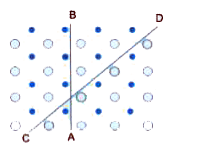
|
|
| 32. |
Explain Anionic detergentswith suitable examples ? |
| Answer» SOLUTION :Those in which ANIONIC part of the molecule is involved in cleansingaction. E.g., SODIUM laurylsulphate. | |
| 33. |
Explain an spirit is an azotropic mixture. How will you prepare absolute alcohol form rectifide spirit ? |
| Answer» SOLUTION :Maximym BOILING : 20.2 % HCI and 79.8% WATER by MASS | |
| 34. |
ADIABATIC PROCESS |
|
Answer» Solution :Adiabatic process : It is a process in which there is no exchange of heat ENERGY between the system and its surroundings HENCE, q = 0 . (a) An adiabatic process is carried out in an isolated system. (b) In adiabatic process is carried out in an isolated system. (b) In this process, TEMPERATURE and internal energy of a system change, `DeltaTne 0, DeltaU ne 0.` |
|
| 35. |
Explain ammonolysis reaction of acid chloride (or) what happens when ammonia reacts with acetyl chloride? |
| Answer» SOLUTION :`underset("Acetyl chloride")(CH_3-undersetoverset(||)(O)(C ) - CL )underset("AMMONIA")(H-NH_2) overset(Delta)(to) underset("acetamide")(CH_3-undersetoverset(||)(O)(C ) - NH_2 + HCL)` | |
| 36. |
Explain Aluminothermic process. |
|
Answer» SOLUTION :Metallic OXIDES such as `Cr_(2)O_(3)` can be reduced by an aluminothermic process. Inthis process, the metal oxide is mixed with aluminium powder and placed in a fire clay crucible. To initiate the reduction process, an ignition mixture (USUALLY magnesium and barium peroxide)is used. `"BaO"_(2)+Mg to"BaO"+"MgO"` During the above reaction a large amount of heat is EVOLVED (temperature upto `2400^(@)C`, is generated and the reaction enthalpy is : `852" kJ mol"^(-1)`)which facilitates the reduction of `Cr_(2)O_(3)` by aluminium power. `"Cr"_(2)"O"_(3)+2Al overset(Delta)to2Cr+Al_(2)O_(3)` |
|
| 37. |
Explain Allosteric site. |
|
Answer» Solution :(ii) Some drugs to not bind to the enzyme’s active site. These bind to a different site of enzyme which is called allosteric site. This BINDING of inhibitor at allosteric site CHANGES the shape of the active site in such a way that substrate cannot recognise it.  If the bond formed between an enzyme and cannot be broken easily, then the enzyme is BLOCKED permanently. The BODY then degrades the enzyme - inhibitor complex and synthesises the NEW enzyme. |
|
| 38. |
Explain aldol condensation with an example. |
Answer» Solution :When aldehydes and ketones containing at least one `alpha-H` atom undergoes SELFCONDENSATION reaction in presence of dilute alkali such as `NaOH//KOH` as CATALYST to form `beta-`hydroxy aldehyde CALLED aldol `beta-` HYDROXYL ketones called ketols respectively. This reaction is known as aldol condensation. 
|
|
| 39. |
Explain adsorption from solution phase. |
|
Answer» Solution :Solid can absorb solutes from solutions also. When a solution of ACETIC acid in water is shaken with charcoal, a part of the acid is adsorbed by the charcoal and the concentration of acid decreases in the solution. Similarly, the litmus solution when shaken with charcoal becomes colourless. The precipitate of `Mg(OH)_(2)` attains blue colour when precipitated in presence of magneson reagent. The colour is due to adsorption of magneson. The following observations have been made in the case of adsorption from solution phase : (i) The extent of adsorption decreases with an increase in temperature. (ii) The extent of adsorption increases with an increase of surface area of the absorbent. (iii) The extent of adsorption depends on the concentration of the solute in solution. (iv) The extent of adsorption depends on the nature of the adsorbent and the adsorbate. The precise mechanism of adsorption from solution is not known. Freundlich.s equation approximately describes the behaviour of adsorption from solution with a difference that instead of pressure, concentration of the solution is taken into account, i.e. `(x)/(m)=kC^((1)/(n))` (C is thc cquilibrium concentration, i.e. when adsorption is complete). On taking logarithm of the above equation we have, `log.(x)/(m)=LOGK+(1)/(n)logC` Plotting `log.(x)/(m)` against log C a straight line is obtained which shows the validity of Freundlich isotherm. This can be TESTED experimentally by taking solution of different concentrations of acetic acid. EQUAL volumes of solutions are added to equal AMOUNT of charcoal in different flasks. The final concentration is determined in each flask after adsorption. The difference in the initial and final concentrations give the value of x. Using the above equation, validity of Freundlich isotherm can be established. |
|
| 40. |
Explain Aldol condensation reaction for acetaldehyde. Write equation. |
|
Answer» Solution :A ` beta`- hydroxy aldehyde is known as aldol . It is produced by the condensation REACTION of two molecules of the same or one molecule each of two different aldehydes in the presence of a base. `underset("ETHANAL")(2CH_3CHO ) OVERSET("DIL." NaOH)to underset(3-"Hydroxybutanal")(CH_3- underset(OH)underset(|) CH - CH_2 - CHO )` |
|
| 41. |
Explain aldol condensation taking CH_3-CHO as example. |
|
Answer» ALDEHYDES with `ALPHA` hydrogen atom when treated with dilute NaOH give `beta`-hydroxy aldehyde or KETONE. The reaction is called aldol condensation. |
|
| 42. |
Explain addition polymerisation with an example. |
|
Answer» SOLUTION :ADDITION POLYMER are obtained by the direct addition of MONOMERS Example : POLYTHENE, Telfon etc. |
|
| 43. |
Explain action of heat on borax. |
|
Answer» Solution :On heating borax, it forms a transparent borax beads. `Na_(2)B_(4)O_(7).10H_(2)Otounderset(-10H_(2)O)overset(Delta)(to)Na_(2)B_(4)O_(7)to2NaBO_(2)+B_(2)O_(3)` |
|
| 44. |
Explain actinoid contraction |
|
Answer» Solution :In actinoid series, there is over all decrease in the ionic radii (`M^(3+)` ions) and atomic radii ACROSS the series with the increase in atomic number. This is known as actinoid contraction. Moving across the series, with the increase in atomic number, the electrons are ADDED successively in 5f- orbital and nuclear charge increases. As one electron in 5f is not effective in sheilding ANOTHER electron, the effective nuclear charge experienced by 5f electrons increases which cause in REDUCTION of size of atom or ion. This is known as actinoid contraction. As compared to lanthanoids, the contraction is more in actinoid because the 5f orbital have poorer sheilding effect than 4f orbitals (in lanthanoids). Hence effective nuclear charge experienced by electrons in CASE of actinoids is more |
|
| 45. |
Explain acidified KMnO is a powerful oxidising agent with 5 examples. |
|
Answer» Solution :In the presence of dilute sulphuric acid, potassium PERMANGANATE acts as a very strong oxidising AGENT, Permanganate ions is converted into `Mn^(2+)` ion. `MnO_(4)^(-)+ 8H^(+)+ 5e^(-) to Mn^(2+)+ 4 H_(2)O` Example: (i) Potassium permanganate oxidises ferrous salts to ferric salts. `2MnO_(4)^(-)+ underset("Ferrous salts")(10Fe^(2+)) + 16H^(+) to2Mn^(2+) + underset("Ferric salts")(10Fe^(3+)) + 8H_(2)O` (ii) Potassium permanganate oxidises iodide ions to iodine. `2MnO_(4) + 10I^(-) + 16H^(+) to2Mn^(2+) + 5S +8H_(2)O` (iii) Potassium permanganate oxidises sulphide ion to sulphur. `2MnO_(4)^(-) + 5S^(2-) + 16H^(+) to2Mn^(2+) +5S + 8H_(2)O` (iv) Potassium permanganate oxidises oxalic acid to CO. `2MnO_(4)^(-)+5(COO)_(2)- + 16H^(+) to 2Mn^(2+) + 10CO_(2) +8H(2)O` v) Potassium permanganate oxidises alcohols to aldehyde. `2KMnO_(4) +3H_(2)SO_(4) + 5CH_(3)CH_(2)OH to 2K_(2)SO_(4) + 2MnSO_(4) + 5CH_(3)CHO +8H_(2)O` |
|
| 46. |
Explain abut conductivity cell with an example. |
|
Answer» Solution :`•` SODIUM chloride (or) potassium chloride is dissolved in a solvent like water, the electrolyte is completely dissociated to give its constituent IONS (cations and anions). `•` When an ELECTRIC FIELD is applied to such an electrolytic solution, the ions PRESENT in the solution carry charge from one electrode to another electrode and thereby they conduct electricity. `•` The conductivity of the electrolytic solution is measured using a conductivity cell. 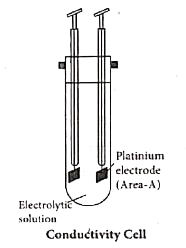
|
|
| 47. |
Explain about ultrasonic dispersion. (or) How would you prepare mercury colloid? |
|
Answer» Solution :(i) Sound waves of frequency more than 20kHz (AUDIBLE limit) could cause transformation of COARSE suspension to colloidal solution. (ii) Claus OBTAINED mercury sol by subjecting mercury to sufficiently high frequency ultrasonic vibrations. (iii) The ultrasonic vibrations PRODUCED by GENERATOR spread the oil and transfer the vibration to the vessel with mercury in water. |
|
| 48. |
Explain about ultrafiltration. |
|
Answer» Solution :(i) The pores of ordinary filter papers permit the passage of colloidal SOLUTIONS. In ultrafilteration, the membranes are made by USING collodion, cellophane or visiking. (ii) When a colloidal solution is filtered using such a filter, colloidal PARTICLES are separated on the filter and the impurities are removed as washings. (iii) This process is quickened by application of pressure. The separation of sol particles from ELECTROLYTE by filtration through an ultrafilter is called ultrafiltration. (iv) Collodian is 4% solution of nitrocellulose in a mixture of ALCOHOL and water. |
|
| 49. |
Explain about the various protrction methods to prevent corrosion. |
|
Answer» Solution :(i) Coating metal surface by paint. (ii) Galvanizing: By coating with another metal such as zinc. Zinc is stronger oxidising agent than iron and hence it can be more EASILY corroded than iron. i.e., instead of iron, zinc is oxidised. (iii) Cathodic protection : In this technique, unlike galvanizing, the entire surface of the metal to be protected need not be covered with a protecting metal instead, metals such as Mg (or) Zn which is corroded more easily than iron can be used as sacrificail ANODE and the iron meterial act as cathode. So iron protected but Mg or Zn GETS corroded. (iv) Passivation: The metal is treated with strong oxidising agent such as Conc. `HNO_3`. As a result, a protective layer is formed on the surface of the metal. (v) Alloy formation : The oxidising tendency of iron can be reduced by forming its alloy with other more anodic metals. Example : STAINLESS steel, an alloy of Fe and Cr. |
|
| 50. |
Explain about the various dehydration reactions of ethylene glycol. |
|
Answer» Solution :Ethylene GLYCOL UNDERGOES dehydration reaction under different conditions to form different products. (i) When ethylene glycol is heated to 773K. it FORMS epoxides 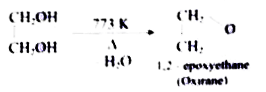 (ii) When heated with dilute sulphurie acid (or) anhydrous `ZnCl_2` under pressure in a SEALED tube, it gives acetaldehyde  (ii) When distilled with CONC.`H_2SO_4`. glycol forms 1, 4-dioxane 
|
|