Saved Bookmarks
This section includes 7 InterviewSolutions, each offering curated multiple-choice questions to sharpen your Current Affairs knowledge and support exam preparation. Choose a topic below to get started.
| 2. |
Element of which group form anions most readily |
|
Answer» OXYGEN family |
|
| 3. |
Element present in the volcanic ashes is ………………. . |
| Answer» Solution :Sulphur | |
| 5. |
Element of atomic number 23 is placed in the periodic table in |
|
Answer» s-block |
|
| 6. |
Element of atomic number 24 belongs to |
|
Answer» s-block |
|
| 7. |
Element furnishing coloured ions in the aqueous medium is |
|
Answer» Zn |
|
| 8. |
Element found in plant systems which forms an important constituent of photosynthesis is: |
|
Answer» Fe |
|
| 9. |
Element easily reducible is : |
|
Answer» Fe |
|
| 10. |
Element E has bcc crystal arrangement, if its unit cell has edge length of 1.469 xx 10^(-10)meter, then atomic radius of this element is .... meter. |
|
Answer» `2.252 XX 10^(-8)` |
|
| 11. |
Element corresponding to which of these//this atomic number belongs to p-block in Modern Periodic Table: |
|
Answer» 19 |
|
| 12. |
Element 'A' having 5 electrons in its valence shell and principle quantum number value for last electron is 3. The 'ic' acid of element 'A' is tribasic acid and its corresponding salts is known as 'atc' salt. The 'ous acid' 'A' is dibasic acid and its corresponding salts is known as 'its' salts. [''For example : The salt of sulphuric acid is sulphate salt '' and the salt of sulfurous acid is sulphite salt] nxx'ic' acid 'A' -H_(2)O=(y)_(n), if n = 3 How many atoms are sp^(3) hybridised in 'y' ? |
|
Answer» 9 
|
|
| 13. |
Element A has 3 electron in the outermost orbit andelement B has 7 electrons in the outermost orbit.The formula of the compound formed between A and B would be |
|
Answer» ` A_2B_3` |
|
| 14. |
Element A burns innitrogento give an ions compound B reactswith water to give C and D .Asolution of chemes ''milky'' on bubbling carbon dioxide identify A,B,C and D |
|
Answer» SOLUTION :The gives DATE SUGGEST the following reactions `underset((A))(3Ca) +N_(2) rarr underset((B))(Ca_(3)N_(2))` `ca_(3)N_(2) + 6H_(2)O rarrunderset((C))( 3Ca(OH)_(2)) + underset((D)) (2NH_(3))` `underset((E))(Ca(OH)_(2)) +CO_(2) rarr CaCO_(3) +H_(2)O` It is giventhat a solution of C Become 'milk'` on bubblingcarbon dioxide .Therefore it must becalciumor bariumhydroxidewhich is morethanmagnessiumhydroxide. |
|
| 15. |
Element A (atomic mass 112) and element B (atomic mass 27) form chlorides . Solutoins of these chlorides are electrolysed separately and it is found that the same quantity of electricity is passed 5.6 gm of A deposited while only 0.9 gm of B was deposited . if the valency of B is 3 , the valency of A is |
|
Answer» 2 Equivalent mass of B = `("Atomic mass")/("valency") = (27)/(3) = 9` `("Mass of A")/("Mass of B") = ("Equivalent mass of A")/("Equivalent mass of B") = (5.6)/(0.9)` `THEREFORE (112//x)/(9) = (5.6)/(0.9)` `therefore x = (112 xx 0.9)/(9 xx 5.6) = 2` Valency of A = 2 |
|
| 16. |
Element A( atomic mass 112) and element B (atomic mass 27) from chlorides. Solutions of these chlorides are electrolysed seperately and it is found that when the same quantity of electricity is passed 5.6 g of A was deposited while only 0.9 g if B was deposited. If the valency of B is 3, then the valency of A is _________. |
|
Answer» 2 |
|
| 17. |
Elemantary unimolecular reactions have first order rate laws, elementary bimolecular reactions have second order rate laws. A rate law is often derived from a proposed mechanism by imposing the state approximation or by assuming that there is a pre -equilibrium. A proposed mechanism must be consistent with the experiment rate law. In a gas phase reaction, a reaction takes place only if the reactant molecules get________________during the molecular collisions |
|
Answer» threshold energy |
|
| 18. |
Elemantary unimolecular reactions have first order rate laws, elementary bimolecular reactions have second order rate laws. A rate law is often derived from a proposed mechanism by imposing the state approximation or by assuming that there is a pre -equilibrium. A proposed mechanism must be consistent with the experiment rate law. The molecularity of the elementary reaction C_(2)N_(2)to2CN is |
|
Answer» zero |
|
| 19. |
Elemantary unimolecular reactions have first order rate laws, elementary bimolecular reactions have second order rate laws. A rate law is often derived from a proposed mechanism by imposing the state approximation or by assuming that there is a pre -equilibrium. A proposed mechanism must be consistent with the experiment rate law. The decomposition of O_(3) obeys themechanism give below Step 1: O_(3)hArrO_(2)+(O) (both forward and backward reactions are fast) Step 2: O_(3)+(O)overset("slow")(to)O_(2)+O_(2) (ignore) backward reaction), the rate of reaction is given by |
|
Answer» `k[O_(3)]^(2)[O_(2)]` |
|
| 20. |
'Elektron'' is an alloy of |
|
Answer» MG and Zn |
|
| 21. |
Electrorefining is used for |
|
Answer» NA |
|
| 22. |
Electrophilic subsitution reaction in phenol take place at : |
|
Answer» p-position |
|
| 23. |
Electrophilic substitution in pyridine preferably occurs at position |
|
Answer» `alpha` |
|
| 24. |
Electrophilic substitution in phenol takes place at |
|
Answer» ORTHO and para-positions |
|
| 25. |
Electrophilic substitution in case of aromatic amines takes place more readily than in benzene. Explain. |
| Answer» SOLUTION :It is because `NH_2` GROUP is ELECTRON releasing and increases electron DENSITY on benzene ring at 2.4 and 6 positions. | |
| 26. |
Electrophilic substitution in phenol takes place at _______ position. |
|
Answer» <P>o- and p- position |
|
| 27. |
Electrophilic substitution in case of aromatic amines takes place more readily than benzene. Why? |
| Answer» Solution :Due to RESONANCE, the electrons on the N-atom in aniline are delocalized over the benzene RING. As a result, the electron DENSITY on the benzene ring increases as compared to benzene itself. In other words, aniline GETS ACTIVATED and hence electrophilic substitution occurs more readily in aniline. | |
| 28. |
Electrophilic substitution in aromic amines can be carried out by _________ the -NH_(2) group by acetylation. |
|
Answer» |
|
| 29. |
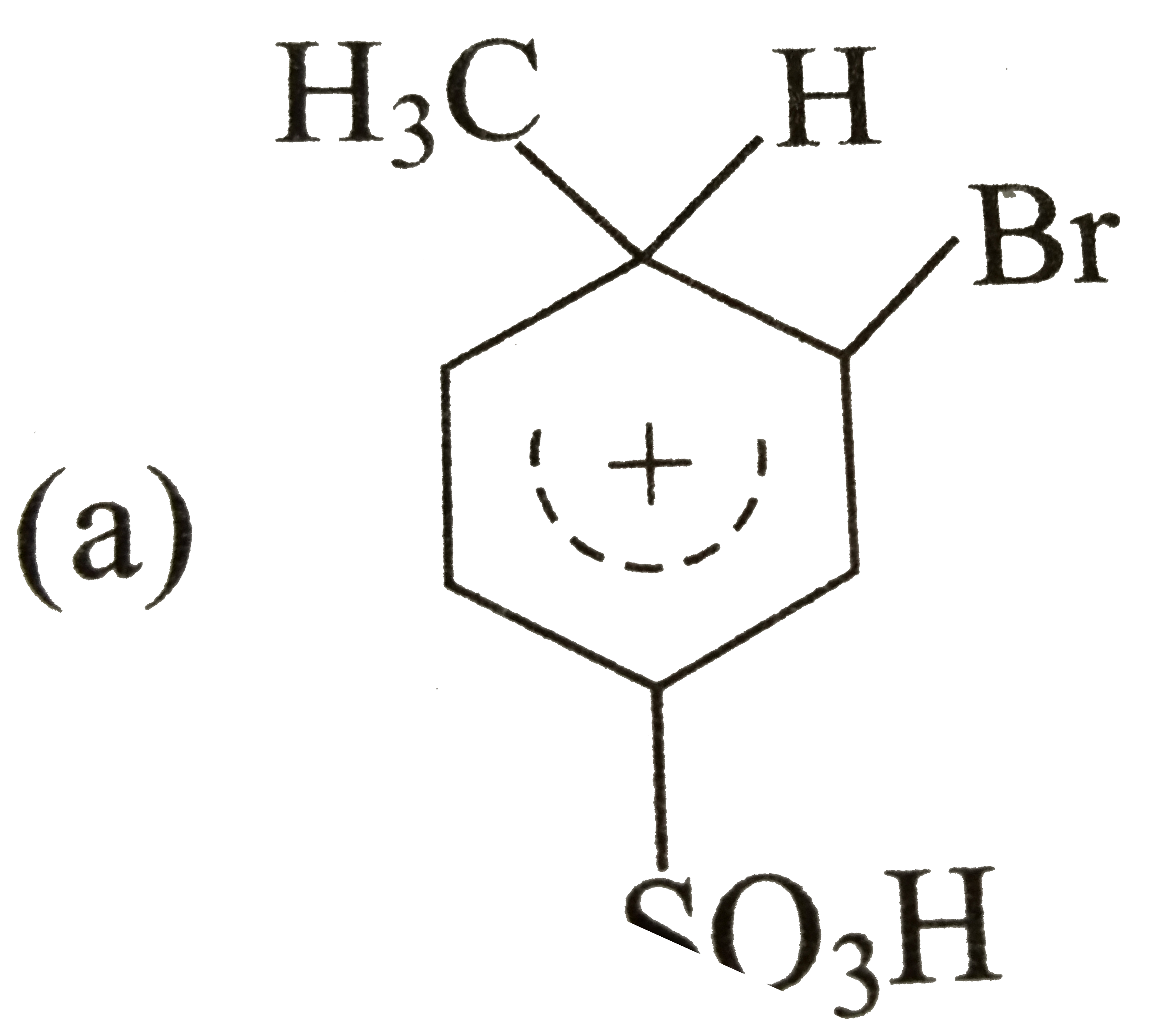
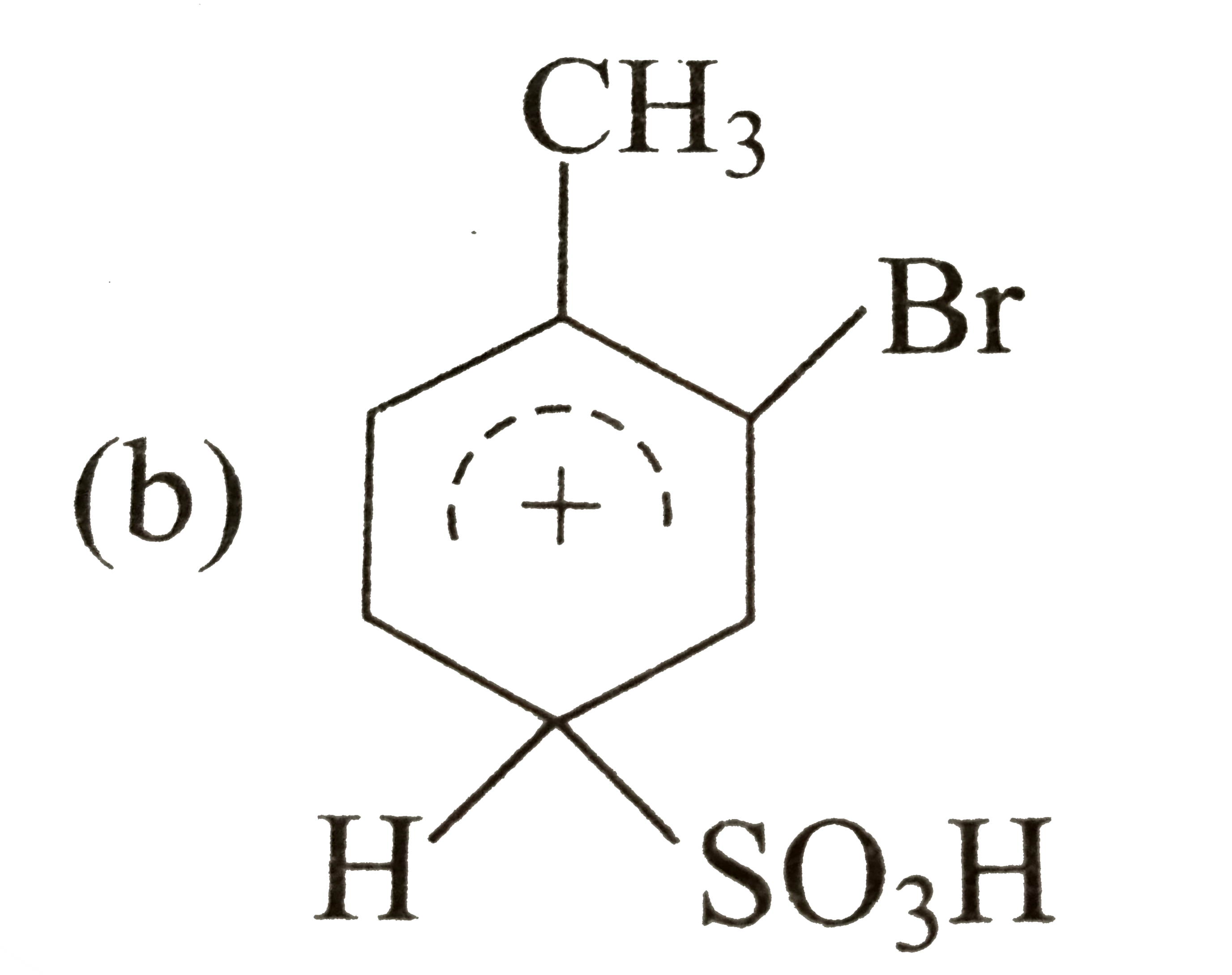
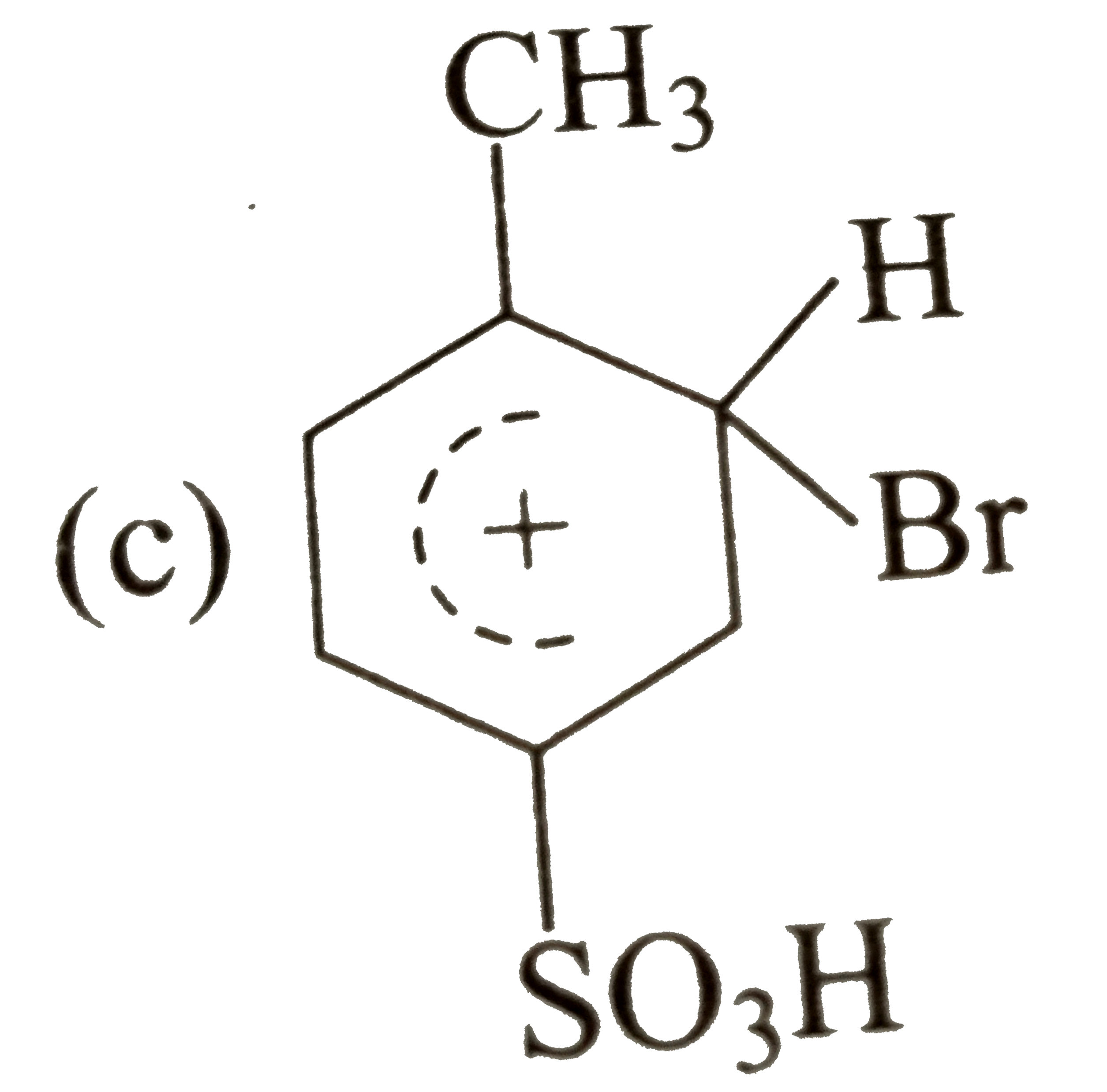
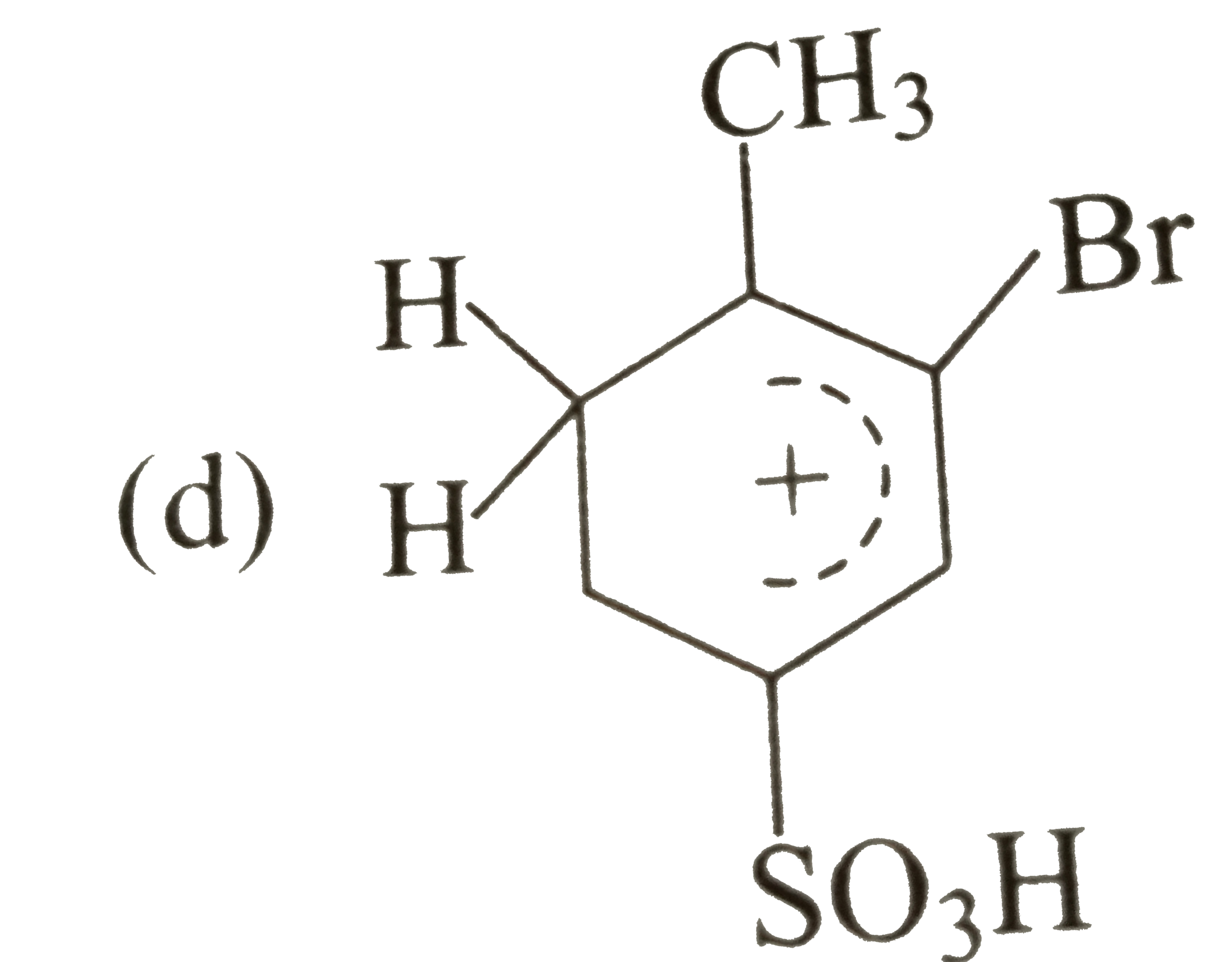
Electrophilicbrominationofp- toluene sulphonicacid, followedby heat with50%H_(2)SO_(4) producesorhto-bromotoluenc. Whichof thefollowingintermediate lendsto thisproduct ? |
|
Answer»
|
|
| 30. |
Electrophilic attack is very difficult for pyridine, but at which position it is relatively easy? |
|
Answer» Only 2 |
|
| 31. |
Electrophilic addition reactions proceed in two steps. The first step involves the addition of an electrophile. Name the type of intermediate reaction. H_(3)C-HC=CH_(2)+H^(+)to? |
|
Answer» `2^(@)` Carbonation |
|
| 32. |
Electrophilic addition reaction is easily given by |
|
Answer» Acetylene The `pi`-electrons of alkynes are more tightly attached to the carbon atoms than `pi`-electrons in alkene and hence less easily AVAILABLE for addition reactions with electrophiles. As a result, alkynes are less reactive than alkenes towards electrophilic addition reaction . A majority of addition reactions of alkynes are catalysed by heavy metal ions such as `Hg^(2+)` and `Ba^(2+)`, etc., while no such catalysts are needed in case of electrophilic addition reactions to alkenes. |
|
| 33. |
Electrophiles are usually……. |
|
Answer» LEWIS acid |
|
| 34. |
Electrophiles are: |
|
Answer» ELECTRON loving |
|
| 35. |
Electrophile that participates in nitration of benzene is |
|
Answer» `NO^(+)` 
|
|
| 36. |
Electrophile in the case of chlorination of benzene in the presence of FeCl_3 is |
|
Answer» `CL^+` |
|
| 37. |
Electrons of energy 10.2 and 12.09 e Vatom"^(-1) can cause radiations to be emitted from H atoms. Name the spectral line in the Balmer series. |
| Answer» SOLUTION :`H_(ALPHA)` LINE | |
| 38. |
Electrons in various sub shell are filled in increasing order of their energies. Pairing of electrons in various orbitals of a subshell takes place only after each orbital is half filled. Moreover no two electrons in an atom can have the same of four quantum numbers. Which of the following have the same number of s-electrons as the d- electrons in Fe^(2+)? |
|
Answer» Li |
|
| 39. |
Electrons occupy the available sub-level which has lower n+l value. This is called: |
|
Answer» HUND's rule |
|
| 40. |
Electrons are revolving around the nucleus in n_(1^(th)) orbit of an atom, have atomic number Z_1, and in the n_2 orbit of other atom, have atomic number Z_2, then [Where P= Linear momentum, L=Angular momentum, f=frequency of revolution and K.E. =kinetic energy] |
|
Answer» `L_1/L_2=n_1/n_2` `(f_1)/(f_2) =(v_1/(2pir_1))/(v_2/(2pir_2))=(Z_1/n_1xxZ_1/n_1^2)/(Z_2/n_2xxZ_2/n_2^2)=(Z_1/Z_2)^2.(n_2/n_1)^3implies (K.E._1)/(K.E._2)=(1/2mv_1^2)/(1/2mv_2^2)=(Z_1/Z_2)^2XX(n_2/n_1)^2=((Z_1n_2)/(Z_2n_1))^2` `(K.E_1)/(K.E_2)=(1/2(KZ_1e^2)/r_1)/(1/2(KZ_2e^2)/r_2)=(Z_1/n_1^2.Z_1)/(Z_2.Z_2/n_2^2)=(Z_1/Z_2.n_2/n_1)^2` |
|
| 42. |
Electronic configuration of vanadium is |
|
Answer» `3d^(4)4s^(1)` |
|
| 43. |
Electronic configuration of noble gases is ……………………. |
|
Answer» `ns^(2)` |
|
| 44. |
Electronic configuration of Pu^(7+) |
|
Answer» `7S^(0), 5F^(14), 6d^(0)` |
|
| 45. |
Electronic configuration of most electronegative elements is |
|
Answer» `1s^2 2s^2 2p^6 3s^1` |
|
| 46. |
Electronic configuration of Ferrous ion is |
|
Answer» `1s^(2)2s^(2)2P^(6)3s^(2)3P^(6)3d^(6)4s^(0)` |
|
| 47. |
Write the the electronic configuration of Fe^(2+) ion. |
|
Answer» `1s^(2)2s^(2)2P^(6)3S^(2)3p^(6)3d^(6)4s^(0)` |
|
| 48. |
Electronic configuration of divalent cation of Eu is |
|
Answer» `4f^(6)` |
|