

Saved Bookmarks
This section includes 7 InterviewSolutions, each offering curated multiple-choice questions to sharpen your Current Affairs knowledge and support exam preparation. Choose a topic below to get started.
| 1. |
Disodium hydrogen phosphate is used in test : |
| Answer» Answer :a | |
| 2. |
Disintegration of radium takes place at an average rate of 2.24xx10^(13) alpha-particles per minute. Each alpha-particle takes up 2 electrons from the air and becomes a neutral helium atom. After 420 days, the He gas collected was 0.5xx10^(-3)L measured at 300K and 750mm of mercury pressure. From the above data, calculate Avogadro's number. |
|
Answer» Solution :No of `alpha` -PARTICLES (or)He formed `=2.24xx10^(13) min^(-1)` `:.` No of He particles formed in `420days=2.24xx10^(13)xx420xx1440` `=1.355xx10^(19)` Also at `27^(@)C` and `750mm`, `He=0.5ml` Using `PV=nRT` `(750)/(760)xx(0.5)/(1000)=nxx0.0821xx300` `impliesn=2.0xx10^(-5)` moles `2.0xx10^(-5)` moles of `He=1.355xx10^(19)` particles of `He` `implies1` mole of He `=(1.355xx10^(19))/(2.0xx10^(-5))` `=6.775xx10^(23)` particles `:.` Avagadro.s NUMBER `=6.775xx10^(23)` particles/mol |
|
| 3. |
Disintegration constant for a radioactive substance is 0.58 hr^(-1). If half-life period |
|
Answer» 8.2 HR |
|
| 4. |
Disodium hydrogen phosphate in presence of NH_4Cl and NH_4OH gives a white ppt. with a solution of Mg^(2+) ion. The precipitate is: |
|
Answer» `MG(H_2PO_4)_2` |
|
| 5. |
Dishwashing soaps are synthetic detergents. What is their chemical nature ? |
| Answer» SOLUTION :Non-ionic DETERGENTS. | |
| 7. |
Diseases caused by the deficiency of vitamin D(X) and vitamin B_(2)(Y) are |
|
Answer» `{:(X,Y),("SCURVY","CHEILOSIS"):}` |
|
| 8. |
Disease caused by under secretion of adrenal cortex is: |
|
Answer» Cretinism |
|
| 9. |
AIDS is caused by |
|
Answer» Cretinism |
|
| 10. |
Disease caused by eating fish found in water contaminated with industrial waste having mercury is : |
|
Answer» MINAMATA disease |
|
| 11. |
Discuss variations in atomic radii and ionization enthalpies in Halogens. |
|
Answer» Solution :(i) Atomic RADII : The halogens have the smallest atomic radii in their respective PERIODS due to maximum effective nuclear charge. The atomic radius of fluorine like the other elements of second period is extremely small. Atomic radii and ionic radii increase from fluorine to iodine due to INCREASING number of quantum SHELLS. (ii) Ionisation enthalpies : Halogens have very high ionisation enthalpy which indicates that they have very less tendency to lose electron. The ionisation enthalpy decreases down the group from fluorine to iodine due to increase in atomic SIZE. Iodine has maximum tendency to lose electron (I+) because of its large size and low ionisation enthalpy. |
|
| 12. |
Discuss trends in oxidation states shown by actinoids |
Answer» Solution :As compared to lanthanoids, there is greater range of oxidation states of actinoids because of the fact that 5f, 6d and 7s LEVELS are of comparable energies. Also in actinoids, the 5f orbitals expand beyond 6S and 6p and participate in chemical bonding while in lanthanoids, 4f orbitals are shielded totally by outer electrons. HENCE, actinoids show greater range of oxidation states  In GENERAL, actinoids show (+3) oxidation state. The elements in the first half of the series frequently show higheroxidation states. For example, the maximum oxidation state increases from (+4) in Th to (+5), (+6) and (+7) respectively in Pa, U and Np but decrease in succeeding elements. The actinoids resembles the lanthanoids is having more compounds in (+3) state than in the (+4) state. However (+3) and (+4) ions tend to hydrolyse. |
|
| 13. |
Discuss trends in ionization enthalpies of lanthanoids |
|
Answer» Solution :The first ionization enthalpies of the lanthanoids are around `600 kJ mol^(-1)` and SECOND is about 1200 kJ `mol^(-1)` comparable to those of calcium The third ionization enthalpies of elements LANTHANUM, gadolinium and lutetium are found to be EXCEPTIONALLY low because of stability of `f^(0), f^(7) and f^(14)` shells respectively in these elements |
|
| 14. |
Discuss the working of hydrogen – oxygen fuel cell. What are the advantages of using this fuel cell? |
|
Answer» |
|
| 15. |
Discuss the variations in atomic and ionic radii of elements in group-15. |
|
Answer» Solution :The atomic radii of the ELEMENTS of group-15 are smaller as compared to the elements of group-14 (carbon family). Down the group, the atomic radii of the elements increases with the increase in atomic number because of ADDITION of new principal shells in each succeeding elements. The increase in covalent radius is more SIGNIFICANT from nitrogen to phosphorus however there is small increase in radii from As to Bi because of PRESENCE of COMPLETELY filled d or f-orbitals in heavier members. |
|
| 16. |
Discuss the uses of phosphine. |
| Answer» Solution :Phosphine is USED for producing smoke screen as it gives LARGE smoke. In a ship, a pierced container with a mixture of calcium carbide and calcium PHOSPHIDE, LIBERATES phosphine and acetylene when thrown into sea. The LIBERATED phosphine catches fire and ignites acetylene. These burnings gases serves as a signal to the approaching ships. This is knwon as Holmes signal. | |
| 17. |
Discuss the use of an acidic flux in metallurgy. |
|
Answer» Solution :`SiO_(2)` is used in the metallurgy of copper to REMOVE FEO as `FeSiO_(3)` (SLAG) (Le) ACIDIC flux is used to remove basic IMPURITIES. `FeO + SiO_(2) rarr FeSiO_(3)` |
|
| 18. |
Discussthe usesof Phosphine. |
| Answer» SOLUTION :PHOSPHINEIS usedforproducingsmokescreen ASIT giveslargesmoke. In ashipa piercedcontainerwith amixutreof calciumcarbideand CALCIUM PHOSPHIDE. Liberatesphosphineandacetylenewhenthrowninto sea.Theisknownas Holmessignal. | |
| 19. |
Discuss the trends in ionisation enthalpies and electronegativity of group-15 elements. |
|
Answer» Solution :The ionisation enthalpies of group-15 elements are much higher than corresponding group-14 elements because of increased nuclear charge, REDUCED atomic radii and stable half filled configuration they have very less tendency to lose electrons. Down the group, there is decrease in the ionisation enthalpy due to increase in atomic SIZE that decreases force of attraction on electrons by nucleus. The order of successive ionisation enthalpies as expected is `Delta_(i)H_(1), LT Delta_(i)H_(2) lt Delta_(i)H_(3)` Nitrogen is the most electronegative element in group-15. Down the group, the electronegativity decreases with increase in atomic size. However, amongst the HEAVIER elements, the difference is not much pronounced. |
|
| 20. |
Discuss the trends in chemical reactivity of group 15 elements. |
|
Answer» <P> Solution :Nitrogen gas exists as diatomic MOLECULE. Dut to the presence of triple bond between Base N - Atoms bond dissociation energy is HIGH (941.4 KJ / mol). Hence nitrogen is inert and unreactive.Phosphorus is a tetra atomic molecule and P-P single bond is weaker than `N-=N`. P - P bond dissociation energy U 213 KJ/mole. Hence phosphorus is more reactive than Nitrogen. Explanation : `to` The single N-N bond is weaker than the single P-P bond due to high inter electronic repulsion of the non-bonding electrons in `N_(2)` because of small bond length. There fore the catenation property is weaker in nitrogen as compound to phosphorares. `R_(3)` P = O exist but `R_(3)N` = O does not. Explanation : `to` Nitrogen does not form `d pi-P pi` multiple bond with oxygen because of lack of d - orbitals in Nitrogen atom. But in case of `R_(3)N=0` the value of nitrogen should be 5. So these compounds do not exist where as in case of 'P' atom d-orbitals are available. So P-atom can able to form `d pi-P pi` multiple bonds hence `R_(3)P=0` exist. i) Reactivity towards hydrogen : Group - 15 elements forms `"EH"_(3)` type hydrides (E = Group - 15 elements) Eg : `"PH"_(3),"NH"_(3),"AsH"_(3),"BiH"_(3),"SbH"_(3)`. `to` Among above hydrides `NH_(3)` is mild reducing agent while `"BiH"_(3)` is strong reducing agent. `to` Stability of hydrides DECREASES from `"NH"_(3)` to `"BiH"_(3)`. `to` Basicity of hydrides decreases as follows. `"NH"_(3)gt"PH"_(3)gt"AsH"_(3)gt"SbH"_(3)gt"BiH"_(3)`. ii) Reactivity towards Oxygen : These forms two types of oxides `E_(2)O_(3)` and `E_(2)O_(5)`. Eg : `P_(2)O_(3),N_(2)O_(5),N_(2)O_(3),P_(2)O_(5)`. `to` Acidic character of oxides decrease down the group. `to E_(2)O_(3)` of N and P are acidic, As and Sb are amphoteric while 'Bi' is basic. iii) Reactivity towards halogens : These elements forms two types of halides `"EX"_(3)" and EX"_(5)`. `to` 'N' - does not form penta halides due to lack of the d-orbitals. `to` Penta halides are more covalent than TRI halides because the elements in higher oxidation state have more polarising power. iv) Reactivity towards metals : All these elements react with metals to form their binary compounds containing - 3 oxidation state. Eg : `"Ca"_(3)"N"_(2),"Ca"_(3)"P"_(2)` etc. |
|
| 21. |
Discuss the thermodynamical changes when a gas is adsorbed on a solid. |
| Answer» | |
| 22. |
Discuss the structure of phosphorous pentaoxide (P_(2)O_(5)). |
Answer» Solution :In `P_(4)O_(10)` each P atoms form three BONDS to oxygen atom and also an ADDITIONAL coordinate BOND with an oxygen atom. Terminal coordinate `P-O` bond length is 143 pm, which is less than the expected single bond distance. This may be DUE to lateral overlap of filled p orbitals of an oxygen atoms with empty d - orbital on PHOSPHOROUS. 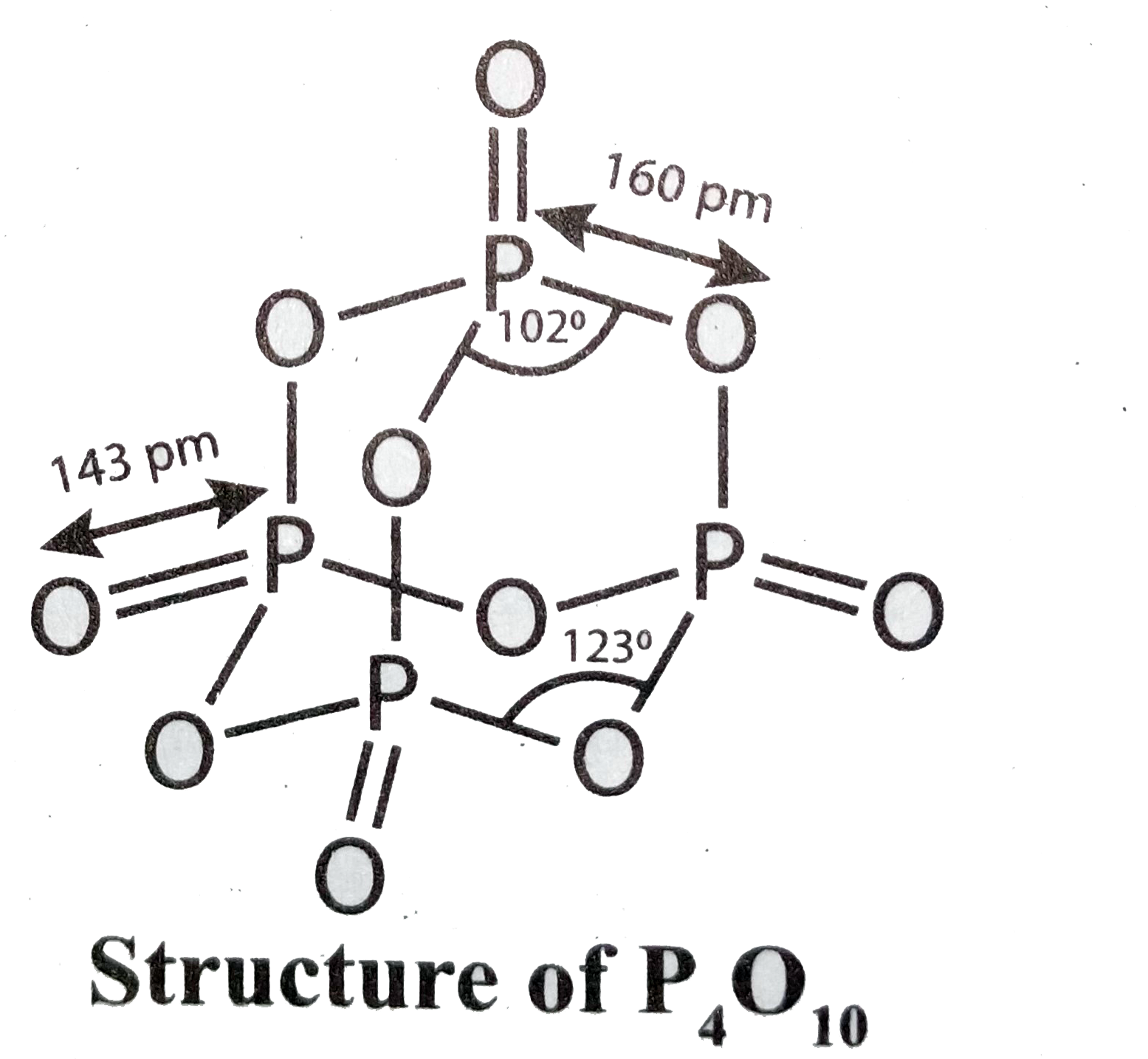
|
|
| 23. |
Discuss the structure and shape of proteins. |
|
Answer» Solution :Structure and SHAPES of proteins are discussed at four levels, i.e., primary, secondary, tertiary and quaternary. Each level being more complex than previous one. (i) Primary structure of proteins : Proteins may have one or more polypeptide chains. Each polypeptide in a protein has amino acids linked with each other in a specific sequence and it is this sequence of amino acids that is said to be the primary structure of protein. Any change in this primary structure creates the different proteins. (ii) Secondary structure of proteins : The secondary structure of protein REFERS to the shape in which a long peptide chain can exist. They are found to exist in TWO different types of structures, i.e., `alpha`-helix and `beta`-pleated sheet structure. This structure arises due to the regular folding of the backbone of the polypeptide chain due to hydrogen bonding between `GT c=0`group and -NH-group of the peptide bond. The `alpha`-helix structure is the most ways in which a polypeptide chain forms all possible hydrogen bonds by twisting into a right-handed SCREW (Helix) with the `-NH` group of each amino acid residue hydrogen bonded `gt C=O`of an adjacent turn the helix. In `beta`-structure, all peptide chains are stretched out to nearly maximum extension and then laid side by side which are held by intermolecular H-bonds. The structure resembles the pleated structure folds of drapery and therefore known as `beta`-pleated sheet.  (iii) Tertiary structure of proteins : The tertiary structure of proteins represents overall folding of the polypeptide chains, i.e., further folding of the secondary structure. It gives rise to two major molecular shapes viz. globular and fibrous. The main forces which STABILISE `2^(@) and 3^(@)` structure of proteins are hydrogen bonds, disulphide linkages, van dar Waals and electrostatic forces. (iv) Quaternary structure of proteins : Some of the proteins are composed of two or more polypeptide chains referred to as sub-units. The spatial arrangement of these sub-units with respect to each other is known as quaternary structure. 
|
|
| 24. |
Discuss the role of molecular interaction in a solution of alcohol and water. |
| Answer» Solution : When we MIX ALCOHOL and WATER, the molecular interactions are decreased. Therefore, the solution will show positive deviations from Raoult.s law. | |
| 25. |
Discussthereaction mechanismoffollowingreactions:(1)o - nitrochlorobenzene reactswithalkali.(2)p-nitro chlorobenzene reactswithalkali. |
|
Answer» Solution :Arylhalidesundergo nucleophilicdisplacementreactionsreadilywhen astrongelectronwithdrawinggrouplike-` NO_ 2`is presentat-orthoor -PARAPOSITIONS. (1)Wheno- nitrochlorobenzenreactswith ALKALI, o-nitrophenolisobtained. When - `NO_2`groupat ORTHO positionwithrespecttohalogen, thenmechanism ofthereactionis asfollows : 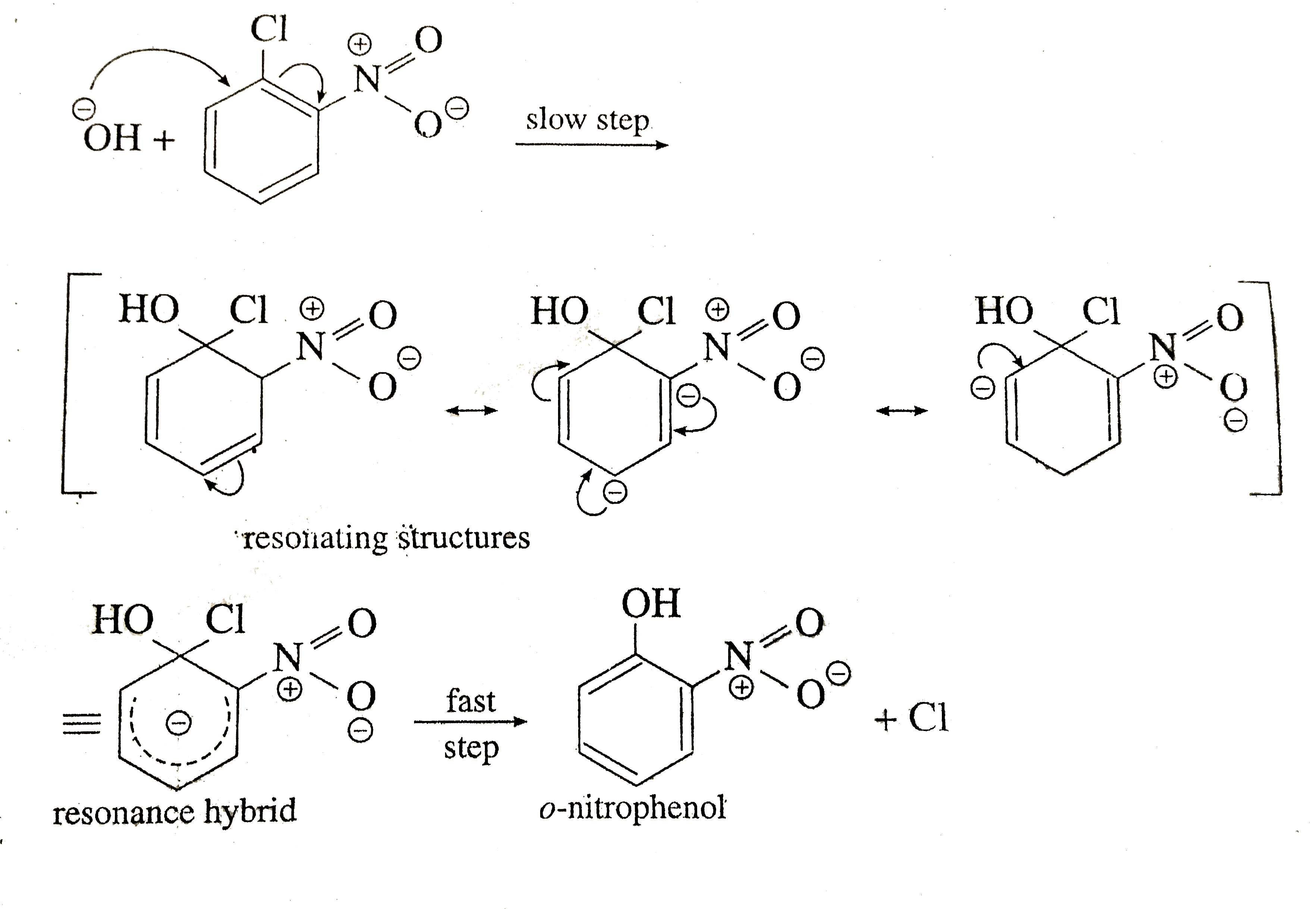 (2) Whenp-nitrochlorobenzenereactswithalkali, p - ntirophenolisobtained. When-` NO _ 2 `GROUP at parapositionwithrespecttohalogen,thenmechanismofthereactionisasfollows : 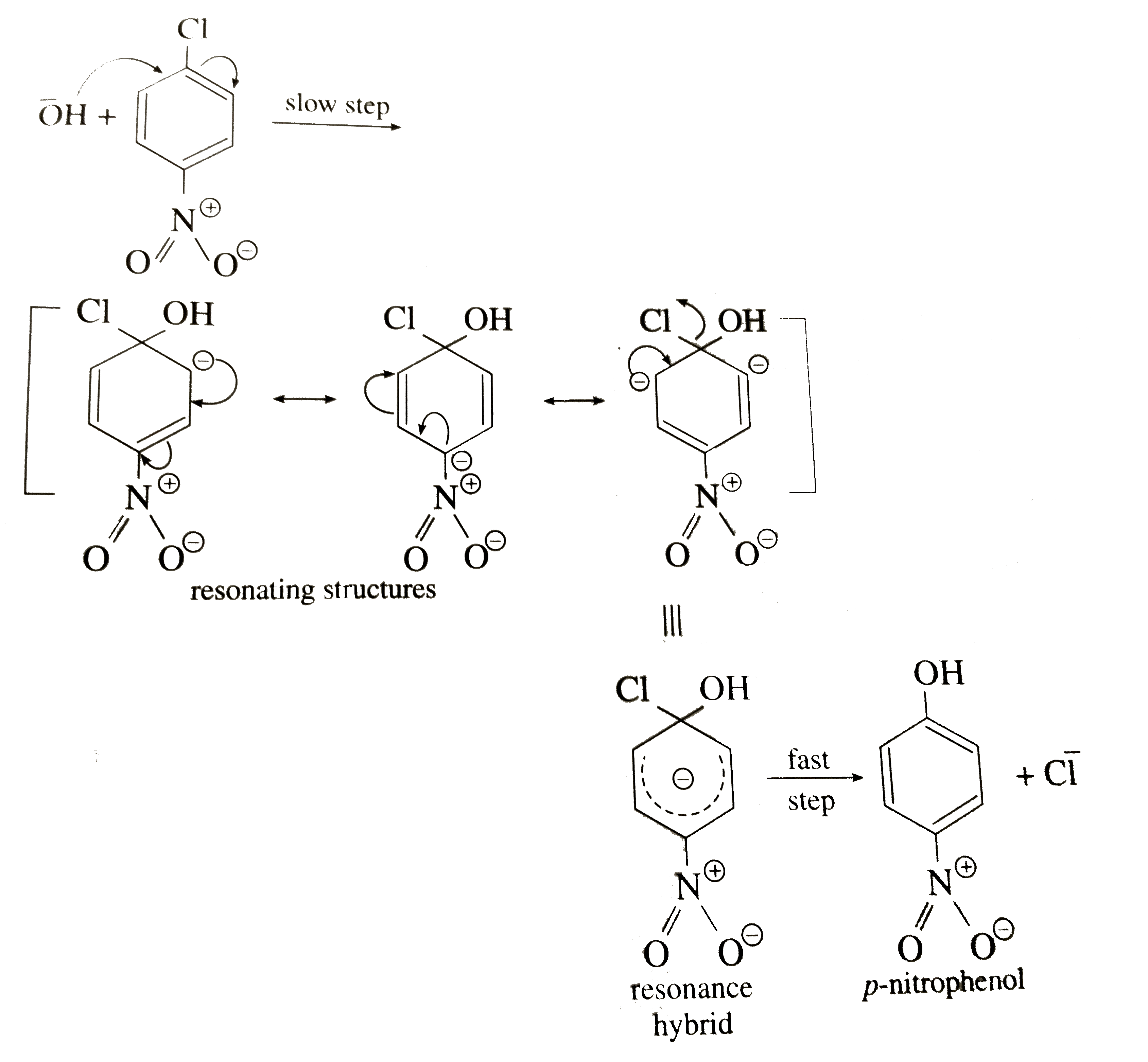
|
|
| 26. |
Discussthepropertiesofphosphorus trichloride and phosphorus pentachloride. |
|
Answer» Solution :Properties of `PCl_3` : It is colourless oily liquid and hydrolyse in presence of moisture: `PCl_(3) + 3H_(2)O to H_(3)PO_(3) + 3HCl` It reacts with organic compounds CONTAINING -OH group such as `CH_(3)COOH_(3)C_(2)H_(5) -OH` etc. `3CH_(3)COOH + PCl_(3) to 3CH_(3)COCl + H_(3)PO_(3)` `3C_(2)H_(5)OH + PCl_(3) to 3C_(2)H_(5)Cl + H_(3)PO_(3)` Properties of `PCl_5 : PCl_5` is a yellowish powder and in MOIST AIR, it hydrolyse to give `POCl_3` and finally gets converted to phosphoric acid `PCl_(5) + H_(2)O to POCl_(3) + 2HCl` `POCl_(3) + 3H_(2)O to H_(3)PO_(4) + 3HCl` When heated, it sublimes but decomposes on strong heating `PCl_(5) overset(Delta) to PCl_(3) + Cl_(2)` It reacts with organic compounds containing -OH group CONVERTING them to chloro derivatives. `C_(2)H_(5)OH + PCl_(5) to C_(2)H_(5)Cl + POCl_(3) + HCl` `CH_(3)COOH + PCl_(5) to CH_(3)COCl + POCl_(3) + HCl` Finely divided metals on heating with `PCl_5` gives corresponding chlorides: `2Ag + PCl_(5) to 2AgCl + PCl_(3)` `Sn + 2PCl_(5) to SnCl_(4) + 2PCl_(3)` |
|
| 27. |
Discuss the properties of interhalogen compounds. |
|
Answer» Solution :Physical PROPERTIES : These are all covalent molecules and are diamagnetic in nature. They are volatile solids or liquids at 298 K except ClF which is a gas. Their physical properties are intermediate between those of constituent halogens except that their melting point and BOILING point are litde higher than expected. The molecular structures of INTERHALOGEN compounds can be EXPLAINED by VSEPR theory. (ii) Chemical properties : Interhalogen compounds are more reactive than halogens (except fluorine) because of weak X - X. bonds as compared to halogens. Interhalogens undergo hydrolysis giving halide ion derived from smaller halogen and a hypohalite (when XX.), halite (when XX.3), halate (when `X X_(5)^(.)`) and perhalate (when `X X_(7)^(.)`) anion derived from larger halogen. `X X^(.) + H_(2)O to HX^(.) + HOX` `X X_(3)^(.) + 2H_(2)O to 3HX^(.) + HOXO` `XX_(5)^(.) + 3H_(2)O to 5HX^(.) + HOXO_(2)` `X X_(7)^(.) + 4H_(2)O to 4HX^(.) + HOXO_(3)` `IF_(7) + 6H_(2)O to 7HF + H_(5)IO_(6)` (ortho periodic acid) |
|
| 28. |
Discuss the process of rusting of iron. |
|
Answer» |
|
| 29. |
Discuss the positive of d-block elements in the perioidc table. |
|
Answer» Solution :In a periodic table, the d-block ELEMENTS are flanked between s-block elements are p-block elements and these elements occupy the large middle SECTION of periodic table. The elements of d-block are present from GROUP 3 group -12 in periods 4 to 7. These elements have the d-orbitals of the PENULTIMATE energy level of atoms that receive ELECTRONS giving rise to four rows of the transition elements i.e., 3d, 4d, 5d and 6d as follows: (i) The first transition series OR 3d- series belongs to `4^(th)` period (ii) The second transition series OR 4d-series belong to `5^(th)` period (iii) The third transition series OR 5d-series belong to `6^(th)` period (iv) The fourth transition series OR 6d-series belong to `7^(th)` period Hence, these are in all forty elements with ten elements in each series |
|
| 30. |
Discuss the physical properties of group-16 elements. |
|
Answer» SOLUTION :(i) Atomicity : Oxygen is diatomic GAS while other elements are polyatomic solid. Example : Sulphur, selenium and tellurium exists as polyatomic molecule such as `S_8`, `Se_8` etc. This is due to tendency of oxygen to form pn-pn bonds due to its small SIZE and high bond enthalpy of (O = O) bond. (II) Metallic character : Down the group, the metallic character of the elements increases. Oxygen and sulphur are non-metals, selenium and tellurium are metalloids where as polonium is a metal. Polonium is radioactive. The half life period is 13.8 days. (iii) Melting points and boiling points : The melting points and boiling points gradually increases down the group. The large difference between melting and boiling points of oxygen and sulphur is due to atomicity. Oxygen is diatomic where as sulphur is polyatomic. (iv) Allotropy : All the elements of group-10 shows allotropy. |
|
| 32. |
Discuss the physical properties of group-15 elements. |
|
Answer» Solution :(i) Atomicity: All the elements except NITROGEN are polyatomic. Nitrogen is diatomic gas while all others are solid. The nitrogen exists as a diatomic gaseous molecules because of its ability to form pn-pit multiple bonds while other elements exists as discrete tetrahedral triatomic molecules due to repulsion of non-bonding electron pairs. Ex. : `P_4, As_4`, etc. (ii) Metallic character : Metallic character of the elements increases down the group. Nitrogen and phosphorus are non-metals, arsenic and antimony metalloids while BISMUTH is a metal. The metallic character increases down the group because of increase in atomic size and decrease in ionisation enthalpy. (iii) Melting and boiling points : The melting points first increases upto arsenic and then decreases upto bismuth. This is because of INERT pair effect due to which antimony and bismuth forms three covalent bonds instead of five due to which INTERATOMIC attraction decreases. The boiling points of the elements decrease regularly down the group. (IV) Allotropy : Except nitrogen all the elements show allotropy. |
|
| 33. |
Discuss the physical and chemical properties of ammonia. |
Answer» Solution :(i) PHYSICAL PROPERTIES : Ammonia molecule is a trigonal pyramidal with the nitrogen atom at apex. It has three bonding electron PAIRS and one non-bonding electron pair. 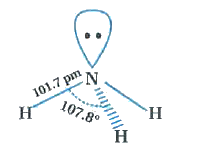 Ammonia is colourless gas with a pungent order. Its freezing and boiling points are 198.4 and 239.7 K respectively. In the solid an liquid states, it is associated through H-bonds as in the CASE of water and that accounts for its higher melting and boiling points than expected on basis of its molecular mass. (ii) Chemical properties : Ammonia is highly soluble in water. Its aqueous solution is weakly basic due to formation of -OH ions. `NH_(3)(g) + H_(2)O (l) For example: `ZnSO_(4)(aq) + 2NH_(4)OH_(aq) to Zn(OH)_(2) + (NH_(4))_(2).SO_(4)(aq)` `FeCl_(3) (aq) + NH_(4)OH(aq) to Fe_(2)O_(3).xH_(2)O(s) + NH_(4)Cl(aq)` (Brown ppt) Ammonia act as a lewis base due to presence of lone pair of electrons on nitrogen atom. It donates the electron pair and forms linkage with metal ions and the formation of such complex compounds find application in detection of metal ions such as `Cu^(2+), Ag^(+)` etc. `underset("blue")(Cu_(aq)^(2+) + 4NH_(3)(aq) |
|
| 34. |
Discuss the optical activity of tertiary amines of the type R_(1)R_(2)R_(3)N: |
Answer» SOLUTION :TERTIARY amines have pyramidal geometry with `sp^(2)`. Hybridization at nitrogen. It should be a chiral molecule (assuming LONE pair to be a substituent) Thus, tertiary amines exist as racemic MIXTURE but they canot be resolved. This is due to the reason that the energy difference between the isomers is very small (25 kJ `"mol"^(-1)`) Hence, rapid nitrogen or amine inversion takes place.   
|
|
| 35. |
Discuss the ortho and pyro silicates. |
|
Answer» Solution :ORTHO silicate: The simplest which contain discrete `[SiO_(4)]^(4-)` tetrahedral units are called ortho SILICATES or neso silicates. Examples: Phenacite `-Be_(2)SiO_(4)(be^(2+)` ions are tetrahedrally surrounded by `O^(2-)` ions) , Olivine- `(Fe//Mg))_(2)SiO_(4)` (`Fe^(2+)` and `Mg^(2+)` cations are octahedrally surrounded by `O^(2-)` ions). Pyro silicates: Silicates which contain `[Si_(2)O_(4)]^(6-)` ions are called pyro silicates (or ) Soro silicates. They are fomed by joining two `[SiO_(4)]^(4-)` tetrahedral units by sharing ONE oxygen atom at one corner: (one oxygen is removed while joining). Example: Thortveitite `-Sc_(2)Si_(2)O_(7)` 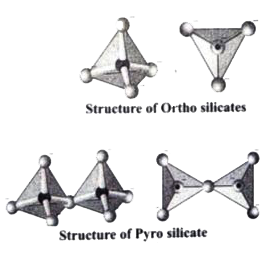
|
|
| 36. |
Discuss the oxidising power of fluorine. |
|
Answer» (ii) Fluorine is thestrongest oxidising agent. It oxidises other halide IONS into halogens in solution or when dry. `F_(2)+2X^(-) rarr 2F^(-)+X_(2)` (where `X^(-)=CL^(-), Br^(-), I^(-)`) |
|
| 37. |
Discuss the optical activity of lactic acid. |
|
Answer» Solution :Optical activity of lactic acid : In lactic acid molecule there is an asymmetric chiral carbon atom with four different groups which lead to spatial configurations (d-lactic acid and l-lactic acid) which are super imposable mirror IMAGES of each other. `H-underset("* Chiral Carbon atom")underset(""CH_(3))underset(|)overset(""COOH)overset(|**)(C)-OH` The structures of two ENANTIOMERS of lactic acid are as follows : 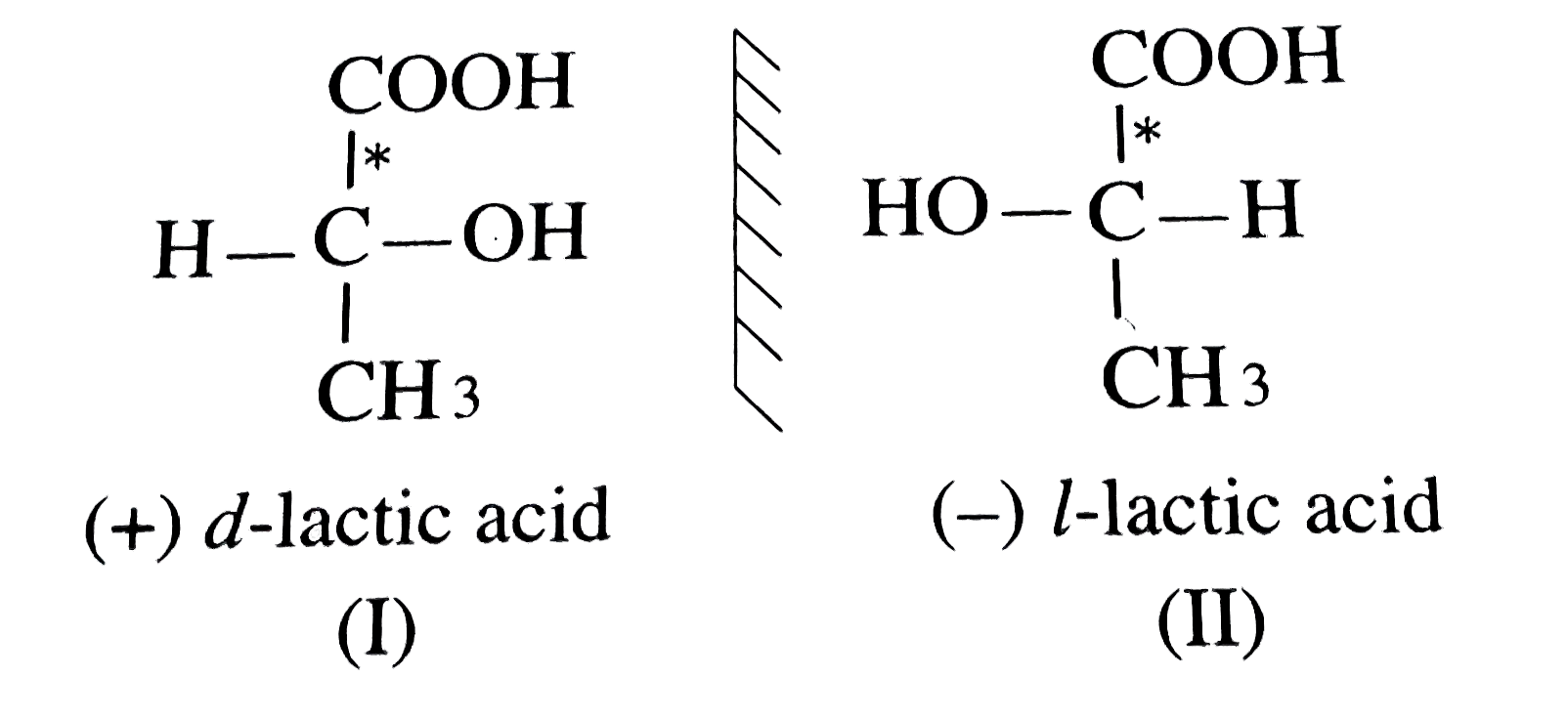 When a plane polarized light is passed through a lactic acid solution, the plane of polarized light gets ratated through a certain ANGLE. This property of ROTATING the plane of polarized light towards right rotating the plane of polarized light towards right (clockwase) or towards (left) (anticlockwise) is called optical activity. d-lactic acid rotates the plane of polarized light towards right whereas l-lactic acid rotates the plane of polarized light towards left, which can be DETECTED by polarimeter. In above structures, structure (I) is representing the (+) isomeric from or dextro rotatory from of lactic acid, while structure (II) is representing (-) isomeric from or leavo rotatory from of lactic acid. |
|
| 38. |
Discuss the nature of bonding in the following coordination entities on the basis of Valence Bond Theory : [Co(C_(2)O_(4))_(3))]^(3-) |
|
Answer» Solution :`[Co(C_(2)O_(4))_(3)]^(3-)` -- `d^(2)sp^(3)`, octahedral, diamagnetic. Formation of `[Co(C_(2)O_(4))_(3)]^(3-)` Oxidation state of Co is +3. Electronic configuration of `Co^(3+)` Pairing of ELECTRONS `d^(2)sp^(3)` hybridisation 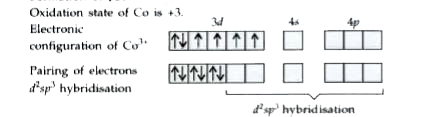 Pairing of electrons TAKES place due to strong `C_(2)O_(4)^(2-)` ions `d^(2)sp^(3)` hybridisation takes place giving RISE to octahedral shape. As there are no unpaired electrons, the complex ion is diamagnetic. |
|
| 39. |
Discuss the nature of bonding in the following coordination entities on the basis of Valence Bond Theory : [CoF_(6)]^(3-) |
|
Answer» Solution :`[CoF_(6)]^(3-)` -- `sp^(3)d^(2)`, octahedral, paramagnetic. FORMATION of `[CoF_(6)]^(3-)` Oxidation state of Co is +3. Electronic configuration of `Co^(3+)` No pairing of electrons `sp^(3)d^(2)` hybridisation 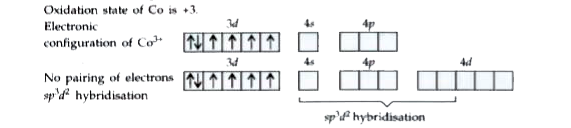 As `F^(-)` ION is a weak ligand, pairing of electrons does not TAKE place, 4s, 4p and two of the 4d orbitals hybridise (`sp^(3)d^(2)` hybridisation) giving rise to octahedral complex. As the d orbitals of the next shell are INVOLVED in hybridisation, it is an outer complex. As there are four unpaired electrons, the complex ion is paramagnetic. |
|
| 40. |
Discuss the nature of bonding in the following coordination entities on the basis of Valence Bond Theory : Fe(CN)_(6)]^(4-) |
|
Answer» Solution :`[Fe(CN)_(6)]^(4-)`-- `d^(2)sp^(3)`, octahedral, diamagnetic Formation of `[Fe(CN)_(6)]^(4-)` Oxidation state of Fe in this COMPLEX is +2. Electronic configuration of `Fe^(2+)` Pairing of electrons followed by `d^(2)sp^(3)` hybridisation of orbitals 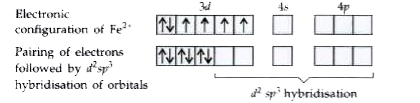 Electrons donated by six `CN^(-)` ions are accommodated in six vacant `d^(2)sp^(3)` HYBRID orbitals giving octahedral shape. Pairing of electrons takes place because of strong `CN^(-)` LIGANDS. As there are no unpaired electrons, the complex is diamagnetic. |
|
| 41. |
Discuss the nature of bonding in the following coordination entities on the basis of Valence Bond Theory : [FeF_(6)]^(3-) |
|
Answer» Solution :`[FeF_(6)]^(3-)` -- `SP^(3)d^(2)`, octahedral, paramagnetic. Formation of `[FeF_(6)]^(3-)` Oxidation state of Fe in the complex is +3. Electronic configuration of `Fe^(3+)` No pairing of electrons `sp^(3)d^(2)` HYBRIDISATION of orbitals 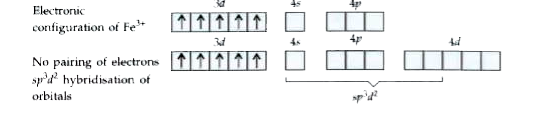 As P- ions are weak ligands, no pairing takes place, outer complex with `sp^(3)d^(2)` hybridisation (octahedral) is formed. As there are 5 unpaired electrons, the complex is paramagnetic. |
|
| 42. |
Discuss the nature of C-X bond in the haloarenes. |
| Answer» Solution :Due to higherr electronegativity of halogen (X) over carbon, the C-X bond in haloarenes is polar. Further, the lone pair of electrons on the X atom are delocalized over the benzener ring. As a result, C-X bondin haloarenes acquires some double bond character (for resonance structures of chlorobenzene). due to donation of the lone paiir of electrons on X towards the benzene ring and PARTIAL double bond character of the C-X bond, the C-X bond in haloarenes is less polar than in ALKYL halides. this is supported by the observation that dipole MOMENT of chlorobenzene (1.69D) is little lower than that of `CH_(3)CL` (1.86D). | |
| 43. |
Discuss the nature of bonding in the following coordination entities on the basis of valence bond theory : (i) [Fe(CN)_(6)]^(4-) (ii) [FeF_(6)]^(3-) (iii) [Co(C_(2)O_(4))_(3)]^(3-) (iv) [CoF_(6)]^(3-) |
|
Answer» Solution :(i) `[Fe(CN)_(6)]^(4-)-d^(2)sp^(3)`, octahedral, diamagnetic. (ii) `[FeF_(6)]^(3-)-sp^(3)d^(2)`, octahedral, PARAMAGNETIC (similar to `[CoF_(6)]^(3-)`) (iii) `[Co(C_(2)O_(4))_(3)]^(3-)-d^(2)sp^(3)`, octahedral, diamagnetic. (iv) `[CoF_(6)]^(3-)-sp^(3)d^(2)`, octahedral, paramagnetic. |
|
| 44. |
Discuss the mechanism of alkaline hydrolysisi of bromomethane. How is carbolic acid prepared from chlorobenzene? What is the action of bromine water on carbolic acid? Write chemical test to distinguish between carbolic acid and alcohol. |
Answer» Solution :Alkaline hydrolysis of bromomethane proceeds via BIMOLECULAR mechanism `(S_(N)2)`. Here hydroxide `(OH^(-))` ion behaves as nucleophile. 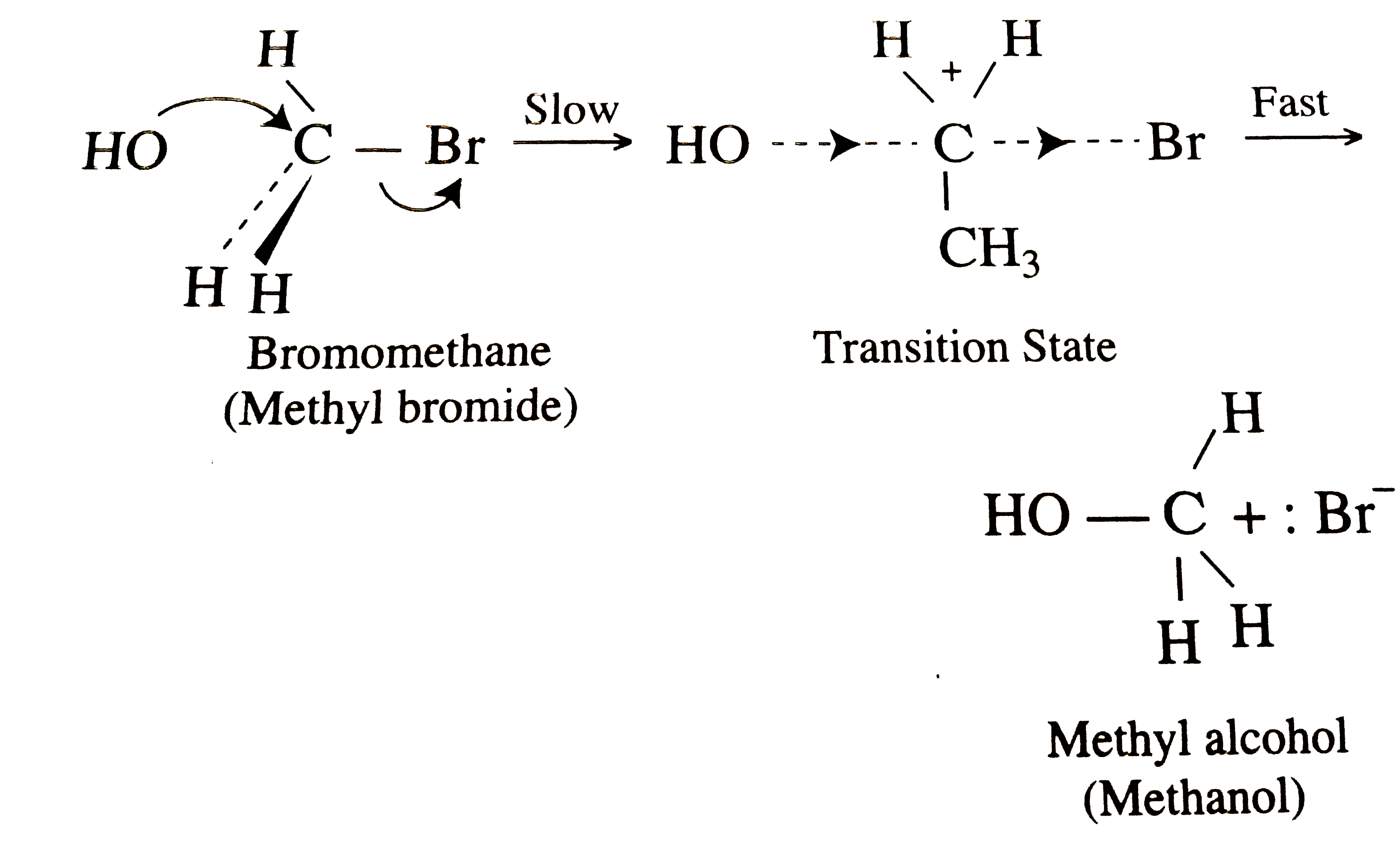 In this reaction a transition state is formed in which the entering hydroxyl group and both are partially BONDED to the same CARBON ATOM. Preparation of carbolic acid (phenol) from chlorobenzene : Phenol is manufactured by heating chlorobenzene with 10% aqueous sodium hydroxide solution at about 623 K under 300 atmosphere in presence of copper salt (as catalyst) to form sodium phenoxide. The sodium salt when treated with dil. HCl gives phenol. This method is called Dow's process. 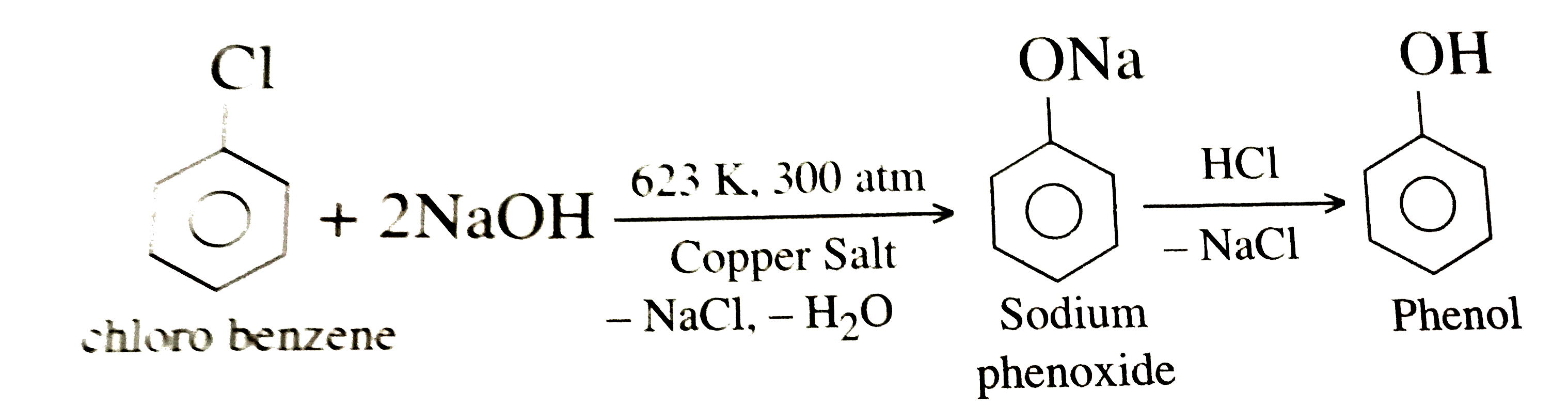 Action of bromine water on carbolic acid (Phenol) : Phenol reacts with bromine water (aqueous solution) to give a precipitate of 2, 4, 6-tribromo phenol. 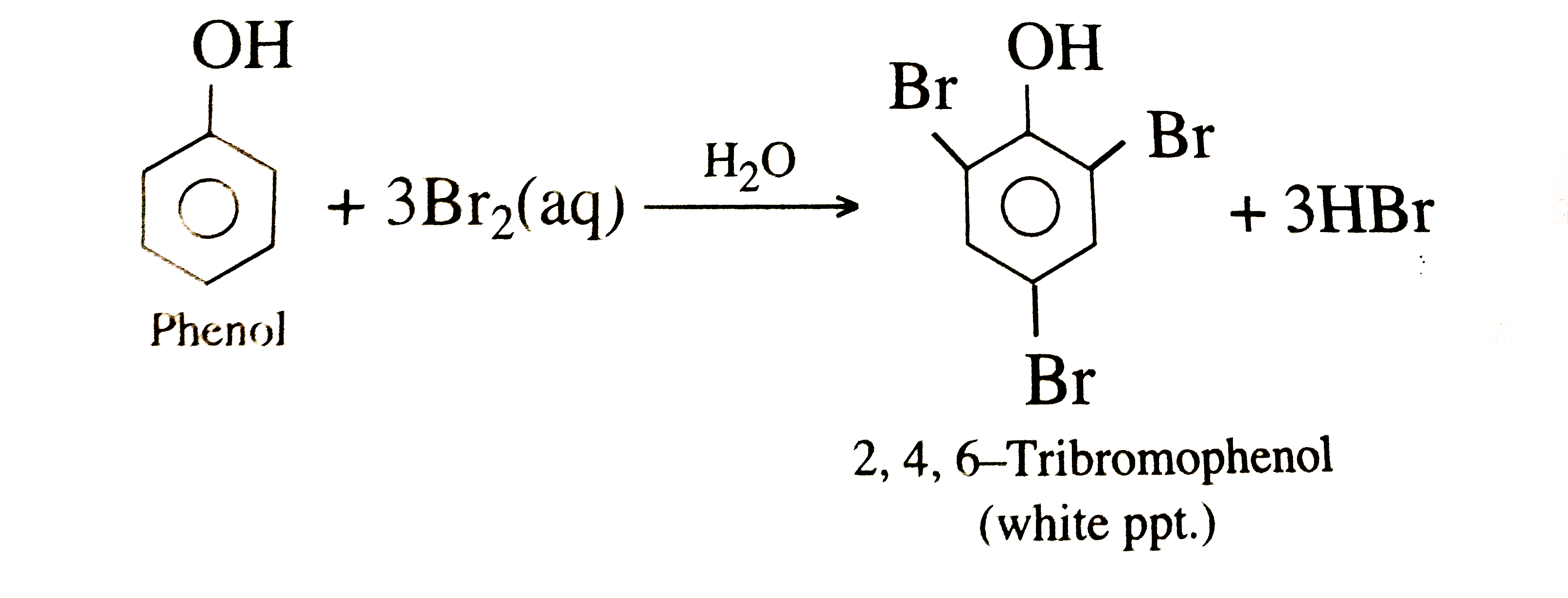 However, if the reaction carried out in CS or `C Cl_(4)` at a low temperature a mixture of ortho and para bromophenol is obtained. 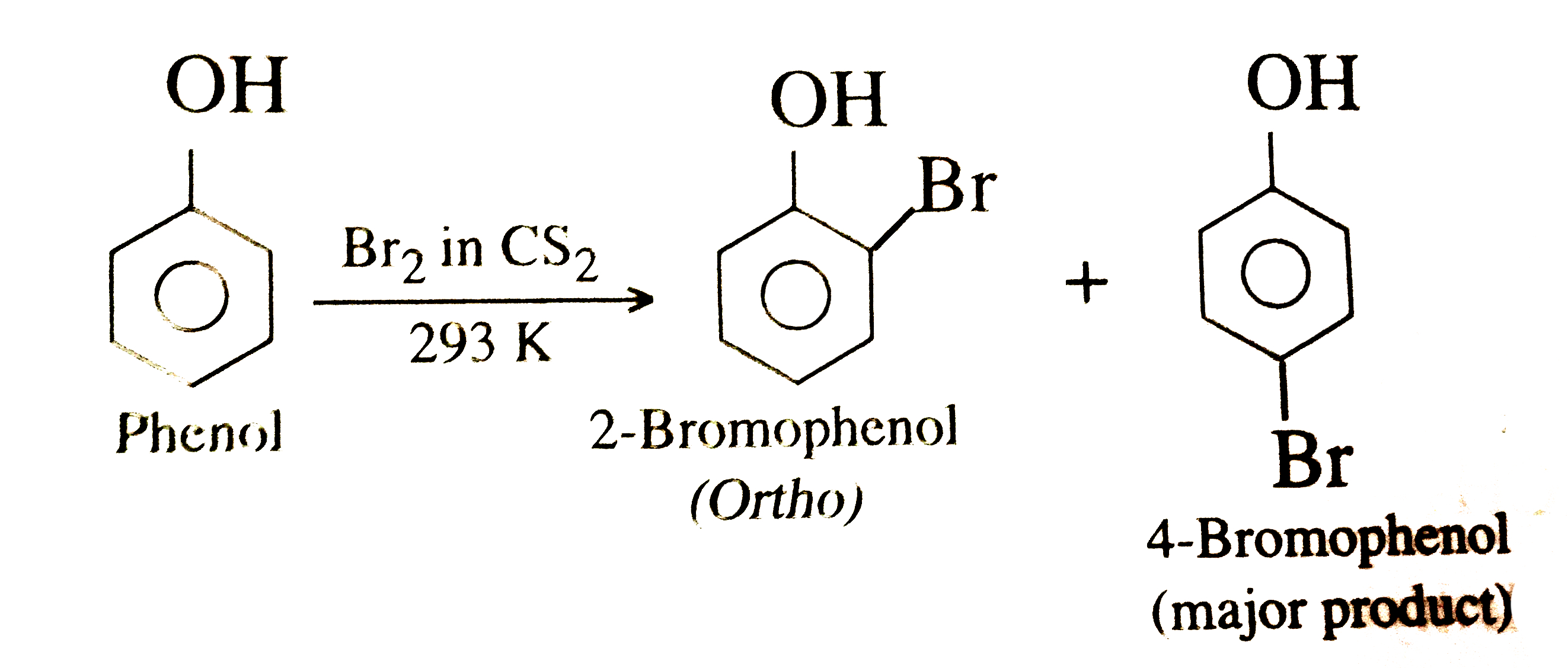 Chemical test to distinguish carbolic acid and alcohol. 1. Carbolic acid (phenol) turns blue litmus to red while alcohol do not have any effect on litmus solution. 2. Carbolic acid reacts with neutral `FeCl_(3)` solution to give chracteristic colours (blue, green, ciolet) on the other hand alcohol do not give any colour with neutral `FeCl_(3)` solution. |
|
| 45. |
Explain the mechanism of Aldolcondensation of acetaldehyde. |
|
Answer» Solution :This reaction is CATALYSED by base. The carbanion generated is nucleophilic in nature. Hence it can bring about nucleophilic attack on carbonyl group Step 1 : The carbanion is FORMED as the `ALPHA` - hydrogen atom is removed as a proton by the base.  Step 2 : The carbanion attacks the carbonyl CARBON of another unionised aldehyde molecule.  Step 3 : The alkoxide ION formed is protonated by water to give 'aldol'. 
|
|
| 46. |
Discuss the method to determine cell potential of any cell when standard hydrogen electrode is considered as cathode with suitable example. |
|
Answer» Solution :At 298K the EMF of the cell, standard hydrogen electrode and second half-cell constructed by taking standard hydrogen electrode as cathode (reference half-cell) and the other half-cell as anode, gives the reduction potential of the other half-cell. Electrode of the other half-cell as anode || Standard hydrogen electrode as cathode E.g.,general cell : `M_((S))|M_((aq))^(n+)(1M)||H_((aq))^(+)(1M)|(1)/(2)|(1)/(2)H_(2(g))(1" bar")|Pt` and `E_(cell)^(THETA)=(E_(R)^(Theta)-E_(L)^(Theta))` but `E_(R)^(Theta)=0.0V` `E_(cell)^(Theta)=-E_(L)^(Theta)` (for such cel the cell potential is negative) e.g., anode of zinc half-cell || cathode of hydrogen electrode half-cell `Zn_((S))|Zn_((aq))^(2+)(1M)||H_((aq))^(+)(1M)|H_(2(g))(1" bar")|Pt_((S))` For above cell, practical value of reduction potential is `-0.76V`. So, for `Zn_((aq))^(2+)(1M)+2e^(-)toZn_((S))`, standard reduction potential `=0.76V` i.e., `E_(Zn^(2+)|Zn)^(Theta)=-0.76V` NOTE: When standard hydrogen electrode is on right side and working as cathode then other half-cell has negative reduction potential value and such cell possess negative emf value. Reduction reaction occurs on cathode electrode present on right side of cell: Reaction: `H_("aq, 1M")^(+)+e^(-) to (1)/(2)H_(2(g))(1" bar")` The negative value of such cell shows oxidation of zinc metal is done by `H^(+)` ions and zinc metal get dissolved in HCl acid. also `H^(+)` ions get reduced by zinc metal. `Zn_((S))+2H_((aq))^(+) to Zn_((aq))^(2+)+H_(2(g))` |
|
| 47. |
Discuss the method to determine cell potential of any cell when standard hydrogen electrode is considered as anode with suitable example. |
|
Answer» Solution :(a) Reduction potential : A 298K the emf of the cell, standard hydrogen electrode and second half-cell constructed by taking standard hydrogen electrode as anode (reference half-cell) and the other half-cell as cathode gives the reduction potential of the other half-cell. Standard: `UNDERSET("anode half-cell")("hydrogen electrode half-cell")||underset("cathode half-cell")("another half-cell")` Cell potential=(Reduction potential of other cell) =emf value of another half-cell. (b) Explanation with general example: (i) If the concenctrations of the oxidised and the reduced forms of the SPECIES in the right-hald half-cell are unity, then the cell potential is equal to the standard electrode potential. General: cell `Pt|H_(2(g))("1 bar")|H_((aq))^(+)(1M)|``|underset("metal ION")(Mn_((aq))^(+)(1M))|underset("metal")(M_((S)))` (ii) `E^(Theta)=E_(R)^(Theta)-E_(L)^(Theta)`: Where `E^(Theta)`=standard reduction potential of cell `E_(R)^(Theta)`=standard reduction potential of cell present on right side. `E_(L)^(Theta)=`standard reduction potential of cell present on left side. As `E_(L)^(Theta)`=for standard hydrogen electrode is zero `therefore E^(Theta)=(E_(R)^(Theta)-0.0)` `E^(Theta)=E_(R)^(Theta)`. . (i) (iii) Hydrogen half-cell || copper half-cell: `Pt|H_(2(g))("1 bar")|H_((aq))^(+)(1M)||Cu_((aq))^(2+)(1M)|Cu_((S))` The measured emf of the cell is +0.34 V and it is also the value for the standard electrode potential of the half-cell corresponding to the reaction: Oxidation left hand side : `H_(2(g)) to 2H_((aq))^(+)+2e^(-)""therefore E_(L)^(Theta)=0.0V` Reduction right hand side: `Cu_((aq))^(2+)+2e^(-)toCu_((S))` `therefore E_(cell)^(Theta)=(E_(R)^(Theta)-E_(L)^(Theta))=0.34` `therefore E_(R)^(Theta)=E_(cell)^(Theta)=0.34V` `therefore E_(cell)^(Theta)=E_(R)^(Theta)` `Cu_((aq))^(2+)(1M)+2e^(-)toCu_((S))` and its standard reduction potential `Cu^(2+)|Cu=+0.34V` So, as `Pt_((S))|H_(2("g, 1 bar"))|H_((aq,1M))^(+)||Zn_((aq,1M))^(2+)|Zn=-0.76V` Note : When standard hydrogen electrode is on left side and working as anode then other half-cell has POSITIVE reduction potential value and such cell possess positive emf value. this shows that `Cu^(2+)` ion does not get reduced easilywith respect to `H^(+)` ions and hence reaction does not occur in BACKWARD direction. |
|
| 48. |
Discuss the magnetic separation process.[OR] How will you separate magnetic ores from non-magnetic ores? |
Answer» Solution :Magnetic separation:This method is applicable to ferromagnetic ores and it is based on the difference in the magnetic properties of the ORE and the impurities.For example tin stone can be separted from the WOLFRAMITE impurities which is magnetic .Similarly,Ores such as chromite ,pyrolusite having magnetic property can be removed from the non magnetic siliceous impurities .The crushed ore is poured on to an electromagnetic separator consisting of a belt moving over two roller of which ONE is magnetic .The magnetic part of the ore is ATTRACTED towards the magnet and falls as a heap close to the magnetic region while the nonmagnetic part falls AWAY from it as shown in the figure. 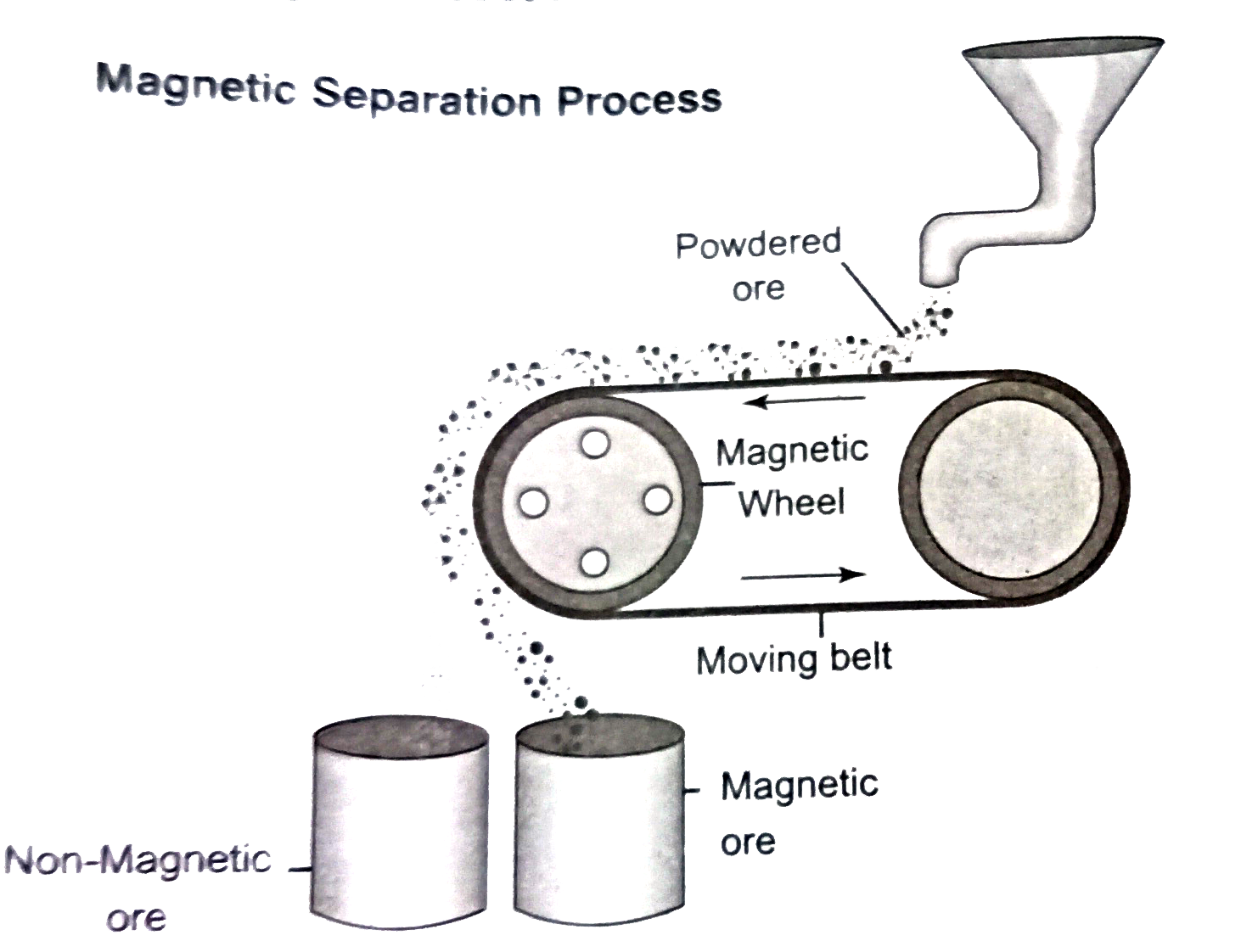
|
|
| 49. |
Discuss the main purpose of vulcanisation of rubber. |
|
Answer» Solution :NATURAL rubber has the following disadvantages: (i) It is soft and sticky at high temperatures and BRITTLE at low temperatures. Therefore, rubber is generally used in a narrow temperature range (283 - 335 K) where its elasticity is maintained (ii) It has a large water absorption CAPACITY, has low tensile strength and low resistance to abrasion. (III) It is not resistant to the action of organic solvents. (iv) It is easily attacked by oxygen and other oxidising agents. To improve upon the properties of natural rubber, it is vulcanised by heating it with about 5% sulphur at 373-415 K. The vulcanised rubber thus obtained has excellent elasticity over a larger range of temperature, has low water absorption tendency, is resistant to the action of organic solvents and oxidising agents. |
|
| 50. |
Discuss the manufacture of chlorine. |
|
Answer» Solution :Electrolytic process : When a solution of BRINE `(NaCl)` is electrolysed, `Na^(+) and Cl^(-)` ions are formed. `Na^(+)` ion reacts with `OH^(-)` ions of water and forms sodium hydroxide. Hydrogen and chlorine are liberated as gases. `{:(NaClrarrNa^(+)+Cl^(-),"At the cathode,","At the cathode,"),(H_(2)Orarr H^(+)+OH^(-),H^(+)+e^(-)rarr H,Cl^(-)rarr Cl+e^(-)),(Na^(+)+OH^(-)rarrNaOH,H+HrarrH_(2),Cl+ClrarrCl_(2)):}` Deacon.s process : In this process a mixture of air and hydrochloric acid is passed up a chamber containing a number of shelves, pumice stones soaked in cuprous chloride are PLACED. HOT gases at about 723 K are passed through a jacket that surrounds the chamber. `4HCl+O_(2)OVERSET(400^(@)C)underset(Cu_(2)Cl_(2))rarr 2H_(2)O+Cl_(2)uarr` The chlorine obtained by this method is dilute and is employed for the manufacture of bleaching power. The catalysed reaction is given below. `2Cu_(2)Cl_(2)+O_(2)rarr underset("Cuprous oxy chloride")(2Cu_(2)OCl_(2))` `Cu_(2)OCl_(2)+2HClrarr underset("CUPRIC chloride")(2CuCl_(2)+H_(2)O)` `2CuCl_(2)rarr underset("Cuprous chloride")(Cu_(2)Cl_(2)+Cl_(2))` |
|