

Saved Bookmarks
This section includes 7 InterviewSolutions, each offering curated multiple-choice questions to sharpen your Current Affairs knowledge and support exam preparation. Choose a topic below to get started.
| 1. |
Dinitrogen pentoxide decomposes to NO_(2) and O_(2) following first order kinetics N_(2)O_(5)(g) rarr 2NO_(2)+O_(2)(g) 0.2 mole of N_(2)O_(5) was taken in 2L vessel and heated at 200K. The concentrated of N_(2)O_(5) is measured at different intervals . Following graphs A and B were obtained from the data. Slope of straight line in graph (B ) is - 6670 . Calculate the activation energy for the reaction |
|
Answer» 12.77kJ |
|
| 2. |
Dinitrogen pentoxide decomposes to NO_(2) and O_(2) following first order kinetics N_(2)O_(5)(g) rarr 2NO_(2)+O_(2)(g) 0.2 mole of N_(2)O_(5) was taken in 2L vessel and heated at 200K. The concentrated of N_(2)O_(5) is measured at different intervals . Following graphs A and B were obtained from the data. Slope of straight line in graph 'A' is -1 .2 xx 10^(2)sec^(-1) . What is half life of the reaction ? |
|
Answer» `2.5 XX 10^(-2) s ` |
|
| 3. |
Dinitrogen pentoxide dissolve in water to give : |
|
Answer» `HNO_(2)` |
|
| 4. |
Dinitrogen (N_(2)) and dioxygen (O_(2)) are the main constituents of air but they do not react with each other to form oxides of nitrogen because |
|
Answer» the REACTION requires initiation by a catalyst The reaction is as follows : `2Cu + H_(2)O + CO_(2) + O_(2) to Cu (OH)_(2) + CuCO_(3)` |
|
| 5. |
Dinitrogen pentoxide decomposes as follows 2N_2O_5 to 4NO_2+O_2, The rate can be given in three ways (-d[N_2O_5])/(dt)=k_1[N_2O_5],(d[NO_2])/(dt)=k_2[N_2O_5],(d[O_2])/(dt)=k_3[N_2O_5] The relation between the rate constants k_1,k_2 and k_3 is |
|
Answer» `k_2=2k_1 and k_3=1//2k_1` |
|
| 6. |
Dinitrogen gas is evolved when sodium nitrite is heated : |
|
Answer» alone |
|
| 7. |
Dinitrogen can be purified from the impurities of NO and NH_(3) by passing through : |
|
Answer» concentrated `HCl` |
|
| 8. |
Dinitrogen cannot be librated by : |
|
Answer» decompostion of ammonium dichromate. `(NH_(4))_(2)CO_(3)overset(DELTA)to2NH_(3)+CO_(2)+H_(2)O` |
|
| 9. |
Dinitrogen and dioxygen are mainconstituentsof air but thesedo not react witheachotherto formoxides of nitrogenbecause "____" |
|
Answer» thereactionis endothermicand requiresvery HIGH TEMPERATURE. |
|
| 10. |
Dinitrogen and dioxygen are main constituents of air but these do not react with each other to form oxides of nitrogen because ____ _ |
|
Answer» the reaction can be INITIATED only in presence of a catalyst. |
|
| 11. |
Dinitrogen and dihydrogen react with each other to produce ammonia according to the chemical equation : ""N_(2)(g)+3H_(2)(g) rarr 2NH_(3)(g) (i) Calculate the mass of ammonia produced if 2.00xx10^(3) g dinitrogen reactw with 1.00xx10^(3)g dihydrogen (ii) Will any of the two reactants remain unreacted? (iii) If yes, which one and what would be its mass? |
|
Answer» Solution :(i) `"1 mole of N"_(2)," i.e., 28 g react with 3 moles of H"_(2)," i.e., 6 g of H"_(2)` `therefore " 2000g of N"_(2)" will react with "H_(2)=(6)/(28)xx200g=428.6g." Thus, "N_(2)" is the limiting reagent while H"_(2) " isthe excess reagent."` 2 moles of `N_(2)`, i.e., 28 g of `N_(2)` produce `NH_(3)` = 2 moles = 34 g `therefore "2000 g of N"_(2)" will produce NH"_(3)=(34)/(28)xx2000g=22428.57g` (ii) `H_(2)` will remain unreacted. (iii) MASS LEFT unreacted `=1000g-428.6g=571.4g` |
|
| 13. |
Dimethyl glyoxime is added to alcoholic solution of NiCl_(2). When ammonium hydroxide is slowly added to it, a rosy red precipitate of a complex appears (i) Give the structure of the complex showing hydrogen bonds. (ii) Give oxidation state and hybridisation of central metal ion. (iii) Identify whether it is paramagnetic or diamagnetic. |
Answer» SOLUTION : (ii) Oxidation state of Ni in the complex = + 2 Hybridisation = `dsp^(2)` (because it is a planar MOLECULE) (III) It is diamagnetic (because there is no unpaired electron present). |
|
| 15. |
Dimethyl terephthalateis a ester of |
|
Answer» Phthalicacid |
|
| 16. |
Dimethyl terephthalate and ethylene glycol react to form |
|
Answer» nylon-66 |
|
| 17. |
Dimethyl glyoxime form asquare planar complex with Ni^(+2) . This complex contain how many number of unpaired electrons ? |
|
Answer» |
|
| 18. |
Dimethyl ether is associated with which one of the isomer? |
|
Answer» Ethanol |
|
| 19. |
Dimethyl ether can be decomposed by heating with |
|
Answer» `H_2O` |
|
| 20. |
Dimethyl ether into formic acid |
|
Answer» Solution :Dimethyl ether into formic acid : `CH_(3)-O-CH_(3)+underset("DIL.")(H_(2)SO_(4))overset(Delta)underset(H_(2)O)rarrunderset("methyl ALCOHOL")(2CH_(3)OH)` `CH_(3)OH+(O)(K_(2)Cr_(2)O_(7)//dil.H_(2)SO_(4))/(Delta)underset("formic acid")(HCOOH)` |
|
| 21. |
Dimethyl cadmium and acetyl chloride produces |
|
Answer» acetone |
|
| 22. |
Dimethyl ether and ethyl alcohol are |
|
Answer» Metamers |
|
| 24. |
Dimer acetic acid in benzene is in equilibrium with acetic acid at a particular condition of temperature and pressure. If half of the dimer molecules are hypothetically separated out then |
|
Answer» Osmotic PRESSURE of the solution reduces |
|
| 25. |
Dilution process of different aqueous solution , with water are given in List-I. The effects of dilution of the solutions on [H^(+)] are given in List-II. (Note : Degree of dissociation (alpha) of weak acid and weak base is ltlt 1, degree of hydrolysis of salt lt lt 1 , [H^(+)] represents the concentration of H^(+) ions) |{:(,"List-I",,"List -II"),((P),"(10 mL of 0.1 M NaOH+20 mL of 0.1 acetic acid)dilutes to 60 mL",(1),"The value of "[H^(+)]" does not change on dilution"),((Q),"(20 mL of 0.1 M NaOH + 20 mL of 0.1 M acetic acid)diluted to 80 mL",(2),"The value of "[H^(+)]" change to half of its initial value on dilution"),((R ),"(20 mL of 0.1 M HCl + 20 mL of 0.1 M ammonia solution)diluted to 80 mL",(3),"The value of "[H^(+)]" change to two times of its initial value on dilution"),((S),"10 mL saturated solution of "Ni(OH)_(2)" in equilibrium with excess solid "Ni(OH)_(2)" is ",(4),"The value of "[H^(+)]" changes to "(1)/(sqrt(2))" times of its initial value on dilution"),(,"diluted to 20 mL (solid "Ni(OH)_(2)" is still present after dilution)",,),(,,(5),"The value of "[H^(+)]" changes to "sqrt(2)" times of its initial value on dilution"):}| |
|
Answer» P. `underset("0.1M, 20ml")(CH_(3)COOH)+underset("0.1M, 10ML")(NaOH)to CH_(3)COONa+H_(2)O` `pH=pKa rArr [H^(+)]` will not change on dilution correct match : F - 1 Q. `{:(underset("0.1M, 20ml")(CH_(3)COOH)+underset("0.1M, 20ml")(NaOH)to CH_(3)COONa+H_(2)O),(""- ""-"0.05M"):}` `[OH^(-)]=sqrt(K_(H)C)=sqrt(((k_(w))/(k_(a))C))` `[H^(+)]_(1)=sqrt((k_(w)k_(a))/(C))` `([H^(+)]_(2))/([H^(+)]_(1))=sqrt((C_(1))/(C_(2)))=sqrt((0.05)/(0.025))=sqrt(2)` Correct match : Q-5 R. `underset("0.1M, 20ml")(NH_(4)OH)+underset("0.1M, 20ml")(HCl)to underset(0.05M)(NH_(4)Cl)` `[H^(+)]=sqrt(K_(H)C)` `([H^(+)]_(2))/([H^(+)]_(1))=sqrt((C_(2))/(C_(1)))=(1)/(sqrt(2))` Correct match : R-4 S. Because of dilution solubility does not change so `[H^(+)]` = constant. |
|
| 26. |
Dilute solutions of H_2O_2 cannot be concentrated by |
|
Answer» VACUUM distillation |
|
| 27. |
Dilute soluion so boric acid is used as |
|
Answer» ANTIBIOTIC |
|
| 28. |
Dilute nitric acid on reaction with silver liberates: |
| Answer» Answer :A | |
| 30. |
Dilute hydrochloric acid solution cannot be concentrated by boiling beyond: |
| Answer» ANSWER :B | |
| 31. |
Dilute H_(2)SO_(4) can be used in groupof dil HCI |
|
Answer» |
|
| 32. |
Dilute HNO_3 reacts with limestone to yield: |
|
Answer» `CA(OH)_2. Ca(NO_3)_2` |
|
| 33. |
Dilute aqueous KMnO_4 , at room temperature reacts with R-CH=CH-R to give |
|
Answer» R-CHO `R-CH=CH-Runderset"HEAT"overset("conc." KMnO_4)to R-COOH+R-COOH` |
|
| 34. |
Dilute aqueous KMnO_(4) at room temperature reactswith R-CH= CH-R to give |
|
Answer» `R-CHO` |
|
| 35. |
Dilute alkaline solution of KMnO_4 is called : |
|
Answer» Baeyer.s reagent |
|
| 36. |
Dilithium is crucial to the propulsion system of some starships. Dilithium is fomred by the adhesionof two lithium atoms in the gas phase: Li(g)+Li(g)toLi_(2)(g) The enthalpy of formation of dilithium is not easily measurable by direct means. However, th following thermochemicalparameters are known. DeltaH_(f)^(@) of Li_(g)=150kJ//mol IE of Li_(g)=5eV//"atom"[1eV//"atom"=100kJ//mol] BE of Li_((g))^(+)=130kJ//mol IE of Li_(2(g))=5eV//"molecule" [IE= ionisation energy] [BE= bond energy] Q. What is DeltaH_(f)^(@) of Li_(2(g))? |
|
Answer» `130kJ//mol` |
|
| 37. |
Dihydroxyacetone (CH_2OH . CO . CH_2OH) has the general formula of carbohydrate but not included in this class due to : |
|
Answer» It does not contain polyhydroxy gp. |
|
| 38. |
Dihydroxy diethyl terephthalate is obtained byethylene glycol and what ? |
|
Answer» PHBV |
|
| 39. |
Dihydrogen reacts with CO at 700 k in presence of a cataylst ZnO//Cr_(2)O_(3)to form |
|
Answer» METHANE |
|
| 40. |
Dihydrogen gas used in Haber's process is produced by reacting methane from natural gas with high temperature steam. The first stage of two stage reaction involves the formation of CO and H_(2). In second stage, CO formed in first stage is reacted with more steam in water gas shift reaction. CO(g)+H_(2)O(g)hArr CO_(2)(g)+H_(2)(g) If a reaction vessel at 400^(@)C is charged with an equimolar mixture of CO and steam such that p_(CO)=p_(H_(2)O)=4.0 bar, what will be the partial pressure of H_(2) at equilibrium? K_(p)=10.1 at 400^(@)C. |
|
Answer» <P> Solution :Let the PARTIAL pressure of `H_(2)` at equilibrium be 'p' bar. So, at equilibrium the partial pressures of the species involved in equilibrium will be as follows:`{:(,CO(g),+,H_(2)O(g),HARR,CO_(2)(g),+,H_(2)(g)),("Initial pressure (bar)",4.0,,4.0,,,,),("Equilibrium pressure (bar)",4-p,,4-p,,p,,p):}` For this reaction, `K_(p)=(p_(CO_(2))xxp_(H_(2)))/(p_(CO)xxp_(H_(2)O))=(pxxp)/((4-p)(4-p))=10.1` or, `(p)/(4-p)=3.178 or, p=(4xx3.178)/(4.178)=3.04` `therefore` The partial pressure of `H_(2)` at equilibrium=3.04 bar. |
|
| 41. |
Dihydrogen has: |
|
Answer» TWO ISOTOPES and no isomers |
|
| 42. |
Dihydrogen forms three types of hydrides. (I) hydrides are formed by alkali metals and alkaline earth metals. (ii) hydrides are formed by non-metals and (iii) hydrides are formed by d-and f-block elements at elevated tempreature. Complex metal hydrides such as (iv) and (v) are powerful reducing agents. |
|
Answer» (i)= Covalent (ii)=Molecular (III) = Saline(iv) NAH , (v) LIH |
|
| 43. |
Dihedral angle in staggerred form of ethane is |
|
Answer» `0^(@)` |
|
| 44. |
Digestion of fat in intestine is aided by : |
|
Answer» DIFFUSION |
|
| 45. |
What is Van't Hoff equation for osmotic pressure ? |
|
Answer» Solution :(i) Boyle-Van.t Hoff LAW : " TEMPERATURE remaining constant , the osmotic pressure` pi` of a DILUTE solution is directly PROPORTIONAL to the concentration of the solution ." `rArr pi prop C or,pi prop 1/V rArr piV = K.` |
|
| 46. |
Difine nolality. What are its units ? |
| Answer» SOLUTION :Moles/kg. | |
| 47. |
Difine Van't Hoff laws of Osmotic pressure. |
|
Answer» Solution :(i) Boyle-Van.t Hoff law : " TEMPERATURE remaining CONSTANT , the osmotic pressure` PI` of a dilute solution is directly proportional to the concentration of the solution ." `rArr pi prop C or,pi prop 1/V rArr piV = K.` |
|
| 48. |
Difine electrophoresis. |
| Answer» Solution :The MOVEMENT of COLLOIDAL particles under the influence of an ELECTRIC FIELD is CALLED electrophoresis. | |
| 49. |
Difine calcinationwith one example. |
Answer» SOLUTION :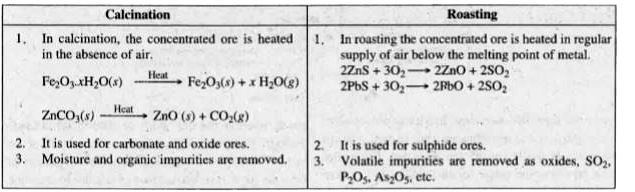
|
|


