

Saved Bookmarks
This section includes 7 InterviewSolutions, each offering curated multiple-choice questions to sharpen your Current Affairs knowledge and support exam preparation. Choose a topic below to get started.
| 1. |
Describe the action of hydroiodic acid on ethyl methyl ether . |
|
Answer» Solution :Ethyl methyl ether (METHOXY ethane) : When ethyl methyl (methoxy ethane) is treated with hydroiodic acid, a mixture of ethyl alcohol and methyl iodide is formed. `underset("ethyl methyl ether")(C_(2)H_(5)-O-CH_(3)+HI) to underset("ETHANOL")(C_(2)H_(5)OH)+underset("methyl iodide")(CH_(3)I)` If excess of hydroiodic acid is available, then ethyl alcohol further REACTS with hydroiodic acid at higher temperature to form ethyl iodide and water. `C_(2)H_(5)OH+HI to underset("ethyl iodide")(C_(2)H_(5)I)+H_(2)O` |
|
| 2. |
Describe the action of following reagents on glucose: HI |
| Answer» Solution :Action of HI: GLUCOSE on PROLONGED heating with HI gives n-hexane, which INDICATES that all the six carbon atoms are linked in straight chain `underset("Glucose")underset(CH_(2)OH)underset(|)overset(CHO)overset(|)((CHOH)_(4)) overset(hot HI)to underset("n-Hexane")(CH_(3)-CH_(2)-CH_(2)-CH_(2)-CH_(2)-CH_(3))` | |
| 3. |
Describe the action of hydroiodic acid ondiethyl ether. |
|
Answer» Solution :Diethyl ether (ethoxy ethane) : When diethyl ether (ethoxy ethane)is treated with hydroiodic acid, a MIXTURE of ethanol and ethyl IODIDE is formed. `underset("diethyl ether")(C_(2)H_(5)-O-C_(2))H_(5)+HI to underset("Ethanol")(C_(2)H_(5)-)OH+underset("ethyl iodide")(C_(2)H_(5)-I)` If excess of hydroiodic acid is available, then ethyl alcohol futher reacts with hydroiodic acid at higher temperature to form ethyl iodide and water. `underset("Ethanol")(C_(2)H_(5)-OH)+HI to underset("ethyl iodide")(C_(2)H_(5)I)+H_(2)O` |
|
| 4. |
Describe the action of excess of ammonia on n-propyl bromide. |
|
Answer» Solution :n-propyl bromide : When n-propylbromide is boiled under pressure with an excess of ammonia,n-propyl amine (PROPANAMINE) is FORMED. `UNDERSET("n-prophyl bromide") (CH_(3)-CH_(2)-CH_(2)-Br) +underset(("excess"))underset(("alc."))(NH_(3)) underset("pressure") overset(413K) to underset("n-propyl amine")(CH_(3)-CH_(2)-CH_(2))-NH_(2)+HBR` |
|
| 5. |
Describe the action of Bromine water reagentson glucose . |
|
Answer» Solution :Action of bromine water : Glucose on OXIDATION with mild oxidising agent LIKE bromine water gives gluconic acid, which SHOWS that the carbonyl GROUP in glucose is aldehyde group. `{:(" CHO"),(" |"),((CHOH)_(4)),(" |"),(" CH"_(2)OH),("Glucose"):}+(O) overset("Bromine water")to {:(" COOH"),(" |"),((CHOH)_(4)),(" |"),(" CH"_(2)OH),("Glucose acid"):}` |
|
| 6. |
Describe the action of dil. Nitricacidreagents on glucose. |
|
Answer» Solution :Action of dil. Nitric acid : Glucose on oxidation with DILUTE nitric acid FORMS dicarboxylic acid, saccharic acid. This indicates the presence of primary ALCOHOLIC group `(-CH_(2)OH)` in glucose. `{:(" CHO"),(" |"),((CHOH)_(4)),(" |"),(" CH"_(2)OH),("Glucose"):} OVERSET(dil. HNO_(3))to {:(" COOH"),(" |"),((CHOH)_(4)),(" |"),(" COOH"),("Saccharic acid"):}` |
|
| 7. |
Describe the action of alcoholic potassium hydroxide (alc. KOH) on n-propyl bromide. |
|
Answer» Solution :When n-prophyl bromide is heated with alcoholic potassium HYDROXIDE, PROPENE is formed. `underset("n-prophyl bromide") (CH_(3)-CH_(2)-CH_(2)-Br)+underset(("alc."))(KOH) overset("heat")to underset("propene") (CH_(3)-CH)=CH_(2)+KBr+H_(2)O` |
|
| 8. |
Describe the action of AgCN on ethyl bromide. |
|
Answer» Solution :Ethyl bromide : When ethyl bromide is HEATED with alcoholic SILVER cyanide, ethylisocyanide is formed. `underset("ethyl bromide") (CH_(3)-CH_(2)-Br)+underset(("alc."))(AGCN) overset("heat") to underset("ethyl isocyanide") (CH_(3)-CH_(2)-NC)+AGBR` |
|
| 9. |
Describe the action of Acetic anhydridereagents on glucose. |
|
Answer» Solution :ACTION of ACETIC anhydride : When GLUCOSE is glucose is heated with acetic anhydride in the presence of catalyst pyridine, glucose penta acetate is formed. It indicates that glucose is a stable COMPOUND and contains five hydroxyl groups. `{:(" CHO"),(" |"),((CHOH)_(4)),(" |"),(" CH"_(2)OH),("Glucose"):}+5(CH_(3)CO)_(2)O overset("Pyridine")to {:(" CHO"),(" |"),((CHOCOCH_(3))_(4)+5CH_(3)COOH),(" |"),(" CH"_(2)OCOCH_(3)),("Glucose penta acetate"):}` |
|
| 10. |
Describe the action of active centres present in the catalyst. |
|
Answer» Solution :(i) Active CENTRES increases the rate of the reaction by adsorbing and activating the reactants. (ii) Increase in the activity of a catalyst by increasing the surface area. Increase in the surface area of metals and metal oxides by reducing the PARTICLE size increases the rate of the reaction. (iii) The action of CATALYTIC poison occurs when the poison blocks the active centres of the catalyst. (iv) A promoter (or) activator increases the NUMBER of active centres on the surface. |
|
| 11. |
Describe tests to distinguish between secondary amine and tertiary amine. |
| Answer» Solution :Add `C_6H_5SO_2Cl.` SECONDARY amines will REACT to FORM a compound insoluble in NAOH. TERTIARY amines will not react with `C_6H_5SO_2Cl.` | |
| 12. |
Describe some features of catalysis by zeolites. |
|
Answer» SOLUTION :(i) Zeolites are hydrated alumino-silicates which have a three-dimensional network structure containing water molecules in their PORES. (ii) On heating, water of hydration present in the pores is lost and the pores become vacant to CARRY out catalysis. (iii) The size of the pores varies from 260 to 740 pm. Thus, only those molecules can be adsorbed in these pores and catalysed whose size fits these pores. Hence, they ACT as molecular sieves or shape selective catalysts. An important catalyst used in petroleum industry is ZSM-5 (Zeolite sieve of molecular porority-5). It converts alcohols into petrol by dehydrating them to FORM a mixture of hydrocarbons. `"Alcohols" to underset("Dehydration " ) overset(ZSM-5)to "Hydrocarbons" ` |
|
| 13. |
Describe some feature of catalysis by Zeolites. |
|
Answer» SOLUTION :(i) Zeolites are microporous, CRYSTALLINE, hydrated, alumino silicates, made of silicon and aluminium tetrahedra. (ii) There are about 50 natural zeolites and 150 synthetic zeolites. As silicon is tetravalent and aluminium is trivalent, the zeolite matrix carries extra negative charge. (iii) To balance the negative charge, there are extra framework cations for example, `H^(+) " or " Na^(+)`ions. (iv) Zeolites carrying protons are used as solid acids, catalysis and they are extensivelyused in the petrochemical industry for cracking heavy hydrocarbon fractions intogasoline, diesel, etc., Zeolites carrying `Na^(+)`ions are used as basic catalysis. (v) One of the most important applications of zeolites is their shape selectivity. (vi)In zeolites, the ACTIVE sites namely protons are lying inside their pores. (vii) So, reactions OCCUR only inside the pores of zeolites. |
|
| 14. |
Describe some feactures of catalysis by zeolites. |
|
Answer» Solution :Fetures of CATALYSIS by zeolite. (i) Zeolites are hydrated alumino-silicates ehich have a threedimensional network structure containing water molecules in their pores. (ii) The size of the pores varies from 260 to 740 pm. Thus, only those molecules can be adosrbed in these pores and CATALYSED whose size is small enough to enter these pores. Hence, they act as molecular sieves or shape selective catalysts. An important catalyst used in petoleum industry is `ZSM-5` (Zeolite sieve of molecular porority 5). It convertsalcohols into petrol by first dehydrating them to FORM a mixture of hydrocarbons. ALCOHOLS `overset(ZSM-5)underset("Dehydration")to` Hydrocarbons |
|
| 15. |
Describe simple chemical tests to distinguish between diethyl ether and propanol. |
|
Answer» (ii) Add `SOCl_(2)` or `PCl_(5)`; propanol evolves HCL gas at r.t. but diethyl ether does not. |
|
| 16. |
Describe Resonance effect with one example. |
|
Answer» Solution :It is not possible to explain the properties of a molecule by giving a single structure to It. Then several possible structures are to be proposed. Each structure will explain some properties of the molecule. All structures put together explain all the properties. This phenomenon is known as resonance. All the structures thus proposed are called resonance or canonical structures. Ex: Urea `CO(NH_(2))_(2)` has the following resonance (or canonical) structures.  Sallent FEATURES of resonance : 1) Resonance structures are interconvertable. 2) Resonance Involves only displacement of electrons without disturbing the positions of atoms. 3) All atoms in the molecule should lie in the same plane. 4) The no. of paired and unpaired electrons should be the same in all the structures. 5) The canonical structures should have nearly equal energy. 6) More stable resonance structure contributes more to the actual structure of the molecule. 7) More the delocalisation of electrons, more is the stability. 8) More the covalent bonds, more is the stability and charge separation gives less stability. Resonance effect: It is the polarity produced in a molecule by the INTERACTIONS of two `pi` bonds or between a `pi` bond and a lone pair of electrons present on adjacent atoms. This effect is TRANSMITTED throughout the chain. If the transfer of electrons is away from the atoms of substituent groups attached to the conjugated system, then the molecule gets high electron density in some of its positions as in aniline and it is GIVEN (+R). If the shift of electrons is towards the atom or substituent groups, it is (-R) as in nitrobenzene. 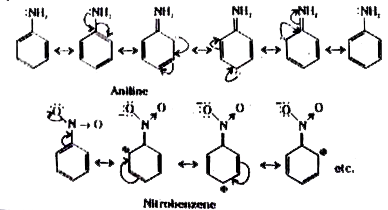 Resonance Energy: The energy dilfference between the real structure and the most stable resonance structure is called resonance stabilisation energy or resonance energy. |
|
| 17. |
Describe Saytzeff's rule with example. |
|
Answer» SOLUTION :(i) During intramolecular dehydration, if there is a possibility to FORM a carbon - carbon double bond at different locations, the preferred location is the one that gives the more (highly) substituted alkene i.e. the stable alkene. (ii) For example, the dehydration of 3,3 dimethyl - 2- butanol gives a mixture of ALKENES. The secondary CARBOCATION formed in this reaction undergoes rearrangement to form a more stable tertiary carbocation. 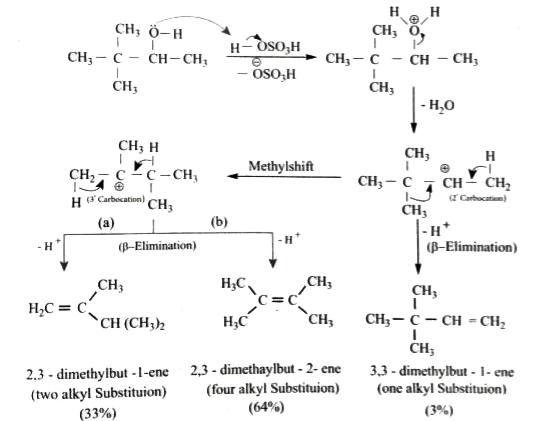
|
|
| 18. |
Describe parke's process of desilverisation of lead. |
|
Answer» Solution :Argentiferrous lead containing silver is extracted by Parke.s PROCESS BASED on the principle of distribution law. Molten lead and Molten zinc are immisible LIQUIDS. Molten zinc is lighter and forms upper layer. Silver is more soluble in Molten zinc than in Molten lead. The distribution RATIO of silver 300 to `500^(@)C` on cooling zinc layer solidifies extraction all silver is extracted. Zinc silver alloy is distilled in fire CLAY retort. Zinc distills over leaving behind silver. |
|
| 19. |
Describe Ostwald process for the manufacture of Nitric acid. Give uses. |
|
Answer» Solution :THEORY: (i) `NH_3`is oxidised to NO by air or `O_2`at 1070 K in the presence of Pt or Rh - Pd alloy `4NH_3 + 5O_2 to 6H_2O +4NO` (ii) Nitric oxide formed is cooled and allowed to come into contact with oxygen or air when it is oxidised to nitrogen dioxide. `2NO + O_2 to 2NO_2` (iii) The nitrogen dioxide formed is dissolved in WATER in the presence of air or oxygen when nitric acid is obtained. `4NO_2 + 2H_2O + O_2 to 4NHO_3` Working of the Plant. The outline of the plant and its working are shown in Fig. 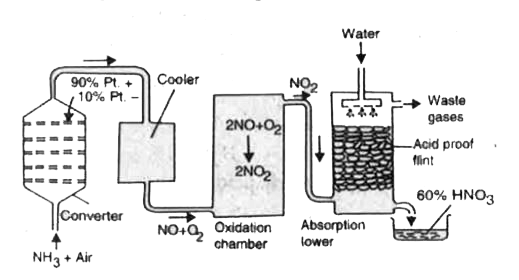 (i) Oxidation of ammonia. Ammonia prepared by Haber.s Process is MIXED with 10 times its volume of pure, dust, free, dry air. The mixture is passed through a converter made of either steel or aluminium with platinum gauze placed in it. The temperature of the converter is kept at about 1070 K. In the course of reaction, the catalyst platinum gauze gets a deposit of dust on it. Thus its efficiency is reduced. These days a more efficient catalyst consisting of an alloy of 90 percent platinum and 10 percent rhodium is being used. Here the ammonia is oxidised to nitric oxide. `4NH_3 + 5O_2 to 6H_2O + 4NO + `heat The reaction is exothermic. Therefore HEATING of the converter is required initially. Later on, the heat of reaction maintains the required temperature and no external heating is required. (ii) Oxidation of nitric oxide. The nitric oxide coming out of the converter, is cooled and passed through a chamber where it mixes with oxygen and oxidised to nitrogen dioxide. It is called oxidising chamber. `2NO + O_2 to 2NO_2` (iii) Absorption of nitrogen peroxide. The nitrogen dioxide from oxidation chamber is absorbed in water in the presence of oxygen. `2H_2O + 4NO_2 + O_2 to 2HNO_3` This solution of `HNO_3`is concentrated further. Uses of Nitric acid (i) Nitric acid finds extensive APPLICATION in the formation of fertilizers such as calcium nitrate `[CaO.Ca(NO)_2].` (ii) It has been used in the manufacture of sulphuric acid by Lead Chamber Process. (iii) It has been used for the preparation of perfumes, dyes, medicines etc. (iv) It finds application for the purification of silver and gold in the form of aqua regia. (v) It has been used for the manufacture of explosive substances like TNT, nitroglycerine, gun cotton, picric acid etc. in combination with concentrated sulphuric acid. (vi) Artificial silk has also been manufactured with its use. (vii) It is a very important laboratory reagent. |
|
| 20. |
Describeprimaryandsecondarystructureofnucleicacids. |
|
Answer» SOLUTION :INFORMATION REGARDINGTHE SEQUENCE ofnucleotidesinthechain ofnucleicacid iscalleditsprimarystructure. JamesWatsonandFrancisCrickgavesecondarystructrure ofDNA.Itisdoublestrandhelixstructure. Thetwochainsarewouldabouteachandheldtogetherbyhydrogenbonds.In secondarystructureofRNAhelicesarepresentwhich aresinglestranded. |
|
| 21. |
Describe magnetic separation. |
|
Answer» Solution :(1) This METHOD is based on the differences in magnetic properties of ore and gangue.  (2) Either ore or gangue must have magnetic properties, which is attracted by a magnet and get separated. (3) In this method, an electromagnetic separator consisting of leather or brass belt moving over two rollers, one of which is fitted with magnets is used. (4) When the finely powdered ore is DROPPED over the moving belt at one end. the magnetic portion of the ore is attracted and froms one heap near to the roller while non-magnetic gangue falls away and FORMS ANOTHER heap. Hence ore can be separated from the imprtites. For example non-magnetic ore of `SnO_(2)` can be separated from magnetic impurities of wolframite, `FeWO_(4) cdot MnWO_(4).` |
|
| 22. |
Describe Lucas test used to distinguish Primary, Secondary and Tertiary alcohols. |
Answer» Solution :When alcohols are treated with Lucas AGENT (conc. HCl+ anhydrous `ZnCl_2`) at room temperature, tertiary alcohols react immediately to form a turbidity DUE to the FORMATION of alkyi chloride which is insoluble in the medium. Secondary alcohols react WITHIN 10 minutes to form a turbidity of ALKYL chloride where primary alcohols do not react at room temperature. 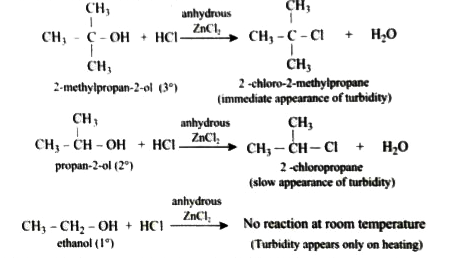
|
|
| 23. |
Describe laboratory method for preparation of glucose . Write the reaction that indicates the presence of - CHO group in glucose . |
|
Answer» Solution :Laboratory method for the preperation of glucose : Glucose can be prepared by boiling sucrose with dilute hydrchloric acid or dilute sulphuric acid for two hours . Sucrose gives glucose and fructose on hydrolysis . `underset("Sucrose")(C_(12)H_(22)O_(11))+H_(2)O overset(H^(+))underset(("dil. HCl"))rarr underset("Glucose")(C_(6)H_(12)O_(6))+underset("Fructose")(C_(6)H_(12)O_(6))` In order to separate glucose from fructose , alcohol during COOLING . Glucose CRYSTALLIZES out first as it is insouble in alchol . While fructose is soluble in alcohol. while fructose is soluable , so it still rmaions in the solution then , the solution is fitered to obtain CRYSTALS of glucose . ,brgt ACTION of BROMINE water on glucose : , The oxidation of glucose with bromine water forms gluconic acid . This indicatyes the presence of aldehyde group . 
|
|
| 24. |
Describe isolation method in determination of rate law and order of reaction. |
|
Answer» SOLUTION :This method is used when there are number of reactants. All reactants EXCEPT one are taken in large excess so that the change in concentration is NEGLIGIBLE and rate of reaction depends only on the reactant taken in small amount. Thus, for the reaction. aA + bB + cC ------products If order with respect to A, B and C are X, y and z, then according to rate law, Rate = `k [A]^(x) [B]^(y) [C]^(z)` If B and C are in large excess, their concentration remains almost constant. These can be included in the rate constant. Hence we can WRITE as, Rate = `k [A]^(x) [B]` Thus, order of reaction with respect to A is found out. Similarly, order with respect to B and C can be determined and hence the overall order of the reaction can be determined. |
|
| 25. |
Describe how does the enthalpy of reaction remain unchanged when a catalyst is used in the reaction? |
|
Answer» According to "intermediate complex formation thoory" reaciants firstcombinewith the catalyst to form an intermedieate complex which isshort-lived and decomposes to form the products and regenerating the catalyst. The intermediate formed has much lower potential energy than the intermediate complex formed between the reactants in the absence of the catalyst. Thus the presence of catalyst lowers the potential energy barrier and the reaction FOLLOWS a new ALTERNATE PATHWAY which require less activation energy. We know that,lower the activationenergy,faster is thereactionbecause morereactantmoleules can cross theenergybarrier andchanger into products . Enthalpy,`DeltaH`is a state functions.Enthalpyof reactions,i.e.,DIFFERECE inenergy between reactants and PRODUCT isconstant,whichis clear formpotential energy diagram. Potential energydiagramof catalysed reaction isgivenas 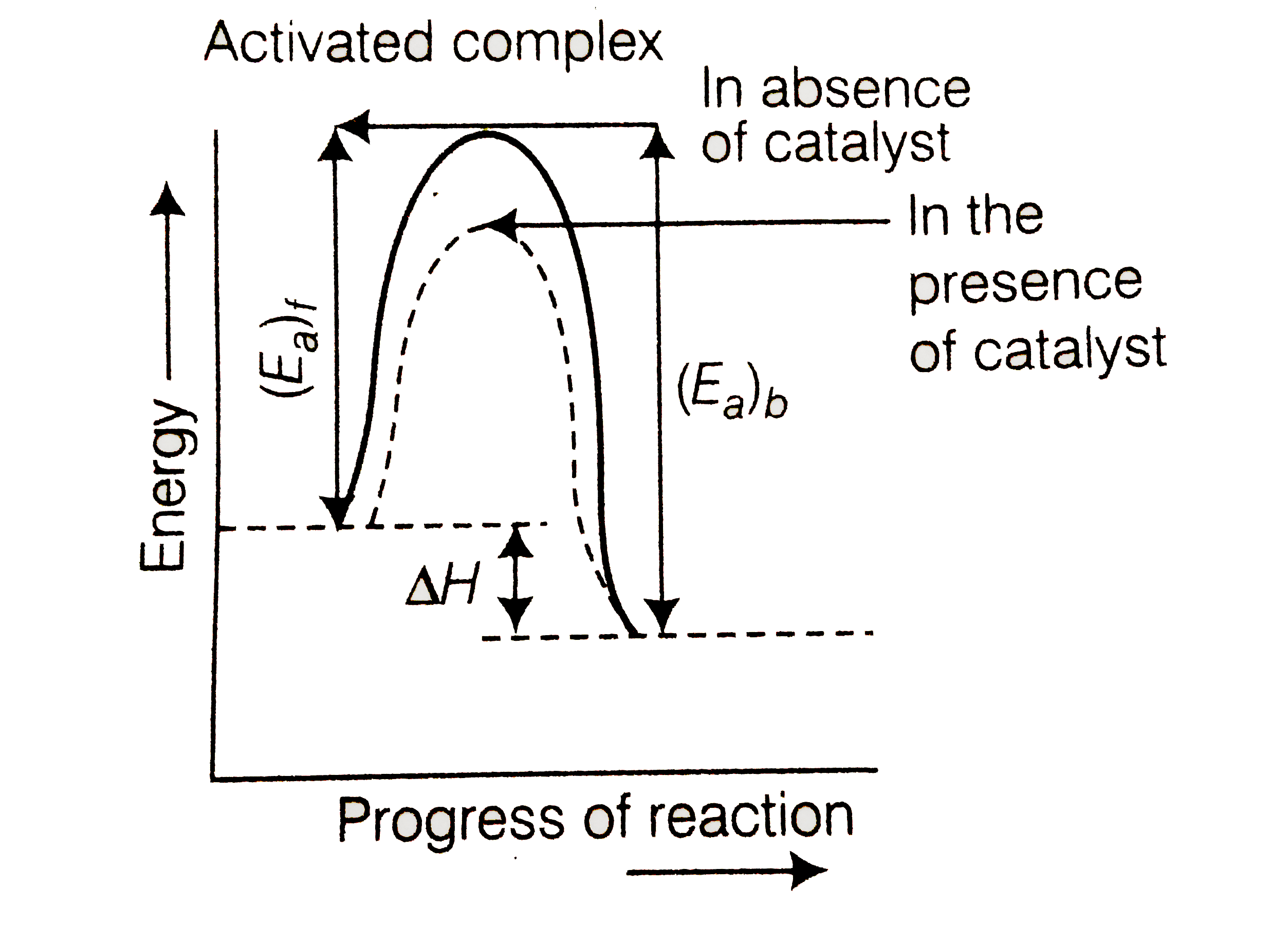
|
|
| 26. |
Describe how does the enthalpy of reaction remain unchanged when a catalyst is used in the reaction . |
|
Answer» Solution :When the reaction is carried out in presence of catalyst the ENTHALPY of reactant `H_(R)` and enthalpy of product `H_(p)` remian as it is without CHANGE .Enthalpy of reaction means change in enthalpy `Delta_(r)H` which does not change. `Delta_(r)H=(H_(P)-H_(R))`  In presence of catalyst height of GRAPH DECREASES.Potential barrier decreases but energy of reactant and product does not change.`DeltaH` remain as it as. In presence of catalyst height of GRAPH DECREASES.Potential barrier decreases but energy of reactant and product does not change.`DeltaH` remain as it as. |
|
| 27. |
Describe how adsorption of a gas on the solid surface depends pon (i) Gas pressure (ii) Temperature. |
| Answer» | |
| 28. |
Describe Hoffmann degradation reaction. (or) How would you obtain methyl amine from acetamide? |
|
Answer» SOLUTION :Acetamide reacts with BROMINE in the presence of caustic alkali to form a primary amine carrying one CARBON less than the parent AMIDE. `underset("acetamide")(CH_3 - undersetoverset(||)(O)(C ) - NH_2) + Br_2+ KOH to underset("methylamine")(CH_3NH_2) + K_2CO_2 + KBr + 2H_2O` |
|
| 29. |
Draw a neat labelled diagram of H_(2)-O_(2) fuel cell. Write the reaction occurs at cathode of the cell. |
Answer» Solution :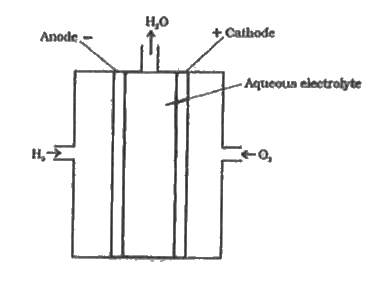 In this cell, hydrogen and OXYGEN are bubbled through porous carbon ELECTRODE into concentrated aqueous sodium HYDROXIDE. Hydrogen is fed into the ANODE compartment where it is oxidised. The oxygen is fed into cathode compartment where it is reduced. Anode : `2[H_(2)(g)+2OH^(-)(aq) to 2H_(2)O(l)+2e^(-)]` Cathode: `O_(2)(g)+2H_(2)O(l)+4e^(-) to 4OH^(-)(aq)` Overall: `2H_(2)(g)+O_(2)(g) to 2H_(2)O(l)` |
|
| 30. |
Describe giving reason which one of the following pairs has the property indicated ? (i) Fe or Cu has higher melting point. (ii) Co^92+) and Ni^(2+) has lowe magnetic moment. |
|
Answer» Solution :(i)Fehas highermelting point than CU. This is becauseFe has four UNPAIREDELECTRONS in 3d -subshell while Cu has only one electron in the 4s-subshell. Hence, METALLIC bonds in Fe are much stronger than those in CU. (ii) `._(27) Co = [Ar] 3d^(7) 4s^(2) ,Co^(2+)= [ Ar] 3d^(7) ( 3 ` unpaired electron) `. _(28) (Ni) =[Ar] 3d^(8) 4s^(2) , Ni^(2+) = [Ar] 3d^(8) ( 2` unpaired electrons) Hence, Ni has lower magnetic MOMENT than Co. |
|
| 31. |
Describe for any two of the following complex ions, the type of hybridisation, shape and magnetic property : (i) [Fe(H_(2)O)_(6)]^(2+) (ii) [Co(NH_(3))_(6)]^(3+) (iii) [NiCl_(4)]^(2-) (At. Nos. Fe = 26, Co = 27, Ni = 28) |
|
Answer» Solution :(i) `Fe(H_(2)O)_(6)]^(2+)` -outer orbital (high spin) complex-`sp^(3)d^(2)` HYBRIDISATION, octahedral, diamagnetic. (II) `[Co(NH_(3))_(6)]^(3+)` - inner orbital (low spin) complex- `d^(2)sp^(3)` hybridisation, octahedral, diamagnetic. (iii) `[NiCl_(4)]^(2-)-sp^(3)`, (Electrons PAIR up as `NH_(3)` is a strong ligand) TETRAHEDRAL, paramagnetic. |
|
| 32. |
Describe for any two of the following complex ions, the type of hybridisation, shape and magnetic property : [NiCl_(4)]^(2-) |
|
Answer» Solution :`[NiCl_(4)]^(2-)` Electronic configuration of Ni : [Ar] `4s^(2) 3d^(8)` Electronic configuration of `Ni^(2+) : [Ar] 4s^(0) 3d^(8)` `Cl^(-)` is weak field ligand and does not cause PAIRING of electrons `[NiCl_(4)]^(2-)`  Electrons donated by the LIGANDS It shows `sp^(3)` hybridisation and, therefore, has tetrahedral structure. It is paramagnetic DUE to the presence of unpaired electrons |
|
| 33. |
Describe for any two of the following complex ions, the type of hybridisation, shape and magnetic property : [Co(NH_(3))_(6)]^(3+) |
|
Answer» Solution :`[Co(NH_(3))_(6)]^(3+)` ELECTRONIC configuration of Co : [Ar] `4s^(2) 3d^(7)` Electronic configuration of `Co^(3+) : [Ar] 4s^(0) 3d^(6)` `NH_(3)` is strong field LIGAND. It will bring about pairing of electrons. `[Co(NH_(3))_(6)]^(3+)`  Electrons DONATED by the ligands Electrons DONATED by the ligands It has `d^(2)sp^(3)` hybridisation with octahedral shape. It is diamagnetic in nature due to absence of unpaired electrons. |
|
| 34. |
Describe for any two of the following complex ions, the type of hybridisation, shape and magnetic property : [Fe(H_(2)O)_(6)]^(2+) |
|
Answer» Solution :`[Fe(H_(2)O)_(6)]^(2+)` Electronic configuration of Fe : [AR] `4s^(2) 3d^(6)` Electronic configuration of `Fe^(2+) : [Ar] 4s^(0) 3d^(6)` `H_(2)O` is WEAK field ligand. It does not cause pairing of electrons. `[Fe(H_(2)O)_(6)]^(2+)`  Electrons DONATED by the ligands Electrons DONATED by the ligands It has `sp^(3)d^(2)` hybridisation with octahedral shape. It is PARAMAGNETIC due to the presence of unpaired electrons. |
|
| 35. |
Describe experiment to determine the mass of KMnO_4 present in 1dm^3 of the solution using standard ferrous ammonium sulphate solution. |
|
Answer» SOLUTION :Equation Procedure (Indicator + END POINT) CALCULATION |
|
| 36. |
Describe electrophoresis briefly. |
| Answer» Solution :It is a phenomenon in which COLLOIDAL PARTICLES move TOWARDS the oppositely charged electrodes in an electric field. For EXAMPLE, `As_2S_3` sol being negatively charged, the colloidal particles will move towards positive electrode. | |
| 37. |
Describe electrophilic substitution reaction of phenol. |
Answer» Solution :PHENOL on reacting with `Br_(2)` gives electrophilic substitution REACTION. <BR> 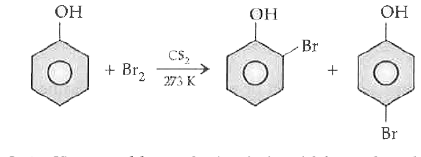
|
|
| 38. |
Describe crossed aldol condensation with two examples. |
Answer» Solution :ALDOL condensation can takes place between two different ALDEHYDE or KETONES or between ONE aldehyde and one ketone is called CROSSED or mixed aldol condensation. E.g., 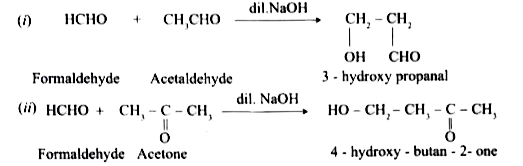
|
|
| 39. |
Describe Dry cell and Leclanche cell. |
|
Answer» |
|
| 40. |
Describe chemical methods of preparation of colloids. |
|
Answer» Solution :When the substance for colloidal particle is present as small sized particle, molecule or ion, they are brought to the colloidal dimension by condensation methods. i. Oxidation method:- When hydroiodic acid is treated with iodic acid `I_(2)` sol is obtained. `HIO_(3)+5HI to 3H_(2)O +3I_(2"(sol)")` ii. Reduction method:- GOLD sol is prepared by reduction of auric chloride using formaldehyde. `2AuCl_(3)+3HCHO+3H_(2)O to 2Au_((sol))+6HCl+3HCOOH` iii. HYDROLYSIS:- Ferric chloride is hydrolysed to get ferric hydroxide colloid `FeCl_(3)+3H_(2)O to Fe(OH)_(3)(sol)+3HCl` iv. Double decomposition:- When hydrogen sulphide gas is passed through a solution of ARSENIC oxide, a yellow coloured arsenic sulphide is obtained as a colloidal solution. `As_(2)O_(3)+3H_(2)S to As_(2)S_(3)+3H_(2)O` v. Decomposition:- When few drops of an acid is added to a dilute solution of sodium thiosulphate, sulphur colloid is produced by the decomposition of sodium thio sulphate. `S_(2)O_(3)^(2-)+2H^(+) to S_((sol))+H_(2)O+SO_(2)` |
|
| 41. |
Describe cesium chloride structure. |
Answer» SOLUTION :The structure of CsCl is SHOWN in Fig. In this structure, `Cl^(-)` ions have simple cubic arrangement and are present at all the comers of the cube. The `Cs^(+)` ions occupy the body POSITIONS of the cubes. The coordination number of `Cs^(+)` ION is 8 and that of `Cl^(-)` ion is 8 in this structure. 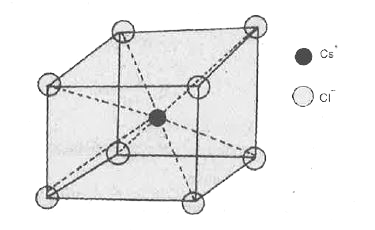
|
|
| 42. |
Describe briefly the nature of bonding in metal carbonyl. |
| Answer» Solution :In metal carbonyl, there is `sigma`-bonding as WELL as `pi`-bonding. `sigma`-bond is FORMED by donation of lone pair of electrons of LIGAND CO to the VACANT d-ORBITAL of transition metal, whereas `pi` bond is formed by donation of a pair of electrons from filled d-orbital of the metal to the vacant antibonding molecular orbital of carbon monoxide. | |
| 43. |
Describe briefly the following : Isomerism shown by [Cr(H_(2)O)_(5)(NCS)]^(2+). |
| Answer» SOLUTION :LINKAGE ISOMERISM. | |
| 44. |
Describe briefly the cleansing action of soap. |
Answer» Solution :Cleansing action of soap. Soaps or detergents have been USED as cleaning agents. The soaps are sodium salts of long chain fatty acids. They have a polar end `COO^(-) Na^+`and non-polar end made of long chain hydrocarbons which may be` - C_15H_31, - C_17C_33- C_17H_35`etc. For example, sodium STEARATE is composed of long chain of alkyl group called tail and a polar part of carboxylate ion and sodium ion called head. 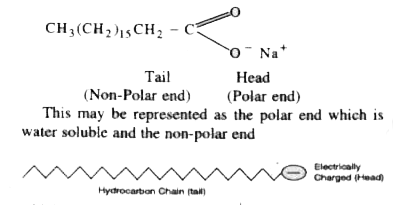 which is soluble in organic solvents and oil. Ordinarily, the dirt in the cloth is due to the presence of dust particles in fat or grease which STICK to the cloth. When the cloth is dipped in aqueous soap solution, the soap and the dirt come in contact with each other. The nonpolar end (tail) is directed towards the oil or grease present on the cloth and the polar end (head) is directed towards water. 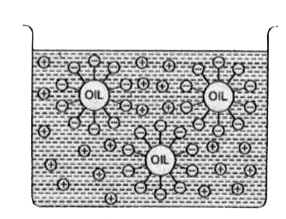 In this manner, each oil droplet is surrounded by a number of negatively charged carboxylate ions (Fig.). Since simple charges repel each other, the oil droplets are prevented from coming in contact with each other.As a result, oil droplets break up and more small droplets are formed. The hand rubbing or the agitation due to the washing machine causes dispersion of the oil or grease THROUGHOUT the SOAPY water. In this way, grease or dirt are removed from the surface of the cloth. |
|
| 45. |
Describe briefly the following: (i) Dialysis (ii) Electrophoresis. |
|
Answer» Solution :(i) Dialysis. It may be defined as the process which removes the excess of electrolyte from the colloidal sol. The colloidal sol containing electrolyte is taken in BAG of cellophane and is suspended from a HOOK. The electrolyte particles slowly pass through the pores of the semi-permeable MEMBRANE and colloidal solution i.e. sol is left behind. (ii) Electrophoresis. It is a process which helps in determining the nature of the charge on the colloidal particles. The colloidal sol is taken in a U-tube and two metal electrodes are placed in its two limbs. A current of low intensity is passed. In case, the colloidal particles are seen moving TOWARDS the negative electrode (cathode), they are POSITIVELY charged. In case, they move towards the positive electrode (anode). they are negatively charged. |
|
| 46. |
(a) Describe briefly allotropism in p - block elements with specific referenceto carbon. |
|
Answer» Solution :ALLOTROPISM in p - block elements : (i) Some elements exist in more than one CRYSTALLINE or molecular forms in the same physical state. (ii) Carbon exists as DIAMOND and graphite. The phenomenon is known as allotropism. (III) Other IMPORTANT allotropes of carbon are graphite, fullerenes, carbon nanotubes. |
|
| 47. |
Describe briefly allotropism in p-block elements with specific reference to carbon. |
|
Answer» Solution :Some elements exist in more than one crystalline or molecular forms in the same physical state. This phenomenon is called allotropism. Most common allotropes of carbon are (i) Graphite, (ii) Diamond (iii) Fullerenes (iv) Carbon nanotubes, (v) Graphene. (i) Graphite: a. It is the most stable ALLOTROPHIC form of carbonat normal termperature and pressure. b. It is soft and conducts electricity. c. It is composed of FLAT two dimensional sheets of carbon atoms. d. Each sheet is a hexagonal net of `sp^(2)` hybridised carbon atoms with a C-C bond length of `1.41Å`. e. Structure of graphite. 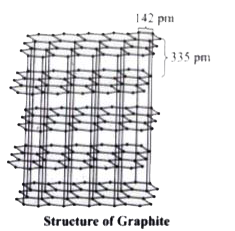 (ii) Diamond: a. It is very hard. b. The carbon atoms in diamond are `sp^(3)` hybridised with a C-C bond length of `1.54Å`. c. In the diamond, carbon atoms are arranged in tetrahedral manner. d. Structure of Diamond. 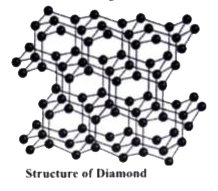 (iii) Fullerenes: a. It is NEWLY synthesised allotropes of carbon. b. The `C_(60)` molecules have a soccer BALL like structure and is called buckminster fullerene or buckyballs. c. It has fused ring structure consists of 20 six membered rings and 12 five membered rings. d. Each carbon atoms is `sp^(2)` hybridised. e. The C-C bond distance is `1.44Å` and C=C distance is `1.38Å`. f. Structure of fullerence, 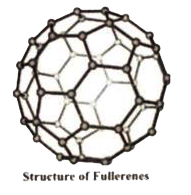 (iv) Carbon nanotubes: a. It is recently discovered allotropes, have graphite like tubes fullerene ends. b. These nanotubes are stronger than steel and conduct electricity. c. Structure of Carbon nanotubes. 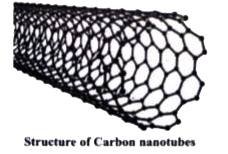 (v) Graphene: (a) It has a single planar sheet of `sp^(2)` hybridised carbon atoms that are densely packed in a honey caomb crystals lattice. d. Structure of Graphene, 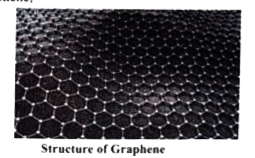
|
|
| 48. |
Describe anomalous behaviour of oxygen as compared with other elements of group16 with reference to : (a) Magnetic property(b) Oxidation state (c ) Hydrides |
|
Answer» Solution :(a) Magnetic property : Oxygen `(O_(2))` is paramagnetic while others are diamagnetic . Oxygen isparamagnetic due to TWO unpaired ELECTRONS in its outermost shell . (b) Oxiddation state :Oxygen shows oxidtion state of - 2 in most of its compunds . It also shows an oxidation state of `+` 2 in `Fe_(2)O" and" -1 "in " H_(2)O_(2)`and it CONNOT show oxidation state BEYOND 2, while , other elements shows oxidation state of `+ 2 , + 4 "and" + 6 ` because theseelements have vacant d - orbitals , so that their shell can expand . (c ) Hydrides : Hydrides of oxygen such as `H_(2)O` axists as liquid while all other hydrides are gases. |
|
| 49. |
Describe anomalous behaviour of fluorine with the other elements of group 17 with reference to : (a) Hydrogen bonding (b) Oxidation state (c) Polyhalide ions. |
|
Answer» Solution :ANOMALOUS behaviour of flurone with the other elements of group 17 : Fluorine shows anomalous behaviour with the other elements of group 17 due to : (1) small size, (2) high electronegativity and (3) non-availability of - orbitals in its valence shell. (a) Hydrogen bonding : O account of high electronegativity of fluorine atom, extensive hydrogen bonding occurs in HF molecule while it is absent in HCL, HBr and HI. The presence of hydrogen bonding in HF is explained as under hydrogen bonding in HF is explained as under : (1) HCl,HBr and HI are gaseous while HF is a liquid with an abnormally high boiling points. (2) HF forms a number of compounds containing `HF_(2)^(-)` ion (e.g., `KHF_(2)`) while such compounds are not given by other HX molecules. `HF* * * * * * * * H-F ** * * * * * *UNDERSET("H-bond")underset(uarr)(H)-F""(HF)_(n)` (b) Oxidation state : Due to maximum electronegativity of fluorine, it shows only a negative oxidation state of - 1. It does not show any positive oxidation state. The other members of group 17 show negative as well positive oxidation states of `+1,+3,""+5and +7`. (c) Polyhalide ions : Because of the absence of d-orbitals in its valence shell, fluorine does not combine with `F^(-)` ions to give polyhalide ions (LIKE `F_(3)^(-)` ) while other members of group 17 give such polyhalide ions like `Cl_(3)^(-),Br_(3)^(-),I_(3)^(-),I_(5)^(-)` etc., because they contain d-orbilats and also there electronegativity is low. |
|
