

Saved Bookmarks
This section includes 7 InterviewSolutions, each offering curated multiple-choice questions to sharpen your Current Affairs knowledge and support exam preparation. Choose a topic below to get started.
| 1. |
Williamson's ether synthesis with an example. |
Answer» SOLUTION :(i) Kolbe.s REACTION: 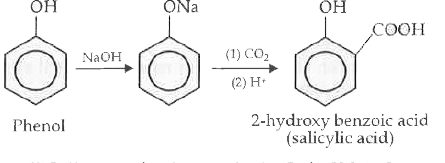 (II) Williamson.s ETHER SYNTHESIS. |
|
| 2. |
Describe the following type of substances, giving suitable example : antiseptics. |
| Answer» Solution :CHEMICALS which PREVENT the growth of microorganisms without affecting living tissues are CALLED antiseptics, For EXAMPLE, `0.2%` solution of phenol. | |
| 3. |
Describe the following : Shape-selective catalysis. |
| Answer» Solution :Shape-selective catalyst : The catalytic reaction that depends upon the pore structure of the catalyst and the size of the reactant and product molecules is CALLED shape-selective catalysis. Catalysts taking PART in such reactions are called shape-selective catalysts. Zeolites are examples of shape-selective catalysts because of their honeycomb like structures. They are MICROPOROUS ALUMINOSILICATES with three dimensional network of silicates. | |
| 4. |
Describe the following : Tyndall effect |
| Answer» Solution : Tyndall effect: If a BEAM of LIGHT is passed through a colloidal solution and the solution is viewed at RIGHT angles to the PATH of light, a bright cone of light is observed. This is called tyndall effect. | |
| 5. |
Describe the following reactions: (i) Cannizzaro's reaction. (ii) Cross aldol reaction. |
Answer» Solution :(i) Cannizzaro.s reaction: Akdehydes which do not have `alpha`- hydrogen atom, undergo self oxidation and reduction (disproportionation) reaction on TREATMENT with concentrated alkali. In this reaction, one molecule of aldehyde is reduced to alcohol while the other is oxidised to carboxylic acid salt. For example, (ii) Cross aldol reaction: When aldol condensation is carried out between two different aldehydes and/or ketones, it is called cross aldol condensation. If both of them CONTAIN `alpha`- hydrogen ATOMS, it gives a mixture of 4 products. Suppose there are two aldehydes RCHO and RCHO both containing `alpha`- hydrogen, one product each will be OBTAINED from (RCHO+RCHO), (R.CHO+R.CHO),(RCHO+R.CHO) and (R.CHO+RCHO). Cross aldol condensation between `CH_(3)CHO` and `CH_(3)CH_(2)CHO` gives the following products. `CH_(3)CHO+CH_(3)CHOoverset("dil" NaOH)(to)underset(OH)underset(|)(CH_(3)CH)-CH_(2)-CHO` `CH_(3)CH_(2)CHO+CH_(3)CH_(2)CHOoverset("dil"NaOH)(to)underset(OH)underset(|)(CH_(3)CH_(2)CH)-overset(CH_(3))overset(|)(CH)-CHO` `CH_(3)CHO+CH_(3)CH_(2)CHOoverset("dil"NaOH)(to)CH_(3)CH_(2)-underset(OH)underset(|)(CH)-CH_(2)CHO` `CH_(3)CH_(2)CHO+CH_(3)CHOoverset("dil"NaOH)(to)underset(OH)underset(|)(CH_(3)CH)-underset(CH_(3))underset(|)(CH)-CHO` Reaction beween benzaldehyde (not containing `alpha`- hydrogen) and acetophenone (containing `alpha` -hydrogen) is given below: 
|
|
| 6. |
Describe the following reactions with examples : (i) Reimer-Teimann reaction (ii) Kolbe’s reaction (iii) Friedel Crafts acylation of anisole |
Answer» SOLUTION :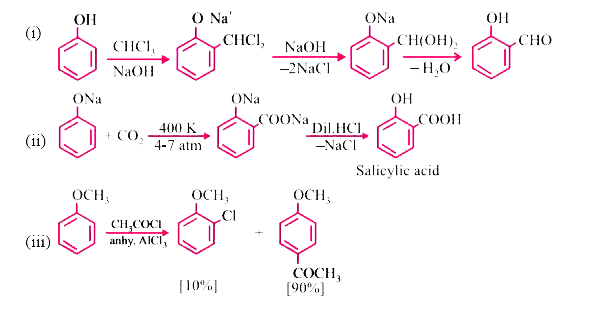
|
|
| 7. |
Describe the following reactions with one example of each: (i) Friedel- Crafts reaction (ii) Electrophilic substitution. |
Answer» SOLUTION :(II) ELECTROPHILIC SUBSTITUTION : 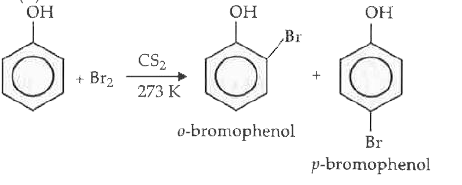
|
|
| 8. |
Describe the following properties of colloidal solutions (i) Brownian movement (ii) Tyndall effect. |
| Answer» | |
| 9. |
Describe the following : (i) Acetylation (ii) Cannizzaro reaction (iii) Cross aldol condensation (iv) Decarboxylation |
|
Answer» Solution :(i) Acetylatin : Replacement of an activehydrogen of alcohol, phenol or amine with an acetyl group RCO or ArCO group to form correspondingester or amide is called ACETYLATION. It is with acid chloride or anhydride in presence of a base. For example, `underset("Acetyl chloride")(CH_(3)COCl)+CH_(2)CH_(2)OHoverset("Pyridine")rarr underset("Ethyl ethanoate")(CH_(3)COOC_(2)H_(5))+HCl` `(CH_(3)CO)_(2)O+C_(6)H_(5)OH overset("Pyridine")rarr underset("Phenyl ACETATE")(CH_(3)COOC_(6)H_(5))+CH_(3)COOH` (IV) Decarboxylation : The PROCESS of removal of a molecule of `CO_(2)`from a carboxylic acid is called decarboxylation. It is CARRIED out by heating a carboxylic acid or its salt with sodalime `(NaOH+CaO)` at 630 K. For example,  `CH_(3)CH_(2)COONa+NaOH overset(CaO)underset(630K)rarr underset("Ethane")(CH_(3)CH_(3))+Na_(2)CO_(3)` |
|
| 10. |
Describe the following : (i) Cross-aldol condensation, (ii) Haloform reaction. |
|
Answer» Solution :Cross-aldol condensation. The aldol condensation between two DIFFERENT aldehydes is called cross-aldol condensation. e.g., `HCHO+CH_(3)CHO to underset(beta-"Hydroxypropionaldehyde")(HO-CH_(2)-CH_(2)-CHO)` (ii) Haloform reaction. The `CH_(3)-underset(O)underset(||)C-` or `CH_(3)-underset(OH)underset(|)CH-` groups when treated with halogen and an excess of alkali form HALOFORMS. This reaction is called haloform reaction. e.g., `CH_(3)CH_(2)OH+4I_(2)+6NaOH overset(Delta)to underset("Iodoform")(CHI_(3))+HCOONa +5NaI+5H_(2)O` |
|
| 11. |
Describe the following : (i) Shape-selective catalysis (ii) Reversible colloids. |
| Answer» | |
| 12. |
Describe the following giving the relevant chemical equation in each case : (i) Carbylamine reaction (ii) Hoffmann' s bromamide reaction. |
|
Answer» Solution :(i) Carbylamine reaction : Primary amines on warming with chloroform and alcoholic KOH gives unpleasent ODOUR of isocyanides or carbylamine. `RNH_(2)+CHCI_(3)+3KOH rarr RNC+3KCI +3H_(2)O` HOFFMANN bromamide reaction : When primary AMIDE is TREATED with KOH solution and bromine, it gives primary amine which has one carbon atom less than the original amide. `underset("Amide")(CH_(3)CONH_(2))+Br_(2)+4KOHrarrunderset(+2KBr+2H_(2)O)underset("Primary amine")(CH_(3)NH_(2))+K_(2)CO_(3)` |
|
| 13. |
Describe the following giving one example for each : (i) Detergents (ii) Food preservatives (iii) Antacids. |
|
Answer» Solution :(i) Substances which help in the removal of fats which bind other materials to the fabric or skin are CALLED detergents. There are two types of detergents : (a) Soaps. These are sodium or potassium salts of long CHAIN fatty acids LIKE stearic, oleic and PALMITIC acids. These soaps do not work with hard water. (b) SYNTHETIC detergents. There are anionic, cationic and non-ionic detergents which work with hard water also. For example, sodium lauryl sulphate and cetyltrimethyl ammonium bromide etc. (iii) Substances which prevent spoilage of food due to microbial growth are called food preservatives. For example, table salt, sugar, vegetable oils and sodium benzoate. (iii) Substances which can neutralise the excess of acid in the stomach are called antacids. Sodium hydrogen carbonate and metal hydroxides are examples of antacids. |
|
| 14. |
Describe the following giving linked chemical equations : (a) Cannizzaro reaction(b) Decarboxylation |
|
Answer» Solution :(a) Cannizzaro reaction `:` Aldehydes which do not have an a-hydrogen atom, undergoes self oxidation and reduction on treatment with concentrated alkali. Examles, `HCHO overset("Conc. NaOH ")(rarr) CH_(3) OH + HCOONa` `C_(6)H_(5) CHO overset("Conc. NaOH ")(rarr) underset("Benzyl alcohol")(C_(6) H_(5) CH_(2) OH) + underset( " Sodium benzoate")(C_(6) H_(5) COONa)` (b) Decarboxylation `:` Sodium salt of an acid on treatment with soda LIME ( `NaOH // CaO `) gives a hydrocarbon. `CH_(3) COONa + NaOH underset("CaO")overset("Soda lime")(rarr) underset( "Methane")(CH_(4)) + Na_(2) CO_(3)` |
|
| 15. |
Describe the following giving an example, Antifertility drugs. |
| Answer» Solution :ANTIFERTILITY drugs : Drugs which CONTROL the BIRTH of the child are called antifertility drugs. For EXAMPLE, Mifepristone and Progesterone. | |
| 16. |
Describe the following electrophilic substitution reaction using phenol. (i) Nitrosation (ii) Nitration (iii) Sulphonation |
Answer» Solution :(i)Nitrosation: Phenol can be readily nitrosoated at low temperature with NITROUS acid. 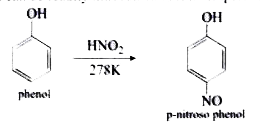 (ii) Nitration: Phenol can be nitrated using20% nitric acid at room temperature, a mixture of ortho and para nitro PHENOLS are formed. 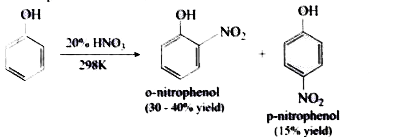 (iii) Phenol when treated with CONC.`HNO_3` and Conc.`H_2SO_4`. picric acid is formed. 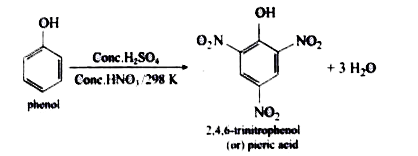 (iv)Sulphonation Phenol when reacts with Conc.`H_2SO_4` at 280K, o-phenol sulphonic acid is formed as major product. But when the REACTION is carried out at 373K, the major product is P-phenol sulphonic acid. 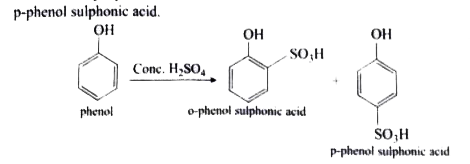
|
|
| 17. |
Describe the following, giving a suitable example: Antioxidants |
| Answer» Solution :CHEMICALS which are used to prevent OXIDATION and SPOILAGE of food are CALLED antioxidants. For example, butylated-hydroxyanisole. | |
| 18. |
describe the following conversions : (i) Ethyl benzene to benzoic acid (ii) Bromobenzene to benzoic acid (iii) Butan-1-01 to butanoic acid. (iv) Ethyl cyanide to ethanoic acid. |
|
Answer» |
|
| 19. |
Describe the following: (A) Fittig reaction (B) Dow's precess (C) Finkelstein's reaction. |
Answer» SOLUTION :(A) FITTIG Reaction (B) Dow.s process (c )Finkelstein.s reaction `C_(2)H_(5)Cl+NaI underset(Delta)overset("ACETONE")to C_(2)H_(5)I+NaCl` |
|
| 20. |
Describe the following: (a) Crossed Aldol condensation. |
|
Answer» Solution :When two aldehydes each containing at least ONE -hydrogen atom are treated with dilute alkali, four different products are obtained of which two are cross-ALDOL condensation products and the other two are self aldol condensation products as shown:`CH_(3) - CH_(2) - CHO + CH_(3) CHO overset("OH")to CH_(3)-CH_(2)-CH_(2)-CHO` PropanalEthanal`underset("3-hydroxypentana"l)(OH)`. (b) SAPONIFICATION: When an ester is hydrolysed in a basic medium it is known as saponification. `CH_(3)underset("Ethyl ACETAT"e)(COOC_(2))H_(5)+NaOHtoCH_(3)underset("sod acetate")(COO^(-))Na^(+)+C_(2)underset(E"thano"l)(H_(5))OH` |
|
| 21. |
Describe the following: (a) Aldol condensation (b) Decarboxylation. |
|
Answer» SOLUTION :(a) Aldol condensation : Two molecules of an aldehyde or ketone having `alpha`-H-atoms when TREATED with dil NaOH or `Ba(OH)_(2)` undergo condensation to give `beta`- hydroxyaldehydes or B-hydroxy ketones. This reaction is CALLED aldol condensation. e.g. `underset(underset("(2 molecules)")("ACETALDEHYDE"))(CH_(3)CHO+CH_(3)CHO) OVERSET("Dil. NaOH")to underset("3-Hydroxybutanol (Aldol)")(CH_(3)-underset(H)underset(|)overset(OH)overset(|)C-CH_(2)-CHO)` (b) Decarboxylation : It is the process of removal of a molecule of `CO_(2)` from a carboxylic acid is called decarboxylation. 
|
|
| 22. |
Describe the following: (a) Aldol condensation (B) Decarboxylation. |
|
Answer» SOLUTION :(a)Aldolcondensation: twomoleculesof analdehydeor ketons having`alpha `- atomswhentreatedwithdilNaOHor Ba`(OH)_2`undergocondensationtogive` beta -`hydroxyaldehydes or B- hydroxyketonsthisreactionis calledaldolcondensation ` e.g.,underset("Acetaldehyde(2molecules)") (CH_3 CHO +CH_2CHOoverset(Dil NaOH )tounderset("3-Hydroxybutanol(ALDOL )") (CH_3 - underset(H) underset(| ) overset(OH) overset(| ) C-CH_2 -CHO` (b) Decarboxylation: it isprocess of removal ofa MOLECULE of `CO_2 ` FROMA carboxylicacidis calleddecarboxylation . |
|
| 23. |
Describe the experimental procedure and give the calculations involved in the estimation of potassium permanganate present in one dm^(3) of its solution using standard oxalic acid solution. Give the equation for the redox reaction. |
|
Answer» Solution :Equation : `2KMnO_4 + 5H_2C_2O_4 + 3H_2SO4 to K_2SO_4 + 2MnSO_4 + 8H_2O + 10CO_2` `2KMnO_4 + 3H_2SO_4 to K_2SO_4 + 2MnSO_4 + 3H_2O + 5[O]` Warm the reaction mixture NEARLY to boiling (nearly `80^@C)` The hot solution is titrated against `KMnO_4` taken in the burette. End point is colour change from colourless to pale pink. Titrations to repeated to GET agreeing values. Results are tabulated. Calculation : `(N_1 V_1)KMnO_4 = (N_2V_2)H_2C_2O_4` `N_(KMnO_4) = (N_2 xx 10)/(V_(KMnO_4)) = N` Mass of `KMnO_4//dm^3 = N_(KMnO_4) xx "g. equivalent mass"` `= .............xx 31.6` `=..........g` |
|
| 24. |
Describe the experiment to determine the effect of temperature on the rate of reaction between potassium persulphate and potassium iodide. What is the conclusion drawn from the experiment ? |
| Answer» SOLUTION :`[2I^(-)+S_(2)O_(8)^(2-)`. Similar to CLOCK reaction of `H_(2)O_(2)` with `I^(-)]` | |
| 25. |
Describe the electrolysis of molten NaCl using inert electrodes. |
|
Answer» Solution :The electrolytic cell consists of two iron electrodes dipped in molten sodium choride and they are connected to an external DC POWER supply via a key. The electrode which is attached to the negative end of the power supply is called the cathode and the one is which attached to the positive end is called the anode. Once the key is closed, the external DC power supply drives the electrons to the cathode and at the same time pull the electrons from the anode. Cell REACTIONS : `Na^(+)` ions are attracted TOWARDS cathode,where they combines with the electrons and reduced to liquid sodium. Cathode (reduction) `Na_((l))^(+)+e^(-)Na_((l))""E^(@)=-2.71V` Similarly, `Cl^(-)` ions are attracted towards anode where they losses their electrons and oxidised to chlorine gas. Anode (oxidation) `2Cl_((l))^(-)rarr Cl_(2(g))+2e^(-)""E^(@)=-1.36V` The overall reaction is , `2Na_((l))^(+)+2Na_((l))+Cl_(2(g))""E^(@)=4,07V` 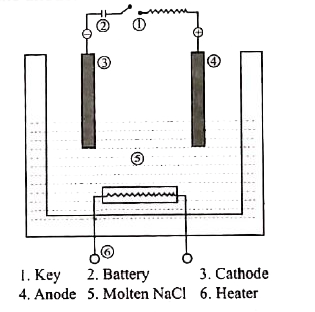 The negative `E^(@)` value shows that the above reaction is a non SPONTANEOUS one. HENCE, we have to supply a voltage greater than 4.07V to cause the electrolysis of molten `NaCl`. In electrolytic cell, oxidation occurs at hte anode and reduction occurs at the anode and reduction and reduction occur at the cathode as in a galvanic cell, but the sign of the electrodes is the reverse i.e.m in the electrolytic cell cathode is `-ve` and anode is `+ve`. |
|
| 26. |
Describe the electrolysisof moltenNaCl using inert electrodes. |
|
Answer» Solution :Let us understand the function of a electrolytic cell by considering the electrolysis of MOLTEN sodiumchloride. The electrolytic cell consists of two iron electrodes dipped in molten sodium chloride and they are connected to an external DC power supply via a key as shown in the figure. The electrode which is attached to the negative end of the power supply is called the cathode, and the one which attached to the positive end is called the anode. Once the key is closed, the external DC power supply drives the ELECTRONS to the cathode and at the same time pull the electrons from the anode. Cell reactions : `Na^(+)` ions are attracted towards cathode, where they combines with the electrons and reduced to liquid sodium. Cathode (reduction) `Na^(+)(l)+e^(-) rarr Na(l) ""E^(@)=-2.71V` Similarly, `Cl^(-)` ions are attracted towards anode where they losses their electrons and oxidised to chlorine gas. Anode (oxidation) `2CL^(-)(l) rarr Cl_(2)(g)+2e^(-) ""E^(@)=-1.36V` The overall reaction is, `2Na^(+)(l)+2Cl^(-)(l) rarr 2Na(l)+Cl_(2)(g) ""E^(@)=-4.07V` The negative `E^(@)` value shows that the above reaction is a non-spontaneous one. Hence, we have to supply a voltage greater than 4.07V to CAUSE the electrolysis of molten NaCl. |
|
| 27. |
Describe the constitution of standard hydrogen electrode. |
|
Answer» |
|
| 28. |
Describe the construction of Daniel cell. Write the cell reaction. |
|
Answer» Solution :Construction of Daniel cell : The separation of half reaction is the basis for the construction of Daniel cell. It consists of two half cells. (i) Oxidation half cell : A metallic zinc strip that dips into an aqueoussolution of zinc sulphate taken in a beaker. (ii) Reduction half cell : A copper strip that dipsinto an aqueous solution of copper sulphate taken in a beaker. (iii) Joining the half cells :The zincand copper strips are externally connected using a wire through a switch (k) and a load (example: volt meter). The electrolytic solution present in the cathodic and anodic compartment are connected using an inverted U tube containing a agar-agar gel mixed with an inert electrolyte such as KCl, `Na_(2)SO_(4)` etc., The ions of inert electrolyte do not react with other ions present in the half cells and they are not either oxidised (or) reduced at the electrodes. Thesolution in the salt bridge cannot get POURED out, butthrough which the ions can MOVE into (or) out of the half cells. (iv) When the switch(k) closes the circuit, the electrons flows from zinc strip to copper strip. This is due to the following redoxreactions which are taking place at the respective electrodes. Cell reaction : Anodicoxidation : The electrode at which the oxidation occuris called the anode. In Daniel cell, the oxidation take place at zinc electrode, i.e., zinc is oxidised to `Zn^(2+)` ions and the electrons. The `Zn^(2+)` ions enters the solution and the electrons enter the zinc metal, then FLOW through the EXTERNAL wire and then enter the copper strip. Electrons are liberated at zincelctrode and hence it is negative (-ve). `Zn_((s)) rarr Zn^(2+)""_((aq))+2e^(-)` `""` (loss of electron-oxidation) (i) Cathodic reduction : The electrons flow through the circuit from zinc to copper, where the `Cu^(2+)` ions in the solution acccept the electrons, get reduced to copper and the same get deposited on the electrode. Here, the electrons are consumed and hence it is POSITIVE (+ve). `Cu^(2+)""_((aq))+2e^(-) rarr Cu_((s))` `""` (gain of electron-reduction) (ii) Salt bridge : The electrolytes present in two half cells are connected using a salt bridge. The anodic oxidation of zinc electrodes results in the increase in concentration of `Zn^(2+)` n solution. i.e., the solution contains more number of `Zn^(2+)` ions as compared to `SO_(4)^(2-)` and hence the solution in the anodic compartment would become positively charged. Similarly, the solution in the cathodic compartment would become negatively charged as the `Cu^(2+)` ions are reduced to copper i.e., the cathodic solution contain more number of `SO_(4)^(2-)` ions compared to `Cu^(2+)`. To maintain the electrical neutrality in both the compartments, the non reactive anions `Cl^(-)` (from KCl taken in the salt bridge) move from the salt bridge and enter into the anodic compartment, at the same time some of the `K^(+)` ions move from the salt bridge into the cathodic compartment. (iii) Completion of circuit : Electrons flow from the negatively charged zinc anode into the positively charged copper electrode through the external wire, at the same time, anions move towards anode and cations are move towards the cathode compartment. This completes the circuit. (iv) Consumption of Electrodes : As the Daniel cell operates, the mass of zinc electrode gradually decreases while the mass of the copper electrode increases and hence the cell will function until the entire metallic zinc electrode is converted in to `Zn^(2+)` or the entire `Cu^(2+)` ions are converted in to metallic copper. Unlike Daniel cell, in certain cases, the reactants (or) products cannot serve as electrodes and in such cases inert electrode such as graphite (or) platinum is used which conducts current in the external circuit. 
|
|
| 29. |
Describe the construction of a H_(2)-O_(2) , fuel cell and the reactions H_(2)O taking place in it. |
|
Answer» Solution :In the`H_(2)- O_(2)`cell, hydrogen and oxygen are bubbled through (+) Cathode porous carbon electrodes into concentrated aqueous solution of sodium hydroxide solution. Catalysts LIKE finely divided platinum Aqueous electrolyte or palladium metal are incorporated into the electrodes for increasing the rate of reaction. The electrode reactions taking PLACE are given below: 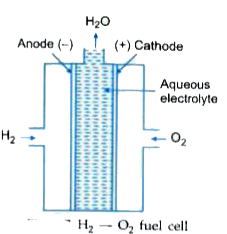 `{:("Cathode", O_(2)(G) + 2H_(2)O(l) + 4e^(-) to 4OH^(-)(AQ)` ANODE: `2H_(2)(g) + 4OH^(-) (aq) to 4H_(2)O(l) + 4e^(-)` The overall reaction is: `2H_(2)(g) + O_(2)(g) to 2H_(2)O` (l) |
|
| 30. |
Describethe construction of Danielcell and writeitscell reaction . |
|
Answer» Solution :Daniel cell :The separation of halfreaction is the basis for theconstruction of Daniel cell. It consists of twoa beaker. (i)Oxidation HALFCELL :A metallic zincstripthat dips intoan AQUEOUS solution of zincsulphatetakenin a beaker. (ii) Reducationhalfcell :A copperstrip thatdipsintoan aqueoussolution of copper sulphatetakenin a beaker. (iii) Joiningthe halfcells : The zinc and copperstripsare externallyconnectedusing a wirethrougha swtich(k) and a load ( example : volt METER ) . The electrolytic solution present in the cathodicand anodiccompatmentare connected using an inverted U tubecontaininga agar-agar gel mixedwith an inert electrolyte such as KCI, ` Na_(2)SO_(4)` etc.The IONS of inert electrolyte do not react with otherionspresent in the half cellsand theyare noteitheroxidised (or) reduced at the electrodes. The solution in the saltbridgecannotget poured out, butthroughwhichthe ions can move into (or) out of the halfcells. (iv)When the switch (k)closesthe circuit, the electronsflows fromzinc stripto copperstrip. Thisis due to the following redoxreactions whichare takingplaceat therespectiveelectrodes. |
|
| 31. |
Describe the construction and working of the standard hydrogenelectrode (S.H.E.) . |
|
Answer» Solution :(1) Construction: (a) The standardhydrogen electrode (S.H.E) consistsof a glass tube at the end of whicha pieceof platinisedplatinumfoil is attachedas SHOWN in the given figure. Aroundthis platethere is an outerjacket of glass which has a sideinlet throughwhich pure and DRY hydrogengas 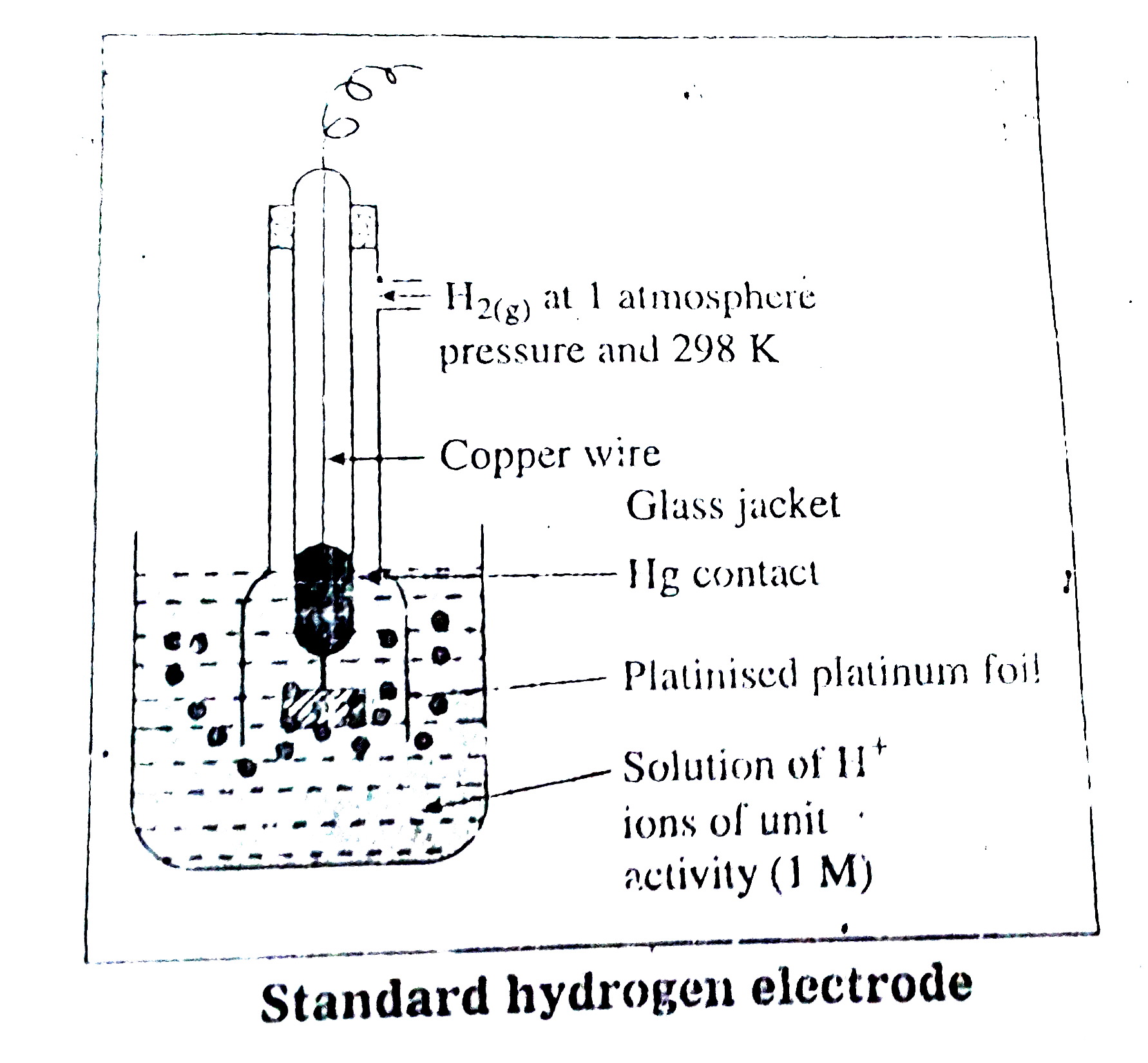 is bubbledat one atmospherepressure. The innertube is filled with a littlemercuryand a copperwire isdippedinto it for an electrical contact. (b) The wholeassemblyis kept immersed in a solution containing hydrogen ions `(H^(+))` of unit activity. (c) Thiselectrodeis arbitrarily assignedzero potential . (2) Representation of S.H.E. : `H^(+) (1M)|H_(2)(g,1 ATM)|Pt` (3) Working : If the electrodeacts asanode then, Oxidation: `1/2H_(2(g)) hArr H_((aq))^(+) + e^(-) E^(0) = 0.00 V` If the electrodeacts ascathodethen, Reduction: `H_((aq))^(+) + e^(-)hArr 1/2 H_(2^((g))) E^(0) = 0.00 V` `H_(2)` gasin CONTACTWITH `H_((aq))^(+)`ions attainsan equilibriumesta-blishing a potential. APPLICATIONS of SHE :A reversiblegalvanic cell with the experimental electrode , `Zn^(2+) (1M) |Zn_((ag))^(2+)(1 M)` and SHEcan be developedas follows : `Zn|Zn_((aq))^(2+) (1M)||H_((aq))^(+) (1M)|H_(2)(g,1atm) |Pt` Then, `E_(cell) = E_(SHE) - E_(M^(n+))//M` `= 0 - E_(M^(n+)//M)` ` = - E_(M^(n+)//M)` Thus the potential can be directlyobtained. (5) Disadvantages (Drawbacks or Difficulties) : (1) It is difficultto constructand handleSHE. (2) Pure anddry `H_(2)` gascannot beobtained. (3) Pressureof `H_(2)` gas cannot be maintainedexactlyat 1atmosphere. (4) The activemass or concentrationof `H^(+)` from `HCl` cannot be maintainedexactlyunity . |
|
| 32. |
Explain construction of Daniel cell. Write half cell reactions. How is Daniel cell symbollically represented? |
Answer» Solution :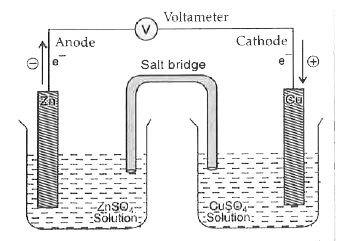 At anode zinc gets oxidised. ELECTRONS flow through external CIRCUIT. At cathode `CU^(+2)` IONS get reduced. At anode: `Zn to Zn^(+2)+2e^-` At cathode: `Cu^(+2)+2e^(-) to Cu` `Zn(s)|Zn^(+2) (aq) ||Cu^(+2) (aq) |Cu(s)` (s and aq are not value points) |
|
| 33. |
Describe the construction and working of the calomel electrode. |
|
Answer» Solution :The calomel electrodeis widelyused as a secondaryreference ELECTRODE. (1) Construction : (1) The calomel electrodeconsists of a glass vessel having side ARM B, for addingmercuryand other constituentsand arm C, for dippingit in any desired solution. A platinum WIRE A is usedfor an electricalcontact. Over this platinum wire are placedpure mercury. a paste of Hg and `Hg_(2)Cl_(2)`(mercurous chloride, i.e., the calomel and saturated KCL solution so as to fill the vessel and the arm C as shown in figure. (2) The potential developed on this electrodedepends upon the concentrationof chlorideions. (2) Representationof the calomel electrode : `KCl_(("sat")) |Hg_(2)Cl_(2(s))| Hg_((l))` KCl solution of differentconcentrationcan alsobe used. 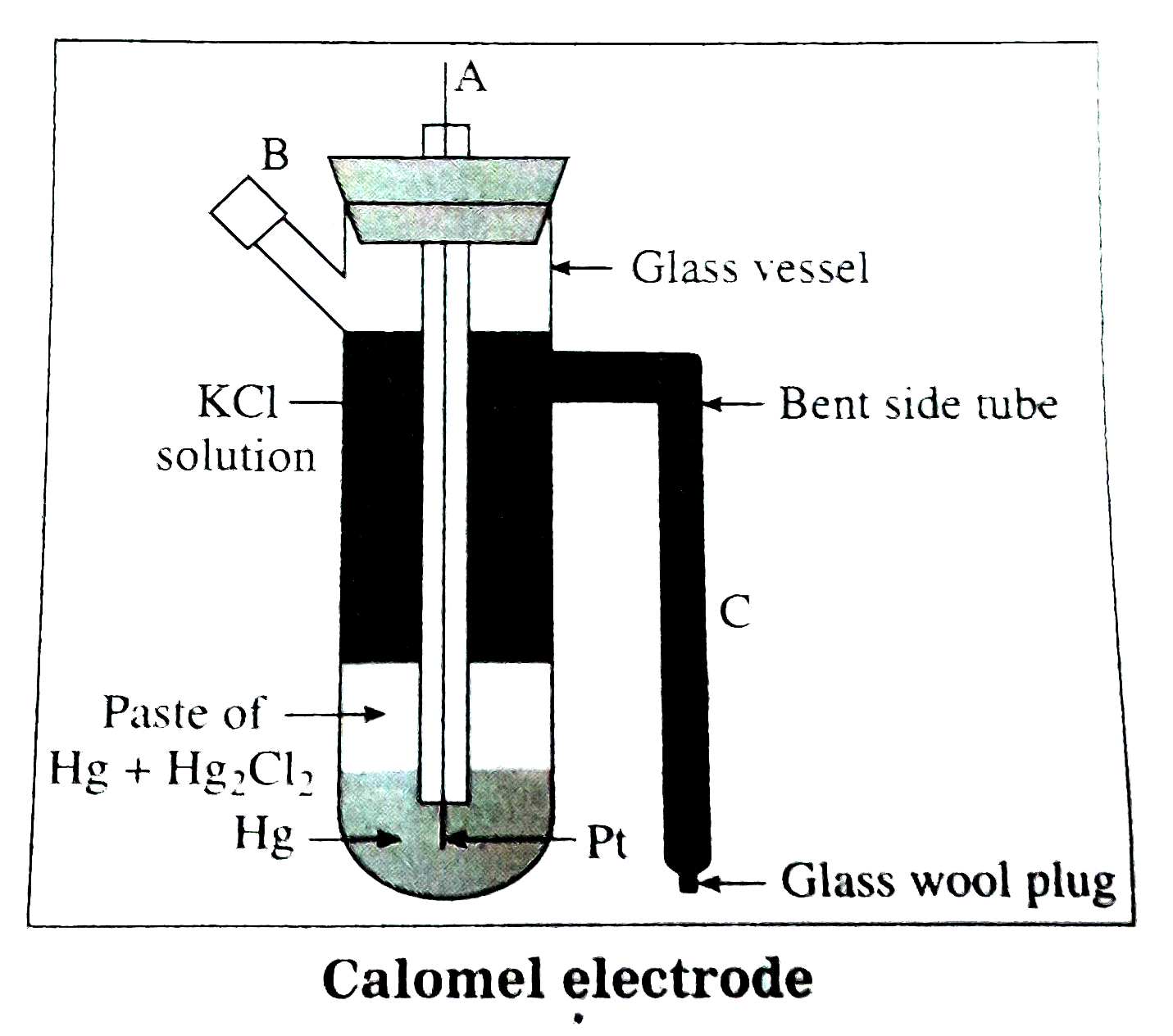 (3) Working: If the electrodeacts as anodethen, Oxidation : The followingreactiontakes place. `2Mg_((l)) rarr Hg_(2)^(2+) + 2e^(-)` `Hg_(2)^(2+) + 2Cl^(-) rarrHg_(2)Cl_(2(s))` Thus overall reaction is , `2Hg_((l)) + 2Cl_((aq))^(-) rarr Hg_(2)Cl_(2(s)) rarr Hg_(2)Cl_(2(s)) + 2e^(-)` If the electrodeacts as cathode then, Reduction : The reduction reaction is represented by `Hg_(2)Cl_(2(g)) +2e^(-) rarr 2Hg_((l)) +2Cl_((aq))^(-)` (4)Applications of calomel electrode : It is used to determinethe potentialsof other electrodes by developing a reversible galvanic cell by combiningwith experimental electrode. (5) Advantage : (1) The calomalelectrode is one of the most widelyused referenceelectrodes. (2) It has constantreproducible potential. (3) It is handy, compact and easy to transport. (4) It has very small temperaturecoefficient ofpotential. |
|
| 34. |
Describe the construction and working of standard hydrogen electrode. |
|
Answer» Solution :i) A rectangular platinum plate coated with platinum black is welded to a platinum WIRE and the wire is fused in to a glass tube with of help of mercury. ii) This tube issealed in to a jacket having a side tube at the top. It acts as the hydrogen inlet. iii) Twoholes are provided at the bottom of the OUTER jacket, which act as the hydrogen outlet iv) The outer jacket is immersed in a glass vessel containing 1M HCI.  Working: Hydrogen gas is passed from the top inlet. The PRESSURE inside the jacket increases. Due to this, acid level is pushed down and the platinum plate gets exposed to hydrogen gas. PT absorbs hydrogen. As a result, pressure falls and acid level increases back. Now, the absorbed film of hydrogen comes in contact with hydrogen ions of the solution and equilibrium is established and potential is developed. The potential developed is taken as zero. `H_(2)hArr 2H^(+)+2E^(-)` The half cell reaction is `H^(+)(aq)+e^(-)rarr(1)/(2)H_(2)(g)` |
|
| 35. |
Describe the construction and working of Normal Hydrogen Electrode. |
Answer» Solution :The absolute value of a single electrode potential cannot be determined experimentally because neither the oxidation nor the reduction can occur by itself. Therefore, we can FIND only the relative electrode potentials. For this purpose, hydrogen electrode has been selected as the reference electrode and is given arbitrary value of zero in its STANDARD state i.E., `2H^(+)(C=1" mol "l^(-1))+2e^(-)toH_(2)(g)(1ATM):E^(@)=0.00V` 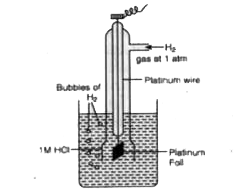 The standard hydrogen electrode consists of platinum wire sealed in a glass tube and has a platinum foil attached to it. The foil is coated with finely divided platinum and acts as platinum electrode. It is dipped into an acid solution containing `H^(+)` ions in 1 M concentration (1 M HCI). Pure hydrogen gas at 1 atmospheric pressure is constantly bubbled into the solution at constant temperature of 298 K. The surface of the foil acts as a site for the reaction. The following reactions occur in this half cell depending upon whether it acts as an anode or as a cathode. If S.H.E. acts as anode `H_(2)(g)to2H^(+)+2e^(-)` If S.H.E. acts as cathode `2H^(+)+e^(-)toH_(2)(g)` The electrode potential of an electrode can be measured by CONNECTING this half cell with standard hydrogen electrode, whose potential is taken as zero. |
|
| 36. |
Describe the construction and workingof lead accumulator(lead storage cell). |
|
Answer» SOLUTION :(A) Principle : (1) The lead accumulator is a secondaryelectrochemicalcell and it is also called lead accumulatoror lead storage battery. (2) It is a reversible cell. (B) Construction : In a lead accumulator, the negativeterminal(anode) is made up ofleadsheets packed withspongylead,while thepositive terminal (cathode) is made up oflead grids packedwith `PbO_(2)` . Sulphuricacid of about `38%` strength`(% w//w)`or specificgravity1.28 or 4.963molar is the electrolytein which the leadsheetsand lead gridsare dipped.The positiveterminal and negativeterminalare alternativelyarrangedin the electrolyteand are separatelyinterconnected . 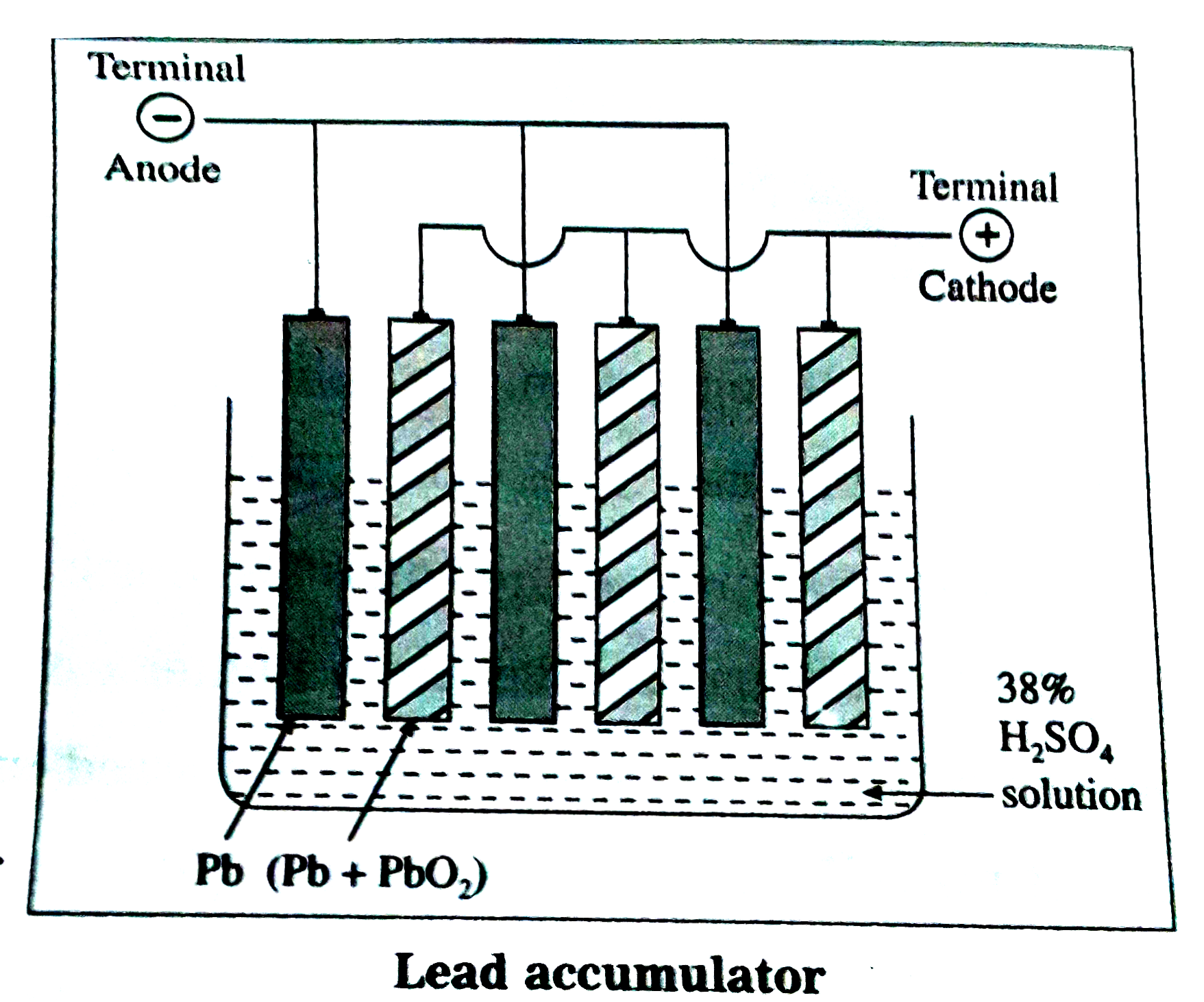 (C ) Representation of leadaccumulator : `underset(("Anode"))(-Pb_((s)))|PbSO_(4(s))|underset(38%)(H_(2)SO_(4(aq)))| PbSO_(4(s))|underset(("Cathode"))(PbO_(2(s)))|Pb^(+)` (D) Workingof a lead accumulator : (1) Discharging: When the electriccurrent is withdrawnfrom lead accumulator,the followingreactionstake place : Oxidationat the -ve electrodeor anode : `({:(Pb_((s))rarrPb_((aq))^(2+)+2e^(-),("oxidation")),(Pb_((aq))^(2+) +SO_(4(aq))^(2-)rarr PbSO_(4(s)),("precipitation")):})/(Pb_((s))+SO_(4(aq))^(2-)rarrPbSO_(4(s))+2e^(-)("overall oxidationat anode"))` Reduction at the +ve electrode or cathode : `({:(PbO_(2(s))+4H_((aq))^(+)+2e^(-)rarrPb_((aq))^(2+)+2H_(2)O_((l)),("reduction")),(Pb_((aq))^(2+)+SO_(4(aq))^(2-) rarr PbSO_(4(s)),("precipitation")):})/(PbO_(2(s))+4H_((aq))^(+)+SO_(4_(aq))^(2-)+2e^(-) rarrPbSO_(4(s))+2H_(2)O_((l))("overall oxidationat anode"))` (2) Net cell reaction : (i) Thus, the overall cell reactionduringdischargingis `Pb_((s)) + PbO_(2(s)) + 4H_((aq))^(+) 2SO_(4(aq))^(2-) rarr 2PbSO_(4(s)) + 2H_(2)O_((l))`OR `Pb_((s)) + PbO_(2(s))+ 2H_(2)SO_(4(aq))rarr2PbSO_(4(s)) + 2H_(2)O_((l))` During theoperation, the concentrationof `H_(2)SO_(4)` decreasesand specificgravitydecreasesfrom 1.28to 1.17. (ii) Rechargingof the cell : The dischargedbatteryis connectedto external electricsource anda higherexternalpotentialis appliedacrossits ELECTRODES and currentis passedin reversedirection. As a resultthe cell reactiongets reversedgenerating`H_(2)SO_(4)`. Reductionat the -ve electrodeor cathode : `PbSO_(4(s)) + 2e^(-) rarr Pb_((s)) + SO_(4(aq))^(2-)` Oxidationat the+ve electrodeor anode : - `PbSO_(4(s)) + 2H_(2)O_((l)) rarr PbO_(2(s)) + 4H_((aq))^(+) + SO_(4(aq))^(2-) + 2e^(-)` The netreactionduring chargingis `2PbSO_(4(s)) + 2H_(2)O_((l)) rarr Pb_((s)) + PbO_(2(s)) + 4H_((aq))^(+) + 2SO_(4(aq))^(-) ` OR `2PbSO_(4(s)) + 2H_(2)O rarrPb_((s))+PbO_(2(s)) + 2H_(2)SO_(4(aq))` (E) Applications : (1) It is USED a sourceof d.c. electricsupply. (2) It is usedin automobilein ignition circuitsand lightingthe head lightsby connecting6 batteriesgiving 12 V potential . (3) It isalsoused in invertors. |
|
| 37. |
Describe the construction and working of hydrogen -oxygen (H_(2) - O_(2)) fuel cell. |
|
Answer» Solution :(A) Principle : (1) The functioning of the fuel cell is based on the fact that the combustion reaction like `2H_(2(g)) + O_(2(g)) RARR 2H_(2)O_((g))` is EXOTHERMIC redox reaction and can be used to produce electricity . (2) The reactants of this fuel cell can be continuously supplied from outside, hence this type of galvanic cell can be used to supply electrical energy for a verylong period. 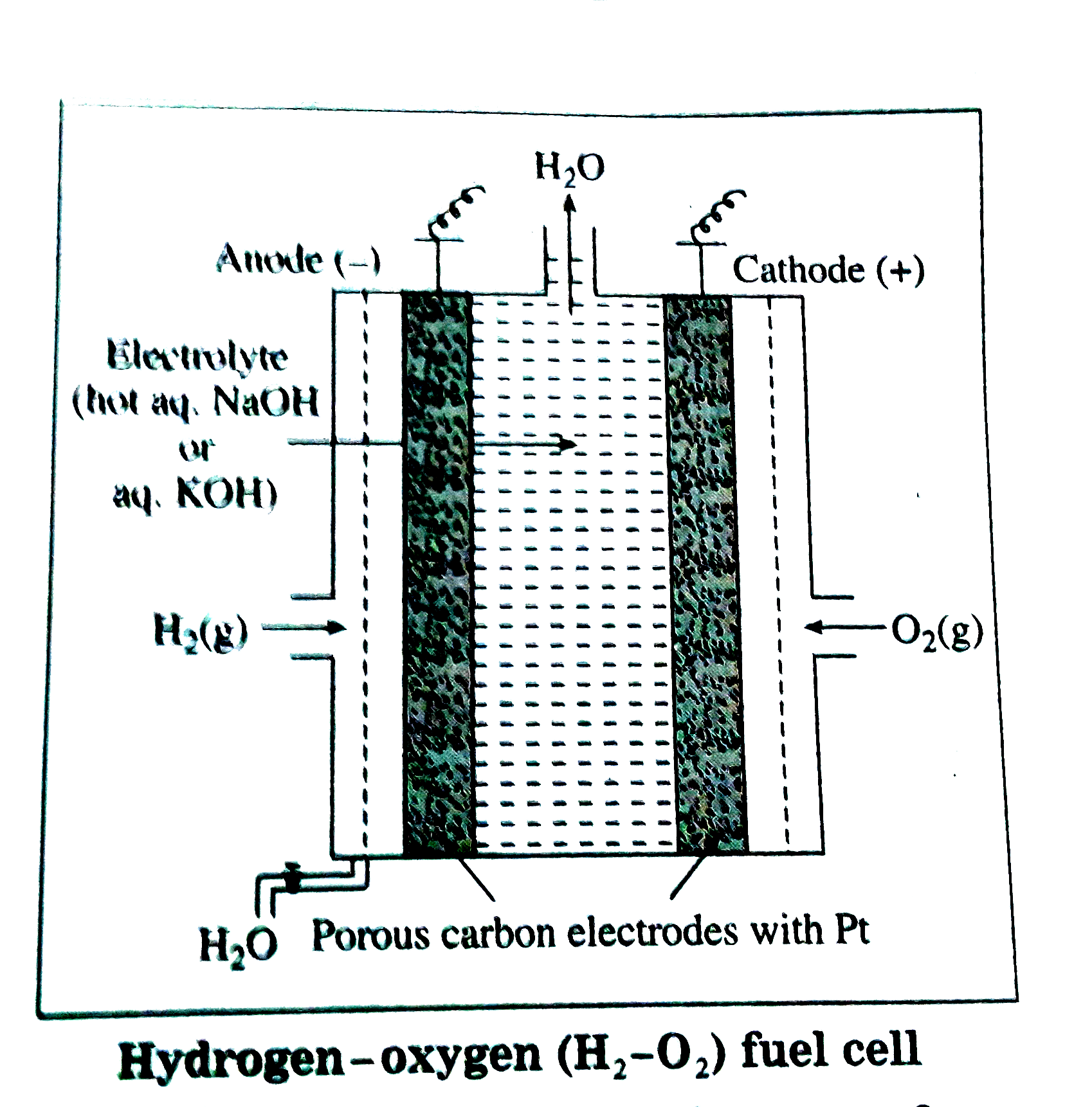 (B) Construction : (1) The fuel cell has porous electrodes with suitable catalyst since combustion of hydrogen is a slow reaction. (2) Anode and cathode cosistsof porous carbon rods impregnatedwith FINELY divided platinum which acts as a catalyst for the reactions. (3) The electrolyte used is not aqueous KOH solution in wich porous anode and cathode carbon rods are immersed. (4) `H_(2)` is continuously bubbled through anode while `O_(2)` gas is bubbled through cathode. (C ) Working (cell reactions) : (1) Oxidation at anode : `2H_(2(g)) + 4OH_((aq))^(-) rarr 4H_(2)O_((l)) + 4e^(-)` (oxidation half reaction) (2) Reduction at cathode : `O_(2(g)) + 2H_(2)O_((l)) + 4e^(-) rarr 4OH_((aq))^(-)` (reduction half reaction) (3) Net cell reaction : Additionof both the above reactions at anode and cathode gives a net cell reaction. `2H_(2(g)) + O_(2(g)) rarr 2H_(2)O_((l))` (overall cell reaction) (D) Representation of the cell : `""^(-)Pt|H_(2(g)) |underset((hot))(NaOH_((aq)))|O_(2(g))|Pt^(+)` `E_("cell")^(0) = E_("cathode")^(0) - E_("anode")^(0)` `= 0 .4- (-0.83)` `= 1.23 V` (E) Advantages : (1) The cell reactions do not cause any pollution. (2) The efficiency of this galvanic cell is the highest about `70%` as compared to ordinarygalvaniccells. (F) Drawbacks of `H_(2)l-O_(2)` fuel cell : (1) The cell requires expensive electrodes like `Pt, Pd`. (2) In practice, voltage is less than `1.23` voltdue to spontaneous reactions at the electrodes. (3) `H_(2)` gas is expensive and hazardous . (G) Applications : (1) It was successfully used in spacecraft. (2) It has potential applications in automobiles power generators for domestic and industrial uses. |
|
| 38. |
Describe the construction and working of Daniell cell. |
|
Answer» |
|
| 39. |
Describe the composition of anode and cathode in a mercury cell. Write the electrode reactions for this cell. |
|
Answer» Solution :Mercury cell: It consists of zinc mercury amalgam as anode, a paste of HGO and CARBON black is USED as cathode. The electrolyte is a paste of KOH and ZnO. At anode : Zn (amalgam) + `2OH^(-) to ZnO(s) + H_2O(l) + 2e^(-)` At cathode : `HgO(s) to ZnO(s) + HG(l)`. |
|
| 40. |
Describe the claensing action of soap. |
| Answer» | |
| 41. |
Describe the chemical properties of phenols. |
|
Answer» Solution :Chemical properties of phenols. Phenols are very reactive compounds and exhibit the reactions of both the hydroxyl group and the benzene ring as given below : 1. Acidic character. Phenols are weakly acidic compounds and in aqueous solution get dissociated to a small extent to form phenoxide and hydrogen ions. For example :  Therefore they turn blue litmus red and react with alkalies to form salts. For example :  2. Reaction with sodium. Phenols react with sodium to form sodium phenoxide and liberate hydrogen. for example :  3. Reaction withphosphorus pentachloride. On treatment with `PCl_(5)`, the hydroxyl group of phenols is replaced by chlorine atom. for example :  4. Reaction with alkyl halides. Sodium phenoxides react with alkyl halides to form ethers. For example :  5. Reaction with acid chlorides and anhydrides. Phenols react with acid chlorides or anhydrides to form esters. For example :  6. Reaction with ammonia. When heated with ammonia in the presence of anhydrous zinc chloride, phenols yields aromatic amines. For example :  7. Reaction with zinc dust. On heating with zinc dust, phenols get reduced to form aromatic hydrocarbons. For example :  8. Reaction with ferric chloride. When treated with a neutral solution of ferric chloride, phenols produce deep coloured compounds. This reaction is used as a test for phenols. For example, phenol gives a deep violet colour with neutral ferric chloride. Reactions DUE to benzene nucleus, Phenols undergo the following reactions due to the presence of benzene nucleus as illustrated below with the help of phenol. 9. Halogenation. On treatment with chlorine or bromine water, phenol gives a trihalogen DERIVATIVE.  When the above reaction is carried out in the presence of less polar solvents such as `CS_(2) and C Cl_(4)` and at lower temperature, monohalophenols are formed. For example :  10. Nitration. When treated with dil. `HNO_(3)`, phenol forms o - and p - nitrophenols.   With conc. `HNO_(3)` in presence of conc. `H_(2)SO_(4)`, phenol gives, 2, 4 - 6 - trinitrophenol known as picirc acid.  11. Sulphontion. Phenol reacts with conc. `H_(2)SO_(4)` at ordinary temperature to give MAINLY o - phenol sulphonic acid. Higher temperature (385K) favours the formation of p - isomer.  12. Friedal - Craft.s reaction. Phenol reacts with alkyl halides in the presence of anhydrous aluminium chloride to form o - and p - substituted compounds. For example:  13. Hydrogenation. On hydrogenation in the presence of nickel catalyst at 435 K, phenol gives cyclohexanol.  14. Libermann.s Nitroso Reaction. When phenol is warmed with a few drops of conc, `H_(2)SO_(4)` and sodium nitrite, a deep blue solution is obtained. The colour of the solution changes to red on dilution but again becomes blue on adding an alkali. The reaction is used as a test for phenol. 15. Coupling reaction. In the presence of alkali, phenol undergoes couplin reaction with benzene diazonium chloride to form p - hydroxy azobenzene which is used as a dye.  16. Kolbe.s reaction. When sodium phenoxide is heated with carbon dioxide at about 413K and high pressure, sodium salicylate is obtained.  Sodium salicylate gives on ACIDIFICATION.  17. Reimer - Tiemann.s reaction. On heating with CHLOROFORM and sodium hdyroxide, phenol form salicyladehyde.  18. Condensation reaction. When heated with phthalic anhydride in the presence of conc. `H_(2)SO_(4)`, phenol undergoes condensation reaction to form phenolphthalein. 
|
|
| 42. |
Describe the : antimicrobials |
|
Answer» SOLUTION :(i) Antimicrobials are drugs used to KILL MICROBES e.g. Erythromycin , penicillin, TETRACYCLIN etc. (ii) analgesics are drugs used as pain relievers e.g. Aspirin. |
|
| 43. |
Describe the acton of aqueous KOH (or NaOH) ontert-butyl chloride |
|
Answer» SOLUTION :Tert-butyl CHLORIDE : When tert-butyl chloride is refluxed with aueous potassium hydroxide, tert-butyl alcohol is formed. `CH_(3)- underset("tert-butyl chloride") underset(CH_(3))underset(|)overset(CH_(3))overset(|)C-Cl+underset((aq))(KOH) overset("boil") to CH_(3)-underset("tert-butyl alcohol") underset(CH_(3))underset(|) overset(CH_(3)) overset(|)C-OH+KCl` |
|
| 44. |
Describe the acton of aqueous KOH (or NaOH) onisopropyl bromide |
|
Answer» Solution :Isopropyl bromide : When isopropyl bromide (2-bromide-propane) is BOILED with aqueous POTASSIUM HYDROXIDE,isopropyl alcoholis formed. `CH_(3)- underset("isoprophyl bromide")underset(Br)underset(|)"CH"-CH_(3)+underset((aq))(KOH) OVERSET("boil") to CH_(3)-underset("isoprophyl alcohol") underset(OH) underset(|) "CH"-CH_(3)+KBr` |
|
| 45. |
Describe the acton of aqueous KOH (or NaOH) onethyl bromide . |
| Answer» Solution :Ethyl bromide: When ethyl bromide (bromoethane)is refluxed with AQUEOUS POTASSIUM hydroxide, ethyl alcohol is formed. The REACTION is called a hydrolysis reaction.<BR> `underset("ethyl bromide")(CH_(3)-CH_(2)-Br)+underset((aq))(KOH) overset("boil")to CH_(3)-underset("ethanol")(CH_(2)-OH)+KBr` | |
| 46. |
Describe the action onconc. HNO_(3) on anisole . |
Answer» SOLUTION :CONC. `HNO_(3)` : When anisole is REACTED with nitrating MIXTURE (conc. `HNO_(3)+`conc. `H_(2)SO_(4)`),a mixture of p-nitroanisole and o-nitroanisole is OBTAINED.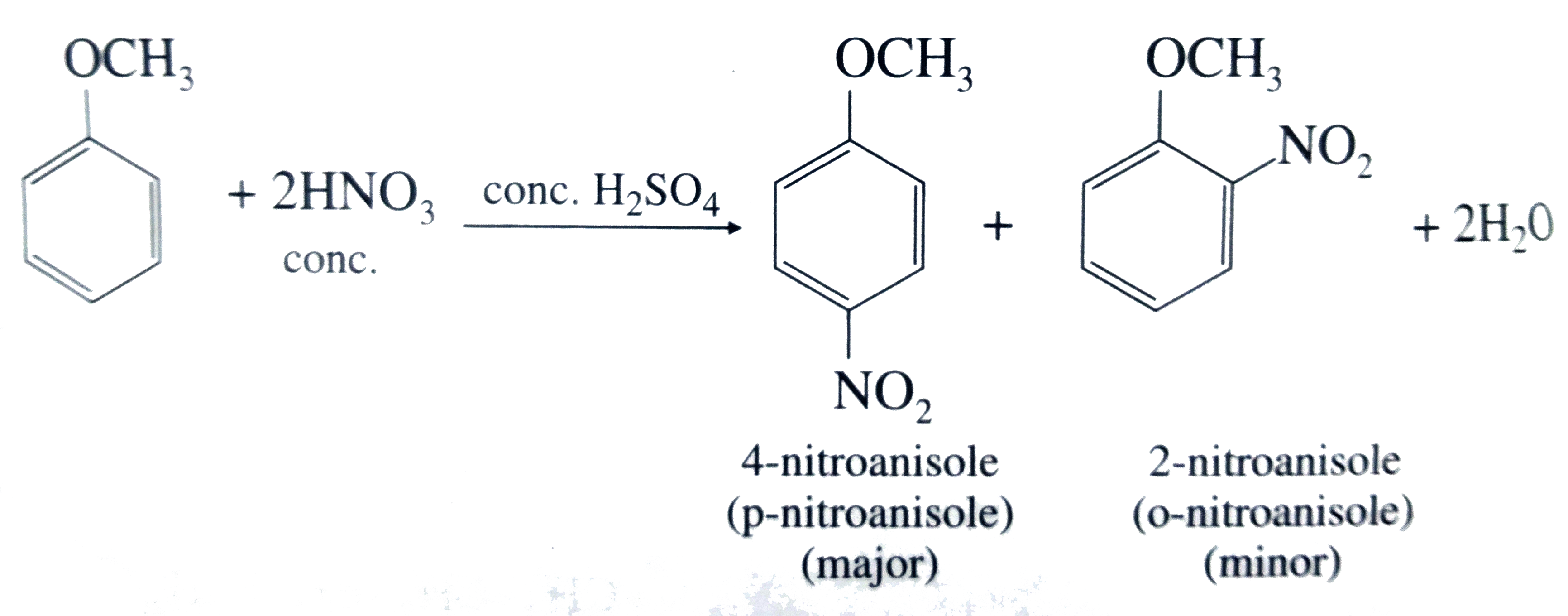
|
|
| 47. |
Describe the action onBr_(2) in acetic acidon anisole. |
Answer» Solution :Bromine in acetic ACID : When ANISOLE is treated with bromine in acetic acid, p-bromoanisole (major PRODUCT) is obtained. 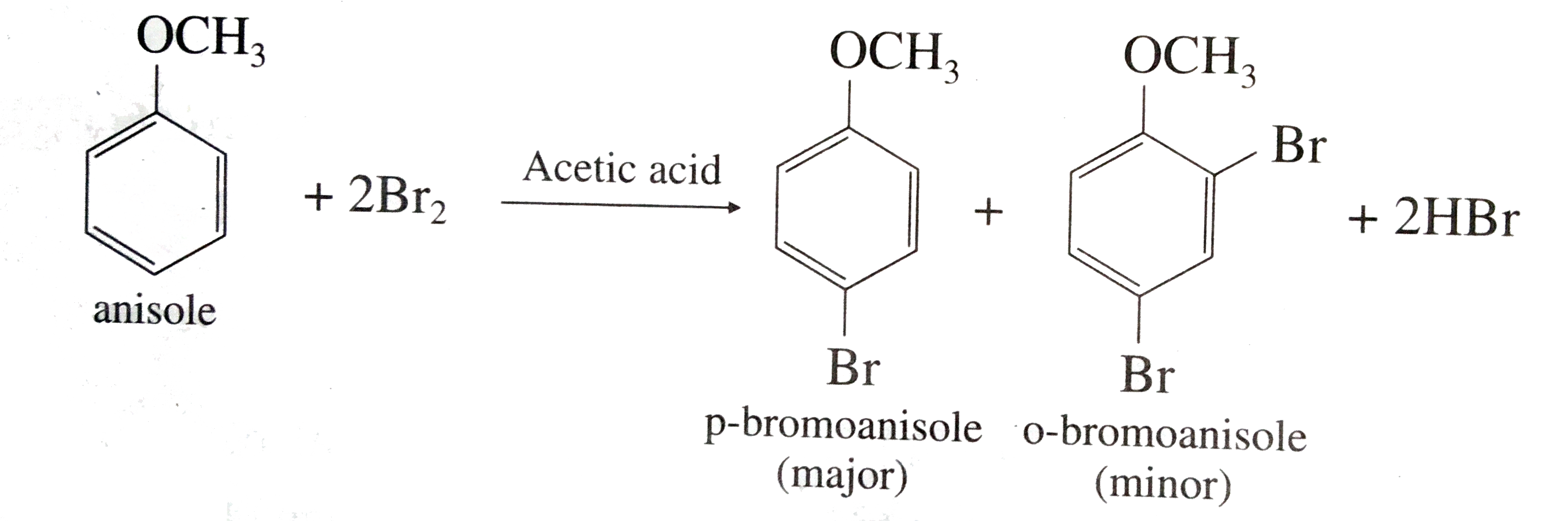
|
|
| 48. |
Describe the action of the following on chlorobenzene :Methyl chloride in the presence of anhydrous AlCl_(3) |
|
Answer» Solution :Methyl chloride in the presence of ANHYDROUS `AlCl_(3)` : When chlorobenzence is TREATED with methyl chloride in the presence of anhydrous `AlCl_(3),` a mixture of 1-chloro-4-methyl benzence (major product) and 1-chloro-2-methyl benzence is formed. Since, the alkyl group is introduced in the benzene RING, the reaction is termed as Friedel Crafts alkylation. 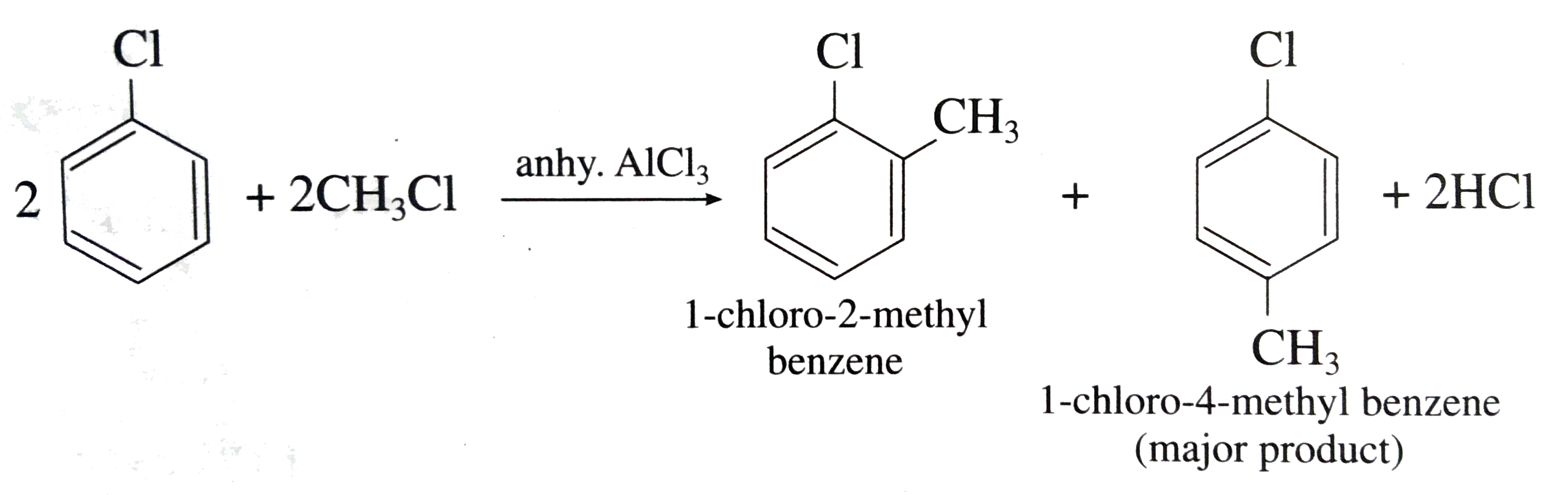
|
|
| 49. |
Describe the action of Hydroxyl aminereagents on glucose. |
|
Answer» SOLUTION :Action of HYDROXYL amine : Glucose reacts with hydroxyl amine in an aqueous solution to form glucose oxime. `{:(" CHO"),(" |"),((CHOH)_(4)),(" |"),(" CH"_(2)OH),("glucose"):} underset("hyroxyl amine")OVERSET(NH_(2)-OH)to {:(" CH"=NOH),(" |"),((CHOH)_(4)),(" |"),(" CH"_(2)OH),("glucose oxime"):}` |
|
| 50. |
Describe the action of hydroiodic acid on methyl phenyl ether. |
Answer» Solution :Methyl phenyl ether (ANISOLE) :When methyl phenyl ether (anisole) is treated with hydroiodic acid, PHENOL and methyl IODIDE is formed. Here, phenol does not react further with HI because - OH group is attached to `sp^(2)`hydbridised CARBON atom andit cannot be replaced by iodide (nucleophile).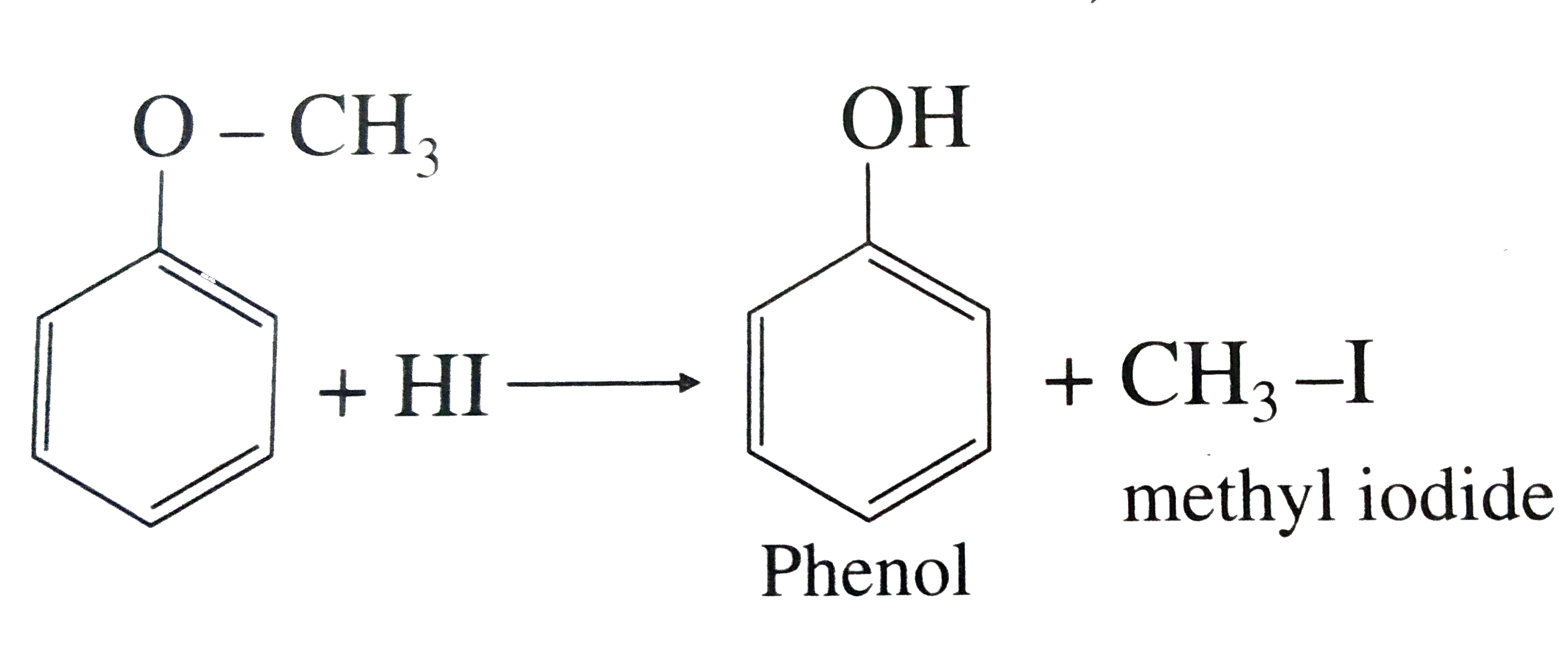
|
|