

Saved Bookmarks
This section includes 7 InterviewSolutions, each offering curated multiple-choice questions to sharpen your Current Affairs knowledge and support exam preparation. Choose a topic below to get started.
| 1. |
Define enzymes. |
|
Answer» Solution :There are many biochemical reactions that occur in our living cells. Digestion of food and harvesting the energy from them, and synthesis of necessary molecules required for various cellular functions are EXAMPLES for such reactions. All these reactions are catalysed by special proteins called ENZYMES. Enzymes are bio CATALYSTS produced by the living cells which catalyse many biochemical reactions in animal and PLANT BODIES. They are more specific in their action. |
|
| 2. |
Define enzymes . |
|
Answer» Solution :There are manybiochemicalreactions that OCCUR in our livingcells.Digestion of FOOD andharvestingthe energyfrom them , and SYNTHESIS of necessarymoleculesrequiredfor variouscellularfunctions are examples for suchreactions. All thesereactionsarecatalysedby specialprotein calledenzymes. Enzymesare bio catalysts produced BYTHE living cellswhichcatalyse MANY biochemicalreactions in animal and plantbodies . Theyare morespecific in theiraction . |
|
| 3. |
Define energy of activation. Draw a diagram of energy profile to show the influence of a positive catalyst on the energy of activation of a reaction. |
|
Answer» Solution :Minimum extra ENERGY that the reacting MOLECULE should ACQUIRE to reach threshold energy/ enter into effective COLLISION and to from products. Or it is the difference between threshold energy and normal average energy of the reacting molecule. 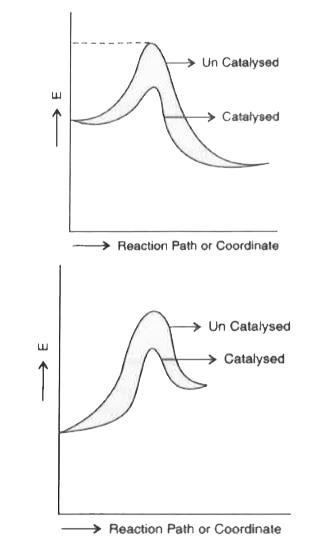
|
|
| 4. |
Define emulsification. |
| Answer» SOLUTION :The process of making an emulsion from an OIL and WATER is termed as EMULSIFICATION. | |
| 5. |
Define electrophoresis. |
| Answer» Solution :The movement of COLLOIDAL particles TOWARDS oppositely CHARGED electrode, on passing ELECTRICITY, is CALLED electrophoresis. | |
| 6. |
Define electrolysis. |
| Answer» Solution :Electrolysis is a PROCESS in which the ELECTRICAL energy is used to cause a non-spontaneous CHEMICAL reaction to OCCUR. | |
| 7. |
Define electrochemical series. or Wrtie two applications of electrochemical series. |
|
Answer» Solution :The ARRANGMENT of various ELECTRODES in the decreasing or increasing order of their standard REDUCTION potential is called electrochemcial SERIES are: (i) To compare oxidizing or reducing powers of DIFFERENT elements. ltbr. (ii) to predict the spontaneity of any redox reaction. |
|
| 8. |
Define electrochemical series. Write its applications. |
|
Answer» SOLUTION :Electrochemical series : The arrangement of ELECTRODES (metal or non-metal in contact with their ions) with the electrode half reaction in order of DECREASING standard potential is known as electrochemical series. Applications of electrochemical series : (i) Relative strength of oxidising agents in terms of `E^(@)` values can be calculated. (ii) Relative strength of reducting agents in terms of `E^(@)` values can be calculated. (iii) To identify the spontaneous DIRECTION of reaction. (iv) To calculate the `E_("cell")^(@)` values. `E_("cell")^(@)=E_("RHE")^(@)-E_("LHE")^(@)` |
|
| 9. |
Define electrochemical equivalent. |
| Answer» SOLUTION :Electrochemical equivalent is DEFINED as the amount of SUBSTANCE deposited or liberated at the electrode by a charge of 1 coulomb. | |
| 10. |
Define each of the following terms : (i) Micelles (ii) Peptization (iii) Desorption. |
|
Answer» Solution :(i) Micelles : There are some substances which at low concentrations behave as normal strong electrolytes, but at HIGHER concentrations EXHIBIT colloidal behaviour due to the formation of aggregates. The aggregated particles are CALLED micelles. Cleansing action of soaps is due to the formation of micelles. Soaps are sodium salts of long fatty acids. The hydrocarbon ends of the soap molecules surround the oil droplet and form a micelle around it. The polar groups of the soap molecules interact with WATER and the oil droplet is pulled from the dirty surface. (ii) Peptization : The process of converting a precipitate into colloidal solution by shaking it with dispersion medium in the presence of a small quantity of an electrolyte is called peptization. During peptization, the precipitate adsorbs an ion of positive or negative charge on its surface. This destablises the precipitate, and it breaks into smaller colloidal size particles. (iii) Desorption : The REMOVAL of the substance which has been adsorbed on the surface of a catalyst is called desorption. It is the reverse of adsorption. |
|
| 11. |
Define dialysis. |
| Answer» Solution :Dialysis is a process of REMOVAL of electrolytes and soluble impurities from a colloidal solution. It is CARRIED out by PUTTING the sol in a cellophane BAG and suspending in running WATER in a trough. The soluble impurities diffuse out gradually leaving behind the pure sol. | |
| 12. |
Define " detergent". |
| Answer» Solution :DETERGENT AREW SODIUM salts of long chain benzene sulphonic acid and long chain alkyl hydrogen SULPHATE. | |
| 13. |
Define degree of dissociation in terms of molar conductance? |
|
Answer» Solution :The FRACTION of TOTAL number of molecules dissociated is called DEGREE of dissociation. `alpha=A_m/(A_m^0)` |
|
| 14. |
Define crystal lattice. |
| Answer» SOLUTION :The regular ARRANGEMENT of these species THROUGHOUT the CRYSTAL is called a crystal LATTICE. | |
| 15. |
Define crystal field stabillisation energy .(CFSE). |
|
Answer» Solution :It is DEFINED as the energy difference of electronic CONFIGURATIONS in the ligand field `(E_(LF))` and the isotopic field/ barycentre `(E_(iso))` CFSE `(DeltaE_(O))={E_(LF)}-{E_(iso)}` `={[n_(T2G)-(0.4)+n_(eg)(0.6)]Delta_(O)+n_(P)P]-n_(P)^(1)P` Where, `n_(t2g)=` the number of electrons in `t_(2g)` orbital. `n_(eg)=` the number of electrons in `n_(g)` orbital. `n_(P)=` number of electron pairs in the ligand field. `N._(P)`= number of elctron pairs in the iso tropic field |
|
| 16. |
Define crystal field splitting energy. On the basis of crystal field theory, write the electronic configuration for d^(4) ion if Delta_(0) lt P. |
|
Answer» <P> Solution :Crystal field splitting ENERGY : It is the MAGNITUDE of difference in energy between two sets of d-orbitals i.E., `t_(2g)` and `e_(g)`.Electronic configuration for `d^(4)` if `Delta_(0) < P : t_(2g)^(3) e_(3)^(g)` |
|
| 17. |
Define crystal field splitting energy. On the basis of crystal field theory, write the electronic configuration for d^(4) ion if Delta_(0)ltP. |
|
Answer» Solution :In a FREE transition metal ion, all the five d-orbitals are degenerate but when it is involved in a COMPLEX formation, the degeneracy is split into two sets of d-orbitals. This is called CRYSTAL field splitting. The difference of energy between the two sets of d-orbitals is called crystal field splitting energy (CFSE). The lower energy sets of three d-orbitals is called `t_(2g)` and the higher energy set of two d-orbital is called `e_(g)`. The three electrons first enter into `t_(2g)`, one in each orbital. If `Delta_(0)ltP`, the 4th electron will enter `e_(g)`. Hence, the configuration will be `t_(2g)^(3)e_(g)^(1)`. |
|
| 18. |
Define : Cryoscopic constant What is the action of hot/concentrated nitric acid on : (a) Arsenic (b) AntimonyDraw the structure of : (a) Orthophosphoric acid (b) Pyrophosphoric acid |
|
Answer» Solution :Cryscopic constant or molal DEPRESSION constant is the depression in frrzing point produced by dissolving 1 mole of solute in 1 kg of solvent . Its units are K kg ` "MOL"^(-1) or .^(@)C "kgmol"^(-1)`or K/molal . (a) When the concentrated nitric acid reacts with the arsenic it forms arsenic acid . ` {:(5 HNO_(3),+,As,rarr,H_(3)AsO_(4),+,5NO_(2),H_(2)O),(("CONC."),,,,("Arsenic acid"),,,):}` (b) When the hot or concentrated nitric acid react with the antimony it forms a COMPOUND named as antimony pentoxide . ` {:(4Sb,+,20HNO_(3),to,Sb_(4)O_(10),+,20NO_(2),+,10H_(2)O),(,,("conc."),,("Antimony oxide"),,,,):}` ( a) Orthophosphoric Acid `(H_(3)PO_(4))` : 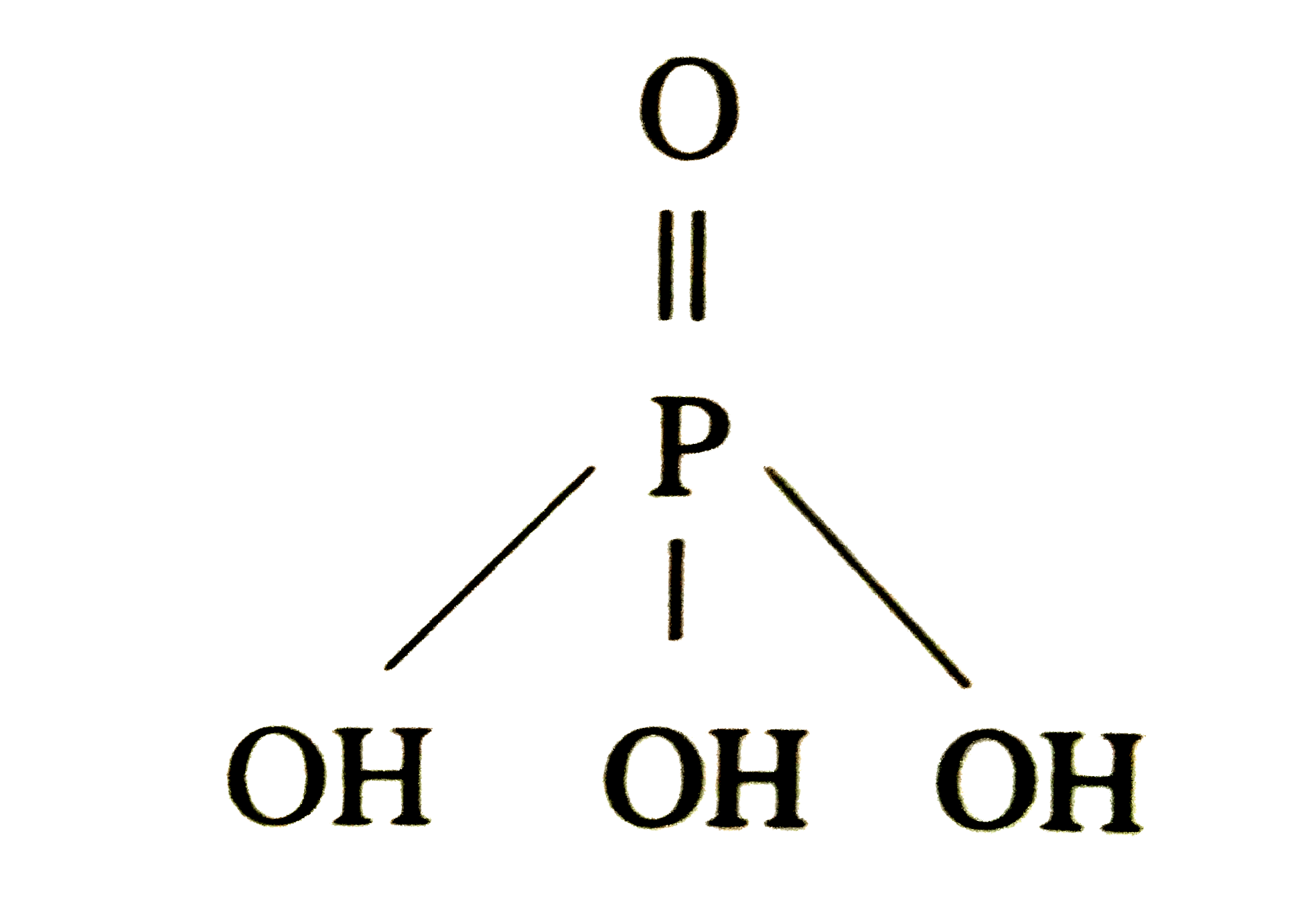 ( b) Pyrophosphoric Acid `(H_(4)P_(2)O_(7)`) : `HO-overset(OH)overset("|")underset("O")underset("||")("P ")-O-overset(OH)overset("|")underset("O")underset("||")("P ")-OH` |
|
| 19. |
Define crystal field splitting energy. |
| Answer» Solution :The ENERGY used to split DEGENERATE d-orbitals DUE to the presence of ligands in a definite geometry is CALLED crystal field splitting energy. | |
| 20. |
Define corrosion. What is the chemical formula of rust? |
|
Answer» Solution :CORROSION. It is a process of cating away of metals when exposed to the atmosphere surrounding it. Many metals when exposed to the atmosphere, react with air or water in the environment to form undesirable compound on their surfaces. In case of iron, the corrosion is called rusting. The RED or orange coating that forms on the surface of iron when exposed to air and moisture is called rust. Chemically rust is a hydrated form of ferric oxide, `Fe_(2)O_(3).xH_(2)O`. Factors which affect corrosion. The main factors which affect corrosion are : (i) Position of metals in e.m.f. series. The reactivity of a metal DEPENDS upon its position in the electrochemical series. More the reactivity of the metal, more will be the possibility of the metal getting corroded. (ii) Presence of impurities in metals. The impurities help in setting up a sort of voltaic cells, which INCREASE the speed of corrosion. (iii) Presence of electrolytes. Presence of electrolytes in water also increases the rate of corrosion. For example, corrosion of iron in sea water takes place to larger extent than in distilled water. (iv) Presence of `CO_(2)` in water. Presence of `CO_(2)` in NATURAL water increases rusting of iron. Water containing `CO_(2)`, acts as an electrolyte and increases the flow of electrons from one place to another. (v) Presence of protective coatings. When the iron surface is coated with layers of metals more active than iron, then the rate of corrosion is retarded. For example, coating of zinc on iron prevents rusting. |
|
| 21. |
Define corrosion. Give one example. |
| Answer» Solution :The redox process which causes the deterioration of metal is called CORROSION. Rusting of IRON is an example of cossosion. It is an electro CHEMICAL process. | |
| 22. |
What is metallie corrosion ? Give one example. |
|
Answer» |
|
| 23. |
Define coordination polyhedron. |
| Answer» SOLUTION :The spatial ARRANGEMENT of the ligand with the central METAL ION. | |
| 24. |
Define coordination number? Give example |
|
Answer» Solution :The NUMBER of ligand donor atoms bonded to a central metal ion in a complex is called the coordination number of a metal. In other words, the coodination number is equal to the number of o bonds between LIGANDS and the central metal ATOM. For e.g, In `K_(4)[Fe(CN)_(6)]` the coordination number of `Fe^(2+)` is `+6`. |
|
| 25. |
Define coordination number. |
| Answer» Solution :Coordination number is number of COORDINATE BONDS FORMED by the ligands with the central metal ATOM. | |
| 26. |
Define conductivity (K). |
|
Answer» SOLUTION :It is the conducting POWER of all the ions present in one ce solution of the electrolyte. Or It is conductance of `1CM^(3)` of the MATERIAL of the CONDUCTOR. |
|
| 27. |
Define conductivity and molar conductivityfor the solution of an electrolyte. Discuss their variation with concentration. |
| Answer» Solution :Conductivity is defined as ease with which current flows through electrolyte. It is reciprocal of SPECIFIC resistance. Molar conductivity is CONDUCTANCE of all the ions produced by one mole of electrolyte when ELECTRODES are at unit DISTANCE apart and have sufficient area of cross-section to hold electrolyte. | |
| 28. |
Define conductance. Give its unit. |
| Answer» Solution :The RECIPROCAL of the RESISTANCE `(1/R)` gives the conductance of an ELECTROLYTIC solution. The SI UNIT of conductance is SIEMEN (S). | |
| 29. |
Define conductance and give its unit. |
|
Answer» SOLUTION :The RECIPROCAL of the resistance `(1/R)` is known as the conductance of an ELECTROLYTIC solution. `C = I/R`. |
|
| 30. |
Define complex lipids. Mention 'two' functions of lipids. |
|
Answer» Solution :COMPLEX lipids : Lipids are a heterogenous group of compounds including FATS, oil steroids, waxes and related compounds which related ome by their physical than by there are related more by their physical than by their chemical properties. Complex lipids are esters of fatty acid containing group in addition to an alcohol and a fatty acids Examples : PHOPHOLIPIDS, Glycolipids etc. Functions : (a) Glycerolipids are the reservoir of storing energy. (b) Glycerophospholipids are used in METABOLISM and cell signalling PROCESS. |
|
| 31. |
Define collision frequency. Give an example for Pseudo-first order reaction. |
| Answer» Solution :Example of pseudo FIRST order REACTION is `C_(12)H_(22)O_(11)+H_(2)Orarr C_(6)H_(12)O_(6)+C_(6)H_(12)O_(6)` | |
| 32. |
Define colloidal solution. |
| Answer» Solution :(i) The COLLOIDAL solutions are INTERMEDIATE between true solutions and suspensions, When the diameter of the PARTICLES RANGES from about 10 Å to 2000 Å, the system is TERMED a colloidal solution. | |
| 33. |
Define collision frequency. |
| Answer» Solution :The NUMBER of collision PER second per unit volume of the reaction mixture is KNOWN as collision frequency (z). | |
| 34. |
Define Colligative property. |
| Answer» Solution :The property of a solution which DEPENDS UPON the number of solute PARTICLES dissolved in a GIVEN amount of solvent but INDEPENDENT of nature of solute particles. | |
| 35. |
Define coenzymes ? Give one example. |
| Answer» Solution :The non - PROTEIN component of an enzyme which is loosely held by the enzyme and which is necessary for its BIOLOGICAL activiry is called a coenzyme. These are mostly DERIVED from vitamins such as thiamine `(B_1)`, riboflavin `(B_2)` etc. | |
| 36. |
Define co-ordination number for a particle in a crystal. |
| Answer» SOLUTION :NUMBER of NEAREST neighbouring PARTICLES for a particle in a crystal. | |
| 37. |
Define chemical adsorption? Give example. |
|
Answer» SOLUTION :Chemical adsorption is a process in which gas MOLECULES are held to the surface by formation of chemical BONDS. e.g., Adsorption of `O_(2)` on TUNGSTEN, Adsorption of `H_(2)`on NICKEL. |
|
| 38. |
Define catalyst. Give example. |
|
Answer» SOLUTION :A catalyst is DEFINED as a substance which alter the RATE of chemical reaction without itself undergoing chemical change. The phenomenon which involves the action of a catalyst is called catalysis. e.g., `C_2H_4 + H_2 OVERSET(Ni) to C_2H_6` Ni - catalyst . |
|
| 39. |
Define chelate with example. Write the importance of chelate. |
| Answer» Solution :Chelate: It is a ligand having two or more donor sites POSITIONED in such a WAY that a five or six membered ring is formed with the metal e.g. oxalate ion, `UNDERSET(COO^(Ɵ)) underset(|)(COO^(Ɵ))` | |
| 40. |
Define catalyst. What are the characteristics of catalysts? |
|
Answer» Solution :A catalyst is defined as a substance which alters the rate of chemical reaction without itself undergoing chemical change. Characteristics of catalyst: (i) For chemical reaction, catalyst is needed in very small quantity. Generally, a pinch of catalyst is enough for a reaction in bulk. (ii) There may be some physical changes, but the catalyst remains unchanged in mass and chemical composition in a chemical reaction. (III) A catalyst itself cannot initiate a reaction. It means it cannot START a reaction which is not taking place. But, if the reaction is taking place in a slow rate it can increase its rate. (iv) A solid catalyst will be more effective if it is taken in a finely divided form. (v) A catalyst can catalyse a particular type of reaction, hence they are SAID to be specific in nature. (vi) In an EQUILIBRIUM reaction, presence of catalyst reduces the time for attainment of equilibrium and hence it does not affect the position of equilibrium and the value of equilibrium constant. (vii) A catalyst is highly effective at a particular temperature called as optimum temperature. (viii) Presence of a catalyst generally does not change the nature of products. (ix) For example `2SO_2 + O_2 to 2SO_3` This reaction is slow in the absence of a catalyst, but fast in the presence of PT catalyst. |
|
| 41. |
Define carbonhydates. Give example . |
|
Answer» Solution :(i)Carbohydrates are definedas polyhydroxy aldehydes (or) ketoes with a GENERAL FORMULA `Cn(H_(2)O)n`. (ii) Theyare considered ashydrates of carbon containinghydrogenand oxygenin the same ratio as in water . (iii) EXAMPLE : glucose , SUCROSE , CELLULOSE . |
|
| 42. |
Calcination |
|
Answer» Solution :It is PROCESS in which the concentrated ore is strongly heated in the absence of air.This method can ALSO be CARRIED out with a limited supply of air. `CaCO_(3)overset(Delta)toCaO+CO_(2)UARR`. |
|
| 43. |
Define Buffer solution. |
| Answer» Solution :Buffer is a solution which CONSISTS of a MIXTURE of a WEEK acid and its conjugate BASE (or) a weak base and its conjugate acid. | |
| 44. |
Define buffer capacity and buffer index. |
|
Answer» SOLUTION :(i) The buffering ability of a solution can be measured in TERMS of BUFFER capacity. (ii) Buffer index `beta`, as a quantative measure of the buffer capacity. (iii) It is defined as the number of gram equivalents of acid or base ADDED to 1 litre of the buffer solution to change its pH by unity. (iv) `beta=(dB)/(d(pH))` dB= number of gram equivalents of acid/base added to 1 litre of the buffer solution. d(pH)= The change in the pH after the ADDITION of acid/base. |
|
| 45. |
Buffer index is |
|
Answer» Solution :Buffer index, `Beta`, as a QUANTITATIVE measure of the buffer CAPACITY. It is defined as the number of GRAM equivalents of acid or base added to 1 litre of the buffer solution to change its pH by unity. `Beta=(dB)/(d(pH))` Here, `dB=` number of gram equivalents of acid/base added to ONE litre of buffer solution `d(pH)=` The change in the pH after the additionof acid/base. |
|
| 46. |
Define Brownian movement. What is the cause of Brownian movement in colloidal particles? How is it responsible for the stability of colloidal Sol? |
|
Answer» Solution :The zig zag and CONTINUOUS movements of particles of a colloidal solution is called Brownian movement. This is due to unbalanced bombardment of the particles by the molecules of the dispersion medium the Brownian movement has a STIRRING effect which does not permit the particles to settle down. It is THUS RESPONSIBLE for the stability of the sols. |
|
| 47. |
Define Brownian movement |
| Answer» SOLUTION :Bromnian MOVEMENT: The zig- ZAG movement of COLLOIDAL PARTICLES in a colloidal solution is called brownian movement. | |
| 48. |
Define Brownian movement. |
| Answer» SOLUTION :Brownian MOVEMENT involves motion of colloidal PARTICLES in ZIG ZAG paths. | |
| 49. |
Define Borax is basic in nature. |
|
Answer» Solution :Borax is BASIC in nature and its solution in bot water is alkaline as it DISSOCIATES into boric acid and sodium hydroxide. `Na_(2)B_(4)O_(7)+7H_(2)Oto4H_(3)BO_(3)+2NAOH` |
|
| 50. |
Define boiling point and find out expression for the molecular mass of non-volatile solute from the elevation in boiling point. |
Answer» Solution :Elevation in boiling point. The boiling point of a liquid is that temperature at which its vapour PRESSURE becomes equal to the atmospheric pressure. The vapour pressure of a solution is lower than that of a pure solvent. This means that the solution has to be heated to a higher temperature, so that its vapour pressure becomes equal to atmospheric pressure. Therefore, the boiling point of a solvent rises on the addition of a nonvolatile solute and this is called elevation in boiling point. 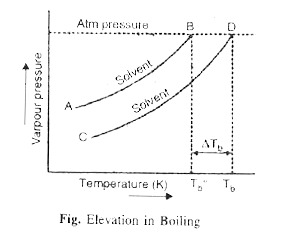 The elevation in boiling point on the addition of a non-volatile solute to a solvent is shown in Fig. The curve AB represents vapour pressure of the solvent and curve CD represents the vapour pressure of the solution. It can be seen from the FIGURE that at point B on the curve AB, the vapour pressure of the solvent corresponds to atmospheric pressure, hence it corresponds to the boiling point `(T_(b)^(0))` of the pure solvent. At point D, the vapour of the solution becomes equal to atmospheric pressure and hence it corresponds to the boiling point (`T_b`) of thesolution. The difference `T_b - T_(b)^(2) = DELTA T_b` is called elevation in boiling point, because `T_b` is greater than `Delta T_(b)^(@)`. Elevation in boiling point, `Delta T_b = T_b - T_b^(@)`. It has been found out experimentally that the elevation in the boiling point `(Delta T_b)` of a solution is PROPORTIONAL to the molal concentration of the solution i.e. `Delta T_b propm orDelta T_b =K_b m,` where K is called molal elevation constant. This is defined as: ` Delta T_b =K_b xx m` `Delta T_b = (K_b xx W_b xx 1000 )/( W_A xx Delta T_b )` `or M_B = (K_b xx w_B xx 1000 )/( w_A xx Delta T_b)` `therefore` knowingalll otherfactors, `M_B` canbecalculated. |
|