

Saved Bookmarks
This section includes 7 InterviewSolutions, each offering curated multiple-choice questions to sharpen your Current Affairs knowledge and support exam preparation. Choose a topic below to get started.
| 1. |
Define molar conductance and secondary cells. |
|
Answer» SOLUTION :Molar conductance : It is the conducting power of all the ions PRESENT in a solution containing one grain equivalent of the electrolyte. It is denoted as `A_(m)` SECONDARY Cells. It is a cell in which the cell reaction can be reversed by using external source of electricity. The cell can be used again and again by rechanging e.g., lead storage cell. |
|
| 2. |
Define molar conductance. |
|
Answer» SOLUTION :The conductivity cell in which the electrodes are SEPARATED by 1 m and having V `m^(3)` of electrolytic solution which contains 1 MOLE of electrolyte. The conductance of such a system is called the molar of conductance `(wedge_(m))`. `wedge_(m)=(kappa(Sm^(-1)) times 10^(-3))/(M)mol^(-1)m^(3)` |
|
| 3. |
Define the term molality. |
| Answer» SOLUTION :MOLALITY (m) is defined as .the number of moles of SOLUTE dissolved PER KILOGRAM of the solvent. | |
| 4. |
Define molality. |
| Answer» Solution :Molality is defined as the NUMBER of MOLES of the solute present in one kilogram of SOLVENT. | |
| 5. |
Define 'molality'. |
| Answer» Solution :MOLALITY of a solution is the moles of the solute DISSOLVED in 1 kg of the SOLVENT. | |
| 6. |
Define molal elevation constant. |
| Answer» Solution :It is the elevation in BOILING point of a solution containing 1 mole of a SOLUTE dissolved in 1000 g of the SOLVENT. | |
| 7. |
Define molal depression constant. How is it related to enthalpy of fusion ? |
|
Answer» Solution :The depression in freezing point when ONE mole of the solute is dissolved in 1000 G of the solvent is called molal depression CONSTANT. It is expressed as `K_f` and is related to enthalpy of fusion, `Delta H` as: `K_f =(RT_(b)^(@2 )M )/(Delta F_(FUS ")xx 1000)` |
|
| 8. |
Define molal depression constant/cryoscopic constant. |
| Answer» SOLUTION :The depression in freezing POINT that takes PLACE when the MOLALITY of the solution is unity. | |
| 9. |
Define Metallurgy |
| Answer» Solution :The various steps INVOLVED in the EXTRACTION of metals from their ORES as well as refining of crude metals are collectively known as METALLURGY. | |
| 10. |
Define "lowering of vapour pressure". Give equation for Raoult' s law of relative lowering of vapour pressure. |
|
Answer» Solution :DIFFERENCE between vapour pressure of a pure solvent and that of the solution. OR When a non-volatile solute is dissolved in a volatile solvent, va.pour pressure of the solution decreases. `(P^(0) - P)/(P^(0)) = (n_(2))/(n_(1) + n_(2))` OR `(P^(0) - P)/(P^(0)) = X_(B)` OR `(P_(A)^(0) - P_(S))/(P_(A)^(0)) = (n_(2))/(n_(1) + n_(2))` . |
|
| 11. |
Define Lyophobic and Lyophilic sol with a suitable example of each. Why is coagulation of Lyophilic sol difficult as compared to Lyophobic sol ? |
|
Answer» SOLUTION :Lyophobic sol : Lyophobic means LIQUID-hating. Sols which are not obtained by simple mixing of the dispersed phase in dispersion medium are called lyophobic sols. Examples are metals and their sulphides. Their colloidal solutions can be obtained by special methods and such sols are readily precipitated on the addition of a small amounts of an ELECTROLYTES. Lyophilic sol : Lyophilic means liquid-loving. Colloidal sols directly formed by mixing substances like gum, gelatine, starch, etc. with the dispersion medium are called lyophilic sols. These sols are quite stable and cannot be easily COAGULATED. Lyophilic colloids are EXTENSIVELY solvated i.e., colloidal particles are covered by a sheath of the liquid in which they are dispersed. This makes lyophilic colloids more stable than lyphobic colloids. |
|
| 12. |
Define limiting molar conductivity. Why conductivity of an electrolyte solution decreases with decrease in concentration ? |
| Answer» SOLUTION :The MOLAR conductivity of a solution at infinite dilution, i.e., when concentration approaches zero is called limiting molar conductivity. With decrease in concentration, i.e., with dilution, number of IONS per `cm^(3)` decreases DUE to large increase in VOLUME of the solution. as conductivity is the conductance per `cm^(3)` of the solution, hence it decreases. | |
| 13. |
Define linkage isomerism of.co-ordination compounds. Give an example. |
|
Answer» SOLUTION :Linkage ISOMERISM in ONE in which two co-ordination compounds have the same molecular COMPOSITION but differ in the mode of attachment of ligands to the central metal atom/ion. Ex : `[Co(NH_3)_5 (NO_2)] Cl_2 and [Co(NH_3)_5 (ONO)] Cl_2` |
|
| 14. |
Define 'Ligand 'Give an example of neutral ligand. |
| Answer» SOLUTION :Ligand is an atom or a group of ATOMS which is either negatively charged or has lone PAIR of ELECTRONS and from co-ordinate BOND with the central metal or ion e.g. `H_2O ` | |
| 15. |
Define ligand. Write four postulates of Werner's theory. |
|
Answer» Solution :A ligand is an ion or molecule that birds to a central metal atom to FOM a complex. Ligands are atoms or molecules with electron pairs available they may be neutral or negatively charged. Ligands are usually thourght of as electron donors attached to the metal (the electron acceptor) at the center of the complex. The ligand provides both of the electrons for the bond that forms between itself and the central metal atom or ion. Alfred werner studied the sturcture of coordinations COMPLEXES and put forward his ideas in the YEAR 1893 which were known as Werner's coordination THEORY. Postulates of Werner's theory (1) Every metal atom has two types of valencies: (a) Primary valency or ionisable valency. (b) Secondary valency or non-ionisable valency. 2. The primary valency corresponds to the oxidation state of the metal ion. The primary valency of the metal ion in always satisfied by negative ions. (3) Secondary valency corresponds to the coordination number of the metal ion or atom. The secondary valencies may be satisfied by either negative ions or neutral molecules (4) The molecules or ion that satisfy secondary valencies are called ligands The ligands which satisfy secondary valencies MUST project in definete directions in space. So, the secondary valencies are directional in nature whereas the primary valencies are non-directional in nature. |
|
| 16. |
Define Lanthanoid contraction. Explain its effects. |
|
Answer» Solution :Lanthanoid CONTRACTION and its effects : The gradual decrease in ATOMIC and ionic radii of lanthanoids with the increase in atomic number is called lanthanoid contraction. Effects : (1) Decrease in basicity : (i) In lanthanoids due to lanthanoid contraction, as the atomic number increases, the size of the lanthanoid atoms and their tripositive ions decreases, i.e. from `La^(3)` + to `Lu^(3+)`. (ii) (ii) As size of the cation decreases, according to Fajan's rule, the polarizability increases and thus the covalent character of the M-OH bond increases, and ionic character decreases. (III) Therefore the basic nature of the hydroxides decreases. (iv) Basicity and ionic character decrease in theorder`La(OH)_(3) gt Ce(OH)_(3) gt Lu(OH)_(3)`. (2) Ionic radii of post-lanthanoids : (i) Elements following the lanthanoids in the 6th period (THIRD transition series, i.e. 5d-series) are known as post-lanthanoids. (ii) Due to lanthanoid contraction the atomic radii (size) of elements which follow lanthanum in the 6th period (3rd TRANSITIONSERIES -hf, Ta, W,Re) - are similarto theelementsof the 5thperiod 4d-series Zr,Nb,Mo Tc). (iii) Due to similarity in their size, post-lanthanoid elements (5d-series) have closely similar properties to the elements of the2nd transition series(4d -series) whichlie immediately abovethem. (iv) Pairs of elements namely `Zr-Hf(Gr -4)` ,Nb-Ta (Gr-5),Mo-W (Gr-6),Tc-Re (Gr-7) are calledchemicaltwins since they possessalmostidenticalsizesand similarproperties. |
|
| 17. |
Define Kraft temperatuer. |
| Answer» Solution :The TEMPERATUE above which the FORMATION of misclles takes PLACE is CALLED Kraft temperature. | |
| 18. |
Define Kraft temperature. |
| Answer» Solution :Micelle FORMATION OCCURS only above a certain TEMPERATURE. This temperature is called KRAFT temperature. | |
| 19. |
Define isotonic solution. What happens when the blood cell is dipped in a solution containing more than normal saline concentration? |
|
Answer» Solution :The solution having the same osmatic pressure at a given temperature are CALLED Isotonic solution. When blood cell is DIPPED in a solution CONTAINING more than normal saline concentration the blood cell SHRINKS. |
|
| 21. |
Define isomerism in coordination compounds. |
| Answer» Solution :ISOMERISM is the phenomenon in which more than one coordination compound having the same molecular FORMULA have different physical and chemical properties DUE to different ARRANGEMENT of ligands around the CENTRAL metal atom. | |
| 22. |
Define isoelectric point. |
| Answer» Solution :At a specific pH VALUE, the NET CHARGE of an amino ACID is neutral is called isoelectric point. | |
| 23. |
Define iso electricpoint . |
| Answer» Solution :At aspecificpH VALUE , the NET CHARGE of an aminoacidin netural is callediso electricpoint . Ata PH valueabovethe iso electricpoint theaminoacidwill benegativelycharged and positivelycharged at pH values belowthe iso electric point . | |
| 24. |
Define ionic product of water. Given its value at room temperature. |
|
Answer» SOLUTION :(i) The product of CONCENTRATION of `H^+ and OH^-` ions in water at a particular temperature is known as ionic product. (ii) The ionic product of water at room temperature `(25^@C)` is `K_w=[H^+][OH^-](or)` `K_w=[H_3O^+][OH^-]` `K_w=(1 times 10^-7) (1 times10^-7)` `K_w=1 times10^-14 mol^2dm^-6` |
|
| 25. |
Define ionic product of water . Give its value at room temperature . |
|
Answer» Solution :(i) The PRODUCT of CONCENTRATION of `H^(+)` and `OH^(-)`ions in water at a particular temperature is known as ionic product . (II) The ionic product of water at room temperature `(25^(@) C)` is `K_(w) = [H^(+)] [OH^(-)]` (or) `K_(w) = [H_(3) O^(+)] [OH^(-)]` `K_(w) = (1 xx 10^(-7)) ( 1 xx 10^(-7))` `K_(w) = 1 xx 10^(-14) mol^(2) DM^(-6)` |
|
| 26. |
Define -ionic product of water? |
|
Answer» Solution :`H_2O+H_2O LEFTRIGHTARROW H_3O^(+)+ OH^-` The dissociation constant for the above IONISATION is given as, `K_w=([H_3O^+][OH^-])/[H_2O]^2` The concentration of pure water is ONE i.e., `[H_2O]^2=1` `therefore K_w=[H_3O^+][OH^-]` `K_w`= ionic PRODUCT of water `K_w=1 times 10^-14` at `25^@C` |
|
| 27. |
Define inert pair effect. |
| Answer» Solution :In heavier post TRANSITIONI metals, the OUTER s-electron (ns) have a TENDENCY to remain inert and show reluctance to take part in the bonding (only p-orbital involved in CHEMIAL bonding), which is KNOWN as inert pair effect. | |
| 28. |
Define (i) Interface (ii) Desorption |
|
Answer» Solution :(i) Interface: The surface of separation of the two PHASES where the concentration of adsorbed MOLECULE is HIGH is KNOWN as interface. (ii) Desorption: The process of removing an adsorbed substance from the substance is CALLED desorption. |
|
| 29. |
Define (i) Epimers (ii) Epimerisation . |
|
Answer» Solution :(i) Sugardifferingat anasymmerticcentre is known as epimers. (ii) The PRCOESS by whichone epimeris convertedinto OTHERIS calledepimerisationand itrequrieed theenzyme EPIMERASE . (iii) Galactosein converted to glucoseby thismannerin our BODY . 
|
|
| 30. |
Define Hypertonic solution. Explain why depressionin freezing point is a colligative property. Calculate the molar mass of solute with it. |
|
Answer» Solution :A solution is said to be HYPERTONIC if its osmotic pressure is MOR etan the of other separated by a semipermeable MEMBRANE. For ANSWER consult section 11. |
|
| 31. |
Define hormone. Give one example. |
| Answer» SOLUTION :Hormones are BIOMOLECULES which control various metabolic processes or show PHYSIOLOGICAL activity at a site other than that of their origin. Fro example , insulin is a peptide hormone. It is produced in the pancreas but controls the metabolism of GLUCOSE in the body. | |
| 32. |
Explainhomoleptic and heteroleptic complexes. |
|
Answer» SOLUTION :Homoleptic: When metal ATOM /ION is linked with one type of ligands. Example: `[Ni(CO)_(4)]` Heteroleptic : With the more than one KIND of ligands. Example : `[CO(NH_(3))_(4)Cl_(2)]^(+)` |
|
| 33. |
Define Henderson- Hasselbalch equation |
|
Answer» Solution :(i) the concentration of hydronium ION in acidic buffer solution DEPENDS on the ratio of concentration of the weak acid to the concentration of its conjugate base present in the solution i.e., `[H_3O^+]=K_a.([acid]_(aq))/([Base]_(aq))`..........(1) (ii) The weak acid is dissociated only to a small extent. moreover due to common ion effect, the dissociation is further suppressed and HENCE the equilibrium concentration of the acid is nearly equal to the initial concentration of the unionised acid. Similarly the concentration of the conjugate base is nearly equal to the initial concentration of the added salt. `[H_3O^+]=K_a.([acid]_(aq))/([Base]_(aq))`..........(2) (iii) [Acid] and [salt] REPRESENT the initial concentration of the acid and salt respectively used to prepare the buffer solution. (iv) Taking logarithm on both sides of the equation `log[H_3O^+]=log K_a-log([acid])/(["salt"])` ...........(3) (v) reverse the sign on both sides `-log[H_3O^+] and pK_a=-log K_a`...........(4) we know that `ph=-log[H_3O^+] and pK_a=-log k_a` `therefore pH=pK_a-log ([acid])/(["salt"])`..........(5) `pH=pK_a-log ([acid])/(["salt"])`......(6) Similarly for basic buffer, `pOH=pK_a+log([acid])/([base])`......(7) Equation (6) & (7) are called Henderson- Hasselbalch equation. |
|
| 34. |
Define half life period. |
| Answer» Solution :The half LIFE PERIOD of a reaction is defined as the time REQUIRED for the REACTANT concentration to reach one half its Initial value. | |
| 35. |
Define half life of reaction . Shows that the first order reaction half life is independent of Intel concentration. |
|
Answer» Solution :Half life of reaction is defined as the time REQUIRED for the REACTANT concentration to each one half of its INITIAL value. For a first ORDER reaction , the half Life is a CONSTANT i.e, it does not depend on the initial concentration. The rate constant for a first order reaction is given by, `k=(2.303)/t=log.([A]_0)/([A])` at `t=t_(1//2),[A]=[A_0]//2` `:.k=(2.303)/(t_(1//2))log.([A_0])/([A_0]//2)` `k=(2.303xx0.3010)/(t_(1//2))=(0.6932)/(t_(1//2))` `t_(1//2)=(0.6932)/k` |
|
| 36. |
Define half life of a reaction, Show that for a first order reaction half life is independent of initial concentration. |
|
Answer» Solution :Half life of a REACTION is defined as the TIME REQUIRED for the reactant CONCENTRATION to reach one half of its initial value. For a first order reaction, the half life is a constant i.e., it does not depend on the initial concentration. The rate constant for a first order reaction is given by, `k=(2.303)/(t)log""([A_(0)])/([A])` at `t=t_((1)/(2)),[A]=[A_(0)]//2` `:. k=(2.303)/(t_(1//2))log""([A_(0)])/([A_(0)]//2)` `k=(2.303)/(t_(1//2))log(2)` `k=(2.303xx0.3010)/(t_(1//2))=(0.6932)/(t_(1//2))` `t_(1//2)=(0.6932)/(k)` |
|
| 37. |
Define gold number. What happens when gelatin is added to a gold sol? |
| Answer» | |
| 38. |
Define Gold number. |
| Answer» Solution :(i) 'GOLD number' is a measure of protecting power of a colloid. (ii) Gold number is defined as the number of milligrams of HYDROPHILIC colloid that will just PREVENT the PRECIPITATION of 10ml of gold sol on the addition of 1ml of 10% NaCl solution. (iii) Smaller the gold number greater the PROTECTIVE power. | |
| 39. |
Define fuel cell? |
| Answer» Solution :A device in which the heat PRODUCED as a RESULT of the combustion of a fuel (like `H_(2)` in presece of `O_(2)` is converted into electricity is CALLED a fuel cell. | |
| 40. |
Define ferromagnetism. |
Answer» Solution :Ferromagnetism : When magnetic moments are aligned in the same direction, it GIVES RISE to ferromagnetism. 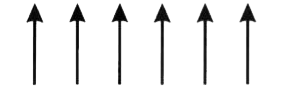 SCHEMATIC ALIGNMENTS of magnetic moments in ferromagnetism. |
|
| 41. |
Define ferrimagnetism with suitable examples. |
Answer» SOLUTION :When magnetic moments are aligned in parallel and anti-parallel directions in unequal NUMBERS resulting in net moment, then the magnetism is CALLED FERRIMAGNETISM. e.g. in `Fe_(3)O_(4), MgFe_(2)O_(4), CuFe_(2)O_(4), ZnFe_(2)O_(4)`, etc. 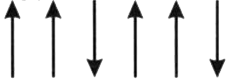 Schematic alignments of magnetic moments in ferrimagnetism. |
|
| 42. |
Define Faraday (F). |
|
Answer» Solution :It is the CHARGE present on ONE MOLE of ELECTRONS. `F = 96,500 C.` |
|
| 43. |
Define fermenation. |
| Answer» Solution :SLOW DECOMPOSITION of ORGANIC substance by ENZYMES (non - living complex nitrogeneous molecules) is know as fermntation e.g. SOURING of milk. | |
| 44. |
Define Faraday. |
|
Answer» Solution :(i) Faraday is DEFINED as the quantity of electricity required to LIBERATE one gram EQUIVALENT of a substance and it is equal to 96,495 COULOMBS. (ii) It is denoted by the symbol .F.. Faraday is the quantity of electricity that contains 1 mole of electrons. (iii) 1 Faraday = 96,496 coulombs = 1 Mole electron. |
|
| 45. |
Define desertification. |
Answer» SOLUTION :"The REACTION in between an acid and alcohol to produce an ESTER in presence of CONC. `H_2SO_4` is termed as ESTERIFICATION."
|
|
| 46. |
Define equivalent conductance. Give its SI unit. |
|
Answer» SOLUTION :Equivalent conductance is DEFINED as the conductance of `.V. m^3` of ELECTROLYTIC solution containing one gram equivalent of electrolyte in a condutivity cell in which the electrodes are one metre apart. `Lambda = (k xx 10^(-3))/(N)` The SI unit of `Lambda = S m^2 gm "equivalent"^(-1)` . |
|
| 47. |
Define equivalent conductance. |
|
Answer» Solution :EQUIVALENT CONDUCTANCE is defined as the conductance of .V. `m^(3)` of ELECTROLYTIC solution containing ONE gram equivalent of electrolyte in a conductivity cell in which the electrodes are one meter apart. `wedge=(kappa(Sm^(-1)) TIMES 10^(-3)("gram equivalent")^(-1)m^(3))/N` |
|
| 48. |
Define equivalent conductance and primary cells. |
|
Answer» Solution :Equivalent CONDUCTANCE. It is the conducting power of all the ions present in a solution CONTAINING one grain equivalent of the electrolyte. It is denoted as `A_(eq)`. PRIMARY Cell. It is an electrochemical cell, in which cell REACTION occurs only once, the cell becomes DEAD once it has been used. The cell reaction cannot be reversed e.g., dry cell: |
|
| 49. |
Define enzymes. How is peptide linkage formed? |
|
Answer» Solution :Enzymes are the biocatalysts for a bichemical reactio in the living organisms. Example MALTOS is convered into glucose in the presence of an ENZYME maltose. `underset("Maltose")(C_(12)H_(22)OH)OVERSET("Maltose") rarr underset("Glucose")(C_(6)H_(12)O_(6))` |
|
| 50. |
Define enzymes ? What is the most important reason for their specific action ? |
|
Answer» Solution :Most of the reactions in living systems proceed at very high rate under physiologicalp HOF 7.4 and temperature of `37^@C (310 K)` under one atmosphere pressure .All these reactions are catalysed by a group of biomolecules called enzymes. THUS , enzymes are bioligical catalysts . Chemically , they are globular (water soluble ) proteins which have high molecular mass ranging from `15,000` to `1,000,000 g mol^(-1)`. SPECIFICITY : Enzyme are HIGHLY specific in their actions. This specificity is DUE to the presence of active sites of definite size and shape on their surfaces so that only specific substances can fit into them. this specific binding leads to the formation of enzymes -substrate complex which accounts for the high specificity of enzymes. |
|