

Saved Bookmarks
This section includes 7 InterviewSolutions, each offering curated multiple-choice questions to sharpen your Current Affairs knowledge and support exam preparation. Choose a topic below to get started.
| 1. |
Correct decreasing order of acidity of oxides is |
|
Answer» `Cl_(2)O_(7) GT SO_(3) gt P_(4)O_(10) gt SiO_(2)` |
|
| 2. |
Correct combination for the preparation of Meoverset(18)OH will be : |
|
Answer» III, ii, p |
|
| 3. |
Correct coombination which gives at last two organic compounds having underset(.)O^(18) in it after propanation : |
|
Answer» II. Iv, q |
|
| 4. |
CORRECT combination among the following is |
|
Answer» (II) (IV) (Q) |
|
| 5. |
Correct atomic size is :- |
|
Answer» `Li GT I gt F lt CL lt Br` |
|
| 6. |
Correct and rewrite the statement---- Ravi, Beas river dispute was resolved between Himachal Pradesh, Punjab and Uttarakhand. |
| Answer» SOLUTION :Ravi, BEAS river DISPUTE was RESOLVED between Punjab, Haryana and Rajasthan. | |
| 7. |
Correct among the following |
|
Answer» Cs is BEST oxidising agent DUE to lowest I.E. |
|
| 8. |
Correct acidic strength of the following carboxylic acids A) C_(6) H_(5) COOH B) o-NO_(2) (C_(6) H_(4)) COOH C) p- NO_(2) (C_(6) H_(4)) COOH D) m- NO_(2) (C_(6) H_(4)) COOH |
|
Answer» `A GT B gt C gt D` |
|
| 9. |
Carbon 14 is used to determine the age of organic material. The procerdure is based on the formationof .^(14)C by neutroncapture in the upper atmosphere. ._(7)^(14)N + ._(0)^(1)n rarr ._(6)^(14)C + ._(1)n^(1) .^(14)C is abosorbed by living organisms duringphostosythesis. The .^(14)Ccontent is constant in living organismsonce theplant or animal dies, the uptake of carbon dioxide by it ceases and the level of .^(14)C in the deadbeing, falls due to thedecay which.^(14)C undergoes. ._(6)^(14)C rarr ._(7)^(14)C+ beta^(-) The half-life period of .^(14)C is 5770 years. The decay constant (lambda) can be calculated by usingthe following formula lambda = (0.693)/(t_(1//2)) The comparison fo the beta^(-)activity fo the dead matterwiththat of the carbon still incirculation enables measurement of the period of the isolation the materail form the livingcycle. Themethod however, ceases to be accurate ever periodslonger than 30,000 years. The proportaion of .^(14)C to .^(12)C living matter is 1:10^(12). What should be the age of fossil for meainingful determination of its age? |
|
Answer» 6 YEARS |
|
| 10. |
Carbon 14 is used to determine the age of organic material. The procedure is based on the formationof .^(14)C by neutroncapture in the upper atmosphere. ._(7)^(14)N + ._(0)^(1)n rarr ._(6)^(14)C + ._(1)p^(1) .^(14)C is absorbed by living organisms duringphotosynthesis. The .^(14)Ccontent is constant in living organismsonce theplant or animal dies, the uptake of carbon dioxide by it ceases and the level of .^(14)C in the deadbeing, falls due to thedecay which.^(14)C undergoes. ._(6)^(14)C rarr ._(7)^(14)N+ beta^(-) The half-life period of .^(14)C is 5730 years. The decay constant (lambda) can be calculated by usingthe following formula lambda = (0.693)/(t_(1//2)) The comparison of the beta^(-)activity of the dead matterwiththat of the carbon still incirculation enables measurement of the period of the isolation the material form the livingcycle. Themethod however, ceases to be accurate ever periodslonger than 30,000 years. The proportion of .^(14)C to .^(12)C living matter is 1:10^(12). Which fo the following option is correct? |
|
Answer» In LIVING organisms, circulation of`.^(14)C` from atmosphere is high so the carbon content is constant in organism Carbon dating can be used to fing out the age of organic materic only .(not for finding the age of earth crust and rocks made of inorganic material) |
|
| 11. |
Copper wire test of halogens is known as : |
|
Answer» BEILSTEIN test |
|
| 12. |
Copper wire test of halogen is known as : |
|
Answer» Liebig's TEST |
|
| 13. |
Copper vessel is used as electrolytic cell in the preparation of F_(2) . It is because |
|
Answer» Copper is a CHEAP metal |
|
| 14. |
Which compound is formed when excess of KCN is added to an aqueous solution of copper sulphate |
|
Answer» `K_2[CU(CN)_4]` |
|
| 15. |
Copper sulphate solution cannot be stored in a vessel made up of: Zinc,Glass,Copper,Plastic. |
|
Answer» Zinc |
|
| 16. |
Copper sulphate solution absorbs red colour form white light. Why? |
| Answer» SOLUTION :When white light is passed through COPPER SULPHATE solution, the unpaired d-electron of copper undergoes d-d transition absorbing the energy of red coloured radiation. | |
| 17. |
Copper sulphate pentahydrate on heating to 423 K gives : |
|
Answer» `CuSO_(4). H_(2)O` |
|
| 18. |
Copper sulphate solution (250 mL) was electrolysed using a platinum anode and copper cathode. A constant current of 2 mA was passed for 16 minutes. It was found that after electrolysis the absorbance of the solution was reduced to 50% of its original value. Calculate the concentration of copper sulphate in the solution to begin with. |
|
Answer» SOLUTION :INITIAL mole of `CuSO_4` per 250 ml `= 2 xx` mole of `CuSO_4` lost 2 x mol of CU deposited `7.958 xx 10^(-5) M` |
|
| 19. |
Copper sulphate is dissolved in water containing…. For making bordeaux mixture. |
|
Answer» NaOH |
|
| 20. |
Copper sulphate is prepared by blowing a current of air through copper scrap and dilute H_(2)SO_(4). Dilute HNO_(3) is also added: |
|
Answer» to oxidize copper to `Cu^(2+)` which then form `CuSO_(4)` with DILUTE `H_(2)SO_(4)` |
|
| 21. |
Copper sulphate is not stored in aluminium container because |
|
Answer» COPPER gets REDUCED |
|
| 22. |
Copper sulphate is commercially made from copper scrap by : |
|
Answer» DISSOLVING in hot CONCENTRATED SULPHURIC acid |
|
| 23. |
Copper sulphate dissolves in excess of KCN to give |
|
Answer» `[Cu(CN)_(4)]^(2-)` `2Cu^(2+)+4CN^(-)rarr2Cu^(+)CN^(-)+underset("Cyanogen")((CN)_(2))` `CuCN+3CN^(-)rarr[Cu(CN)_(4)]^(3-)` or `3KCN+CuCNrarrK_(3)[Cu(CN)_(4)]` |
|
| 24. |
Copper sulphate dissolves in excess of KCN to give : |
| Answer» Solution :`[Cu(CN)_(4)]^(3-)` is formed | |
| 25. |
Copper sub-group ppt. and arsenic salt -group ppt. are sepeated using (a) ____. |
|
Answer» |
|
| 26. |
Copper, silver and gold are collectively called as "…............."metals. |
|
Answer» |
|
| 27. |
Copper sulphate solution ______ stored in an iron vessel. |
| Answer» SOLUTION :cannot be | |
| 28. |
Copper reduces NO_3^(-) into NO and NO_2 depending upon concentration of HNO_3 in solution . Assuming [Cu^(2+)] = 0.1 M, and P_(NO) = P_(NO_2) = 10^(-3) bar . At which concentration of HNO_3 . Thermodynamic tendency for reduction of NO_3^(-)into NO and NO_2 by copper is same ? Given : E_(Cu^(2+)|Cu)^(@) = + 0.34 V , E_(NO_3^(-)|NO)^(@) = + 0.96 V , E_(NO_3^(-)|NO_2)^(@) = + 0.79 V |
|
Answer» <P>`10^(1.32) M ` ` E^(0) =E_("cathode") -E_("anode") = E_(NO_3^(-) // NO ) - E_(Cu^(+2)// NO_2) -E_(Cu^(+2)//Cu) = 0.96 - 0.34 = 0.02 ` ` E_("CELL") = E^(0) -(0.059)/(n) log""([Cu^(+2)]^(3) P_(NO)^(2))/([H^(+)]^(8)) = 0.62 - (0.059)/(6) log_(10)""((0.1)^(3)(10^(-3)^(2)))/([H^(+)]^(8))` `Cu + 2NO_3^(-) + 4H^(+) to Cu^(+2) + 2NO_2 + 2H_2O , E^(0) =E_(NO_3^(-) // NO_2)^(0)-E_(Cu^(+2)//Cu) = 0.79 - 0.34 = 0.45 ` `E_("cell")^(11) = E^(0) -(0.059)/(2) log ""([Cu^(+2)]P_(NO_2)^(2))/([H^(+)]^(4)) = 0.45 - (0.059)/(2) log""((0.1)(10^(-3))^(2))/([H^(+2)]^4), E_("cell")=E_("cell")` Then `[H^(+)] = 10^(1.32)` |
|
| 29. |
Copper reduces NO_3^- into NO and NO_2 depending upon conc of HNO_3 in solution. Assuming [Cu^(2+)] =0.1M, and P_(NO)=P_(NO_2)=10^(-3)atm and using given data answer the following questions. E_(Cu^(2+)//Cu)^0=+0.34 volt E_(NO_3^-//NO)^0=+0.96 volt E_(NO_3^-//NO_2)^0=+0.79 volt at 298K (RT)/F(2.303)=0.06 volt At what HNO_3 concentration thermodynamic tendency for reduction of NO_3 into NO and NO_2 by copper is same ? |
|
Answer» `10^(1.23)M` |
|
| 30. |
Copper reduces: |
|
Answer» Na |
|
| 32. |
Copper react with conc. H_2SO_4 to gives |
|
Answer» `CuSO_(4)+H_(2)` |
|
| 33. |
Copper reduces |
|
Answer» Na |
|
| 34. |
Copper pyrites , the chief ore of copper , is chemically : |
|
Answer» `Cu_2S` |
|
| 35. |
Copper pyritesore is concentrated by |
|
Answer» Electromagneticmethod |
|
| 36. |
Copper pyrites is roasted in a current of air of remove |
|
Answer» SULPHUR and FEO |
|
| 37. |
Copper pyrites ore is concentrated by |
|
Answer» ELECTROMAGNETIC method |
|
| 38. |
Copper pyrite and zinc blende are purified by…….. |
|
Answer» GRAVITY SEPARATION process |
|
| 39. |
Copper oxide was prepared by the following methods : (a) In one case, 1.75 g of the metal were dissolved in nitric acid and igniting the residual copper nitrate yielded 2.19 g of copper oxide. (b) In the second case, 1.14 g of metal dissolved in nitric acid were precipitated as copper hydroxide by adding caustic alkali solution. The precipitated copper hydroxide after washing, drying and heating yielded 1.43 g of copper oxide. (c) In the third case, 1.45 g of copper when strongely heated in a current of air yielded 1.83 g ofcopper oxide. Show that the given data illustrate the law of constant composition. |
|
Answer» Solution :Step 1. In the FIRST experiment. 2.19 g of copper OXIDE contained 1.75 g of Cu. `therefore"100 g of copper oxide contained Cu"=(1.75)/(2.19)xx100=79.91g`, i.e., `%" of Cu"= 79.91` Step 2. In the second experiment. 1.43 g of copper oxide contained 1.14 g of copper `therefore"100 g of copper oxide contained Cu"=(1.14)/(1.43)xx100=79.72g`, i.e., `%" of Cu"=79.72` Step 3. In the third experiment. 1.83 g of copper oxide contained 1.46 g of copper `therefore"100 g of copper oxide contained Cu"=(1.46)/(1.83)xx100=79.78g`, i.e., `%" of Cu"=79.78` THUS, the percentage of copper oxide derived from all the three exkperiments is nearly the same. Hence the above DATA illustrate the law of constant COMPOSITION. |
|
| 40. |
Copper nitrate on strongly heating gives: |
|
Answer» Cu |
|
| 41. |
Copper metal of high purity is obtained by : |
|
Answer» Carbon reduction |
|
| 42. |
Copper metal obtained from Bessemer converter is known as ____. |
| Answer» SOLUTION :BLISTERED COPPER. | |
| 43. |
Copper metal is not used: |
|
Answer» In TAPS and WATER connections |
|
| 44. |
Copper metal has a face-centred cubic structure with unit cell length equal to 0.361 nm. Picturing copper ions in contact along the face diagonal, find the apparent radius of a copper ion. |
| Answer» SOLUTION :0.128 NM | |
| 45. |
Copper metal has a face-centred cubic structure with the unit-cell length equal to 0.361 nm. Picturing copper ions in contact along the face diagonal, what is the apparent radius of a copper ion? |
|
Answer» SOLUTION :For a face-centred CUBE, we have RADIUS `=(SQRT(2)a)/4 = (sqrt(2) xx 0.361)/4 nm = 0.128 nm` |
|
| 46. |
Copper metal has a face-centred cubic structure with the unit cell length equal to 0.361 nm. Picturing copper ions in contact along the face diagonal,The apparent radius of a copper ion is- (A) 0.128(B) 1.42 (C) 3.22(D) 4.22 |
|
Answer» Solution : (A) For a face-centred cube, we have, RADIUS`=(sqrt(2A))/(4)=(sqrt(2)xx0.361)/(4)` nm=0.128. |
|
| 47. |
Copper metal dissolves in an aqueous solution of silver nitrate, imparting it a blue colour. This is because |
|
Answer» CU is oxidized to `Cu^(+)` ions |
|
| 48. |
Copper metal crystallizes in face-centred cubic arrangement and surface of adjacent atoms along the edge of unit cell are 106 picometre apart. Determine the density of metal. Atomic mass of copper metal is 63.5 u. |
|
Answer» Solution : According to the given information, a view of one FACE of the UNIT cell will be as shown below. In FCC: `4sqrt(2a)` 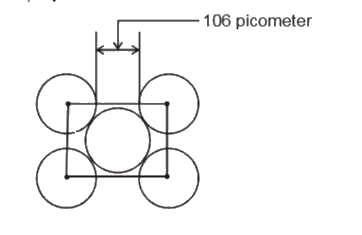 The given distance is a -`2r=a-(a)/(SQRT(2))` `=a[(sqrt(2)-1)/(sqrt(2))]`=106 pm `IMPLIES`Density `(rho)=(4xx63.5)/(6.023xx10^(23)(3.62xx10^(-8))^(3)` `=8.89 g//cm^(3)` |
|
| 49. |
Copper metal can be prepared by roasting copper ore, which contain cuprite (Cu_(2)S) and copper sulfide. (CuS) Cu_(2)S (s) + O_(2) (g) rarr 2Cu (s) + SO_(2) (g) CuS (s) + O_(2) (g) rarr Cu (s) + SO_(2) (g) If ore contains 14.6% impurity in addition to a mixture of CuS and Cu_(2)S. Heating 100 gm of mixture produces 70 gm of Cu metal with 90% purity. [Cu = 63] Percentage (By mass ) of CuS in the sample is : |
|
Answer» 0.095 |
|
| 50. |
Copper metal can be prepared by roasting copper ore, which contain cuprite (Cu_(2)S) and copper sulfide. (CuS) Cu_(2)S (s) + O_(2) (g) rarr 2Cu (s) + SO_(2) (g) CuS (s) + O_(2) (g) rarr Cu (s) + SO_(2) (g) If ore contains 14.6% impurity in addition to a mixture of CuS and Cu_(2)S. Heating 100 gm of mixture produces 70 gm of Cu metal with 90% purity. [Cu = 63] Percentage (By mass) of sulphur in the sample is : |
|
Answer» 0.448 `a xx 158 + b xx 95 = 85.4` …(i) `(2A + b) xx 63 = (70 xx 90)/(100) = 63` `2a + b = 1` …(ii) `a = 0.3, b = 0.4` % by mass of SULPHUR in sample `= ((0.3 + 0.4) 32 xx 100)/(100)` `= 22.4 %` |
|