

Saved Bookmarks
This section includes 7 InterviewSolutions, each offering curated multiple-choice questions to sharpen your Current Affairs knowledge and support exam preparation. Choose a topic below to get started.
| 1. |
Convert:Aniline into 1, 3,5-tribromobenzene. |
Answer» SOLUTION :
|
|
| 2. |
Convert acetone to t-butyl alcohol. |
Answer» SOLUTION :
|
|
| 3. |
Convert acetone into propan-2-ol. |
| Answer» Solution :`UNDERSET("ACETONE")(CH_3-underset(O)underset(||)C-CH_3) underset(H_2O)overset(LiAlH_4)tounderset("Propan-2-ol")(CH_3-underset(OH)underset(|)(CH)-CH_3)` | |
| 4. |
Convert acetaldehyde to isopropyl alcohol. |
Answer» SOLUTION :
|
|
| 5. |
Convert: Acetaldehyde to 2-Butanol |
Answer» SOLUTION :
|
|
| 6. |
Convert: Acetaldehyde to Butan-2-ol |
|
Answer» SOLUTION :
|
|
| 7. |
Convert: 3-Methylaniline into 3-nitrotoluene |
Answer» SOLUTION :
|
|
| 8. |
Convert |
Answer» SOLUTION : 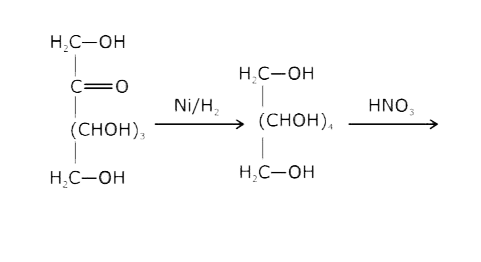
|
|
| 9. |
Convert 16.1 km to miles using the following units equivalents: 1 km = 1000 m, 1 ft = 12 inches, 1 m = 100 cm, 1 mile = 1760 yd, 1 inch = 2.54 cm, 1 yd = 3 ft |
|
Answer» Note that the least precise term (2.54) has three significant FIGURES. |
|
| 10. |
Convert: 2-Propanol to 1-propanol |
Answer» SOLUTION :
|
|
| 11. |
Converstion of benzene diazonium chloride to chloro benzene is an example of which of the following reaction? |
|
Answer» Claisen 
|
|
| 12. |
Conversion of oxygen to ozone represented by the equation 3O_(2)rarr2O_(3) is an endothermic reaction. Enthalpy change DeltaH accompanying the reaction |
|
Answer» Is negative |
|
| 13. |
Select schemes A, B, C out of - I. acid catalysed hydration II. HBO III. Oxymercuration-demercuraton |
|
Answer» I in all the CASES |
|
| 14. |
Conversion of precipitates into colloidal sol is known by which process ? |
|
Answer» Coagulation |
|
| 15. |
Conversion of oxygen into ozone is non-spontaneous at |
|
Answer» all TEMPERATURES EQUATION, `DeltaG= DeltaH-T Delta S = +ve - (-ve)` `DeltaG= +ve`, Non-spontaneous at all temperatures. |
|
| 16. |
Conversion of nitrobenzene to aniline is carried out in |
| Answer» Solution :acidic medium | |
| 17. |
Conversion of nitrobenzene to aniline is carried out in: |
|
Answer» ACIDIC medium |
|
| 18. |
Conversion of milk into curd is made by : |
|
Answer» Diastase |
|
| 19. |
Conversion of KMnO_4 to MnSO_4 is a process of : |
|
Answer» OXIDATION |
|
| 20. |
Conversion of ester to aldehyde which of the following reagent is used ? |
|
Answer» `SnCl_(2) + HCL` |
|
| 21. |
Conversion of 'E' isomer of sorivudine to Z isomer of of sorivudine flow revesible first order kinetics with equilibrium constant equal to 10. Starting with 0.1M of 'E' isomer only, calculate concentration of 'E' "isomer 60 sec after the start if rate constant of forward reaction is" 0.063 min^(-1) |
|
Answer» 0.08M |
|
| 22. |
Conversion of CH_(4) to CH_(3)Cl is an example of which of the following reaction |
|
Answer» Electrophilic substitution |
|
| 23. |
Conversion ofCH_3OH to CH_3COOH can suitably be carried out with the reagent (under high pressure condition) : |
|
Answer» `CO_2//H_2SO_4` |
|
| 24. |
Conversion of CH_(3)OH to CH_(3)COOH can suitablly be carried out with the reagent (under high pressure condition). |
|
Answer» `CO_(2)//H_(2)SO_(4)` 
|
|
| 25. |
Conversion of benzoyl chloride of benzaldehyde using H_(2)//Pd-BaSO_(4) is an example of |
|
Answer» STEPHEN's reaction. |
|
| 26. |
Conversion of diazonium salt to phenol involves __________ . |
|
Answer» alkalinehydrolysis |
|
| 27. |
Conversion of benzene diazonium chloride to chlorobezene is called…………. |
|
Answer» SANDMEYER's reaction |
|
| 28. |
Conversion of benzen diazonium salt into chlorobenzne in presence of Cu_(2)Cl_(2) is called |
|
Answer» Azocoupling REACTION |
|
| 29. |
Conversion of an alkyl halide to alcohol can be done by _________. |
|
Answer» oxidation |
|
| 30. |
Conversion of alcohol to ether in the presence of conc. H_2SO_4 is an example of |
|
Answer» `SN^1` REACTION |
|
| 31. |
Conversion of alcohol into ether in the presence of conc. H_(2)SO_(4) is an example of : |
|
Answer» `S_(N^(1))` |
|
| 32. |
Conversion of acetaldehyde into ethyl acetate in presence of aluminium ethoxide is called |
|
Answer» Aldol condensation `underset"Acetaldehyde"(2CH_3CHO) overset(Al(OC_2H_5)_3)to [CH_3COOH +CH_3CH_2OH] to underset"Ethyl acetate"(CH_3COOC_2H_5)` |
|
| 33. |
Conversion of a primary amide into a primary amine is called |
|
Answer» GABRIEL's pthalimide reaction |
|
| 34. |
Conversion of acetone into 2,3-dimethylbutane-2,3-diol can be achieved by _________. |
|
Answer» Zn-Hg/Hcl |
|
| 35. |
Conversationof CH_(4) to CH_(3)CHl is an example of which of the following reactions ? |
|
Answer» Free radical addition `CH_(4)+Cl_(2) OVERSET(U.V."light") to HCl+CH_(3)Cl`. In this REACTION METHANE reacts with chlorine and the four hydrogen atoms of methane are successively replaced by chlorine atoms . This typeof reaction is an example of free radical substitution. |
|
| 36. |
Convert: 3-Methylaniline into 3-nitrotoluene |
Answer» SOLUTION :
|
|
| 37. |
Conventionalmethodscannotbeusedforseparationofindividual lanthanoid elements beacausetheirpropertiesare quitesimilar. Suggestasuitablemethod fortheirseparation. |
| Answer» SOLUTION :Ionexchangemethodcanbeusedtoseparateindividuallanthanoidelements. Themethodisbaseduponthefactthathydratedradiioflanthanoidionsincreasewithincreasingatomicnumbers. THUS,WHENA solutioncontainingamixtureof severallanthanoidionsis passedthrougha COLUMN ofacationexchangeresin, theheavierelementswill COMEOUT firstfrom thecoulumn. | |
| 38. |
Controlled oxidation of primary alcohols give |
|
Answer» aldehydes |
|
| 39. |
Control of sweetness of food is difficult with |
|
Answer» Asparatame |
|
| 40. |
Contribution of each face in the calculation of no. of atoms in unit cells is? |
|
Answer» 43832 |
|
| 41. |
Continuous zig-zag motion of particles was studied by |
|
Answer» Newton |
|
| 42. |
Continuous etherification process based upon |
|
Answer» oxidation |
|
| 43. |
{:(Content,Resistance ,"Volume of gas produced"),(,(at same T & P),),(Cell-1 CuSO_(4)(aq),10Omega,"at anode is" V_(1)),(Cell-2NaCI(aq),2Omega,"at anode is"V_(2)),(Cell-3 ZnSO_(4)(aq),6Omega,"at cathode is"V_(3)):} |
|
Answer» |
|
| 44. |
Contact process is used to prepareColloidal sulphur |
|
Answer» `SO_(2)` |
|
| 45. |
Contact process is better than chamber process for the manufacture of H_2SO_4 because |
|
Answer» in CONTACT process PURE ACID is obtained |
|
| 46. |
Consumption of alcohol by vehicle drivers is detected by |
|
Answer» blow of mouth air in test tube containing ACIDIC `K_2Cr_2O_7` |
|
| 47. |
Consult the table of the standard electrode potentials and suggest three substances that can oxidize ferrous ions under suitable conditions. |
|
Answer» SOLUTION :Oxidation of ferrous ions MEANS that the FOLLOWING reactions should OCCUR: `Fe^(2+)toFe^(3+)+e^(-),E_(o x)^(@)=-0.77V` Only those substances can oxidize `Fe^(2+)` to `Fe^(3+)` which are stronger oxidizing agents and have positive reduction potentials greater than 0.77 V so that EMF of the cell reaction is positive. this is so for elements lying below `Fe^(3+)//Fe^(2+)` in the electrochemical series, i.e., `Br_(2),Cl_(2)` and `F_(2)`. |
|
| 48. |
Consult the table of standard eletrode potentials and suggest three substances that can oxidise ferrous ions under suitable conditions |
|
Answer» Solution :Oxidation of ferrous ions means the following reaction should occur <BR> : `Fe^(2+) toFe^(3+) + e^(-),E_("ox")^(@) =-0.77 V` Only those substances can OXIDISE `Fe^(2+)` to `Fe^(3+)`which are stronger oxidising AGENTS and have POSITIVE reduction potentials greater than 0.77 V so that emf of the cell reaction is positive. Elements lying below `Fe^(3+) // Fe^(2+)`in the electrochemical series, e.g.,`Br_(2)``Cl_(2)` , and `F_(2)`will satisfy this requirement. |
|
| 49. |
Consult the table of standard electrode potentials and suggets three substances that can oxidise ferrous ions under suitable conditions. |
|
Answer» Solution :* Substances that are stronger OXIDISING agents than ferrous ions can oxidise ferrous ions. `Fe^(2+) to Fe^(3+) +e^(-)(E_(Fe^(2+)|Fe)^(THETA)=0.77V)` * This implies that the substances having HIGHER reduction POTENTIAL than +0.77 V can oxidise ferrous ions to ferric ions. Three substances that can do so are `F_(2), Cl_(2) and O_(2)`. |
|
| 50. |
Consult the table of standard electrode potential and suggest three substances that can oxidise ferrous ions under suitable conditions. |
| Answer» Solution :Form the table it is seen that `E_(Fe(3+))^o//Fe^2=0.77V`When OXIDATION occurs in this couple, STANDARD electrode potential will be -0.77V.i.e.,`E_(Fe(2+))^o//Fe^(2+)=-0.77`.Those substances which are stronger oxidising agents only can bring about this oxidation. EXAMPLE of such oxidising agents are `Br_2,Cl_2,F_2`,etc. | |