Saved Bookmarks
This section includes 7 InterviewSolutions, each offering curated multiple-choice questions to sharpen your Current Affairs knowledge and support exam preparation. Choose a topic below to get started.
| 1. |
Consider the following relations for emf of a electrochemical cell (1) emf of cell=(Oxidation potential of anode)-(Reduction potential of cathode) (2) emf of cell=(Oxidation potential of anode)+(Reduction potential of cathode) (3) emf of cell=(Reduction potential of anode)-(Reduction potential of cathode). (4) emf of cell=(Oxidation potential of anode)-(Oxidation potential of cathode) Which of the above relations are correct |
|
Answer» 3 and 1 or `C_(cell)=E_("anode (oxid)")^(0)-E_("cathode (oxid)")^(0)` |
|
| 2. |
Consider the following reduction processes : Zn^(2+)+2e^(-)toZn(s), E^(o)=-0.76 V Ca^(2+)+2e^(-)toCa(s),E^(o)=-2.87 V Mg^(2+)+2e^(-)toMg(s),E^(o)=-2.36 V Ni^(2+)+2e^(-)toNi(s), E^(o)=-0.25 V The reducing power of the metals increases in the order : |
|
Answer» `Ca LT ZN lt MG lt Ni` |
|
| 3. |
Consider the following reduction processes : (I) Fe_2O_3 + Crarr Fe (II) Al_2O_3 + Crarr Al (III) Pbo + C rarr Pb (IV) Ca_3(PO_4)_2 + C + SiO_2 rarr P The correct processe(s) is/ are |
|
Answer» (I) and (III) |
|
| 4. |
Consider the following redox reaction occurring in acidic medium : The unknown standard reduction potential is : |
|
Answer» `-1.6V` |
|
| 5. |
Consider the following redox reaction: 2lrCl_(6)^(3-)+3HCOOHto2lr+3CO_(2)+12Cl^(-)+6H^(+) Given: CO_(2)+2H_(3)O^(+)+2etoHCOOH+2H_(2)O""E^(@)=-0.20V lrCl_(6)^(3-)+3etolr+6Cl^(-)""E^(@)=0.77V (a). Determine standard state emf of cell. (b). Is this reaction thermodynamically spontaneous as written? Briefly explain. |
|
Answer» |
|
| 6. |
Consider the following reactions: Zn(s)+cu^(2+)(aq)rarrZn^(2+) (aq)+Cu(s) With reference to the above reaction which one of the following is correct statement: |
|
Answer» Zn is REDUCE to `Zn^(2+)` |
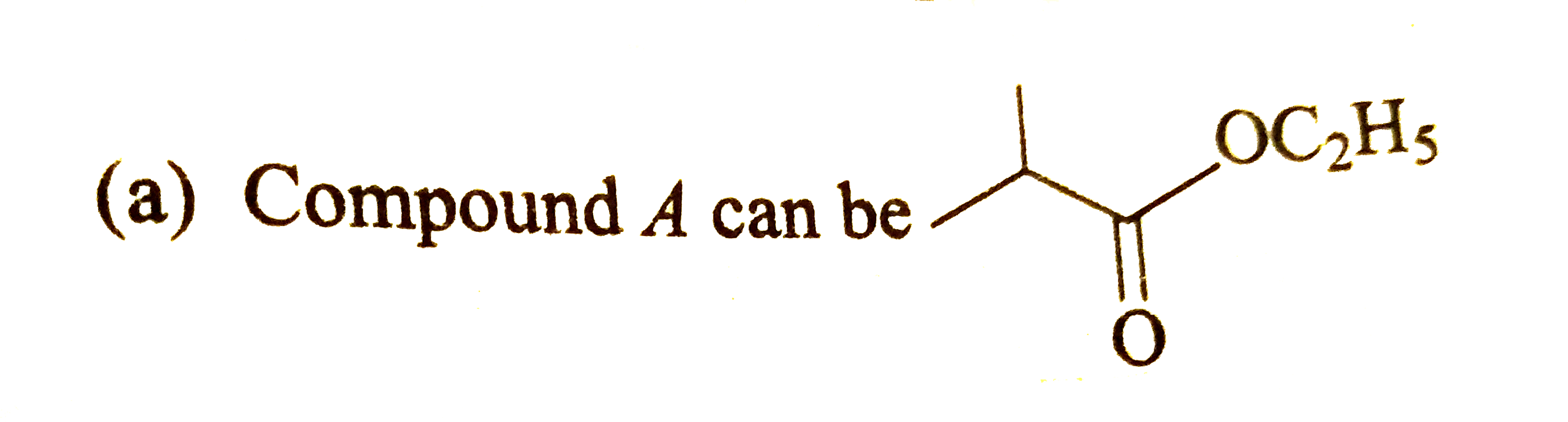
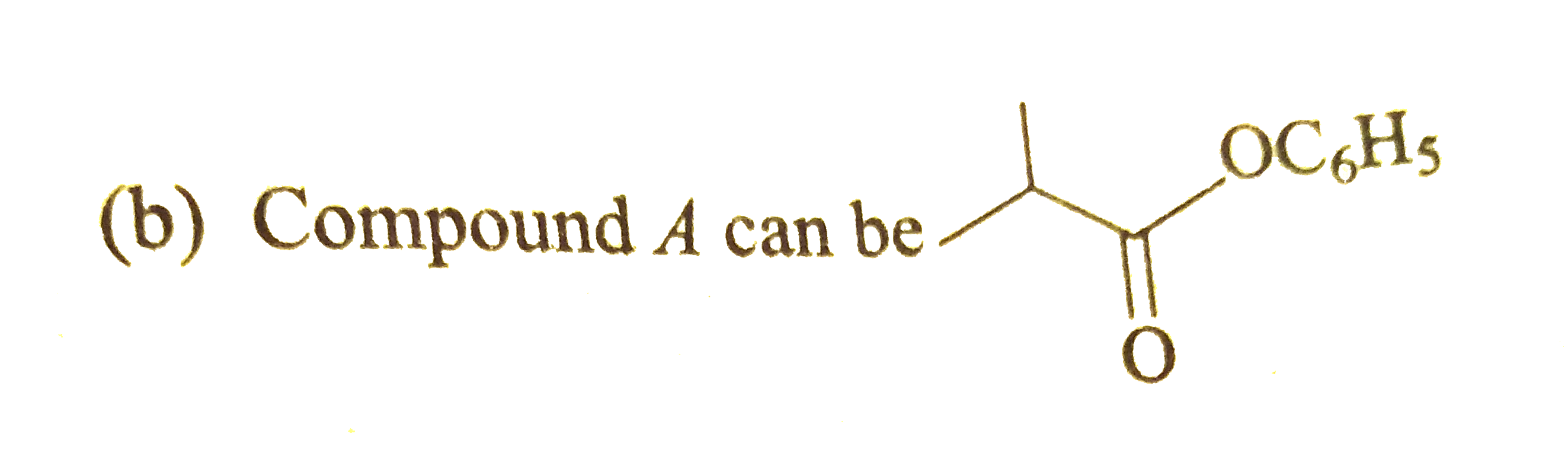
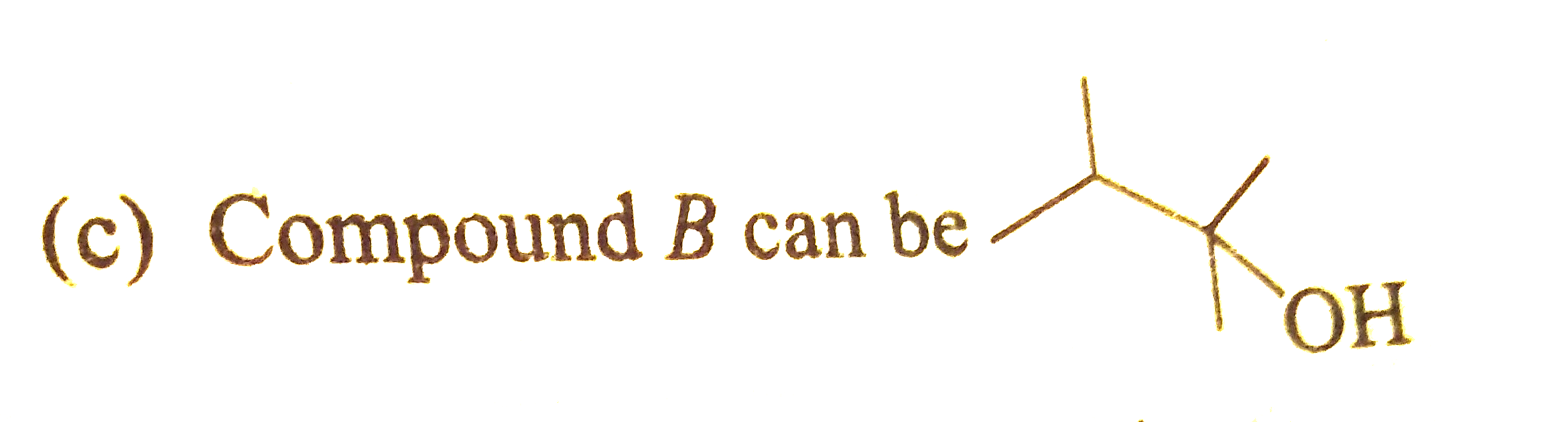
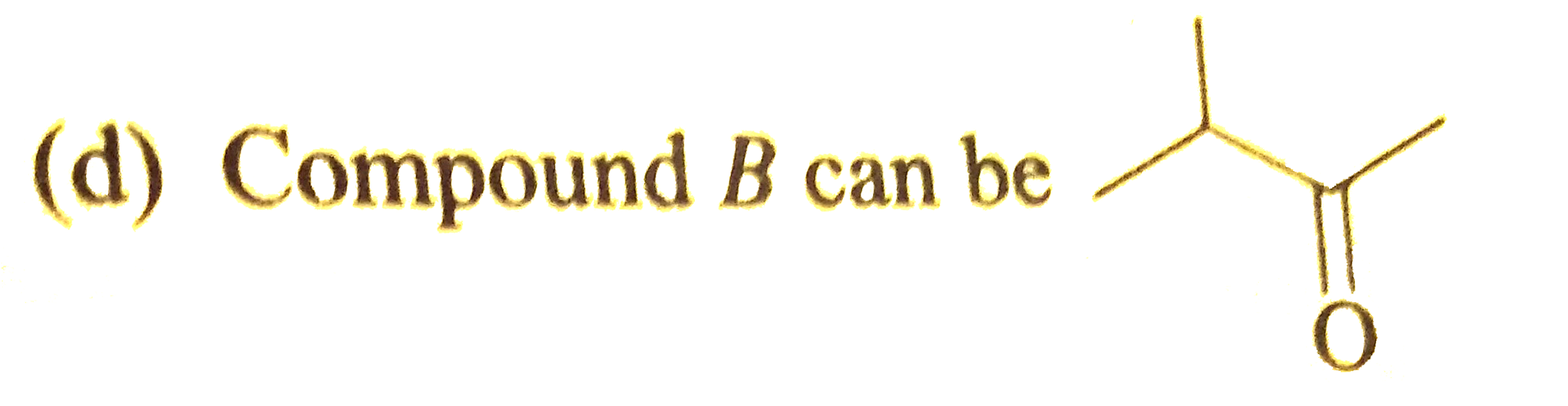
|
| 7. |
Consider the following reactions :Which of these reactions will not produce Saytzeff product ? |
|
Answer» `(CH_(3))_(3)C CH(OH)CH_(3)overset("CONC."H_(2)SO_(4))RARR` 
|
|
| 8. |
Consider the following reactions underset(2)(Xe)+underset(1)(F_2)overset(Ni)to A underset(1)(Xe)+underset(20)(F_2)to B underset(1)(Xe)+underset(5)(F_2)to C Select incorrect statements: |
|
Answer» (A) A, B and C all are non-polar and planner molecule |
|
| 9. |
Consider the following reactions to answer the next question: If product X is treated with AlCl_(3), it undergoes Friedel-Crafts reaction. The expected product is |
|
Answer»
|
|
| 10. |
Consider the following reactions to answer the next three questions Q. If product X is treated with AlCl_(3) it undergoes friedel-crafts reaction. The expected product is |
|
Answer»
|
|
| 11. |
Consider the following reactions of complex compounds A,B and C (i) ClCl_(2)Br*5NH_(3) +excess" "Ag^(+)(aq)to1AgCl(s) (ii) underset("Compound B")(CoCl_(2)Br*5NH_(3))+"excess "Ag^(+)(aq) to 2AgCl(s) (iii) underset("Compound C")(CoCl_(2)Br*4NH_3)+"excess "Ag^(+)(aq.) to 1AgCl(s) Then according to the given information the correct statement(s) is/are: |
|
Answer» Compounds(A) and (B) are ionisation isomers `B:[CoBr(NH_(3))_(5)]*Cl_(2)` `C:[CoBrCl(NH_(3))_(4)]*CL` |
|
| 12. |
Consider the following reactions: Reaction I: underset((1.0" mole"))(CH_(3)-overset(O)overset(||)(C)-CH_(3)) underset("aqueous NaOH")overset(Br_(2)(1.0" mole"))to Reaction II: CH_(3)-overset(O)overset(||)(C)-CH_(3) underset(CH_(3)COOH)overset(Br_(2)("1.0 mole"))to (a) Discuss briefly the composition of the reaction mixture in each case. (b) Discuss the mechanism of the reaction under basic conditions. |
Answer» Solution :(b) Step 1. In presence of a base, the three weakly ACIDIC `alpha`-hydrogens of ACETONE are successively replaced by Br atoms to form `alpha, alpha, alpha`-tribromoacetone (I). 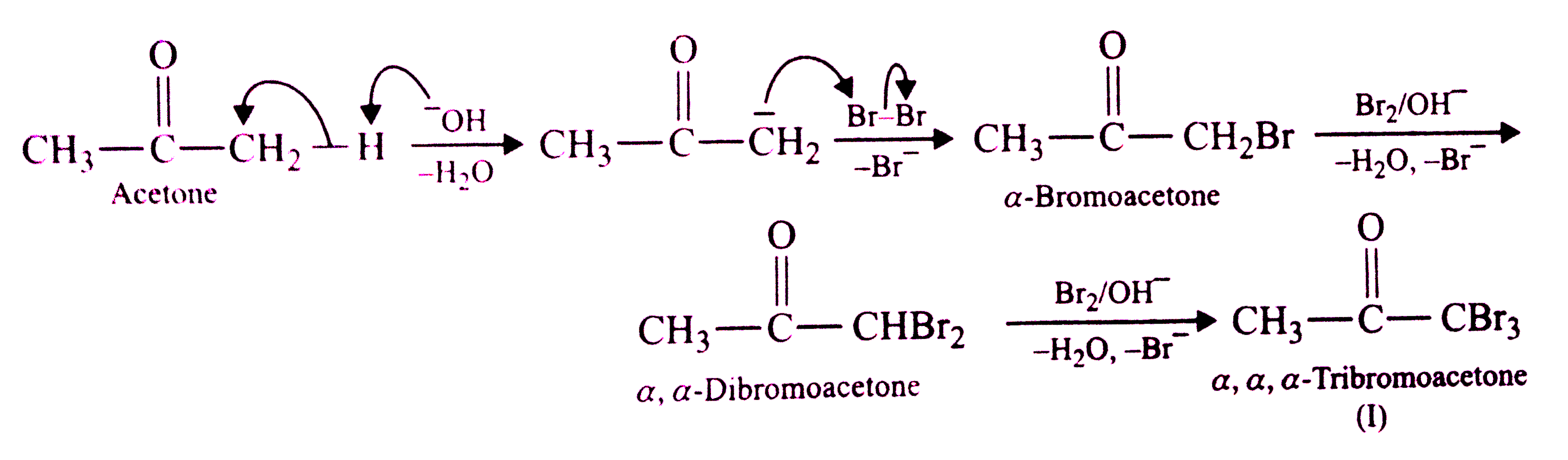 Step 2. The `alpha, alpha, alpha`-tribromocetone (I) thus formed undergoes nucleophilic attack by `OH^(-)` ion on the C=O group followed by cleavage of the `C-CBr_(3)` bond and proton to ultimately give bromoform (II) and `CH_(3)COO^(-)` ion. 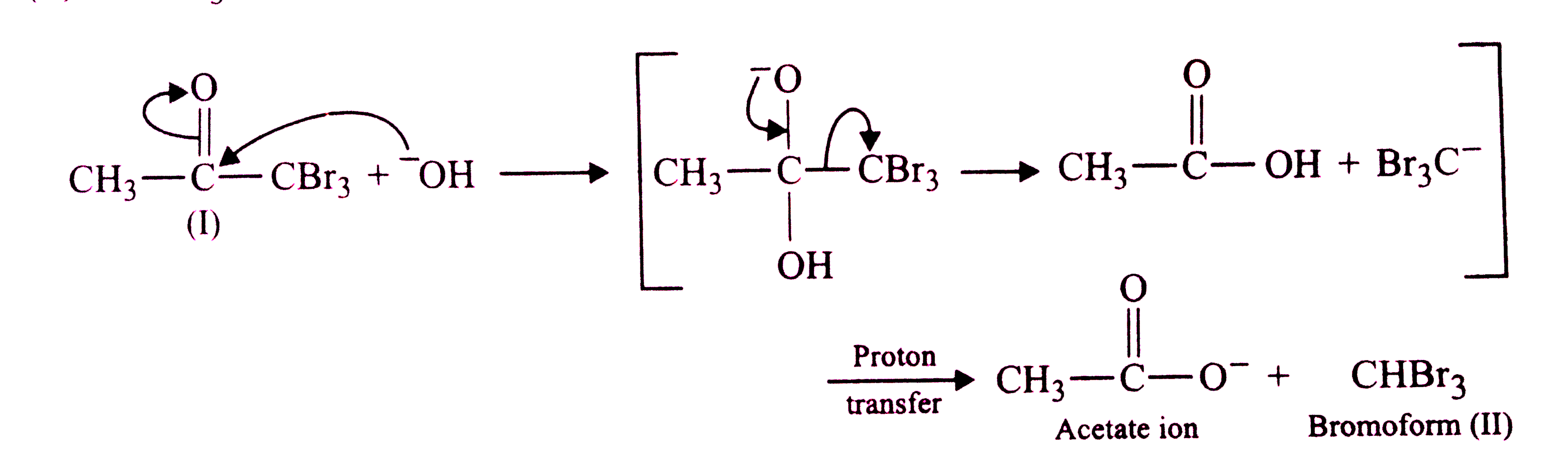
|
|
| 13. |
Consider the following reactions of water : (i) 2H_(2)O + Ca to Ca^(2+) + 2OH^(-) + H_(2) (ii) Mg^(2+) + 6H_(2)O to [Mg(OH)_(6)]^(2+) (iii) 2H_(2)O + 2F_(3) to 4HF+ O_(2) The role of a water in a reaction (i), (ii) and (iii) are............... |
|
Answer» OXIDANT, BASE and REDUCTANT |
|
| 14. |
Consider the following reactions in which all the reactants and the products are in gaseous state None 2PQhArrP_(2)+Q_(2),""K_(1)=2.5xx10^(5) PQ+1//2R_(2)hArrPQR,""K_(2)=5xx10^(-3) The value of K_(1) for the equlibrium 1//2P_(2)+1//2Q_(2)+1//2R_(2)hArrPQR, is |
|
Answer» <P>`2.5xx10^(-3)` `K_(1)=([P_(2)][Q_(2)])/([PQ]^(2))=2.5xx10^(5)` `PQ+1//2R_(2)hArrPQR.` `K_(2)=([PQR])/([PQ][R_(2)]^(1//2))=5xx10^(-3)` Required equlibrium is: `1//2P_(2)+1//2Q_(2)+1//2R_(2)hArrPQR,` `K_(3)=([PQR])/([P_(2)]^(1//2)[Q_(2)]^(1//2)[R_(2)]^(1//2))` `K_(3)=K_(2)xxsqrt((1)/(K_(1)))` `=5xx10^(-3)xxsqrt((1)/(2.5xx10^(5)))=(5xx10^(-3))/(0.5xx10^(3))=1XX10^(-5)` |
|
| 15. |
Consider the following reactions sequence Propan- 1-oloverset(SOCl_2)(to)Xoverset(alc.KOH)underset(Delta)(to)Yoverset((i)B_2H_6//THF)underset((ii)H_2O_2//NaOH)(to) Z (Major) Product Z is |
|
Answer» `CH_3CH_2COOH` 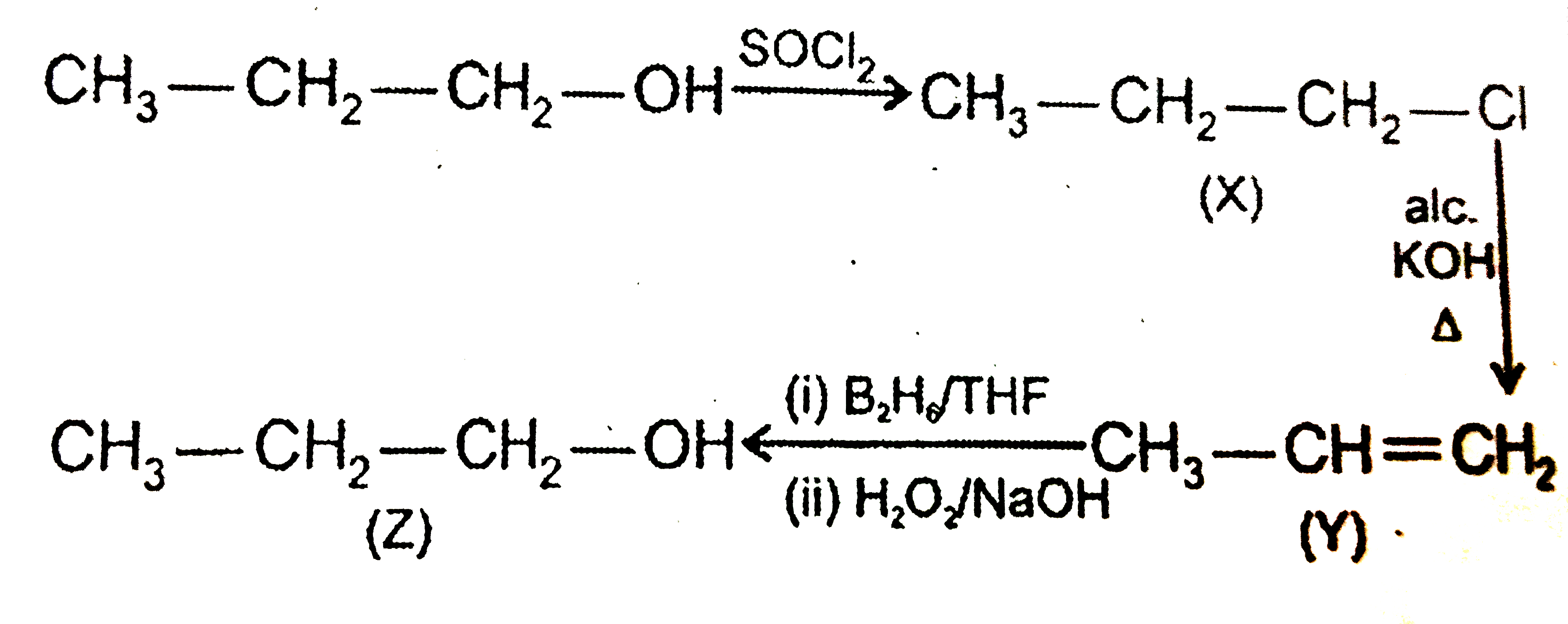
|
|
| 16. |
Consider the following reactions : I : II. (CH_(3))_(2)underset(OH)underset(|)C-CH_(2)-CHOoverset(Delta)rarr III. (CH_3)_(2)CHCH_(2)-underset(F)underset(|)(CH)-CH_(3)overset(CH_(3)O^(-)Na^(+))underset(Delta)rarr IV. (CH_3)_(2)CH-underset(Br)underset(|)CH-CH_(3)overset((CH_3)_(3)CO^(-)K^(+))rarr Which of these reaction(s) will not produce Hoffmann product ? |
|
Answer» I and II  II. `(CH_(3))_(2)underset(OH)underset(|)C-CH_(2)-CHO underset("Elcb")overset(Delta)to underset(("SAYTZEFF ELIMINATION"))((CH_(3))_(2)C=CH-CHO)` III. `(CH_(3))_(2)CHCH_(2)-underset(F)underset(|)CH-CH_(3)underset(Delta)overset(CH_(3)O^(-)Na^(+))to underset(("Hoffmann elimination"))((CH_(3))_(2)CHCH_(2)-CH=CH_(2))` IV. `(CH_(3))_(2)CH-underset(Br)underset(|)CH-CH_(3)overset((CH_(3))_(3)CO^(-)K^(+))to underset(("Hoffmann elimination"))((CH_(3))_(2)CH-CH=CH_(2))` |
|
| 17. |
Consider the following reactions: I. C_(2)H_(5) - I + NH_(3) rarr C_(2) H_(5) N^(o+)H_(3) + I^(o-) II. C_(2)H_(5) - I + ddot(P)H_(3) rarr C_(2)H_(5) P^(o+)H_(5) + I^(o-) III. C_(2)H_(5) - I + EtO^(o-) rarr C_(2) H_(5) - Oet + I^(o-) IV. Me - overset(o+)(S) - Me_(2) + O^(o-)H rarr Me-OH + Me_(2)S In which of the above reactionsdoes not the rate of SN^(2) reactions increasesin solvent polarity? |
| Answer» Solution :If the recatant and/or nucleophilic are changed, INCREASING the polarity of the SOLVENT stablises any charged ground state speicesand decreases the RATE of `SN^(2)` reaction with an increase with the increases in polaityof the solvent. | |
| 18. |
Consider the following reactions I. H_(3)C CI_(3) overset(OH^(Theta))rarr II. H_(3)C CHO overset([Ag(NH_(3))_(2)]^(+)OH^(Theta))rarr III. H_(3)C CO_(2)C(2)H_(5) overset(OH^(Theta))rarr Carboxylic acid is the final product only in the reduction (s) |
|
Answer» I,II `H_(3)C CO_(2)C_(2)H_(5)overset(OH^(-))rarrH_(3)C COO^(-)+underset(("BASIC HYDROLYSIS of ester"))(C_(2)H_(5)OH)` |
|
| 19. |
Consider the following reactions: (i) (1)/(2)N_(2)(g)+(1)/(2)O_(2)(g) to NO(g),Delta_(r)H^(ө)=90" kJ "mol^(-1) (ii) NO(g)+(1)/(2)O_(2)(g) to NO_(2)(g),Delta_(r)H^(ө)=-74" kJ "mol^(-1) Select the correct statement about the given reaction. |
|
Answer» In (i) reaction, `NO(g)` is UNSTABLE because the ENERGY is released. The energy is released in (ii) reaction, `NO_(2)(g)` is stable. Unstable NO(g) changes into the stable `NO_(2)(g)` |
|
| 20. |
Consider the following reactions H_(3)C-underset(D)underset(|)(C)H-underset(CH_(3))underset(|)(C)H-CH_(3)+overset(*)(B)r to 'X'+HB r Identify the structure of the major product 'X' |
|
Answer» `H_(3)C-underset(D)underset(|)(C)H-underset(CH_(3))underset(|)(C)H-OVERSET(*)(C)H_(2)` |
|
| 21. |
Consider the following reactions, Ethanol overset(PBr_3)to X overset"alc. KOH"to Y underset((ii) H_2O , "heat")overset((i) H_2SO_4 , "room temperature") to Z,product Z is |
|
Answer» `CH_2=CH_2` `underset"(Y)"(CH_2=CH_2) underset((i)H_2O, "HEAT")overset((i)H_2SO_4)to underset"(Z)"(CH_3CH_2OH)` |
|
| 22. |
Consider the following reactions at 1000^(@)C (I) Zn(s)+1//2O_(2)(g)overset(Delta)to ZnO(g), Delta G^(@)= -360 " kJ mol"^(-1) (II) C(s)+1//2O_(2)(g) overset(Delta)to CO(g), Delta G^(@) = -460 " kJ mol"^(-1) and choose the correct statement at 1000^(@)C |
|
Answer» ZNO is more stable than CO |
|
| 23. |
Consider the following reactions at 1000^@C : (a) Zn(s) +1/2O_2(g) rarr ZnO (s) ,DeltaG^@=-360kJ mol^(-1) (b) C (g) +1/2O_2(g) rarr CO(g),DeltaG^@=-460 " kJ mol"^(-1) Choose the correct statement at 1000^@C : |
|
Answer» Zinc can be oxidised by CARBON monoxide |
|
| 24. |
Consider the following reactions at 1000^@C (A) Zn_((s)) + 1/2O_(2(s)) to ZnO_((s)) DeltaG^(@) = -360 kJ mol^(-) (B) C("graphite")+ 1/2 O_(2(g)) to CO_((g)) DeltaG^@, = -460 J mol^(-1) |
|
Answer» Zinc can be oxidised by CARBON monoxide. |
|
| 25. |
Consider the following reactions, A+B underset(k_(-1))overset(k_1)hArr C, C + B overset(k_2)to D The rate in terms of -(d[B])/(dt) will be |
|
Answer» `k_1[A][B]-k_(-1)[C]` `-(d[B])/(dt)=k_1[A][B]-k_(-1)[C]` From `2^(ND)` reaction, `-(d[B])/(dt)=k_2[C][B]` `therefore` TOTAL `-(d[B])/(dt)=k_1[A][B]-k_(-1)[C]+k_2[C][B]` |
|
| 26. |
Consider the following reactions |
|
Answer» Both X and Y are soame and are 1-methoxy-2-methylpropan-2-ol |
|
| 27. |
Consider the following reactions 1^(@)R-X+Nu^(-) to R-Nu+x^(-) The rateof reaction maximum in the case of |
|
Answer» Solvent `=H_(2)O,X=I` |
|
| 28. |
Consider the following reactions 1 CH_(3)CH_(2)Cl+NH_(3) (alc) to 2 (CH_(3))_(3)CBr+KCN(alc) to 3 CH_(4)CHBrCH_(3)+agCN(alc) to 4 CH_(3)CHBrCH_(3)+KOH(alc) to The most likely productsis these reations would be |
|
Answer» `CH_(3)CH_(2)NH_(2),(CH_(3))_(3)CNC,(CH_(3))_(2)CHCN,(CH_(3))_(2)CHOH` 2 `(CH_(3))_(3) CBr+KCN(alc) to (CH_(3))_(2)C=CH_(2)` 3 `CH_(3)CHBrCH_(3)+AGCN (alg) to (CH_(3))_(2) CHNC` 4. `CH_(3)CHBrCH_(3)KOH (alc) to CH_(3)CH=CH_(2)` |
|
| 29. |
Consider the following reactions: |
|
Answer» |
|
| 30. |
Consider the following reactions. |
|
Answer» I, II, III & IV 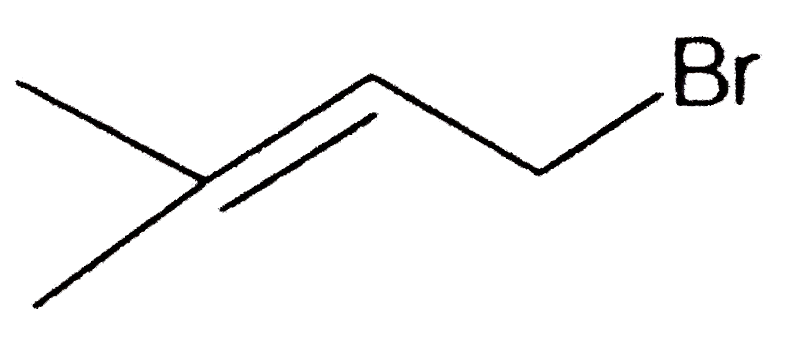
|
|
| 31. |
Consider the following reactions (1) (CH_3)_3"CC"H(OH)CH_3overset("conc".H_2SO_4)rarr (2) (CH_3)_2"CHCH(Br)CH_(3)overset(conc.KOH)rarr(3) (CH_3)_2"CHCH(Br)CH_(3)overset((CH_3)_3CO^(-) Koplus)rarr (4) (CH_3)_2underset("OH")underset(" |")(C-CH_2)-CHOoverset(Delta)rarrWhich of these reaction(s) will produce Saytzeff product? |
|
Answer» (1) , (2) and (4) |
|
| 32. |
Consider the following reaction, Zn+2H^(+)rarrZn^(2+)+H_(2) Half-life period is independent of concentration of Zn at constatn pH. At constant Zn concentration, half-life is 10 minutes at pH = 2 and half-life is 100 minutes at pH = 3. Hence, rate law is : |
|
Answer» `k[ZN][H^(+)]` |
|
| 33. |
Consider the following reaction: zMnO_(4)^(-) + yC_(2)O_(4)^(2-) + zH^(+) rarr xMn^(2+) + 2yCO_(2) + (Z)/(2) H_(2)O The value of x,y and z are: |
|
Answer» 5,2 and 8 |
|
| 34. |
Consider the following reaction : xMnO_(4)^(-)+yC_(2)O_(4)^(2-)+zH^(+)toxMn^(2+)+2yCO_(2)+(z)/(2)H_(2)OThe values of x,y and z in the reaction are , respectively : |
|
Answer» 5 , 2 and 16 `thereforex=2,y=5andz=16` |
|
| 35. |
Consider the following reaction : xAs_(2)S_(3)+yO_(2)to zAs_(2)O_(3)+wSO_(2) What is y (the coefficient for O_(2)) when this equation is balanced using whole number coefficients ? |
|
Answer» 5 `2As_(2)S_(3) +9 O_(2) toAs_(2)O_(3) +6SO_(2) .` SOY is 9 |
|
| 36. |
Consider the following reaction Which of these reactions are possible ? |
|
Answer» (B), (C) and (d) |
|
| 38. |
Consider the following reaction, The electrophile involved in the above reaction is |
|
Answer» dichloromethyl cation, `overset(+)(C)HCl_(2)` `bar(C)Cl_(3)rarr: underset(underset(("electrophile"))("Dichlorocarbene"))(C Cl_(2))+Cl^(-)` |
|
| 39. |
Consider the following reaction sequence The compounds S is: |
|
Answer» Ph-CH=CH-CN 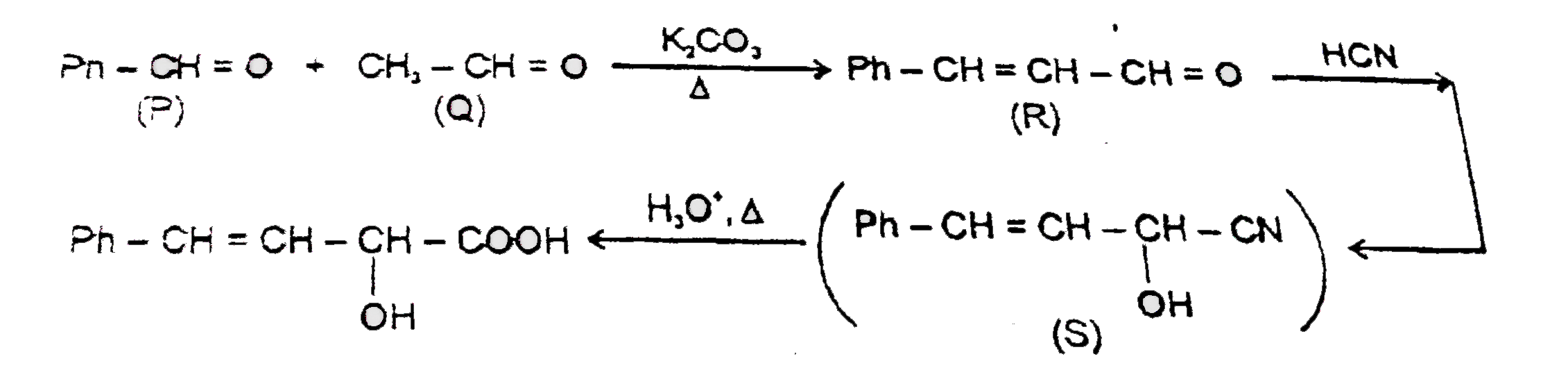
|
|
| 40. |
Consider the following reaction sequence The compounds P and Q are : |
|
Answer» `Ph-CH=O+CH_3CH=O` |
|
| 41. |
In the following sequence of reactions, the alkene affords the compound B: CH_(3)CH=CHCH_(3)overset(O_(3))rarrAunderset(Zn)overset(H_(2)O)rarrB The compound B is |
|
Answer» `CH_3CH_2COCH_3` |
|
| 43. |
Consider the following reaction sequence: Choose the most correct of the following ? |
|
Answer»
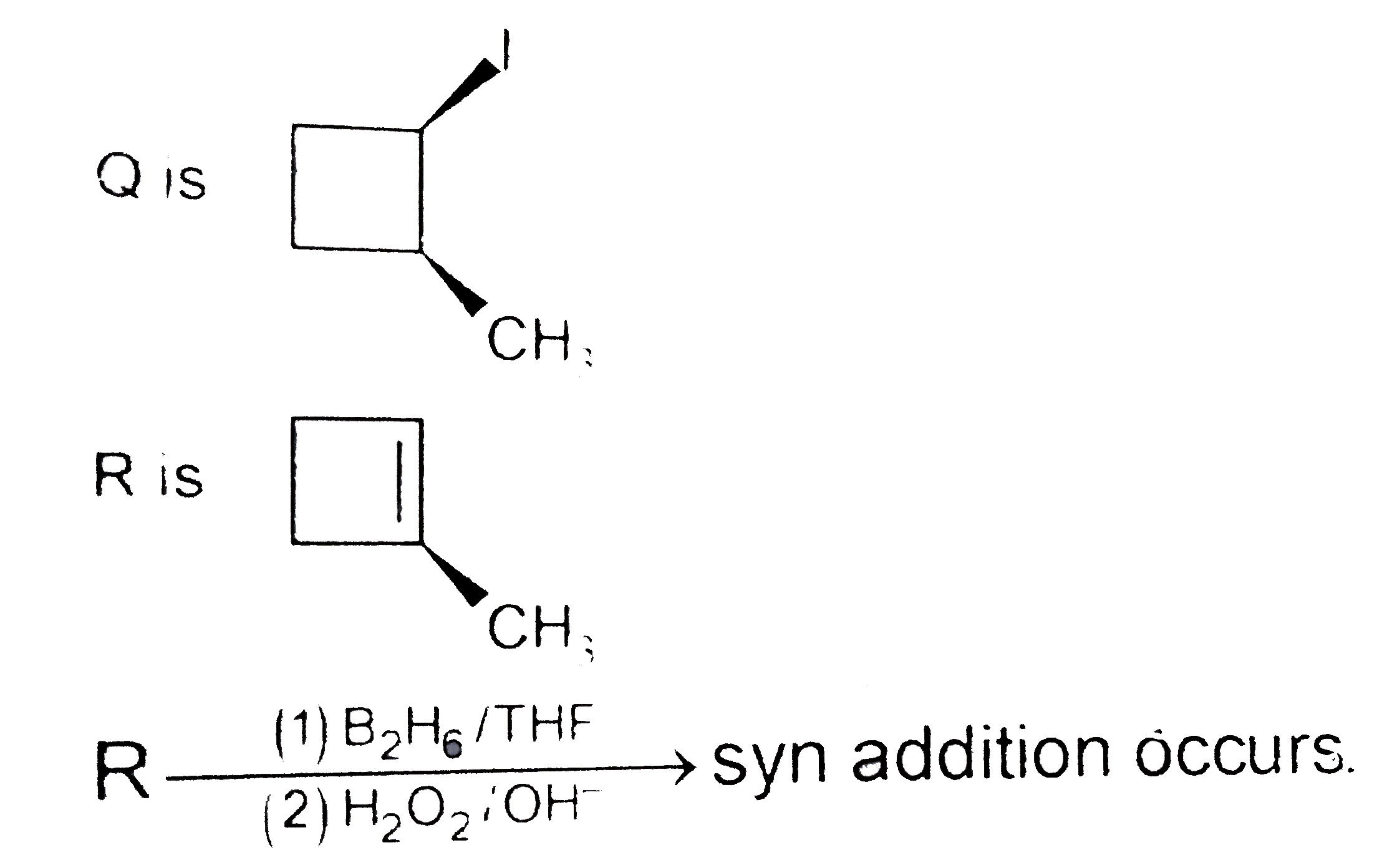 `Runderset((2)H_(2)O_(2)//OH^(-))OVERSET((1)B_(2)H_(6)//THF)rarr`syn addition occurs. |
|
| 44. |
Consider the following reaction :s Phenol underset(Zn "dust")to X underset("Anhydrous" AlCl_(3))overset(Ch_(3)Cl)to Y overset("Alkaline " KMnO_(4))to Z. The product Z is |
|
Answer» Toluene 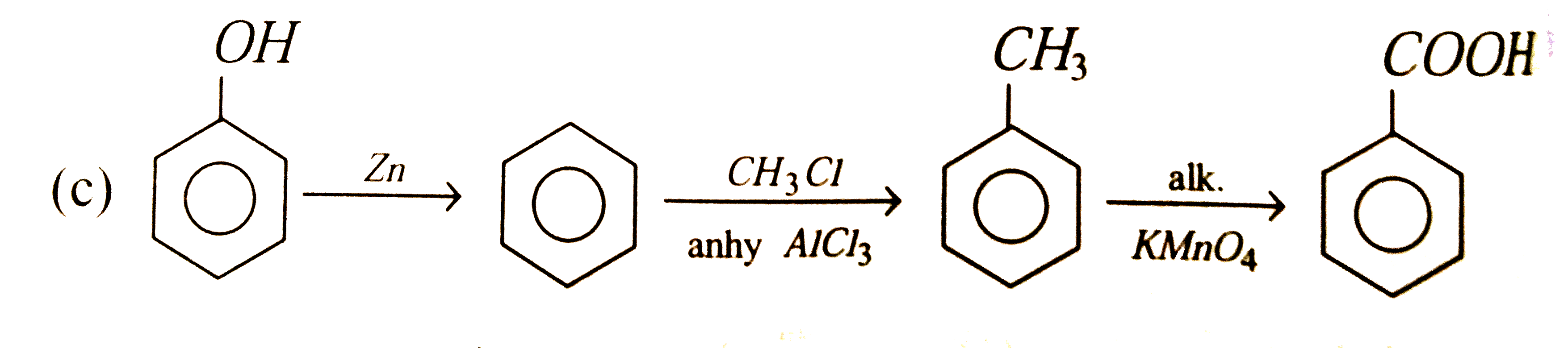
|
|
| 45. |
Consider the following reaction :s ethanol C_2H_5OHoverset(PBr_(3))(rarr)Xoverset(alc.KOH)(rarr)Yoverset((i)O_3 Zn" ")underset((ii)H_(2)O,heat)(rarr)Z the product Z is |
|
Answer» `2CO_(2)` |
|
| 46. |
Consider the following reaction :s ethonal overset(PBr_(3))to X overset(alc. KOH)to Yunderset((ii)H_(2)O, "heat")overset((i) H_(2)SO_(4) " room temperature")to Z, product Z is |
|
Answer» `CH_(2)=CH_(2)` |
|
| 47. |
Consider the following reaction RONa+H_(2)C to ROH+NaOH ROH+NaNH_(2) to RONa+NH_(3) Predict which of the following order reagarding base strength is correct. |
|
Answer» `OH^(-)LT NH_(2)^(-) lt RO^(-)` `ROH+NaNH_(2) to RONa+NH_(3)` Since the reaction is favoured in forward DIRECTION, `RO^(-)` is stronger BASE than `OH^(-)`. According to the second reaction `NH_(2)^(-)` is stronger than `RO^(-) as NH_(2)^(-) "forms" NH_(3)`. The order of basic strength if `OH^(-) lt RO^(-) lt NH_(2)^(-)` . |
|
| 48. |
Consider the following reaction RCOO^(-) Ag^(+) overset(Br_(2))to RBr + AgBr + CO_(2) The given reaction is known as X reaction and proceeds via a Y intermediate 'X' and 'Y' stand respectively for |
|
Answer» Hell-Volhard ZELINSKY, carbanion |
|
| 49. |
Consider the following reaction :R-OH overset(HCl)rarr R-Cl+H_(2)OThe above reaction is not true if R is ……. |
|
Answer»
|
|