

Saved Bookmarks
This section includes 7 InterviewSolutions, each offering curated multiple-choice questions to sharpen your Current Affairs knowledge and support exam preparation. Choose a topic below to get started.
| 1. |
Column -I Colmun -II (A) Sucrose overset(H_3O^(oplus)) (to) (P) Product is glucose + Fructose (B) Maltose overset(H_3O^(oplus)) (to) (Q) Product is 2 Glucose (C ) Lactose overset(H_3O^(oplus)) (to) (R ) Product is Glucose + Galactose (S) Oligo saccharides |
| Answer» SOLUTION :A-PS, B-QS, C-RS | |
| 2. |
Column-I and Column-II contains four entries each. Entries of Column-I are to be matched with some entries of Column-II One or more than one entries of Column-I may have the matching with the same entries of Column-II. |
|
Answer» |
|
| 3. |
Column-I and Column-II contains four entries each. Entries of Column-I are to be matched with some entries of Column-II. Each entry of Column-I may have the matching with one or more than one entries of Column-II |
|
Answer» |
|
| 4. |
Column-I and Column-II contains four entries each. Entries of column-I are to be matched with some entries of column-II. Each entry of column-I may have the matching with one or more than one entries of column-II. |
|
Answer» |
|
| 5. |
Column-I and Column-II contains four entries each. Entries of column-I are to be matched with some entries of column-II. Each entry of column-I may have the matching with one or more than one entries of column-II. |
|
Answer» |
|
| 6. |
Column-I and Column-II contains four entries each. Entries of column-I are to be matched with some entries of column-II. Each entry of column-I may have the matching with one or more than one entries of column-II. |
|
Answer» |
|
| 7. |
Column-I and Column-II contains four entries each. Entries of column-I are to be matched with some entries of column-II. Each entry of column-I may have the matching with one or more than one entries of column-II. |
|
Answer» Cupellation is used when impurities are of other metals, mainly used for silver. Electro-refining : Cu,Ag,Au,Cr,Zn,Ni,etc., are mainly purified by removing insoluble impurities as ANODE MUD. van Arkel method : (VAPOUR phase refining) Metals like titanium, ZIRCONIUM, thorium and uranium are purified by this method. |
|
| 8. |
Column-I and Column-II contains four entries each. Entries of column-I are to be matched with some entries of column-II. Each entry of column-I may have the matching with one or more than one entries of column-II. |
|
Answer» CERUSSITE `PbCO_(3)` (carbonate ore) Kainite `KCl. MgSO_(4). 3H_(2)O` (chloride and sulphate ore) CALAMINE `ZnCO_(3)` (carbonate ore) |
|
| 9. |
Column-I and Column-II contains four entries each. Entries of column-I are to be matched with some entries of column-II. Each entry of column-I may have the matching with one or more than one entries of column-II. |
|
Answer» Dolomite `CaCO_(3). MgCO_(3)` Carnaollitge `KCL. MgCl_(2).6H_(2)O` Chromite `FeCr_(2)O_(4) or FeO. Cr_(2)O_(3)` |
|
| 10. |
Column-I and Column-II contains four entries each. Entries of column-I are to be matched with some entries of column-II. Each entry of column-I may have the matching with one or more than one entries of column-II. |
|
Answer» |
|
| 11. |
Column-I and Column-II contains four entries each. Entries of column-I are to be matched with some entries of column-II. Each entry of column-I may have the matching with one or more than one entries of column-II. |
|
Answer» |
|
| 12. |
Column-I and Column-II contains four entries each. Entries of column-I are to be matched with some entries of column-II. Each entry of column-I may have the matching with one or more than one entries of column-II. |
|
Answer» |
|
| 13. |
Column-I and Column-II contains four entries each. Entries of column-I are to be matched with some entries of column-II. Each entry of column-I may have the matching with one or more than one entries of column-II. |
|
Answer» |
|
| 14. |
Column-I and Column-II contains four entries each. Entries of Column -I are to be matched with some entries of Column-II. One or more than one entries of Column-I may have the matching with the same entries of Column-II. |
|
Answer» `XeOF_(4)``sp^(3)d`T-shaped (3-bp, 2lp) `ICl_(4)^(-)``sp^(3)d^(2)`square planar (4-bp, 2-lp) `[SbF_(5)]^(-)``sp^(3)d^(2)`square pyramidal(5-bp, 1lp) |
|
| 15. |
Column-I and Column-II contains four entries each. Entries of Column -I are to be matched with some entries of Column-II. One or more than one entries of Column-I may have the matching with the same entries of Column-II. |
Answer» 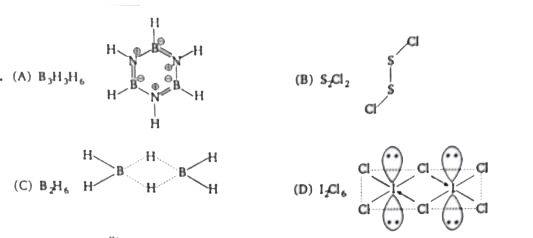
|
|
| 16. |
Column-I and Column-II contains four entries each. Entries of Column -I are to be matched with some entries of Column-II. One or more than one entries of Column-I may have the matching with the same entries of Column-II. |
Answer» 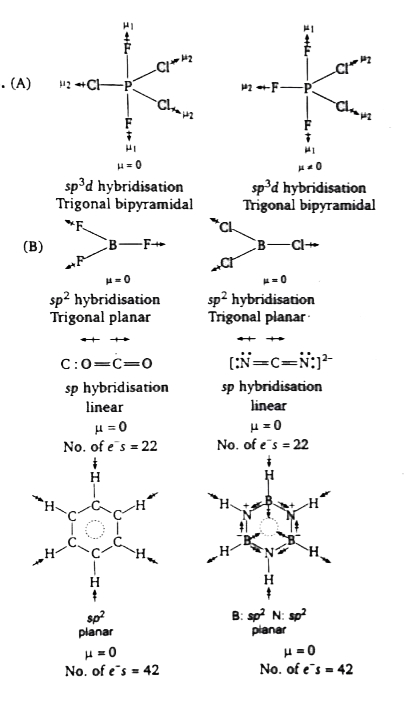
|
|
| 17. |
Column-I and Column-II contains four entries each. Entries of Column -I are to be matched with some entries of Column-II. One or more than one entries of Column-I may have the matching with the same entries of Column-II. |
|
Answer» |
|
| 18. |
Column-I and Column-II contains four entries each. Entries of Column -I are to be matched with some entries of Column-II. One or more than one entries of Column-I may have the matching with the same entries of Column-II. |
|
Answer» |
|
| 19. |
Column-I and Column-II contains four entries each. Entries of Column -I are to be matched with some entries of Column-II. One or more than one entries of Column-I may have the matching with the same entries of Column-II. |
|
Answer» |
|
| 20. |
Column-I and Column-II contains four entries each. Entries of Column -I are to be matched with some entries of Column-II. One or more than one entries of Column-I may have the matching with the same entries of Column-II. |
|
Answer» |
|
| 21. |
Column-I and Column-II contains four entries each. Entries of Column -I are to be matched with some entries of Column-II. One or more than one entries of Column-I may have the matching with the same entries of Column-II. |
|
Answer» |
|
| 22. |
Column-I and Column-II contains four entries each. Entries of Column -I are to be matched with some entries of Column-II. One or more than one entries of Column-I may have the matching with the same entries of Column-II. |
Answer» 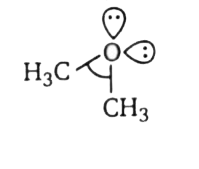 `to` upaired DISTRIBUTION of s-character in HYBRID orbitals `to angleCl-O-Cgt109^(@)28.` `to` Both `O-C` bondsare equivalent. (B) 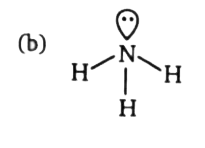 `to` unequal distribution of s-character in hybrid orbitals `to angleHNHlt109^(@)28.` `to` All three `N-H` BONDS are equivalent (c) 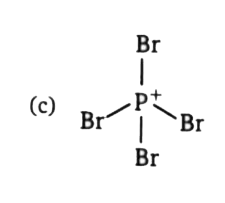 `to` Equal distribution of s-character in hybrid orbitals `to angleBr-P-B^(+)=109^(@)28.` `to` All `P-Br` bonds are equivalent (d) 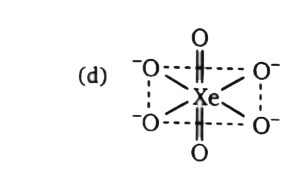 `to` Equal distribution of s-character in all hybrid ORBITAL `to angle O-Xe-O=90^(@)` `to` All `Xe-O` bonds are equivalent |
|
| 23. |
Column-I and Column-II contains four entries each. Entries of Column -I are to be matched with some entries of Column-II. One or more than one entries of Column-I may have the matching with the same entries of Column-II. |
Answer» 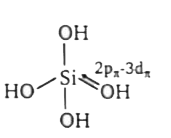 `to2p_(PI)-3d_(pi)` back bond `to` can exhibit intermolecular H-bonding as H-atom is BOUND in O-atom. `to` PROTON donor acid: basicity=4 `implies` 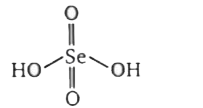 `to` back is absent. `to`can FORM intermolecular H-bonding as H-atom is directly bounded to O-atom `to`Proton donor acid, basicity=2 `to` Hypervalent, Number of `e^(-)` at Se=12 `implies` 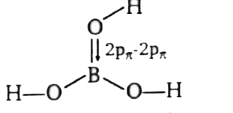 `to2p_(pi)-2d_(pi)` back bond of present `to`Hypervalent as number of `e^(-)s` atj B-atom=6 `to` does not fornish `H^(+)` `implies` 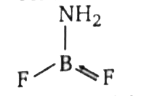 `to2p_(pi)-2d_(pi)` back bond is present `to` can form intermolecular H-bonding as H-atom is directly bonded to N-atom hypervalent number of `e^(-)s` B-atom=6 `to` Does not furnish `H^(+)` |
|
| 24. |
Column-I and Column-II contains four entries each. Entries of Column -I are to be matched with some entries of Column-II. One or more than one entries of Column-I may have the matching with the same entries of Column-II. |
Answer» 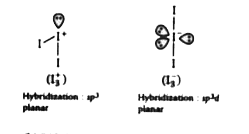 (b) `B(OH)_(3)+OH^(-) to B(OH)_(4)^(-)` 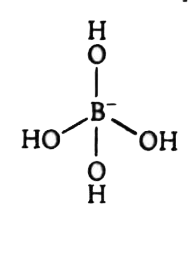 `to` hybridization of B: `sp^(3)` `to` hybridization of B: `sp^(3)` `to` Non-polar (c) `BA^(2+)SO_(4)^(2-)` 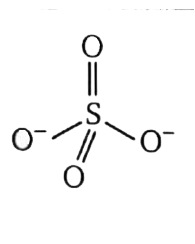 Hyrbridization of S, `sp^(3)` Non-polar `ppi-dpi` bonds =2 (d)` MgO implies SO_(2)` : covalent 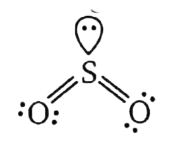 Hybridization of `S, sp^(2)` Hybridization of `S, sp^(2)` Planar `ppi-dpi` bonds =1 |
|
| 25. |
Column-I and Column-II contains four entries each. Entries of Column -I are to be matched with some entries of Column-II. One or more than one entries of Column-I may have the matching with the same entries of Column-II. |
Answer» 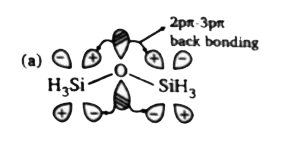 `toSi-O-Si=144^(@)` `to`Hybridization of O-atom changed to `sp^(2)` `to` In `2p_(pi)-3d_(pi)` back bonding non-axial d-orbital of `t_(2g)` is used `to`Electron density at O-atom decrease (b) 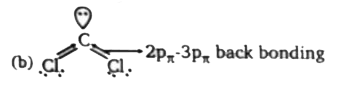 `toangleCl-O-Cl` increase due to back bonding and steric repulsion between both Cl-atoms `to` Hybridization of C remains `sp^(2)` `to` Electron density increase at central C-atom. (c) 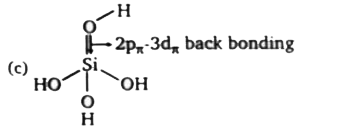 `to` Electron density at Si-atom increase due to `2p_(pi)-3d_(pi)` back bonding `to` Non-axial d-orbital of `t_(2g)` set of orbitals is involved in back bonding `to` All `O-Si-O` remains at `109^(@)28.` because all FOUR substituents are same (d) 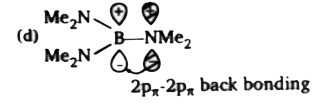 `to` hybridization of central does not change. `to` Electron density at B-atom increase `to` All `N-B-N` remain same as all three substituentare same. |
|
| 26. |
Column-I and Column-II contains four entries each. Entries of Column -I are to be matched with some entries of Column-II. One or more than one entries of Column-I may have the matching with the same entries of Column-II. |
|
Answer» `sigma1sltoverset("*")(sigma)1sltsigma2sltoverset("*")(sigma)2sltunderset(pi2p_(y))(pi2p_(x))ltpi2p_(Z)ltunderset(overset("*")(PI)2p_(y))(overset("*")(pi)2p_(x))ltoverset("*")(pi)2p_(z)`For molecules havingtotal number of `E^(-)` s greater than 14`sigma1sltoverset("*")(sigma)1sltsigma2sltoverset("*")(sigma)2sltunderset(pi2p_(y))(sigma2p_(x))ltpi2p_(z)ltunderset(overset("*")(pi)2p_(y))(overset("*")(pi)2p_(x))ltoverset("*")(sigma)2p_(z)` 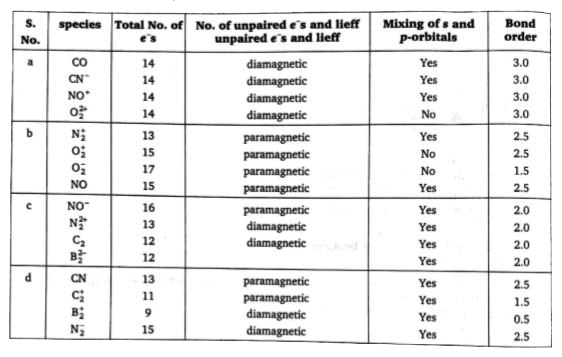
|
|
| 27. |
Column-I and Column -II contains four entries each. Entries of Column-I are to be matched with some entries of Column-II. One or more than one entries of Column-I may have the matching with the same entries of Column-II. |
Answer» 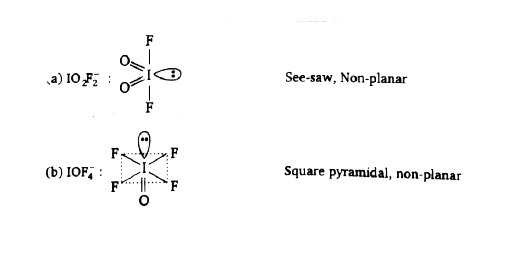 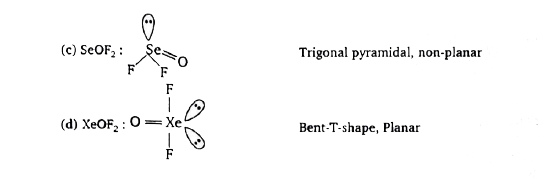
|
|
| 28. |
Column-I and Column -II contains four entries each. Entries of Column-I are to be matched with some entries of Column-II. One or more than one entries of Column-I may have the matching with the same entries of Column-II. |
Answer» 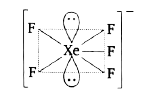 `sp^(3)d^(3)` hybridisation `(s+p_(X)+p_(y)+p_(Z)+d_(x^(2)-y^(2))+d_(z^(2))+d_(xy))`, d-orbital with zero nodal PLANE `(d_(z^(2)))` and non-axial d-orbital `(d_(xy))` used in hybridisation. PLANAR. Bond angle, `72^(@)` 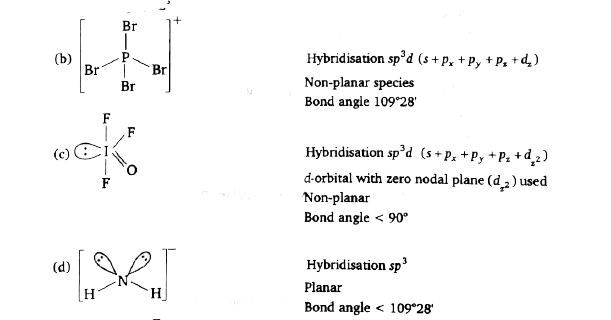
|
|
| 29. |
Column-I and Column -II contains four entries each. Entries of Column-I are to be matched with some entries of Column-II. One or more than one entries of Column-I may have the matching with the same entries of Column-II. |
Answer» 
|
|
| 30. |
Column-I and Column -II contains four entries each. Entries of Column-I are to be matched with some entries of Column-II. One or more than one entries of Column-I may have the matching with the same entries of Column-II. |
Answer» 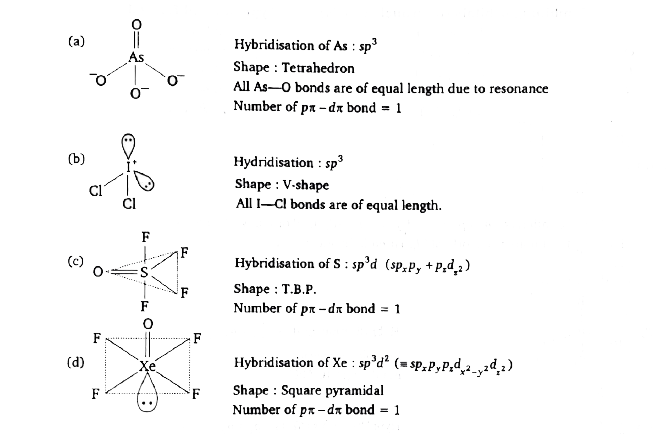
|
|
| 31. |
Column-I and Column -II contains four entries each. Entries of Column-I are to be matched with some entries of Column-II. One or more than one entries of Column-I may have the matching with the same entries of Column-II. |
Answer» 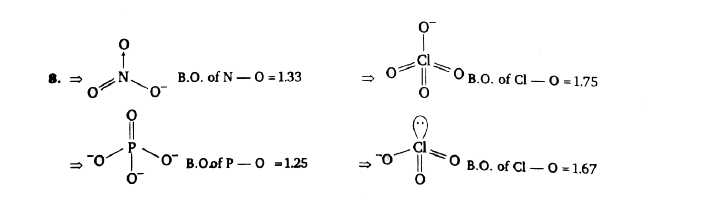 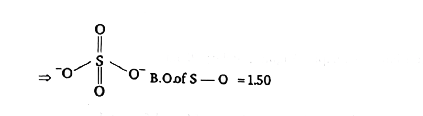
|
|
| 32. |
Column-I and Column -II contains four entries each. Entries of Column-I are to be matched with some entries of Column-II. One or more than one entries of Column-I may have the matching with the same entries of Column-II. |
|
Answer» |
|
| 33. |
Column-I and Column -II contains four entries each. Entries of Column-I are to be matched with some entries of Column-II. One or more than one entries of Column-I may have the matching with the same entries of Column-II. |
Answer» 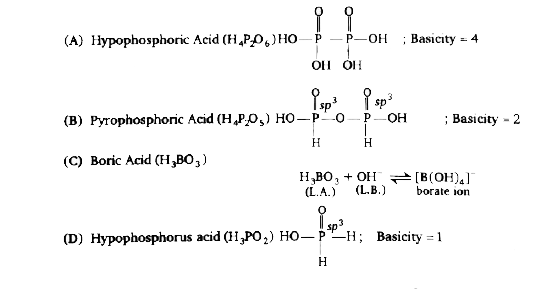
|
|
| 34. |
Column-I and Column -II contains four entries each. Entries of Column-I are to be matched with some entries of Column-II. One or more than one entries of Column-I may have the matching with the same entries of Column-II. |
|
Answer» |
|
| 35. |
Column-I and Column -II contains four entries each. Entries of Column-I are to be matched with some entries of Column-II. One or more than one entries of Column-I may have the matching with the same entries of Column-II. |
Answer» 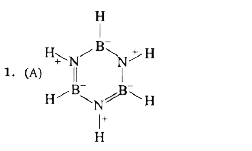 `to` PLANAR as both B and N are `SP^(2)`-hybridized `to mu_(o)=0` (non-polar) `to` has `2p_(pi)-2p_(pi)` back bonding between B-N BOND. `to` has no co-ordinate bond 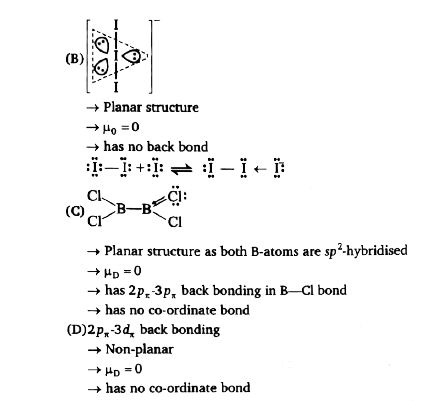
|
|
| 36. |
Column-I and Column -II contains four entries each. Entries of Column-I are to be matched with some entries of Column-II. One or more than one entries of Column-I may have the matching with the same entries of Column-II. |
|
Answer» |
|
| 37. |
Column - I (A) Oxidation of 1^@ alcohol in aldehyde Oxidation of alkyne into acid Column-II (P) KMnO_4 , Delta, overeset(Theta)(OH) (Q) Collin’s reagent(R ) Jone’s reagent (S) PCC |
|
Answer» |
|
| 38. |
Column I (A) K_(p) lt K_(c) (B) Introduction (C) K_(P)^(0) is dimensionless (D) Temperature increase Column II (P)N_(2)+3H_(2)hArr2NH_(3) (Q) PCl_(5)(g)hArrPCl_(3)(g) + Cl_(2)(g) of inert gas at pressure will decrease the constant concentration of reactants. (R) 2NO_(2)(g)hArrN_(2)O_(4)(g) (S) NH_(3)(g) + HI (g)hArrwill shift the reaction NH_(4)I (s) on product side |
|
Answer» |
|
| 39. |
Column- I (A) Identification of 1^@, 2^@ and 3^@ alcohol (B) Identification of 1^@, 2^@ and 3^@ Nitroalkane (C) Formation of alcohol by anti-Markownikoff’s addition (D) Formation of alcohol by Markownikoff’s addition Column-II (P) Oxymercuration demercuration react (Q) prop// 300^@C, Delta (R) Victor Meyer test (S) Hydroboration oxidation (T) Lucas test |
|
Answer» |
|
| 40. |
Column-I (A) Electron moving in 2nd orbit in He ^(+) electron is (B) Electron moving in 3 ^(rd) orbit in H-atom (C ) Electron moving in 1 ^(st) orbit in Li ^(+2) ion (D) Electron moving in 2 ^(nd) orbit in Be^(+3) ion Column-II (P) Radius of orbit in which moving is 0.529Å (Q) Total enrgy of electron is (-) 13.6 xx 9 eV (R) Velocity of electronis (2. 188 xx 10 ^(6))/(3)m//s (S) De-broglie wavelength of electron is sqrt((150)/(13.6))Å |
|
Answer» |
|
| 41. |
Column I (A) DeltaH_"mix"=0 (B) DeltaT_"f"//"molarity" (C) (n-1)alpha+1 (D) pi_1=pi_2 € DeltaP//P^@ Column II (P) Isotonic solutions (Q) Mole fraction of solute (R) Ideal solution (S) Van’t Hoff factor for electrolyte (T) Molal depression constant |
|
Answer» |
|
| 42. |
Column-I(A) CH_3CH_2CH_2CN (B) CH_3CH_2OCOCH_3 (C ) CH_3-CH=CH-CH_2OH (D) CH_3CH_2CH_2CH_2NH_2 (s) Column-II (P) Reduction with Pd-C//H_2 (Q) Reduction with SnCl_2//HCl Development of foul smell o n treatment with chloroform and alcoholic KOH (S) Reduction with diisobutylauminium hydride (DiBAL- H) (T) Alkaline hydrolysis |
|
Answer» |
|
| 43. |
Column - I (A) CH_3-overset(O)overset(||)-O-overset(Ph)overset(|)underset(Ph)underset(|)-Phoverset(H^(oplus)//H_2O)to (B) CH_3-overset(CH_3)overset(|)underset(CH_3)underset(|)-overset(O)overset(||)C-o-Ph overset(H^(oplus)//H_2O)to (C ) CH_3-O- overset(CH_3)overset(|)underset(CH_3)underset(|)C-CH_3 overset(H^(oplus)//H_2O)to (D) CH_3-O-underset(CH_3)underset(|)CH-CH_3 overset(HI)to Column-II (P) Unimolecular (Q) Bimolecular (R) Alkyl oxygen bond cleavage (S) Acyl oxygen bond cleavage |
|
Answer» <P> |
|
| 44. |
Column-I (A) A_(2(g))+B_(2(g))overset("Exothermic")hArr(2AB_((g))) (B) 2AB_(2(g))+B_(2(g))overset("Exothermic")hArr( 2AB_(3(g))) (C) 2AB_(3(g))overset("Exothermic")hArr(A_(2(g))+3B_(2(g))) Column-II factors affecting forward (p) High temperature (q) Low temperature (r) High pressure (s) Low pressure (t) Independent of pressure |
|
Answer» <P> |
|
| 45. |
Column A describes nature of bonding and column B the solid having that type of bonding: Correct matching between A and B is: |
|
Answer» `{:("I","II","III","IV"),("P","Q","R","S"):}` |
|
| 46. |
Column–I and Column–II contain data on Schrondinger Wave–Mechanical model, where symbols have their usual meanings. Match the columns. Column-I (C ) psi (theta, phi) =K (independent of theta & phi) (D) atleast one angular node is present Column-II {:((P) 4s, (Q)5p_(x)),((R) 3s, (S)6d_(xy)):} |
|
Answer» |
|
| 47. |
{:("Column 1","Column 2"),((A) "Temperature of a system always decreases",(p)CH_(2)=CH-CH=CH_(2)),((B)((dE)/(dV))_(T)=0,(q)"internal energy increases"),(( C)"Temperature of the system increases",( r)"Ideal gas"),((D)DeltaH_("Hydrogenation experimental") lt DeltaH_("hydrogenation calculated",(s)"Adiabatic expansion"),(,(t)"Benzene")):} |
|
Answer» Solution :`A to s`, WHENEVER internal energy of a system DECREASES then the temperature always decreases. In an adiabatic EXPANSION work is doen by the gas `rArr W` is `-ve` `rArr DeltaE =-ve` `rArr` temperature decreases `B to r`, For an ideal gas `((dE)/(dV))_(y)=0` `C to q` `D to (p,t)` |
|
| 48. |
Column -1( Reaction Equilibrium )Column -II ( Degree of dissociation of X in terms of their equilibrium constants assuming degree of dissociation of Y is same that of Xwhenever applicable ) ( P ) X ( g) rarr Z (g) + Y ( s)( 1)( 2 sqrt( K))/( 1+ 2 sqrt(K))( Q )2X(g) rarr Y (g) + Z ( g)( 2) ( 2 sqrt( K))/( 1+sqrt(K)) ( R )X ( g) +Y(g) rarr Z(g) + W(g)( 3)( K )/( K+1) ( S ) X ( g) rarr ( Y )/( 2)(s) + ( Z)/( 2) (g)( 4) ( 2K)/( 1+ 2K) Codes : |
|
Answer» <P>`{:(P,Q,R,S),(3,2,2,4):}` |
|
| 49. |
Column 1,2 and 3 contain starting materials, reaction conditions, and type of reactions, respectively The only CORRECT combination that gives two different carboxylic acid is |
| Answer» Answer :D | |
| 50. |
Column 1,2 and 3 contain starting materials, reaction conditions, and type of reactions, respectively For the synthesis of benzoic acid, the only CORRECT combination is |
| Answer» Answer :A | |