

Saved Bookmarks
This section includes 7 InterviewSolutions, each offering curated multiple-choice questions to sharpen your Current Affairs knowledge and support exam preparation. Choose a topic below to get started.
| 1. |
{:("Column I",,"Column II"),((A)"Cogulation",(p),"Electrolyte"),((B)"Brownain movement",(q),"sol"),((C)"Gold number",(r),"Zig-Zag path"),((D)"Tyndall effect",(s),"Protection of sol"):} |
| Answer» | |
| 2. |
{:("COLUMN-I","COLUMN-II"),("A)"Cl_(2)O,"p) Linear shape"),("B)" BrO_(2)^(+),"q)" sp^(3)-"hybridisation"),("C)" ClF_(3),"r)" sp^(2)-"hybridisation"),("D)" I_(3)^(-),"s)" sp^(3)d-"hybridisation"):} |
|
Answer» |
|
| 3. |
{:("COLUMN-I","COLUMN-II"),((A)angleOSO" in "SO_(2),(p)120^(0)),((B)angleOSO" in "SO_(3),(q)103^(0)),((C )angleCISCI" in "SCl_(2),(r )104^(0)),((D) angleS SCl" in "S_(2)Cl_(2),(s)119^(0)30'):} |
Answer» 
|
|
| 4. |
{:("","Column-I","",Column-II),((A),"Aluminimu carbide",(p),"Octane number value "100),((B),"Calcium carbide",(q),"Acetylene"),((C ),"n-Heptane",(r),"Octane number-value"0),((D),"2,2,4-Trimethyl pentane",(s),"Methane"):} |
| Answer» SOLUTION :`Ararrs, Brarrq,Crarrr,Drarrp` | |
| 5. |
{:("Column-I","Column-II"),((A)"An unknown gas at STP having Boyle's temperature " 0^@C,(p)"Behaves as an ideal gas"),((B)"He gas at NTP having density less than"1/5.6g//L,(q)"Attractive tendencies are dominant between molecules"),((C )H_2"gas at NTP",(r)"Gas is less compressible with respect to an ideal gas "),((D)O_2"gas at NTP having density "10/7 g//L,(s) "For gas , Critical temperature lt Boyle's temperature"),(,(t)"Molar volume of gas is greater than 22.4 L"):} |
|
Answer» (A)`T_c=8/27(a/(Rb))=8/27T_bltT_b` (B)`Z_(He)=(PV_m)/(RT)GT(1xx5.6xx4)/(273xx.821)=1` (C )`Z_(H_2)gt1` (D)`Z_(O_2)=(PV_m)/(RT)=(1xx7xx32)/(273xx10xx.0821)=1` |
|
| 6. |
{:("Column-I","Column-II"),((A)"Acetone +"CHCl_3, (p)DeltaS_("mix") gt0),((B)"Ethanol + Water ",(q)DeltaV_(mix)gt0),((C )C_2H_5Br+C_2H_5I,(r)DeltaH_(mix) lt 0),((D)"Aceton + Benzene",(s)"Maximum boiling azeotropes"),(,(t)"Minimum boiling azeotropes"):} |
|
Answer» `DeltaHlt0 " " DeltaVlt0` Maximimum Boiling AZEOTROPES (B)Ethanol+Water+ve Deviation from Raoult's law `DeltaSlt0` `DELTAHGT0 " " DeltaVgt0`Minimum Boiling Azeotropes `( C)C_2H_5Br+C_2H_5I`Ideal solution No Azeotropes `DeltaH=0 " " DeltaV=0` (D)Acetone + Benzene+ve Deviation from RAOULTS law `DeltaH gt0 " " DeltaVgt0 "" DeltaSgt0` Minimum Boiling Azeotropes |
|
| 7. |
{:("COLUMN-I","COLUMN-II"),((A)AlCl_(3) "if" alpha=0.8,(p)i=3.4),((B)BaCl_(2)"if"alpha=0.9,(q)i=2.8),((C)Na_(3)PO_(4)"if"alpha=0.9,(r)i=3.8),((D)K_(4)[Fe(CN)_(6))"if"alpha=0.7,(s)i=3.7):} |
|
Answer» |
|
| 8. |
{:(Column-I,Column-II),((a)"Acetone" +CHCI_(3),(p)DeltaS gt 0),((b)"Ethanol +water",(q)DeltaH gt 0),((c)C_(2)H_(5)Br+C_(2)H_(5)I,(r)DeltaH lt 0),((d)"Acetone+Benzne",(s)"Maximum boiling azetropes"),(,(t)"Minimum boiling azeotropes"):} |
Answer» 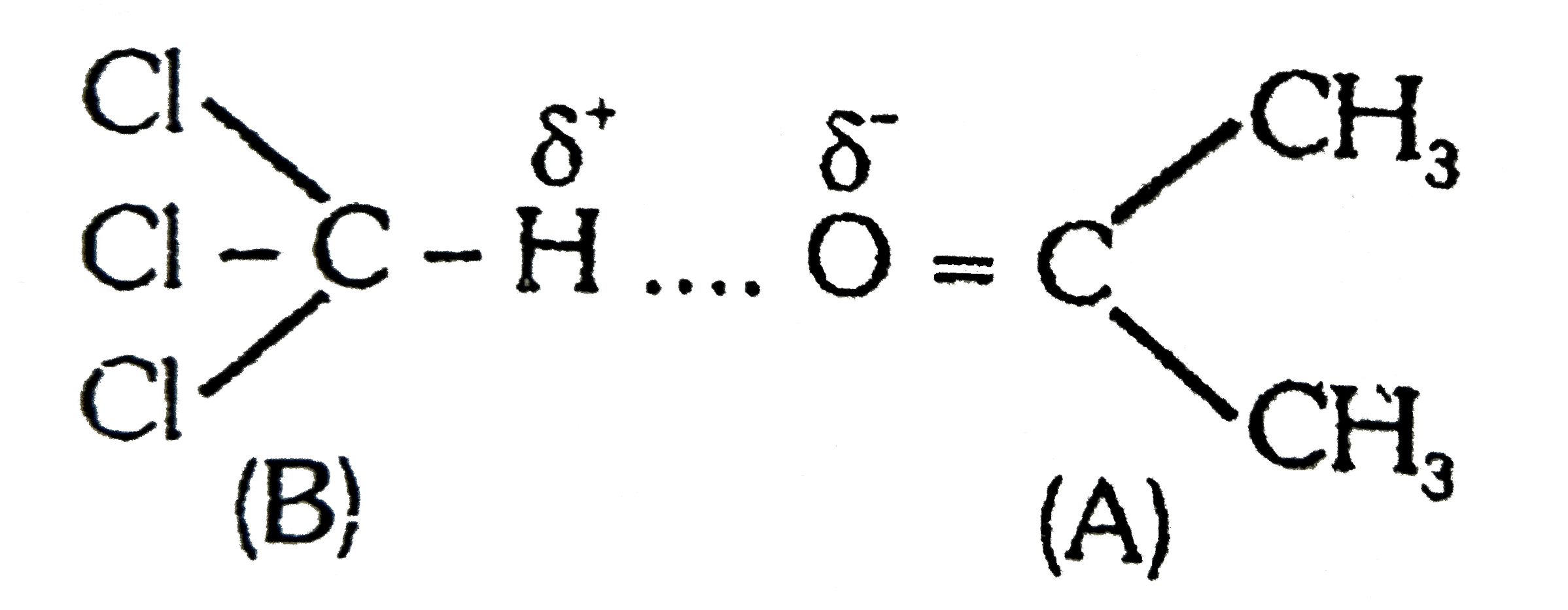 On MIXING entropy (disroder) ALWAYS increase (P) `F_(A-A) & F_(B-B) =` Dipole - Dipole `lt F_(A)-B` [H-Bond] `:.` Negative deviation from ideal solution `DeltaH_(miax) lt 0 (r)` Those solutions which exihibt negative deviation form maximum BOILING axeotrope(s) |
|
| 9. |
{:(,"Column-I",,"Column-II"),("(a)",A+BrarrC+D r=k_(1)[A][B],,"(p)Unit of rate constant possess concentration unit"),("(b)",A+B rarr C+D r=k_(2)[A][B],,"(q)Rate constant for the reaction of both the reactants are equal"),("(c)",A+B rarrC+D r=k_(2)[A]^(0)[B]^(0),,(r)underset("rate of production of at least one of the product")"Rate of consumption of at least one of the reactants is equal to"),("(d)",2A+Brarr2C+3D r=k_(3)[A]^(0)[B]^(0),,(s)underset("stoichiometric ratio half life for both reactants are equal")"If both reactants are taken in"):} |
|
Answer» |
|
| 10. |
{:("Column-I","Column-II"),((A)"74% occupancy of space",(p)"cubic close packing of identical spheres"),((B)"Coordination number =6",(q)"hexagonal close packing of identical spheres."),((C )"68% occupancy of space",(r)"body centered cubic packing of identical spheres."),((D)"Coordination number =12",(s)"simple cubic packing of identical spheres"),(,(t)"AB AB AB ....type of close packing of identical spheres"):} |
|
Answer» |
|
| 11. |
{:("COLUMN-I","COLUMN-II"),((A)6%w//v"urea"(M=60) "queous solution",(p)0.5M K_(2)SO_(4)(aq)"solution"(alpha=1)),((B)5.85% w//v NaCl,(q)0.1M K_(3)[Fe(CN)_(6)(aq)]"Solution"(alpha=1)),((C)0.2NH_(4)Cl "sq solution"(alpha=1),(r)36% w//v "glucose (aq)solution"),((D)0.2MK_(3)[Fe(CN)_(6)]aq "solution" (alpha=1),(s)18% w//v "glucose(aq)solution"):} |
|
Answer» |
|
| 12. |
{:(,"Column-I",,"Column-II"),("(a)",2N_(2)O_(5)(g)overset(1st o rder)rarr4NO_(2)(g)+O_(2)(g),,"(p)All the gaseous products are paramagnectic in nature"),("(b)",2H_(2)O_(2)(aq)overset(zero order)rarr2H_(2)O(g)+O_(2)(g),,"(q)Hybridization of reactant involves only s and p orbitals"),("(c)",2NH_(3)(g) overset(zero order)rarrN_(2)(g)+3H_(2)(g),,"(r)As the reaction proceeds half life of reactant changes with time"),("(d)",2C1_(2)O_(7)(g)overset(zero order)rarr4C1O_(2)(g)+3O_(2)(g),,"(s)Rate of production of gases decreases with increase in concentration of products"):} |
|
Answer» |
|
| 13. |
{:(,"Column -I",,"Column -II"),((A),52" g of He",(p),"13 atoms"),((B),"52 moles of He ",(q),44.8 " L at STP"),((C),"34 g of " NH_(3),(r),313.196 xx 10^(23) " atoms"),((D),"52 u of He",(s),78.299 xx 10^(23)" atoms"),(,,(t),):} |
|
Answer» |
|
| 14. |
{:("COLUMN-I","COLUMN-II"),((A)0.1 M AlCl_(3(aq)),(p)"Solution with lowest freezing point"),((B)0.1M CH_(3)COOH "in benzene",(q)"Solution with lowest osmatic pressure"),((C)0.1M "Glucose"_((aq)),(r)"Van't Hoff factor equal to 3 When" alpha=1 ),((D)0.1M CcaCl_(2(aq)),(s)"Degree of dissociation is zero"):} |
|
Answer» |
|
| 15. |
{:("column I","column II"),("(A)"4.1gH_(2)SO_(3),"(p) 200 mL of 0.5 N base is used for complete neutralization"),("(B)" 4.9 g H_(3)PO_(4),"(q) 200 millimoles of oxygen atoms"),("(C)"4.5 g " oxalic acid" (H_(2)C_(2)O_(4)),"(r) Central atom is in its highest oxidation number"),("(D)"5.3 g Na_(2)CO_(3),"(s)May react with an oxidising agent"):} |
|
Answer» |
|
| 16. |
{:("COLUMN-I","COLUMN-II"),((A)0.1M Al_(2)(SO_(4))_(3),(p)"Solution with highest boiling point " ),((B)0.1 MAlPO_(4),(q)"Van't Haff factor is grater than 1"),((C)0.1M "urea",(r)"Solution with lowest osmotic pressure"),((D)0.1 M Mg Cl_(2),(s) "Solution with lowest freezing point " ):} |
|
Answer» |
|
| 17. |
{:("Column-I","Column-II"),((A)"0.1 M "Al_2(SO_4)_3, (p)"Solution with highest boiling point"),((B)"0.1 M"AlPO_4,(q)"Van't Hoff factor is greater than 1"),((C )"0.1 M urea",(r)"Solution with lowest osmotic pressure"),((D)"0.1 M"MgCl_2,(s)"Solution with lowest freezing point"):} |
|
Answer» |
|
| 18. |
{:(,"Column-I",,"Column-II"),("(a)",+ve +ve,,(p)underset("respectively when a sol is prepared by mixing" FeC1_(3) "and NaOH solution")"charges obtained on dispersion medium and particles of despersed phase"),("(b)",-ve +ve,,(q)underset("between [l n (solubility)" v//s1/T"for gasses dissolved in water[where solubility is in" moles//litres"and temperature in kelvin]")"Sign of slope and intercept (either x or y)respectively of the straight line graph"),("(c)",+ve -ve,,(r)underset("respectively of reactions which undergoes 100% completion") "Sign of order of reaction and" DeltaH_(reaction)^(0)),("(d)",-ve -ve,,(s)underset("occurs during electrophoresis when colloid of a basic dye and blood are taken")"Charges of electrodes where coagulation"),(,,,(t)underset("slope and y intercept respectively for a graph between" l n K v//s 1/T)"According to Arrhenius theory the sign of"):} |
|
Answer» |
|
| 19. |
{:("COLUMN-I","COLUMN-II"),("A) Tear gas","p)" (C_(2)H_(4)Cl)_(2)S),("B) Musturd gas ","q)" COCl_(2)),("C) Phosgene","r)" C Cl_(3)NO_(2)),("D) Teflon","s)" (C_(2)F_(4))_(n)):} |
|
Answer» |
|
| 20. |
{:("COLUMN-I","COLUMN-II"),("A)" SiO_(2),"p) React with HF"),("B)"CN^(-),"q) Pseudo halide"),("C)" I^(-),"r) Gives compound with " Cu^(2+) "via redox react"),("D)" SnO_(2), "s) Dissolves in alkali "):} |
|
Answer» |
|
| 21. |
{:("COLUMN-I","COLUMN-II"),("A)" PCl_(5),"p)" sp^(3)),("B)" ClO_(4)^(-),"q) Tetrahedral"),("C)" XeF_(2),"r) Trigonol bipyramidal"),("D)" SO_(4)^(-2),"s)" sp^(3)d):} |
|
Answer» |
|
| 22. |
{:("COLUMN-I","COLUMN-II"),("A) Most electronegative","p)" Br),("B) Most electron affinity","q)" At),("C) Liquid halogen","r)" F),("D) Radio active halogen","s)" Cl):} |
|
Answer» |
|
| 23. |
{:("COLUMN-I","COLUMN-II"),("A) Maximum S.R.P.","p)" F_(2)),("B) Corrosive liquid","q)" Cl_(2)),("D) Maximum enthalpy of dissociation","s)" I_(2)):} |
|
Answer» B) Corrosive LIQUID -`Br_(2)` C) Maximum intermolecular distance `- I_(2)` D ) Maximum ENTHALPY of dissociation( kj `m o l^(-1)`) `UNDERSET(239.7 ) (Cl_(2)) gt underset( 190.61) (Br_(2)) gt underset(154.8)(F_(2)) gt underset( 148.92)(I_(2))` |
|
| 24. |
{:("COLUMN-I","COLUMN-II"),("A) HF","p) Monobasic"),("B) HCl","q) Strong reducing agent"),("C) HBr","r) Strong acid"),("D) HI","s) React with glass"):} |
|
Answer» |
|
| 25. |
{:("COLUMN-I","COLUMN-II"),("A)" ClO^(-),"p) One Lp on Cl"),("B)"ClO^(-2),"q) Two Lp on Cl"),("C)" ClO_(3)^(-),"r) Three Lp on Cl"),("D)" ClO_(4)^(-),"s) Cl is in "sp^(3)),(,"t) No Lp on Cl"):} |
Answer»  All UNDERGO `SP^(3)-` HYBRIDISATION |
|
| 26. |
{:(,"Column I",,"Column II"),(("A"),": CN :"^(-),(p),"Unidentate ligand"),(("B"),"glycinate",(q),"Didentate ligand"),(("C"),"ethylenediamine",(r),"Ambidentate ligand"),(("D"),"carbonate ion",(s),"Chelating ligand"):} |
|
Answer» |
|
| 27. |
{:("COLUMN-I","COLUMN-II"),("A) Chlorine water","p)" HF),("B) Sylvine","q)" CaOCl_(2)),("C) Glass etching","r)" HCl + HOCl),("D) Calcium chloro hypochloride","s)" KCl):} |
|
Answer» C ) Glass ETCHING -HFD) Calcium hypochlorite -`CaOCl_(2)` (Bleaching Powder ) |
|
| 28. |
{:("COLUMN-I","COLUMN-II"),("A) Bromine","p) Beckmann's method"),("B) Bleaching powder","q) Carnallite "(KCl.MgCl_(2).6H_(2)O)),("C) Isolation of "F_(2),"r) Weldon's process"),("D) Manufacturing of "Cl_(2),"s) Dennis method"):} |
|
Answer» B) BLEACHING powder `rarr` Back mann.s method. `[Ca(OH)_(2) + Cl_(2) rarr CaOCl_(2) + H_(2) O]` C) Isolation of `F_(2) rarr ` Dennis method. D) MANUFACTURING of `Cl_(2)` weldon.s process `[mnO_(2) + 4HCl rarr mnCl_(2) + 2H_(2) O + Cl_(2) ]` |
|
| 29. |
{:("Column I","Column II"),("(A) Carbon tetrachloride + Toluene","(p) Shows positive deviation from ideal behaviour"),("(B) Chloroform + Benzene","(q) Shows negative deviation from ideal behaviour"),("(C) Carbon tetrachloride + Chloroform ","(r) Mixing is endothermic "),("(D) Benzene + Toluene","(s) Shows ideal behaviour"):} |
|
Answer» |
|
| 30. |
{:("Column I","Column II"),((A)." Benzaldehyde reacts with methanal in presence of NaOH to give benzyl alcohol and sodium methanoate",(p)." Acidic nature of "alpha-"Hydrogens"),((B)." Propanone reacts with "Ba(OH)(2)" to form 4-hydroxy-4-methylpentan-2-one",(q)." Hydride transfer"),((C)." Iodoform is produced when butanone is treated with NaOI",(r)." Halogenation"),((D)." Carboxylic acids containing "alpha-"hydrogen/s on treatment with "Br_(2)" in presence of red P give "alpha-"haloacids",(s)." Nucleophilic addition"):} |
|
Answer» |
|
| 31. |
{:("Column-I","Column"-II),((A) Ag^(+) Cu^(+2),(P) NH_(4) Cl + NH_(4) OH),((B) Cu^(+2) Mn^(+2),(Q) H_(2)S// HCl),((C)Fe^(+2)Mg^(+2),,(R) HCl),((D)Mg^(+2),Zn^(+2),NH_(4)OH+NH_(4)Cl + H_(2)S):} |
|
Answer» |
|
| 32. |
|{:(Column I,Column 2,Column 2),((I)"Toluene",(i)NaOH//Br_(2),(P)"Condensation"),((II)"Acetophenone",(ii)Br_(2)//hv,(Q)"Carboxylation"),((III)"Benzaldehyde",(iii)(CH_(3)CO)_(2)O //CH_(3)COOK,(R)"Substitution"),((IV)"Phenol",(iv)NaOH//CO_(2),(S)"Haloform"):}| For the synthesis of benzoic acid, the only CORRECT combination is |
|
Answer» (II) (i) (S) |
|
| 33. |
{:("COLUMN-I","COLUMAN-II"),((A)[Ni(CO)_(4)],(p)"Tetrahedral"),((B)[Fe(CO)_(2)(NO)_(2)],(q)pi-"back bonding"),((C)[Ni(PF_(3))_(4)],(r)"diamagnetic"),((D)[Ni(PPh_(3))_(2)Br_(2)],(s)"one of the ligand is " 3e^(-)"donar"):} |
|
Answer» .NO. donates 3 ELECTRONS to the METAL atom and BECOMES `NO^(+)`. |
|
| 34. |
{:("COLUMN-I","COLUMAN-II"),((A)"EDTA",(p)"Monodeutate"),((B)"DMG",(q)"Chelate ligand"),((C)en,(r)"Bidentate"),((D)CN^(-),(s)"Hexadinatate"):} |
Answer»  DMG [Dimethy ] Glyoximate]  (en) ethylene diamine `H_(2)overset(**)N-CH_(2)-CH_(2)-overset(**)NH_(2)` POLYDENTATE LIGANDS are chelating. |
|
| 35. |
{:("Column-I(Arrangement in unit cell , raidus ratio in higher limit)","Column-II(Coordination number of cation :Anion)"),((A)"Cations in CCP and anions in alternate tetrahedral voids",(p)"Ratio of number of cation to anion in one unit cell is 1:1"),((B)"Cations in simple cubic and anions in the body centre.",(q)"Ratio of coordination number of cation of anion is 1:1"),((C )"Anions in CCP and cations in all tetrahedral voids",(r)"Ratio of number of cation to anion just touching each other is not 1"),((D)"Cation in CCP and anions in all octahedral voids",(s)"Number of next neighbours of ion is greater than 10"),(,(t)"Effective number of formula units=4"):} |
|
Answer» (B)BCC lattice ( C )Anti FLUORITE structure `(Na_2O)` (D)Anti structure to NACL |
|
| 36. |
Column -Iand Column -II contains four entries each. Entry of column-I are to be uniquely matched with only one entry of column-II |
|
Answer» |
|
| 37. |
Column -Iand Column -II contains four entries each. Entry of column-I are to be uniquely matched with only one entry of column-II |
|
Answer» (C ) H-bonding`""` (d) Comparatively |
|
| 38. |
{:("Column I (Solvent)","Column II "("Value of "K_(f)or K_(b))),("(A) 0.1 M Glucose sol.","(p) Lowest freezing point"),("(B) 0.1 M Sucroe sol.","(q) Highest freezing point"),("(C) 0.1 M "BaCl_(2)" sol.","(r) Lowest osmotic pressure"),("0.1 M "Ca(NO_(3))_(2)" sol.","(s) Highest osmotic pressure"):} |
|
Answer» |
|
| 39. |
{:("Column I (No. of significant figures)","Column II (Numbers)"),("(A)1","(p)"6.022xx10^(23)),("(B)2","(q)"0.0085),("(C)3","(r)"2.850),("(D)5","(s)"0.0200):} |
|
Answer» |
|
| 40. |
{:("Column I (No. of moles)","Column II (Amount)"),("(A)0.1 mole","(p)4480 mL of CO"_(2)" at STP"),("(B)0.2 mole","(q)0.1 g atom of iron"),("(B)0.25 mole","(r)"1.5xx10^(23)" molecules of oxygen gas"),("(C)0.25 mole","(s)9 mL of water"),("(D)0.5 mole","(t)200 mg of hydrogen gas"):} |
|
Answer» |
|
| 41. |
Column I may match with more than one conditions of column II. {:("Column-I","Column-II"),((A)Ph-CH=CH-Ph,(p)"Ozonolysis followed by reaction with" NH_2OH "leads to more than one oxime prouduct"),((B)(CH_3)_2C=CH-undersetunderset(CH_3)(|)CH-Cl,(q)"Can exhibit geometrical isomers"),(( C)CH_2=CH-CH=CH_2,(r)"Compounds with this structure formula can be separated into different fractions upon fractional distillation"),((D)OHC-undersetunderset(OH)(|)(CH)CH-undersetunderset(OH)(|)(CH)-CHO,(s)"is capable of showing steroisomerism"),(,(t)"On hydrogenation it gives more than one product"):} |
|
Answer» Ph-CH=CH-Ph SHOWS geometrical isomers and can be sepearated by fractional distillation. `Ph-CH=CH-PHh+H_2toPh-CH_2-CH_2-Ph`(one product) (B)`(CH_3)_2C=CH-undersetunderset(CH_3)(|)CH-Cloverset((O_3//Zn))toCH_3-undersetunderset(O)(||)C-CH_3+CH_3-undersetunderset(CL)(|)CH-CHOoverset(NH_2OH)to`more thanone OXIME `(CH_3)_2C=CH-undersetunderset(CH_3)(|)CH-Cl+H_2to(CH_3)_2CH-CH_2-undersetunderset(CH_3)(|)overset(**)CH-Cl`(more than one product) (D)`OHC-undersetunderset(OH)(|)overset(**)CH-undersetunderset(OH)(|)overset(**)CH-CHO+H_2toundersetunderset(OH)(|)CH_2-undersetunderset(OH)(|)overset(**)CH-undersetunderset(OH)(|)overset(**)CH-undersetunderset(OH)(|)CH_2`(more than one product) |
|
| 42. |
{:(,"Column I (Complex)",,"Column II (Magnetic moment)"),(("A"),K[Cr(H_(2)O)_(2)(C_(2)O_(4))_(2)].3H_(2)O,(p),1.73 BM),(("B"),K_(4)[Mn(CN)_(6)],(q),5.92 BM),(("C"),[Co(NH_(3))_(5)Cl]Cl_(2),(r),3.87BM),(("D"),Cs[FeCl_(4)],(s),"Zero"):} |
|
Answer» A-r, B-p, C-s, D-q |
|
| 43. |
{:("column I","""Column II"),("Solvent ","""Relative rate of SN"^(1)),((A)100% "water" ,""(P)1200),((B)80% "water"+20%"ethanol",""(Q) 400),((D)50% "water"+80%"ethanol",""(R)60),((D)20%"water"+80%"ethanol",""(S)10),((E)100% "water"+80% "ethanol",""(T)1):} |
|
Answer» <P> |
|
| 44. |
{:("COLUMN - I" , "COLUMN - II"),("(oxo - acod)","(ox.state of P)"),("A)"H_3PO_3,"p)"+4),("B)" H_3PO_2,"q)" +1),("C)" H_4P_2O_6,"r)" +3),("D)" H_4P_2O_7,"s)" +5):} |
|
Answer» B) `H_3PO_2-3(+1)+x+2(-2)=0, +3+x -4=0 , x =+4-3=+1,p=+1` C) `H_(4)P_(2)O_6-4(+1)+2X+6(-2)=0, +4+2x-12=0 , 2x +12 -4 =+8,x =+8//12 =+4P=+4` D) `H_4P_2O_7-4(+1)+2x+7(-2)=0,+4+2x-14=0,2x=+14-4=+10,x =+10//2 =+5,P=+5` |
|
| 45. |
{:("Column - I", "Column - II"),("A)Coagulation ","p) Scatering of light"),("B) Peptization", "q) Purification of colloidal solution"),("C) Tyndall effect","r) Addition of electrolyte"),("D) Dialysis","s) Precipitation of colloidal solution"):} |
|
Answer» PURIFICATION of colloidal solution is called dialysis |
|
| 46. |
{:("Column" (I) , "Column" (II)) , ((a) CH_(3)-overset(o+)(C)H- CH_(3) , P . "Pyramidal structure"), ((b) overset(Theta)(C)H_(3) , Q. "Planar geometry"), ((c) CH_(3)-overset(.)(C)H- CH_(3) , R. "Electrophile"), ((d) "Singlest carbene" , S. "Nucleophile"):} |
|
Answer» |
|
| 48. |
Column IColumn II (1) Increase in oxidation (a) Loss of electrons number (2) Decrease in oxidation (b) Redox reaction number (3) Oxidising agent (c) Fractional oxidation number (4) Reducing agent (d) Zero oxidation number (5) 2Cu^(+) rarr Cu^(2+) + Cu(e) Simple neutralisation reaction (6) MnO_(2)+4HClrarr MnCl_(2)+Cl_(2)+2H_(2)O(f) Gain of electrons (7) underset(-)(Mn)_(3)O_(4)(g) Disproportionation (8) underset(-)(C)H_(2)Cl_(2) (h) Oxidation (9) 1NaOH+HCl rarrNaCl +H_(2)O (i) Reduction |
| Answer» Solution :`1rarrh , 2 rarr I , 3 rarr f, 4 rarr a, 5 rarr g, 6 rarr B , 7 rarr c, 8 rarr d, 9 rarr E ` | |
| 50. |
Column -I Colmun -II (P) It will undergo osazone formation (Q) When undergo acetylation reaction with acetic anhydride molecular weight increases by 210 (R ) It is reducing sugar (S) is known as alpha-D- Glucopyranose (T) It is not reducing sugar & not show the mutarotation |
| Answer» SOLUTION :A-P,Q,R,S, B-P,Q,R, C-T, D-P,R | |