

Saved Bookmarks
This section includes 7 InterviewSolutions, each offering curated multiple-choice questions to sharpen your Current Affairs knowledge and support exam preparation. Choose a topic below to get started.
| 1. |
Chlorobenzene on treatment with acetyl chloride and anhydrous AlCl_3 the major product formed will be |
|
Answer» o-Chloroacetophenone |
|
| 2. |
Chlorobenzene on reduction with Na/Al alloy and alcohol gives : |
|
Answer» TOLUENE 
|
|
| 3. |
Chlorobenzene on reaction with CH_(3)Cl in the presence of anhy. AlCl_(3) will give |
|
Answer» TOLUENE |
|
| 4. |
Chlorobenzene on heating with NaOH at350^(@) Cunderpressure gives |
|
Answer» PHENOL |
|
| 5. |
Chlorobenzene on reaction with CH_3Cl in the presence of AlCl_3 will give |
|
Answer» <P>TOLUENE |
|
| 6. |
Chlorobenzene on heating with aqueous NH_(3) under pressure in the presence of cuprous chloride gives |
|
Answer» Benzamide |
|
| 7. |
Chlorobenzene on fusing with solid NaOH gives |
|
Answer» benzene |
|
| 8. |
Chlorobenzene on fusing with solid NaOH follwed by acidification gives |
|
Answer» Benzene |
|
| 9. |
Chlorobenzene is o,p-directing in electrophilic substitution reaction. The directing influence is explained by |
|
Answer» `+M` of PH |
|
| 10. |
Chlorobenzene is less reactive than that of alkyl chlorides towards nucleophilic substitution reactions . How can the reactivity of chlorine in chlorobenzene be increased ? |
| Answer» SOLUTION :By indroducing electron withdrawing GROUPS such as nitrogroup at the ortho and PARA POSITIONS in chlorobenzene | |
| 11. |
Chlorobenzene is formed by reaction of chlorine with benzene in the presence of AlCl_(3). Which of the following species attacks the benzene ring in this reaction ? |
|
Answer» `Cl^(-)` |
|
| 12. |
Chlorobenzene is formed by reaction of chlorine with benzene in the presence of AlCl_(3). Which of the following species attacks the benzene ring in the reaction? |
|
Answer» `CL^(-)` |
|
| 13. |
Chlorobenzene does not give SN^(1) reaction, because of |
|
Answer» chlorine is attached to sp hybridized CARBON atom. |
|
| 14. |
Chlorobenzene is |
|
Answer» More REACTIVE than ethyl bromide |
|
| 15. |
Chlorobenzene can be prepared by reacting aniline with : |
|
Answer» Zn and HCl 
|
|
| 17. |
How is chlorobenzene prepared from aniline? How is chlorobenzene converted into disphenyl? |
Answer» SOLUTION : ANILINE to CHLOROBENZENE : 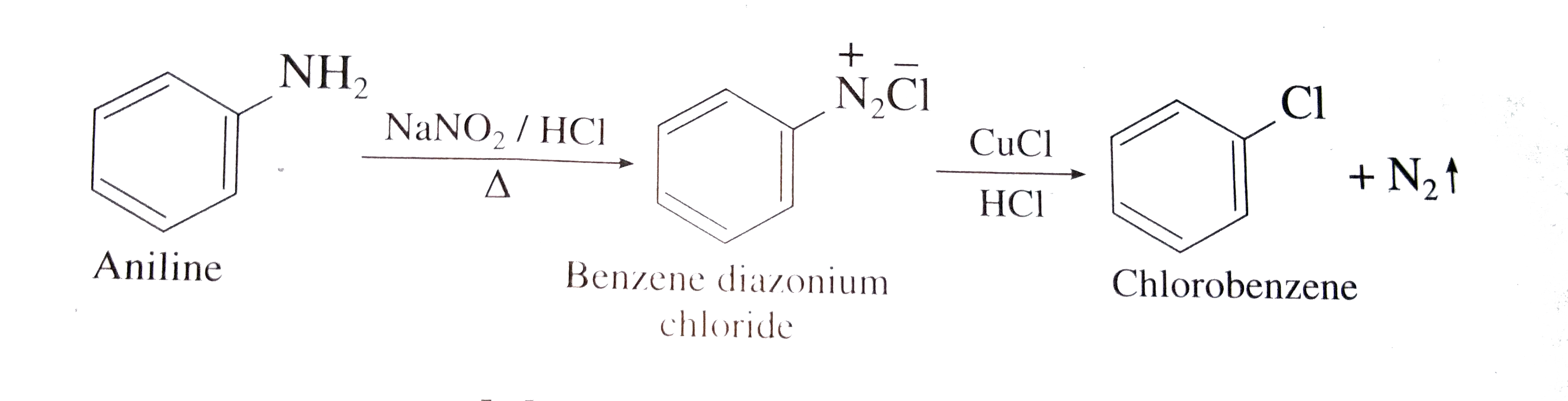 (2) |
|
| 18. |
Chlorobenzene can be prepared by reacting aniline with |
|
Answer» Nitrous acid followed by HEATING with cuprous chloride and HCl |
|
| 19. |
Chloroamphenicol is used in the treatment of which of the following |
|
Answer» Typhoid 
|
|
| 20. |
Chloroamphenicol is an |
|
Answer» ANTIFERTILITY drug |
|
| 21. |
Chloroacetic acid si a stronger acid than acetic acid due to____of the chlorine ato. |
| Answer» SOLUTION :`-I`-EFFECT. | |
| 22. |
Chloroamphenicol is |
|
Answer» Broad spectrum antibacterial |
|
| 23. |
Chloramphenicol is an : |
|
Answer» ANTIFERTILITY drug |
|
| 24. |
Chloroacetic acid has K_(a) = 1.36 xx 10^(-3). Calculate the concentration of each ion and freezing point of 0.1 M its solution, assuming molarity and malality same.(K_(f) "for"H_(2)O = 1.86 K "molality"^(-1)) |
|
Answer» |
|
| 25. |
Chloro acetic acid is stronger acid than acetic acid . Explain . |
|
Answer» SOLUTION :Carbon ATOM of -`CH_2Cl` group acquires partial positive charge which SPREADS to oxygen of CHLORO acetate ion, when `H^(+)` is released. So the negative charge of this oxygen is stabilised and anion becomes a weak base. Correspondingly the acid becomes a strong acid. 
|
|
| 26. |
Chloroacetic acid is a stronger acid than acetic acid. This can be explained using |
|
Answer» `-M` effect 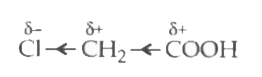
|
|
| 27. |
Chlorine water on standing loses its yellow colour due to the formation of ____________and _________ |
| Answer» SOLUTION :`HCL, HOCL` | |
| 28. |
Chlorine water on standing loses its colour and forms ........ |
|
Answer» HCl only |
|
| 29. |
Chlorine water on cooling deposits greenish-yellow crystals of: |
|
Answer» `Cl_2. 2H_2O` |
|
| 30. |
Chlorine water on cooling deposites greenish-yellow crystals of Cl_(2). XH_(2)O. What is the value of X. |
|
Answer» |
|
| 31. |
Chlorine was discovered by: |
|
Answer» Priestley |
|
| 32. |
Chlorine trioxide is paramagnetic, but chlorine hexoxide is diamagnetic. Explain. |
|
Answer» Solution :CHLORINE trioxide , `ClO_(3)` has unpaired electron . HENCE it is paramagnetic . UPON dimerisation , chlorine hexoxide is formed . `Cl_(2)O_(6)` has all PAIRED electrons . Therefore it is diamagnetic . 
|
|
| 33. |
Chlorine reacts with sodium hydroxide under various condition to give |
|
Answer» Sodium chloride `underset("(Conc.)")(6NaOH) +3Cl_(2) overset("heat")to5NaCl + underset("Sodium chlorate")(NaClO_(3) +3 H_(2)O)` |
|
| 34. |
Chlorine shows bleaching action in : |
|
Answer» dry CONDITION |
|
| 35. |
Chlorine reacts with nitric oxide to form |
|
Answer» `NOCl_(2)` |
|
| 36. |
Chlorine reacts with excess NH_3 to give |
|
Answer» `NCl_3` |
|
| 37. |
Chlorine reacts with hot and cone. NaOH and produces compounds X and Y. Compound X gives a white precipitate with AgNO_(3)soln. The average bond order between CI and O atoms in Y is? |
Answer»  Bond ORDER=`("TOTAL NUMBER of BONDS")/("Total resonating structures") = 5/3 = 1.67` |
|
| 38. |
Chlorine reacts with ethanol to give: |
|
Answer» ETHYL CHLORIDE |
|
| 39. |
Chlorine reacts with ethanol to give : |
|
Answer» ETHYL chloride |
|
| 40. |
Chlorine reacts with cold, dil. Sodium hydroxide under various conditions to give: |
|
Answer» SODIUM CHLORIDE and sodium hypochlorite |
|
| 41. |
Chlorine reacts with benzadehyde to give |
|
Answer» CHLOROBENZENE |
|
| 43. |
Chlorine is used in water for |
|
Answer» Killing GERMS |
|
| 44. |
Chlorine is soluble in water and its solution is refered as ………….. . |
| Answer» SOLUTION :CHLORINE WATER | |
| 45. |
Chlorine is prepared in the laboratory by treating manganese dioxide (MnO_(2)) with aqueous hydrochloric acid according to the reaction. 4HCl(aq)+MnO_(2)(s) rarr 2H_(2)O(l)+MnCl_(2)(aq)+Cl_(2)(g) How many grams of HCl react with 5.0 g of manganese dioxide ? (Atomic mass of Mn = 55 u) |
|
Answer» Solution :1 mole of `MnO_(2)`, i.e, `55+32=87g MnO_(2)` REACT with 4 MOLES of HCl, i.e., `4xx36.5g=146g` of HCl. `therefore "5.0 G of MnO"_(2)" will react with HCl"=(146)/(87)xx5.0 g=8.40g` |
|
| 46. |
Chlorine is passed through boiling toluene, how many chloro derivatives would you get |
|
Answer» |
|
| 47. |
Chlorine is passed into dilute, cold KOH solution. What are the oxidation numbers of chlorine in the products formed ? |
|
Answer» `-1and+5` |
|
| 48. |
Chlorine gas is not produced by heating: |
|
Answer» ELECTROLYSIS of aqueous solution of NaCl |
|
| 49. |
Chlorine is most reactive towards NaOH in : |
|
Answer» `CH_3Cl` |
|
| 50. |
Chlorine is mixed with drinking water so that: |
|
Answer» BACTERIA are killed |
|