Saved Bookmarks
This section includes 7 InterviewSolutions, each offering curated multiple-choice questions to sharpen your Current Affairs knowledge and support exam preparation. Choose a topic below to get started.
| 1. |
BaTiO_(3) crystallizes in the prevoskite structure. This structure may be described as a cubic lattice with barium ions occupying the corner of the unit cell, oxide ions occupying the face-centers and titanium ion occupying the center of the unit cell. (a) If titanium is described as occupying holes in BaO lattice, what type of holes does it occupy? (b) What fraction of this type hole does it occupy ? |
| Answer» Solution :(a) Ti is present at the dbody centre i.e. it occupies OCTAHEDRAL HOLE. (b) No. of octahedral in c.c.p. = 4 FRACTIONAL of octahedral hole OCCUPIED = `(1)/(4)` | |
| 2. |
Bath soap is a mixture of______. |
|
Answer» potassium salts of higher FATTY acids |
|
| 3. |
Bassemer converter is used in the refining of : |
|
Answer» PIG IRON |
|
| 4. |
Bassemer converter is used in the manufacture of |
|
Answer» Pig iron `2Mn+O_(2)rarr2MnO, Si+O_(2)rarrSiO_(2)` `2C+O_(2)rarr 2CO, MnO+SiO_(2)rarr underset("Slag")(MnSiO_(3))` |
|
| 6. |
BaSO_4 and carbon on heating reacts to produce |
|
Answer» `Ba+SO_(2) + CO_(2)` Thus, on heating they produce `BaS +4CO`. |
|
| 7. |
BaSO_4 is ionic and PCl_3 is covalent but a saturated solution of BaSO_4 is a weak electrolyte, while that the PCl_3 is a strong electrolyte. Explain. |
| Answer» Solution :`BaSO_(4)` has high lattice energy. It is very LESS soluble in water, EVEN in saturated solutions. The ionic concen-tration is in the order of `10^(-5)` M .Hence it is a wea electro-lyte. `PCl_(3)` is covalent. It undergoes HYDROLYSIS in water to give hydrochloric acid, which is a STRONG ELECTROLYTE. | |
| 8. |
BaSO_4 acts as _____ for Pd in Rosenmunds reaction : |
|
Answer» Promoter |
|
| 9. |
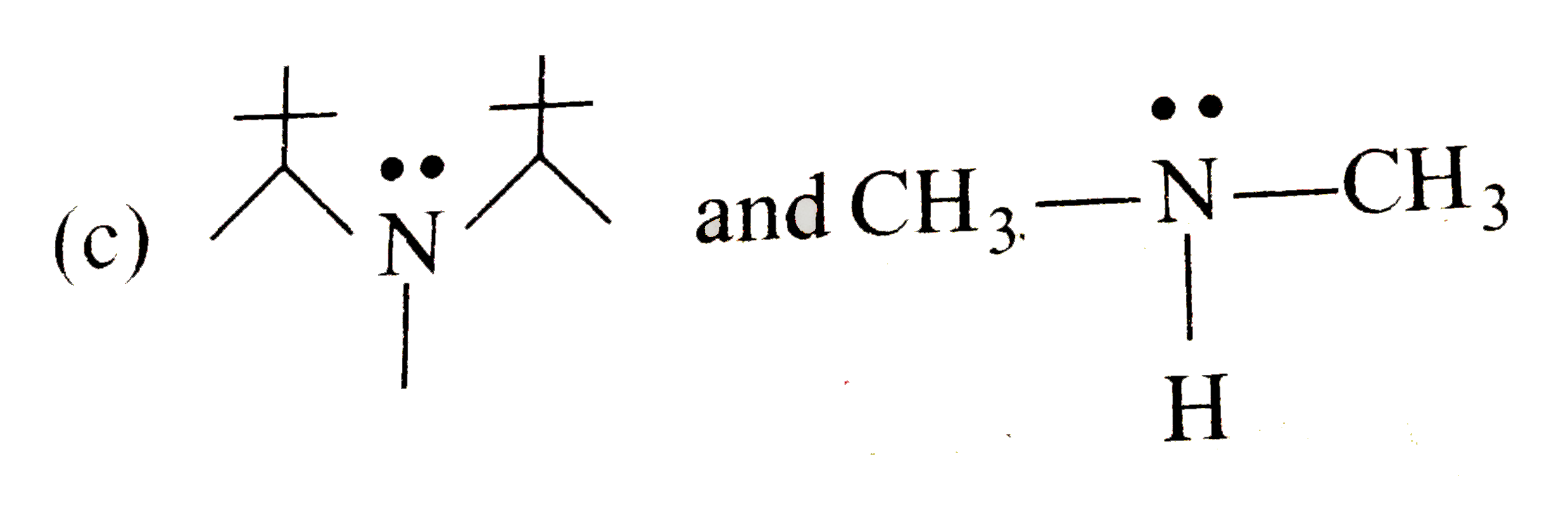
Basicity order of N in following compound is: . |
|
Answer» `bgtdgtagtc` |
|
| 10. |
Basicity order of following heterocycles are (##FIITJEE_CHE_MB_08_C03_E06_004_Q01.png" width="80%"> |
|
Answer» `1 GT 2 gt 3 gt 4` |
|
| 11. |
Basicityof the followingaminesin aqueous mediumis (1) CH_(3) - NH_(2)(2) (CH_(3))_(2)NH (3) (CH_(3))_(2)N (4) NH_(3) |
|
Answer» `1 GT 2 gt 3 gt 4` |
|
| 12. |
Basicity of the lanthanides depends upon |
|
Answer» GAIN of electrons |
|
| 13. |
Basicity of phosphorous acid is ........... |
|
Answer» 1 |
|
| 15. |
Basicity of orthophosphoric acid is : |
|
Answer» 2 |
|
| 16. |
Basicity of orthophosphoric acid is |
|
Answer» 2 |
|
| 17. |
Basicity of H_3PO_2, H_2PO_3 and H_3PO_4 is not the same. Explain |
|
Answer» Solution :In oxoacids of PHOSPHORUS, ONE OXYGEN makes P= 0 bonds. THEREFORE, `H_3PO_2, PO_3` and `H_3PO_4` can be represented as follows: 
|
|
| 18. |
Basicity of H_3PO_2, H_3PO_3 and H_3PO_4 is not the same. Explain |
|
Answer» <P> Solution :In oxoacids of PHOSPHORUS, ONE oxygen MAKES P= 0 bonds.Therefore, `H_3PO_2, PO_3` and `H_3PO_4` can be represented as follows:
|
|
| 19. |
Basicity of H_3 PO_3 in 2NaOH + H_3 PO_3 to Na_2 HPO_3 + 2H_2 Ois |
|
Answer» 3 |
|
| 20. |
Basicity of CH_(3)CH_(2)NH_(2)(I),CH_(3)CONH_(2)(II)and C_(6)H_(5)CONH_(2)(III) follows the order: |
|
Answer» IgtIIgtIII 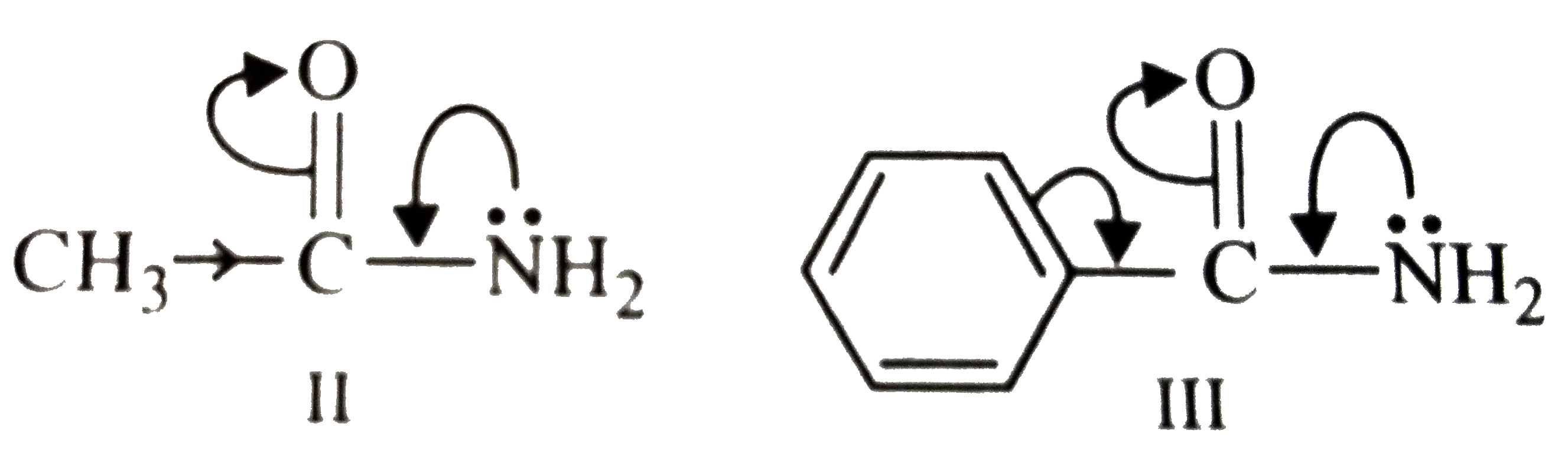 electrons into the C=O group more readily than the `CH_(3)` group which can exert only it weak +I-effect. in other words, electrons on `NH_(2)` group in `CH_(3)CONH_(2)(II)` are more easily delocalised than on the `NH_(2)` group of `C_(6)H_(5)CONH_(2)(III)`. this means `C_(6)H_(5)CONH_(2)` is a stronger base than `CH_(3)CONH_(2)(II)`. thus, the OVERALL basicity decreases in the order: IgtIIIgtII. |
|
| 21. |
Basicityof aminesin gaseousstate is (1) (CH_(3))_(3)N(2) CH_(3)-NH_(2) (3) (CH_(3))_(2)NH (4)NH_(3) |
|
Answer» `1 GT 2 gt 3 gt 4` |
|
| 22. |
Basicity of any oxyacid of sulphur is |
|
Answer» 3 |
|
| 23. |
Basicity is defined by equilibrium constant for abstracting a proton. Nucleophilicity is defined by rate of attack on an electrophilic carbon atom, A species with a negative charge is stronger nucleophile than similar neutral species.Nucleophilicity decreases form left to right in periodic table and increases down the group in periodic table. As the size of similar type of negatively charged species increases, basicity increases and nuleophilicity decreases. Among the given pairs, in which first has lower nucleophilic character? |
|
Answer» `CH_(3)OVERSET(Ɵ)SandCH_(3)OH` |
|
| 24. |
Basicity is defined by equilibrium constant for abstracting a proton. Nucleophilicity is defined by rate of attack on an electrophilic carbon atom, A species with a negative charge is stronger nucleophile than similar neutral species.Nucleophilicity decreases form left to right in periodic table and increases down the group in periodic table. As the size of similar type of negatively charged species increases, basicity increases and nuleophilicity decreases. Which of the following negatively charged species has maximum basic character? |
|
Answer» `CH_(3)OVERSET(Ɵ)O` |
|
| 25. |
Basicity is defined by equilibrium constant for abstracting a proton. Nucleophilicity is defined by rate of attack on an electrophilic carbon atom, A species with a negative charge is stronger nucleophile than similar neutral species.Nucleophilicity decreases form left to right in periodic table and increases down the group in periodic table. As the size of similar type of negatively charged species increases, basicity increases and nuleophilicity decreases. Which of the following is incorrect order of nucleophilicity? |
|
Answer» `overset(Ɵ)OHgtH_(2)O` |
|
| 26. |
Basically all soaps are made by boiling fats or oils with suitable soluble hydroxide. Variations are made by using different raw materials. Toilet soaps are prepared by using better grades of fats and oils and care is taken to remove excess alkali. Colour and perfumes are added to make these more attractive. Soaps that float in water are made by beating tiny air bubbles before their hardening. Transparent soaps are made by dissolving the soap in ethanol and then evaporating the excess solvent. In medicated soaps, substances of medicinal value are added. In some soaps, deodorants are added. Shaving soaps contain glycerol to prevent rapid drying. A gum called, rosin is added while making them. It forms sodium rosinate which lathers well. Laundry soaps contain fillers like sodium rosinate, sodium silicate, borax and sodium carbonate. Soap chips are made by running a thin sheet of melted soap onto a cool cylinder and scraping off the soaps in small broken pieces. How do we prepare transparent soap ? |
| Answer» SOLUTION :Transparent soaps are made by dissolving the SOAP in ETHANOL and then EVAPORATING the excess SOLVENT. | |
| 27. |
Basically all soaps are made by boiling fats or oils with suitable soluble hydroxide. Variations are made by using different raw materials. Toilet soaps are prepared by using better grades of fats and oils and care is taken to remove excess alkali. Colour and perfumes are added to make these more attractive. Soaps that float in water are made by beating tiny air bubbles before their hardening. Transparent soaps are made by dissolving the soap in ethanol and then evaporating the excess solvent. In medicated soaps, substances of medicinal value are added. In some soaps, deodorants are added. Shaving soaps contain glycerol to prevent rapid drying. A gum called, rosin is added while making them. It forms sodium rosinate which lathers well. Laundry soaps contain fillers like sodium rosinate, sodium silicate, borax and sodium carbonate. Soap chips are made by running a thin sheet of melted soap onto a cool cylinder and scraping off the soaps in small broken pieces. Why do we add glycerol in the preparation of shaving soap ? |
| Answer» SOLUTION :Glycerol is ADDED so that the lather does not DRY RAPIDLY. | |
| 28. |
Basically all soaps are made by boiling fats or oils with suitable soluble hydroxide. Variations are made by using different raw materials. Toilet soaps are prepared by using better grades of fats and oils and care is taken to remove excess alkali. Colour and perfumes are added to make these more attractive. Soaps that float in water are made by beating tiny air bubbles before their hardening. Transparent soaps are made by dissolving the soap in ethanol and then evaporating the excess solvent. In medicated soaps, substances of medicinal value are added. In some soaps, deodorants are added. Shaving soaps contain glycerol to prevent rapid drying. A gum called, rosin is added while making them. It forms sodium rosinate which lathers well. Laundry soaps contain fillers like sodium rosinate, sodium silicate, borax and sodium carbonate. Soap chips are made by running a thin sheet of melted soap onto a cool cylinder and scraping off the soaps in small broken pieces. Which additional materials are added in the preparation of laundry soap ? |
| Answer» SOLUTION :SODIUM rosinate, sodium SILICATE, BORAX and sodium CARBONATE. | |
| 29. |
Basically all soaps are made by boiling fats or oils with suitable soluble hydroxide. Variations are made by using different raw materials. Toilet soaps are prepared by using better grades of fats and oils and care is taken to remove excess alkali. Colour and perfumes are added to make these more attractive. Soaps that float in water are made by beating tiny air bubbles before their hardening. Transparent soaps are made by dissolving the soap in ethanol and then evaporating the excess solvent. In medicated soaps, substances of medicinal value are added. In some soaps, deodorants are added. Shaving soaps contain glycerol to prevent rapid drying. A gum called, rosin is added while making them. It forms sodium rosinate which lathers well. Laundry soaps contain fillers like sodium rosinate, sodium silicate, borax and sodium carbonate. Soap chips are made by running a thin sheet of melted soap onto a cool cylinder and scraping off the soaps in small broken pieces. Why do we remove excess alkali from the soap ? |
| Answer» SOLUTION :ALKALI is HARMFUL for the skin. THEREFORE its removal is necessary. | |
| 30. |
Basically all soaps are made by boiling fats or oils with suitable soluble hydroxide. Variations are made by using different raw materials. Toilet soaps are prepared by using better grades of fats and oils and care is taken to remove excess alkali. Colour and perfumes are added to make these more attractive. Soaps that float in water are made by beating tiny air bubbles before their hardening. Transparent soaps are made by dissolving the soap in ethanol and then evaporating the excess solvent. In medicated soaps, substances of medicinal value are added. In some soaps, deodorants are added. Shaving soaps contain glycerol to prevent rapid drying. A gum called, rosin is added while making them. It forms sodium rosinate which lathers well. Laundry soaps contain fillers like sodium rosinate, sodium silicate, borax and sodium carbonate. Soap chips are made by running a thin sheet of melted soap onto a cool cylinder and scraping off the soaps in small broken pieces. What is the general procedure of making soap ? |
| Answer» Solution :SOAPS in general are made by boiling fats or OILS with suitable SOLUBLE hydroxide. | |
| 31. |
Basic propertiesof TiO_(2), ZrO_(2) and HfO_(2) are in the order : |
|
Answer» `TiO_(2) lt ZrO_(2) lt HfO_(2)` |
|
| 32. |
Basic oxide is: |
|
Answer» `Bi_2 O_3` |
|
| 33. |
Basic nature of the compounds of |
|
Answer» Lanthanoids GT actinoids |
|
| 34. |
Basic nature of compounds of |
|
Answer» lanthanide `gt ` actinide Actinides are larger size than lanthanides. Hencxe actinides compounds are more basic than lanthnide compounds. |
|
| 35. |
Basic lead carbonate is : |
|
Answer» `PB(OH)_2. 2PbCO_3` |
|
| 36. |
Basic nature of H_(3)O^(+),H_(2)O and OH^(-) is in order |
|
Answer» `H_(3)O^(+) LT H_(2)O lt OH^(-)` |
|
| 37. |
Basic hydrolysis of ethyl acetate gives acetate ion and …........ |
|
Answer» ETHYL alcohol |
|
| 38. |
Basic crystal systems known are: |
|
Answer» 7 |
|
| 39. |
Basic amino acid among these compounds is |
|
Answer» LYSINE |
|
| 40. |
Basic characters of Ln ^(3+) ion is |
|
Answer» increases with IONIC size increases |
|
| 41. |
Basic alpha-amino acids are |
|
Answer» ASPARTIC ACID and histidine |
|
| 42. |
Bases turn red litmus blue and acids turn blue litmus red A student tested a liquid with a red litmus paper and it styed red withnochange this shows that the liquid |
|
Answer» I only |
|
| 43. |
Bases common to RNA and DNA are |
|
Answer» adenine, guanine, CYTOSINE |
|
| 44. |
Bases common to DNA and RNA are : |
|
Answer» ADENINE, CYTOSINE ,URACIL |
|
| 45. |
Based upon paragraph, 3 multiple choice questions have to be answered. Each question has 4 choices (A), (B). (C) and (D), out of which ONLY ONE is correct. Paragraph for Questions:The noble gases have closed-shell electronic configuration and are monoatomic gases under normal -conditions. The low boiling points of the lighter noble gases are due to weak dispersion forces between the atoms and the absence of other interatomic interactions.The direct reaction of xenon with fluorine leads to a series of compounds with oxidation numbers +2, +4 and +6. XeF_(4) reacts violently with water to give XeO_(3). The compounds of xenon exhibit rich stereochemistry and their geometries can be deduced considering the total number of electron pairs .: in the valence shell.QArgon is used in arc welding because of its |
|
Answer» low reactivity with metal |
|
| 46. |
Based upon paragraph, 3 multiple choice questions have to be answered. Each question has 4 choices (A), (B). (C) and (D), out of which ONLY ONE is correct. Paragraph for Questions:The noble gases have closed-shell electronic configuration and are monoatomic gases under normal -conditions. The low boiling points of the lighter noble gases are due to weak dispersion forces between the atoms and the absence of other interatomic interactions.The direct reaction of xenon with fluorine leads to a series of compounds with oxidation numbers +2, +4 and +6. XeF_(4) reacts violently with water to give XeO_(3). The compounds of xenon exhibit rich stereochemistry and their geometries can be deduced considering the total number of electron pairs .: in the valence shell.QThe structure-of XeO_(3), is |
|
Answer» linear 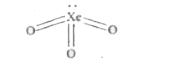
|
|
| 47. |
Based upon paragraph, 3 multiple choice questions have to be answered. Each question has 4 choices (A), (B). (C) and (D), out of which ONLY ONE is correct. Paragraph for Questions:The noble gases have closed-shell electronic configuration and are monoatomic gases under normal -conditions. The low boiling points of the lighter noble gases are due to weak dispersion forces between the atoms and the absence of other interatomic interactions.The direct reaction of xenon with fluorine leads to a series of compounds with oxidation numbers +2, +4 and +6. XeF_(4) reacts violently with water to give XeO_(3). The compounds of xenon exhibit rich stereochemistry and their geometries can be deduced considering the total number of electron pairs .: in the valence shell.QXeF_(4) and XeF_(5) are expected to be |
|
Answer» oxidizing ` XeF_(6) + 3H_(2)Oto-XeO_(3) + 6HF` |
|
| 48. |
Based on which two opposite phenomena Langmuir derived adsorption isotherm equation ? |
|
Answer» Adsorption and desorption of gas. |
|
| 49. |
Based on VSEPR theory, the number of 90^(@) degree F-Br-F angles in BrF_(5) is |
|
Answer» |
|
| 50. |
Based on VB theory explain why [Cr(NH_(3))_(6)]^(3+) is paramagnetic, while [Ni(CN)_(4)]^(2-) is diamagnetic. |
|
Answer» SOLUTION :`(a)[Cr(NH_(3))_(6)]^(3+)` In this complex `Cr` is in the `+3` oxidation state. Electronic configuration of `Cr` atom Electronic configuration of `Cr^(3+)` ion  Hybridisation and formation of `[Cr(NH_(3))_(6)]^(3+)` complex Due to the presence of three unpaired ELECTRONS in `[Cr(NH_(3))_(6)]^(3+)` it behaves as a paramagnetic substance. The spin magnetic MOMENT, `mus=sqrt(3(3+2))=sqrt(15)=3.87BM` `[Cr(NH_(3))_(6)]^(3+)` is an inner ORBITAL octahedral complex.  `(b) [NI(CN)_(4)]^(2-)` In this complex `Ni` is in the `+2` oxidation state. Electronic configuration of `Ni` atom Electronic configuration of `Ni^(2+)` ion Hybridisation and formation of `[Ni(CN)_(4)]^(2-)` Complex Since `CN^(-)` is strong field ligand, hence the electrons in `3d` orbitals are forced to pair up and there is no unpaired electron in `[Ni(CN)_(4)]^(2-)`, hence it should be diamagnetic substance. 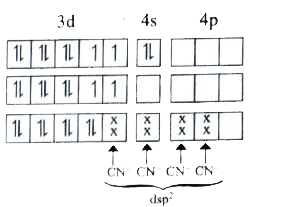
|
|