

Saved Bookmarks
| 1. |
Based on VB theory explain why [Cr(NH_(3))_(6)]^(3+) is paramagnetic, while [Ni(CN)_(4)]^(2-) is diamagnetic. |
|
Answer» SOLUTION :`(a)[Cr(NH_(3))_(6)]^(3+)` In this complex `Cr` is in the `+3` oxidation state. Electronic configuration of `Cr` atom Electronic configuration of `Cr^(3+)` ion  Hybridisation and formation of `[Cr(NH_(3))_(6)]^(3+)` complex Due to the presence of three unpaired ELECTRONS in `[Cr(NH_(3))_(6)]^(3+)` it behaves as a paramagnetic substance. The spin magnetic MOMENT, `mus=sqrt(3(3+2))=sqrt(15)=3.87BM` `[Cr(NH_(3))_(6)]^(3+)` is an inner ORBITAL octahedral complex.  `(b) [NI(CN)_(4)]^(2-)` In this complex `Ni` is in the `+2` oxidation state. Electronic configuration of `Ni` atom Electronic configuration of `Ni^(2+)` ion Hybridisation and formation of `[Ni(CN)_(4)]^(2-)` Complex Since `CN^(-)` is strong field ligand, hence the electrons in `3d` orbitals are forced to pair up and there is no unpaired electron in `[Ni(CN)_(4)]^(2-)`, hence it should be diamagnetic substance. 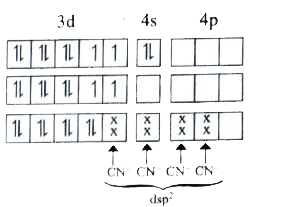
|
|