

Explore topic-wise InterviewSolutions in Current Affairs.

This section includes 7 InterviewSolutions, each offering curated multiple-choice questions to sharpen your Current Affairs knowledge and support exam preparation. Choose a topic below to get started.

1.

Assertion : Neopentane forms one mono substituted compound. Reason : Neopentane is isomer of pentane.

Answer»

If both ASSERTION and reason are true and the reason is the correct EXPLANATION of the assertion
If both assertion and reason are true and the reason is not the correct explanation of the assertion.
If assertion is true but reason is false.
If the assertion and reason both are false.

Solution :Neopentane is isomer of pentane and neopentane forms only one substitution product. Both assertion and reason are true but reason is not a correct explanation of assertion. Neopentane forms mono substituted product DUE to presence of four identical methyl GROUPS present on carbon atom.
2.

Assertion : Network polymers are thermosetting. Reason : Network polymer have high molecular mass.

Answer»

Assertion and reason both are correct statement but reason does not explain assertion.
Assertion and reason both are correct STATEMENTS and reason explains the assertion.
Both assertion and reason are WRONG statement.
Assertion is correct statement and reason is wrong statement.

ANSWER :a
3.

Assertion : Neither pure H_(2)SO_(4) nor pure HClO_(4) conduct electric current but a mixture of two does. Reason : Both are strong acids.

Answer»

If both assertion and reason are correct and reason is correct explanation for assertion.
If both assertion and reason are correct but reason is not correct explanation for assertion.
If assertion is correct but reason is incorrect.
If assertion and reason both are incorrect.

Solution :(b) Correct explanation : `HClO_(4)` is a stronger acid than `H_(2)SO_(4)` and donates `H^(+)` to `H_(2)SO_(4)`
`underset(Acid)(HCIO_(3))+underset(Base)(HOSO_(3)H) hArr OCIO_(3)^(-)+H_(2)O^(+)SO_(3)H`
Since the solution now CONTAINS ions, it conducts electricty.
4.

Assertion: NBS is a specific reagent for allylic bromination Reason: Allylic bromination oC Curs through free radical intermediates .

Answer»

If both assertion and REASON are TRUE and the reasone is the correct explanation of the assertion .
If both assertion and reason are true but reason is the correct explanation of the assertion .
If assertion is true but reasone is false
If assertion is false but reason is true .

Solution :Correct Explanation `NBS` gives a constant LOW concentration of `Br_(2)` thereby favouring substitution and preventing addition reaction .
5.

Assertion : ^^_(NaCl)^(@)=lambda_(Na^(+))^(@)+lambda_(Cl^(-))^(@) Reason : This is according to Kohlrausch's Law of independent migration of ions.

Answer»

If both ASSERTION and REASON are CORRECT and reason is correct EXPLANATION for assertion.
If both assertion and reason are correct but reason is not correct explanation for assertion.
If assertion is correct but reason is INCORRECT.
If assertion and reason both are incorrect.

Solution :(a) Reason is correct explanation for assertion.
6.

Assertion : NaOH cannot be stored in a vessel made of aluminium or zinc. Reason : A protective layer of oixde is formed on the surface of the metal

Answer»

Both ASSERTION and Reason are TRUE and Reason is the correct explanation of Assertion
Both Assertion and Reason are true and Reason is not the correct explanation of Assertion
Assertion is true but Reason is FALSE
Both Assertion and Reason are false

Answer :C
7.

Assertion : NaCl reacts with concentrated H_2SO_4 to give colourless fumes with pungent smell. But on adding MnO_(2)the fumes become greenish yellow. Reason : MnO_2 oxidises HClto chlorine gas which is greenish yellow.

Answer»

Both assertion and reason are CORRECT STATEMENTS, and reason is the correct explanation of the assertion.
Both assertion and reason are correct statements, but reason is not the correct explanation of the assertion.
Assertion is correct, but reason is WRONG statement.
Assertion is wrong but reason is correct statement.

Solution :`MnO_2` OXIDISES HCl to `Cl_2`. Hence, fumes becomes greenish yellow.
8.

Assertion : NaCl solution can be purfied by passage of hydrogen chloride through brine. Reason: This type of purfication is based on Le-Chatelier's principle.

Answer»

If both ASSERTION and reason are true and the reason is the CORRECT explanation of the assertion.
If both assertion and reason are true but reason is not the correct explanation of the assertion.
If assertion is true but reason is false.
If the assertion and reason both are false.

ANSWER :A
9.

Assertion : NaCl reacts with concentrated H_(2)SO_(4) to give colourless fumes with pungent smell. But on adding MnO_(2) the fumes become greenish yellow. Reason : MnO_(2) oxidisesHCl to chlorine gas which is greenish yellow.

Answer»


SOLUTION :REASON is the CORRECT EXPLANATION for ASSERTION.
10.

Assertion : NaCl reacts with concentrated H_(2)SO_(4) to give colourless fumes with pungent smell. But on adding MnO_(2) the fumes become greenish yellow. Reason : MnO_(2) oxidises HCl to chlorine gas which is greenish yellow.

Answer»

Both ASSERTION and REASON are correct statements, and reason is the correct explanation of the assertion.
Both assertion and reason are correct statements, but reason is not the correct explanation of the assertion.
Assertion is correct, but reason is wrong statement.
Both assertion and reason are wrong statement.

Solution :Reason is the correct explanation of assertion. (NaCl REACTS with conc. `H_(2)SO_(4)` to give colourless fumes of HCl which on treatment with `MnO_(2)` get oxidised to yellowish GREEN coloured `Cl_(2)` gas).
11.

Assertion : NaCl is precipitated when HCl gas is passed in a saturated solution of NaCl. Reason : HCl is strong acid.

Answer»

If both assertion and reason are TRUE and reason is the CORRECT explanation of the assertion
If both assertion and reason are true but reason is not the correct explanation of the assertion.
If assertion is true but reason is false.
If the assertion and reason both are false.

Solution :Pure NaCl is PRECIPITATED when HCl gas is passed in a saturated solution of NaCl because the value of `[Na^(+)]` and `[Cl^(-)]` becomes greater than `K_(SP)` of NaCl.
12.

Assertion. Na_(2)SO_(4) is soluble in water while NASO_(4) is insoluble. Reason. Lattice energy of NaSO_(4) exceeds its hydration energy.

Answer»

If both assertion and REASON are true, and reason is the true EXPLANATION of the assertion.
If both assertion and reason are true, but reason is not the true explanation of the assertion.
If assertion is true, but reason is false.
If both assertion and reason are false.

Solution :Both A and R are correct and R is the correct explanation of A.
13.

Assertion: Na^(+) and Al^(3+) are isoelectronic but ionic radius Al^3+ is less than that of Na6(+) Reason: The magnitude of effective nuclear charge on the outershell electrons in Al^(3+) is greater than that of Na^(+).

Answer»

If both assertion and REASON are TRUE annd the reason is the CORRECT EXPLANATION of assertion
If both assertion and reason are true but reason is not the correct explanation of assertion
If assertion is true but the reason is false
if assertion is false but the reason is true

Answer :A
14.

Assertion: N_(3)^(-) is a weaker base than NH_(2)^(-) Reason: The lone pair of electrons on N atom in N_(3)^(-) is in a sp^(2)-orbital while in NH_(2)^(-) it is in an sp^(3)-orbital.

Answer»

If both ASSERTION and REASON are TRUE, and reason is the true EXPLANATION of the assertion.
If both assertion and reason are TURE, but reason is not the true explanation of the assertion.
If assertion is true, but reason is false.
If both assertion and reason are false.

Answer :A
15.

Assertion : N_(2) is more stable than O_(2). Reason : Bond order of N_(2) is more than that of O_(2).

Answer»

Both assertion and REASON are TRUE and reason is the CORRECT explanation of the assertion
Both assertion and reason are true and reason is not the correct explanation of the assertion.
Assertion is true but reason is false
Both assertion and reason are false.

Answer :A::B::C::D
16.

Assertion : N_2 is less reactive than P_4. Reason : Nitrogen has more electron gain enthalpy than phosphorus.

Answer»

Both assertion and reason are correct STATEMENTS, and reason is the correct EXPLANATION of the assertion.
Both assertion and reason are correct statements, but reason is not the correct explanation of the assertion.
Assertion is correct, but reason is WRONG statement.
Assertion is wrong but reason is correct statement.

Solution :`N_2` is LESS REACTIVE because of high bond dissociation enthalpy.
17.

Assertion : N_(2) is less reactive than P_(4) Reason : Nitrogen has more electron gain enthalpy than phosphorus.

Answer»

Both assertion and reason are correct statements, and reason is the correct explanation of the assertion.
Both assertion and reason are correct statements, but reason is not the correct explanation of the assertion.
Assertion is correct, but reason is wrong statement.
Both assertion and reason are wrong statement.

Solution :Correct reason. P-P single BOND in `P_(4)` molecules is much WEAKER (213 kJ `mol^(-1)`) than N = N triple bond (341.4 kJ `mol^(-1)`) in `N_(2)`.
18.

Assertion : n-propylamine has higher boiling point than trimethylamine. Reason: Among n-propylamine molecules, there is hydrogen bonding but there is not hydrogen in trimethylamine.

Answer»

Assertion and REASON both are both WRONG statements .
Assertion is correct STATEMENT but reason is wrong statement
Assertion is wrongstatement but reason is correct statement
Assertion and reason both are correct statements but REASSON is not correct explanation of assertion

Answer :A
19.

Assertion : N_(2) and NO^(+) both are diamagnetic substances. Reason : NO^(+) is isoelectronic with N_(2).

Answer»

If assertion is TRUE but the REASON is FALSE
If assertion is false but reason is true
If both assertion and reason are true and the reason is the correct explanation of assertion
If both assertion and reason are true and the reason is not the correct explanation of assertion

Answer :D
20.

Assertion : N, N-Diethyl ethanamine is more basic the N, N-Dimethyl methanamine. Reason : +I effect of ethyl group is more then methyl

Answer»

If both ASSERTION and REASON are TRUE and reason is the CORRECT EXPLANATION of assertion.
If both assertion and reason are true but reason is not the correct explanation of assertion.
If assertion is true but reason is false.
If both assertion and reason are false.

Answer :A
21.

Assertion: N-Ethylbenzenesulphonamide is soluble in alkali. Reason: Hydrogen atached to nitrogen in sulphonamide is strongly acidic.

Answer»

Both ASSERTION and REASON are wrong.
Both assertion and reason are correct STATEMENTS but reason is not correct EXPLANATION of assertion.
Assertion is correct STATEMENT but reason is wrong statement.
Both assertion and reason are correct statements and reason is correct explanation of assertion.

Solution :Reason is the correct explanation of the assertion.
22.

Assertion : Multiple bond between two bonded atoms can have more than three bonds. Reason : Multiple bond between two bonded atoms can not have more than two pi-bonds.

Answer»

If assertion is true but the REASON is false
If assertion is false but reason is true
IF both assertion and reason are true and the reason is the CORRECT EXPLANATION of assertion
If both assertion and reason are true but reason is not the correct explanation of assertion

Answer :D
23.

Assertion: M.P of BeCl_(2) is less than that of MgCl_(2), but reverse is true for their thermal stability. Reason: M.P. and thermal stability of both compounds depend upon their lattice energy.

Answer»

If both assertion and reason are true and the reason is the correct explanation of assertion
If both assertion and reason are true and the reason is not the correct explanation of assertion
If assertion is FALSE but reason is true
If assertion is true but the reason is false

Answer :C
24.

Assertion : Most of the synthetic polymers are not biodegradable. Reason : Polymerisation process induces toxic character in organic molecules.

Answer»

Assertion and reason both are correct statements and reason does not explain assertion.
Assertion and reason both are correct statements but reason EXPLAINS the assertion.
Both assertion and reason are wrong statements.
Assertion is correct STATEMENT and reason is wrong statement.

Solution :Correct reason . Most of the synthetic are notdegraded by enzymatic HYDROLYSIS and ENVIRONMENT oxidation.
25.

Assertion : Most of the synthetic polymers are not biodegradable. Reason : Nylon-2-nylon-6 is a biodegradable polymer.

Answer»

ASSERTION and REASON both are CORRECT STATEMENTS and reason is correct explanation for assertion.
Assertion and reason both are correct statements but reason is not correct explanation for assertion.
Assertion is correct statement but reason is WRONG statement.
Assertion is wrong statement but reason is correct statement.

Answer :B
26.

Assertion : Moving phase is liquid and stationary phase is solid in paper chromatography. Reason : Paper chromatography is used for analysis of polar organic compounds.

Answer»

If both assertion and reason are true and the reason is the correct explanation of the assertion.
If both assertion and reason are true but RESON is not the correct explanation of the assertion.
If assertion is true but reason is FALSE.
If assertion is false but reason is true.

Solution :Paper chromatography is a liquid-liquid partition chromatography in which the water is absorbed or chemically BOND to cellulose of paper which acts as the stationary phase while the mobile phase is another liquidwhich is usually a mixture of two or three solventsin which water is ONE of the components.
27.

Assertion : Most of the synthetic polmers are non-biodegradable . Reason : During polymerisation , the polymers become toxic and non-biodegradable .

Answer»

If both assertion and reason are TRUEAND reason is the correct explanationof assertion .
If both assertion and reason are true but reason is not the correct explanationof assertion .
If assertion is true but reason is false.
If both assertion and reason are false.

ANSWER :C
28.

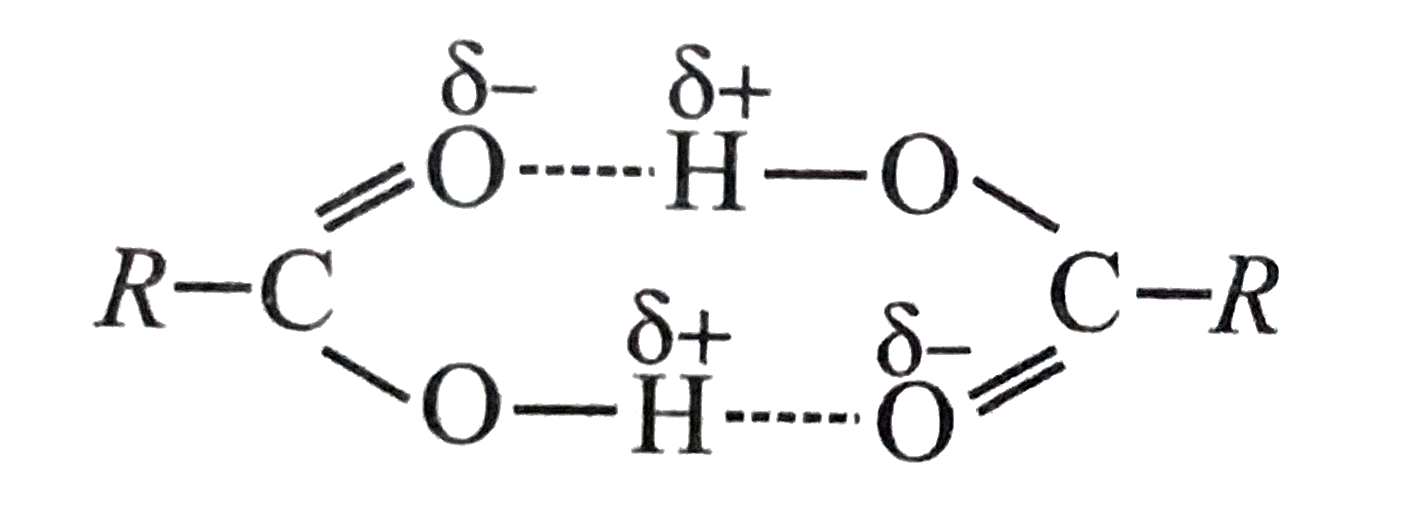
Assertion : Most carboxylic acids exist as dimers in the vapour phase or in aprotic solvents. Reason : Higher carboxylic acids are practically insoluble in water due to the increased hydrophobicinteraction of hydrocarbon part.

Answer»

If both ASSERTION and reason are true and reason is the CORRECT explanation of assertion.
If both assertion and reason are true but reason is not the correct explanation of assertion.
If assertion is true but reason is false.
If both assertion and reason are false.

Solution :Carboxylic acids exist as DIMERS due to intermolecular hydrogen bonding which is not broken COMPLETELY even in the VAPOUR phase or in aprotic solvents.
29.

Assertion : More is the electron affinity greater is the reducing character. Reason : Reducing character depends on number of electrons gained.

Answer»

If both assertion and REASON are TRUE and the reason is the correct explanation of the assertion
If both assertion and reason are true but reason is not a correct explanation of the assertion
If assertion is true but reason is FALSE
If the assertion and reason both are false

Solution :Assertion is false but reason is true.
More is the electron AFFINITY, greater is the oxidising character.
30.

Assertion :- Monocytes and lympholcytes are agranulocytes : Reason :- Monocytes and lymphocytes have no lobes in their nucleus.

Answer»

If both ASSERTION & Reason are True & the Reason is a correct explanation of the Assertion.
If both Assertion & Reason are True but Reason is not a correct explanation of the Assertiion.
If Assertion is True but the Reason is False.
If both Assertion & Reason are False

Answer :B
31.

Assertion : monoclinic sulphur is an example of monoclinic crystal system Reason : for a monoclinic system, a ne b ne c and a = gamma = 90^(@), beta ne 90^(@)

Answer»

Both assertion and REASON are TRUE and reason is the CORRECT explanation of assertion.
Both assertion and reason are true but reason is not the correct explanation of assertion.
Assertion is true but reason is FALSE.
Both assertion and reason are false

Solution :Both assertion and reason are true and reason is the correct explanation of assertion.
32.

Assertion: Molecules that are not superimposable on their mirror images are chiral. Reason: All chiral molecules hae chiral centres.

Answer»

If both assertion and reason are CORRECT and reason is correct explanation for assertion
If both assertion and reason are correct but reason is not correct explanation for assertion.
If assertion is correct but reason is incorrect.
if both assertion and reason are incorrect.

Solution :Correct reason. CHIRAL MOLECULES are dissymmetric in nature.
33.

Assertion : Molecularity has no meaning for a complex reaction . Reason : The overall molecularity of a complex reaction is equal to the molecularity of the slowest step .

Answer»

If both assertion and reason are true and the reason is the CORRECT explanation of the assertion .
If both assertion and reason are true but reason is not the correct explanation of the assertion
If assertion is true but reason is false
If the assertion and reason both are false .

Solution :Molecularity of a REACTION can be defined only for an ELEMENTARY reaction because complex reaction does not take place in one single STEP and it is almost impossible for all the total molecules of the reactants to be in a state of ENCOUNTER simultaneously .
34.

Assertion : Molecular mass of bezxoic acid when determined by colligative properties is found high. Reason : Dimerisation of benzene acid.

Answer»

If both the assertion and reason are true and reason is a true explanation of the assertion.
If both the assertion and reason are true but reason is not the correct explanation of the assertion
If assertion is true but reason is false
If assertion is false but reason is true.

Solution :Colligative property are the properties of solutions containing non-volatilw solute.it is correct that MOLECULES MASS of benzoic acid when determined by colligative properties is FOUND abnormally high.this is because dimerisatio of benzoic acid takes PLACE in solution resulting high MOLECULAR mass.Therefore ,assertion and reason are true and reason is correct explanation.
35.

Assertion : Molecular mass of benzoic acid when determined by colligative properties is found high. Reason : Dimerisation of benzoic acid.

Answer»

If both assertion and reason are true and the reason is the correct explanation of the assertion.
If both assertion and reason are true but reason is not the correct explanation of the assertion.
If assertion is true but reason is false.
If the assertion and reason both are false.

SOLUTION :Colligative properties are the properties of SOLUTIONS containing non volatile solute. It is correct thatmolecular mass of benzoic ACID when determined by colligative properties is found ABNORMALLY high. This is because dimerisation of benzoic TAKES place in solution resulting in high molecular mass. Therefore, assertion and reason are true and reason is correct explanation.
36.

Assertion :Molecular mass of benzoic acid when determine by colligative properties is found high. Reason: Dimerisationof benzoic acid.

Answer»

If both assertion and reason are true and the reason is the correct explanation of the assertion
If both the assertion and reason are true but reason is not the correct explanation of the assertion
If assertion is true but reason is false
If assertion is false but reason is true.

Solution :Coligative properties are the properties of solutions containing nonvolatile solute.It is correct that MOLECULAR mass of benzoic acid when determine by colligative properties is found abnormally HIGH.This is because dimerisation of benzoic takes place in solution resulting high molecular mass. Therefore ,assertion and reason are true and reason is explanation.
37.

Assertion :- Molecular mass of polymers cannot be calculated using boiling point or freezing point method. Reason : Polymers solutions do not possess a constant boiling point or freezing point.

Answer»

If both ASSERTION and reason are TRUE and the reason is the correct explanation of the assertion.
If both assertion and reason are true but reason is not the correct explanation of the assertion.
If assertion is true but reason is false.
If the assertion and reason both are false.

Solution :The polymer solutions POSSESS very LITTLE elevation in boiling point or DEPRESSION in freezing point.
38.

Assertion : Molecular mass of A is M/4 if the molecular mass of B is M. Reason : Vapour density of A four times that of B.

Answer»

If both assertion and REASON are TRUE and the reason is the CORRECT explanation of the assertion.
If both assertion and reason are true but reason is not the correct explanation of the assertion.
If assertion is true but reason is false.
If the assertion and reason both are false.

Solution :VAPOUR density of `B=M/2`
Vapour density of `A=M/4xx1/2 =M/8`
Molecular mass of `A=M/4`.
39.

Assertion : Molarity of a solution in liquid state changes with temperature.Reason : The volume of a solution changes with change in temperature.

Answer»

Assertion and reason both are correct statements and reason is correct EXPLANATION for assertion.
Assertion and reason both are correct statements but reason is not correct explanation for assertion.
Assertion is correct statement but reason is wrong statement.
Assertion and reason both are incorrect statements.

Solution :Explanation : (i) Strength of a solution in terms of .Molarity (M). is represents the number of moles of the solute dissolved per litre of solution, i.e.,
Molarity `= ("No. of moles of solute component")/("Volume of solution in LITRES")`
(ii) Since volume of a liquid varies with changes of temperature, the volume of solution WOULD also change while the number of moles of solute PRESENT in it will REMAIN the same (or unchanged). This therefore, would affect the molarity of the solution.
40.

Assertion : Molarity of a solution in liquid state changes with temperature. Reason : The volume of a solution changes with change in temperature.

Answer»

Assertion and reason both are correct STATEMENT and reason is correct EXPLANATION for assertion.
Assertion and reason both are correct STATEMENTS but reason is not correct explanation for assertion.
Assertion is correct statement but reason is wrong statement.
Assertion and reason both are INCORRECT statements.

Answer :a
41.

Assertion : Molarity of a solution in liquid state changes with temperatuer. Reson : The volume of a solution changes with change in temperature.

Answer»

Assertion and RESON both are correct statements and reson is sorrect explanation for assertion.
Assertion and reson both are correct statements but RESONS is not correct explanation for assertion.
Assertion and reason both are INCORRECT statements.
Assertion is wrong STATEMENT but reason is correct statement.

Solution :Reason is the correct explanation for assertion.
42.

Assertion : Molarity of the solution changes with temperature. Reason : Molarity is a colligative property.

Answer»

If both ASSERTION are reason are CORRECT and reason is correct explanation for assertion.
If both assertion and reason are corrct but reason is not correct explanation for assertion.
If assertion is corrct but reason is incorrect.
If assertion and reason both are incrrect.

Solution :Correct Reason. Molarity depends upon volume which CHANGES with change in TEMPERATURE.
43.

Assertion : Molar mass of D_(2)O is more than than of protium oxide. Reason : Boiling point of protium oxide is higher than that of D_(2)O.

Answer»

If both ASSERTION & REASON are TRUE & the Reason is a correct explanation of the Assertion.
If both Assertion & Reason are True but Reason is not a correct explanation of the Assertion.
If Assertion is True but the Reason is False.
If both Assertion & Reason are False.

Answer :C
44.

Assertion: Molar entropy of vaporization of water is different from ethanol. Reason: Water is more polar than ethanol.

Answer»

If both assertion and reason are true and the reason is the correct explanation of the assertion.
If both assertion and reason are true but reason is not the correct explanation of the assertion
If assertion is true but reason is false
If the assertion and reason both are false.

Solution :The molar entropy of vaporization of water differ from ETHANOL due to HYDROGEN bonding according to VSEPR THEORY water molecule and show some polarity which is higher than that of ethanol so both assertion and reason are correct but reason is not explanation assertion.
45.

Assertion: Molar conductivity of a weak electrolyte at infinite dilution cannot be determined experimentally. Reason: Kohlrausch law helps to find molar conductivity of a weak electrolyte at infinite dilution.

Answer»

If both assertion and reason are TRUE, and reason is the true explanation of the assertion
if both assertion and reason are true, but reason is not the true explanation of the assertion.
if assertion is true, but reason is false.
If both assertion and reason are false.

Solution :Correct explanation. The dissociation of WEAK electrolyte keeps increasing with dilution and is not COMPLETE even infinite dilution.
46.

Assertion: Molar conductance of an electrolyse increases with dilution. Reason: Ions move faster in dilute solution.

Answer»

If both ASSERTION and reason are true, and reason is the true explanation of the assertion
if both assertion and reason are true, but reason is not the true explanation of the assertion.
if assertion is true, but reason is false.
If both assertion and reason are false.

Solution :Correct explanation. MOLAR CONDUCTANCE increases because with DILUTION in a weak electrolyte, dissociation increases while in a STRONG electrolyte, interionic attraction decreases.
47.

Assertion : Molar conductance of an electrolyte increases upon dilution. Reason : Ions move faster in dilute solution.

Answer»

If both ASSERTION and reason are correct and reason is correct explanation for assertion.
If both assertion and reason are correct but reason is not correct explanation for assertion.
If assertion is correct but reason is INCORRECT.
If assertion and reason both are incorrect.

Solution :(b) Correct explanation.Molar conductance increases because with DILUTION in a weak ELECTROLYTE, dissociation increases while in a strong electrolyte, inter-ionic attractions decrease.
48.

Assertion : Molar conductance increases with increase in dilution. Reason : For a strong electrolyte, interionic forces of attraction increase with dilution

Answer»

(A) and (R) are TRUE and (R) is the correct explanation of (A)
Both (A) and (R) are true but (R) does not explain (A)
(A) is true but (R) is false
Both (A) and (R) are false

Answer :C
49.

Assertion : Mnshowsexceptionalmeltingpointin 3dseries. Reason : Itsouterconfiguration is 4s^(2) 3d^(5)

Answer»

bothassertionand reasonare truereasonis thecorrectexplanationof THEASSERTION .
bothassertinandreasonare truebutreasonis notcorrectexplanationof theassertion
Assertionis truebutreasonis FALSE
Bothassertionand reasonare false.

Answer :A
50.

Assertion : Molality is perferred to molarity for expression the concentration of the solution. Reason : Molality can be determined more easily than molarity.

Answer»

If both assertion are REASON are CORRECT and reason is correct explanation for assertion.
If both assertion and reason are CORRCT but reason is not correct explanation for assertion.
If assertion is corrct but reason is incorrect.
If assertion and reason both are incrrect.

Solution :Correct Reason. MOLALITY does not change with temperature while molarity CHANGES.