

Saved Bookmarks
This section includes 7 InterviewSolutions, each offering curated multiple-choice questions to sharpen your Current Affairs knowledge and support exam preparation. Choose a topic below to get started.
| 1. |
Assertion : On passing electric current in colloidal solution they do not move towards anode or cathode. Reason: They do not contain any charge |
|
Answer» If both ASSERTION and reason are true and reason is the correct explanation of assertion. |
|
| 2. |
Assertion :- O.N. of carbon in H-C-=N is +4. Reason :- Carbon always shows an O.N of +4. |
|
Answer» If both ASSERTION & Reason are TRUE & the Reason is a CORRECT explanation of the Assertion. |
|
| 3. |
Assertion : On mixing 500 ml of 10^(-6) M Ca^(2+) ion and 500 ml of 30 xx 10^(-6) M F^(-)ion, the precipitate of CaF_(2) will be obtained. K_(sp) (CaF_(2) = 10^(-18)) Reason : If K_(sp) is greater than ionic product, a precipitate will develop. |
|
Answer» If both assertion and reason are TRUE and reason is the correct EXPLANATION of the assertion `K = ((10^(-6))/(2))((10^(-6))/(2))^(2) = 1.25 xx 10^(-19)` which is less than `K_(sp)`. Hence, no precipitate will develop. Thus, both assertion and reason are false. |
|
| 4. |
Assertion: On dilution, the equivalent as well as molar conductivity of the solution increases. Reason: With dilution, the number of current carrying particles per cm^(3) increases. |
|
Answer» If both ASSERTION and reason are true, and reason is the true explanation of the assertion |
|
| 5. |
Assertion : ON cooling a frezing maxture, colour of the mixture turns to pink from deep blue for a reaction Co(H_(2)P)_(6(aq))^(2+)+4Cl_(aq)^(-)hArrCoCl_(4(aq))^(2-)+6H_(2)O_((1)). Reason: Reaction is endothermic so on cooling, the reacton moves to backward direction. |
|
Answer» If both ASSERTION and reason are TRUE and the reason is the CORRECT explanation of the assertion. |
|
| 6. |
Assertion. On cooling, the brown colour of nitrogen dioxide disappears. Reason. ON cooling, NO_(2) undergoes dimerisation resulting in the pairing of odd electron of NO_(2). |
|
Answer» If both assertion and reason are true, and reason is the correct explanation of the assertion. |
|
| 7. |
Assertion :- On adding NACl to water its vapour pressure increases. Reason :- Addition of non-volatile solute increases the vapour pressure. |
|
Answer» If both assertion and reason are true and the reason is the correct explanation of the assertion. |
|
| 8. |
Assertion : Oils are purified by steam distillation. Reason : The compound which decompose at their boiling points can purified by steam distillation. |
|
Answer» If both assertion and reason are TRUE and the reason is the correct explanation of the assertion. |
|
| 9. |
Assertion : Olefinic monomers undergo addition polymerisation. Reason : Polymerisation of vinyl chloride is initiated by peroxides/ persulphates. |
|
Answer» Assertion and reason both are correct statements and reason does not explain assertion. |
|
| 10. |
Assertion : Octahedral complex of type [MABCDEF) ^(n+-)exhibits only two geometrical isomers. Reason: As the number of different ligands increase the number of possible isomers decreases. |
|
Answer» Both ASSERTION and reason are true and the reason is the CORRECT EXPLANATION of the assetion |
|
| 11. |
Assertion: Octahedral complex[Fe(CN)_6]^(3-)is a low spin complex . Reason : It has a negative CFSE value. |
|
Answer» Both ASSERTION and REASON are TRUE and the reason is the correct EXPLANATION of the assetion |
|
| 12. |
Assertion: o-Nitrophenol is less soluble in water in water than the m- and p-isomers. Reason: m- and p-Nitrophenols exist as associated molecules. |
|
Answer» Assertion and reason both are CORRECT and reason is correct EXPLANATION of assertion. |
|
| 13. |
Assertion : o-Hydrozybenaldehyde is less soluable in water than p-Hydroxybenzalbenzaldehye. Reason : Intra molecular hydrogen bonding in o-Hydrozbenzaldehyde Decrease extent of intermolecular hydrogen bonding with water |
|
Answer» Assertion is TRUE, REASON is true, Reason is a correct explanation for Assertion |
|
| 14. |
Assertion: O and p-nitrophenols can be separated by steam distillation Reason: O-isomeris steamvolatile due to chelation and p-isomer is not steam volatile due to intermolecular hydrogen bonding |
|
Answer» If both ASSERTION and reasonare CORRECT and REASON is the CORRECT EXPLANATION of the assertion |
|
| 15. |
Assertion : Nylon - 66 is condensation polymer Reason : It is formed by the reaction between functional groups of adjacent monomers with elimination of H_2O . |
|
Answer» (A) and (R) are true and (R) is the CORRECT explanation of (A) |
|
| 16. |
Assertion : Nylon 6, 6 is prepared by condensation Reason polymerisation of hexamethylenediamine and terephthalic acid. Reason : Nylon 6, 6 is a fibre polymer. |
|
Answer» Assertion and reason both are CORRECT statements and reason is correct EXPLANATION for assertion. |
|
| 17. |
Assertion: Number of unpaired electrons present in [Cu(NH_3)_2](+)complex is zero Reason:The complex [Cu(NH_3)_2]^(+) is linear with sp-hybridization. |
|
Answer» Both Assertion & REASON are true ,Reason is the correct explanation of Assertion |
|
| 18. |
Assertion: Nucleophilic substitution reaction in an optically active alkyl halide gives a mixture of enantiomers. Reason: Reactio occurs by S_(N^(1)) mechanism. |
|
Answer» If both ASSERTION and REASON are CORRECT and reason is correct EXPLANATION for assertion |
|
| 19. |
Assertion : Nuclear forces and called short range forces. Reason :Nuclear forces operate over very small distance i.e., 10^(-15) m or 1 fermi |
|
Answer» If both assertion and reason are TRUE and the reason is the correct EXPLANATION of the assertion |
|
| 20. |
Assertion : Non-competitive inhibitor inhibits the catalytic activity of enzyme by binding with its active site Reason: Non-competitive inhibitor changes the shape of the active site in such a way that substrate can't recognise it. |
|
Answer» ASSERTION and reason both are correct statement but reason does not EXPLAIN assertion |
|
| 21. |
Assertion : Nuclear fission is always accompanied by release of energy Reason : Nuclear fission is a chain process |
|
Answer» If both ASSERTION and REASON are true and the reason is the correct explanation of the assertion |
|
| 22. |
Assertion : Noble gases have positive electron gain enthalpy. Reason : Noble gases have stable closed shell electronic configuration. |
|
Answer» If both assertion and REASON are TRUE, and reason is the correct EXPLANATION of the assertion. |
|
| 23. |
Assertion : Noble gases have maximum electron affinity. Reason : High electron affinity shows that the electron is loosely bonded to the atom. |
|
Answer» If both ASSERTION and reason are true and the reason is the correct EXPLANATION of the assertion |
|
| 24. |
Assertion : Noble gases have highest ionization energies in their respective periods. Reason : The outermost sub-shell of noble gases in which electron enters is completely filled. |
|
Answer» Both assertion and reason are true and reason is the CORRECT EXPLANATION of the assertion |
|
| 25. |
Assertion : Noble gases have highest ionisation enthalpies in their respective periods. Reason : Noble gases have stable closed shell electronic configuration. |
|
Answer» If both ASSERTION and REASON are TRUE ANND the reason is the correct explanation of assertion |
|
| 26. |
Assertion: NO_(3)^(-) ion can not be detected by brown ring test in presence of NO_(2)^(-) ion. Reason: Both NO_(2)^(-) and NO_(3)^(-) ions evolve brown NO_(2) gas with conc. H_(2)SO_(4) acid. |
|
Answer» If ASSERTION is true but the reason is FALSE |
|
| 27. |
Assertion: N,N-Diethylbenzenesulphonamide is insoluble in alkali. Reason: Sulhponyl group attached to nitrogen atom is a strong electron withdrawing group. |
|
Answer» Both assertion and REASON are WRONG. |
|
| 28. |
Assertion : N,N–Diethylethanamine is more basic then N,N-Dimethylmethanamine Reason : +I effect of ethyl is more then methyl |
|
Answer» (1) If both assertion and reason are true and reason is the CORRECT explanation of assertion. 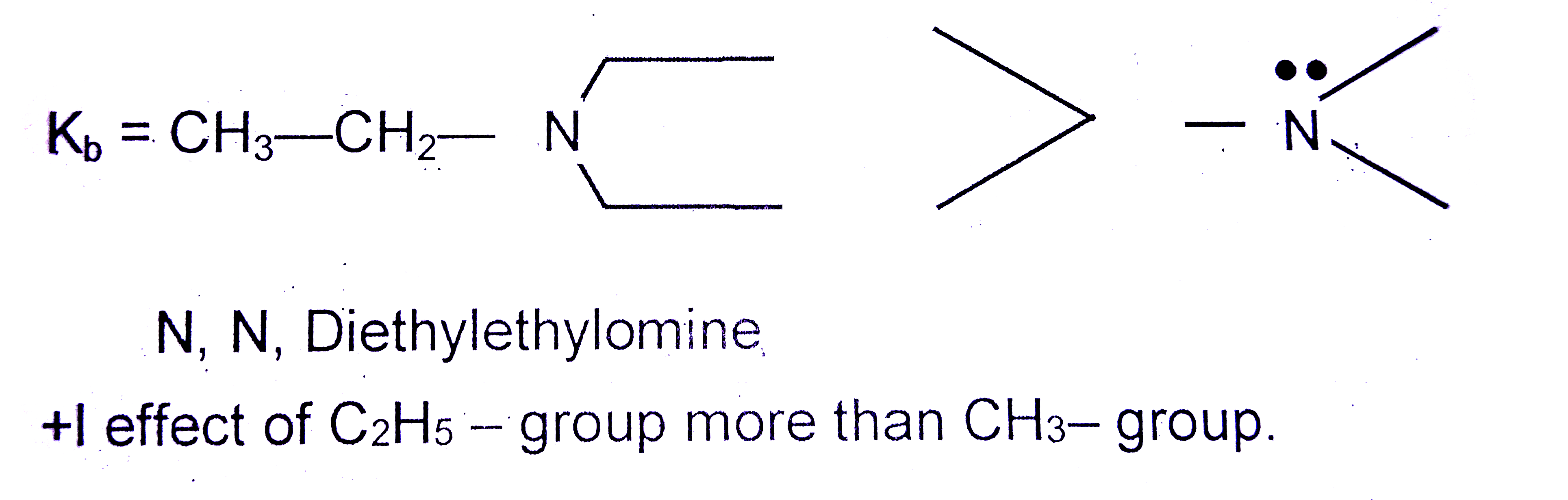 N, N Diethylethylomine +l EFFECT of `C_(2)H_(5)-` GROUP more than `CH_(3)-` group. |
|
| 29. |
Assertion : Nitrogen in inactive at room temperature but becomes reactive at elevated temperature (on heating or in the presence of catalyst). Reason : In nitrogen molecule, there is delocalization electrons. |
|
Answer» If assertion is TRUE but the REASON is false |
|
| 30. |
Assertion. Nitrogen is less reactive than molecular oxygen. Reason. The bond length of N_(2) is shorter than that of oxygen. |
|
Answer» If both assertion and reason are true, and reason is the CORRECT explanation of the assertion. |
|
| 31. |
Assertion : Nitrogenand Oxygenare themaincomponentsin theatmospherebutthese do notreact to formoxidesofnitrogen Reason : Thereactionbetweennitrogenand oxygenrequireshightemperature. |
|
Answer» bothassertion and reasonare correctandther REASON is the CORRECTEXPLANATION for theassertion. |
|
| 32. |
Assertion: Nitrobenzene is used as a solvent in Friedel-Crafts reaction. Reason: Fusion of nitrobenzene with solid KOH gives a low yield of a mixture of o- and p-nitrophenols. |
|
Answer» If both assertion and reason are true, and reason is the true explanation of the assertion. |
|
| 33. |
Assertion. Nitrogen and oxygen are the main components in the atmosphere but these do not react to form oxides of nitrogen. Reason. The reaction between nitrogen and oxygen requires high temperature. |
|
Answer» If both ASSERTION and reason are TRUE, and reason is the CORRECT explanation of the assertion. |
|
| 34. |
Assertion: Nitrobenzene is used as a solvent in Friedel-Craft's reaction. Reason: Fusion of nitrobenzene with solid KOH gives a low yield of a mixture of o-and p-nitro phenols. |
|
Answer» |
|
| 35. |
Assertion : Nitriding is the process of heating steel in presence of N_(2) to form iron nitrides. Reason : The surface of steel becomes hard after nitriding process. |
|
Answer» If both assetion and reason are CORRECT, and reason is the CORRECT explanation of the ASSERTION |
|
| 36. |
Assertion : Nitride ion (N^(3-)) and magnesium ion (Mg^(2+)) are both isoelectronic species. Reason : the charge on nitride is different from Mg^(2+) ion. |
|
Answer» If both ASSERTION and reason are correct and reason is correct EXPLANATION for assertion. |
|
| 37. |
Assertion: Nitriding is a process of heating steel in an atmosphere of nitrogen. Reason: Steel becomes brittle after nitriding. |
|
Answer» If both assertion and Reason are true and the Reason is the correct explanation of the assertion. |
|
| 38. |
Assertion: Nitration of chlorobenzene leads to the formation of m-nitrochlorobenzene. Reason: -NO_(2) group is a m-directing group. |
|
Answer» ASSERTION and reason both are CORRECT and reason is correct explanation of assertion. |
|
| 39. |
Assertion: Nitrating mixture used for carrying out nitration of benzene consists of conc. HNO_(3)+"conc". H_(2)SO_(4). Reason: In presence of H_(2)SO_(4),HNO_(3) acts as a base and produces NO_(2)^(+) ions. |
|
Answer» If both assertion and reason are true and the reason is the CORRECT EXPLANANTION of the assertion. |
|
| 40. |
Assertion :NiO is less than CaO. Reason :Ni^(2+) is pseudo noble gas configuration cation whereas Ca^(2+) is noble gas configuration cation. |
|
Answer» If ASSERTION is TRUE but the REASON is false |
|
| 41. |
Assertion : Nickel can be purified by Mond's process. Reason: Ni(CO)_4 is a volatile compound which decomposes at 460 K to give pure Ni. |
|
Answer» Both ASSERTION and REASON are TRUE and reason is the correct explanation of assertion. |
|
| 42. |
Assertion. Ni(CO)_(4) is a diamagnetic complex. Reason. All the electrons in the complex are paired. |
|
Answer» If both ASSERTION and reason are TRUE, but reason is not the true explanation of the assertion |
|
| 43. |
Assertion : Nickel can be purified by Mond processs. Reason : Ni(CO)_(4) is a volatile compound which decomposes at 460 K to give pure Ni. |
|
Answer» Both ASSERTION and REASON are TRUE and reason is the correct explanation of assertion. |
|
| 44. |
Assertion:Nickelcan bepurifiedby Mondprocess.Reason:Ni (CO ) _4isavolatilecompoundwhichdecomposes at460Kto givepureNi. |
|
Answer» Bothassertionandreason aretrueandreason is thecorrectexplanationofassertion. |
|
| 45. |
Assertion: Ni//Ni^(2+)(1.0M)||Au^(3+)(1.0M)|Au, for this cell emf is 1.75V if E_(Au^(3+)//Au)^(o)=1.50 and E_(Ni^(2+)//Ni)^(o)=0.25V Reason: Emf of the cell =E_("cathode")^(o)-E_("anode")^(o) |
|
Answer» if both assertion and REASON are TRUE and the reason is the correct EXPLANATION of the assertion. `E_(AU^(3+)//Au)^(@)-E_(Ni//Ni^(2+))^(@)=1.50-(+0.25)=1.25V` |
|
| 46. |
Assertion [Ni (CO)_(4)] has longer C-O bond lengththan the same in [Cr(CO)_(5) NH_(3)] Reason There is greater extent of d pi - rho pi back bonding in [Ni (CO)_(4)] than in [Cr (CO)_(5) NH_(3)] |
|
Answer» |
|
| 47. |
Assertion. NF_(3) is weaker ligand than N(CN_(3))_(3). Reason. NF_(3) ionizes to give F^(-) ions in aqueous solution. |
|
Answer» If both ASSERTION and REASON are true, but reason is not the true explanation of the assertion |
|
| 48. |
Assertion : Network polymers are thermosetting. Reson : Network polymers have high molecular mass. |
|
Answer» Assertion and reason both are correct statements and reason does not explain assertion. |
|
| 49. |
Assertion: Neoprene can be further hardened by heating in presence of sulphur. Reason : Neoprene contains allylic double bonds which help in introducing sulphur bridges between different polymer chains. |
|
Answer» If both assertion and reason are TRUE , and reason is the true EXPLANATION of the assertion. |
|
| 50. |
Assertion: Neopenty alcohol on treatment with HCl gives neopentyl chloride. Reason: Neopentyl is a tertiary alcohol. |
|
Answer» If both ASSERTION and reason are true, and reason is the true explanation of the assertion. Correct reason. This reaction occurs via rearrangement of initially formed less stable `1^(@)` carbocation to the more stable `3^(@)` carbocations. `CH_(3)-UNDERSET(CH_(3))underset(|)overset(CH_(3))overset(|)(C)-CH_(2)OH underset(-H_(2)O)overset(HCl)to CH_(3)-underset(Cl)underset(|)overset(CH_(3))overset(|)(C)-CH_(2)CH_(3)`. |
|