

Saved Bookmarks
This section includes 7 InterviewSolutions, each offering curated multiple-choice questions to sharpen your Current Affairs knowledge and support exam preparation. Choose a topic below to get started.
| 1. |
Assertion : K_w increases with increase in temperature. Reason : Concentration of H_3O+ and OH^- increases. |
|
Answer» (A) and ( R) are TRUE and ( R) is the correct explanation of (A) |
|
| 2. |
Assertion: K_(p)=K_(c) for all reaction. Reason: At constnat temperatue, the pressure of the gas is proportional to its concentration. |
|
Answer» If both assertin and REASON are TRUE and the reason is the CORRECT EXPLANATION of the assertion. |
|
| 3. |
Assertion: KMnO_(4) is purple in colour due to charge transfer . Reason :There is no electron present in d-orbitals of maganese in MnO_(4)^(-)) |
|
Answer» If both assertion and reason are true and the reason is the CORRECT explanation of assertion |
|
| 4. |
Assertion: KMnO_(4) has different equivalent wieghts in acid, neutral or alkaline medium. Reason: In different, change in oxidation number shown by maganese is altogether different. |
|
Answer» If both assertion and reason are TRUE and the reason is the CORRECT EXPLANATION of assertion 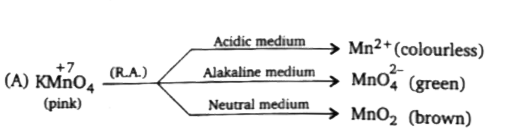
|
|
| 5. |
Assertion : Ketones are not easily oxidised Reason : The oxidation of unsymmetrical ketones is governed by Popoff's rule |
|
Answer» (A) and ( R) are true and ( R) is the CORRECT EXPLANATION of (A) |
|
| 6. |
Assertion: KCN reacts with methyl chloride to give methyl isocyanide. Reason: CN^(-) is an ambident nucleophile. |
|
Answer» Assertion and reason both are correct and reason is correct explanation of assertion. |
|
| 7. |
Assertion: Ketones are less reactive than aldehydes. Reason: Ketones do not give Schiff's test. |
|
Answer» If both assertion and reason are TRUE and the reason is the CORRECT explanation of the assertion |
|
| 8. |
Assertion K_2[Ni("EDTA") ] is more stable thanK_3[Al(C_2O_4) _3] Reason: Ni is a transition element whereas A1 is non-transition element. |
|
Answer» Both assertion and REASON are true and the reason is the CORRECT explanation of the ASSETION |
|
| 9. |
Assertion: K_(2)Cr_(2)O_(7) is used as a primary standard in volumetric analysis. Reason: It has a good solubility in water. |
|
Answer» If both ASSERTION and REASON are true and the reason is the CORRECT explanation of the assertion. |
|
| 10. |
Assertion. K_(2)Cr_(2)O_(7) is used as primary standard in volumetric analysis. Reason. It hasa good solubilityin water. |
| Answer» Solution :CORRECT R. `K_(2)Cr_(2)O_(7)` is not MUCH SOLUBLE in cold water. HOWEVER , it is obtained in pure stateandisnot hygroscopic in nature. | |
| 11. |
Assertion: K, Rb and Cs form superoxides. Reason: The stability of the superoxides increases from 'K' to 'Cs' due to decrease in lattice energy. |
|
Answer» If both assertion and Reason are true and the Reason is the correct explanation of the assertion. |
|
| 12. |
Assertion: K^(+) and NH_(4)^(+) ions have many similarities in their test Reason:Radius of K^(+) is almost equal to radius NH_(4)^(+) |
|
Answer» If both assertion and reason are true and the reason is the CORRECT EXPLANATION of assertion |
|
| 13. |
Assertion: IUPAC name of the compound CH_(3)-underset(CH_(3))underset(|)(C)H-O-CH_(2)-CH_(2)-CH_(3) is Ethoxy-2-methylethane. Reason: In IUPAC nomenclature, ether is regarded as hydrocarbon derivative in which a hyddrogen atom is replaced by -OR or -OAr group [where R=alkyl group and Ar=aryl group]. |
|
Answer» Assertion and reason both are correct and reason is correct EXPLANATION of assertion. `CH_(3)-underset(CH_(3))underset(|)(C)H-O-CH_(2)CH_(2)CH_(3)` is 1-(2-Propoxy)propane. |
|
| 14. |
Assertion: K and Cs are sued in photoelectrical cells. Reason: K and Cs emit electrons on exposure to light. |
|
Answer» if both assertion and reason are TRUE and the reason is the CORRECT explanation of the assertion. |
|
| 15. |
Assertion: IUPAC name of K_3[Fe(CN)_6] is potassium hexacyanoferrate (II) Reason: K_3[Fe(CN)_6]is commonly called potassium ferricyanide |
|
Answer» Both ASSERTION & Reason are true ,Reason is the correct explanation of Assertion |
|
| 16. |
Assertion: Isotonic solutions do not show osmosis. Reason:Isotonic solutions have equal osmotic pressure. |
|
Answer» Both Assertion and Reason are TRUE and Reason is the correct EXPLANATION of Assertion |
|
| 17. |
Assertion : Isotonic solution do not show the phenomenon of osmosis. Reason : Isotonic solution have equal osmotic pressure. |
|
Answer» If both assertion and REASON are true and the reason is the correct EXPLANATION of the assertion |
|
| 18. |
Assertion : Isotonic solution do not show the phenomenon of osmosis. Reason : Isotonic solutions have equal osmotic pressure. |
|
Answer» If both ASSERTION and reason are true and the reason is the CORRECT explanation of the assertion. |
|
| 19. |
Assertion Istonic solution donot show any osmosis when placed side by side. Reson : Isotnic solutions have same solute concentration. |
|
Answer» If both ASSERTION are reason are correct and reason is correct explanation for assertion. |
|
| 20. |
Assertion. Isoelectric point is the pH at which colloidal particles can move towards either of the electrodes. Reason. At the isoelectirc point, colloidal particles may carry positive or negative charge. |
|
Answer» If both ASSERTION and reason are ture, and reason is the trure EXPLANATION of the assertion. Correct R. At the isoelectric point, colloidal particles do not carry any charge. |
|
| 21. |
Assertion : isotonic solution do not show the phenomenon of osmosis. Reason : Isotonic solution have equal osmotic pressure |
|
Answer» If both the ASSERTION and REASON are true and reason is a true explanation of the assertion. |
|
| 22. |
Assertion : is named as tetrakis (ethylene- diammine) mu-"hydroxo"-mu-"imido dicobalt (III) ion". Reason : In naming polynuclear complexes i.e., containing two or more metal atoms joined by bridging ligands, the word mu is added with hyphen before the nane of such ligands. |
|
Answer» If both ASSERTION and reason are true and reason is the correct explanation of assertion 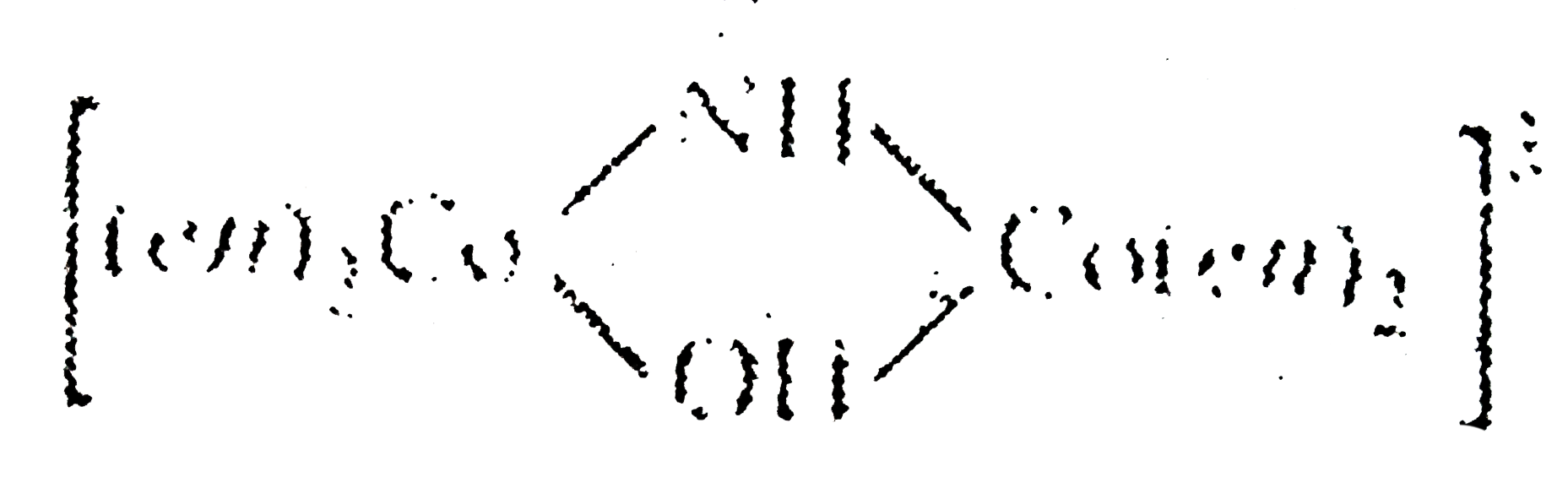 is named as tetrakis (ethylenediammine)-`mu`-hydroxo-`mu`-imido dicobalt (III) ion. For more than one bridging group the WORD u is repeated before cach bridging group. is named as tetrakis (ethylenediammine)-`mu`-hydroxo-`mu`-imido dicobalt (III) ion. For more than one bridging group the WORD u is repeated before cach bridging group.
|
|
| 23. |
Assertion: is less acidic than Reason: -F exerts better+mesomeric effect than -Cl. |
|
Answer» If both assertion and REASON are TRUE and the Reason is the correct explanation of the assertion.  is less ACIDIC than 
|
|
| 24. |
Assertion : Ionisation enthalpy is always negative. Reason : Energy is always released when electrons are removed. |
|
Answer» If both assertion and REASON are TRUE and the reason is the correct explanation of the assertion Ionisation ENTHALPIES are always positive. Energy is always absorbed when ELECTRONS are removed from an atom. |
|
| 25. |
Assertion : Ionic reactions are not instantaneous. Reason : Oppositely charged ions exert strong forces. |
|
Answer» If both assertion and reason are TRUE and reason is the correct explanation of the assertion |
|
| 26. |
Assertion : Insulin is a glubular protein. Reason : Gloubular proteins are water soluble. |
|
Answer» If both ASSERTION and reason are TRUE , and is the true explanation of the assertion. |
|
| 27. |
Assertion: Intermolecular dehydration is not useful for the perparation of unsymmetrical ethers from primary alcohols Reason: The reaction leads to a mixture of products. |
|
Answer» Assertion is TRUE, Reason is true, Reason is a CORRECT explanation for Assertion |
|
| 28. |
Assertion :Iodination of alkanes is reversible Reason:Iodination is carried out in presence of iodic acid |
|
Answer» If both assertion and reason are true and the reason is the correct explanation of the assertion `CH_4+I_2 hArr CH_3I+HI` |
|
| 29. |
Assertion : Instantaneous rate of reaction is equal to dx/dt . Reason : It is the rate of reaction at any particular instant of time |
|
Answer» If both assertion and reason are true and the reason is the correct explanation of the assertion |
|
| 30. |
Assertion Increasing temperature of a volatile liquid increases itsvapour pressure. Reason Increase in temperatureincreases the average kinetic energy of molecules in the vapour phase hence they collide to the surface of liquid with greater force. |
|
Answer» Both assertion and reason are CORRECT and reason is the correct EXPLANATION of the assertion, |
|
| 31. |
Assertion: Indigo is an indigoid dye. Reason: Indigo contains an azo (-N=N-) group |
|
Answer» Both A and R and true and R is the CORRECT expalantion of A |
|
| 32. |
Assertion. Increasing pressure on pure water decreases its freezing point. Reason. Density of water is maximum at 273 K. |
|
Answer» If both ASSERTION and reason are true, and reason is the true explanation of the assertion. |
|
| 33. |
Assertion: Increasing order of covalent character among given compounds is HgCl_(2)ltCdCl_(2)ltZnCl_(2) Reason: Order of size of cations is Zn^(2+)ltCd^(2+)ltHg^(2+) . |
|
Answer» If both ASSERTION and REASON are TRUE and the reason is the CORRECT explanation of assertion |
|
| 34. |
Assertion : Increase in temperature, decreases conductance Reason : This is due to the increase in the attractive forces between the oppositely charged ions |
|
Answer» (A) and (R) are true and (R) is the CORRECT explanation of (A) |
|
| 35. |
Assertion:Increase in temperature increases vapour pressure of a liquid Reason :Volume of a solution increases by increasing the temperature. |
|
Answer» Both Assertion and REASON are true and Reason is the CORRECT explanation of Assertion |
|
| 36. |
Assertion : Increase in temperature, increases chemisorption first and then decreases Reason : Due to the formation of a activated complex followed by desorption. |
|
Answer» (A) and (R) are true and (R) is the CORRECT explanation of (A) |
|
| 37. |
Assertion: In vulcanisation of rubber, sulphur cross links are introduced Reason: Vulcanisation is a free radical initiated chian reaction. |
|
Answer» If both assertion and reason are true and the reason is the correct explanation of the assertion. |
|
| 38. |
Assertion: In vulcanisation of rubber , sulphur cross links are introduced. Reason: Vulcanisation is a free radical intiated chain reaction. |
|
Answer» If both assertion and reason are trueand reason is the CORRECT explanationof assertion . |
|
| 39. |
Assertion: In the reaction of but-1-ene with HBr, 1-bromobutane is obtained in the presence of a peroxide. Reason: The reaction involves the formation of a primary free radical. |
|
Answer» If both assertion and REASON are CORRECT and reason is correct explanation for assertion |
|
| 40. |
Assertion: In the reaction N_(2) + 3H_(2) rarr 2NH_(3), the rate of reaction is different in terms of N_(2), H_(2) and NH_(3). Reason: Rate of disapperenace of N_(2) and H_(2) and rate of formation of NH_(3) are not equal to each other. |
|
Answer» If both ASSERTION and reason are TRUE and the reason is the CORRECT EXPLANATION of the assertion. |
|
| 41. |
Assertion: In the reaction of tert-butyl bromide with aq. KOH, rate becomes double by increasing the concentration of both aq. KOH and tert-butyl bromide Reason: Rate of reaction is, rate = kſtert butyl bromide) [OH^(-)]. |
|
Answer» Assertion and REASON both are CORRECT statements and reason is correct explanation for assertion. |
|
| 42. |
Assertion : In the reaction , I_2+I^(-) to I_3, I_2 acts as a Lewis base. Reason : In this reaction I_2 donates a electron pair to I^-. |
|
Answer» (A) and ( R) are TRUE and ( R) is the correct EXPLANATION of (A) |
|
| 43. |
Assertion : In the reaction, (1)/(2)O_(2)+F_(2)rarrOF_(2) Fluorine is oxidant. Reason :- Fluorine cannot show positive oxidation state. |
|
Answer» If both Assertion & REASON are True & the Reason is a correct EXPLANATION of the Assertion. |
|
| 44. |
Assertion : In the presence of alkalineKMnO_(4) 4-methylacetophenone is oxidised to benzoic acid. Reason : Keto group is oxidised to -COOH group. |
|
Answer» If both assertion and REASON are true and reason is the correct explanation of assertion. HENCE benzene-1, 4-dicarboxylic acid (terephthalic acid) will be formed. |
|
| 45. |
Assertion : In the manufacturing of iron from hematite, silicon dioxide is added as flux. Reason : Lime stone is used as acidic flux in many case. |
|
Answer» Both (A) and (R ) are TRUE and (R ) is the CORRECT EXPLANATION of (A). |
|
| 46. |
Assertion In the equation HCl+H_(2)OhArrH_(3)O^(+)+Cl^(-) HCl is a strong acid and Cl^(-) is a weak base while in the equation CH_(3)COOH+H_(2)OhArrCH_(3)COO^(-)+H_(3)O^(+) CH_(3)COOU is a weak acid and CH_(3) and CH_(3)COO^(-)is a strong base. Reason The stronger an acid, the weaker must be its base and vice-versa. |
|
Answer» Both A and R are TRUE and R is the CORRECT EXPLANATION of A |
|
| 47. |
Assertion : In the electrolytic reduction of Al_(2)O_(3), cryolite is used. Reason : Cryolite is an ore of aluminium. |
|
Answer» If both assetion and reason are CORRECT, and reason is the CORRECT EXPLANATION of the ASSERTION |
|
| 48. |
Assertion: In the electrolysis of aqueous NaCl, Na is preferentially discharged at the mercury cathode forming sodium amalgam. Reason: It is due to the fact that hydrogen has high overvoltage at mercury cathode. |
|
Answer» If both assertion and REASON are TRUE, and reason is the true explanation of the assertion |
|
| 49. |
Assertion :In the brown ringtest for mixture through westart with Fe^(II)SO_(4) , we end upwith [Fe(H_(2)O)_(3)NO]SO_(4) inwhichiron is in the +1 oxidationstates Reasion : No transfers its odd electronsto iron (II) |
|
Answer» If both (A) and (B) are CORRECT and (R ) is the correct explqanation of (A) |
|
| 50. |
Assertion: In the electrolysis of aqueous NaCl, Na is preferentially discharged at mercury cathode forming sodium amalgam. Reason: It is due to the fact that hydrogen gas a high over voltage at mercury cathode. |
|
Answer» if both ASSERTION and reason are true and the reason is the correct explanation of the assertion. |
|