

Saved Bookmarks
This section includes 7 InterviewSolutions, each offering curated multiple-choice questions to sharpen your Current Affairs knowledge and support exam preparation. Choose a topic below to get started.
| 1. |
Assertion: In the E2 elimination, beta-H and leaving group should be antiperiplanar. Reason: In the E2 elimination, base always abstracts unhindered beta-H. |
|
Answer» If both assertionn and REASON are true, and reason is the true EXPLANATION of the ASSERTION. |
|
| 2. |
Assertion: In the E_(2) elimination beta-H and leaving group should be antiperiplanar Reason In the E_(2) elimination base always abstracts unhindered beta-H . |
|
Answer» |
|
| 3. |
Assertion : In SO_(3) molecule bond dissociation energy of all S=O bonds are not equivalent. Reason : SO_(3) molecule is having two types of 2 p pi - 3 p pi and 2p pi- 3d pi pi-bonds. |
|
Answer» If ASSERTION is true but the REASON is false |
|
| 4. |
Assertion: In rate law, unlike in expression for equilibrium constants, the exponents for the concentration donot necessarily match the stoichometric coefficients. Reason: It is the mechanism and not the balanced chemical equation for the overall change that governs the reaction rate. |
|
Answer» If both ASSERTION and REASON are correct EXPLANATION for assertion. |
|
| 5. |
Assertion: In rate law, the exponents for concentration donot necessarily match the stoichiometric coefficients. Reason: It is the mechanism and not the balanced chemical equation for the overall change which governs the reaction rate . |
|
Answer» If both ASSERTION and REASON are CORRECT EXPLANATION for assertion. |
|
| 6. |
Assertion : In smelting, roasted ore is heated with powdered coke in presence of a flux. Reason : Oxides are reduced to metals by C or CO. Impurities are removed as slag. |
|
Answer» If both Assertion and REASON are true and Reason is the correct EXPLANATION of Assertion. |
|
| 7. |
Assertion : In Rosenmund reduction acetyl chloride is reduced to alcohol Reason : BaSO_(4) acts a positive catalyst in this reaction |
|
Answer» (A) and ( R) are TRUE and ( R) is the correct explanation of (A) |
|
| 8. |
Assertion : In physical adsorption , enthalpy of adsorption in very low. Reason : In physical adsorption , enthalpy of adsorption is very low. Reason : In physical adsorption , attraction between gas molecules and solid surface is due to weak van der Walls forces. |
|
Answer» If both assertion and REASON are true and REASONIS the correct explanation of assertion. |
|
| 9. |
Assertion : In presence of enzyme , substrate molecule can be attacked by the reagent effectively. Reason : Active sites of enzymes hold the substrate molecule in a suitable position. |
|
Answer» Assertion and REASON both are CORRECT statements and reason EXPLAINS the assertion. |
|
| 10. |
Assertion : In presence of ozone, mercury loses its meniscus and sticks to glasses. This is called tailing of mercury Reason: Tailing of mercury is due to the formation of mercurous oxide |
|
Answer» Statement-I and Statement-II are CORRECT and Statement-II is correct EXPLANATION of Statement-I |
|
| 11. |
Assertion : In presence of positve catalyst, activation energy & threshold energy decreases. Reason : Minimum energy required to permit a reaction is known as threshold energy. |
|
Answer» Both assertion and REASON are true and reason is the CORRECT EXPLANATION of assertion. |
|
| 12. |
Assertion: In N_(2)H_(4), any one N-atom can coordination with central metal cation in a coordination compound. Reason: N_(2)H_(4) can also act as ambidentate ligand. |
|
Answer» If assertion is TRUE but the reason is false 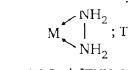 three membered (unstable) ring. Hence it ACTS as monodenate ligand only. three membered (unstable) ring. Hence it ACTS as monodenate ligand only.
|
|
| 13. |
Assertion: In N_(2) Molecule, any N-atom can coordinate with central atom/ion. Reason: N_(2) molecule can also act as ambidentate ligand. |
|
Answer» If assertion is true but the REASON is FALSE |
|
| 14. |
Assertion: In order to convert R-Cl to pure R-NH_(2), Gabriel pthalimide synthesis can be used. Reasaon: With proper choice of alkyl halides. Pthalimide synthesis can be used to prepare 1^(@),2^(@) or 3^(@) amines. |
|
Answer» If both ASSERTION and reason are TRUE and the reason is the correct EXPLANANTION of the assertion. |
|
| 15. |
Assertion: In NaCl structure, the inter ionic distance is a//2. ( a Unit cell edge length ). Reason : NaCl forms face centered cubic unit cell. |
|
Answer» Both ASSERTION and reason are TRUE and reason is the correct EXPLANATION of assertion. |
|
| 16. |
Assertion: In monohaloarenes, further electrophilic substitution occurs at ortho and para positions. Reason: Halogen atom is a ring deactivator. |
|
Answer» ASSERTION and reason both are CORRECT and reason is correct EXPLANATION of assertion. |
|
| 17. |
Assertion : In high spin situation, configurationofd^5ions will be t_(2g)^3e_g^2 Reason : In high spin situation pairing energy is less than crystal field energy. |
|
Answer» if both assertion and reason are true and reason is thr correct explanationof assertion 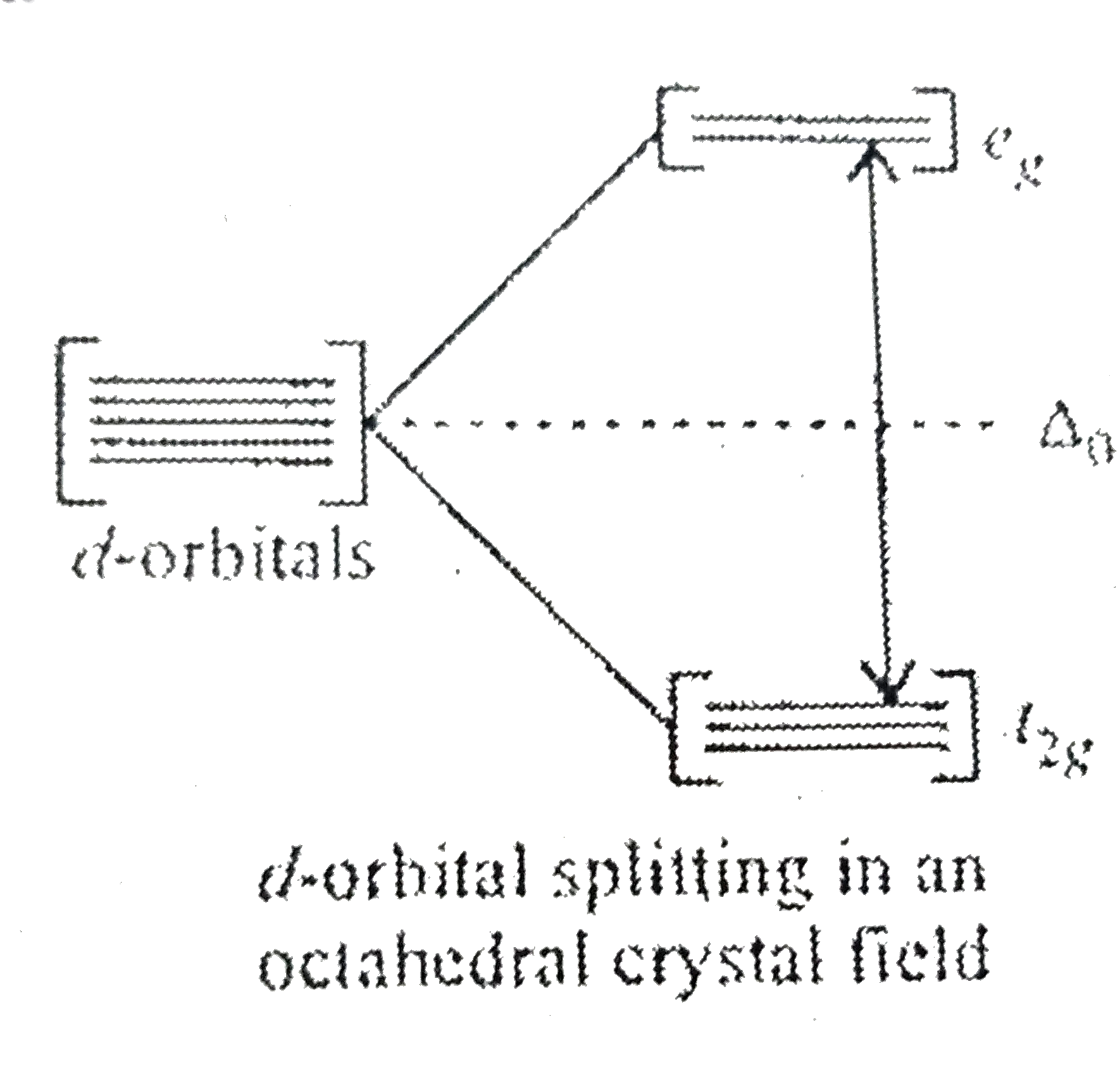 `THEREFORE` In HIGH spin situation ` Delta_0 lt P ` , in `d^s ` configuration `4^th` and `5^th` elctronare added to ` e_g ` rather than `t_2g1`So configuration of ` d^5` ION will be `t_(2G)^3 e_g^2 ` |
|
| 18. |
Assertion : In froth floatation process sodium ethyl xanthate is used as collector. Reason : Sulphide ores are water soluble. |
|
Answer» If both assetion and REASON are CORRECT, and reason is the CORRECT explanation of the ASSERTION |
|
| 19. |
Assertion : In formaldehyde all the four atoms lie in one plane. Reason : Carbonyl carbon forms a pi-bond with oxygen by overlapping of p -orbitals. |
|
Answer» If both assertion and reason are true and reason is the correct EXPLANATION of assertion. |
|
| 20. |
Assertion: In diffusion the flow of solvent molecules occur in one direction only. Reason: In osmosis the flow of solvent molecules occur in both directions |
|
Answer» Both Assertion and REASON are TRUE and Reason is the CORRECT explanation of Assertion |
|
| 21. |
Assertion : In diborane containing eight -B-H bonds, the four terminal bonds are covalent Reason : Boron in B_(2)H_(6) is sp^(2) hybridised. |
|
Answer» Both ASSERTION and reason are true and the reason is the correct EXPLANATION of the assertion. |
|
| 22. |
Assertion : In Daniel cell, oxidation takes place at the zinc electrode Reason : To maintain electrical neutrality in the anode and cathode compartment, a salt bridge is used |
|
Answer» (A) and (R) are true and (R) is the CORRECT EXPLANATION of (A) |
|
| 23. |
Assertion: In CsF, salt, size of Cs^(+) is slight higher than size of F^(-). Reason: Cs^(+) is largest monoatomic cation and F^(-) is smallest anion. |
|
Answer» If both ASSERTION and reason are TRUE ANND the reason is the CORRECT explanation of assertion |
|
| 24. |
Assertion . In Cr_(2)O_(7)^(2-) ion, all the Cr-O bond lengths are equal. Reason. In Cr_(2)O_(7)^(2-) ion, all the O-C-O bond angles are equal. |
|
Answer» Solution :Correct A. TWO Cr-O bonds have different bond LENGTHS than the remaining SIX Cr-O bonds. Correct R. Cr-O-Cr bond in the middle is different from other O-Cr-O bond angles. |
|
| 25. |
Assertion: In comparison to ethyl chloride, it is difficult to carry out nucleophilic substitution on vinyl chloride. Reason: Vinyl group is electron-donating. |
|
Answer» If both assertionn and reason are true, and reason is the true explanation of the ASSERTION. |
|
| 26. |
Assertion. In chemisorption, adsorptions keeps on increasing with temperature. Reason. Heat keeps on providing more an more of activation energy. |
|
Answer» If both ASSERTION and reason are ture, and reason is the trure explanation of the assertion. Correct R. Heat absorbed initially provides activation energy for the reaction between adsorbate and ADSORBENT. |
|
| 27. |
Assertion : In an isolated system the entropy increases. Reason : The processes in an isolated system are adiabatic. |
|
Answer» If both assertion and REASON are true and the reason is the CORRECT EXPLANATION of the assertion. |
|
| 28. |
Assertion :- In an isolated system the entropy increases due to spontanous process. Reason :- The processes in an isolated system are adiabatic. |
|
Answer» If both ASSERTION & Reason are True & the Reason is a CORRECT EXPLANATION of the Assertion. |
|
| 29. |
Assertion: In an electrochemical cell anode and cathode are respectively negative and positive electrodes. Reason: At anode oxidation takes place and at cathode reduction takes place. |
|
Answer» if both assertion and reason are true and the reason is the correct explanation of the assertion. Anode (oxidation) for EQ. `ZntoZn^(2+)+2E^(-)`, so Excess of electrons and HENCE negatively charged while cathode is positively charged. |
|
| 30. |
Assertion : In a reaction Zn_((s))+CuSO_(4 (aq)) rarr ZnSO_(4(aq))+Cu_((s)), Zn is a reductant but itself get oxidized. Reason : In a redox reaction, oxidant is reduced by accepting electrons and reductant is oxidized by losing electrons. |
|
Answer» If both ASSERTION and REASON are TRUE and the reason is the CORRECT EXPLANATION of the assertion. 
|
|
| 31. |
Assertion : In an ideal solution, DeltaH maximum is zero. Reson A…B interaciton are the same as A…A and B…B interations. |
|
Answer» If both ASSERTION are REASON are CORRECT and reason is correct EXPLANATION for assertion. |
|
| 32. |
Assertion: Iit iis difficut to replace chlorine by -OH in chlorobenzenne in comparison to that in chloroethane. Reason: Chlororine-carbon (C-Cl) bond in chlorobenzene has a partial double bond character due to resonance. |
|
Answer» ASSERTION and REASON both are CORRECT and reason is correct EXPLANATION of assertion. |
|
| 33. |
Assertion. In a combustion reaction in the air, oxygen is the limiting reactant. Reason. Oxygen is present in limited amount (only 21%) in the air. |
|
Answer» If both assertion and REASON are true, and reason is the true explanation of the assertion. Correct R. Oxygen is PRESENT in large excess in the air and is the excess reactant. |
|
| 34. |
Assertion: If yellow precipitate is obtained on adding ammonium molybdate solution on boiling then phosphoate radical is identified. Reason: Ammonium phosphomolybdate is a yellow compound. |
|
Answer» If assertion is true but the reason is false `(NH_(4))_(3)PO_(4)*12MoO_(3)` (yellow ppt.) |
|
| 35. |
Assertion: If two liquids on mixing form a solution with liberation of heat, it is a non ideal solution with negative deviation. Reason: Solutions with negative deviation are accompanied by decrease in volume. |
|
Answer» Both ASSERTION and Reason are TRUE and Reason is the correct explanation of Assertion |
|
| 36. |
Assertion (A) : If the activation energy of a reaction is zero, temperature will have no effect on the rate constant. Reason (R ): Lower the activation energy, faster is the reaction. |
|
Answer» If both assertion and reason are true and the reason is the correct explanation of the assertion . |
|
| 37. |
Assertion : If temperature does not affect the rate of reaction, Ea = 0. Reason : Lesser the activation energy, slower will be the reaction. |
|
Answer» Both assertion and REASON are true and reason is the correct explanation of assertion. |
|
| 38. |
Assertion: If solutions of sugar and sodium chloride are prepared by dissolving one mole of each of the solute in 1000g of water they will show different lowering in freezing point. Reason: The colligative properties depend on the nature of the solute. |
|
Answer» Both A and R are TRUE and R is the CORRECT EXPLANATION of A |
|
| 39. |
Assertion : If red blood cells were removed from the body and placed in pure water, pressure inside the cells increases. Reason : The concentration of salt content in the cells increases. |
|
Answer» If both assertion and REASON are true and the reason is the correct explanation of the assertion. |
|
| 40. |
Assertion. If red blood cells were removed from the body and placed in pure water, pressure inside the cells increases. Reason. Boiling point inside the pressure cooker. |
|
Answer» If both assertion and reason are TRUE, and reason is the true explanation of the assertion. |
|
| 41. |
Assertion: If Q_(c) (reacton quotient) lt K_(C) (equlibrium constant) reaction moves in direction of reactants. Reason: Reactin quotient is difined in the same way as equilibrium constant at any stage of the reaction. |
|
Answer» If both ASSERTIN and REASON are true and the reason is the correct explanation of the asserttion. |
|
| 42. |
Assertion: If one component obeys Raoult's law over a certain range of composition, the other component would not obey Henry's law in that range Reason:Raoult's law concept is not related to Henry's law |
|
Answer» Both Assertion and Reason are true and Reason is the correct EXPLANATION of Assertion |
|
| 43. |
Assertion: If lamda_(Na)^(o)+lamda_(Cl^(-))^(o) are molar limiting conductivity of the sodium and chloride ions respectively, then the limiting molar conductivity for sodium chloride is given by the equation: ^^_(NaCl)^(o)=lamda_(Na^(+))^(o)+lamda_(Cl^(-))^(o). Reason: This is according to Kohlrausch law of independent migration of ions. |
|
Answer» if both ASSERTION and reason are true and the reason is the correct EXPLANATION of the assertion. |
|
| 44. |
Assertion : If E^(@) value for reaction Ag^(+)+e^(-) to Ag is 0.80" V", then the value of reverse reaction will be 1.60" V". Reason : If concentration of Ag^(+) ions is doubled, the electrode potential will be also doubled. |
|
Answer» If both ASSERTION and reason are correct and reason is correct EXPLANATION for assertion. Correct assertion : Effect of concentration is studied by Nernst EQUATION. |
|
| 45. |
Assertion : If d_(x^(2)-y^(2)) and p_(y) orbitals come close together along z-axis, they can form pi- bond by sideways overlapping. Reason : Both oritals do not electron density along z-axis. |
|
Answer» If assertion is true but the reason is false 
|
|
| 46. |
Assertion: If d_(x^(2)-y^(2)) and p_(y) orbitals come close togetheralong z-axis, then they can form pi- bond bysideways overlapping. Reason : Both orbitals do not have electron density along z-axis. |
|
Answer» If ASSERTION is true but the reason is false |
|
| 47. |
Assertion: If blood cells are placed in pure water, they swell and burst Reason:Due to osmosis, the movement of water molecules into the cell dilutes the salt content. |
|
Answer» Both Assertion and Reason are true and Reason is the CORRECT EXPLANATION of Assertion |
|
| 48. |
Assertion :- If a liquid solute more volatile than the solvent is added to the solvent, the vapour pressure of the solution may increase i.e., p_(s)gt p^(@). Reason :- In the presence of a more volatile liquid solute, only the solute will form vapours and solvent will not. |
|
Answer» If both assertion and reason are true and the reason is the correct EXPLANATION of the assertion. |
|
| 49. |
Assertion. If beta_(4) for [Cu(NH_(3))_(4)]^(2+) is 2.1xx10^(13), its instability constant is 4.76xx10^(-14). Reason. Overall dissociation equilibrium constant varies inversely with formation constant. |
|
Answer» If both assertion and REASON are true, but reason is not the true explanation of the assertion Dissociation constant (instability constant) `=(1)/("Formation constant "beta_(4))` `=(1)/(2.1xx10^(13))=4.76xx10^(-14)` |
|
| 50. |
Assertion. If a liquid solute more volatile than the solvent is added to a solvent, the vapour pressure of the solution may increase, i.e., p_(s) gt p^(@). Reason. In thepresence of the more volatile solute, only the solute will form the vapours and solvent will not. |
|
Answer» If both assertion and reason are true, and reason is the true EXPLANATION of the assertion. |
|