

Saved Bookmarks
This section includes 7 InterviewSolutions, each offering curated multiple-choice questions to sharpen your Current Affairs knowledge and support exam preparation. Choose a topic below to get started.
| 1. |
Assertion: For the 2NH_(3(g))hArr N_(2(g))+3H_(2(g)), the unit of K_(p) will be at. Reason: Unit of K_(p) is (atm)^(Deltan), |
|
Answer» If both ASSERTION and REASON are TRUE and the reason is the CORRECT explanation of the assertion. |
|
| 2. |
Assertion: For measuring resistance of an ionic solution, an AC source is used. Reason: Concentration of ionic solution will change if DC source is used. |
|
Answer» Both ASSERTION and REASON are TRUE and the reason is the CORRECT EXPLANATION of assertion. |
|
| 3. |
Assertion : For measuring resistance of an ionic solution an AC source is used. Reason : Concentration of ionic solution will change if DC source is used. |
|
Answer» Both assertion and reason are TRUE and the reason is the correct EXPLANATION of assertion. |
|
| 4. |
Assertion : For maximum stability N/P ratio must be equal to 1 Reason : Loss of alpha - beta - particles has no role in N/P ratio |
|
Answer» If both assertion and reason are true and the reason is the correct explanation of the assertion |
|
| 5. |
Assertion : For measurement of specific resistance of a metallic wire, AC current is used. Reason : This is to prevent electrolysis |
|
Answer» (A) and (R) are TRUE and (R) is the CORRECT explanation of (A) |
|
| 6. |
Assertion : For making rubber synthetically , isoprenemolecules are polymerised. Reason : Neoprene (a plymer of chloroprene) is a synthetic rubber. |
|
Answer» Assertion and reason both are correct STATEMENTS and reason does not explain assertion. |
|
| 7. |
Assertion : For a strong electrolyte, higher the concentration, lower the molar conductivity Reason : The plot ofwedge_(m)V_(s)sqrt(C) is not linear one for a weak electrolyte |
|
Answer» (A) and (R) are TRUE and (R) is the correct explanation of (A) |
|
| 8. |
Assertion :- For an isolated system q is zero. Reason :- In an isolated system change in U and V is zero. |
|
Answer» If both ASSERTION & Reason are TRUE & the Reason is a CORRECT explanation of the Assertion. |
|
| 9. |
Assertion: For a reaction A(g) rarr B(g) -r_(A) = 2.5 P_(A) at 400 K r_(A) = 2.5 P_(A) at 600 K activation energy is 4135 J//"mol". Reason: Since for any reaction, values of rate constant at two different temp is same therefore activation energy of the reaction is zero. |
|
Answer» If both assertion and reason are true and the reason is the correct explanation of the assertion. `-r_(A) = [2.5 R(600)]C_(A)`(at `600 K`) `log((6)/(4)) = (E_(a))/(2.303 R) [(1)/(400) - (1)/(600)]` `E_(a) = 4135` So Assertion and Reason both are correct and reason is not the correct explanation. |
|
| 10. |
Assertion: For a reaction H_(2(g))+I_(2(g))hArr2HI_((g)) if the volume of vessel is reduced to half of its original volume, equlibrium constant will be doubled. Reason: According to Le-Chatelier principle, reaction shifts in a direction that tends to undo the effect of the stress. |
|
Answer» If both assertion and REASON are treu and the reason is the CORRECT EXPLANATION of the assertion. |
|
| 11. |
Assertion: For a gaseouss reaction, xA+yBhArr1C+mD,K_(p)=K_(C). Reason: Concentration of gaseous reactant is taken to be unity. |
|
Answer» If both assertion and REASON are true and the reason is the correct EXPLANATION of the assertion. |
|
| 12. |
Assertion. For a first order reaction, the concentration of the reactant decreases exponentially with time. Reason. Rate of reaction at any time depends upon the concentration of the reactant at that time. |
|
Answer» If both assertion and reason are true and reason is the true EXPLANATION of the assertion. |
|
| 13. |
Assertion: For a first order reaction, the concentration of the reactant decreases exponentially with time. Reason: Rate of reaction at any time depend upon the concentration of reactant at that time. |
|
Answer» If both assertion and reason are TRUE and the reason is the CORRECT explanation of the assertion. |
|
| 14. |
Assertion: Following reaction takes place according to Antimarkownikov's rule. CF_(3)CH=CH_(2)+HCltoCF_(3)CH_(2)CH_(2)Cl Reason: Primary carboction is the intermediate. |
|
Answer» If both assertion and reason are correct and reason is correct explanation for assertion |
|
| 15. |
Assertion: For a cell reaction Zn_((s))+Cu_((aq))^(2+)toZn_((aq))^(2+)+Cu_((s)), at the equilibrium voltmeter gives zero reading. Reason: At the equilibrium, there is no change in the concentration of Cu^(2+) and Zn^(2+) ions. |
|
Answer» if both ASSERTION and REASON are true and the reason is the CORRECT explanation of the assertion. |
|
| 16. |
Assertion: Fluoroacetic acid is stronger acid than bromoacetic acid. Reason: Acidity depends upon the electron withdrawing effect of the fluorine and chlorine. |
|
Answer» If both ASSERTION and reason are true and the reason is the correct explanation of the assertion. |
|
| 17. |
Assertion: First four aliphatic monocarboxylic acids are colourless. Reason: Carboxylic acids with more than five carbon atoms are insoluble in water. |
|
Answer» If both ASSERTION and reason are true and the reason is the CORRECT explanation of the assertion. |
|
| 18. |
Assertion: First electron affinity of all elements is positive. Reason: Successive electron affinity of all elements is negative. |
|
Answer» If both assertion and REASON are TRUE annd the reason is the CORRECT explanation of assertion |
|
| 19. |
Assertion : FeOis basicin charcter Reason: Oxidesof transitionmetalsare basicwhenmetalis inloweroxidationstate. |
|
Answer» Bothassertionand reasontrueand REASONIS thecorrectexplanationof thehassertion . |
|
| 20. |
Assertion: FeSO_(4) and Fe_(2)(SO_(4))_(3) undergoes intramolecular redox reaction on thermal decomposition Reason: Both salts give brown solid of Fe_(2)O_(3) after decomposition. |
|
Answer» If both ASSERTION and reason are TRUE and the reason is the CORRECT EXPLANATION of assertion |
|
| 21. |
Assertion : Ferricyanide ion oxidises H_(2)O_(2) to H_(2)O. Reason : Oxidation product of H_(2)O_(2) is O_(2). |
|
Answer» If both Assertion & REASON are TRUE & the Reason is a CORRECT EXPLANATION of the Assertion. |
|
| 22. |
Assertion : Fehling solution does not oxidise benzaldehyde to benzoic acid. Reason : Fehling solution is a alkaline solution of copper sulphate containing Rochelle salt. |
|
Answer» (A) and ( R) are TRUE and ( R) is the correct EXPLANATION of (A) |
|
| 23. |
Assertion : Fehling reagent is a test for all aliphatic aldehydes. Reason : Aliphatic aldehydes can be easily oxidised even with mild oxidising agents. |
|
Answer» If both ASSERTION and REASON are CORRECT and reason is correct EXPLANATION for assertion. |
|
| 24. |
Assertion: [Fe(EDTA)]^(-) complex is octahedral in shape. Reason: EDTA is a hexadentate ligand and undergoing sp^(3)d^(2) hybridisation. |
|
Answer» If assertion is true but the reason is FALSE |
|
| 25. |
Assertion (A) [Fe(CN)_(6)]^(3-) ion shows magnetic moment corresponding to two unpaired electrons. Reason (R) Because it has d^(2)sp^(3) type hybridisation. |
|
Answer» Both assertion and reason are True, and reason is the CORRECT EXPLANATION of the assertion. |
|
| 26. |
Assertion: [Fe(CN)_6]^(3-)is weakly paramagnetic while [Fe(CN)_6]^(4-)is diamagnetic Reason:Both [Fe(CN)_6]^(3-)and [Fe(CN)_6]^(4-) involve d^2sp^3 hybridisation. In [Fe(CN)_6]^(3-)singly occupied d-orbital is available but in [Fe(CN)_6]^(4-)paired electrons are present |
|
Answer» Both Assertion & Reason are TRUE ,Reason is the correct explanation of Assertion |
|
| 27. |
Assertion : [Fe(CN)_(6)]^(3-) ion shows magnetic moment corresponding to two unpaired electrons. Reason : Because it has d^(2)sp^(3) type hybridisation. |
|
Answer» |
|
| 28. |
Assertion: FeCI_(3) reacts with KCNS to give bloodredcolour . Reason: FeCI_(3)reactswith KCNS to formpotassiumferro-ferricyanide . |
|
Answer» bothassertionand reasonare truereasonis thecorrectexplanationof THEASSERTION . |
|
| 29. |
Assertion. Fe^(3+) can be used for coagulation of As_(2)S_(3) sol. Reason. Fe^(3+) reacts with As_(2)S_(3) to give Fe_(2)S_(3). |
|
Answer» If both assertion and reason are ture, and reason is the trure explanation of the assertion. |
|
| 30. |
Assertion : Fe^(3+)can be used for coagulation of As_2S_3 sol. Reason: Fe^(3+)reacts with As_2 S_3 to give Fe_2S_3 . |
|
Answer» (A) and (R) are TRUE and (R) is the correct EXPLANATION of (A) |
|
| 31. |
Assertion. F_(2) has high reactivity. Reason. F-F bond has low bond dissociation enthalpy. |
|
Answer» If both assertion and reason are true, and reason is the CORRECT EXPLANATION of the assertion. |
|
| 32. |
Assertion: F^(-) ion has highest hydrated radius among the other halide ions. Reason: Ionic radius of F^(-) is smallest in the periodic table. |
|
Answer» If both ASSERTION and reason are TRUE annd the reason is the correct explanation of assertion |
|
| 33. |
Assertion: F atom has less electron afffinity than Cl atom. Reason: Additional electrons are repelled more strongly by 3p electrons in Cl atom than by 2p electrons in F atom. |
|
Answer» If both assertion and reason are true annd the reason is the correct EXPLANATION of assertion |
|
| 34. |
Assertion. F-F bond in F_(2) molecule is weak. Reason. F atom is small in size. |
|
Answer» If both assertion and REASON are true, and reason is the correct explanation of the assertion. |
|
| 35. |
Assertion : Except glycine all other amino acide are optiocallyinactive. Reason : Other amino acids do not have chiral carbon. |
| Answer» SOLUTION : Both {A) and (R) are FALSE | |
| 36. |
Assertion : Extraction of iron metal from iron oxide ore is carried out by heating with coke. Reason : The reaction Fe_(2)O_(3)(s)rarrFe(s)+(3)/(2)O_(2)(g) is a spontaneous process. |
|
Answer» If both assertion and REASON are true and the reason is not thecorrect EXPLANATION of the assertion. The REACTION : `Fe_(2)O_(3(s))rarrFe_((s))+3//2O_(2(g))` is not aspontaneous process `Fe_(2)O_(3)` is converted to `FeO` at about `400^(@)C,FeO` is converted to FE at about `800^(@)C -1000^(@)C,` |
|
| 37. |
Assertion : Ethyl slcohol and water form maximum boiling azetrope. Reason : Attractive forces in solution tend to increase. |
|
Answer» If both assertion are reason are correct and reason is correct explanation for assertion. Correct Reason. Attractive forces in solution tend to DECREASE. |
|
| 38. |
Assertion: Ethyl chloride is more reactive than vinyl chloride towards nucleophilic substitution. Reason: Vinyl group is electron donating in nature. |
|
Answer» If both ASSERTION and reason are correct and reason is correct explanation for assertion |
|
| 39. |
Assertion: Ethyl bromide reacts with alcoholic silver cyanide solution to give ethyl carbylamine as the major product. Reason: CN^(-) ion is an ambident nucleophile. |
|
Answer» If both ASSERTION and REASON are CORRECT and reason is correct EXPLANATION for assertion |
|
| 40. |
Assertion : Ethyl benzene and methyl benzene both are oxidised to benzoic acid with acidified KMnO_(4). Reason : The entire side chain of aromatic carboxylic acid is oxidised to COOH irrespective of the length of the side chain |
|
Answer» (A) and ( R) are true and ( R) is the CORRECT explanation of (A) |
|
| 41. |
Assertion : Ethers have specific dipole moment values. Reason : The C-O bond is of polar nature. |
|
Answer» BothA and B are TRUE and R is the correct explanation of A. 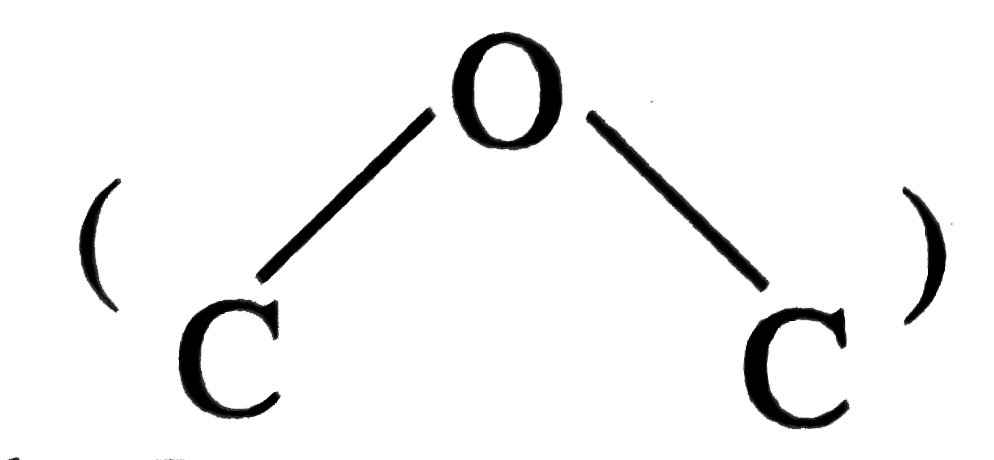 donot cancel out. donot cancel out.
|
|
| 42. |
Assertion : Ethers behave as bases in the presence of mineral Reason : Due to the presence of lone electron pair on the oxygen atom. |
|
Answer» BOTHA and B are true and R is the CORRECT explanation of A. |
|
| 43. |
Assertion : Ethers behave as bases in the presence of mineral acids. Reason : Due to the presence of lone electrons pair on the oxygen atom. |
|
Answer» If both assertion and REASON are CORRECT and reason is correct EXPLANATION for assertion. |
|
| 44. |
Assertion :Etherates are coordinates complexes of ethers with Lewis acids. Reason : Ethers are easily cleaved by mineral acids such as HCl and H_(2)SO_(4) at 373 K. |
|
Answer» if both ASSERTION and reason are TRUE and the reason is the correct EXPLANATION of the assertion |
|
| 45. |
Assertion: Ethanol is a weaker aciid than phenol. Reason: Sodium ethoxide may be prepared by the reaction of ethanol with aqueous NaOH. |
|
Answer» Assertion and reason both are correct and reason is correct EXPLANATION of assertion. |
|
| 46. |
Assertion : Etard reaction helps to stop the oxidation of toluene at the aldehydestage. Reason : Chromyl chloride oxidises methyl group to a chromium complex, which on hydrolysis gives corresponding benzaldehyde. |
|
Answer» If both assertion and REASON are true and reason is the CORRECT EXPLANATION of assertion. |
|
| 47. |
Assertion: Equlibrium constant has meaning only when the corresponding balanced chemical equation is given. Reason: Its value changes for the new equation obtained by multiplying or dividing the original equation by a number |
|
Answer» If both ASSERTION and REASON are true and the reason is the CORRECT explanation of the assertion. |
|
| 48. |
Assertion : Equivalent weight of Cu in CuO is 63.6 and in Cu_(2)O 31.8. Reason : Equivalent weight of an element =("Atomic weight of the element")/("Valency of the element") |
|
Answer» If both assertion and reason are TRUE and the reason is the CORRECT explanation of the assertion. Equivalent wt. of Cu in `Cu_(2)O=63.6/1=63.6` (Valency of `Cu=1`). |
|
| 49. |
Assertion. Equivalent weight of a base=("Molecular weight")/("Acidity") Reason. Acidity is the number of replaceable hydrogen atoms in one molecule of the base. |
|
Answer» If both assertion and REASON are TRUE, and reason is the true explanation of the assertion. |
|
| 50. |
Assertion. Equivalent mass of KMnO_(4) is same in the neutral as well alkalinemedium. Reason. The product formed in both cases in MnO_(2). |
| Answer» SOLUTION :R is the CORRECT EXPLANATION of A. | |