

Saved Bookmarks
This section includes 7 InterviewSolutions, each offering curated multiple-choice questions to sharpen your Current Affairs knowledge and support exam preparation. Choose a topic below to get started.
| 1. |
Assertion: Equivalent mass of K_(2) Cr_(2) O_(7) whenit actsas anoxidisingagentin acidicmediumis M// 6 Reason: Duringreductionoxidationnumberof chromiumchange from+6to + 3 |
|
Answer» Bothassertion andreasonare trueandreasonis thecorrectexplanation of thehassertion |
|
| 2. |
Assertion. Equal moles of different substances contain same number of constituent particles. Reason. Equal weights of different substances contain the same number of constituent particles. |
|
Answer» If both ASSERTION and reason are true, and reason is the true explanation of the assertion. |
|
| 3. |
Assertion : Enzymes have active sites that hold substrate molecule for a chemical reaction. Reason: Drugs compete with natural substrate by attaching covalently to the active site of enzyme |
|
Answer» Assertion and reason both are CORRECT statement but reason does not EXPLAIN assertion |
|
| 4. |
Assertion (A) Enzymes have active sites that hold substrte molecule for a chemical reaction. Reason (R) Drugs compete with natural substrate by attaching convalency to the active site of enzyme. |
|
Answer» Assertion and REASON both are correct STATEMENT but reason does not EXPLAIN assertion. |
|
| 5. |
Assertion :- Entropy of system increases for a spontaneous reactions. Reason :- Enthalpy of reaction always decreases for spontaneous reaction. |
|
Answer» If both Assertion & Reason are TRUE & the Reason is a CORRECT EXPLANATION of the Assertion. |
|
| 6. |
Assertion : Entropy of ice is less than water. Reason : Ice have cage like structure. |
|
Answer» If both assertion and reason are true and the reason is the CORRECT explanation of the assertion. |
|
| 7. |
Assertion :- Entropy is always constant for a closed system. Reason :- Closed system is always reversible. |
|
Answer» If both Assertion & REASON are True & the Reason is a CORRECT explanation of the Assertion. |
|
| 8. |
Assertion : Enthalpy and entropy of any elementary substance in the standard state are taken as zero. Reason : At zero degree completely motionless. |
|
Answer» If both ASSERTION and REASON are TRUE and the reason is the CORRECT explanation of the assertion. |
|
| 9. |
Assertion :- End systolic volume is 50ml Reason :- Stroke volume is 70ml |
|
Answer» If both ASSERTION & Reason are TRUE & the Reason is a CORRECT explanation of the Assertion. |
|
| 10. |
Assertion. Empirical and molecular formula of Na_(2)CO_(3) is same. Reason. Na_(2)CO_(3) does not form hydrates. |
|
Answer» If both assertion and reason are true, and reason is the true EXPLANATION of the assertion. |
|
| 11. |
Assertion: E.m.f. and potential difference are same for cell. Reason: Both gives the difference in electrode potential under any condition. |
|
Answer» if both assertion and reason are true and the reason is the correct explanation of the assertion. |
|
| 12. |
Assertion: Elevation in boiling point is inversely proportional to lowering of vapour pressure for dilute solutions. Reason: Lowering of vapour pressure is directly proportional to mole fraction of solvent. |
|
Answer» Both ASSERTION and Reason are true and Reason is the correct EXPLANATION of Assertion |
|
| 13. |
Assertion :- Elevation in boiling point and depression in freezing point are colligative properties. Reason :- All colligative properties are used for the calculation of molecular masses. |
|
Answer» If both assertion and reason are true and the reason is the correct explanation of the assertion. |
|
| 14. |
Assertion. Elementary phosphorus exists in three principal allotropic forms, i.e., white (yellow), red (or violet) and black. Reason. Of the three forms, white phosphorus is the most important and most reactive. |
|
Answer» If both assertion and reason are true, and reason is the correct explanation of the assertion. |
|
| 15. |
Assertion: Electron withdrawing groups decrease the acidity of carboxylic acids. Reason: Substituents affect the stability of the conjugate base and acidity of carboxylic acids. |
|
Answer» If both ASSERTION and REASON are true and the reason is the CORRECT explanation of the assertion. |
|
| 16. |
Assertion: Electron withdrawing groups in aryl halides decrease the reactivity towards nucleophilic substitution. Reason: 2,4-Dinitrochlorobenzene is less reactive than chlorobenzene. |
|
Answer» If both Assertion and reason are true and the reason is the CORRECT EXPLANATION of the assertion. 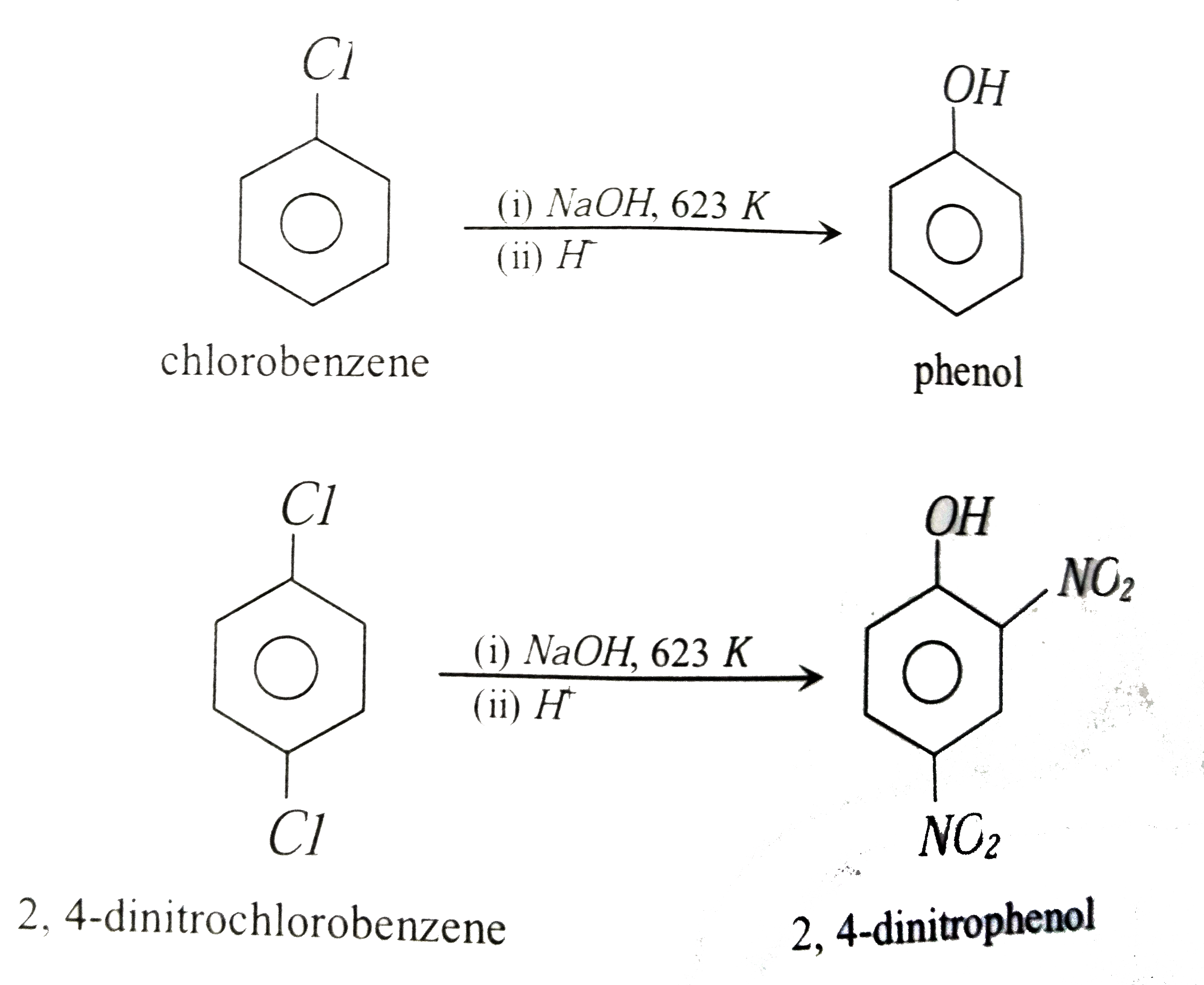
|
|
| 17. |
Assertion :- Electron gain enthalpy strictly becomes less negative on moving down the group. Reason :- Size increases and addition of extra electron is close to nucleas on moving down the group. |
|
Answer» If both ASSERTION & Reason are True & the Reason is a CORRECT EXPLANATION of the Assertion. |
|
| 18. |
Assertion: Electrolysis of NaCl solution gives chlorine at anode instead of O_(2). Reason: Formation of oxygen at anode requires overvoltage. |
|
Answer» Both ASSERTION and REASON are TRUE and the reason is the CORRECT EXPLANATION of assertion. |
|
| 19. |
Assertion : Electrolysis of NaCl solution gives chlorine at anode instead of O_(2). Reason: Formation of oxygen at anode requires over voltage. |
|
Answer» Both assertion and REASON are true and the reason is the correct explanation of assertion. `Cl_((aq))^(-) to (1)/(2) Cl_(2(g))+e^(-),E_(CELL)^(THETA)=1.36V`. . (Oxidation) `H_(2)O_((l)) to (1)/(2)O_(2(g))+4H_((aq))^(+)+4e^(-) , E_(cell)^(Theta)=1.23V` . . (Oxidation) * Lower value of `E_(cell)` is preferred but due to over voltage CHLORINE is liberated at anode. |
|
| 20. |
Assertion : Electrolysis of NaCl (aq) produces Na metal. Reason : Na^(+) ion is obtained at cathode. |
|
Answer» If both assertion and REASON are correct and reason is correct EXPLANATION for assertion. Correct reason. `H_(2)` is liberated at CATHODE. |
|
| 21. |
Assertion:Electrolysis of NaCl solution gives chlorine at anode instead of O_(2). Reason:Formation of oxygen at anode requires overvoltage. |
|
Answer» Both ASSERTION and REACTION are true and the reason is correct explanation for assertion |
|
| 22. |
Assertion : Electrolysis of molten PbBr_(2) using platinum electrodes produces Br_(2) at anode. Reason : Br_(2) is obtained in gaseous state at room temperature. |
|
Answer» If both assertion and reason are correct and reason is correct explanation for assertion. <BR>If both assertion and reason are correct but reason is not correct explanation for assertion. `2Br^(-) to Br_(2)+2e^(-)`. |
|
| 23. |
Assertion: Electrolysis of molten CaH_(2) products hydrgen gas at anode. Reason: In CaH_(2), hydrogen is present in the form of H^(-). |
|
Answer» If both ASSERTION and REASON are true, and reason is the true EXPLANATION of the assertion At andoe: `H^(-)toH+e^(-),H+HtoH_(2)` Hence, R is the CORRET explanation of A. |
|
| 24. |
Assertion: Electrical conductivity of copper inicreases with increase in temperature. Reason: The electrical conductivity of metals is due to the motion of electrons. |
|
Answer» if both ASSERTION and reason are true and the reason is the correct explanation of the assertion. |
|
| 25. |
Assertion : Electro dialysis is carried out under the influence of electric field. Reason : The combination of three layers of charges around the sol particle is called Helmholtz double layer. |
|
Answer» (A) and (R) are true and (R) is the correct EXPLANATION of (A) |
|
| 26. |
Assertion. EDTA is a hexadentate ligand. Reason. Denticity of a ligand is given by number of lone pairs donated to central atom by a ligand. |
|
Answer» If both assertion and reason are true, but reason is not the true EXPLANATION of the assertion |
|
| 27. |
Assertion: E_(cell) should have a positive value for the cell to function. Reason: E_("cathode") lt E_("anode") |
|
Answer» Both assertion and reason are true and the reason is the correct EXPLANATION of assertion. |
|
| 28. |
Assertion : E_(cell)^(@) should have a positive value for the cell to function. Reason : E_("Cathode") lt E_("Anode") |
|
Answer» Both ASSERTION and reason are true and the reason is the correct EXPLANATION of assertion. For the cell reaction to be FEASIBLE `E_("Cathode")` should be positive. `-DeltaG^(Theta)=nF" "E_(cell)^(Theta)` * `E_(cell)` for the VALUE of `E_(cell)` to be positive, `E_("Cathode") GT E_("Anode")` |
|
| 29. |
Assertion : E_(Ag^(+)|Ag)^(Theta) increases with increases in concentration of Ag^(+) ions. Reason : E_(Ag^(+)|Ag)^(Theta) has a positive value. |
|
Answer» Both assertion and reason are TRUE and the reason is the CORRECT explanation of assertion. |
|
| 30. |
Assertion: E_(Ag^(+)//Ag)^(@) increases with increase in concentration of Ag^(+) ions. Reason: E_(Ag^(+)//Ag) has a positive value. |
|
Answer» Both assertion and reason are true and the reason is the correct explanation of assertion. |
|
| 31. |
Assertion:E_(Ag^(+)//Ag increases with in concentration of Ag^(+) ions. Reason:E_(Ag^(+)//Ag) has a positive value. |
|
Answer» Both assertion and reaction are true and the reason is CORRECT explanation for assertion |
|
| 32. |
Assertion. E^(@) for Mn^(3+)//Mn^(2+) is more positivethan for Cr^(3+) //Cr^(2+) . Reason. The thirdionization energy of Mn is larger than that of Cr. |
| Answer» SOLUTION :R is the CORRECT EXPLANATION OFA. | |
| 33. |
Assertion : E_(a) of the forward reaction is higher than that of backward reaction in a reversible endothermic reaction. Reason : Increasing the tempreature of the substance increases the fraction of molecules which collide with energies greater than E_(a). |
|
Answer» If both assertion and reason are TRUE and reason is the correct explanation of assertion. |
|
| 34. |
Assertion : During test for nitrogen with Lassaigne extract on adding FeCl_(3) obtain solution sometimes a red precipitate is obtained. Reason :Sulphur is also present. |
|
Answer» If both assertion and reason are true and the reason is the correct explanation of the assertion. `3NaCNS + FeCl_(3) rarr underset(" Red colour")(Fe(CNS)_(3) + 3NaCl)` |
|
| 35. |
Assertion :- During physical adsorption multimolecular layers are formed. Reason :- For physical adsorption value of Delta H=-20 to -40 kJ/mol. |
|
Answer» If both Assertion & REASON are True & the Reason is a CORRECT EXPLANATION of the Assertion. |
|
| 36. |
Assertion : During digestion with concentrated H_(2)SO_(4), Nitrogenof the organic compound is converted into (NH_(4))_(2)SO_(4). Reason : (NH_(4))_(2)SO_(4)On heating with akali liberatesNH_(3). |
|
Answer» If both ASSERTION and reason are TRUE and the reason is the CORRECT explanation of the assertion. |
|
| 37. |
Assertion : During a chemical reaction, total moles remains constant. Reason: During a chemical reaction, total mass remains constant. |
|
Answer» Statement-1 is TRUE, statement-2 is true and statement-2 is CORRECT explanation for statement-1. |
|
| 38. |
Assertion : due to Frenkel defect, density of the crystalline solid decreases. Reason : in Frenkel defect cation and anion leaves the crystal. |
|
Answer» Both ASSERTION and REASON are true and reason is the CORRECT explanation of assertion. |
|
| 39. |
Assertion : Dry SO_(2) does not bleach dry flowers Reason: The bleaching action of SO_(2) is due to its readucing nature |
|
Answer» Statement-I and Statement-II are CORRECT and Statement-II is correct EXPLANATION of Statement-I |
|
| 40. |
Assertion- Diusruption of the natural structure of a protein is called denaturation. Reason : The change in colour and appearance of egg during cooking is due to denaturation. |
|
Answer» Both Assertion and Reason are true and reason is the correct explanation of Assertion. |
|
| 41. |
Assertion : Dissolution of concentrated H_(2)SO_(4) in water is highly exothermic process. Reason : Sulphuric acid is always diluted by adding acid to water slowly. |
|
Answer» Both ASSERTION and reason are TRUE and reason is the CORRECT explanation of the assertion |
|
| 42. |
Assertion: Disruption of the natural structural of a protein is called denaturation. Reason: The change in colour and apperance of egg during cooking is due to denaturation. |
|
Answer» If both ASSERTION and reason are true and the reason is the correct EXPLANATION of the assertion. |
|
| 43. |
Assertion : Dipole moment of NF_(3) is less than that of NH_(3). Reason : polarity of N-F bond is less than that of N-H bond. |
|
Answer» If ASSERTION is true but the REASON is false |
|
| 44. |
Assertion : Direct attachment of groups such as phenyl or vinyl to the carboxylic acid, increases the acidity of the carboxylic acid. Reason : Resonance effect always increases the acidity of carboxylic acids. |
|
Answer» If both ASSERTION and REASON are TRUE and reason is the correct EXPLANATION of assertion. |
|
| 45. |
Assertion : Dinegative anion of oxygen (O^(2-)) is quite common but dinegative anion of sulphur (S^(2-)) is less common. Reason : Covalency of oxygen is two. |
|
Answer» If both assertion and REASON are true and the reason is the correct EXPLANATION of the assertion |
|
| 46. |
Assertion : Dinegativeanion of oxygen(O^(2-))is quite common but dinegativeanion of sulphur(S^(2-))is less common. Reason : Covalency of oxygen is two. |
|
Answer» If both the ASSERTION and reason are true andreason is CORRECT EXPLANATION of the assertion . |
|
| 47. |
Assertion: Diastereomers hae different physical properties. Reason: These are non-superimporsable mirror images. |
|
Answer» If both assertion and REASON are CORRECT and reason is correct explanation for assertion |
|
| 48. |
Assertion : Diastereoisomers have different physical properties. Reason : They are non-superimposable mirror images. |
|
Answer» If both ASSERTION and reason are true and the reason is the CORRECT explanation of the assertion |
|
| 49. |
Assertion : Diagonal relationship is shown between Be and Al. Reason : Ionization potential of Be is almost the same as that of Al. |
|
Answer» If both (A) and (R) are TRUE and (R) is the \CORRECT explanation of (A) |
|
| 50. |
Assertion : Detergents with straight chain of hydrocarbons are preferredover branched chain. Reason : Detergentswith brached chain hydrocarbon part are expensive. |
|
Answer» If both assertion and REASON are trueand reason is the correct explanationof assertion . |
|