

Saved Bookmarks
This section includes 7 InterviewSolutions, each offering curated multiple-choice questions to sharpen your Current Affairs knowledge and support exam preparation. Choose a topic below to get started.
| 1. |
Assertion (A) : Methyl cyanide has higher boiling point than methyl isocyanide. Reason (R ) : Dipole moment of methyl cyanide is higher than that of methyl iso cyanide. |
|
Answer» (A) and (R ) are true and (R ) is the correct EXPLAINATION of (A) |
|
| 2. |
Assertion (A) : Metallurgy of Ag from argentite is known as hydro-metallurgy. Reason (R ) : Argentite is Ag_(2)S. |
|
Answer» Both (A) and (R ) are TRUE and (R ) is the CORRECT EXPLANATION of (A). |
|
| 3. |
Assertion (A) : Metallic zinc is used in galvanising metals such as iron and steel. Reason (R ) : Zinc is also used to produce die castings. |
|
Answer» Both (A) and (R ) are TRUE and (R ) is the CORRECT EXPLANATION of (A). |
|
| 4. |
Assertion (A): MeMgBr should be preapared under perfectlyanhydrous conditions. Reason (R):Grinardreagent reacts with water. |
|
Answer» Both `(A)` and `(R)` are true and `(R0` is the correct EXPLANATION of `(A)`. |
|
| 5. |
Assertion (A): Melamine and acetaldehyde are the monomers for the preparation of melamine polymers. Reason (R) Butadiene-styrene copolymer is quite tough and is a good substitute for natural rubber. |
|
Answer» Both Assertion (A) and REASON (R) are CORRECT STATEMENTS, and Rerson (R) is the correct explanation of the Assertion (A) |
|
| 6. |
Assertion (A) : Many gemstones are impure form of Al_(2)O_(3). Reason (S) : A downward stream of running water is used in hydraulic washing. |
|
Answer» Both A and R are correct STATEMENT, and R is the correct EXPLANATION of the A. |
|
| 7. |
Assertion (A): Maltose is obtained by the hydrolysis of sucrose. Reason (R) : Citrus fruits and green leafy vegetables contain vitamin C. |
|
Answer» Both Assertion (A) and REASON (R) are correct statementand Reason (R) is the correctexplanationof the Assertion (A). |
|
| 8. |
Assertion (A) : Lyphobic colloids are solvent loving and are prepared by direct mixing of the dispersed phase in dispersion medium. Reason (R) : Substances that enhance the activity of catalyst are called promotars. |
|
Answer» Both ASSERTION (A) and Reason (R) are CORRECT STATEMENTS, and Reason (R) is the correct EXPLANATION of the Assertion (A). |
|
| 9. |
Assertion (A) : Lyophobic sols are more stable than lyophilic sols. Reason (R) : The process of settling colloidal particles is called coagulation. |
|
Answer» Both Assertion (A) and Reason (R) are correct STATEMENTS, and Reason (R) is the correct EXPLANATION of the Assertion (A). |
|
| 10. |
Assertion (A): Lyophobic colloids like sols of gold will precipitate readily. Reason (R) : In lyophobic colloids, no attractive force exists between the dispersed phase and dispersion medium and are less stable. |
|
Answer» Both A and R are CORRECT and R is the correct EXPLANATION of A. |
|
| 11. |
Assertion (A): Lyophillic colloids will not get precipitated easily. Reason (R) : In lyophillic colloids, definite attractive forces exists between dispersion medium and dispersed phase and they are more stable. |
|
Answer» Both A and R are CORRECT and R is the correct EXPLANATION of A. |
|
| 12. |
Assertion (A): Low spin tetrahedral complexes are rarely observed. Reason(R ): Crystal field splitting energy is less than pairing energy for tetrahedral complexes. |
|
Answer» Both Assertion (A) and Reason (R ) are CORRECT STATEMENTS, and Reason ( R) is the correct explanation of the Assertion (A) |
|
| 13. |
Assertion (A) : Low spin tetrahedral complexes are rarely observed. Reason (R ) : The orbital splitting energies are not sufficiently large to forcing pairing |
|
Answer» Both Assertion (A) and REASON (R ) are CORRECT statements, and Reason (R ) is the correct EXPLANATION of the Assertion (A). |
|
| 14. |
Assertion (A) : Linkage isomerism is studied under stereoisomerism. Reason (R) : The names of coordination compounds are derived by following the principles of additive nomenclature. |
|
Answer» Both Assertion (A) and REASON (R) are CORRECT STATEMENTS, and Reason (R) is the correct EXPLATION of the Assertion (A). |
|
| 15. |
Assertion (A) : Linkage isomerism arises in a coordination compound containing ambidentate ligand. Reason (R) : Coordination isomerism arises from the interchange of ligands between cationic and anionic entities of different metal ions present in the complex. |
|
Answer» Both ASSERTION (A) and Reason (R) are CORRECT statements, and Reason (R) is the correct EXPLATION of the Assertion (A). |
|
| 16. |
Assertion (A) : Linkage isomerism arises in coordination compounds because of ambidentateligand. Reason (R ) : Ambidentate ligand like NO_(2) has two different donor atoms i.e., N and O. |
|
Answer» Both ASSERTION (A) and Reason (R ) are correct STATEMENTS, and Reason (R ) is the correct explanation of the Assertion (A). |
|
| 17. |
Assertion (A): Like bromination of benzene bromination of phenol is also carried out in presence of Lewis acid. Reason (R) : Lewis acid polarises bromine molecule. |
|
Answer» Assertion and reason both are correct statements and reason explains the assertion. |
|
| 18. |
Assertion (A): Latex is a colloidal solution of rubber in water. Reason (R) : Natural rubber may be considered as a linear polymer of isoprene. |
|
Answer» Both Assertion (A) and REASON (R) are correct STATEMENTS, and Rerson (R) is the correct explanation of the Assertion (A) |
|
| 19. |
Assertion: A large dry cell has high e.m.f. Reason: The e.m.fof a dry cell is proportional to its size. |
|
Answer» if both ASSERTION and REASON are true and the reason is the CORRECT explanation of the assertion. |
|
| 20. |
Assertion (A) : Kohlrausch law states that limiting molar conductivity of an electrolyte can be represented as the difference of individual contributions of the anion and the cation. Reason (R): A cell in which an external source of voltage is used to bring about a chemical reaction is called electrolytic solution. |
|
Answer» Both ASSERTION (A) and REASON (R) are correct statements, and Reason (R) is the correct explanation of the Assertion (A). |
|
| 21. |
Assertion (A) : IUPAC name of the compound is 2-ethoxy-2-methylethane CH_(3)- underset(CH_(3))underset(|)CH-O-CH_(2)- CH_(2)- CH_(3) Reason (R) : In IUPAC nomenclature, ether is regarded as hydrocarbon derivative in which a hydrogen atom is replaced by -OR or -OAr group. [R = alkyl group, Ar = aryl group] |
|
Answer» Assertion and reason both are CORRECT statements and reason explains the assertion. |
|
| 22. |
Assertion (A) : KCN reacts with methyl chloride to give methyl isocyanide.Reason (R ) : CN^(-) is an ambident nucleophile. |
|
Answer» Assertion and reason both are correct and reason is correct EXPLANATION of assertion. |
|
| 23. |
Assertion (A) : IUPAC name of ethanamine is ethylamine. Reason (R) : In IUPAC system, C_(6)H_(5)-NH_(2) is named as benzenamine. |
|
Answer» Both Assertion (A) and Reason (R) are CORRECT STATEMENTS, and Reason (R) is the correct EXPLANATION of the Assertion (A). |
|
| 24. |
Assertion (A) : It is difficult to replace chlorine by - OH in chlorobenzene in comparison to that in chloroethane.Reason (R ) : Chlorine - carbon (C - Cl) bond in chlorobenzene has a partial double bond character due to resonance. |
|
Answer» Assertion and reason both are CORRECT and reason is correct EXPLANATION of assertion. 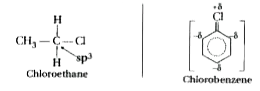
|
|
| 25. |
Assertion (A): Iron colloid cannot be prepared by Bredig's are method. Reason (R): Iron cannot react with alkali hydroxide stabilising agent added in water. |
|
Answer» Both A and R are CORRECT and R is the correct EXPLANATION of A. |
|
| 26. |
Assertion (A) : Ions of the same charge in a given series show progressive decrease in radius with increasing atomic number. Reason (R) : The new electron enters a d-orbital each time the nuclear charge increases by unity. |
|
Answer» Both Assertion (A) and REASON (R) are CORRECT statements, and Reason (R) is the correct explanation of the Assertion (A). |
|
| 27. |
Assertion (A) : Industrially, sulphur dioxide is produced as a byproduct of roasting of sulphide ores. Reason (R) : In the reaction of SO_2 with water and alkalies, the behaviour of SO_2 is very similar to that of CO_2. |
|
Answer» Both Assertion (A) and Reason (R) are CORRECT STATEMENTS, and Reason (R) is the correct explanation of the Assertion (A) |
|
| 28. |
Assertion (A) : Ionic solids do not conduct electricity in solid state but in molten state they conduct electricity. Reason (R) : In solid state, the ions are fixed in their lattice positions but in molten state, the ions are free to move and conduct electricity |
|
Answer» Both A and R are CORRECT but R is not the correct EXPLANATION of A |
|
| 29. |
Assertion (A): In transition metal series, the ionization enthalpy increases. Reason (R): This is due to increase in nuclear charge corresponding to the filling of d electrons. |
|
Answer» Both (A) and (R) are CORRECT and (R) EXPLAINS (A). |
|
| 30. |
Assertion (A) : In the complex ions [Fe(C_(2)O_(4))_(3)]^(3-), the coordination number of Fe is six. Reason (R) : Complexes in which a metal is bound to only one kind of groups are called hornoleptic. |
|
Answer» Both ASSERTION (A) and Reason (R) are correct STATEMENTS, and Reason (R) is the correct explation of the Assertion (A). |
|
| 31. |
Assertion (A) : In the complex ion [PtCl_(6)]^(2-), the coordination number of Pt is 6. Reason (R) : Both double salts as well as complexes are formed by the combination of two or more stable compounds in stoichiometric ratio. |
|
Answer» Both Assertion (A) and REASON (R) are correct statements, and Reason (R) is the correct explation of the Assertion (A). |
|
| 32. |
Assertion (A): In the case of optically active alkyl halide, the product formed as a result of S_(N)2 mechanism has the inverted configuration as compared to the reactant.Reason (R) In S_(N)2 mechanism, the nucleophile attaches itself on the side opposite to the one where the halogen is present resulting in inversion in configuration of the product. |
|
Answer» Both Assertion (A) and Resort (R) are correct statements, QUID Reason (R) is the correct explanation of the Assertion (A). |
|
| 33. |
Assertion (A) : In presence of enzymes, substrate molecule can be attacked by the reagent effectively. Reason (R) : Active sites of enzymes hold the substrate molecule in a suitable position. |
|
Answer» ASSERTION and REASON both are correct STATEMENTS and reason explains the assertion. |
|
| 34. |
Assertion (A) In presence of enzyme, substrate molecule can be attacked by the reagent effectively. Reason (R) Active sites of enzymes hold the substrate molecule in a suitable position. |
|
Answer» If both ASSERTION and REASON are TRUE and reason is the CORRECT EXPLANATION of assertion. |
|
| 35. |
Assertion (A) : In order to convert R-Cl to pure R-NH_(2) Gabriel Phthalimide synthesis can be used. Reason (R) : Phthalimide synthesis can be used to prepare pure 1^(@) or 2^(@) or 3^(@) amines separately with proper choice of alkyl halide. |
|
Answer» Both A and R are TRUE and R is the correct EXPLANATION of A. |
|
| 36. |
Assertion (A) : In K_(4)[Fe(CN)_(6)], the coordination number is six. Reason (R ) : The number of sigma bonds between ligands and the central metal atom is known as coordination number. |
|
Answer» Both A and R are CORRECT and R is the correct EXPLANATION of A. |
|
| 37. |
Assertion (A) : In monohaloarenes, further electrophilic substitution occurs at ortho and para positions.Reason (R ). Halogen atom is a ring deactivator. |
|
Answer» ASSERTION and REASON both are CORRECT and reason is correct EXPLANATION of assertion. |
|
| 38. |
Assertion (A) : In Daniel cell, the salt bridge contains an agar-agar gel mixed with an inert electrolyte KCl (or) Na_2SO_4 Reason (R) : The ions of inert electrolyte do not react with other ions present in half cells and they are not either oxidised or reduced at electrodes. |
|
Answer» Both A and R are CORRECT |
|
| 39. |
Assertion (A) : In H_(2) Cl_(2) and I_(2), the atoms or molecules are held by weak dispersion forces. Reason (R) : Diamond and silicon carbide are examples of ionic solids. |
|
Answer» Both ASSERTION (A) and Reason (R) are correct STATEMENTS, and Reason (R) is the correct EXPLANATION of the Assertion (A). |
|
| 40. |
Assertion (A): IN comparison to C_(2) H_(5)Br, it is difficultto carry out SN reaction o vinylbromide. Reason (R):Vinyl groupis electrondonating. |
|
Answer» Both `(A)` and `(R)` are true and `(R0` is the correct explanation of `(A)`. `(C-X)` bond has some double bond character. |
|
| 41. |
Assertion (A) : In bcc, the available volume is more efficiently used than in simple cubic packing. Reason (R) : In simple cubic arrangement, the number of spheres belongs to a unit cell is equal to one whereas in bcc, it is equal to 2. |
|
Answer» Both A and R are CORRECT and R is the correct EXPLANATION of A. |
|
| 42. |
Assertion (A) : In a reversible endothermic reaction, E_("act") of forward reaction is more than that of backward reaction. Reason (R ) : The threshold energy of the forward reaction is more than that of the backward reaction. |
|
Answer» Both ASSERTION (A) and Reason (R ) are correct statements, and Reason (R ) is the correct explanation of the Assertion (A). |
|
| 43. |
Assertion (A): In 3d transition elements, the expected decrease in atomic radius is observed from Sc to V, thereafter upto Cu, the atomic radius nearly remains the same. Reason (R): As we move from Sc to V, the added 3d electrons only partially shield the increased nuclear charge but upto Cu, the extra electron added to 3d sub-shell repel the 4s electrons and the slight increase in nuclear charge operated in opposite direction and it leads to constancy in atomic radii. |
|
Answer» Both (A) and (R) are CORRECT and (R) EXPLAINS (A). |
|
| 44. |
Assertion (A) : If the temperature of the electrolytic solution increases, conductance also increases. Reason (R) : Increase in temperature increases the kinetic energy of the ions and decreases the attractive force between the oppositely charged ions and hence conductivity increases. |
|
Answer» Both A and R are CORRECT and R is the correct EXPLANATION of A |
|
| 45. |
Assertion (A): If the standard reduction potential of an electrode is greater than zero, then its reduced form is less stable compared to hydrogen gas. Reason (R) : Standard hydrogen electrode represented by Pt (s)|H_(2) (g)|H^+(aq) is assigned a zero potential at all temperatures. |
|
Answer» Both ASSERTION (A) and REASON (R) are CORRECT statements, and Reason (R) is the correct explanation of the Assertion (A). |
|
| 46. |
Assertion (A) : If the solution does not obey Raoult's law over the entire range of concentration,it is called non-ideal solution.Reason (R) : Azeotropes are binary mixtures which have the same composition in liquid and vapour phase. |
|
Answer» Both Assertion (A) and REASON (R) are CORRECT statements, and Reason (R) is the correct EXPLANATION of the Assertion (A). |
|
| 47. |
Assertion (A) : If the activation energy of a reaction is zero, temperature will have no effect on the rate constant Reason (R) :Lower the activation energy , faster is the reaction . |
|
Answer» Both A and R are CORRECT and R is the correct EXPLANATION of A |
|
| 48. |
Assertion (A) : If manganese dioxide is added to potassium chlorate and the mixture is heated, we get O_2 gas at a much lower temperature. Reason (R) : If a catalyst is added to the reagent, the activation energy is lowered. |
|
Answer» Both Assertion (A) and REASON (R) are correct statements, and Reason (R) is the correct EXPLANATION of the Assertion (A). |
|
| 49. |
Assertion (A) : If an iron rod is dipped in CuSO_4 solution, then blue colour of solution turns red. Reason (R) : Iron is more reactive than copper and so iron displaces copper from CuSO_4 solution. |
|
Answer» Both A and R are CORRECT, but R is not the correct EXPLANATION of A. |
|
| 50. |
Assertion (A) : If an iron rod is dipped in CuSO_(4) solution, then blue colour of the solution truns red. Reason (R ): Iron is more reactive than copper and so iron displaces copper from CuSO_(4) solution. |
|
Answer» Both A and R are correct and R is the correct explanation of A |
|