

Saved Bookmarks
This section includes 7 InterviewSolutions, each offering curated multiple-choice questions to sharpen your Current Affairs knowledge and support exam preparation. Choose a topic below to get started.
| 1. |
Among the following halide ions (X^-) reaction, which is feasible is? |
|
Answer» `x^-)+CH_3-CH_2-H rarr CH_3-CH_2-X+H^-` |
|
| 2. |
Among the following groups of oxides, the group containing oxides that cannot be reduced by carbon to give the respective metals is |
|
Answer» `Cu_(2)O, SnO_(2)` |
|
| 3. |
Among the following halide ions (X^-) reaction, which is feasible? |
|
Answer»
|
|
| 4. |
Among the following group of oxides, the group containing oxides that cannot be reduced by carbon to give the respective metals , is : |
|
Answer» `Cu_2O , SnO_2` |
|
| 5. |
Among the following group-I carbonate having highest solubility ? |
| Answer» Answer :D | |
| 6. |
Among the following group of element, the one whose element can have positive as well as negative oxidation states are : |
| Answer» Answer :D | |
| 7. |
Among the following graphs showing variation of rate constant with temperature (T) for a reaction, the one that exhibits Arrhenius behavior over the entire temperature range is ......... |
|
Answer» Solution :`k=Ae^(((E_a)/(RT)))` ` LN k = ln A - ((E_a)/R)(1/T)` this equation is in the form of a straight line with NEGATIVE slope . |
|
| 8. |
Amongthe followinggraphsshowingvariationof rateconstantwithtemperature(T) for areactionthe onethatexhibitsArrheniusbehaviorover theenituretemperaturerangeis ….. |
|
Answer»
|
|
| 9. |
Among the following given chlorides,covalent in nature is |
|
Answer» `MgCl_2` |
|
| 10. |
Among the following four structures I to IV (I) H_(5)C_(2)-overset(CH_(3))overset(|)(C)H-C_(3)H_(7) (II) H_(3)C-overset(O)overset(|)(C)-overset(CH_(3))overset(|)(C)H-CH_(2)H_(5) (III) H-underset(H)underset(|)overset(H)overset(|)(H^(+)) (IV) H_(5)C_(2)-overset(CH_(3))overset(|)(C)H-C_(2)H_(5) In is true that |
|
Answer» only II and IV are CHIRAL compounds |
|
| 11. |
Amongthe following four structures 1 to 4. {:(1,C_(2)H_(5)-overset(CH_(3)) overset(|)(CH)-C_(3)H_(7),3,CH_(3)- overset(CH_(3)) overset(|)(CH)-COCH_(3)),(2,CH_(3)CO underset(CH_(3)) underset(|)(CH)-C_(2)H_(5),4,C_(2)H_(5)-overset(CH_(3)) overset(|)(CH)-C_(2)H_(5)):} |
|
Answer» |
|
| 12. |
Among the following four compounds (i) phenol (ii) methylphenol (iii) meta-nitrophenol (iv) para-nitrophenol the acidity order is : |
|
Answer» `II GT i gt III gt IV`  
|
|
| 13. |
among the following four compounds (i) phenol (ii) methylphenol (iii) meta - nitrophenol(iv) para -nitrophenol the acidity order is: |
|
Answer» `II gtigtiiigtiv` 
|
|
| 14. |
Among the following four compounds (i) phenol (ii) methylphenol (iii) meta-nitrophenol (iv) para-nitrophenol the acidity order is |
|
Answer» (iv)gt(iii)gt(i)gt(ii) p-nitrophenol (iv)gt m-nitrophenol (iii)gtphenol (i) gtmethylphenol (ii) i.e., option (a) is correct. |
|
| 15. |
Arrange the following in the increasing acidic strength: Phenol, o-chlorophenol, m-chlorophenol and p-chlorophenol. |
|
Answer» IV GT III gt I gt II |
|
| 16. |
Among the following for spontaneity of chemical reaction there should be |
|
Answer» DECREASE in entropy and increase in FREE ENERGY |
|
| 17. |
Among the following find the incorrect statement: |
|
Answer» stability of LYOPHILIC colloids is mainly due to the strong interaction between dispersed particle and DISPERSION medium. |
|
| 18. |
Among the following ethers which one will produce methyl alcohol on treatment with hot HI? |
|
Answer» `(H_(3)C)_(3)-C-O-CH_(3)` |
|
| 19. |
Among the following ethers, which one will produce methyl alcohol on treatment with hot concentreated HI? |
|
Answer» `CH_3-UNDERSET(CH_(3))underset(|)CH-CH_2-O-CH_3` 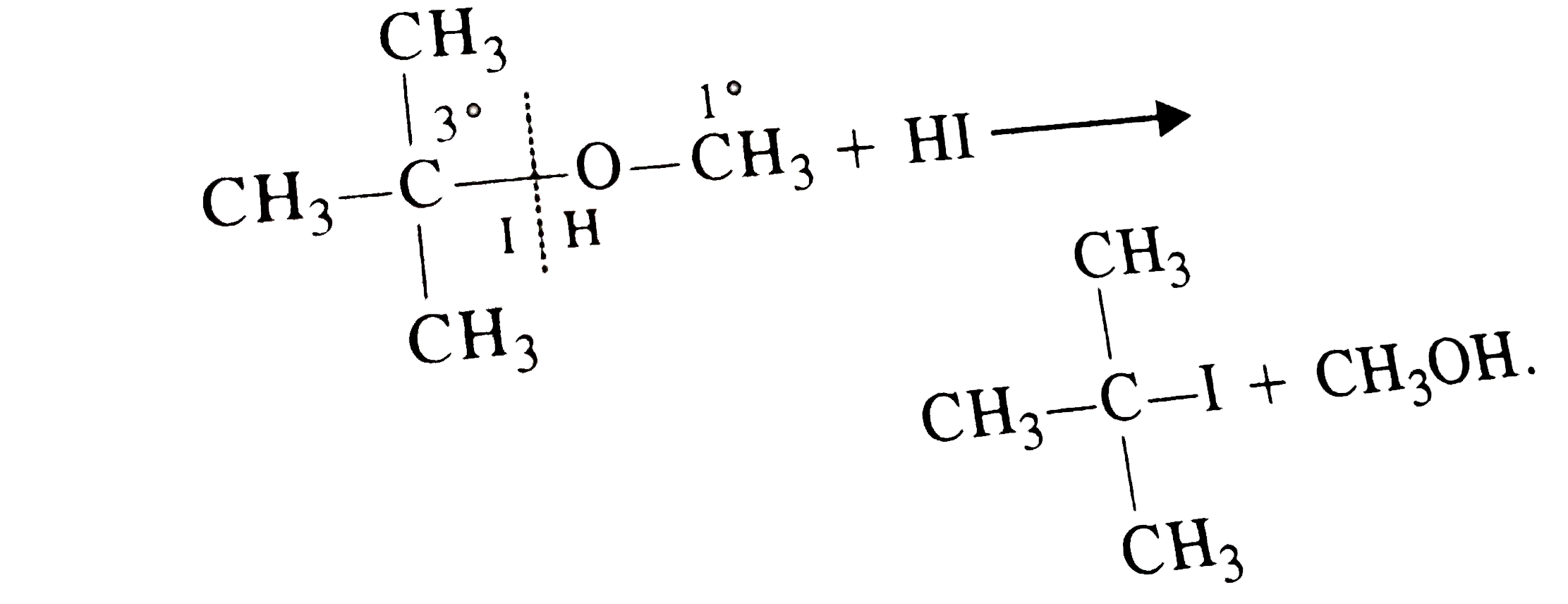
|
|
| 20. |
Among the following ethers, which one will produce methyl alcohol on treatment with hot concentrated HI ? |
|
Answer» `CH_(3)-underset(CH_(3))underset(|)CH-CH_(2)-O-CH_(3)` |
|
| 21. |
Among the following ethers, which one will produce methyl alcohol on treatment with hot concentrated HI |
|
Answer» `CH_3 - UNDERSET(CH_3)underset(|)OVERSET(CH_3)overset(|)C-O-CH_3` |
|
| 22. |
Among the following ethers which one will produce methyl alcohol on teatment with hot HI? |
|
Answer» `(H_3C)_3 -C - O - CH_3` 
|
|
| 23. |
Among the following elements which one exhibits both positive and negative oxidation states ? |
|
Answer» Cs |
|
| 24. |
Among the following ethers, which one will not be soluble in NaHCO_3? |
|
Answer» 2,4,6 - Trinitrophenol |
|
| 25. |
Among the following, dissociation constant is highest for |
|
Answer» `C_(6)H_(5)OH` |
|
| 26. |
Among the following, density is maximum for |
|
Answer» `CH_3 CL` |
|
| 27. |
Among the following, correct statement is: |
|
Answer» Brownian movement is more pronounced for SMALLER particles than for bigger-particles |
|
| 28. |
Among the following compounds, which will react with carbonates and bicarbonates to evolve carbon dioxide gas? |
|
Answer»
|
|
| 29. |
Among the following configurations, the element which has the highest electron affinity is: |
|
Answer» `[Ne]3s^(1)3p^(2)` |
|
| 30. |
Among the following correct basic strength order is i) La(OH)_3 , ii) Ce(OH)_3 , iii) Lu(OH)_3 |
|
Answer» `i GT II gt III` |
|
| 31. |
Among the following compounds, which will react with acetone to give product |
|
Answer» `C_(6)H_(5)NH_(2)` |
|
| 32. |
Among the following compounds, which will react with acetone to give a product cotaining gtC = N- ? |
|
Answer» `C_(6)H_(5)NH_(2)` |
|
| 33. |
Among the following compounds which will react with acetone to give a product containing C=N-: |
|
Answer» `C_6H_5NH_2` |
|
| 34. |
Among the following compounds, which will react with acetone to give a product containing gt C = N- ? |
|
Answer» `C_(6)H_(5)NH_(2)` D `C_(6)H_(5) NHNH_(2) + OC (CH_(3))_(2) overset(H^(+))rarr C_(6)H_(5)NH - N = C (CH_(3))_(2) + H_(2)O` |
|
| 35. |
A compound does not react with 2,4-dinitrophenyl hydrazine, compound is : |
|
Answer» `CH_(3)CONH_(2)` |
|
| 36. |
Among the following compounds which one will produce a Schiff base on reaction with cyclopentanone ? |
|
Answer»
|
|
| 37. |
Among the following compounds, which one will be dehydrated very easily : |
|
Answer» `CH_(3)CH_(2)CH_(2)CH_(2)CH_(2)OH` |
|
| 38. |
Among the following compounds, which one is used as a flavouring agent in ice creams, chocolates and candies? |
|
Answer» vanillin |
|
| 39. |
Among the following compounds which can be dehydrated very easily is |
|
Answer» `CH_3-CH_2-undersetunderset(OH)|oversetoverset(CH_3)|C-CH_2-CH_3` |
|
| 40. |
Among the following compounds which can be dehydrated very easily? |
|
Answer» ` CH_3 CH_2 CH_ 2 CH_2 CH_2 OH ` |
|
| 41. |
Among the following compounds, the strongest acid is " |
|
Answer» HC = CH |
|
| 42. |
Among the following compounds, the one(s) that gives (give) effervescence with aqueous NaHCO_(3) solution is (are) underset(I)((CH_(3)CO)_(2)O)""underset(II)(CH_(3)COOH) underset(III)(PhOH)""underset(IV)(CH_(3)COCHO) |
|
Answer» I and II 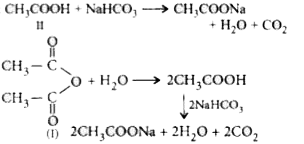
|
|
| 43. |
Among the following compounds, the optically active alkane having the lowest molecular mass is: |
|
Answer» `CH_(3)CH_(2)CH_(2)CH_(3)` |
|
| 44. |
Among the following compounds, the one(s) that gives (give) effervescence with aqueous NaHCO_(3) solution is (are) I. (CH_(3)CO)_(2)O (II). CH_(3)COOH III. PhOH IV. CH_(3)COCHO |
|
Answer» I and II |
|
| 45. |
Among the following compounds, the one that gets hydrolysed to form metallic hydroxide, hydrogen peroxide and oxygen is |
|
Answer» `Na_(2)O` `2KO_(2)+2H_(2)Oto2KOH+H_(2)O_(2)+O_(2)` |
|
| 46. |
Among the following compounds strongest acid is __________ |
|
Answer» HC`-=`CH |
|
| 47. |
Among the following compounds, select the ones which does not undergo aldol condensation. |
|
Answer»
|
|
| 48. |
Among the following compounds NH_(3),CH_(3)NH_(2),C_(6)H_(5)NH_(2) and C_(2)H_(5)NH_(2), the least basic compound is : |
|
Answer» `NH_(3)` |
|
| 49. |
Among the following compounds how many has a stereoisomer that is a meso compound ? (a ) (i) 2,3-dimethylbutane (ii) 2-bromo-3-methylpentane (iii)1-bromo-2-methylcyclohexane (b) (i) 3,4dimethylhexane (ii) 3,4-diethylhexane (c) (i) 1,3 dimethylcyclohexane (ii) 1,4-dimethylcyclohexane (iii) 1,2-dimethylcyclohexane |
|
Answer» |
|


